
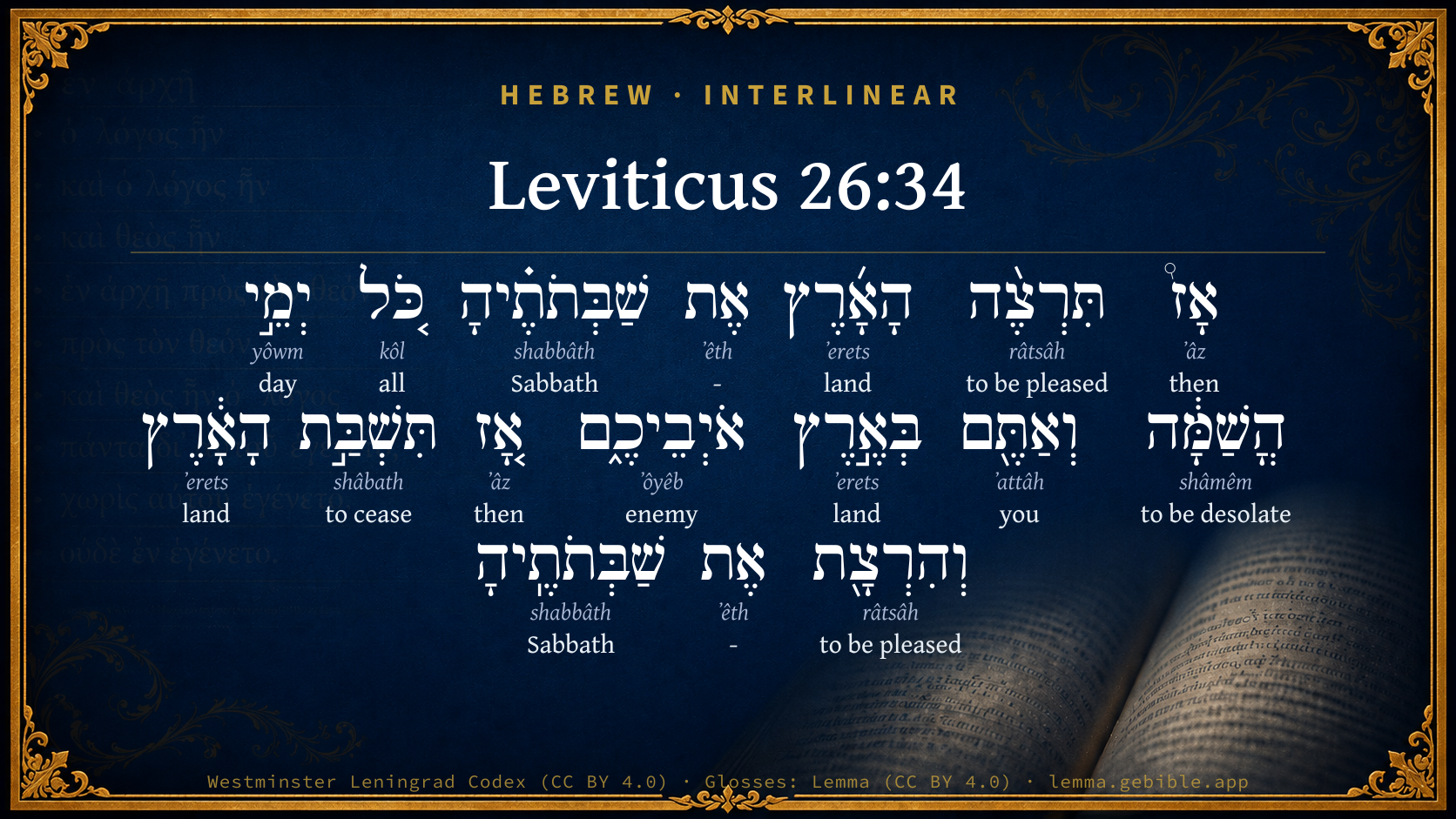
Leviticus 26:34

Hebrew (Westminster Leningrad Codex) Leviticus 26:34 appears in the Hebrew Old Testament. The text above is from the Westminster Leningrad Codex. Each word links to its Strong’s number, a concise gloss, and parsing drawn from the Open Scriptures Hebrew Bible morphology. Click any word for its full Brown-Driver-Briggs (BDB) entry.
Download image
Cite this verse

Leviticus 26:34 (World English Bible). Public Domain. Lemma interlinear Bible study tool, https://lemma.gebible.app/v/leviticus/26/34.

Show BibTeX & RIS
BibTeX
RIS
English Translation
Then the land will enjoy its sabbaths as long as it lies desolate and you are in your enemies' land. Even then the land will rest and enjoy its sabbaths.
World English Bible · Public Domain
Download a study sheet

One document with this verse’s original text, its word-by-word gloss line, the meaning frame, cross-references with their text, attributed commentary, and full source and license credits — printable, and it pastes into notes with its structure intact.

This verse Autodidact and up

Study sheet (.html) Plain text (.txt)

A passage Seminary Student

Up to 50 verses in one chapter. A passage sheet keeps up to 6 commentary sources and 12 cross-references per verse, in the order this page ranks them, and says so on the sheet whenever that leaves anything out. Ask for a single verse and you get the Autodidact verse sheet above.

Everything on this page stays free to read, with no account — the sheet is a download of what is already on screen, not access to it.

Want to remove ads? Support Godless Engineer
Compare translations 3

The same verse in 3 English versions, stacked beneath the original-language interlinear above. Click any original word for its lexicon entry.

Each is an independent rendering of the whole verse — the interlinear is not word-aligned to these translations.

Highlighted words mark where these versions differ — a whole-verse word diff, not a word-by-word alignment.

  • World English Bible Public Domain
    Then the land will enjoy its sabbaths as long as it lies desolate and you are in your enemies' land. Even then the land will rest and enjoy its sabbaths.
  • King James Version Public Domain
    Then shall the land enjoy her sabbaths, as long as it lieth desolate, and ye be in your enemies' land; even then shall the land rest, and enjoy her sabbaths.
  • unfoldingWord Literal Text CC BY-SA 4.0
    Then the land will enjoy its sabbaths all the days of its desolation, and you in the land of your enemies. Then the land will rest and enjoy its sabbaths.

unfoldingWord Literal Text — © unfoldingWord, licensed CC BY-SA 4.0. Word-aligned USFM3 via Door43 (git.door43.org/unfoldingWord/en_ult).

Versions to compare (up to 4)

3 of 4 selected

Show all 18 translations

Every available English version of this verse, each an independent rendering of the whole verse.

  • World English Bible Public Domain
    Then the land will enjoy its sabbaths as long as it lies desolate and you are in your enemies' land. Even then the land will rest and enjoy its sabbaths.
  • Berean Standard Bible Public Domain
    Then the land shall enjoy its Sabbaths all the days it lies desolate, while you are in the land of your enemies. At that time the land will rest and enjoy its Sabbaths.
  • Majority Standard Bible Public Domain
    Then the land shall enjoy its Sabbaths all the days it lies desolate, while you are in the land of your enemies. At that time the land will rest and enjoy its Sabbaths.
  • King James Version Public Domain
    Then shall the land enjoy her sabbaths, as long as it lieth desolate, and ye be in your enemies' land; even then shall the land rest, and enjoy her sabbaths.
  • American Standard Version (1901) Public Domain
    Then shall the land enjoy its sabbaths, as long as it lieth desolate, and ye are in your enemies' land; even then shall the land rest, and enjoy its sabbaths.
  • Revised Version (1885) Public Domain
    Then shall the land enjoy her sabbaths, as long as it lieth desolate, and ye be in your enemies’ land; even then shall the land rest, and enjoy her sabbaths.
  • Geneva Bible (1599) Public Domain
    Then shall the land inioy her Sabbaths, as long as it lieth voide, and yee shalbe in your enemies land: then shall the land rest, and enioy her Sabbaths.
  • Douay-Rheims (1899) Public Domain
    Then shell the land enjoy her sabbaths all the days of her desolation: when you shall be
  • Young's Literal Translation Public Domain
    `Then doth the land enjoy its sabbaths -- all the days of the desolation, and ye in the land of your enemies -- then doth the land rest, and hath enjoyed its sabbaths;
  • Literal Standard Version CC BY-SA 4.0
    Then the land enjoys its Sabbaths all the days of the desolation—and you [are] in the land of your enemies; then the land rests, and has enjoyed its Sabbaths;
  • Unlocked Literal Bible CC BY-SA 4.0
    Then the land will enjoy its Sabbaths for as long as it lies abandoned and you are in your enemies' lands. During that time, the land will rest and enjoy its Sabbaths.
  • unfoldingWord Literal Text CC BY-SA 4.0
    Then the land will enjoy its sabbaths all the days of its desolation, and you in the land of your enemies. Then the land will rest and enjoy its sabbaths.
  • Darby Bible Public Domain
    Then shall the land enjoy its sabbaths all the days of the desolation, when ye are in your enemies' land; then shall the land rest, and enjoy its sabbaths.
  • World Messianic Bible Public Domain
    Then the land will enjoy its Sabbaths as long as it lies desolate and you are in your enemies’ land. Even then the land will rest and enjoy its Sabbaths.
  • Webster's Bible Public Domain
    Then shall the land enjoy its sabbaths, as long as it lieth desolate, and ye are in your enemies' land; even then shall the land rest, and enjoy its sabbaths.
  • Free Bible Version CC BY-SA 4.0
    At least then the land will be able to enjoy its Sabbaths all the time it's abandoned while you are in exile in the land of your enemies. The land will finally be able to rest and enjoy its Sabbaths.
  • Bible in Basic English Public Domain
    Then will the land take pleasure in its Sabbaths while it is waste and you are living in the land of your haters; then will the land have rest.
  • JPS Tanakh (1917) Public Domain
    Then shall the land be paid her sabbaths, as long as it lieth desolate, and ye are in your enemies' land; even then shall the land rest, and repay her sabbaths.

Literal Standard Version (2020), Covenant Press — licensed CC BY-SA 4.0. Text via the HelloAO Bible API (eBible.org). Unlocked Literal Bible (unfoldingWord) — licensed CC BY-SA 4.0. Text via the HelloAO Bible API (eBible.org). unfoldingWord Literal Text — © unfoldingWord, licensed CC BY-SA 4.0. Word-aligned USFM3 via Door43 (git.door43.org/unfoldingWord/en_ult). Free Bible Version, Dr. Jonathan Gallagher — licensed CC BY-SA 4.0. Text via the HelloAO Bible API (eBible.org).

Word by word

More ways to search: Search by grammar → Find every occurrence → Compare this word →

Practice this passage: Drill this verse → Learn its vocabulary →

תִּרְצֶ֨ה
râtsâh
H7521
“to be pleased”
Verb, Qal, Imperfect, 3rd Person, Feminine, Singular
Part of Speech
Verb
Stem
Qal
Form
Imperfect
Person
3rd Person
Gender
Feminine
Number
Singular
Full BDB Definition

Origin: a primitive root

TWOT: 2207

to be pleased with, be favourable to, accept favourably - (Qal) - to be pleased with, be favourable to - to accept - to be pleased, be determined - to make acceptable, satisfy - to please - (Niphal) to be accepted, be pleased with - (Piel) to seek favour of - (Hiphil) to please, pay off - (Hithpael) to make oneself acceptable or pleasing
  1. אָז֩ ʼâz H227 “then” Adverb
  2. הָאָ֜רֶץ ʼerets H776 “the · land” Particle, Definite Article + Noun, Common, Both, Singular, Absolute
  3. אֶת ʼêth H853 “-” Particle, Direct Object
  4. שַׁבְּתֹתֶ֗יהָ shabbâth H7676 “Sabbaths · her” Noun, Common, Both, Plural, Construct + Suffix, Personal, 3rd Person, Feminine, Singular
  5. כֹּ֚ל kôl H3605 “all of” Noun, Common, Masculine, Singular, Construct
  6. יְמֵ֣י yôwm H3117 “days of” Noun, Common, Masculine, Plural, Construct
  7. הֳשַׁמָּ֔ה shâmêm H8074 “to be desolate · her” Verb, Hophal, Infinitive Construct + Suffix, Personal, 3rd Person, Feminine, Singular
  8. וְאַתֶּ֖ם ʼattâh H859 “and · you” Conjunction + Pronoun, Personal, 2nd Person, Masculine, Plural
  9. בְּאֶ֣רֶץ ʼerets H776 “in/at · land of” Preposition + Noun, Common, Both, Singular, Construct
  10. אֹיְבֵיכֶ֑ם ʼôyêb H341 “enemy · you” Verb, Qal, Participle Active, Masculine, Plural, Construct + Suffix, Personal, 2nd Person, Masculine, Plural
  11. אָ֚ז ʼâz H227 “then” Adverb
  12. תִּשְׁבַּ֣ת shâbath H7673 “to cease” Verb, Qal, Imperfect, 3rd Person, Feminine, Singular
  13. הָאָ֔רֶץ ʼerets H776 “the · land” Particle, Definite Article + Noun, Common, Both, Singular, Absolute
  14. וְהִרְצָ֖ת râtsâh H7521 “and · to be pleased” Conjunction + Verb, Hiphil, Sequential Perfect, 3rd Person, Feminine, Singular
  15. אֶת ʼêth H853 “-” Particle, Direct Object
  16. שַׁבְּתֹתֶֽיהָ shabbâth H7676 “Sabbaths · her” Noun, Common, Both, Plural, Construct + Suffix, Personal, 3rd Person, Feminine, Singular

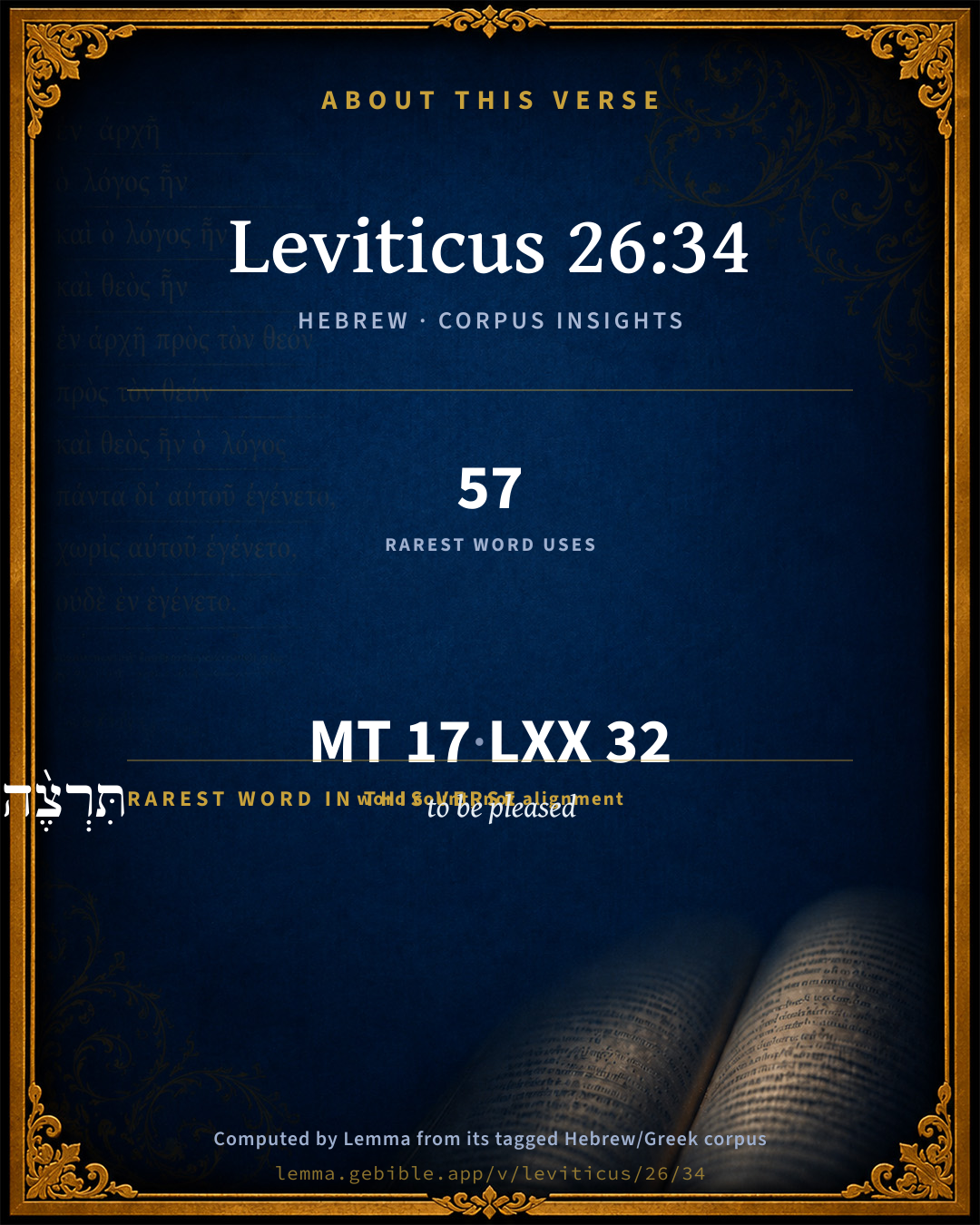
About this verse

These counts appear in no published source. They are computed here, from the morphology-tagged text and Lemma’s own curated glosses. What Lemma adds →

17
words
11
distinct lemmas
Pentateuch
section

Shared distinctive vocabulary

תִּרְצֶ֨ה to be pleased H7521 occurs in 55 verses of the Hebrew Bible. Also found in:

Grammatical profile

  • 5 verbs
  • 7 nouns
  • 1 pronoun
  • 2 adverbs
  • 2 particles

Verb forms

  • תִּרְצֶ֨ה Qal · Imperfect
  • הֳשַׁמָּ֔ה Hophal · Infinitive Construct
  • אֹיְבֵיכֶ֑ם Qal · Participle Active
  • תִּשְׁבַּ֣ת Qal · Imperfect
  • וְהִרְצָ֖ת Hiphil · Sequential Perfect

Repetition

Words recur within this verse — often emphatic in Hebrew:

  • הָאָ֜רֶץ land H776 ×3
  • תִּרְצֶ֨ה to be pleased H7521 ×2
  • שַׁבְּתֹתֶ֗יהָ Sabbath H7676 ×2
  • אָז֩ then H227 ×2

Hebrew & Septuagint length

In English translation the verse runs 30 words from the Hebrew and 13 from the Septuagint (LXX English) — the Septuagint runs noticeably shorter here. See the side-by-side →

A rough comparison of the two English renderings, which tokenize alike — not a word-level alignment.

Word counts can differ between the Hebrew and the Greek without any difference in meaning — e.g. the Hebrew direct-object marker אֵת has no separate Greek word, and Greek often adds the article ὁ.

In the original languages it is 17 Hebrew tokens and 32 Greek tokens — but the two are counted differently (Hebrew bundles its prefixes and suffixes into one token; the Greek is in lemma form), so that isn’t a like-for-like length.

Cross-references

4

Topical passages linked to Leviticus 26:34 in the Treasury of Scripture Knowledge — connected by theme and wording, ordered by reader-vote popularity; previews shown in the World English Bible.

  • 2 Chronicles 36:21 to fulfill the word of Yahweh by the mouth of Jeremiah, until the land had enjoyed its Sabbaths: [for] as long as it lay desolate it kept Sabbath, to fulfill seventy years.
  • Leviticus 25:2–4 "Speak to the children of Israel, and tell them, 'When you come into the land which I give you, then the land shall keep a Sabbath to Yahweh.
  • Leviticus 26:43 The land also will be left by them, and will enjoy its sabbaths while it lies desolate without them: and they will accept the punishment of their iniquity; because, even because they rejected my ordinances, and their soul abhorred my statutes.
  • Leviticus 25:10 You shall make the fiftieth year holy, and proclaim liberty throughout the land to all its inhabitants. It shall be a jubilee to you; and each of you shall return to his own property, and each of you shall return to his family.

Cross-references courtesy of OpenBible.info (CC BY 4.0).

Hebrew and Greek witnesses Masoretic Hebrew ↔ Greek Septuagint

The same verse in the two great witnesses to the Old Testament, shown verse-for-verse.

Here the Septuagint runs noticeably shorter than the Hebrew — LXX2012 (modern English Septuagint) 13 words vs World English Bible 30. A rough length comparison of the two English translations, not a word-level alignment — read both below.

These are two independent witnesses, not word-aligned to each other, and the Septuagint is shown in lemma (dictionary) form.

Hebrew Leviticus 26:34 Masoretic · Westminster Leningrad Codex

אָז֩ תִּרְצֶ֨ה הָאָ֜רֶץ אֶת שַׁבְּתֹתֶ֗יהָ כֹּ֚ל יְמֵ֣י הֳשַׁמָּ֔ה וְאַתֶּ֖ם בְּאֶ֣רֶץ אֹיְבֵיכֶ֑ם אָ֚ז תִּשְׁבַּ֣ת הָאָ֔רֶץ וְהִרְצָ֖ת אֶת שַׁבְּתֹתֶֽיהָ

Then the land will enjoy its sabbaths as long as it lies desolate and you are in your enemies' land. Even then the land will rest and enjoy its sabbaths.

World English Bible · Public Domain

Greek LXX Leviticus 26:34 Septuagint · lemma form

τότε εὐδοκέω ὁ γῆ ὁ σάββατον αὐτός καί πᾶς ὁ ἡμέρα ὁ ἐρήμωσις αὐτός καί σύ εἰμί ἐν ὁ γῆ ὁ ἐχθρός σύ τότε σαββατίζω ὁ γῆ καί εὐδοκέω ὁ σάββατον αὐτός

Then the land shall enjoy its sabbaths all the days of its desolation.

LXX2012 (modern English Septuagint) · Public Domain

Hebrew: Westminster Leningrad Codex (CC BY 4.0). Greek: Septuagint (public domain); English from LXX2012 (modern English Septuagint) (Public Domain). How the Septuagint differs from the Hebrew →

Targum (Aramaic paraphrase)

2

The Targum is the ancient Jewish Aramaic paraphrase of the Hebrew Scriptures — an interpretive translation, not the Hebrew text itself. Onkelos (literal) and Pseudo-Jonathan (expansive) render the Torah, and Jonathan the Prophets. Coverage is partial: where no permissively-licensed English translation exists for a verse, only the Aramaic is shown. This is verse-level text, not a word-by-word alignment to the Hebrew.

  1. Targum Onkelos Torah (Genesis–Deuteronomy)
    בְּכֵן תַּרְעֵי אַרְעָא יָת שְׁמִטָהָא כֹּל יוֹמִין דִי צְדִיאַת וְאַתּוּן בְּאַרַע בַּעֲלֵי דְבָבֵיכוֹן בְּכֵן תַּשְׁמֵט אַרְעָא וְתִרְעֵי יָת שְׁמִטָּהָא

    (no public-domain English translation for this verse)

    Targum Onkelos — Aramaic: “Onkelos Genesis” (public domain); “Onkelos Exodus” (public domain); “Onkelos Leviticus” (public domain); “Onkelos Numbers” (public domain); “Onkelos Deuteronomy” (public domain). English: “Sefaria Community Translation” (CC0 1.0 (public-domain dedication)); “J.W. Etheridge. The Targums of Onkelos and Jonathan Ben Uzziel on the Pentateuch. London: Longmans, Green, 1862” (public domain). Text via Sefaria.

  2. Targum Pseudo-Jonathan Torah (Genesis–Deuteronomy)
    הָא בְּכֵן תַּרְעֵי אַרְעָא יַת שְׁנֵי שְׁמִיטָהָא כָּל יוֹמִין דְהִיא צַדְיָא מִנְכוֹן וְאַתּוּן תֶּהֱווֹן מִיטַלְטְלִין בַּאֲרַע בַּעֲלֵי דְבָבֵיכוֹן בְּכֵן תִּתְנַיַיח אַרְעָא וְתִרְעֵי יַת שִׁזְבֵי שְׁמִיטָהָא

    Behold, then shall the land enjoy the years of its Sabbaths all the days that it is forsaken of you, and you are wanderers in the land of your enemies.

    Targum Pseudo-Jonathan — Aramaic: “Targum Jonathan on Genesis” (public domain); “Targum Jonathan on Exodus” (public domain); “Targum Jonathan on Leviticus” (public domain); “Targum Jonathan on Numbers” (public domain); “Targum Jonathan on Deuteronomy” (public domain). English: “The Targum of Jonathan ben Uzziel, trans. J. W. Etheridge, London, 1862” (public domain). Text via Sefaria.

Commentary

Notes on Leviticus 26:34 from classic Christian and Jewish commentators (each source and its license shown beneath its notes). The classic Christian expositions comment on the surrounding passage and are grouped to its opening verse, so a note may address several verses; the Jewish commentaries on the Tanakh (Rashi and others) are per-verse, so they appear only where the commentator wrote on this verse.

Lemma curates 59 commentaries, every one of them public domain or Creative Commons licensed, each selected and text-cleaned for this edition rather than reprinted as found. About our sources →

Trapp's Complete Commentary

John Trapp

Lev 26:34 Then shall the land enjoy her sabbaths, as long as it lieth desolate, and ye [be] in your enemies’ land; [even] then shall the land rest, and enjoy her sabbaths.

Ver. 34. Then shall the land rest, and enjoy her Sabbaths.] Rest from your disquietments, whilst ye sinned upon it; and gat out the heart of it to spend it on your lusts. Compare 2Ch 36:21. Where there is not a resting from sin, the Sabbaths are not truly kept.

John Trapp, A Commentary or Exposition upon All the Books of the Old and New Testament (1647–1656) — public domain. Text from a community e-Sword module.

Joseph Benson's Commentary

Lev 26:34. The land shall enjoy her sabbaths — It shall enjoy those sabbatical years of rest from tillage, which you, through covetousness, would not give it: a most seasonable warning this. Jeremiah complains, that in his time they had contemned the ordinance of God respecting the septennial sabbaths, and had not given their servants liberty, (Jer 34:17,) and gives this as one cause of their being delivered to slavery, Lam 1:3. And this is expressly mentioned as a principal reason of their seventy years captivity, 2Ch 36:21.

Joseph Benson's Commentary on the Old and New Testaments (1811–1818) — public domain. Text from a community e-Sword module.

Keil & Delitzsch

C. F. Keil & F. Delitzsch

Object of the Divine Judgments in Relation to the Land and Nation of Israel. - Lev 26:34 and Lev 26:35. The land would then enjoy and keep its Sabbaths, so long as it was desolate, and Israel was in the land of its foes. השּׁמּה ימי כּל, during the whole period of its devastation. השּׁמּה inf. Hophal with the suffix, in which the mappik is wanting, as in Exo 2:3 (cf. Ewald, 131e). רצה to have satisfaction: with בּ and an accusative it signifies to take delight, take pleasure, in anything, e.g., in rest after the day's work is done (Job 14:6); here also to enjoy rest (not "to pay its debt:" Ges., Kn.). The keeping of the Sabbath was not a performance binding upon the land, nor had the land been in fault because the Sabbath was not kept. As the earth groans under the pressure of the sin of men, so does it rejoice in deliverance from this pressure, and participation in the blessed rest of the whole creation. וגו אשׁר את תּשׁבּת: the land "will rest (keep) what it has not rested on your Sabbaths and whilst you dwelt in it;" i.e., it will make up the rest which you did not give it on your Sabbaths (daily and yearly). It is evident from this, that the keeping of the Sabbaths and sabbatical years was suspended when the apostasy of the nation increased, - a result which could be clearly foreseen in consequence of the inward dislike of a sinner to the commandments of the holy God, and which is described in Ch2 26:21 as having actually occurred.

Keil & Delitzsch — Biblical Commentary on the Old Testament (1861–1891) — public domain (CC PDM 1.0). Text via the HelloAO Bible API. (Old Testament only.)

Tyndale Open Study Notes

Tyndale Open Resources

26:34 With the people gone into captivity in a foreign land, there would be no one to work the land. It would at last have the “rest” of lying fallow that the people had denied it (see 25:1-7).

Tyndale Open Study Notes — © Tyndale Open Resources, licensed CC BY-SA 4.0. Text via the HelloAO Bible API.

Jamieson, Fausset & Brown

Robert Jamieson, A. R. Fausset & David Brown

Then shall the land enjoy her sabbaths, as long as it lieth desolate, &c.--A long arrear of sabbatic years had accumulated through the avarice and apostasy of the Israelites, who had deprived their land of its appointed season of rest. The number of those sabbatic years seems to have been seventy, as determined by the duration of the captivity. This early prediction is very remarkable, considering that the usual policy of the Assyrian conquerors was to send colonies to cultivate and inhabit their newly acquired provinces.

Jamieson, Fausset & Brown — Commentary Critical and Explanatory on the Whole Bible (1871) — public domain (CC PDM 1.0). Text via the HelloAO Bible API.

Adam Clarke's Commentary

Verse 34. Then shall the land enjoy her Sabbaths] This Houbigant observes to be a historical truth. - "From Saul to the Babylonish captivity are numbered about four hundred and ninety years, during which period there were seventy Sabbaths of years; for 7, multiplied by 70, make 490. Now the Babylonish captivity lasted seventy years, and during that time the land of Israel rested. Therefore the land rested just as many years in the Babylonish captivity, as it should have rested Sabbaths if the Jews had observed the laws relative to the Sabbaths of the land." This is a most remarkable fact, and deserves to be particularly noticed, as a most literal fulfilment of the prophetic declaration in this verse: Then shall the land enjoy her Sabbaths as long as it lieth desolate, and ye be in your enemies' land.

May it not be argued from this that the law concerning the Sabbatical year was observed till Saul's time, as it is only after this period the land enjoyed its rest in the seventy years' captivity? And if that breach of the law was thus punished, may it not be presumed it had been fulfilled till then, or else the captivity would have lasted longer, i. e., till the land had enjoyed all its rests, of which it had ever been thus deprived?

Adam Clarke's Commentary on the Bible (1810–1826) — public domain. Text from a community e-Sword/MySword module.

Ellicott's Commentary for English Readers

(34) Then shall the land enjoy her sabbaths.—The land, which participates both in the happiness and misery of the Israelites (see Lev_18:25), and which through their disobedience of the Divine laws would be deprived of her sabbatical rests as long as the rebellious people occupy it, would now at last be able to enjoy its prescribed legal rest, when it is ridden of these defiant transgressors, and as long as they remain in exile.

A Bible Commentary for English Readers, edited by Charles John Ellicott (1878–1897) — public domain. Text from a community e-Sword module.

The Cambridge Bible for Schools and Colleges

gen. ed. J. J. S. Perowne

34. Then shall the land enjoy her sabbaths] The verb râẓâh has for its general meaning in Ḳal. ‘to accept,’ ‘to be satisfied with,’ and so ‘to enjoy,’ the land being regarded as having been long deprived of its rights, which are now restored. Accordingly the Hiph. (as the causative voice), occurring only in 34 b, may perhaps mean ‘cause [God] to accept’ her sabbaths, and so virtually ‘pay back’ those which had been disregarded and were due to God. The same verb is rendered ‘accept’ in Lev_26:41; Lev_26:43. See on Lev_26:41.

The Cambridge Bible for Schools and Colleges (gen. ed. J. J. S. Perowne; Cambridge University Press, 1878–1918) — public domain. Text from a community e-Sword module.

John Gill's Exposition

As long as it lieth desolate it shall rest,.... From tillage, neither man nor beast working upon it; for which reason such a space of time was called a sabbath:

because it did not rest in your sabbaths, when you dwelt upon it; they manured and tilled it on the seventh years, as on others, neglecting the command which God had given them; and this they did not once or twice, but many times, while they were dwellers in the land; which seems to confirm pretty much the notion of their having omitted so many years, though that cannot be affirmed with certainty; see Jarchi on the place.

John Gill's Exposition of the Whole Bible (1746–1763) — public domain (CC PDM 1.0). Text via the HelloAO Bible API.

Haydock's Catholic Bible Commentary

Desolation. It shall be uncultivated; and though you would not comply with my injunctions to let it rest one year out of seven, it shall now remain desolate for many years together. (Haydock) --- Theodoret (q. 37) says for 70 years; the number of sabbatic years, from the reign of Saul till the captivity of Babylon, during the space of 490 years. This verse seems evidently to allude to those days of distress. (Calmet) (2 Paralipomenon xxxvi. 21.) --- But we can hardly suppose that none of the sabbatic years should have been duly observed during the reigns of David, Solomon, &c. (Haydock) --- Instead of enjoy, Hebrew may be "shall expiate her sabbaths," or the neglect of them. The same term, tirtse, is used, (ver. 41, 43,) and the Vulgate generally renders it agreeable, speaking of sacrifices, chap. i. 4., and xxii. 20. (Calmet)

George Leo Haydock (1774–1849), Haydock's Catholic Family Bible and Commentary, 1859 edition — public domain. Excludes Psalms (Douay-Rheims chapter numbering differs from Protestant) and Deuterocanonical books (Catholic canon only).

Matthew Poole's English Annotations

Either,

1. Because it shall be rid of you, who were the unprofitable and heavy burdens thereof, under whom it in a manner groaned. Or rather,

2. Because it shall now enjoy those sabbatical years of rest from tillage, which you through covetousness ofttimes would not give it, as the next verse informs us, though God commanded it, Lev 25:4.

Matthew Poole's English Annotations on the Holy Bible (1683–1685) — public domain. Text from a community e-Sword/MySword module.

Whedon's Commentary on the Bible

Daniel D. Whedon

34. Then shall the land enjoy her sabbaths — The sabbatical years are here referred to. Probably from the death of Joshua to the time of the Babylonish captivity, seventy of the years of rest had been neglected. During the seventy years in Babylon the land of Canaan had a period of rest equivalent to the number of which it had been defrauded by the disobedience of the Hebrews.

Daniel D. Whedon (gen. ed.), Commentary on the Old and New Testaments (1874–1909) — public domain. Text from a community e-Sword module.

The Pulpit Commentary

Vers. 34, 35. The land had not participated in the sins of its inhabitants. The latter had thought that, by the neglect of the sabbatical years, they had enriched themselves by the fruits of those years which would otherwise have been wasted. The result was that they lost the land altogether for a period equal to that during which it ought to have kept sabbath, and the land "as long as she lay desolate kept sabbath, to fulfill threescore and ten years". (2Ch_36:21) From the entrance into the holy land until the Babylonish Captivity there elapsed eight hundred and sixty-three years, in which time there ought to have been kept one hundred and twenty-three sabbatical years. As only seventy are made up by the duration of the Captivity, it may be concluded that fifty-three sabbatical years were observed by the Israelites; but this conclusion is very doubtful. It is more likely that seventy, being a multiple of the sacred number seven, was regarded as sufficient to purge all previous neglects, whatever they might have been.

The Pulpit Commentary (1880–1919), ed. H.D.M. Spence-Jones & Joseph S. Exell — public domain. Text from a community e-Sword module.

John Wesley's Explanatory Notes

The land shall enjoy her sabbaths - It shall enjoy those sabbatical years of rest from tillage, which you through covetousness would not give it.

John Wesley, Explanatory Notes Upon the Whole Bible (1754–1765) — public domain. Text via the GEBible commentary corpus.

Kretzmann's Popular Commentary

Paul E. Kretzmann

The Effects of these Visitations and the Restoration of the Covenant

v. 34. Then shall the land enjoy her Sabbaths, as long as it lieth desolate, and ye be in your enemies’ land; even then shall the land rest and enjoy her Sabbaths. It is here implied that Israel, in its revolt against Jehovah and His commandments, would omit the observance of the sabbatical years, and that the land, suffering under the oppression of this greed, would feel the relief brought about by the deportation of the owners.

v. 35. As long as it lieth desolate, it shall rest, because it did not rest in your Sabbaths when ye blood upon it.

v. 36. And upon them that are left alive of you I will send a faintness into their hearts in the lands of their enemies, filling their hearts with a cowardly fear, with the despondency of an unreasonable terror; and the sound of a shaken leaf shall chase them; and they shall flee, as fleeing from a sword; and they shall fall when none pursueth, victims more of their own terror than of any harm done to them by their enemies,

v. 37. And they shall fall one upon another, as it were before a sword, when none pursueth; and ye shall have no power to stand before your enemies.

v. 38. And ye shall perish among the heathen, and the land of your enemies shall eat you up. Cf Numbers 13-32; Eze 36:13.

v. 39. And they that are left of you shall pine away in their iniquity in your enemies’ lands, So long as they remain in their unrepentant attitude toward God; and also in the iniquities of their fathers shall they pine away with them; for if the children follow in the footsteps of their sinful parents, the sins of the latter are visited upon them also. But now the mercy of the Lord comes into the foreground Again.

v. 40. If they shall confess their iniquity and the iniquity of their fathers, the guilt which they brought upon themselves by their misdeeds, with their trespass which they trespassed against Me, and that also they have walked contrary unto Me, an open confession being necessary to show the sincerity of their repentance;

v. 41. and that I also have walked contrary unto them, and have brought them into the land of their enemies, thereby freely acknowledging that they were suffering a well-deserved punishment; if then their uncircumcised hearts be humbled, and they then accept of the punishment of their iniquity,

v. 42. then will I remember My covenant with Jacob, and also My covenant with Isaac, and also my covenant with Abraham will I remember, with all the blessings promised therein; and I will remember the land, turn back to it with thoughts of love and kindness.

v. 43. The land also shall be left of them, and shall enjoy her Sabbaths, while she lieth desolate without them, being free from the oppression of a population that disregarded the will of the Lord; and they shall accept of the punishment of their iniquity, bowing their backs to the Lord’s chastening rod; because, even because they despised My judgments, and because their soul abhorred My statutes.

v. 44. And yet for all that, when they be in the land of their enemies, when it seems that they are absolutely forsaken by God, I will not cast them away, neither will I abhor them to destroy them utterly, for that had not been the purpose of His punishment in the first place, and to break My covenant with them; for I am the Lord, their God, who always has mercy upon the repentant sinner.

v. 45. But I will for their sakes remember the covenant of their ancestors, whom I brought forth out of the land of Egypt in the sight of the heathen. I am the Lord. In this way the punishment of the Lord would finally result in blessing the people, in bringing them back to the fellowship of the covenant which He had never repudiated.

v. 46. These are the statutes and judgments and laws which the Lord made between Him and the children of Israel in Mount Sinai by the hand of Moses. The history of Israel, as foreshadowed in this Chapter, is an example of warning to all men. Unto those that are disobedient to the truth the Lord will render tribulation and anguish, Rom 2:8-9. He will in flaming fire take vengeance on them that know not God, that obey not the Gospel of our Lord Jesus Christ, 2Th 1:8-9. But His mercy is always ready to turn to those that come to Him with a sorrowful and repentant heart.

Paul E. Kretzmann, Popular Commentary of the Bible (1921–1924) — public domain. Text from a community e-Sword module.

unfoldingWord translationNotes

Door43 World Missions Community

Then the land will enjoy its Sabbaths

The people were supposed to obey the Sabbath law by not farming the land every seventh year. God speaks about this as if the land were a person that would obey the Sabbath law and rest. AT: "Then the land will rest according to the Sabbath law" or "Then, as required by the Sabbath law, the land will not be farmed" (See: Personification)

it will have rest

God speaks about the land not being farmed as if it were a person that would rest. AT: "it will not be farmed" (See: Personification)

I will send fear into your hearts

Sending fear into their hearts represents making them afraid. AT: "I will make you terribly afraid" (See: Metaphor)

as though you were fleeing from the sword

The sword represents either someone who is ready to kill using a sword or an attack from an enemy army. AT: "as though you were fleeing from someone who was chasing you with a sword" or "as though you were fleeing from an enemy army" (See: Metonymy)

translationWords

Sabbath

rest

fear

heart

unfoldingWord translationNotes — © Distant Shores Media and the Door43 World Missions Community, licensed CC BY-SA 4.0. Source: git.door43.org/Door43/en_tn.

Rashi

Rabbi Shlomo Yitzchaki (Rashi)

אז תרצה means: then the land shall appease the wrath of the Omnipresent who was angry because of the neglect of the Sabbatical years.

והרצת — means, it will give satisfaction to the King as regards its Sabbatical years.

Rashi on the Tanakh — English translations: “The Judaica Press complete Tanach with Rashi, translated by A. J. Rosenberg” (CC BY 4.0); “Pentateuch with Rashi's commentary by M. Rosenbaum and A.M. Silbermann, 1929-1934” (public domain); “The Metsudah Tanach series, Lakewood, N.J” (CC BY 4.0); and “The Book of Joshua, Metsudah Publications, 1997” (CC BY 4.0). Text via Sefaria.

Sforno

Rabbi Ovadia Sforno

The land will then be appeased. It shall be paid and avenged.

For its Shabbosos. The Sabbatical and Jubilee years, as the verse elucidates (Divrei HaYamim II 36:21): “Until the land was appeased for its Shabbosos; [for] all the days of its desolation it rested until the completion of seventy years”.

Sforno on the Tanakh — English translation: “Yalkut, Sifsei Chachomim Chumash, Metsudah Publications, 2009” (CC BY 4.0). Text via Sefaria.

Lesson kit

Teaching starters — assembled from the data on this page, not authored interpretation. Every prompt links to the verse data it draws on. Edit before teaching.

Leviticus, in the Pentateuch, opens this verse with 17 words (11 distinct Hebrew lemmas). Its most distinctive word is râtsâh (“to be pleased”). The Greek Septuagint runs shorter here. A historical commentator’s framing appears above. Read the whole chapter for the surrounding context.

Discussion questions

  1. What does “to be pleased” (râtsâh) contribute to the verse as a whole?
  2. How does Genesis 33:10, which shares the word «to be pleased», read alongside this verse?
  3. What does the repetition of “land” (3× in this one verse) do in this verse?
  4. The Septuagint runs shorter here than the Hebrew. What might account for the difference?
  5. The translations on this page render this verse differently — a whole-verse word diff, not a word-by-word alignment. What might account for the different wordings?
  6. «תִּרְצֶ֨ה» is a Qal Imperfect verb. How does that grammatical form shape the action described?
  7. Compare how Trapp's Complete Commentary and Joseph Benson's Commentary read this verse. Where do they agree or differ?

Things to notice

Reading settings

Reading text

Shown beneath each verse's original-language words.

Old Testament
Old Testament edition

Read the OT as the Masoretic Hebrew (MT) or the Greek Septuagint (LXX).

English shown for the Greek Septuagint (in the Hebrew ↔ Greek comparison).

Comparing translations? Open the Compare panel on any verse page to stack up to four side by side.