
2 Samuel 5:20

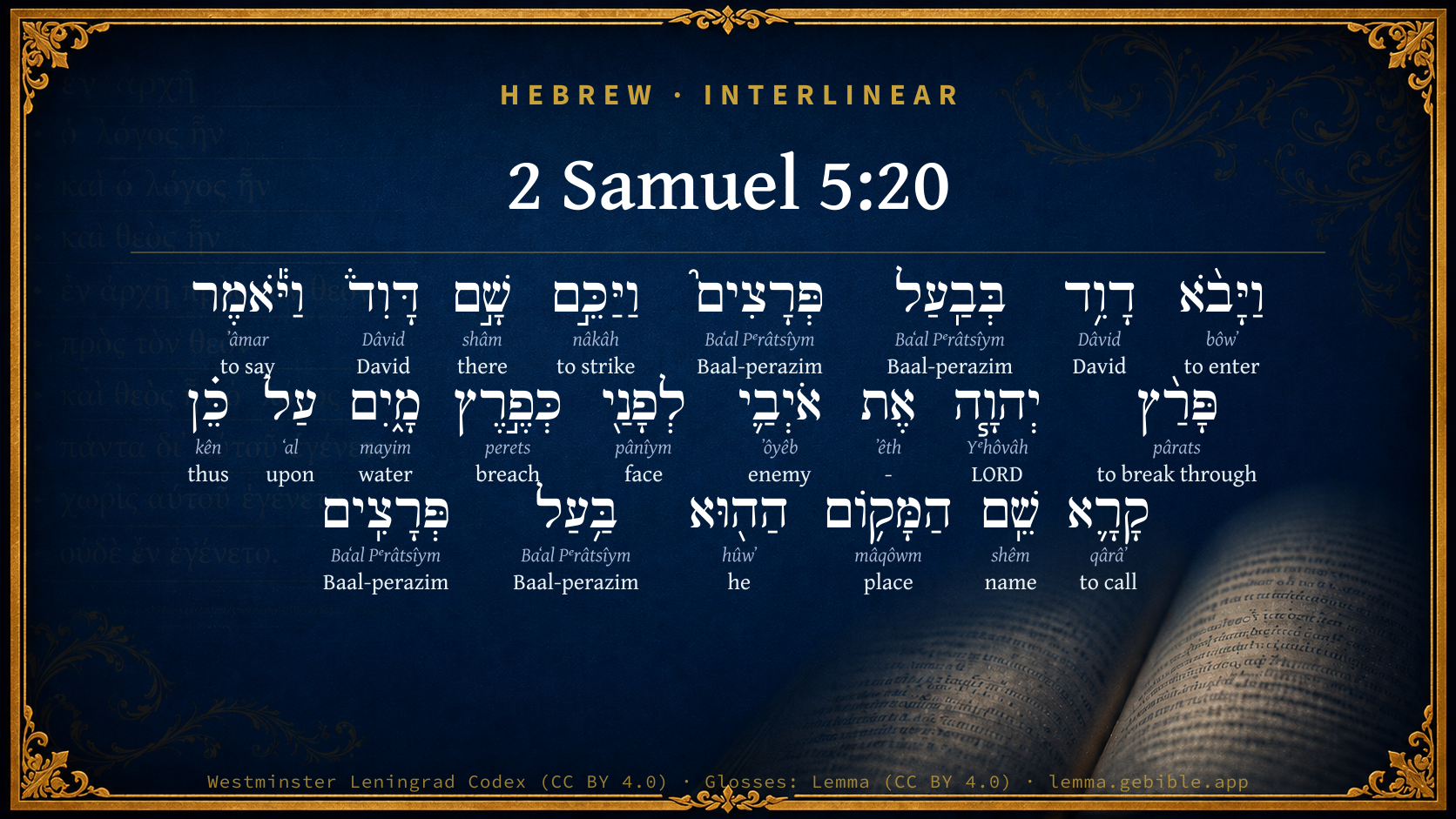
Hebrew (Westminster Leningrad Codex) 2 Samuel 5:20 appears in the Hebrew Old Testament. The text above is from the Westminster Leningrad Codex. Each word links to its Strong’s number, a concise gloss, and parsing drawn from the Open Scriptures Hebrew Bible morphology. Click any word for its full Brown-Driver-Briggs (BDB) entry.
Download image
Cite this verse

2 Samuel 5:20 (World English Bible). Public Domain. Lemma interlinear Bible study tool, https://lemma.gebible.app/v/2-samuel/5/20.

Show BibTeX & RIS
BibTeX
RIS
English Translation
David came to Baal Perazim, and David struck them there; and he said, Yahweh has broken my enemies before me, like the breach of waters. Therefore he called the name of that place Baal Perazim.
World English Bible · Public Domain
Highlights
  • 1 first appearance in the Hebrew Bible
Full analysis ↓
Download a study sheet

One document with this verse’s original text, its word-by-word gloss line, the meaning frame, cross-references with their text, attributed commentary, and full source and license credits — printable, and it pastes into notes with its structure intact.

This verse Autodidact and up

Study sheet (.html) Plain text (.txt)

A passage Seminary Student

Up to 50 verses in one chapter. A passage sheet keeps up to 6 commentary sources and 12 cross-references per verse, in the order this page ranks them, and says so on the sheet whenever that leaves anything out. Ask for a single verse and you get the Autodidact verse sheet above.

Everything on this page stays free to read, with no account — the sheet is a download of what is already on screen, not access to it.

Want to remove ads? Support Godless Engineer
Compare translations 3

The same verse in 3 English versions, stacked beneath the original-language interlinear above. Click any original word for its lexicon entry.

Each is an independent rendering of the whole verse — the interlinear is not word-aligned to these translations.

Highlighted words mark where these versions differ — a whole-verse word diff, not a word-by-word alignment.

  • World English Bible Public Domain
    David came to Baal Perazim, and David struck them there; and he said, Yahweh has broken my enemies before me, like the breach of waters. Therefore he called the name of that place Baal Perazim.
  • King James Version Public Domain
    And David came to Baalperazim, and David smote them there, and said, The LORD hath broken forth upon mine enemies before me, as the breach of waters. Therefore he called the name of that place Baalperazim.
  • unfoldingWord Literal Text CC BY-SA 4.0
    So David came Baal Perazim, and David struck them there. And he said, “Yahweh has broken through my enemies to my face like the breach of waters.” Therefore he called the name of that place Baal Perazim.

unfoldingWord Literal Text — © unfoldingWord, licensed CC BY-SA 4.0. Word-aligned USFM3 via Door43 (git.door43.org/unfoldingWord/en_ult).

Versions to compare (up to 4)

3 of 4 selected

Show all 18 translations

Every available English version of this verse, each an independent rendering of the whole verse.

  • World English Bible Public Domain
    David came to Baal Perazim, and David struck them there; and he said, Yahweh has broken my enemies before me, like the breach of waters. Therefore he called the name of that place Baal Perazim.
  • Berean Standard Bible Public Domain
    So David went to Baal-perazim, where he defeated the Philistines and said, “Like a bursting flood, the LORD has burst out against my enemies before me.” So he called that place Baal-perazim.
  • Majority Standard Bible Public Domain
    So David went to Baal-perazim, where he defeated the Philistines and said, “Like a bursting flood, the LORD has burst out against my enemies before me.” So he called that place Baal-perazim.
  • King James Version Public Domain
    And David came to Baalperazim, and David smote them there, and said, The LORD hath broken forth upon mine enemies before me, as the breach of waters. Therefore he called the name of that place Baalperazim.
  • American Standard Version (1901) Public Domain
    And David came to Baal-perazim, and David smote them there; and he said, Jehovah hath broken mine enemies before me, like the breach of waters. Therefore he called the name of that place Baal-perazim.
  • Revised Version (1885) Public Domain
    And David came to Baal-perazim, and David smote them there; and he said, The LORD hath broken mine enemies before me, like the breach of waters. Therefore he called the name of that place Baal-perazim.
  • Geneva Bible (1599) Public Domain
    Then Dauid came to Baal-perazim, and smote them there, and sayde, The Lord hath deuided mine enemies asunder before mee, as waters be deuided asunder: therefore he called the name of that place, Baal-perazim.
  • Douay-Rheims (1899) Public Domain
    And David consulted the Lord, saying: Shall I go up to the Philistines? and wilt thou deliver them into my hand? And the Lord said to David: Go up, for I will surely deliver the Philistines into thy hand.
  • Young's Literal Translation Public Domain
    And David cometh in to Baal-Perazim, and David smiteth them there, and saith, `Jehovah hath broken forth `on' mine enemies before me, as the breaking forth of waters;' therefore he hath called the name of that place Baal-Perazim.
  • Literal Standard Version CC BY-SA 4.0
    And David comes to Ba‘al-Perazim, and David strikes them there, and says, “YHWH has broken forth [on] my enemies before me, as the breaking forth of waters”; therefore he has called the name of that place Ba‘al-Perazim.
  • Unlocked Literal Bible CC BY-SA 4.0
    So David attacked at Baal Perazim, and there he defeated them. He commented, “Yahweh has burst through my enemies before me like a bursting flood of water.” So the name of that place became Baal Perazim.
  • unfoldingWord Literal Text CC BY-SA 4.0
    So David came Baal Perazim, and David struck them there. And he said, “Yahweh has broken through my enemies to my face like the breach of waters.” Therefore he called the name of that place Baal Perazim.
  • Darby Bible Public Domain
    And David came to Baal-perazim, and David smote them there; and he said, Jehovah has broken in upon mine enemies before me, as the breaking forth of waters. Therefore he called the name of that place Baal-perazim.
  • World Messianic Bible Public Domain
    David came to Baal Perazim, and David struck them there. Then he said, “The LORD has broken my enemies before me, like the breach of waters.” Therefore he called the name of that place Baal Perazim.
  • Webster's Bible Public Domain
    And David came to Baal-perazim, and David smote them there, and said, The LORD hath broken forth upon my enemies before me, as the breach of waters. Therefore he called the name of that place Baal-perazim.
  • Free Bible Version CC BY-SA 4.0
    David went to Baal-perazim and he defeated the Philistines there. “Like a flood that bursts out, so the Lord has burst out against my enemies right before me,” David declared. So he named that place Baal-perazim.
  • Bible in Basic English Public Domain
    And David went to Baal-perazim, and overcame them there; and he said, The Lord has let the forces fighting against me be broken before me as a wall is broken by rushing waters. So that place was named Baal-perazim.
  • JPS Tanakh (1917) Public Domain
    And David came to Baal-perazim, and David smote them there; and he said: 'The LORD hath broken mine enemies before me, like the breach of waters.' Therefore the name of that place was called Baal-perazim.

Literal Standard Version (2020), Covenant Press — licensed CC BY-SA 4.0. Text via the HelloAO Bible API (eBible.org). Unlocked Literal Bible (unfoldingWord) — licensed CC BY-SA 4.0. Text via the HelloAO Bible API (eBible.org). unfoldingWord Literal Text — © unfoldingWord, licensed CC BY-SA 4.0. Word-aligned USFM3 via Door43 (git.door43.org/unfoldingWord/en_ult). Free Bible Version, Dr. Jonathan Gallagher — licensed CC BY-SA 4.0. Text via the HelloAO Bible API (eBible.org).

Word by word

More ways to search: Search by grammar → Find every occurrence → Compare this word →

Practice this passage: Drill this verse → Learn its vocabulary →

בְּבַֽעַל
Baʻal Pᵉrâtsîym
H1188
“in/at · Baal-perazim”
Preposition + Noun, Proper
Part of Speech
Preposition + Noun
Type
Proper
Full BDB Definition

Origin: from H1167 and the pl. of H6556

TWOT: None

Baal-perazim = "lord of the breaks" - the site of a victory of David over the Philistines, and of a great destruction of their images; also called 'Mount Perazim'
  1. וַיָּבֹ֨א bôwʼ H935 “and · to enter” Conjunction + Verb, Qal, Sequential Imperfect, 3rd Person, Masculine, Singular
  2. דָוִ֥ד Dâvid H1732 “David” Noun, Proper
  3. פְּרָצִים֮ Baʻal Pᵉrâtsîym H1188 “Baal-perazim” Noun, Proper
  4. וַיַּכֵּ֣ם nâkâh H5221 “and · to strike · them” Conjunction + Verb, Hiphil, Sequential Imperfect, 3rd Person, Masculine, Singular + Suffix, Personal, 3rd Person, Masculine, Plural
  5. שָׁ֣ם shâm H8033 “there” Adverb
  6. דָּוִד֒ Dâvid H1732 “David” Noun, Proper
  7. וַיֹּ֕אמֶר ʼâmar H559 “and · to say” Conjunction + Verb, Qal, Sequential Imperfect, 3rd Person, Masculine, Singular
  8. פָּרַ֨ץ pârats H6555 “to break through” Verb, Qal, Perfect, 3rd Person, Masculine, Singular
  9. יְהוָ֧ה Yᵉhôvâh H3068 “LORD” Noun, Proper
  10. אֶת ʼêth H853 “-” Particle, Direct Object
  11. אֹיְבַ֛י ʼôyêb H341 “enemy · me” Verb, Qal, Participle Active, Masculine, Plural, Construct + Suffix, Personal, 1st Person, Common, Singular
  12. לְפָנַ֖י pânîym H6440 “to/for · face(s) · my” Preposition + Noun, Common, Both, Plural, Construct + Suffix, Personal, 1st Person, Common, Singular
  13. כְּפֶ֣רֶץ perets H6556 “like/as · breach of” Preposition + Noun, Common, Masculine, Singular, Construct
  14. מָ֑יִם mayim H4325 “water(s)” Noun, Common, Masculine, Plural, Absolute
  15. עַל ʻal H5921 “upon” Preposition
  16. כֵּ֗ן kên H3651 “thus” Particle, Demonstrative
  17. קָרָ֛א qârâʼ H7121 “to call” Verb, Qal, Perfect, 3rd Person, Masculine, Singular
  18. שֵֽׁם shêm H8034 “name of” Noun, Common, Masculine, Singular, Construct
  19. הַמָּק֥וֹם mâqôwm H4725 “the · place” Particle, Definite Article + Noun, Common, Masculine, Singular, Absolute
  20. הַה֖וּא hûwʼ H1931 “the · he” Particle, Definite Article + Pronoun, Personal, 3rd Person, Masculine, Singular
  21. בַּ֥עַל Baʻal Pᵉrâtsîym H1188 “Baal-perazim” Noun, Proper
  22. פְּרָצִֽים Baʻal Pᵉrâtsîym H1188 “Baal-perazim” Noun, Proper

About this verse

These counts appear in no published source. They are computed here, from the morphology-tagged text and Lemma’s own curated glosses. What Lemma adds →

23
words
19
distinct lemmas
Historical
section

Notable vocabulary

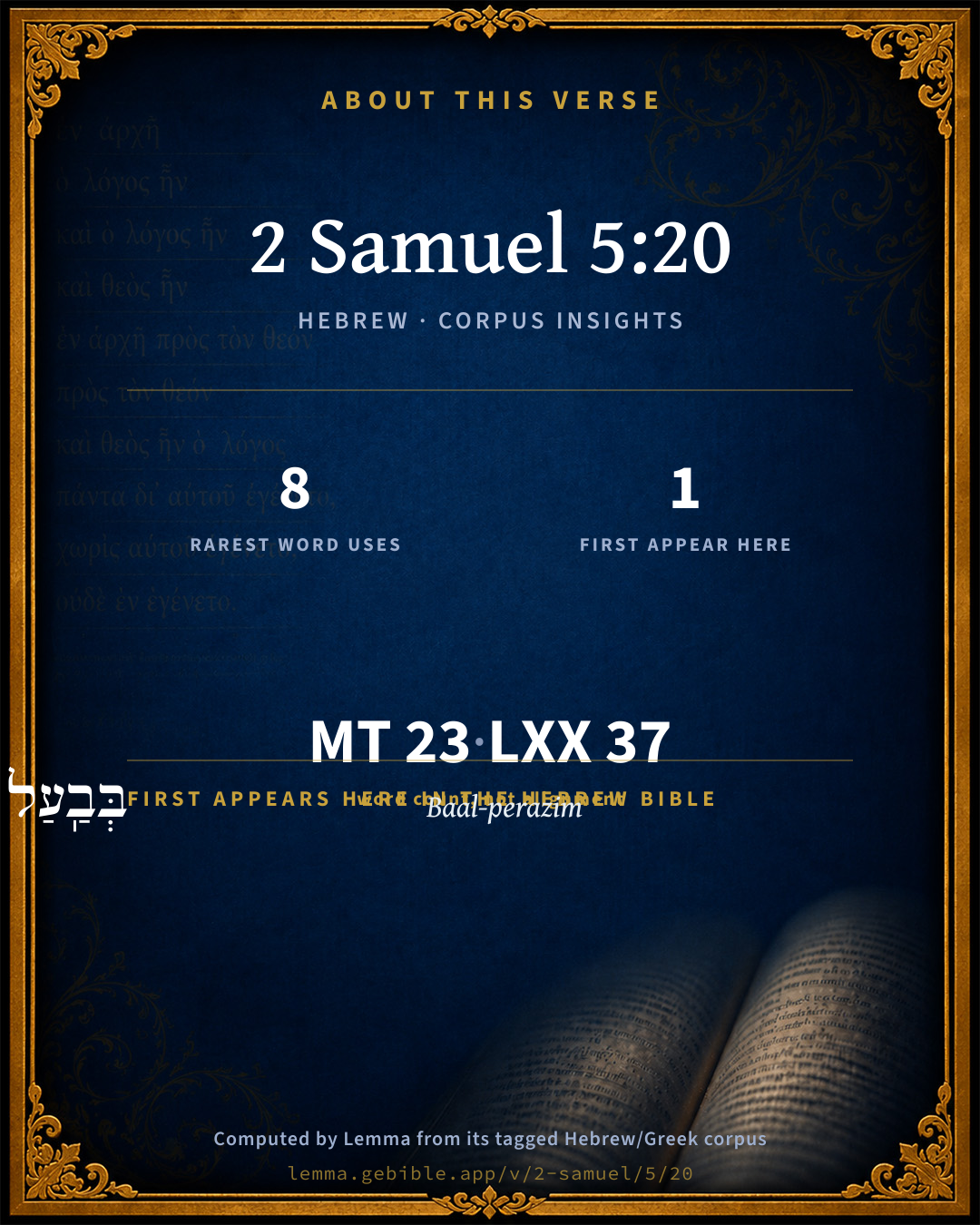
The rarest word here is בְּבַֽעַל Baal-perazim H1188 — appearing just 8 times in the whole Hebrew Bible.

First appearance in Scripture

This word makes its first canonical appearance in the Hebrew Bible here:

  • בְּבַֽעַל Baal-perazim H1188

Shared distinctive vocabulary

בְּבַֽעַל Baal-perazim H1188 occurs in 2 verses of the Hebrew Bible. Also found in:

Grammatical profile

  • 6 verbs
  • 12 nouns
  • 1 pronoun
  • 1 preposition
  • 1 adverb
  • 2 particles

Verb forms

  • וַיָּבֹ֨א Qal · Sequential Imperfect
  • וַיַּכֵּ֣ם Hiphil · Sequential Imperfect
  • וַיֹּ֕אמֶר Qal · Sequential Imperfect
  • פָּרַ֨ץ Qal · Perfect
  • אֹיְבַ֛י Qal · Participle Active
  • קָרָ֛א Qal · Perfect

Repetition

Words recur within this verse — often emphatic in Hebrew:

  • בְּבַֽעַל Baal-perazim H1188 ×4
  • דָוִ֥ד David H1732 ×2

Hebrew & Septuagint length

In English translation the verse runs 35 words from the Hebrew and 37 from the Septuagint (LXX English) — closely comparable.

A rough comparison of the two English renderings, which tokenize alike — not a word-level alignment.

Word counts can differ between the Hebrew and the Greek without any difference in meaning — e.g. the Hebrew direct-object marker אֵת has no separate Greek word, and Greek often adds the article ὁ.

In the original languages it is 23 Hebrew tokens and 37 Greek tokens — but the two are counted differently (Hebrew bundles its prefixes and suffixes into one token; the Greek is in lemma form), so that isn’t a like-for-like length.

Cross-references

1

Topical passages linked to 2 Samuel 5:20 in the Treasury of Scripture Knowledge — connected by theme and wording, ordered by reader-vote popularity; previews shown in the World English Bible.

  • Isaiah 28:21 For Yahweh will rise up as on Mount Perazim, he will be angry as in the valley of Gibeon; that he may do his work, his strange work, and bring to pass his act, his strange act.

Cross-references courtesy of OpenBible.info (CC BY 4.0).

Hebrew and Greek witnesses Masoretic Hebrew ↔ Greek Septuagint

The same verse in the two great witnesses to the Old Testament, shown verse-for-verse.

These are two independent witnesses, not word-aligned to each other, and the Septuagint is shown in lemma (dictionary) form.

Hebrew 2 Samuel 5:20 Masoretic · Westminster Leningrad Codex

וַיָּבֹ֨א דָוִ֥ד בְּבַֽעַל פְּרָצִים֮ וַיַּכֵּ֣ם שָׁ֣ם דָּוִד֒ וַיֹּ֕אמֶר פָּרַ֨ץ יְהוָ֧ה אֶת אֹיְבַ֛י לְפָנַ֖י כְּפֶ֣רֶץ מָ֑יִם עַל כֵּ֗ן קָרָ֛א שֵֽׁם הַמָּק֥וֹם הַה֖וּא בַּ֥עַל פְּרָצִֽים

David came to Baal Perazim, and David struck them there; and he said, Yahweh has broken my enemies before me, like the breach of waters. Therefore he called the name of that place Baal Perazim.

World English Bible · Public Domain

Greek LXX 2 Samuel 5:20 Septuagint · lemma form

καί ἔρχομαι δαυίδ ἐκ ὁ ἐπάνω διακόπτω καί κόπτω ὁ ἀλλόφυλος ἐκεῖ καί εἶπον δαυίδ διακόπτω κύριος ὁ ἐχθρός ἐγώ ὁ ἀλλόφυλος ἐνώπιον ἐγώ ὡς διακόπτω ὕδωρ διά οὗτος καλέω ὁ ὄνομα ὁ τόπος ἐκεῖνος ἐπάνω διακόπτω

And David came from Upper Breaches, and struck the Philistines there: and David said, The Lord has destroyed the hostile Philistines before me, as water is dispersed; therefore the name of that place was called Over Breaches.

LXX2012 (modern English Septuagint) · Public Domain

Hebrew: Westminster Leningrad Codex (CC BY 4.0). Greek: Septuagint (public domain); English from LXX2012 (modern English Septuagint) (Public Domain). How the Septuagint differs from the Hebrew →

Targum (Aramaic paraphrase)

1

The Targum is the ancient Jewish Aramaic paraphrase of the Hebrew Scriptures — an interpretive translation, not the Hebrew text itself. Onkelos (literal) and Pseudo-Jonathan (expansive) render the Torah, and Jonathan the Prophets. Coverage is partial: where no permissively-licensed English translation exists for a verse, only the Aramaic is shown. This is verse-level text, not a word-by-word alignment to the Hebrew.

  1. Targum Jonathan Prophets (Joshua–Malachi)
    וַאֲתָא דָוִד בְּמֵישַׁר פְּרָצִים וּמְחָנוּן תַּמָן דָוִד וַאֲמַר תְּבַר יְיָ יַת בַּעֲלֵי דְבָבֵי קֳדָמַי כְּתִבּוּר מָאן דַחֲסַף דְמָלֵי מַיָין עַל כֵּן קְרָא שְׁמֵיהּ דְאַתְרָא הַהוּא מֵישַׁר פְרָצִים:

    (no public-domain English translation for this verse)

    Targum Jonathan — Aramaic: “Mikraot Gedolot” (public domain). English: “Sefaria Community Translation” (CC0 1.0 (public-domain dedication)); “London "Chaldee Paraphrase," 1871” (public domain). Text via Sefaria.

Commentary

Notes on 2 Samuel 5:20 from classic Christian and Jewish commentators (each source and its license shown beneath its notes). The classic Christian expositions comment on the surrounding passage and are grouped to its opening verse, so a note may address several verses; the Jewish commentaries on the Tanakh (Rashi and others) are per-verse, so they appear only where the commentator wrote on this verse.

Lemma curates 59 commentaries, every one of them public domain or Creative Commons licensed, each selected and text-cleaned for this edition rather than reprinted as found. About our sources →

John Gill's Exposition

And the Philistines came up yet again,.... And, as Josephus says (z), with an army three times larger than the former:

and spread themselves in the valley of Rephaim; in the same place where they were before, Sa2 5:20.

(z) Antiqu. l. 7. c. 4. sect. 1.

John Gill's Exposition of the Whole Bible (1746–1763) — public domain (CC PDM 1.0). Text via the HelloAO Bible API.

Trapp's Complete Commentary

John Trapp

2Sa 5:20 And David came to Baalperazim, and David smote them there, and said, The LORD hath broken forth upon mine enemies before me, as the breach of waters. Therefore he called the name of that place Baalperazim.

Ver. 20. As the breach of waters.] Whenas, overflowing the banks, they bear all before them. See 1Ch 14:11. Or, As the division of waters; that is, as waters are easily divided with hand or foot, so God hath dispersed mine enemies with great facility. See a like place in Isa 25:11, "And he shall spread forth his hands in the midst of them, as he that swimmeth spreadeth forth his hands to swim: and he shall bring down their pride together with the spoils of their hands." See also Isa 26:21.

John Trapp, A Commentary or Exposition upon All the Books of the Old and New Testament (1647–1656) — public domain. Text from a community e-Sword module.

Joseph Benson's Commentary

2Sa 5:20. David came to Baal-perazim — For thither the Philistines marched from Rephaim, where they first pitched; as appears from 1Ch 14:11. Hath broken forth upon mine enemies as the breach of waters — Hath overpowered and scattered them, as waters, when they make a breach in a bank, overflow and carry all before them. Therefore he called the name of that place Baal-perazim — That is, The master of the breaches. Thus ascribing all to God, and giving the place this name, that it might put him and his posterity in mind of God’s great power and goodness shown in that place.

Joseph Benson's Commentary on the Old and New Testaments (1811–1818) — public domain. Text from a community e-Sword module.

The Expositor's Bible

CHAPTER V I I.

THE KINGDOM ESTABLISHED.

2Sa_5:20-25.

THE events in David's reign that followed the capture of Mount Zion and the appointment of Jerusalem as the capital of the country were all of a prosperous kind. "David," we are told, "waxed greater and greater, for the Lord of hosts was with him." "And David perceived that the Lord had established him to be king over Israel, and that He had exalted his kingdom for His people Israel's sake."

In these words we find two things: a fact and an explanation. The fact is, that now the tide fairly turned in David's history, and that, instead of a sad chronicle of hardship and disappointment, the record of his reign becomes one of unmingled success and prosperity. The fact is far from an unusual one in the history of men's lives. How often, even in the case of men who have become eminent, has the first stage of life been one of disappointment and sorrow, and the last part one of prosperity so great as to exceed the fondest dreams of youth. Effort after effort has been made by a young man to get a footing in the literary world, but his books have proved comparative failures. At last he issues one which catches in a remarkable degree the popular taste, and thereafter fame and fortune attend him, and lay their richest offerings at his feet. A similar tale is to be told of many an artist and professional man. And even persons of more ordinary gifts, who have found the battle of life awfully difficult in its earlier stages, have gradually, through diligence and perseverance, acquired an excellent position, more than fulfilling every reasonable desire for success. No man is indeed exempt from the risk of failure if he chooses a path of life for which he has no special fitness, or if he encounters a storm of unfavourable contingencies; but it is an encouraging thing for those who begin life under hard conditions, but with a brave heart and a resolute purpose to do their best, that, as a general rule, the sky clears as the day advances, and the troubles and struggles of the morning yield to success and enjoyment later in the day.

But in the present instance we have not merely a statement of the fact that the tide turned in the case of David, giving him prosperity and enlargement in every quarter, but an explanation of the fact - it was due to the gracious presence and favour of God. This by no means implies that his adversities were due to an opposite cause. God had been with him in the wilderness, save when he resorted to deceit and other tricks of carnal policy; but He had been with him to try him and to train him, not to crown him with prosperity. But now, the purpose of the early training being accomplished, God is with him to ''grant him all his heart's desire and fulfill all his counsel." If God, indeed, had not been with him, sanctifying his early trials, He would not have been with him in the end, crowning him with loving-kindness and tender mercies. But in the time of their trials, God is with His people more in secret, hid, at least, from the observation of the world; when the time comes for conspicuous blessing and prosperity, He comes more into view in His own gracious and bountiful character. In the case of David, God was not only with him, but David "perceived" it; he was conscious of the fact. His filial spirit recognized the source of all his prosperity and blessing, as it had done when he was enabled in his boyhood to slay the lion and the bear, and in his youth to triumph over Goliath. Unlike many successful men, who ascribe their success so largely to their personal talents and ways of working, he felt that the great factor in his success was God. If he possessed talents and had used them to advantage, it was God who had given them originally, and it was God who had enabled him to employ them well. But in every man's career, there are many other elements to be considered besides his own abilities. There is what the world calls "luck," that is to say those conditions of success which are quite out of our control; as for instance in business the unexpected rise or fall of markets, the occurrence of favourable openings, the honesty or dishonesty of partners and connections, the stability or the vicissitudes of investments. The difference between the successful man of the world and the successful godly man in these respects is, that the one speaks only of his luck, the other sees the hand of God in ordering all such things for his benefit. This last was David's case. Well did he know that the very best use he could make of his abilities could not ensure success unless God was present to order and direct to a prosperous issue the ten thousand incidental influences that bore on the outcome of his undertakings. And when he saw that these influences were all directed to this end, that nothing went wrong, that all conspired steadily and harmoniously to the enlargement and establishment of his kingdom, he perceived that the Lord was with him, and was now visibly fulfilling to him that great principle of His government which He had so solemnly declared to Eli, "Them that honour Me, I will honour."

But is this way of claiming to be specially favoured and blessed by God not objectionable? Is it not what the world calls "cant"? Is it not highly offensive in any man to claim to be a favourite of Heaven? Is this not what hypocrites and fanatics are so fond of doing, and is it not a course which every good, humble-minded man will be careful to avoid?

This may be a plausible way of reasoning, but one thing is certain - it has not the support of Scripture. If it be an offence publicly to recognize the special favour and blessing with which it has pleased God to visit us, David himself was the greatest offender in this respect the world has ever known. What is the great burden of his psalms of thanksgiving? Is it not an acknowledgment of the special mercies and favours that God bestowed on him, especially in his times of great necessity? And does not the whole tenor of the Psalms and the whole tenor of Scripture prove that good men are to take especial note of all the mercies they receive from God, and are not to confine them to their own bosom, but to tell of all His gracious acts and bless His name forever and ever? "They shall abundantly utter the memory of Thy great goodness, and shall sing of Thy righteousness." That God is to be acknowledged in all our ways, that God's mercy in choosing us in Christ Jesus and blessing us with all spiritual blessings in Him is to be especially recognized, and that we are not to shrink from extolling God's name for conferring on us favours infinitely beyond what belong to the men of the world, are among the plainest lessons of the word of God.

What the world is so ready to believe is, that this cannot be done save in the spirit of the Pharisee who thanked God that he was not as other men. And whenever a worldly man falls foul of one who owns the distinguishing spiritual mercies that God has bestowed on him, it is this accusation he is sure to hurl at his head. But this just shows the recklessness and injustice of the world. Strange indeed if God in His word has imposed on us a duty which cannot be discharged but in company with those who say, "Stand by thyself; come not nigh; I am holier than thou"! The truth is, the world cannot or will not distinguish between the Pharisee, puffed up with the conceit of his goodness, and for this goodness of his deeming himself the favourite of Heaven, and the humble saint, conscious that in him dwelleth no good thing, and filled with adoring wonder at the mercy of God in making of one so unworthy a monument of His grace. The one is as unlike the other as light is to darkness. What good men need to bear in mind is, that when they do make mention of the special goodness of God to them they should be most careful to do so in no boastful mood, but in the spirit of a most real, and not an assumed or formal, humility. And seeing how ready the world is to misunderstand and misrepresent the feeling, and to turn into a reproach what is done as a most sincere act of gratitude to God, it becomes them to be cautious how they introduce such topics among persons who have no sympathy with their view. ''Cast not your pearls before swine," said our Lord, "lest they turn again and rend you," "Come near," said the Psalmist "and hear, all ye that fear God, and I will declare what He hath done for my soul."

Midway between the two statements before us on the greatness and prosperity which God conferred on David, mention is made of his friendly relations with the king of Tyre (2Sa_5:11). The Phoenicians were not included among the seven nations of Palestine whom the Israelites were to extirpate, so that a friendly alliance with them was not forbidden. It appears that Hiram was disposed for such an alliance, and David accepted of his friendly overtures. There is something refreshing in this peaceful episode in a history and in a time when war and violence seem to have been the normal condition of the intercourse of neighbouring nations. Tyre had a great genius for commerce; and the spirit of commerce is alien from the spirit of war. That it is always a nobler spirit cannot be said; for while commerce ought to rest on the idea of mutual benefit, and many of its sons honourably fulfill this condition, it often degenerates into the most atrocious selfishness, and heeds not what havoc it may inflict on others provided it derives personal gain from its undertakings. What an untold amount of sin and misery has been wrought by the opium traffic, as well as by the traffic in strong drink, when pressed by cruel avarice on barbarous nations that have so often lost all of humanity they possessed through the fire-water of the Christian trader! But we have no reason to believe that there was anything specially hurtful in the traffic which Tyre now began with Israel, although the intercourse of the two countries afterwards led to other results pernicious to the latter - the introduction of Phoenician idolatry and the overthrow of pure Worship in the greater part of the tribes of Israel Meanwhile what Hiram does is to send to David cedar trees, and carpenters, and masons, by means of whom a more civilized style of dwelling is introduced; and the new city which David has commenced to build, and especially the house which is to be his own, present features of skill and beauty hitherto unknown in Israel. For, amid all his zeal for higher things, the young king of Israel does not disdain to advance his kingdom in material comforts. Of these, as of other things of the kind, he knows well that they are good if a man use them lawfully; and his effort is at once to promote the welfare of the kingdom in the amenities and comforts of life, and to deepen that profound regard for God and that exalted estimate of His favour which will prevent His people from relying for their prosperity on mere outward conditions, and encourage them ever to place their confidence in their heavenly Protector and King.

We pass by, as not requiring more comment than we have already bestowed on a parallel passage (2Sa_3:2-5), the unsavoury statement that "David took to him more concubines and wives" in Jerusalem. With all his light and grace, he had not overcome the prevalent notion that the dignity and resources of a kingdom were to be measured by the number and rank of the king's wives. The moral element involved in the arrangement he does not seem to have at all apprehended; and consequently, amid all the glory and prosperity that God has given him, he thoughtlessly multiplies the evil that was to spread havoc and desolation in his house.

We proceed, therefore, to what occupies the remainder of this chapter - the narrative of his wars with the Philistines. Two campaigns against these inveterate enemies of Israel are recorded, and the decisive encounter in both cases took place in the neighbourhood of Jerusalem.

The narrative is so brief that we have difficulty in apprehending all the circumstances. The first invasion of the Philistines took place soon after David was anointed king over all Israel. It is not said whether this occurred before David possessed himself of Mount Zion, nor, considering the structure common in Hebrew narrative, does the circumstance that in the history it follows that event prove that it was subsequent to it in the order of time. On the contrary, there is an expression that seems hardly consistent with this idea. We read (2Sa_5:17) that when David heard of the invasion he "went down into the hold." Now, this expression could not be used of the stronghold of Zion, for that hill is on the height of the central plateau, and invariably the Scriptures speak of "going up to Zion." If he had possession of Mount Zion, he would surely have gone to it when the Philistines took possession of the plain of Rephaim. The hold to which he went down must have been in a lower position; indeed, "the hold" is the expression used of the place or places of protection to which David resorted when he was pursued by Saul (see 1Sa_22:4). Further, when we turn to the twenty-third chapter of this book, which records some memorable incidents of the war with the Philistines, we find (2Sa_23:13-14) that when the Philistines pitched in the valley of Rephaim David was in a hold near the cave of Adullam. The valley of Rephaim, or "the giants," is an extensive plain to the south-west of Jerusalem, forming a great natural entrance to the city. When we duly consider the import of these facts, we see that the campaign was very serious, and David's difficulties very great. The Philistines were encamped in force on the summit of the plateau near the natural metropolis of the country. David was encamped in a hold in the low country in the south-west, making use of that very cave of Adullam where he had taken refuge in his conflicts with Saul. This was far from a hopeful state of matters. To the eye of man, his position may have appeared very desperate. Such an emergency was a fit time for a solemn application to God for direction. "David inquired of the Lord, saying, Shall I go up to the Philistines? Wilt Thou deliver them into mine hand? And the Lord said unto David, Go up, for I will doubtless deliver the Philistines into thine hand." Up, accordingly, David went, attacked the Philistines and smote them at a place called Baal-perazim, some- where most likely between Adullam and Jerusalem. The expression "The Lord hath broken forth on mine enemies before me, as the breach of waters," seems to imply that He broke the Philistine host into two, like flooded water breaking an embankment, preventing them from uniting and rallying, and sending them in two detachments into flight and confusion. Considering the superior position of the Philistines, and the great advantage they seem to have had over David in numbers also, this was a signal victory, even though it did not reduce the foe to helplessness.

For when the Philistines had got time to recover, they again came up, pitched again in the plain of Rephaim, and appeared to render unavailing the signal achievement of David at Baal-perazim. Again David inquired what he should do. The reply was somewhat different from before. David was not to go straight up to face the enemy, as he had done before. He was to "fetch a compass behind them," that is, as we understand it, to make a circuit, so as to get in the enemy's rear over against a grove of mulberry trees. That tree has not yet disappeared from the neighbourhood of Jerusalem; a mulberry tree still marks the spot in the valley of Jehoshaphat where, according to tradition, Isaiah was sawn asunder (Stanley's "Sinai and Palestine"). When he should hear "the sound of a going" (Revised Version, "the sound of a march") in the tops of the mulberry trees, then he was to bestir himself. It is difficult to conceive any natural cause that should give rise to a sound like that of a march "in the tops of the mulberry trees;" but if not a natural, it must have been a supernatural indication of some sound that would alarm the Philistines and make the moment favourable for an attack. It is probable that the presence of David and his troop in the rear of the Philistines was not suspected, the mulberry trees forming a screen between them. When David got his opportunity, he availed himself of it to great advantage; he inflicted a thorough defeat on the Philistines, and smiting them from Geba to Gazer, he appears to have all but annihilated their force. In this way, he gave the coup de grace to his former allies.

We have said that it appears to have been during these campaigns against the Philistines that the incidents took place which are recorded fully in the twenty-third chapter of this book. It does not seem possible that these incidents occurred at or about the time when David was flying from Saul, at which time the cave of Adullam was one of his resorts. Neither is it likely that they occurred during the early years of David's reign, while he was yet at strife with the house of Saul. At least, it is more natural to refer them to the time when the Philistines, having heard that David had been anointed king over Israel, came up to seek David, although we do not consider it impossible that they occurred in the earlier period of his reign. The record shows how wonderfully the spirit of David had passed into his men, and what splendid deeds of courage were performed by them, often in the face of tremendous odds. We get a fine glimpse here of one of the great sources of David's popularity - his extraordinary pluck as we now call it, and readiness for the most daring adventures, often crowned with all but miraculous success. In all ages, men of this type have been marvellous favourites with their comrades. The annals of the British army, and still more the British navy, contain many such records. And even when we go down to pirates and freebooters, we find the odium of their mode of life in many cases remarkably softened by the splendour of their valour, by their running unheard-of risks, and sometimes by sheer daring and bravery obtaining signal advantages over the greatest odds. The achievements of David's "three mighties,'' as well as of his "thirty," formed a splendid instance of this kind of warfare. All that we know of them is comprised within a few lines, but when we call to mind the enthusiasm that used to be awakened all over our own country by the achievements of Nelson and his officers, or more recently by General Gordon, of China and Egypt, we can easily understand the thrilling effect which these wonderful tales of valour would have throughout all the tribes of Israel.

The personal affection for David and his heroes which would thus be formed must have been very warm, nay, even enthusiastic. In the case of David, whatever may have been true of the others, all the influence thus acquired was employed for the welfare of the nation and the glory of God. The supreme desire of his heart was that the people might give all the glory to Jehovah, and derive from these brilliant successes fresh assurances how faithful God was to His promises to Israel. Alike as a man of piety and a man of patriotism, he made this his aim. Knowing as he did what was due to God, and animated by a profound desire to render to God His due, he would have been horrified had he intercepted in his own person aught of the honour and glory which were His. But for the people's sake also, as a man of patriotism, his desire was equally strong that God should have all the glory. What were military successes however brilliant to the nation, or a reputation however eminent, compared to their enjoying the favour and friendship of God? Success - how ephemeral it was; reputation - as transient as the glow of a cloud beside the setting sun; but God's favour and gracious presence with the nation was a perpetual treasure, enlivening, healing, strengthening, guiding for ever-more. "Happy is that people that is in such a case; yea, happy is that people whose God is the Lord."

William Robertson Nicoll, ed., The Expositor's Bible (London: Hodder & Stoughton, 1887–1910) — public domain. 65 of 66 books (1 Corinthians is not separately keyed, as that volume carries no machine-parseable verse references); section-level commentary keyed to the opening verse. Introductory and overview sections not keyed to a specific passage are excluded.

Tyndale Open Study Notes

Tyndale Open Resources

5:20 Baal-perazim: David used the term Baal to honor the Lord for the victory he gave Israel. The title means “the lord of earthquakes/openings,” and was evidently an acceptable title for Yahweh until the Canaanite worship of Baal became an overwhelming problem in Israel. Every time David engaged in combat with the Philistines in 2 Samuel (5:17-25; 8:1; 21:15-22; 23:13-17), he won without losing a single soldier. How different from Saul, for whom victory over the Philistines was impossible!

Tyndale Open Study Notes — © Tyndale Open Resources, licensed CC BY-SA 4.0. Text via the HelloAO Bible API.

Geneva Bible (1599)

Geneva Bible translators

Or, the plain of divisions.

Geneva Bible (1599) marginal notes — public domain. Text via Bolls.life.

Adam Clarke's Commentary

Verse 20. The Lord hath broken forth] He very properly attributes the victory of Jehovah, without whose strength and counsel he could have done nothing.

Baal-perazim] The plain or chief of breaches, because of the breach which God made in the Philistine army; and thus he commemorated the interference of the Lord.

Adam Clarke's Commentary on the Bible (1810–1826) — public domain. Text from a community e-Sword/MySword module.

Ellicott's Commentary for English Readers

(20) Baal – perazim = possessor (or lord) of breaches. After David had inquired of the Lord and received a favourable answer (2Sa_5:19), he made a sudden attack, like a bursting forth of waters, and carried all before him. The victory was so signal as to give a new name to the locality, and to be remembered centuries afterwards as a memorable instance of Divine aid (Isa_28:21). The name has no reference to the heathen deity Baal.

A Bible Commentary for English Readers, edited by Charles John Ellicott (1878–1897) — public domain. Text from a community e-Sword module.

The Cambridge Bible for Schools and Colleges

gen. ed. J. J. S. Perowne

20. as the breach of waters] Isaiah calls the scene of the battle “mount Perazim” (Isa_28:21). David, we may suppose, occupied the hill, and swept down from it upon the Philistines in the plain below, scattering them irresistibly as a mountain torrent swollen by a sudden storm sweeps all before it and bursts through every obstacle in its way.

Baal-perazim] Baal = owner or possessor, so that the name signifies “Place of breaches.”

The Cambridge Bible for Schools and Colleges (gen. ed. J. J. S. Perowne; Cambridge University Press, 1878–1918) — public domain. Text from a community e-Sword module.

Albert Barnes' Notes on the Bible

Baal-perazim - Master or possessor of breaches, equivalent to place of breaches. It was on a hill near Gibeon (see the marginal reference).

Albert Barnes' Notes on the Bible (1834–1885) — public domain. Text from a community e-Sword/MySword module.

Haydock's Catholic Bible Commentary

Baal-Pharisim, "the master of the divisions or god of the scattered;" as the place was afterwards called, in memory that David became master, and put the enemy to flight, taking their idols, (Calmet) which were unable to save themselves. (Haydock)

George Leo Haydock (1774–1849), Haydock's Catholic Family Bible and Commentary, 1859 edition — public domain. Excludes Psalms (Douay-Rheims chapter numbering differs from Protestant) and Deuterocanonical books (Catholic canon only).

Matthew Poole's English Annotations

Baal-perazim; whither the Philistines were come from the valley of Rephaim, 1Ch 14:11.

As the breach of waters; as floods or rivers of waters, which break the banks, and overflow a land, and overturn all that stands in their way.

Matthew Poole's English Annotations on the Holy Bible (1683–1685) — public domain. Text from a community e-Sword/MySword module.

Whedon's Commentary on the Bible

Daniel D. Whedon

20. Baal-perazim — Furst renders, Baal of Perazim mount, and understands it as the name of a mountain city in the immediate vicinity of the place where the battle was fought. The word perazim means breakings forth, or breaches. Not only does David undertake the battle by the counsel of Jehovah, but he gives to the place of his triumph a name forever suggestive of Jehovah’s assistance in battle.

Daniel D. Whedon (gen. ed.), Commentary on the Old and New Testaments (1874–1909) — public domain. Text from a community e-Sword module.

The Pulpit Commentary

Baal-Perazim; literally, possessor of breaches, that is, the place where the attack burst forth. It is called Mount Perazim, "the hill of breaches," in Ps 28 Ps 21, and as we have seen, it was the rocky height on the north of the valley of Rephaim. David must, therefore, have stolen round the army of the Philistines, creeping, probably by night, up to this ridge of Ben-Hinnom, and thence at the dawn of day have rushed down upon the comp. And his onset was sudden and irresistible, like the rush of the waters of some mountain lake when, swollen with rains, it bursts through the opposing dam, and carries hasty destruction to everything that lies in its way.

The Pulpit Commentary (1880–1919), ed. H.D.M. Spence-Jones & Joseph S. Exell — public domain. Text from a community e-Sword module.

John Wesley's Explanatory Notes

Baal-perazim-Whither the Philistines were come from the valley of Rephraim, 1 Chron. xiv, 11. Baal-perazim, signifies the master of the breaches: So he ascribes all to God. As waters - As floods or rivers of waters, which break the banks, and overflow a land, and overturn all that stands in their way.

John Wesley, Explanatory Notes Upon the Whole Bible (1754–1765) — public domain. Text via the GEBible commentary corpus.

Rashi

Rabbi Shlomo Yitzchaki (Rashi)

Into the plain of Perotzim. The plain of Perotzim

Like water bursting over [walls]. Like water bursting over the walls edge.

Rashi on the Tanakh — English translations: “The Judaica Press complete Tanach with Rashi, translated by A. J. Rosenberg” (CC BY 4.0); “Pentateuch with Rashi's commentary by M. Rosenbaum and A.M. Silbermann, 1929-1934” (public domain); “The Metsudah Tanach series, Lakewood, N.J” (CC BY 4.0); and “The Book of Joshua, Metsudah Publications, 1997” (CC BY 4.0). Text via Sefaria.

Lesson kit

Teaching starters — assembled from the data on this page, not authored interpretation. Every prompt links to the verse data it draws on. Edit before teaching.

2 Samuel, in the Historical, opens this verse with 23 words (19 distinct Hebrew lemmas). Its most distinctive word is Baʻal Pᵉrâtsîym (“Baal-perazim”). A historical commentator’s framing appears above. Read the whole chapter for the surrounding context.

Discussion questions

  1. What does “Baal-perazim” (Baʻal Pᵉrâtsîym) contribute to the verse as a whole?
  2. The word “Baal-perazim” first appears here in Scripture. What is being introduced at this debut?
  3. 1 Chronicles 14:11 shares the word «Baal-perazim» with this verse. How do the two illuminate each other?
  4. “Baal-perazim” occurs 4× in this one verse. What is the effect of the repetition?
  5. The translations on this page render this verse differently — a whole-verse word diff, not a word-by-word alignment. What might account for the different wordings?
  6. The verb «וַיָּבֹ֨א» is Qal Sequential Imperfect. How does its form color the action?
  7. Reading how John Gill's Exposition and Trapp's Complete Commentary read this verse, where do the two commentators agree and where do they part?

Things to notice

Reading settings

Reading text

Shown beneath each verse's original-language words.

Old Testament
Old Testament edition

Read the OT as the Masoretic Hebrew (MT) or the Greek Septuagint (LXX).

English shown for the Greek Septuagint (in the Hebrew ↔ Greek comparison).

Comparing translations? Open the Compare panel on any verse page to stack up to four side by side.