
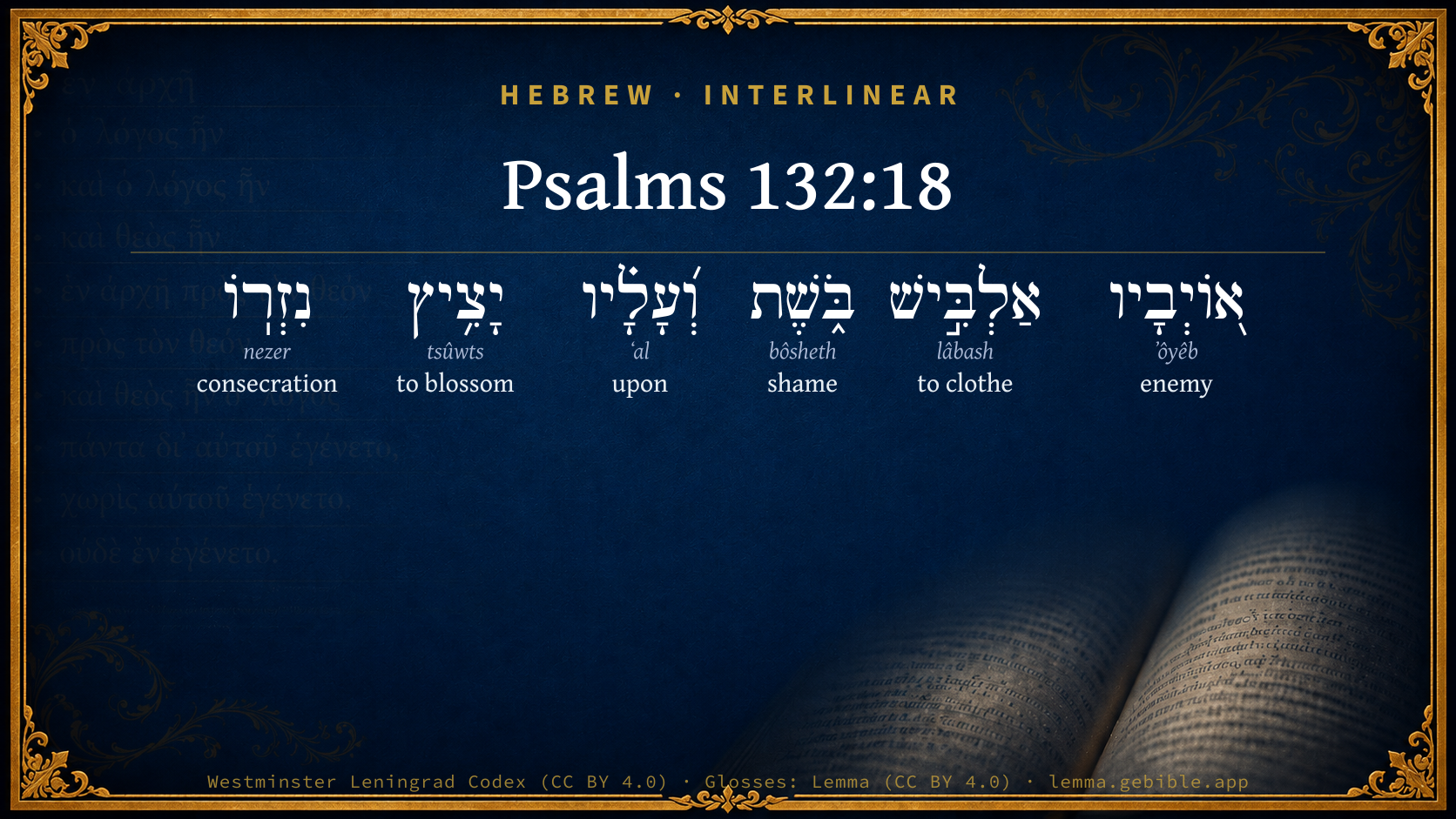
Psalms 132:18

Hebrew (Westminster Leningrad Codex) Psalms 132:18 appears in the Hebrew Old Testament. The text above is from the Westminster Leningrad Codex. Each word links to its Strong’s number, a concise gloss, and parsing drawn from the Open Scriptures Hebrew Bible morphology. Click any word for its full Brown-Driver-Briggs (BDB) entry.
Download image
Cite this verse

Psalms 132:18 (World English Bible). Public Domain. Lemma interlinear Bible study tool, https://lemma.gebible.app/v/psalms/132/18.

Show BibTeX & RIS
BibTeX
RIS
English Translation
I will clothe his enemies with shame, But on himself, his crown will be resplendant."
World English Bible · Public Domain
Download a study sheet

One document with this verse’s original text, its word-by-word gloss line, the meaning frame, cross-references with their text, attributed commentary, and full source and license credits — printable, and it pastes into notes with its structure intact.

This verse Autodidact and up

Study sheet (.html) Plain text (.txt)

A passage Seminary Student

Up to 50 verses in one chapter. A passage sheet keeps up to 6 commentary sources and 12 cross-references per verse, in the order this page ranks them, and says so on the sheet whenever that leaves anything out. Ask for a single verse and you get the Autodidact verse sheet above.

Everything on this page stays free to read, with no account — the sheet is a download of what is already on screen, not access to it.

Want to remove ads? Support Godless Engineer
Compare translations 3

The same verse in 3 English versions, stacked beneath the original-language interlinear above. Click any original word for its lexicon entry.

Each is an independent rendering of the whole verse — the interlinear is not word-aligned to these translations.

Highlighted words mark where these versions differ — a whole-verse word diff, not a word-by-word alignment.

  • World English Bible Public Domain
    I will clothe his enemies with shame, But on himself, his crown will be resplendant."
  • King James Version Public Domain
    His enemies will I clothe with shame: but upon himself shall his crown flourish.
  • unfoldingWord Literal Text CC BY-SA 4.0
    His enemies I will clothe shame, but upon him his crown will flourish.”

unfoldingWord Literal Text — © unfoldingWord, licensed CC BY-SA 4.0. Word-aligned USFM3 via Door43 (git.door43.org/unfoldingWord/en_ult).

Versions to compare (up to 4)

3 of 4 selected

Show all 17 translations

Every available English version of this verse, each an independent rendering of the whole verse.

  • World English Bible Public Domain
    I will clothe his enemies with shame, But on himself, his crown will be resplendant."
  • Berean Standard Bible Public Domain
    I will clothe his enemies with shame, but the crown upon him will gleam.”
  • Majority Standard Bible Public Domain
    I will clothe his enemies with shame, but the crown upon him will gleam.”
  • King James Version Public Domain
    His enemies will I clothe with shame: but upon himself shall his crown flourish.
  • American Standard Version (1901) Public Domain
    His enemies will I clothe with shame; But upon himself shall his crown flourish. Psalm 133 A Song of Ascents; of David.
  • Revised Version (1885) Public Domain
    His enemies will I clothe with shame: but upon himself shall his crown flourish.
  • Geneva Bible (1599) Public Domain
    His enemies will I clothe with shame, but on him his crowne shall florish.
  • Young's Literal Translation Public Domain
    His enemies I do clothe `with' shame, And upon him doth his crown flourish!
  • Literal Standard Version CC BY-SA 4.0
    I clothe His enemies [with] shame, || And His crown flourishes on Him!”
  • Unlocked Literal Bible CC BY-SA 4.0
    I will clothe his enemies with shame, but on him his crown will shine.”
  • unfoldingWord Literal Text CC BY-SA 4.0
    His enemies I will clothe shame, but upon him his crown will flourish.”
  • Darby Bible Public Domain
    His enemies will I clothe with shame; but upon himself shall his crown flourish.
  • World Messianic Bible Public Domain
    I will clothe his enemies with shame, but on himself, his crown will shine.”
  • Webster's Bible Public Domain
    His enemies will I clothe with shame: but upon himself shall his crown flourish.
  • Free Bible Version CC BY-SA 4.0
    I will humiliate his enemies, but the crown he wears will shine brightly.”
  • Bible in Basic English Public Domain
    His haters will be clothed with shame; but I will make his crown shining.
  • JPS Tanakh (1917) Public Domain
    His enemies will I clothe with shame; but upon himself shall his crown shine.'

Literal Standard Version (2020), Covenant Press — licensed CC BY-SA 4.0. Text via the HelloAO Bible API (eBible.org). Unlocked Literal Bible (unfoldingWord) — licensed CC BY-SA 4.0. Text via the HelloAO Bible API (eBible.org). unfoldingWord Literal Text — © unfoldingWord, licensed CC BY-SA 4.0. Word-aligned USFM3 via Door43 (git.door43.org/unfoldingWord/en_ult). Free Bible Version, Dr. Jonathan Gallagher — licensed CC BY-SA 4.0. Text via the HelloAO Bible API (eBible.org).

Word by word

More ways to search: Search by grammar → Find every occurrence → Compare this word →

Practice this passage: Drill this verse → Learn its vocabulary →

About this verse

These counts appear in no published source. They are computed here, from the morphology-tagged text and Lemma’s own curated glosses. What Lemma adds →

6
words
6
distinct lemmas
Wisdom
section

Notable vocabulary

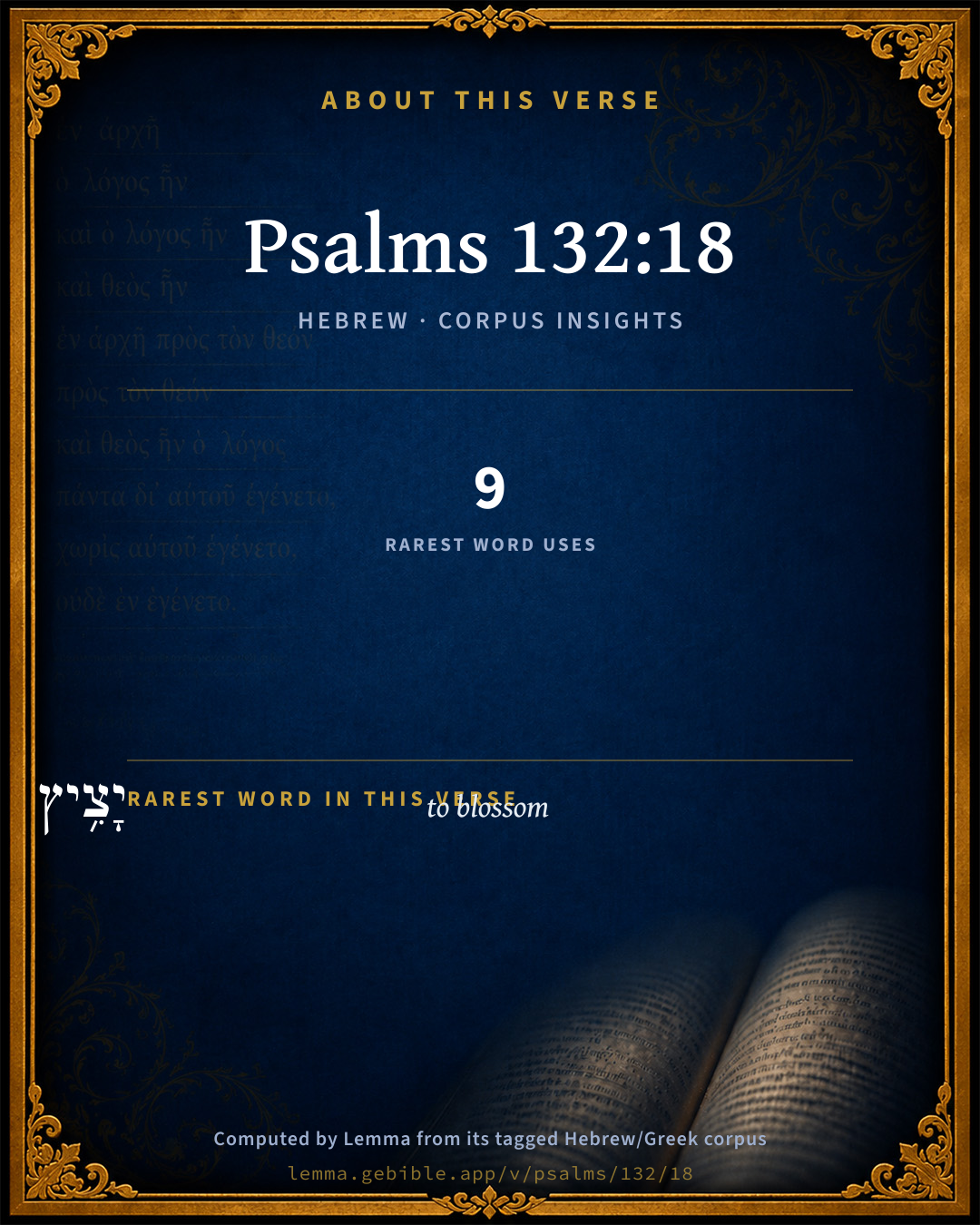
The rarest word here is יָצִ֥יץ to blossom H6692 — appearing just 9 times in the whole Hebrew Bible.

Shared distinctive vocabulary

יָצִ֥יץ to blossom H6692 occurs in 9 verses of the Hebrew Bible. Also found in:

Grammatical profile

  • 3 verbs
  • 2 nouns
  • 1 preposition

Verb forms

  • א֭וֹיְבָיו Qal · Participle Active
  • אַלְבִּ֣ישׁ Hiphil · Imperfect
  • יָצִ֥יץ Hiphil · Imperfect

Hebrew & Septuagint length

In English translation the verse runs 15 words from the Hebrew and 15 from the Septuagint (LXX English) — the same length.

A rough comparison of the two English renderings, which tokenize alike — not a word-level alignment.

Word counts can differ between the Hebrew and the Greek without any difference in meaning — e.g. the Hebrew direct-object marker אֵת has no separate Greek word, and Greek often adds the article ὁ.

Cross-references

12

Topical passages linked to Psalms 132:18 in the Treasury of Scripture Knowledge — connected by theme and wording, ordered by reader-vote popularity; previews shown in the World English Bible.

  • Psalms 35:26 Let them be disappointed and confounded together who rejoice at my calamity. Let them be clothed with shame and dishonor who magnify themselves against me.
  • Job 8:22 Those who hate you shall be clothed with shame. The tent of the wicked shall be no more."
  • Luke 1:32–33 He will be great, and will be called the Son of the Most High. The Lord God will give him the throne of his father, David,
  • Psalms 21:8–9 Your hand will find out all of your enemies. Your right hand will find out those who hate you.
  • Psalms 109:29 Let my adversaries be clothed with dishonor. Let them cover themselves with their own shame as with a robe.
  • Matthew 28:18 Jesus came to them and spoke to them, saying, "All authority has been given to me in heaven and on earth.
  • Psalms 72:8–11 He shall have dominion also from sea to sea, From the River to the ends of the earth.
  • Isaiah 58:10–12 and if you draw out your soul to the hungry, and satisfy the afflicted soul: then shall your light rise in darkness, and your obscurity be as the noonday;
  • Revelation 11:15 The seventh angel sounded, and great voices in heaven followed, saying, "The kingdom of the world has become the Kingdom of our Lord, and of his Christ. He will reign forever and ever!"
  • Isaiah 9:6–7 For to us a child is born, to us a son is given; and the government shall be on his shoulder: and his name shall be called Wonderful, Counselor, Mighty God, Everlasting Father, Prince of Peace.
  • Daniel 12:2 Many of those who sleep in the dust of the earth shall awake, some to everlasting life, and some to shame and everlasting contempt.
  • Revelation 17:14 These will war against the Lamb, and the Lamb will overcome them, for he is Lord of lords, and King of kings. They also will overcome who are with him, called and chosen and faithful."

Cross-references courtesy of OpenBible.info (CC BY 4.0).

Hebrew and Greek witnesses Masoretic Hebrew ↔ Greek Septuagint

The same verse in the two great witnesses to the Old Testament, shown verse-for-verse.

You’re reading Greek Psalm 131 (Hebrew Psalm 132). The Septuagint counts the superscription, so verse numbers can differ from the Hebrew — chapter-level alignment, not verse-by-verse. Numbering follows Rahlfs.

These are two independent witnesses, not word-aligned to each other, and the Septuagint is shown in lemma (dictionary) form.

Hebrew Psalms 132:18 Masoretic · Westminster Leningrad Codex

א֭וֹיְבָיו אַלְבִּ֣ישׁ בֹּ֑שֶׁת וְ֝עָלָ֗יו יָצִ֥יץ נִזְרֽוֹ

I will clothe his enemies with shame, But on himself, his crown will be resplendant."

World English Bible · Public Domain

Greek LXX Greek Psalm 131:18 Septuagint · lemma form

ὁ ἐχθρός αὐτός ἐνδύω αἰσχύνη ἐπί δέ αὐτός ἐκ ἀντιἵημι ὁ ἁγίασμα ἐγώ

His enemies will I clothe with a shame; but upon himself shall my holiness flourish.

LXX2012 (modern English Septuagint) · Public Domain

Hebrew: Westminster Leningrad Codex (CC BY 4.0). Greek: Septuagint (public domain); English from LXX2012 (modern English Septuagint) (Public Domain). How the Septuagint differs from the Hebrew →

Commentary

Notes on Psalms 132:18 from classic Christian and Jewish commentators (each source and its license shown beneath its notes). The classic Christian expositions comment on the surrounding passage and are grouped to its opening verse, so a note may address several verses; the Jewish commentaries on the Tanakh (Rashi and others) are per-verse, so they appear only where the commentator wrote on this verse.

Lemma curates 59 commentaries, every one of them public domain or Creative Commons licensed, each selected and text-cleaned for this edition rather than reprinted as found. About our sources →

Trapp's Complete Commentary

John Trapp

Psa 132:18 His enemies will I clothe with shame: but upon himself shall his crown flourish.

Ver. 18. His enemies will I clothe with shame] Shame shall be the promotion of all such fools as set against Christ and his people; yea, they shall be clothed with it; so that it shall be conspicuous to all men.

But upon himself shall his crown flourish] His royal diadem, whereby he is separated (Nezer) and distinguished from other men. Alexander dropped his diadem once into the water, and because he who fetched it out, put it on his own head while he swam out with it, he cut off his head. Our Edward IV hanged one for saying he would make his son owner of the crown; though he only meant his own house (having a crown for the sign) in Cheapside.

John Trapp, A Commentary or Exposition upon All the Books of the Old and New Testament (1647–1656) — public domain. Text from a community e-Sword module.

The Biblical Illustrator

Joseph S. Exell

Psa_132:18

His enemies will I clothe with shame: but upon Himself shall His crown flourish.

The Redeemers glory, and the confusion of His enemies

I. The confusion of His enemies. Tis an astonishing and melancholy fact that such a government should have enemies, but evidently it is so (Psa_2:1-12.). The opposition of Jews and Gentiles only a specimen of the opposition of human nature in all ages. Describe the enemies. In individuals--pride, unbelief, self-righteousness, inconsistency. The same enmity in the world on an extended scale; carnal policy, etc., arising from inveterate hatred of religion is too humbling and too holy. Christs enemies are clothed with shame when their machinations are detected. Ariel, etc. (Milton), Gehazi. When their own plans defeat themselves. Haman, Esther, Mordecai. The cross as peopling heaven. The stone, watch, seal at Christs tomb established the fact of His resurrection. Persecution drove out the disciples to spread the Gospel.

II. The prosperity of His reign. This consists in--

1. The settled and undisturbed title to His crown.

2. When His counsels are wise, and the laws of legislation are pure, salutary, and securing to the subject his liberties and immunities.

3. When His laws are administered in prudence, firmness, and integrity. He died for the ungodly; therefore He is just and the justifier of the ungodly.

4. When His realm consists of extensive empire, when other rulers are His subjects and willingly receive His laws into their administration.

5. When His subjects are happy and united.

III. The certainty of both. (Homilist.)

A flourishing crown

Look at Melvile when standing before King James. Danger threatened the Church of Christ in that kingdom, and upon the prosperity of the Church depended the stability of James throne. Melvile and others obtained a private audience of the king, and, among other points, Melvile reminded James of his duty to his Saviour. There are two kings in Scotland, said the Covenanter, King James and King Jesus, but King Jesus reigned hero before King James, and His authority is supreme. That bold and uncompromising speech carries us back in thought to another scene equally momentous and interesting. Paul, that bold champion of his Masters cause, standing in the midst of an infuriated crowd, fearlessly told them that while Caesar had his claims to sovereign power, there was another King, one Jesus, who had His claims also, but they were superior to Caesars claims. It is recorded of the first and the greatest of the Caesars that such were his capacious powers that he could at once keep six pens racing to his dictation on as many different subjects. That may be true; but Christ can attend to the affairs of the whole world at once! Crowns have always been highly valued. What schemes to obtain them! what bloodshed! what treachery! With what pomp and pride they have been and are still worn! No crown like this! (E. Digby.)

.

Psa_133:1-3

The Biblical Illustrator, edited by Joseph S. Exell (c. 1880s–1900s) — public domain. Text from a community e-Sword module.

J. A. Alexander on Psalms

Joseph Addison Alexander

18. (Psa 132:18) His enemies I will clothe with shame, and on him shall bloom his crown. The pronouns refer to David, as the Lord's Anointed, mentioned in Psa 132:17. The figure in the first clause is the converse or counterpart of that in Psa 132:9; Psa 132:16, and the same with that in Psa 35:26; Psa 109:29. With the last clause compare Psa 89:39. The verb to bloom or blossom agrees well with the idea of a wreath or chaplet. Compare with 1Pe 5:4. Some prefer, however, to retain what they regard as the original meaning of the Hebrew verb; on him shall his crown shine (or glitter). See above, on Psa 72:16.

Joseph Addison Alexander, The Psalms Translated and Explained (1850) — public domain. Text from a community e-Sword module.

Tyndale Open Study Notes

Tyndale Open Resources

132:18 The adversaries will be humiliated, in contrast to the glorious king (132:9, 16).

Tyndale Open Study Notes — © Tyndale Open Resources, licensed CC BY-SA 4.0. Text via the HelloAO Bible API.

Adam Clarke's Commentary

Verse 18. His enemies will I clothe with shame] Every opponent of the Christian cause shall be confounded.

But upon himself shall his crown flourish.] There shall be no end of the government of Christ's kingdom. From Ps 132:11-18, the spiritual David and his posterity are the subjects of which the Psalm treats.

ANALYSIS OF THE HUNDRED AND THIRTY-SECOND PSALM

This Psalm is divided into three parts: -

I. A petition, before which is David's care and vow to settle the ark, and with what reverence they would settle it in the temple; and he sets down the solemn prayer then used, Ps 132:1-10.

II. An explication of the promises made unto David for the continuance of his kingdom in his posterity, Ps 132:11-12, and God's love to his Church, Ps 132:13.

III. A prophecy, spoken in the person of God, for the stability of Christ's Church; and the blessings upon the people, the priests, and the house of David, Ps 132:14-18.

I. In all prayer a man must reflect upon God's promise; otherwise he cannot pray in faith.

1. "Lord, remember David:" Thy promises made to him. First he prays for the king; then for the ecclesiastics, Ps 132:8-9; then for the people, Ps 132:8.

2. "And all his afflictions:" Many he had before he was king; and one of the greatest was the settling of the ark.

Now this his ardent and sincere desire appears by his oath. And now, -

1. "How he sware unto the Lord," c.

2. The substance of which was, "Surely I will not come," &c.

Now this is hyperbolical for we must not conceive that he went not into his house or bed till he found out a place to build God's house. But see the note.

1. "I will not come into - my house:" So as to forget to build God's house.

2. "Nor go up into my bed:" Or let any thing make me forget the work.

3. "I will not give sleep," c.: But make provision for building the temple.

And here the prophet inserts two verses by way of gratitude.

First, he exults for the news of the ark: "Lo, we heard of it at Ephratah," &c.

By Ephratah some understand the land of Ephraim, in which the ark remained at Shiloh. Being afterwards sent home, it was found in the field of Joshua thence conveyed to the house of Amminadab, who dwelt in Kirjath-jearim, that signifies a woody city. Hence, David might well say, "And found it in the fields of the wood," c.

And the place for the ark being found, he calls on Israel, saying,

1. "We will go into his tabernacles." Now the ark is rested in Mount Zion.

2. "And we will worship," &c. Not make rash approaches to the ark, but come with reverence, and bow in his presence.

The ark being brought into the temple, he uses this solemn form: -

1. "Arise, O Lord," &c. He prays and invites him to dwell in his temple.

2. "Into thy rest." To pass no more from place to place.

3. "Thou, and the ark of thy strength." Show thy power and strength, as thou didst at Jordan, &c.

Before the ark in the temple he prays, -

1. "Let thy priests be clothed," &c. Inwardly, in heart and soul.

2. "Let thy saints shout," &c. With a cheerful voice, for the ark rests.

3. "For thy servant David's sake," &c. 1. David is not here to be taken absolutely for his person only, as having the covenants and promises made to him, but for the promise' sake. 2. "Turn not away," &c. Suffer me not to depart from thy presence unheard.

II. The prophet now proceeds to count up the promises made to David, which God confirmed by oath, in which we are to observe, 1. The manner of the promise: "The Lord hath sworn in truth," &c. It was merciful to promise but more so to bind himself by oath. 2. The matter of his oath expressed Ps 132:11-14.

1. For the seed of David, as respects Christ, is categorical and absolute: "Of the fruit of thy body," c. Which word St. Peter refers to Christ, Ac 2:30. According to the flesh he was David's seed for by the mother's side Christ was to be David's seed, not by the father's.

2. For the seed of David, as it relates to his posterity, the oath is hypothetical and conditional: "If thy children will keep," &c.

As the external kingdom was by this oath annexed to one family, so the external worship was assigned by it to one place.

1. "For the Lord hath chosen Zion," &c.

2. "This is my rest for ever." Zion was the seat of the sanctuary till the coming of the Messiah. But Zion was but a type of Christ's Church, which he hath chosen to be his rest for ever.

III. The prophet represents God as promising good things to his Church.

1. Such abundance of temporal things that the poor shall not want: "I will abundantly bless her provision," &c.

2. That her "priests shall be clothed with salvation," &c.

3. "There will I make the horn of David to flourish," &c. That is, the kingdom of the Messiah.

4. The fourth benefit God promises is the confusion of their enemies, and the eternal authority in this kingdom: "His enemies will I clothe with shame, but upon himself shall his crown flourish."

Adam Clarke's Commentary on the Bible (1810–1826) — public domain. Text from a community e-Sword/MySword module.

John Calvin's Commentaries

18. His enemies will I clothe with shame. The priests were said above “to be clothed with righteousness and salvation,” now the enemies of David are represented as “clothed with shame.” It is not enough that all go well within. God must keep us from the various harms and evils which come upon us from without, and hence we have this second promise added, which is one wherein we recognize often the goodness of God even more than in the blessings which he may shower upon us in the day of prosperity. The greater that fear which seizes upon us when exposed to aggression from enemies, the more are we sensibly awakened to take hold of divine help. The passage teaches us that the Church and people of God will never enjoy such peace on earth as altogether to escape being assaulted by the variety of enemies which Satan stirs up for their destruction. It is enough to have it declared, upon divine authority, that their attempts shall be unsuccessful, and that they will retire eventually with ignominy and disgrace. The, clause which follows has been variously interpreted. The verb which we have translated to flourish, in the Hiphil conjugation means sometimes to see, so that some have explained the words — In that place shall the crown of David be seen, when the horn shall have been made to bud. Some derive the word from ציף, tsits, a plate, as if it had been said that the crown of the king would be resplendent with plates of gold. But I consider that the crown is here said to flourish, just as formerly the allusion was to budding or germinating. Isaiah, on the other hand, speaks (Isaiah 28:5) of the crown of drunkenness of Ephraim as being a fading flower. Thus we have it here declared that however frail to appearance the crown of David might be in his posterity, it would be invigorated by some secret virtue, and flourish for ever.

John Calvin's Commentaries (1540-1563) — public domain. Text from the Calvin Translation Society English edition (1840s-50s) via the Christian Classics Ethereal Library (ccel.org). Calvin's coverage is partial (roughly two-thirds of the Bible); uncommented books and verses are honest gaps, never fabricated. The 19th-century editor's footnotes and remarks are omitted so the notes are faithfully Calvin's own voice.

Ellicott's Commentary for English Readers

(18) Crown (nezer).—As the distinctive use of this word in Israel—by its derivation meaning mark of separation—was for the golden plate, inscribed “Holiness to the Lord,” worn on the high priest’s mitre (see Exo_29:6; Exo_39:30), we cannot be wrong in seeing here a special allusion to the same. This allusion is rendered more probable by the use of the word rendered “flourish” (properly, shine), a cognate to which was the technical name given to this golden plate. (See the reference in Exodus 39, above.) It is also possibly alluded to in Psa_89:39, the only other place in the psalms where the word occurs, though as the word is used of the royal crown in 2Sa_1:10, &c, the allusion is not certain. But if the Maccabæan hypothesis is correct, the use of the word, instead of the more usual word for “crown,” is interesting. “One relic of the ancient insignia has been preserved, which was probably prized as the most precious of all. It was the golden plate affixed to the turban, inscribed ‘Holiness to Jehovah,’ which was believed to have come down from the time of Aaron, and which, treasured through all the vicissitudes of the Jewish state, was carried to Rome by Titus, and seen there by the great Jewish Rabbi, in the time of Hadrian” (Stanley, J. C. 3:353).

A Bible Commentary for English Readers, edited by Charles John Ellicott (1878–1897) — public domain. Text from a community e-Sword module.

The Cambridge Bible for Schools and Colleges

gen. ed. J. J. S. Perowne

18. will I clothe with shame] The opposite of salvation, Psa_132:16. Cp. Psa_35:26; Job_8:22.

upon himself] Upon David in the person of his representative, who is called David in Eze_34:23-24.

shall his crown flourish] The expression is a peculiar one. (1) The word for ‘crown’ (nçzer) used here as in Psa_89:39, means (a) ‘consecration,’ (b) ‘a crown’ or ‘diadem,’ as the mark of consecration to an office. It is used not only of a king’s crown, but of the high-priest’s diadem (Exo_29:6). (2) The verb yâtsîts, ‘flourish,’ or rather ‘sparkle,’ ‘glitter,’ is cognate to the word tsîts, which denotes the glittering plate of gold bearing the inscription “Holiness to Jehovah” which the High-priest wore on his turban, and which is called in Exo_29:30, “the plate of the holy diadem.” This phraseology seems intended to suggest that David’s representative will have high-priestly as well as royal dignity. Cp. Jer_30:21; Zec_6:11-13.

The Cambridge Bible for Schools and Colleges (gen. ed. J. J. S. Perowne; Cambridge University Press, 1878–1918) — public domain. Text from a community e-Sword module.

Albert Barnes' Notes on the Bible

His enemies will I clothe with shame - They shall be so confounded that shame shall seem to cover them as a garment. See the notes at Psa 109:29. That is, David would be triumphant.

But upon himself shall his crown flourish - His crown shall be as a fresh, blooming garland. The Hebrew word used here may mean either to glitter, or to flower, to fiourish or bloom. As applied to a crown, it may mean either that it would sparkle or glitter, as set with precious stones - or (under the idea of a garland) it may mean that it would appear to bloom or blossom. In either case it denotes success, joy, triumph - and is a promise of prosperity to David as a king. This was a part of the promise referred to by the psalmist, and a ground of the plea in the psalm. God had made these precious promises to David and his posterity; and now, in a time of sorrow and disaster, when the glory of the crown seemed about to pass away, the psalmist, in the name of the people, and in language to be used by the people, prays that those ancient promises might be remembered and fulfilled. So, in a time of general religious declension, we may plead the promises, so rich and so abundant, which God has made to his church, as a reason for his gracious interposition, for his coming to revive his work.

Albert Barnes' Notes on the Bible (1834–1885) — public domain. Text from a community e-Sword/MySword module.

Matthew Poole's English Annotations

Clothe with shame; for the shameful and unexpected disappointment of all their vain hopes and wicked designs.

Upon himself; upon him and his posterity, which are nothing else but a man’s self multiplied.

Matthew Poole's English Annotations on the Holy Bible (1683–1685) — public domain. Text from a community e-Sword/MySword module.

The Treasury of David

Charles H. Spurgeon

Ver. 18. His enemies will I clothe with shame. They shall be utterly defeated, they shall loathe their evil design, they shall be despised for having hated the Ever Blessed One. Their shame they will be unable to hide, it shall cover them: God will array them in it for ever, and it shall be their convict dress to all eternity. But upon himself shall his crown flourish. Green shall be his laurels of victory. He shall win and wear the crown of honour, and his inherited diadem shall increase in splendour. Is it not so to this hour with Jesus? His kingdom cannot fail, his imperial glories cannot fade. It is himself that we delight to honour; it is to himself that the honour comes, and upon himself that it flourishes. If others snatch at his crown their traitorous aims are defeated; but he in his own person reigns with ever growing splendour.

"Crown him, crown him,

Crowns become the victor's brow."

Ver. 18. His enemies will I clothe with shame. That is, shame shall so inseparably cover them, that as wheresoever a man goeth, he carrieth his clothes with him; so wheresoever they go they shall carry their shame with them. And that which is strangest of all, they which are ashamed use to clothe or cover their shame, and then think themselves well enough; but David's enemies shall be so ashamed, that even the very covering of their shame shall be a discovering of it; and the clothing or cloaking of their ignominy shall be nothing else but a girding of it more closely and more inseparably unto them. Thomas Playfere.

Ver. 18. Upon himself shall the crown flourish. This idea seems to be taken from the nature of the ancient crowns bestowed upon conquerors. From the earliest periods of history, the laurel, olive, ivy, etc., furnished crowns to adorn the heads of heroes, who had conquered in the field of battle, gained the prize in the race, or performed some other important service to the public. These were the dear bought rewards of the most heroic exploits of antiquity. This sets the propriety of the phrase in full view. The idea of a crown of gold and jewels flourishing, is at least unnatural; whereas, flourishing is natural to laurels, oaks, etc. These were put upon the heads of the victors ill full verdure, and their merit seemed to make them flourish on their heads, in fresher green. The literal crown which Jesus wore was also of the vegetable kind, and the thorn of sorrow never flourished in such rigour as on his head. Now he has got the crown of life, which shall not fade away, like the perishing verdure of the crowns of other heroes. It shall flourish for ever, with all the rigour of immortality, and bring forth all the olive fruits of peace for his people. Its branches shall spread, and furnish crowns for all the victors in the spiritual warfare. Alexander Pirie, 1804.

Ver. 18.

1. His enemies clothed.

a) Who are they? The openly profane. The moral but irreligious. The self righteous. The hypocritical.

b) How clothed with shame? In repentance, in disappointment, in remorse, in destruction. Sin detected. Self defeated. Hopes scattered.

c) Who clothes them The Lord. He will shame them thoroughly.

2. Himself crowned.

a) His crown: his dominion and glory.

b) Its flourishing. Glory extending. Subjects increasing. Wealth growing. Foes fearing, etc.

Ver. 18. (last clause). The Lord Jesus himself the source, sustenance, and centre of the prosperity of his kingdom.

In "The Works of John Boys", 1626, folio, pp. 821-5, there is an Exposition of Psalm 132. This is a poor and lean performance.

Charles H. Spurgeon's The Treasury of David (1869–1885) — public domain. Psalms only. Text from a community e-Sword/MySword module.

Whedon's Commentary on the Bible

Daniel D. Whedon

18. Clothe with shame—Contrasted with the clothing of the priests. Psa_132:16.

Upon himself—A clear indication that David was living at the writing of this psalm, and consequently that it was not written after the exile, as some suppose; for after that period no literal heir of David ever sat upon his throne. But the language in any case is highly spiritual and Messianic.

Shall his crown flourish—His crown shall put forth blossoms, as the original denotes. This brings forward the figure of Psa_132:17 : his horn shall “bud.” Perpetual life, vigour, and beauty shall adorn his reign.

Daniel D. Whedon (gen. ed.), Commentary on the Old and New Testaments (1874–1909) — public domain. Text from a community e-Sword module.

The Pulpit Commentary

His enemies will I clothe with shame. David"s "enemies" are those who oppress his "Seed," and will not have him to reign over them. All such will be "confounded and put to shame", (Psa_35:4) "clothed with shame and dishonor". (Psa_35:26) But upon himself shall his crown flourish. The true and the final Davidic representative is Christ, who "remaineth a King forever". (Psa_29:10) On him his crown will ever flourish.

The shame of Christ"s enemies and the glory of his crown.

That part of the Old Testament history to which this psalm refers is in all probability the dedication of the temple which Solomon had built. Part of it forms the conclusion of the prayer which Solomon offered on that occasion (cf. vers. 8-10 and 2Ch_6:41, 2Ch_6:42). And the whole of it is appropriate to that event. Its first portion expresses the earnest anxiety of God"s people for his presence amongst them, and the second recounts those facts and promises on which their faith that God would come amongst them rested. David had been full of concern about the building of the house of the Lord. It was a real distress to him until he had found a place, etc. (ver. 5). And all his conduct had been in keeping with this holy desire. Now, this the psalmist prays the Lord to remember. And what an example such holy anxiety is to us all when we are seeking the presence of the Lord in our midst! Such holy longing after himself God will never disappoint. The latter part of the psalm proves this, and our text is the closing promise of a series, all of which assure the people of God that Christ shall live and reign and triumph in their midst. So, then, let us consider

I THE SHAME OF CHRIST"S ENEMIES.

1. It is strange that he should have any enemies, so good and gracious as he was.

2. But some of these enemies do not think themselves to be such. Those that are openly and flagrantly against Christ all can recognize; but there are a number of others who, though not with Christ, would protest against being regarded as his enemies. But such protest will not avail. To be not with Christ is to be against him his enemy.

3. And for his enemies there awaits open shame. They shall be clothed with it.

(1) There will be the shame of defeat. They cannot, shall not, have their way. The Church they would despoil the Lord will keep.

(2) And of contempt. For think what it is they oppose; not some tyrannous oppression, but a just, holy, and most beneficent rule. And how inexcusable such opposition, for God"s Word was all against them, and the testimony of the best and wisest of men, and conscience, when suffered to speak, condemned them! but, nevertheless, they persisted in their sin and folly. What but the shame of contempt can come to them? What else should come?

(3) And of the profound moral condemnation of all the good. For these opponents of Christ have violated all their better nature, have incurred the guilt of deep ingratitude, and have wrought widespread evil; they have dragged down with them many precious souls, and they have done foul dishonor to God. May he keep us from all such shame!

II THE GLORIES OF THE SAVIOR"S CROWN. "Upon himself," etc. None of us are capable of adequately speaking of these glories, but we are able to see some of the sources whence these glories spring. As:

1. From the nature of Christs rule. It is supreme, universal, eternal, attained at vast cost and in infinite wisdom, righteousness, and love.

2. From the universal and glad response which it shall receive. "His saints shall shout aloud for joy." His rule is their delight.

3. From the results of his rule. See the numbers of his subjects, their happy condition, their spotless purity. These are some of the results of our Savior"s rule.

CONCLUSION. In which shall you and I share in these glories, or in the shame with which his enemies shall be clothed? One or the other it must be. Before God let us settle this question. S.C.

The Pulpit Commentary (1880–1919), ed. H.D.M. Spence-Jones & Joseph S. Exell — public domain. Text from a community e-Sword module.

Rashi

Rabbi Shlomo Yitzchaki (Rashi)

will shine Heb. יציץ, which shine, like (Ezek. 1:7): “and they sparkled (ונצצים) like the color of burnished copper.”

Rashi on the Tanakh — English translations: “The Judaica Press complete Tanach with Rashi, translated by A. J. Rosenberg” (CC BY 4.0); “Pentateuch with Rashi's commentary by M. Rosenbaum and A.M. Silbermann, 1929-1934” (public domain); “The Metsudah Tanach series, Lakewood, N.J” (CC BY 4.0); and “The Book of Joshua, Metsudah Publications, 1997” (CC BY 4.0). Text via Sefaria.

Lesson kit

Teaching starters — assembled from the data on this page, not authored interpretation. Every prompt links to the verse data it draws on. Edit before teaching.

Psalms, in the Wisdom, opens this verse with 6 words (6 distinct Hebrew lemmas). Its most distinctive word is tsûwts (“to blossom”). A historical commentator’s framing appears above. Read the whole chapter for the surrounding context.

Discussion questions

  1. The word tsûwts carries the sense “to blossom.” How does it shape the verse?
  2. How does Numbers 17:8, which shares the word «to blossom», read alongside this verse?
  3. These translations render this verse differently. What is at stake in choosing one wording over another?
  4. «א֭וֹיְבָיו» is a Qal Participle Active verb. How does that grammatical form shape the action described?
  5. Compare how Trapp's Complete Commentary and The Biblical Illustrator read this verse. Where do they agree or differ?

Things to notice

Reading settings

Reading text

Shown beneath each verse's original-language words.

Old Testament
Old Testament edition

Read the OT as the Masoretic Hebrew (MT) or the Greek Septuagint (LXX).

English shown for the Greek Septuagint (in the Hebrew ↔ Greek comparison).

Comparing translations? Open the Compare panel on any verse page to stack up to four side by side.