

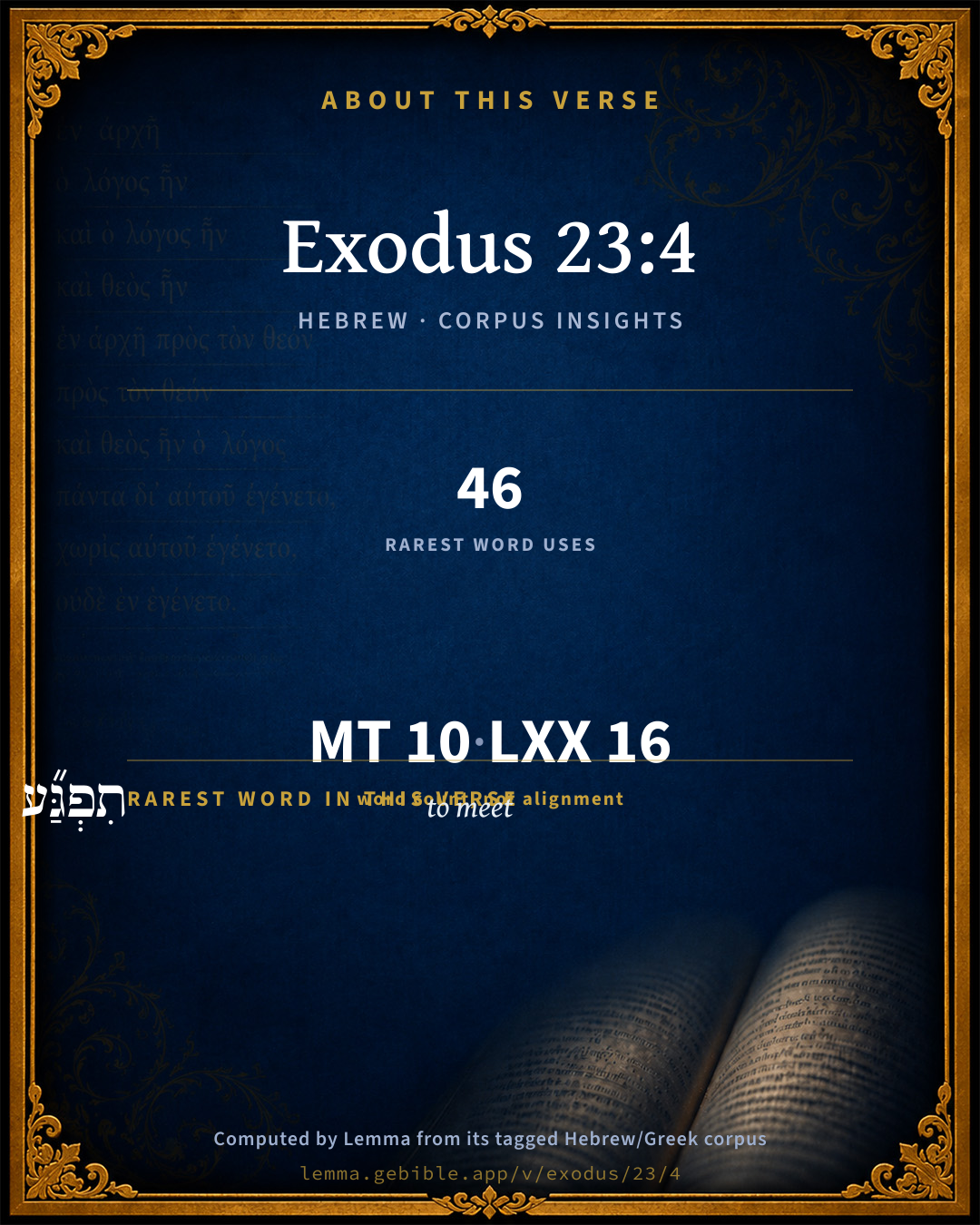
Exodus 23:4

Hebrew (Westminster Leningrad Codex) Exodus 23:4 appears in the Hebrew Old Testament. The text above is from the Westminster Leningrad Codex. Each word links to its Strong’s number, a concise gloss, and parsing drawn from the Open Scriptures Hebrew Bible morphology. Click any word for its full Brown-Driver-Briggs (BDB) entry.
Download image
Cite this verse

Exodus 23:4 (World English Bible). Public Domain. Lemma interlinear Bible study tool, https://lemma.gebible.app/v/exodus/23/4.

Show BibTeX & RIS
BibTeX
RIS
English Translation
"If you meet your enemy's ox or his donkey going astray, you shall surely bring it back to him again.
World English Bible · Public Domain
Download a study sheet

One document with this verse’s original text, its word-by-word gloss line, the meaning frame, cross-references with their text, attributed commentary, and full source and license credits — printable, and it pastes into notes with its structure intact.

This verse Autodidact and up

Study sheet (.html) Plain text (.txt)

A passage Seminary Student

Up to 50 verses in one chapter. A passage sheet keeps up to 6 commentary sources and 12 cross-references per verse, in the order this page ranks them, and says so on the sheet whenever that leaves anything out. Ask for a single verse and you get the Autodidact verse sheet above.

Everything on this page stays free to read, with no account — the sheet is a download of what is already on screen, not access to it.

Want to remove ads? Support Godless Engineer
Compare translations 3

The same verse in 3 English versions, stacked beneath the original-language interlinear above. Click any original word for its lexicon entry.

Each is an independent rendering of the whole verse — the interlinear is not word-aligned to these translations.

Highlighted words mark where these versions differ — a whole-verse word diff, not a word-by-word alignment.

  • World English Bible Public Domain
    "If you meet your enemy's ox or his donkey going astray, you shall surely bring it back to him again.
  • King James Version Public Domain
    If thou meet thine enemy's ox or his ass going astray, thou shalt surely bring it back to him again.
  • unfoldingWord Literal Text CC BY-SA 4.0
    If you meet the ox of your enemy or his donkey going astray, you shall certainly bring it back to him.

unfoldingWord Literal Text — © unfoldingWord, licensed CC BY-SA 4.0. Word-aligned USFM3 via Door43 (git.door43.org/unfoldingWord/en_ult).

Versions to compare (up to 4)

3 of 4 selected

Show all 18 translations

Every available English version of this verse, each an independent rendering of the whole verse.

  • World English Bible Public Domain
    "If you meet your enemy's ox or his donkey going astray, you shall surely bring it back to him again.
  • Berean Standard Bible Public Domain
    If you encounter your enemy’s stray ox or donkey, you must return it to him.
  • Majority Standard Bible Public Domain
    If you encounter your enemy’s stray ox or donkey, you must return it to him.
  • King James Version Public Domain
    If thou meet thine enemy's ox or his ass going astray, thou shalt surely bring it back to him again.
  • American Standard Version (1901) Public Domain
    If thou meet thine enemy's ox or his ass going astray, thou shalt surely bring it back to him again.
  • Revised Version (1885) Public Domain
    If thou meet thine enemy’s ox or his ass going astray, thou shalt surely bring it back to him again.
  • Geneva Bible (1599) Public Domain
    If thou meete thine enemies oxe, or his asse going astray, thou shalt bring him to him againe.
  • Douay-Rheims (1899) Public Domain
    If thou meet thy enemy's ox or ass going astray, bring it back to him.
  • Young's Literal Translation Public Domain
    `When thou meetest thine enemy's ox or his ass going astray, thou dost certainly turn it back to him;
  • Literal Standard Version CC BY-SA 4.0
    When you meet your enemy’s ox or his donkey going astray, you certainly turn it back to him;
  • Unlocked Literal Bible CC BY-SA 4.0
    If you meet your enemy's ox or his donkey going astray, you must bring it back to him.
  • unfoldingWord Literal Text CC BY-SA 4.0
    If you meet the ox of your enemy or his donkey going astray, you shall certainly bring it back to him.
  • Darby Bible Public Domain
    -- If thou meet thine enemy's ox or his ass going astray, thou shalt certainly bring it back to him.
  • World Messianic Bible Public Domain
    “If you meet your enemy’s ox or his donkey going astray, you shall surely bring it back to him again.
  • Webster's Bible Public Domain
    If thou shalt meet thy enemy's ox or his ass going astray, thou shalt surely bring it back to him again.
  • Free Bible Version CC BY-SA 4.0
    If you come across your enemy's ox or donkey that has wandered off, take it back to him.
  • Bible in Basic English Public Domain
    If you come across the ox or the ass of one who is no friend to you wandering from its way, you are to take it back to him.
  • JPS Tanakh (1917) Public Domain
    If thou meet thine enemy's ox or his ass going astray, thou shalt surely bring it back to him again.

Literal Standard Version (2020), Covenant Press — licensed CC BY-SA 4.0. Text via the HelloAO Bible API (eBible.org). Unlocked Literal Bible (unfoldingWord) — licensed CC BY-SA 4.0. Text via the HelloAO Bible API (eBible.org). unfoldingWord Literal Text — © unfoldingWord, licensed CC BY-SA 4.0. Word-aligned USFM3 via Door43 (git.door43.org/unfoldingWord/en_ult). Free Bible Version, Dr. Jonathan Gallagher — licensed CC BY-SA 4.0. Text via the HelloAO Bible API (eBible.org).

Word by word

More ways to search: Search by grammar → Find every occurrence → Compare this word →

Practice this passage: Drill this verse → Learn its vocabulary →

תִפְגַּ֞ע
pâgaʻ
H6293
“to meet”
Verb, Qal, Imperfect, 2nd Person, Masculine, Singular
Part of Speech
Verb
Stem
Qal
Form
Imperfect
Person
2nd Person
Gender
Masculine
Number
Singular
Full BDB Definition

Origin: a primitive root

TWOT: 1731

to encounter, meet, reach, entreat, make intercession - (Qal) - to meet, light upon, join - to meet (of kindness) - to encounter, fall upon (of hostility) - to encounter, entreat (of request) - to strike, touch (of boundary) - (Hiphil) - to cause to light upon - to cause to entreat - to make entreaty, interpose - to make attack - to reach the mark
  1. כִּ֣י kîy H3588 “that” Conjunction
  2. שׁ֧וֹר shôwr H7794 “ox of” Noun, Common, Masculine, Singular, Construct
  3. אֹֽיִבְךָ֛ ʼôyêb H341 “enemy · you” Verb, Qal, Participle Active, Masculine, Singular, Construct + Suffix, Personal, 2nd Person, Masculine, Singular
  4. א֥וֹ ʼôw H176 “or” Conjunction
  5. חֲמֹר֖וֹ chămôwr H2543 “donkey · his” Noun, Common, Both, Singular, Construct + Suffix, Personal, 3rd Person, Masculine, Singular
  6. תֹּעֶ֑ה tâʻâh H8582 “going astray” Verb, Qal, Participle Active, Masculine, Singular, Absolute
  7. הָשֵׁ֥ב shûwb H7725 “to return” Verb, Hiphil, Infinitive Absolute
  8. תְּשִׁיבֶ֖נּוּ shûwb H7725 “to return · him” Verb, Hiphil, Imperfect, 2nd Person, Masculine, Singular + Suffix, Personal, 3rd Person, Masculine, Singular

About this verse

These counts appear in no published source. They are computed here, from the morphology-tagged text and Lemma’s own curated glosses. What Lemma adds →

10
words
8
distinct lemmas
Pentateuch
section

Shared distinctive vocabulary

תִפְגַּ֞ע to meet H6293 occurs in 43 verses of the Hebrew Bible. Also found in:

Grammatical profile

  • 5 verbs
  • 2 nouns
  • 1 preposition
  • 2 conjunctions

Verb forms

  • תִפְגַּ֞ע Qal · Imperfect
  • אֹֽיִבְךָ֛ Qal · Participle Active
  • תֹּעֶ֑ה Qal · Participle Active
  • הָשֵׁ֥ב Hiphil · Infinitive Absolute
  • תְּשִׁיבֶ֖נּוּ Hiphil · Imperfect

Repetition

A word recurs within this verse — often emphatic in Hebrew:

  • הָשֵׁ֥ב to return H7725 ×2

Hebrew & Septuagint length

In English translation the verse runs 20 words from the Hebrew and 22 from the Septuagint (LXX English) — closely comparable.

A rough comparison of the two English renderings, which tokenize alike — not a word-level alignment.

Word counts can differ between the Hebrew and the Greek without any difference in meaning — e.g. the Hebrew direct-object marker אֵת has no separate Greek word, and Greek often adds the article ὁ.

In the original languages it is 10 Hebrew tokens and 16 Greek tokens — but the two are counted differently (Hebrew bundles its prefixes and suffixes into one token; the Greek is in lemma form), so that isn’t a like-for-like length.

Cross-references

8

Topical passages linked to Exodus 23:4 in the Treasury of Scripture Knowledge — connected by theme and wording, ordered by reader-vote popularity; previews shown in the World English Bible.

  • Deuteronomy 22:1–4 You shall not see your brother's ox or his sheep go astray, and hide yourself from them: you shall surely bring them again to your brother.
  • 1 Thessalonians 5:15 See that no one returns evil for evil to anyone, but always follow after that which is good, for one another, and for all.
  • Matthew 5:44 But I tell you, love your enemies, bless those who curse you, do good to those who hate you, and pray for those who mistreat you and persecute you,
  • Proverbs 25:21 If your enemy is hungry, give him food to eat; If he is thirsty, give him water to drink:
  • Luke 6:27–28 "But I tell you who hear: love your enemies, do good to those who hate you,
  • Romans 12:17–21 Repay no one evil for evil. Respect what is honorable in the sight of all men.
  • Job 31:29–30 "If I have rejoiced at the destruction of him who hated me, Or lifted up myself when evil found him;
  • Proverbs 24:17–18 Don't rejoice when your enemy falls. Don't let your heart be glad when he is overthrown;

Cross-references courtesy of OpenBible.info (CC BY 4.0).

Hebrew and Greek witnesses Masoretic Hebrew ↔ Greek Septuagint

The same verse in the two great witnesses to the Old Testament, shown verse-for-verse.

These are two independent witnesses, not word-aligned to each other, and the Septuagint is shown in lemma (dictionary) form.

Hebrew Exodus 23:4 Masoretic · Westminster Leningrad Codex

כִּ֣י תִפְגַּ֞ע שׁ֧וֹר אֹֽיִבְךָ֛ א֥וֹ חֲמֹר֖וֹ תֹּעֶ֑ה הָשֵׁ֥ב תְּשִׁיבֶ֖נּוּ לֽוֹ

"If you meet your enemy's ox or his donkey going astray, you shall surely bring it back to him again.

World English Bible · Public Domain

Greek LXX Exodus 23:4 Septuagint · lemma form

ἐάν δέ συνἀντάω ὁ βοῦς ὁ ἐχθρός σύ ἤ ὁ ὑποζύγιον αὐτός πλανάω ἀποστρέφω ἀποδίδωμι αὐτός

And if you meet your enemy's ox or his ass going astray, you shall turn them back and restore them to him.

LXX2012 (modern English Septuagint) · Public Domain

Hebrew: Westminster Leningrad Codex (CC BY 4.0). Greek: Septuagint (public domain); English from LXX2012 (modern English Septuagint) (Public Domain). How the Septuagint differs from the Hebrew →

Targum (Aramaic paraphrase)

2

The Targum is the ancient Jewish Aramaic paraphrase of the Hebrew Scriptures — an interpretive translation, not the Hebrew text itself. Onkelos (literal) and Pseudo-Jonathan (expansive) render the Torah, and Jonathan the Prophets. Coverage is partial: where no permissively-licensed English translation exists for a verse, only the Aramaic is shown. This is verse-level text, not a word-by-word alignment to the Hebrew.

  1. Targum Onkelos Torah (Genesis–Deuteronomy)
    אֲרֵי תִפְגַע תּוֹרָא דְסָנְאָךְ אוֹ חֲמָרֵהּ דְטָּעֵי אָתָבָא תְּתִיבִנֵהּ לֵהּ:

    (no public-domain English translation for this verse)

    Targum Onkelos — Aramaic: “Onkelos Genesis” (public domain); “Onkelos Exodus” (public domain); “Onkelos Leviticus” (public domain); “Onkelos Numbers” (public domain); “Onkelos Deuteronomy” (public domain). English: “Sefaria Community Translation” (CC0 1.0 (public-domain dedication)); “J.W. Etheridge. The Targums of Onkelos and Jonathan Ben Uzziel on the Pentateuch. London: Longmans, Green, 1862” (public domain). Text via Sefaria.

  2. Targum Pseudo-Jonathan Torah (Genesis–Deuteronomy)
    אִין תֶּאֱרַע תּוֹרָא דְסַנְאָךְ דְּאַתְּ סָנֵי לֵיהּ עַל חוֹבָתָא דְאַנְתְּ יְדַע בֵּיהּ בִּלְחוֹדָךְ אוֹ חַמְרָא דְטָעֵי מִן אָרְחָא אָתָבָא תִתְבִינֵיהּ לֵיהּ

    If thou meet the ox of thine enemy whom thou dislikest on account of the wickedness which thou only knowest is in him, or an ass that wandereth from the way, thou shalt surely bring it to him.

    Targum Pseudo-Jonathan — Aramaic: “Targum Jonathan on Genesis” (public domain); “Targum Jonathan on Exodus” (public domain); “Targum Jonathan on Leviticus” (public domain); “Targum Jonathan on Numbers” (public domain); “Targum Jonathan on Deuteronomy” (public domain). English: “The Targum of Jonathan ben Uzziel, trans. J. W. Etheridge, London, 1862” (public domain). Text via Sefaria.

Commentary

Notes on Exodus 23:4 from classic Christian and Jewish commentators (each source and its license shown beneath its notes). The classic Christian expositions comment on the surrounding passage and are grouped to its opening verse, so a note may address several verses; the Jewish commentaries on the Tanakh (Rashi and others) are per-verse, so they appear only where the commentator wrote on this verse.

Lemma curates 59 commentaries, every one of them public domain or Creative Commons licensed, each selected and text-cleaned for this edition rather than reprinted as found. About our sources →

Trapp's Complete Commentary

John Trapp

Exo 23:4 If thou meet thine enemy’s ox or his ass going astray, thou shalt surely bring it back to him again.

Ver. 4. Ox or his ass going astray.] How much more his soul. {See Trapp on "Jas 5:20"} {See Trapp on "Jdg 1:22"} {See Trapp on "Jdg 1:23"}

John Trapp, A Commentary or Exposition upon All the Books of the Old and New Testament (1647–1656) — public domain. Text from a community e-Sword module.

The Biblical Illustrator

Joseph S. Exell

Exo_23:4-5

Thine enemys ox.

On duties to enemies

I. That duties to enemies are enjoined (Pro_24:17; 1Th_5:15).

1. It is our duty to protect the interests of our enemy.

(1) If they are damaged, we should endeavour to retrieve them.

(2) If they are in danger of damage, we should endeavour to prevent them (Jam_5:19-20).

2. It is our duty to help the difficulties of our enemy.

(1) His mind may be in difficulties.

(2) His soul may be in difficulties.

(3) His material interests may be in difficulties.

II. That duties to enemies are difficult: and wouldest forbear to help him.

1. Such duties are against the grain of human nature.

2. Such duties are apparently against self-interest.

3. Such duties require self-denials and sacrifices.

III. That duties to enemies are rewarded (Pro_25:21-22; Mat_5:44-45; Rom_12:20).

IV. That neglect of duties to enemies is punished (Job_31:29; Pro_24:18). In conclusion--

1. Our text applies to all enmity, whether polemical, political, or national.

2. Its precepts should be obeyed, because we may be in the wrong and our enemy in the right.

3. Because God has Himself set us the sublime example. When we were enemies, we were reconciled by the death of His Son. (J. W. Burn.)

Neighbourly conduct

The horse of a pious man living in Massachusetts, North America, happening to stray into the road, a neighbour of the man who owned the horse put him into the pound. Meeting the owner soon after, he told him what he had done; And if I catch him in the road again, said he, Ill do it again. Neighbour, replied the other, not long since I looked out of my window in the night and saw your cattle in my meadow, and I drove them out and shut them in your yard; and Ill do it again. Struck with the reply, the man liberated the horse from the pound, and paid the charges himself. A soft answer turneth away wrath.

A humane disposition

In one of my temperance pilgrimages through Illinois I met a gentleman who was the companion of a dreary ride which Mr. Lincoln made in a light waggon, going the rounds of a circuit court where he had clients to look after. The weather was rainy, the road heavy with mud. Lincoln enlivened the way with anecdotes and recital, for few indeed were the incidents that relieved the tedium of the trip. At last, in wallowing through a slough, they came upon a poor hog, which was literally fast in the mud. The lawyers commented on the poor creatures pitiful condition and drove on. About half a mile was laboriously gone over, when Lincoln suddenly exclaimed, I dont know how you feel about it, but Ive got to go back and pull that pig out of the slough. His comrade laughed, thinking it merely a joke; but what was his surprise when Lincoln dismounted, left him to his reflections, and striding slowly back, like a man on stilts picking his way as his long walking implements permitted, he grappled with the drowning swine, dragged him out of the ditch, left him on its edge to recover his strength, slowly measured off the distance back to his waggon, and the two men drove on as if nothing had happened. The grand and brotherly nature which could not consent to see the lowest of animals suffer without coming to its rescue at great personal discomfort was nurtured by years of self-abnegation for the great struggle, when he should be strong enough to put a shoulder to the wheel, that should lift the chariot of State out of the mire and set a subject race upon its feet. (Frances E. Willard.)

The Biblical Illustrator, edited by Joseph S. Exell (c. 1880s–1900s) — public domain. Text from a community e-Sword module.

Joseph Benson's Commentary

Exo 23:4. Thou shalt surely bring it back to him — So far shalt thou be from revenging his injuries, that thou shalt render good to him for them, whereby if thou dost not reconcile him, thou wilt at least procure peace to thyself, and an honour to religion.

Joseph Benson's Commentary on the Old and New Testaments (1811–1818) — public domain. Text from a community e-Sword module.

Geneva Bible (1599)

Geneva Bible translators

If we be bound to do good to our enemy’s beast, much more to our enemy himself, Matt. 5:44.

Geneva Bible (1599) marginal notes — public domain. Text via Bolls.life.

Adam Clarke's Commentary

Verse 4. If thou meet thine enemy's ox - going astray] From the humane and heavenly maxim in this and the following verse, our blessed Lord has formed the following precept: "Love your enemies, bless them that curse you, do good to them that hate you, and pray for them which despitefully use you and persecute you;" Mt 5:44. A precept so plain, wise, benevolent, and useful, can receive no other comment than that which its influence on the heart of a kind and merciful man produces in his life.

Adam Clarke's Commentary on the Bible (1810–1826) — public domain. Text from a community e-Sword/MySword module.

Ellicott's Commentary for English Readers

(4) Thine enemy’s ox.—The general duty of stopping stray animals and restoring them to friendly owners, expressly taught in Deu_22:1-3, is here implied as if admitted on all hands. The legislator extends this duty to cases where the owner is our personal enemy. It was not generally recognised in antiquity that men’s enemies had any claims upon them. Cicero, indeed, says—“Sunt autem quædam officia etiam adversus eos servanda, a quibus injuriam aceeperis” (De Off. i. 11); but he stops short of enjoining active benevolence. Here and in Exo_23:5 we have a sort of anticipation of Christianity—active kindness to an enemy being required, even when it costs us some trouble. The principle of friendliness is involved—the germ which in Christianity blossoms out into the precept, “Love your enemies.”

A Bible Commentary for English Readers, edited by Charles John Ellicott (1878–1897) — public domain. Text from a community e-Sword module.

The Cambridge Bible for Schools and Colleges

gen. ed. J. J. S. Perowne

4. thine enemy’s ox] that such a service would be rendered to a friend, is taken for granted. In Dt. the comprehensive term ‘brother,’ i.e. fellow-countryman, is employed, in accordance with the prevalent usage of that book (cf. Deu_15:2-3; Deu_15:7; Deu_15:9; Deu_15:11-12; Deu_17:15 al.).

4, 5. An enemy’s beast to be preserved from harm. These two injunctions breathe a spirit unusual in the OT. (cf., however, Lev_19:17-18), and reminding one of Mat_5:44. They are repeated in Deu_22:1-4, in an expanded form, accommodating them to the spirit and point of view of Deuteronomy. They can hardly be here in their original place; for they evidently interrupt the connexion between vv. 1–3 and vv. 6–9: they would follow better after Exo_22:24 or 27.

The Cambridge Bible for Schools and Colleges (gen. ed. J. J. S. Perowne; Cambridge University Press, 1878–1918) — public domain. Text from a community e-Sword module.

John Gill's Exposition

If thou meet thine enemy's ox or his ass going astray,.... Or any other beast, as the Samaritan version adds; for these are only mentioned for instances, as being more common, and creatures subject to go astray; now when such as these are met going astray, so as to be in danger of being lost to the owner, though he is an enemy; or as the Targum of Jonathan,"whom thou hatest because of a sin, which thou alone knowest in him;''yet this was not so far to prejudice the finder of his beasts against him, as to be careless about them, to suffer them to go on without acquainting him with them, or returning them to him, as follows:

thou shalt surely bring it back to him again; whether it be an ox, or an ass, or any other beast, the law is very strong and binding upon the finder to return it to his neighbour, though an enemy, and bring it either to his field or to his farm.

John Gill's Exposition of the Whole Bible (1746–1763) — public domain (CC PDM 1.0). Text via the HelloAO Bible API.

Albert Barnes' Notes on the Bible

So far was the spirit of the law from encouraging personal revenge that it would not allow a man to neglect an opportunity of saving his enemy from loss.

Exo 23:5

The sense appears to be: “If thou see the ass of thine enemy lying down under his burden, thou shalt forbear to pass by him; thou shalt help him in loosening the girths of the ass.”

Albert Barnes' Notes on the Bible (1834–1885) — public domain. Text from a community e-Sword/MySword module.

Matthew Poole's English Annotations

So far shalt thou be from revenging his injuries, that thou shalt render good to him for them, whereby if thou dost not reconcile him, thou wilt procure peace to thyself, and honour to religion.

Matthew Poole's English Annotations on the Holy Bible (1683–1685) — public domain. Text from a community e-Sword/MySword module.

Whedon's Commentary on the Bible

Daniel D. Whedon

4, 5. Enemy’s ox… bring it back — This statute embodies the essence of our Lord’s command to “do good to them that hate you,” (Mat_5:44,) and furnishes a most admirable illustration of it.

Daniel D. Whedon (gen. ed.), Commentary on the Old and New Testaments (1874–1909) — public domain. Text from a community e-Sword module.

The Pulpit Commentary

Thine enemy"s ox. A private enemy is here spoken of, not a public one, as in Deu_23:6. It is remarkable that the law should have so far anticipated Christianity as to have laid it down that men have duties of friendliness even towards their enemies, and are bound under certain circumstances to render them a service. "Hate thine enemies" (Mat_5:43) was no injunction of the Mosaic taw, but a conclusion which Rabbinical teachers unwarrantably drew from it. Christianity, however, goes far beyond Mosaism in laying down the broad precept your enemies."

The Pulpit Commentary (1880–1919), ed. H.D.M. Spence-Jones & Joseph S. Exell — public domain. Text from a community e-Sword module.

unfoldingWord translationNotes

Door43 World Missions Community

General Information:

Yahweh continues telling Moses his laws for the people of Israel.

translationWords

cow

donkey

astray

unfoldingWord translationNotes — © Distant Shores Media and the Door43 World Missions Community, licensed CC BY-SA 4.0. Source: git.door43.org/Door43/en_tn.

Lesson kit

Teaching starters — assembled from the data on this page, not authored interpretation. Every prompt links to the verse data it draws on. Edit before teaching.

Exodus, in the Pentateuch, opens this verse with 10 words (8 distinct Hebrew lemmas). Its most distinctive word is pâgaʻ (“to meet”). A historical commentator’s framing appears above. Read the whole chapter for the surrounding context.

Discussion questions

  1. How does “to meet” (pâgaʻ) shape what this verse is saying?
  2. How does Genesis 23:8, which shares the word «to meet», read alongside this verse?
  3. What does the repetition of “to return” (2× in this one verse) do in this verse?
  4. These translations render this verse differently. What is at stake in choosing one wording over another?
  5. «תִפְגַּ֞ע» is a Qal Imperfect verb. How does that grammatical form shape the action described?
  6. Compare how Trapp's Complete Commentary and The Biblical Illustrator read this verse. Where do they agree or differ?

Things to notice

Reading settings

Reading text

Shown beneath each verse's original-language words.

Old Testament
Old Testament edition

Read the OT as the Masoretic Hebrew (MT) or the Greek Septuagint (LXX).

English shown for the Greek Septuagint (in the Hebrew ↔ Greek comparison).

Comparing translations? Open the Compare panel on any verse page to stack up to four side by side.