
Deuteronomy 23:14

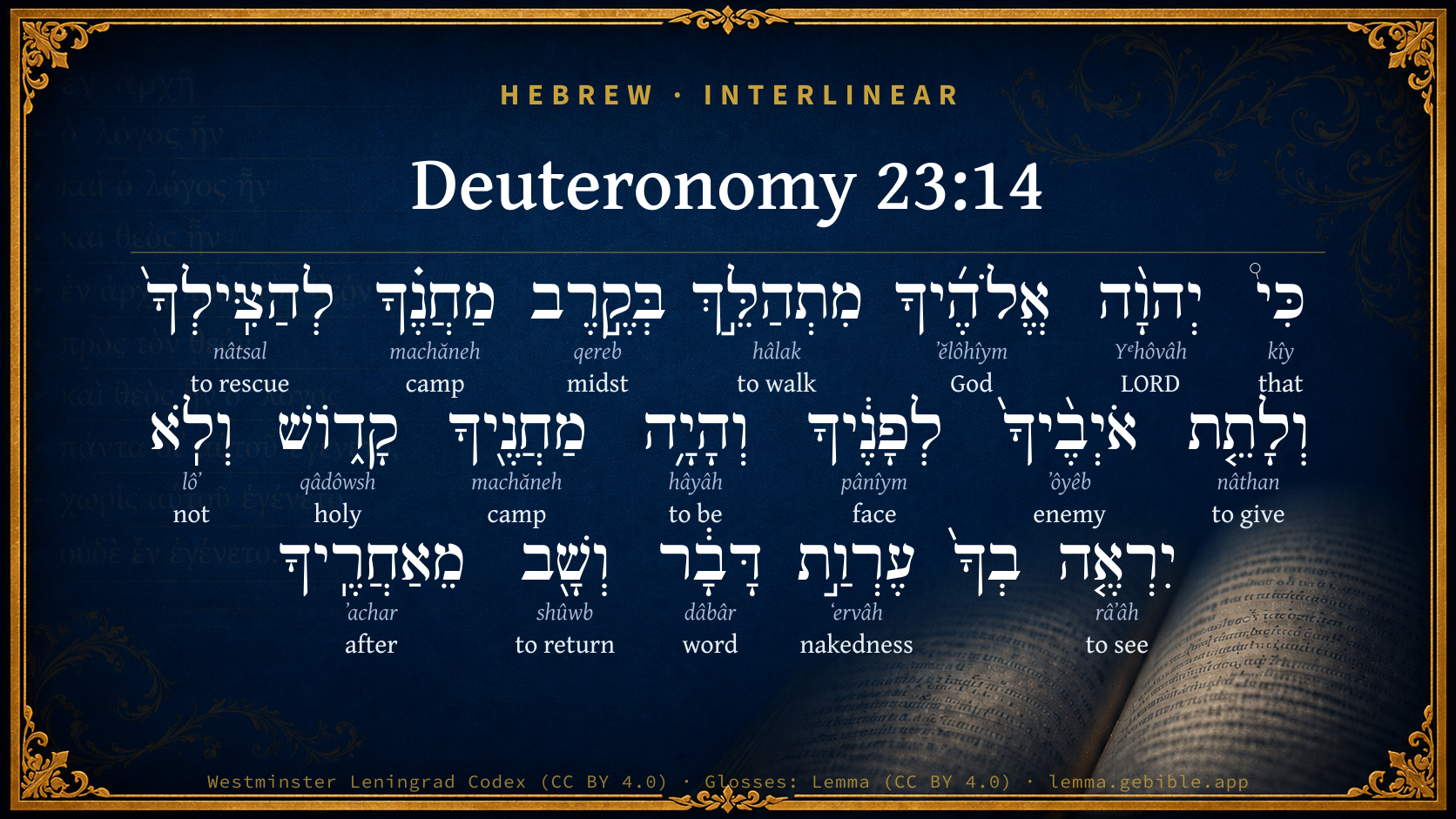
Hebrew (Westminster Leningrad Codex) Deuteronomy 23:14 appears in the Hebrew Old Testament. The text above is from the Westminster Leningrad Codex. Each word links to its Strong’s number, a concise gloss, and parsing drawn from the Open Scriptures Hebrew Bible morphology. Click any word for its full Brown-Driver-Briggs (BDB) entry.
Download image
Cite this verse

Deuteronomy 23:14 (World English Bible). Public Domain. Lemma interlinear Bible study tool, https://lemma.gebible.app/v/deuteronomy/23/14.

Show BibTeX & RIS
BibTeX
RIS
English Translation
for Yahweh your God walks in the midst of your camp, to deliver you, and to give up your enemies before you; therefore shall your camp be holy, that he may not see an unclean thing in you, and turn away from you.
World English Bible · Public Domain
Download a study sheet

One document with this verse’s original text, its word-by-word gloss line, the meaning frame, cross-references with their text, attributed commentary, and full source and license credits — printable, and it pastes into notes with its structure intact.

This verse Autodidact and up

Study sheet (.html) Plain text (.txt)

A passage Seminary Student

Up to 50 verses in one chapter. A passage sheet keeps up to 6 commentary sources and 12 cross-references per verse, in the order this page ranks them, and says so on the sheet whenever that leaves anything out. Ask for a single verse and you get the Autodidact verse sheet above.

Everything on this page stays free to read, with no account — the sheet is a download of what is already on screen, not access to it.

Want to remove ads? Support Godless Engineer
Compare translations 3

The same verse in 3 English versions, stacked beneath the original-language interlinear above. Click any original word for its lexicon entry.

Each is an independent rendering of the whole verse — the interlinear is not word-aligned to these translations.

Highlighted words mark where these versions differ — a whole-verse word diff, not a word-by-word alignment.

  • World English Bible Public Domain
    for Yahweh your God walks in the midst of your camp, to deliver you, and to give up your enemies before you; therefore shall your camp be holy, that he may not see an unclean thing in you, and turn away from you.
  • King James Version Public Domain
    For the LORD thy God walketh in the midst of thy camp, to deliver thee, and to give up thine enemies before thee; therefore shall thy camp be holy: that he see no unclean thing in thee, and turn away from thee.
  • unfoldingWord Literal Text CC BY-SA 4.0
    For Yahweh your God walks in the midst of your camp to give you victory and to give your enemies to your faces. And your camp shall be holy, and he will not see an unclean thing among you and turn away from you.

unfoldingWord Literal Text — © unfoldingWord, licensed CC BY-SA 4.0. Word-aligned USFM3 via Door43 (git.door43.org/unfoldingWord/en_ult).

Versions to compare (up to 4)

3 of 4 selected

Show all 18 translations

Every available English version of this verse, each an independent rendering of the whole verse.

  • World English Bible Public Domain
    for Yahweh your God walks in the midst of your camp, to deliver you, and to give up your enemies before you; therefore shall your camp be holy, that he may not see an unclean thing in you, and turn away from you.
  • Berean Standard Bible Public Domain
    For the LORD your God walks throughout your camp to protect you and deliver your enemies to you. Your camp must be holy, lest He see anything unclean among you and turn away from you.
  • Majority Standard Bible Public Domain
    For the LORD your God walks throughout your camp to protect you and deliver your enemies to you. Your camp must be holy, lest He see anything unclean among you and turn away from you.
  • King James Version Public Domain
    For the LORD thy God walketh in the midst of thy camp, to deliver thee, and to give up thine enemies before thee; therefore shall thy camp be holy: that he see no unclean thing in thee, and turn away from thee.
  • American Standard Version (1901) Public Domain
    for Jehovah thy God walketh in the midst of thy camp, to deliver thee, and to give up thine enemies before thee; therefore shall thy camp be holy, that he may not see an unclean thing in thee, and turn away from thee.
  • Revised Version (1885) Public Domain
    for the LORD thy God walketh in the midst of thy camp, to deliver thee, and to give up thine enemies before thee; therefore shall thy camp be holy: that he see no unclean thing in thee, and turn away from thee.
  • Geneva Bible (1599) Public Domain
    For the Lord thy God walketh in the mids of thy campe to deliuer thee, and to giue thee thine enemies before thee: therefore thine hoste shalbe holy, that he see no filthie thing in thee and turne away from thee.
  • Douay-Rheims (1899) Public Domain
    That which thou art eased of: (for the Lord thy God walketh in the midst of thy camp, to deliver thee, and to give up thy enemies to thee:) and let thy camp be holy, and let no uncleanness appear therein, lest he go away from thee.
  • Young's Literal Translation Public Domain
    for Jehovah thy God is walking up and down in the midst of thy camp, to deliver thee, and to give thine enemies before thee, and thy camp hath been holy, and He doth not see in thee the nakedness of anything, and hath turned back from after thee.
  • Literal Standard Version CC BY-SA 4.0
    For your God YHWH is walking up and down in the midst of your camp, to deliver you and to give your enemies before you, and your camp has been holy, and He does not see the nakedness of anything in you, and has turned back from after you.
  • Unlocked Literal Bible CC BY-SA 4.0
    For Yahweh your God walks in the midst of your camp to give you victory and to give your enemies into your hand. Therefore your camp must be holy, so that he may not see any unclean thing among you and turn away from you.
  • unfoldingWord Literal Text CC BY-SA 4.0
    For Yahweh your God walks in the midst of your camp to give you victory and to give your enemies to your faces. And your camp shall be holy, and he will not see an unclean thing among you and turn away from you.
  • Darby Bible Public Domain
    For Jehovah thy God walketh in the midst of thy camp, to deliver thee, and to give up thine enemies before thee; and thy camp shall be holy, that he see nothing unseemly with thee, and turn away from thee.
  • World Messianic Bible Public Domain
    for the LORD your God walks in the middle of your camp, to deliver you, and to give up your enemies before you. Therefore your camp shall be holy, that he may not see an unclean thing in you, and turn away from you.
  • Webster's Bible Public Domain
    For the LORD thy God walketh in the midst of thy camp, to deliver thee, and to give up thy enemies before thee; therefore shall thy camp be holy: that he may see no unclean thing in thee, and turn away from thee.
  • Free Bible Version CC BY-SA 4.0
    The Lord your God is present with you in your camp to keep you safe and to defeat your enemies. Your camp must be kept holy, because if he sees anything unclean among you, he will leave you.
  • Bible in Basic English Public Domain
    For the Lord your God is walking among your tents, to keep you safe and to give up into your hands those who are fighting against you; then let your tents be holy, so that he may see no unclean thing among you, and be turned away from you.
  • JPS Tanakh (1917) Public Domain
    (23-15) For the LORD thy God walketh in the midst of thy camp, to deliver thee, and to give up thine enemies before thee; therefore shall thy camp be holy; that He see no unseemly thing in thee, and turn away from thee.

Literal Standard Version (2020), Covenant Press — licensed CC BY-SA 4.0. Text via the HelloAO Bible API (eBible.org). Unlocked Literal Bible (unfoldingWord) — licensed CC BY-SA 4.0. Text via the HelloAO Bible API (eBible.org). unfoldingWord Literal Text — © unfoldingWord, licensed CC BY-SA 4.0. Word-aligned USFM3 via Door43 (git.door43.org/unfoldingWord/en_ult). Free Bible Version, Dr. Jonathan Gallagher — licensed CC BY-SA 4.0. Text via the HelloAO Bible API (eBible.org).

Word by word

More ways to search: Search by grammar → Find every occurrence → Compare this word →

Practice this passage: Drill this verse → Learn its vocabulary →

עֶרְוַ֣ת
ʻervâh
H6172
“nakedness of”
Noun, Common, Feminine, Singular, Construct
Part of Speech
Noun
Type
Common
Gender
Feminine
Number
Singular
State
Construct
Full BDB Definition

Origin: from H6168

TWOT: 1692b

nakedness, nudity, shame, pudenda - pudenda (implying shameful exposure) - nakedness of a thing, indecency, improper behaviour - exposed, undefended (figuratively)
  1. כִּי֩ kîy H3588 “that” Conjunction
  2. יְהוָ֨ה Yᵉhôvâh H3068 “LORD” Noun, Proper
  3. אֱלֹהֶ֜יךָ ʼĕlôhîym H430 “God(s) · your” Noun, Common, Masculine, Plural, Construct + Suffix, Personal, 2nd Person, Masculine, Singular
  4. מִתְהַלֵּ֣ךְ hâlak H1980 “walking” Verb, Hithpael, Participle Active, Masculine, Singular, Absolute
  5. בְּקֶ֣רֶב qereb H7130 “in/at · midst of” Preposition + Noun, Common, Masculine, Singular, Construct
  6. מַחֲנֶ֗ךָ machăneh H4264 “camp · your” Noun, Common, Both, Singular, Construct + Suffix, Personal, 2nd Person, Masculine, Singular
  7. לְהַצִּֽילְךָ֙ nâtsal H5337 “to rescue · you” Preposition + Verb, Hiphil, Infinitive Construct + Suffix, Personal, 2nd Person, Masculine, Singular
  8. וְלָתֵ֤ת nâthan H5414 “and · to give” Conjunction + Preposition + Verb, Qal, Infinitive Construct
  9. אֹיְבֶ֨יךָ֙ ʼôyêb H341 “enemy · you” Verb, Qal, Participle Active, Masculine, Plural, Construct + Suffix, Personal, 2nd Person, Masculine, Singular
  10. לְפָנֶ֔יךָ pânîym H6440 “to/for · face(s) · your” Preposition + Noun, Common, Both, Plural, Construct + Suffix, Personal, 2nd Person, Masculine, Singular
  11. וְהָיָ֥ה hâyâh H1961 “and · to be” Conjunction + Verb, Qal, Sequential Perfect, 3rd Person, Masculine, Singular
  12. מַחֲנֶ֖יךָ machăneh H4264 “camps · your” Noun, Common, Both, Plural, Construct + Suffix, Personal, 2nd Person, Masculine, Singular
  13. קָד֑וֹשׁ qâdôwsh H6918 “holy” Adjective, Adjective, Masculine, Singular, Absolute
  14. וְלֹֽא lôʼ H3808 “and · not” Conjunction + Particle, Negative
  15. יִרְאֶ֤ה râʼâh H7200 “to see” Verb, Qal, Imperfect, 3rd Person, Masculine, Singular
  16. דָּבָ֔ר dâbâr H1697 “word” Noun, Common, Masculine, Singular, Absolute
  17. וְשָׁ֖ב shûwb H7725 “and · to return” Conjunction + Verb, Qal, Sequential Perfect, 3rd Person, Masculine, Singular
  18. מֵאַחֲרֶֽיךָ ʼachar H310 “from · after · you” Preposition + Preposition + Suffix, Personal, 2nd Person, Masculine, Singular

About this verse

These counts appear in no published source. They are computed here, from the morphology-tagged text and Lemma’s own curated glosses. What Lemma adds →

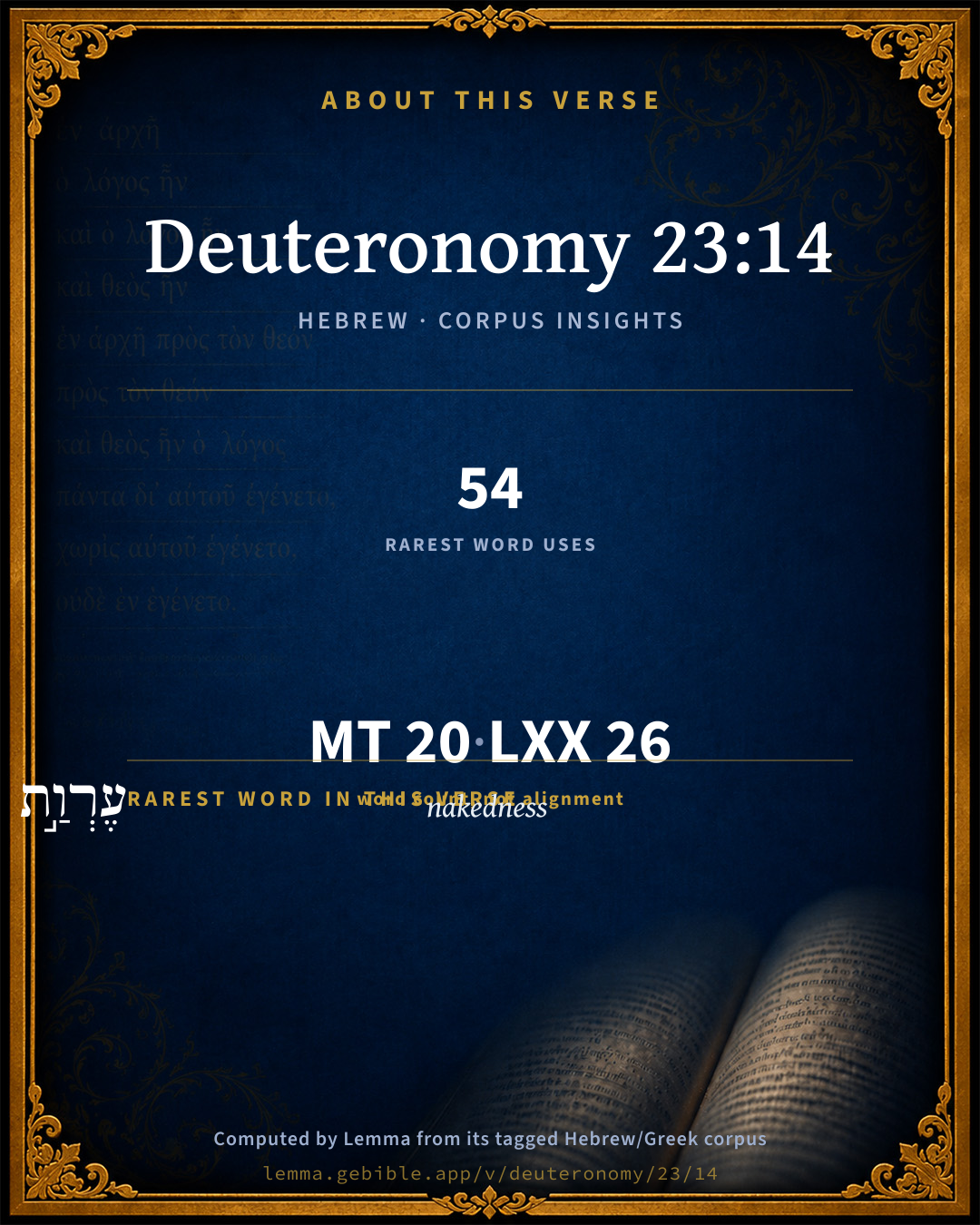
20
words
18
distinct lemmas
Pentateuch
section

Shared distinctive vocabulary

עֶרְוַ֣ת nakedness H6172 occurs in 40 verses of the Hebrew Bible. Also found in:

Grammatical profile

  • 7 verbs
  • 8 nouns
  • 1 adjective
  • 2 prepositions
  • 1 conjunction
  • 1 particle

Verb forms

  • מִתְהַלֵּ֣ךְ Hithpael · Participle Active
  • לְהַצִּֽילְךָ֙ Hiphil · Infinitive Construct
  • וְלָתֵ֤ת Qal · Infinitive Construct
  • אֹיְבֶ֨יךָ֙ Qal · Participle Active
  • וְהָיָ֥ה Qal · Sequential Perfect
  • יִרְאֶ֤ה Qal · Imperfect
  • וְשָׁ֖ב Qal · Sequential Perfect

Repetition

A word recurs within this verse — often emphatic in Hebrew:

  • מַחֲנֶ֗ךָ camp H4264 ×2

Hebrew & Septuagint length

In English translation the verse runs 43 words from the Hebrew and 45 from the Septuagint (LXX English) — closely comparable.

A rough comparison of the two English renderings, which tokenize alike — not a word-level alignment.

Word counts can differ between the Hebrew and the Greek without any difference in meaning — e.g. the Hebrew direct-object marker אֵת has no separate Greek word, and Greek often adds the article ὁ.

In the original languages it is 20 Hebrew tokens and 26 Greek tokens — but the two are counted differently (Hebrew bundles its prefixes and suffixes into one token; the Greek is in lemma form), so that isn’t a like-for-like length.

Cross-references

4

Topical passages linked to Deuteronomy 23:14 in the Treasury of Scripture Knowledge — connected by theme and wording, ordered by reader-vote popularity; previews shown in the World English Bible.

  • Genesis 17:1 When Abram was ninety-nine years old, Yahweh appeared to Abram, and said to him, "I am God Almighty. Walk before me, and be blameless.
  • Leviticus 26:12 I will walk among you, and will be your God, and you will be my people.
  • 2 Corinthians 6:16 What agreement has a temple of God with idols? For you are a temple of the living God. Even as God said, "I will dwell in them, and walk in them; and I will be their God, and they will be my people."
  • Exodus 3:5 He said, "Don't come close. Take off your sandals from off your feet, for the place you are standing on is holy ground."

Cross-references courtesy of OpenBible.info (CC BY 4.0).

Hebrew and Greek witnesses Masoretic Hebrew ↔ Greek Septuagint

The same verse in the two great witnesses to the Old Testament, shown verse-for-verse.

These are two independent witnesses, not word-aligned to each other, and the Septuagint is shown in lemma (dictionary) form.

Hebrew Deuteronomy 23:14 Masoretic · Westminster Leningrad Codex

כִּי֩ יְהוָ֨ה אֱלֹהֶ֜יךָ מִתְהַלֵּ֣ךְ בְּקֶ֣רֶב מַחֲנֶ֗ךָ לְהַצִּֽילְךָ֙ וְלָתֵ֤ת אֹיְבֶ֨יךָ֙ לְפָנֶ֔יךָ וְהָיָ֥ה מַחֲנֶ֖יךָ קָד֑וֹשׁ וְלֹֽא יִרְאֶ֤ה בְךָ֙ עֶרְוַ֣ת דָּבָ֔ר וְשָׁ֖ב מֵאַחֲרֶֽיךָ

for Yahweh your God walks in the midst of your camp, to deliver you, and to give up your enemies before you; therefore shall your camp be holy, that he may not see an unclean thing in you, and turn away from you.

World English Bible · Public Domain

Greek LXX Deuteronomy 23:14 Septuagint · lemma form

καί πάσσαλος εἰμί σύ ἐπί ὁ ζωνή σύ καί εἰμί ὅταν δια καταἱζάνω ἔξω καί ὀρύσσω ἐν αὐτός καί ἐπιἄγω καλύπτω ὁ ἀσχημοσύνη σύ ἐν αὐτός

Because the Lord your God walks in your camp to deliver you, and to give up your enemy before your face; and your camp shall be holy, and there shall not appear in you a disgraceful thing, and so he shall turn away from you.

LXX2012 (modern English Septuagint) · Public Domain

Hebrew: Westminster Leningrad Codex (CC BY 4.0). Greek: Septuagint (public domain); English from LXX2012 (modern English Septuagint) (Public Domain). How the Septuagint differs from the Hebrew →

Targum (Aramaic paraphrase)

2

The Targum is the ancient Jewish Aramaic paraphrase of the Hebrew Scriptures — an interpretive translation, not the Hebrew text itself. Onkelos (literal) and Pseudo-Jonathan (expansive) render the Torah, and Jonathan the Prophets. Coverage is partial: where no permissively-licensed English translation exists for a verse, only the Aramaic is shown. This is verse-level text, not a word-by-word alignment to the Hebrew.

  1. Targum Onkelos Torah (Genesis–Deuteronomy)
    וְסִכְּתָא תְּהֵי לָךְ עַל זֵינָךְ וִיהֵי בְּמִיתְבָךְ לְבָרָא וְתַחְפַּר בַּהּ וּתְתוּב וּתְכַסֵי יָת מִפְּקָתָךְ

    (no public-domain English translation for this verse)

    Targum Onkelos — Aramaic: “Onkelos Genesis” (public domain); “Onkelos Exodus” (public domain); “Onkelos Leviticus” (public domain); “Onkelos Numbers” (public domain); “Onkelos Deuteronomy” (public domain). English: “Sefaria Community Translation” (CC0 1.0 (public-domain dedication)); “J.W. Etheridge. The Targums of Onkelos and Jonathan Ben Uzziel on the Pentateuch. London: Longmans, Green, 1862” (public domain). Text via Sefaria.

  2. Targum Pseudo-Jonathan Torah (Genesis–Deuteronomy)
    וְסִיכָא תֶהֱוֵי קְבִיעָא לְכוֹן עַל מָנֵי זֵינֵיכוֹן אֲתַר דְּתִסְרוּן סְיָיפֵיכוֹן וִיהֵי בְּמִתְבָךְ לְבָרָא וְתֶהֱוֵי חָפַר בָּהּ וְתִפְנֵי תַמָּן וּתְתוּב וּתְכַס יַת רַעֲיָיךְ

    and insert a blade with your weapon in the place oil which you bind your swords, and in thy sitting without thou shalt dig with it, and do what thou needest there, and turn and cover it.

    Targum Pseudo-Jonathan — Aramaic: “Targum Jonathan on Genesis” (public domain); “Targum Jonathan on Exodus” (public domain); “Targum Jonathan on Leviticus” (public domain); “Targum Jonathan on Numbers” (public domain); “Targum Jonathan on Deuteronomy” (public domain). English: “The Targum of Jonathan ben Uzziel, trans. J. W. Etheridge, London, 1862” (public domain). Text via Sefaria.

Commentary

Notes on Deuteronomy 23:14 from classic Christian and Jewish commentators (each source and its license shown beneath its notes). The classic Christian expositions comment on the surrounding passage and are grouped to its opening verse, so a note may address several verses; the Jewish commentaries on the Tanakh (Rashi and others) are per-verse, so they appear only where the commentator wrote on this verse.

Lemma curates 59 commentaries, every one of them public domain or Creative Commons licensed, each selected and text-cleaned for this edition rather than reprinted as found. About our sources →

The Biblical Illustrator

Joseph S. Exell

Deu_23:14

The Lord thy God walketh in the midst of thy camp.

Camp law and camp life

I. An instructive comparison. The Church of God is in many respects comparable to a camp.

1. It is a camp for separation. We are crusaders, and are separated from the mass for the service of the Cross which we bear on our hearts. We are in an enemys country, and we must keep ourselves to ourselves very much, or else we shall certainly fail of that holy military discipline which the Captain of our salvation would have us strictly enforce.

2. It is a camp, because it is on the defensive.

3. It is a camp, especially, because it is always assailing the powers of darkness. We have a world to conquer, and we cannot afford to loiter. We have a kingdom to set up for the Lord of hosts, and we must not sleep, for the adversaries of the Lord are ruing. We are an army, sworn to war against the Canaanites of error and sin, to cast down their walled cities, to break their idols, and to cut down their groves.

4. It is a camp, because we are on the march. We ought to be advancing in grace, in knowledge, in earnestness, in holiness, in usefulness, and if not we scarcely realise the figure of a camp.

5. Yet, once more, no doubt, a camp, as formed for temporary purposes, was a token of the Church; for although the Church stands still and abides, yet in her individual members she is subject to the same law of decay, and death, and change as the rest of the world. Soon shall the camp cease, and the soldiers become citizens, and the tents be exchanged for mansions.

II. A special privilege.

1. God is present in the camp of His people with a special presence of love. The Church is the garden of the Lord, His paradise. Where is a father most at home but with his children?

2. God is present in the camp of His people with a special presence of observation. He sees all things; but His eyes are, in the first place, fixed on His Church. With burning glance He searches the very heart of professors.

3. The peculiar privilege of Israel is to have a special presence of salvation. The Lord thy God walketh in the midst of thy camp to deliver thee. God is with His people, to help them in their times of trouble, to rescue them out of danger, to answer their cries in their necessity, to save them in the hour of temptation.

4. The Lord is with the camp of His people, as a special presence for victory.

5. It is a special presence in covenant. The Lord thy God.

III. A corresponding conduct.

1. This rule, that the camp be holy, applies to the commonest places wherein we are found. The Holy Spirit arrays you in the white raiment of holiness, that you may shine out bright and clear and distinct before the sons of men.

2. While this holiness pertained to their commonest things, it was also ordered that every unclean thing was to be put from them. Let us come continually to the washing place--even to the fountain opened. Let us beseech the cleansing Spirit to operate as with fire, and burn His purifying way through and through our souls.

3. Note well the fearful warning which is added. If there be in the camp an unclean thing tolerated and delighted in, and He see it--if it becomes conspicuous and grievous to Him, then the worst consequences will follow--Lest He turn away from thee. Oh! what would happen to us if the Lord were to turn away from us as a Church? (C. H. Spurgeon.)

The Biblical Illustrator, edited by Joseph S. Exell (c. 1880s–1900s) — public domain. Text from a community e-Sword module.

Tyndale Open Study Notes

Tyndale Open Resources

23:14 shameful thing (literally nakedness of a thing): Because the camp of God’s army was holy, it was necessary that nakedness, especially of the genitalia, not be exposed within the camp (cp. Gen 2:25; 3:7-11; 9:21-23; Exod 20:26; Isa 47:3; Rev 3:18).

Tyndale Open Study Notes — © Tyndale Open Resources, licensed CC BY-SA 4.0. Text via the HelloAO Bible API.

John Gill's Exposition

For the Lord thy God walketh in the midst of thy camp,.... In the tabernacle, which moved when the host marched after the camps of Judah and Reuben, and before those of Ephraim and Dan, in the midst of them: this was the position of it while in the wilderness, and afterwards when they came into the land of Canaan, and went to war with their enemies, the ark sometimes went with them, the symbol of the divine Presence; and here it is made a reason why they should avoid all uncleanness, since the holy God, or that token of his, presence, was in the midst of them:

to deliver thee, and give up thine enemies before thee: to save them from falling into the hands of their enemies, and to deliver their enemies into their hands, which depended not upon their numbers, strength, and skill, but on the Presence, providence, and power of God with them; wherefore, as the above writer (t) observes, by these actions (of purity and cleanliness) God meant to confirm the faith of those that engaged in war, that the divine Majesty dwelt among them; for which reason such orders were strictly to be observed by them:

therefore shall thy camp be holy; both in a moral and ceremonial sense:

that he see no unclean thing in thee; whether natural, moral, or ceremonial; the word here used signifies such nakedness as is forbidden to be uncovered, Lev 18:6. Hence Maimonides (u) applies it to whoredom; for he says,"by this phrase God meant to deter and dehort from whoredom, which is too usual and common among soldiers, as long as they are absent from their own houses; that therefore we may be delivered and abstain from those impure works, God has commanded such things to be done, which may bring to our remembrance that his glory dwells in the midst of us:"

and turn away from thee; and so they fall into the hands of their enemies, and become an easy prey to them, their God having forsaken them; and that this might not be their case, care should be taken not to offend him, and cause him to depart from them.

(t) Moreh Nevochim, par. 3. c. 41. (u) lbid.

John Gill's Exposition of the Whole Bible (1746–1763) — public domain (CC PDM 1.0). Text via the HelloAO Bible API.

Haydock's Catholic Bible Commentary

No uncleanness. This caution against suffering any filth in the camp was to teach them to fly the filth of sin, which driveth God away from the soul. (Challoner) Those who have had the misfortune to fall into the sink of iniquity, must not fail to use the sharp instrument of compunction, with which they may hide the enormity of their crimes. (Haydock) --- Incessanter terram mentis nostræ pœnitentiæ dolore confodiat &....abscondat. (St. Gregory, Mor. iii. 13.) --- In a camp where three million people were collected, if some such regulation had not been made, great and serious inconveniences would have ensued. The lawgiver, therefore, descends to several particulars which to us might appear minute; but besides the obvious meaning, which is very rational, the words convey other mystical instructions of the highest importance. --- God was pleased to assume to character of a powerful monarch, residing among his people, and hence every appearance of indecency must be removed. (Haydock)

George Leo Haydock (1774–1849), Haydock's Catholic Family Bible and Commentary, 1859 edition — public domain. Excludes Psalms (Douay-Rheims chapter numbering differs from Protestant) and Deuterocanonical books (Catholic canon only).

Matthew Poole's English Annotations

In the midst of thy camp; either because the ark was commonly present with them, or at least some of the holy instruments, which were pledges of God’s presence; or because God had promised to go forth with them when they engaged in a just and necessary war.

Matthew Poole's English Annotations on the Holy Bible (1683–1685) — public domain. Text from a community e-Sword/MySword module.

The Pulpit Commentary

The camp was to be kept holy, because God went forth with their armies, and in his presence there must be nothing that defileth or is unclean. That he see no unclean thing in thee; literally, nakedness, shamefulness of a thing, i.e. anything that one would be ashamed of.

The Pulpit Commentary (1880–1919), ed. H.D.M. Spence-Jones & Joseph S. Exell — public domain. Text from a community e-Sword module.

Rashi

Rabbi Shlomo Yitzchaki (Rashi)

על אזנך [AND THOU SHALT HAVE A PIN] על אזנך — i.e. besides (על, “in addition to”, not “upon”) your other implements.

אזנך has the same meaning as זין in the phrase כלי זין.

Rashi on the Tanakh — English translations: “The Judaica Press complete Tanach with Rashi, translated by A. J. Rosenberg” (CC BY 4.0); “Pentateuch with Rashi's commentary by M. Rosenbaum and A.M. Silbermann, 1929-1934” (public domain); “The Metsudah Tanach series, Lakewood, N.J” (CC BY 4.0); and “The Book of Joshua, Metsudah Publications, 1997” (CC BY 4.0). Text via Sefaria.

Lesson kit

Teaching starters — assembled from the data on this page, not authored interpretation. Every prompt links to the verse data it draws on. Edit before teaching.

Deuteronomy, in the Pentateuch, opens this verse with 20 words (18 distinct Hebrew lemmas). Its most distinctive word is ʻervâh (“nakedness”). A historical commentator’s framing appears above. Read the whole chapter for the surrounding context.

Discussion questions

  1. The word ʻervâh carries the sense “nakedness.” How does it shape the verse?
  2. How does Genesis 9:22, which shares the word «nakedness», read alongside this verse?
  3. What does the repetition of “camp” (2× in this one verse) do in this verse?
  4. These translations render this verse differently. What is at stake in choosing one wording over another?
  5. «מִתְהַלֵּ֣ךְ» is a Hithpael Participle Active verb. How does that grammatical form shape the action described?
  6. Compare how The Biblical Illustrator and Tyndale Open Study Notes read this verse. Where do they agree or differ?

Things to notice

Reading settings

Reading text

Shown beneath each verse's original-language words.

Old Testament
Old Testament edition

Read the OT as the Masoretic Hebrew (MT) or the Greek Septuagint (LXX).

English shown for the Greek Septuagint (in the Hebrew ↔ Greek comparison).

Comparing translations? Open the Compare panel on any verse page to stack up to four side by side.