
1 Chronicles 17:10

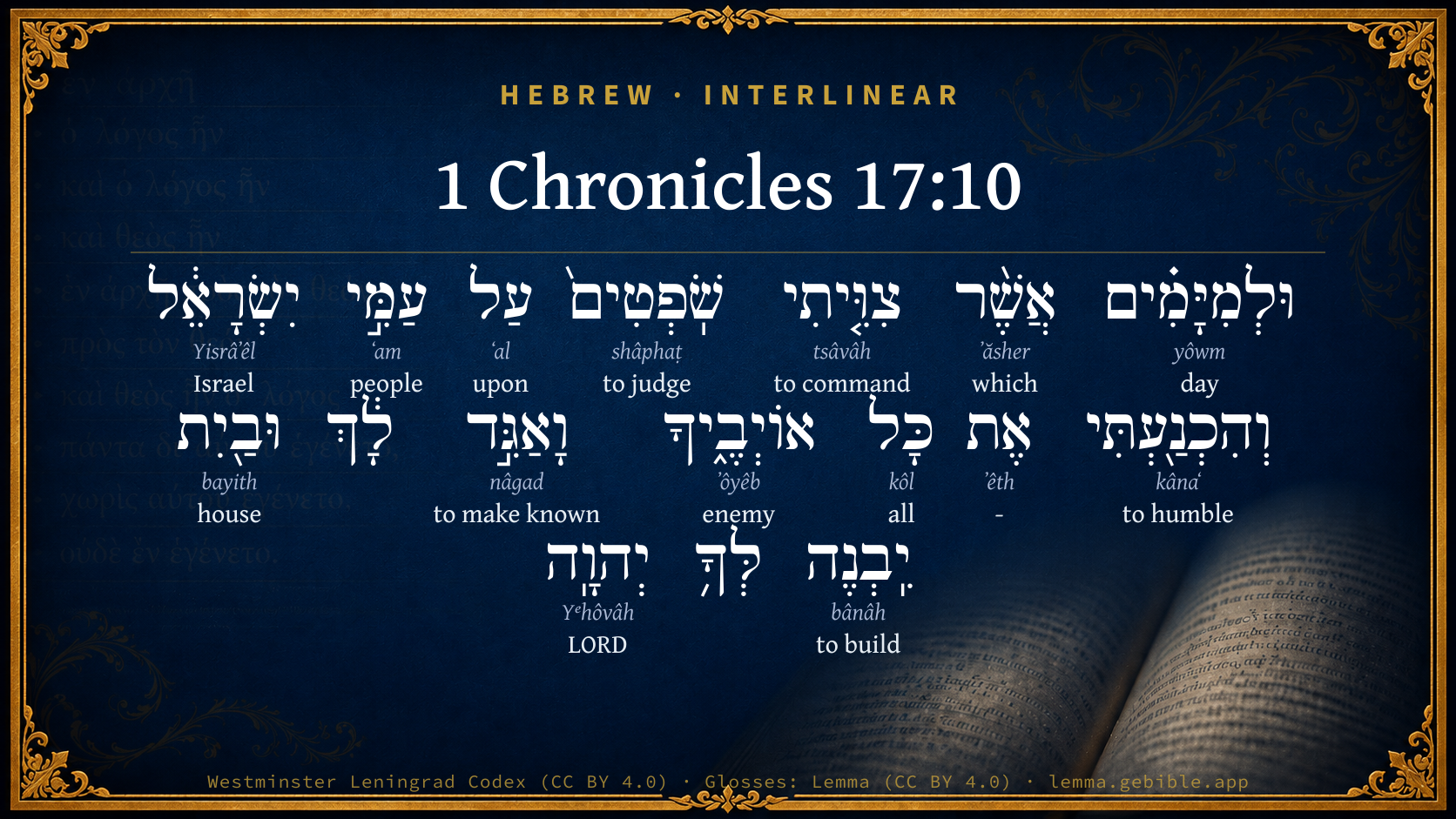
Hebrew (Westminster Leningrad Codex) 1 Chronicles 17:10 appears in the Hebrew Old Testament. The text above is from the Westminster Leningrad Codex. Each word links to its Strong’s number, a concise gloss, and parsing drawn from the Open Scriptures Hebrew Bible morphology. Click any word for its full Brown-Driver-Briggs (BDB) entry.
Download image
Cite this verse

1 Chronicles 17:10 (World English Bible). Public Domain. Lemma interlinear Bible study tool, https://lemma.gebible.app/v/1-chronicles/17/10.

Show BibTeX & RIS
BibTeX
RIS
English Translation
and [as] from the day that I commanded judges to be over my people Israel; and I will subdue all your enemies. Moreover I tell you that Yahweh will build you a house.
World English Bible · Public Domain
Download a study sheet

One document with this verse’s original text, its word-by-word gloss line, the meaning frame, cross-references with their text, attributed commentary, and full source and license credits — printable, and it pastes into notes with its structure intact.

This verse Autodidact and up

Study sheet (.html) Plain text (.txt)

A passage Seminary Student

Up to 50 verses in one chapter. A passage sheet keeps up to 6 commentary sources and 12 cross-references per verse, in the order this page ranks them, and says so on the sheet whenever that leaves anything out. Ask for a single verse and you get the Autodidact verse sheet above.

Everything on this page stays free to read, with no account — the sheet is a download of what is already on screen, not access to it.

Want to remove ads? Support Godless Engineer
Compare translations 3

The same verse in 3 English versions, stacked beneath the original-language interlinear above. Click any original word for its lexicon entry.

Each is an independent rendering of the whole verse — the interlinear is not word-aligned to these translations.

Highlighted words mark where these versions differ — a whole-verse word diff, not a word-by-word alignment.

  • World English Bible Public Domain
    and [as] from the day that I commanded judges to be over my people Israel; and I will subdue all your enemies. Moreover I tell you that Yahweh will build you a house.
  • King James Version Public Domain
    And since the time that I commanded judges to be over my people Israel. Moreover I will subdue all thine enemies. Furthermore I tell thee that the LORD will build thee an house.
  • unfoldingWord Literal Text CC BY-SA 4.0
    and from the days when I commanded judges over my people Israel. And I will humble all of your enemies. And I declare to you that Yahweh will build a house for you.

unfoldingWord Literal Text — © unfoldingWord, licensed CC BY-SA 4.0. Word-aligned USFM3 via Door43 (git.door43.org/unfoldingWord/en_ult).

Versions to compare (up to 4)

3 of 4 selected

Show all 18 translations

Every available English version of this verse, each an independent rendering of the whole verse.

  • World English Bible Public Domain
    and [as] from the day that I commanded judges to be over my people Israel; and I will subdue all your enemies. Moreover I tell you that Yahweh will build you a house.
  • Berean Standard Bible Public Domain
    and have done since the day I appointed judges over My people Israel. And I will subdue all your enemies. Moreover, I declare to you that the LORD will build a house for you.
  • Majority Standard Bible Public Domain
    and have done since the day I appointed judges over My people Israel. And I will subdue all your enemies. Moreover, I declare to you that the LORD will build a house for you.
  • King James Version Public Domain
    And since the time that I commanded judges to be over my people Israel. Moreover I will subdue all thine enemies. Furthermore I tell thee that the LORD will build thee an house.
  • American Standard Version (1901) Public Domain
    and `as' from the day that I commanded judges to be over my people Israel; and I will subdue all thine enemies. Moreover I tell thee that Jehovah will build thee a house.
  • Revised Version (1885) Public Domain
    and as from the day that I commanded judges to be over my people Israel; and I will subdue all thine enemies. Moreover I tell thee that the LORD will build thee an house.
  • Geneva Bible (1599) Public Domain
    And since the time that I commanded iudges ouer my people Israel) And I wil subdue all thine enemies: therefore I say vnto thee, that the Lord wil buylde thee an house.
  • Douay-Rheims (1899) Public Domain
    Since the days that I gave judges to my people Israel, and have humbled all thy enemies. And I declare to thee, that the Lord will build thee a house.
  • Young's Literal Translation Public Domain
    yea, even from the days that I appointed judges over My people Israel. `And I have humbled all thine enemies, and I declare to thee that a house doth Jehovah build for thee,
  • Literal Standard Version CC BY-SA 4.0
    indeed, even from the days that I appointed judges over My people Israel. And I have humbled all your enemies, and I declare to you that YHWH builds a house for you.
  • Unlocked Literal Bible CC BY-SA 4.0
    as they were doing from the days that I commanded judges to be over my people Israel. Then I will subdue all your enemies. Moreover I tell you that I, Yahweh, will build you a house.
  • unfoldingWord Literal Text CC BY-SA 4.0
    and from the days when I commanded judges over my people Israel. And I will humble all of your enemies. And I declare to you that Yahweh will build a house for you.
  • Darby Bible Public Domain
    and since the days that I commanded judges to be over my people Israel. And I will subdue all thine enemies; and I tell thee that Jehovah will build thee a house.
  • World Messianic Bible Public Domain
    and from the day that I commanded judges to be over my people Israel. I will subdue all your enemies. Moreover I tell you that the LORD will build you a house.
  • Webster's Bible Public Domain
    And since the time that I commanded judges to be over my people Israel. Moreover, I will subdue all thy enemies. Furthermore, I tell thee that the LORD will build thee a house.
  • Free Bible Version CC BY-SA 4.0
    from the time I placed judges in charge of my people. I will defeat all of your enemies. Also I want to make it clear that I the Lord will build a house for you.
  • Bible in Basic English Public Domain
    From the time when I put judges over my people Israel; and I will overcome all those who are against you; and I will make you great and the head of a line of kings.
  • JPS Tanakh (1917) Public Domain
    even from the day that I commanded judges to be over My people Israel; and I will subdue all thine enemies. Moreover I tell thee that the LORD will build thee a house.

Literal Standard Version (2020), Covenant Press — licensed CC BY-SA 4.0. Text via the HelloAO Bible API (eBible.org). Unlocked Literal Bible (unfoldingWord) — licensed CC BY-SA 4.0. Text via the HelloAO Bible API (eBible.org). unfoldingWord Literal Text — © unfoldingWord, licensed CC BY-SA 4.0. Word-aligned USFM3 via Door43 (git.door43.org/unfoldingWord/en_ult). Free Bible Version, Dr. Jonathan Gallagher — licensed CC BY-SA 4.0. Text via the HelloAO Bible API (eBible.org).

Word by word

More ways to search: Search by grammar → Find every occurrence → Compare this word →

Practice this passage: Drill this verse → Learn its vocabulary →

וְהִכְנַ֖עְתִּי
kânaʻ
H3665
“and · to humble”
Conjunction + Verb, Hiphil, Sequential Perfect, 1st Person, Common, Singular
Part of Speech
Conjunction + Verb
Stem
Hiphil
Form
Sequential Perfect
Person
1st Person
Gender
Common
Number
Singular
Full BDB Definition

Origin: a primitive root

TWOT: 1001

to be humble, be humbled, be subdued, be brought down, be low, be under, be brought into subjection - (Niphal) - to humble oneself - to be humbled, be subdued - (Hiphil) - to humble - to subdue
  1. וּלְמִיָּמִ֗ים yôwm H3117 “and · to/for · from · days” Conjunction + Preposition + Preposition + Noun, Common, Masculine, Plural, Absolute
  2. אֲשֶׁ֨ר ʼăsher H834 “which” Particle, Relative
  3. צִוִּ֤יתִי tsâvâh H6680 “to command” Verb, Piel, Perfect, 1st Person, Common, Singular
  4. שֹֽׁפְטִים֙ shâphaṭ H8199 “judging” Verb, Qal, Participle Active, Masculine, Plural, Absolute
  5. עַל ʻal H5921 “upon” Preposition
  6. עַמִּ֣י ʻam H5971 “people · my” Noun, Common, Masculine, Singular, Construct + Suffix, Personal, 1st Person, Common, Singular
  7. יִשְׂרָאֵ֔ל Yisrâʼêl H3478 “Israel” Noun, Proper
  8. אֶת ʼêth H853 “-” Particle, Direct Object
  9. כָּל kôl H3605 “all of” Noun, Common, Masculine, Singular, Construct
  10. אוֹיְבֶ֑יךָ ʼôyêb H341 “enemy · you” Verb, Qal, Participle Active, Masculine, Plural, Construct + Suffix, Personal, 2nd Person, Masculine, Singular
  11. וָאַגִּ֣ד nâgad H5046 “and · to make known” Conjunction + Verb, Hiphil, Sequential Imperfect, 1st Person, Common, Singular
  12. וּבַ֖יִת bayith H1004 “and · house” Conjunction + Noun, Common, Masculine, Singular, Absolute
  13. יִֽבְנֶה bânâh H1129 “to build” Verb, Qal, Imperfect, 3rd Person, Masculine, Singular
  14. יְהוָֽה Yᵉhôvâh H3068 “LORD” Noun, Proper

About this verse

These counts appear in no published source. They are computed here, from the morphology-tagged text and Lemma’s own curated glosses. What Lemma adds →

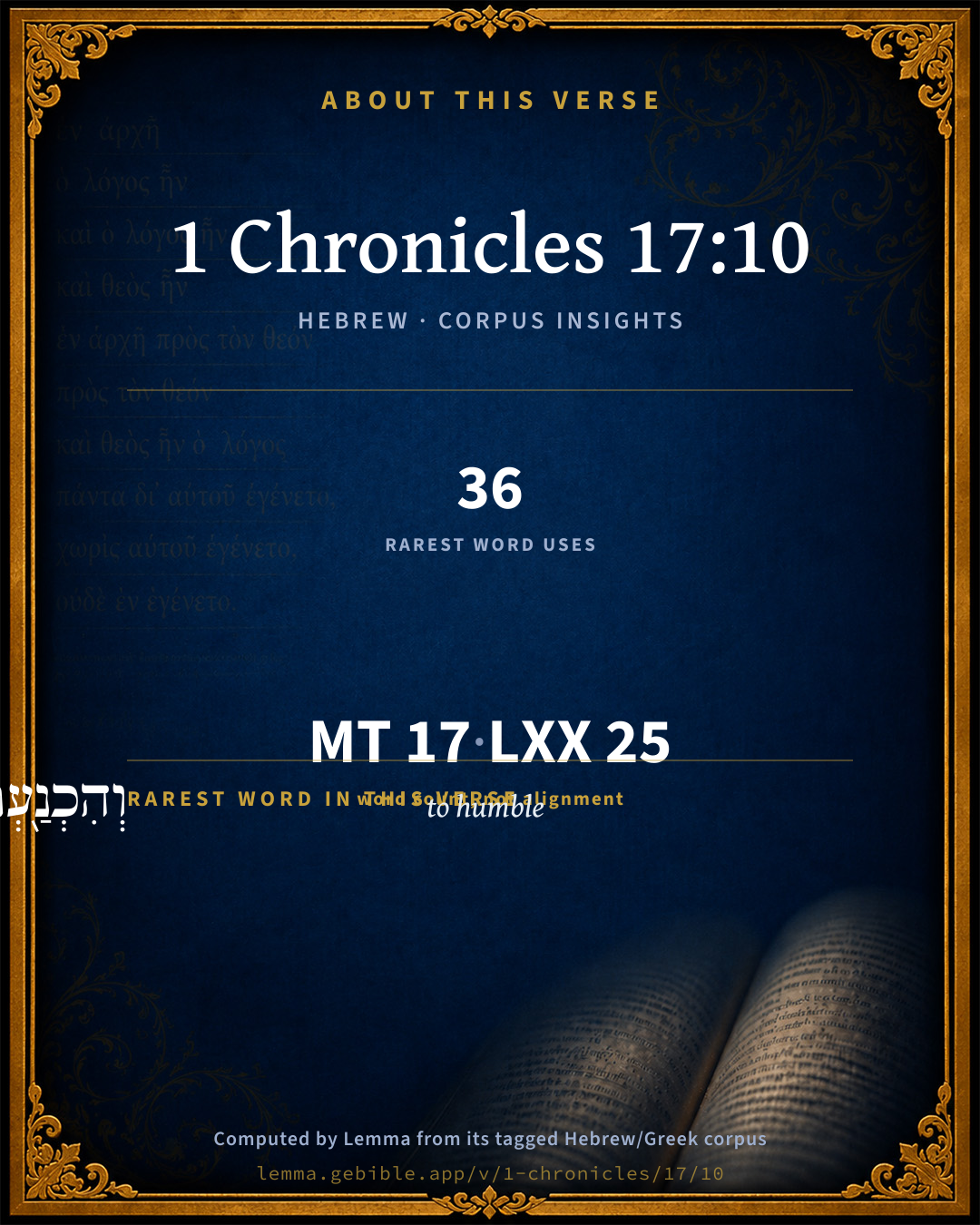
17
words
15
distinct lemmas
Historical
section

Shared distinctive vocabulary

וְהִכְנַ֖עְתִּי to humble H3665 occurs in 32 verses of the Hebrew Bible. Also found in:

Grammatical profile

  • 6 verbs
  • 6 nouns
  • 3 prepositions
  • 2 particles

Verb forms

  • צִוִּ֤יתִי Piel · Perfect
  • שֹֽׁפְטִים֙ Qal · Participle Active
  • וְהִכְנַ֖עְתִּי Hiphil · Sequential Perfect
  • אוֹיְבֶ֑יךָ Qal · Participle Active
  • וָאַגִּ֣ד Hiphil · Sequential Imperfect
  • יִֽבְנֶה Qal · Imperfect

Hebrew & Septuagint length

In English translation the verse runs 33 words from the Hebrew and 32 from the Septuagint (LXX English) — closely comparable.

A rough comparison of the two English renderings, which tokenize alike — not a word-level alignment.

Word counts can differ between the Hebrew and the Greek without any difference in meaning — e.g. the Hebrew direct-object marker אֵת has no separate Greek word, and Greek often adds the article ὁ.

In the original languages it is 17 Hebrew tokens and 25 Greek tokens — but the two are counted differently (Hebrew bundles its prefixes and suffixes into one token; the Greek is in lemma form), so that isn’t a like-for-like length.

Cross-references

14

Topical passages linked to 1 Chronicles 17:10 in the Treasury of Scripture Knowledge — connected by theme and wording, ordered by reader-vote popularity; previews shown in the World English Bible.

  • 2 Samuel 7:11 and [as] from the day that I commanded judges to be over my people Israel; and I will cause you to rest from all your enemies. Moreover Yahweh tells you that Yahweh will make you a house.
  • Psalms 18:40–50 You have also made my enemies turn their backs to me, That I might cut off those who hate me.
  • Psalms 89:23 I will beat down his adversaries before him, And strike those who hate him.
  • Exodus 1:21 It happened, because the midwives feared God, that he gave them families.
  • Judges 2:14–18 The anger of Yahweh was kindled against Israel, and he delivered them into the hands of spoilers who despoiled them; and he sold them into the hands of their enemies round about, so that they could not any longer stand before their enemies.
  • Judges 4:3 The children of Israel cried to Yahweh: for he had nine hundred chariots of iron; and twenty years he mightily oppressed the children of Israel.
  • Psalms 21:8–9 Your hand will find out all of your enemies. Your right hand will find out those who hate you.
  • 1 Corinthians 15:25 For he must reign until he has put all his enemies under his feet.
  • 1 Samuel 13:19–20 Now there was no smith found throughout all the land of Israel; for the Philistines said, Lest the Hebrews make them swords or spears:
  • Psalms 127:1 Unless Yahweh builds the house, They labor in vain who build it. Unless Yahweh watches over the city, The watchman guards it in vain.
  • Judges 3:8 Therefore the anger of Yahweh was kindled against Israel, and he sold them into the hand of Cushan Rishathaim king of Mesopotamia: and the children of Israel served Cushan Rishathaim eight years.
  • Judges 6:3–6 So it was, when Israel had sown, that the Midianites came up, and the Amalekites, and the children of the east; they came up against them;
  • 1 Samuel 13:5–6 The Philistines assembled themselves together to fight with Israel, thirty thousand chariots, and six thousand horsemen, and people as the sand which is on the sea-shore in multitude: and they came up, and encamped in Michmash, eastward of Beth Aven.
  • Psalms 110:1 Yahweh says to my Lord, "Sit at my right hand, Until I make your enemies your footstool for your feet."

Cross-references courtesy of OpenBible.info (CC BY 4.0).

Hebrew and Greek witnesses Masoretic Hebrew ↔ Greek Septuagint

The same verse in the two great witnesses to the Old Testament, shown verse-for-verse.

These are two independent witnesses, not word-aligned to each other, and the Septuagint is shown in lemma (dictionary) form.

Hebrew 1 Chronicles 17:10 Masoretic · Westminster Leningrad Codex

וּלְמִיָּמִ֗ים אֲשֶׁ֨ר צִוִּ֤יתִי שֹֽׁפְטִים֙ עַל עַמִּ֣י יִשְׂרָאֵ֔ל וְהִכְנַ֖עְתִּי אֶת כָּל אוֹיְבֶ֑יךָ וָאַגִּ֣ד לָ֔ךְ וּבַ֖יִת יִֽבְנֶה לְּךָ֥ יְהוָֽה

and [as] from the day that I commanded judges to be over my people Israel; and I will subdue all your enemies. Moreover I tell you that Yahweh will build you a house.

World English Bible · Public Domain

Greek LXX 1 Chronicles 17:10 Septuagint · lemma form

καί ἀπό ἡμέρα ὅς τάσσω κριτής ἐπί ὁ λαός ἐγώ ἰσραήλ καί ταπεινόω ἅπας ὁ ἐχθρός σύ καί αὐξάνω σύ καί οἶκος οἰκοδομέω σύ κύριος

and from the days when I appointed judges over my people Israel. Also I have humbled all your enemies, and I will increase you, and the Lord will build you a house.

LXX2012 (modern English Septuagint) · Public Domain

Hebrew: Westminster Leningrad Codex (CC BY 4.0). Greek: Septuagint (public domain); English from LXX2012 (modern English Septuagint) (Public Domain). How the Septuagint differs from the Hebrew →

Commentary

Notes on 1 Chronicles 17:10 from classic Christian and Jewish commentators (each source and its license shown beneath its notes). The classic Christian expositions comment on the surrounding passage and are grouped to its opening verse, so a note may address several verses; the Jewish commentaries on the Tanakh (Rashi and others) are per-verse, so they appear only where the commentator wrote on this verse.

Lemma curates 59 commentaries, every one of them public domain or Creative Commons licensed, each selected and text-cleaned for this edition rather than reprinted as found. About our sources →

Joseph Benson's Commentary

1Ch 17:10. Furthermore I tell thee, &c. — Must he think that his purpose was in vain, and that he should lose the reward of it? No: it being God’s act that prevented the execution of it, he shall be as fully recompensed as if it had been done.

Joseph Benson's Commentary on the Old and New Testaments (1811–1818) — public domain. Text from a community e-Sword module.

Tyndale Open Study Notes

Tyndale Open Resources

17:10-14 David had resolved to build a house for the Lord—the Temple. Instead, the Lord would build a house for David—a dynasty of kings. Establishing David’s eternal dynasty was the central part of God’s plan to establish his rule on earth.

Tyndale Open Study Notes — © Tyndale Open Resources, licensed CC BY-SA 4.0. Text via the HelloAO Bible API.

Geneva Bible (1599)

Geneva Bible translators

Will give thee great posterity.

Geneva Bible (1599) marginal notes — public domain. Text via Bolls.life.

Ellicott's Commentary for English Readers

(10) And since the time that I commanded judges.—Heb., from days that . . . Samuel, more definitely, “from the day that I appointed judges ever my people.” This whole clause should not have been separated from 1Ch_17:9, which it properly concludes. The allusion is to the oppressions undergone in the period of the judges, and the troubles of the former reign.

Moreover (and) I will subdue all thine enemies.—A continuation of the promises at the beginning of 1Ch_17:9. “I will subdue the foes of the king, as I subdued the foes of the shepherd and the outlaw.” (Comp. 1Ch_17:8.) Instead of this, Samuel has, “And I will give thee rest from all thy enemies.”

Furthermore I tell thee . . .—Literally, And I have told thee, and a house will Jehovah build thee;” that is, I have foretold it. (Comp. Isa_40:21; Isa_45:21.) That which follows is a sort of ironical inversion of David’s wish to build a house for the Lord. The term “house” is figurative (offspring), as in Psa_127:1. (Comp. Gen_30:3.) The reading of Samuel is, “And Jehovah hath [now] told thee [by my mouth] that a house will Jehovah make for thee.” This looks original, with its rare construction of the perfect, which the chronicler has altered; its repetition of the most holy Name; and its less exact “make,” which Chronicles improves into “build,” with an eye to 1Ch_17:4; 1Ch_17:6, as well as to the play on the word (bânâh, build; bânîm, sons).

A Bible Commentary for English Readers, edited by Charles John Ellicott (1878–1897) — public domain. Text from a community e-Sword module.

The Cambridge Bible for Schools and Colleges

gen. ed. J. J. S. Perowne

10. and since the time … Israel. Moreover … Furthermore …] R.V. and as from the day … Israel; and … Moreover …

subdue all thine enemies] Sam. (R.V.) cause thee to rest from all thine enemies.

build thee a house] Sam. make thee an house, the house meant being a dynasty, and not a building.

The Cambridge Bible for Schools and Colleges (gen. ed. J. J. S. Perowne; Cambridge University Press, 1878–1918) — public domain. Text from a community e-Sword module.

The Pulpit Commentary

This verse should read on continuously with the preceding, as far as to the word "enemies." The time here denoted will stretch from the people"s occupation of the laud to the death of Saul, as the expression, "at the beginning," in ver. 9, will point to the experience of Egyptian oppression. Will build thee a house; i.e. will guarantee thee an unfailing line of descendants.

Ver. 10 (latter part).

The Divine response: its righteousness and riches.

I THE RIGHTEOUSNESS OF THE DIVINE RESPONSE. David had it in his heart to build God a house, but he did not actually do so. Yet God honoured his intention, and met it by the response intimated in the text: "The Lord will build thee a house." In this we can recognize the act of a righteous God righteous because

(1) the essence of any act is in the intention of the agent;

(2) the intention of the human mind is often defeated by irresistible obstacles.

We are not responsible for the event. With David, in this instance, the direct Divine prohibition was interposed. With us, insuperable obstacles often intervene, and the result is not ascribable to anything but the limitation of our faculties. Our righteous God accepts, approves, honours, not indeed barren and Worthless sentiment, but an earnest desire and honest intention to please and serve him. This may be in our personal, family, or Church relations.

II THE AMPLITUDE (OR RICHES) OF THE DIVINE RESPONSE. David desired to build for God a house. God replied to his servant, "I will build thee an house." The house which David wished to build was one of stone and wood, of silver and gold; but that which the Divine Giver purposed to build was far more precious. It was a human house; it was the elevation of the king"s children and of their children to honour and power and influence; it was a bestowment of a kind and character which in its nature far outweighed the gift which the servant of Jehovah proposed to present. God"s response had a Divine largeness, amplitude, wealth, answering to his beneficent and bountiful nature. Thus does he meet his children now. He makes us to know the length, and breadth, and depth, and height of his responsiveness in the gospel of Christ. He acts toward us in the spirit of the promise in Mar_10:28-30. He responds

(1) to our penitence with free forgiveness and full reconciliation;

(2) to our trust with constant guidance, provision, guardianship, "all our journey through;

(3) to our trust with the indwelling of his own Divine Spirit;

(4) to our faithfulness during the brief period of time with everlasting glory. C.

The Pulpit Commentary (1880–1919), ed. H.D.M. Spence-Jones & Joseph S. Exell — public domain. Text from a community e-Sword module.

John Wesley's Explanatory Notes

Furthermore, &c. - Must he think, that his purpose was in vain, and that he should lose the reward of it? No: it being God's act that prevented the execution of it, he shall be as fully recompensed as if it had been done.

John Wesley, Explanatory Notes Upon the Whole Bible (1754–1765) — public domain. Text via the GEBible commentary corpus.

Rashi

Rabbi Shlomo Yitzchaki (Rashi)

And even from the days that I commanded judges over My people Israel they did not have rest like you, for I vanquished all your enemies before you.

Moreover I tell you what your reward will be, because you wished to build Me a house.

that the Lord will build you a house You thought to build Me a house in My name; your reward will be with the same measure; the Holy One, blessed be He, brings you the tidings that the Lord will give you a son who will reign after you and who will sit on the throne of Israel in your stead, and everything that endures for a person after him is called a house, as it says (v. 11): “... and I shall raise up your seed after you.”

Rashi on the Tanakh — English translations: “The Judaica Press complete Tanach with Rashi, translated by A. J. Rosenberg” (CC BY 4.0); “Pentateuch with Rashi's commentary by M. Rosenbaum and A.M. Silbermann, 1929-1934” (public domain); “The Metsudah Tanach series, Lakewood, N.J” (CC BY 4.0); and “The Book of Joshua, Metsudah Publications, 1997” (CC BY 4.0). Text via Sefaria.

Lesson kit

Teaching starters — assembled from the data on this page, not authored interpretation. Every prompt links to the verse data it draws on. Edit before teaching.

1 Chronicles, in the Historical, opens this verse with 17 words (15 distinct Hebrew lemmas). Its most distinctive word is kânaʻ (“to humble”). A historical commentator’s framing appears above. Read the whole chapter for the surrounding context.

Discussion questions

  1. What does “to humble” (kânaʻ) contribute to the verse as a whole?
  2. Leviticus 26:41 shares the word «to humble» with this verse. How do the two illuminate each other?
  3. These translations render this verse differently. What is at stake in choosing one wording over another?
  4. The verb «צִוִּ֤יתִי» is Piel Perfect. How does its form color the action?
  5. Reading how Joseph Benson's Commentary and Tyndale Open Study Notes read this verse, where do the two commentators agree and where do they part?

Things to notice

Reading settings

Reading text

Shown beneath each verse's original-language words.

Old Testament
Old Testament edition

Read the OT as the Masoretic Hebrew (MT) or the Greek Septuagint (LXX).

English shown for the Greek Septuagint (in the Hebrew ↔ Greek comparison).

Comparing translations? Open the Compare panel on any verse page to stack up to four side by side.