
Judges 2:18

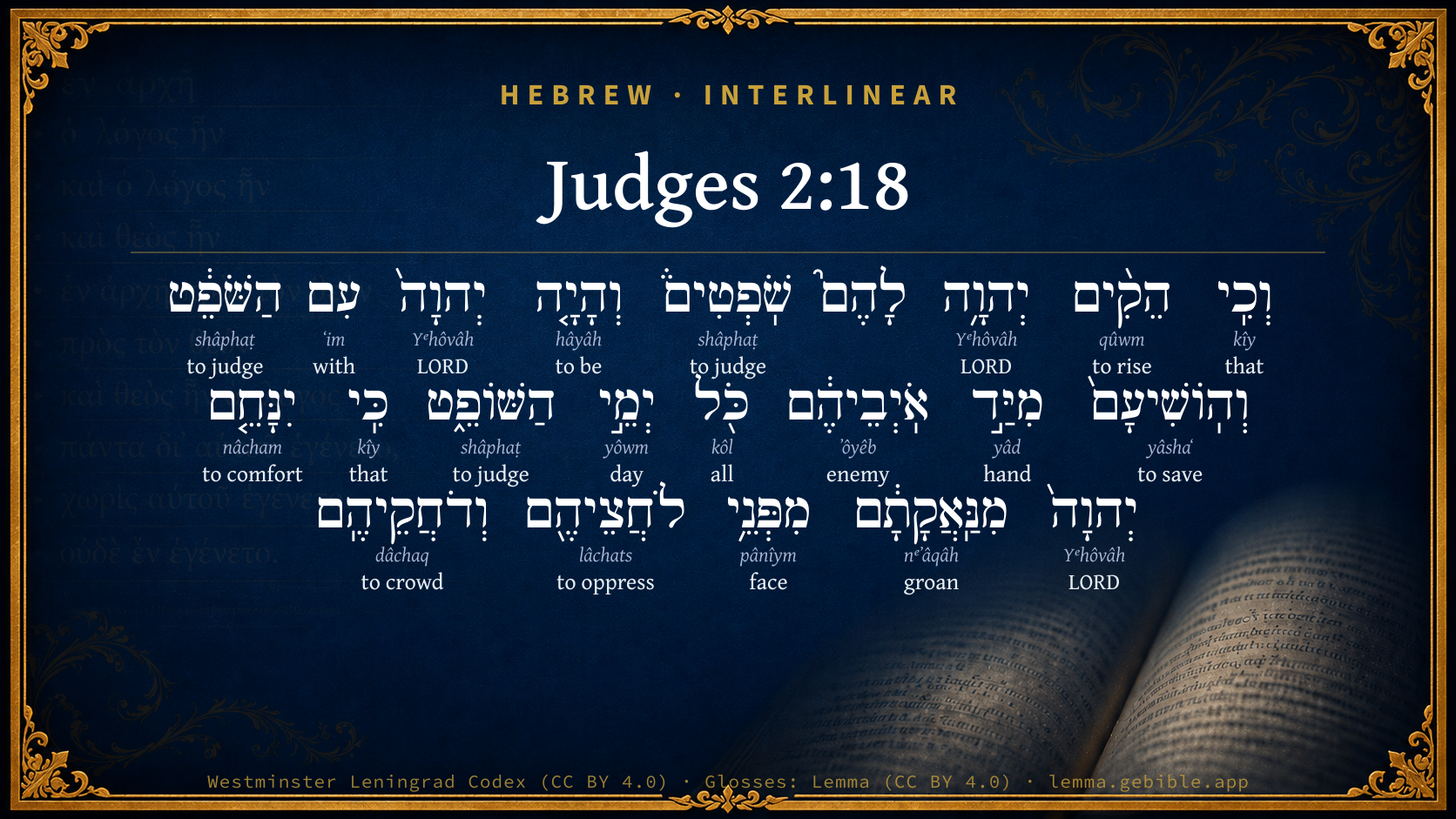
Hebrew (Westminster Leningrad Codex) Judges 2:18 appears in the Hebrew Old Testament. The text above is from the Westminster Leningrad Codex. Each word links to its Strong’s number, a concise gloss, and parsing drawn from the Open Scriptures Hebrew Bible morphology. Click any word for its full Brown-Driver-Briggs (BDB) entry.
Download image
Cite this verse

Judges 2:18 (World English Bible). Public Domain. Lemma interlinear Bible study tool, https://lemma.gebible.app/v/judges/2/18.

Show BibTeX & RIS
BibTeX
RIS
English Translation
When Yahweh raised them up judges, then Yahweh was with the judge, and saved them out of the hand of their enemies all the days of the judge: for it repented Yahweh because of their groaning by reason of those who oppressed them and vexed them.
World English Bible · Public Domain
Highlights
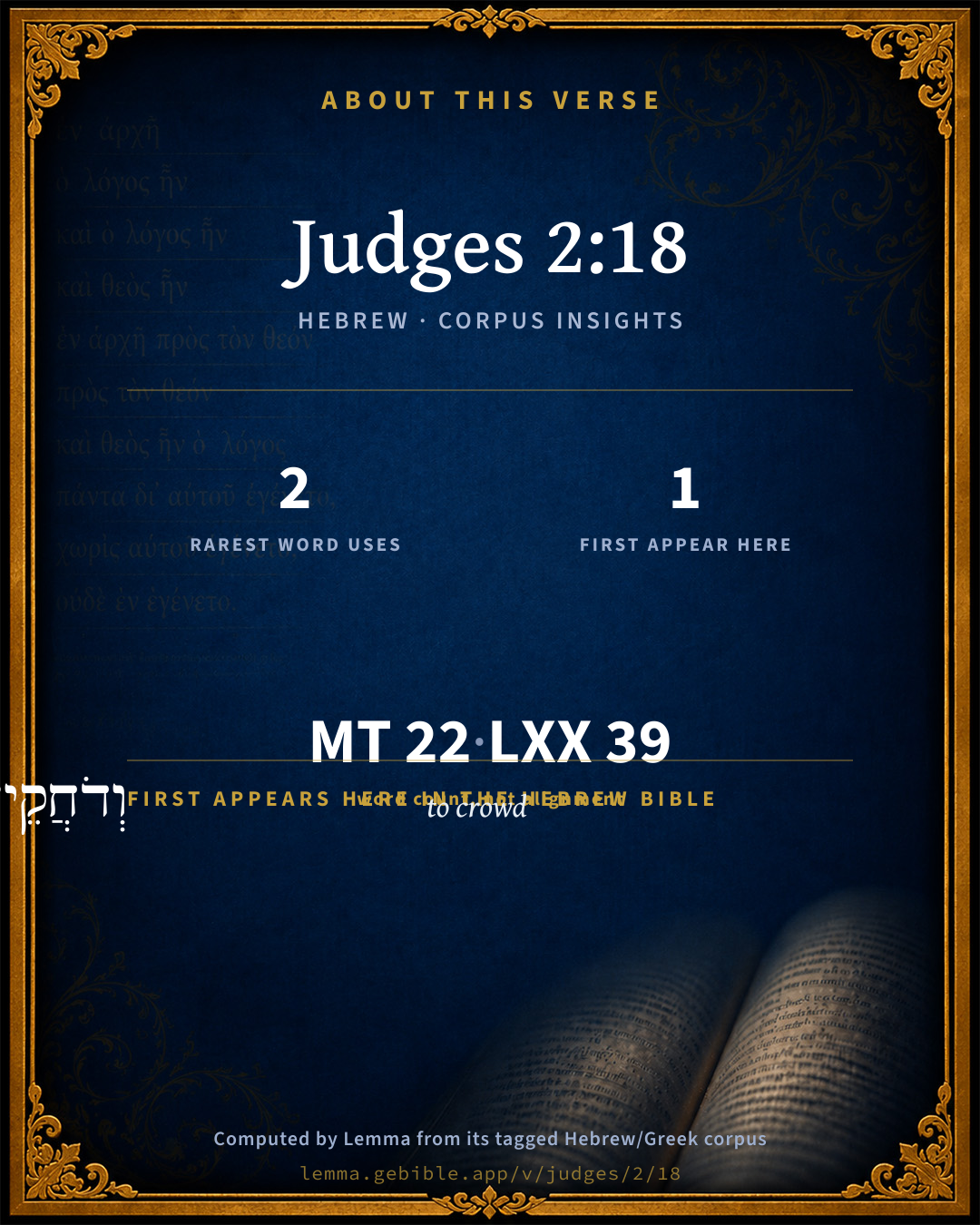
  • 1 first appearance in the Hebrew Bible
Full analysis ↓
Download a study sheet

One document with this verse’s original text, its word-by-word gloss line, the meaning frame, cross-references with their text, attributed commentary, and full source and license credits — printable, and it pastes into notes with its structure intact.

This verse Autodidact and up

Study sheet (.html) Plain text (.txt)

A passage Seminary Student

Up to 50 verses in one chapter. A passage sheet keeps up to 6 commentary sources and 12 cross-references per verse, in the order this page ranks them, and says so on the sheet whenever that leaves anything out. Ask for a single verse and you get the Autodidact verse sheet above.

Everything on this page stays free to read, with no account — the sheet is a download of what is already on screen, not access to it.

Want to remove ads? Support Godless Engineer
Compare translations 3

The same verse in 3 English versions, stacked beneath the original-language interlinear above. Click any original word for its lexicon entry.

Each is an independent rendering of the whole verse — the interlinear is not word-aligned to these translations.

Highlighted words mark where these versions differ — a whole-verse word diff, not a word-by-word alignment.

  • World English Bible Public Domain
    When Yahweh raised them up judges, then Yahweh was with the judge, and saved them out of the hand of their enemies all the days of the judge: for it repented Yahweh because of their groaning by reason of those who oppressed them and vexed them.
  • King James Version Public Domain
    And when the LORD raised them up judges, then the LORD was with the judge, and delivered them out of the hand of their enemies all the days of the judge: for it repented the LORD because of their groanings by reason of them that oppressed them and vexed them.
  • unfoldingWord Literal Text CC BY-SA 4.0
    For when Yahweh raised up for them judges, then Yahweh was with the judge and he saved them from the hand of their enemies all of the days of the judge. For Yahweh had compassion because of their groaning from the faces of their afflictors and their oppressors.

unfoldingWord Literal Text — © unfoldingWord, licensed CC BY-SA 4.0. Word-aligned USFM3 via Door43 (git.door43.org/unfoldingWord/en_ult).

Versions to compare (up to 4)

3 of 4 selected

Show all 18 translations

Every available English version of this verse, each an independent rendering of the whole verse.

  • World English Bible Public Domain
    When Yahweh raised them up judges, then Yahweh was with the judge, and saved them out of the hand of their enemies all the days of the judge: for it repented Yahweh because of their groaning by reason of those who oppressed them and vexed them.
  • Berean Standard Bible Public Domain
    Whenever the LORD raised up a judge for the Israelites, He was with that judge and saved them from the hands of their enemies while the judge was still alive; for the LORD was moved to pity by their groaning under those who oppressed them and afflicted them.
  • Majority Standard Bible Public Domain
    Whenever the LORD raised up a judge for the Israelites, He was with that judge and saved them from the hands of their enemies while the judge was still alive; for the LORD was moved to pity by their groaning under those who oppressed them and afflicted them.
  • King James Version Public Domain
    And when the LORD raised them up judges, then the LORD was with the judge, and delivered them out of the hand of their enemies all the days of the judge: for it repented the LORD because of their groanings by reason of them that oppressed them and vexed them.
  • American Standard Version (1901) Public Domain
    And when Jehovah raised them up judges, then Jehovah was with the judge, and saved them out of the hand of their enemies all the days of the judge: for it repented Jehovah because of their groaning by reason of them that oppressed them and vexed them.
  • Revised Version (1885) Public Domain
    And when the LORD raised them up judges, then the LORD was with the judge, and saved them out of the hand of their enemies all the days of the judge: for it repented the LORD because of their groaning by reason of them that oppressed them and vexed them.
  • Geneva Bible (1599) Public Domain
    And when the Lord had raysed them vp Iudges, the Lord was with the Iudge, and deliuered them out of the hande of their enemies all the dayes of the Iudge (for the Lord had compassion on their gronings, because of them that oppressed them and tormented them)
  • Douay-Rheims (1899) Public Domain
    And when the Lord raised them up judges, in their days he was moved to mercy, and heard the groanings of the afflicted, and delivered them from the slaughter of the oppressors.
  • Young's Literal Translation Public Domain
    And when Jehovah raised up to them judges -- then was Jehovah with the judge, and saved them out of the hand of their enemies all the days of the judge; for it repenteth Jehovah, because of their groaning from the presence of their oppressors, and of those thrusting them away.
  • Literal Standard Version CC BY-SA 4.0
    And when YHWH raised up judges for them—then YHWH was with the judge, and saved them out of the hand of their enemies all [the] days of the judge; for YHWH sighs, because of their groaning from the presence of their oppressors, and of those thrusting them away.
  • Unlocked Literal Bible CC BY-SA 4.0
    When Yahweh raised up judges for them, Yahweh helped the judges and rescued them from the hand of their enemies all the days the judge lived. Yahweh had pity on them as they groaned because of those who oppressed them and afflicted them.
  • unfoldingWord Literal Text CC BY-SA 4.0
    For when Yahweh raised up for them judges, then Yahweh was with the judge and he saved them from the hand of their enemies all of the days of the judge. For Yahweh had compassion because of their groaning from the faces of their afflictors and their oppressors.
  • Darby Bible Public Domain
    Whenever the LORD raised up judges for them, the LORD was with the judge, and he saved them from the hand of their enemies all the days of the judge; for the LORD was moved to pity by their groaning because of those who afflicted and oppressed them.
  • World Messianic Bible Public Domain
    When the LORD raised up judges for them, then the LORD was with the judge, and saved them out of the hand of their enemies all the days of the judge; for it grieved the LORD because of their groaning by reason of those who oppressed them and troubled them.
  • Webster's Bible Public Domain
    And when the LORD raised up judges for them, then the LORD was with the judge, and delivered them out of the hand of their enemies all the days of the judge: (for the LORD repented because of their groanings by reason of them that oppressed them and burdened them.)
  • Free Bible Version CC BY-SA 4.0
    When the Lord provided Israel with judges over Israel, he was with each judge and saved the people from their enemies during that judge's lifetime, because the Lord felt sorry for his people, who groaned under their oppressors and persecutors.
  • Bible in Basic English Public Domain
    And whenever the Lord gave them judges, then the Lord was with the judge, and was their saviour from the hands of their haters all the days of the judge; for the Lord was moved by their cries of grief because of those who were cruel to them.
  • JPS Tanakh (1917) Public Domain
    And when the LORD raised them up judges, then the LORD was with the judge, and saved them out of the hand of their enemies all the days of the judge; for it repented the LORD because of their groaning by reason of them that oppressed them and crushed them.

Literal Standard Version (2020), Covenant Press — licensed CC BY-SA 4.0. Text via the HelloAO Bible API (eBible.org). Unlocked Literal Bible (unfoldingWord) — licensed CC BY-SA 4.0. Text via the HelloAO Bible API (eBible.org). unfoldingWord Literal Text — © unfoldingWord, licensed CC BY-SA 4.0. Word-aligned USFM3 via Door43 (git.door43.org/unfoldingWord/en_ult). Free Bible Version, Dr. Jonathan Gallagher — licensed CC BY-SA 4.0. Text via the HelloAO Bible API (eBible.org).

Word by word

More ways to search: Search by grammar → Find every occurrence → Compare this word →

Practice this passage: Drill this verse → Learn its vocabulary →

וְדֹחֲקֵיהֶֽם
dâchaq
H1766
“and · crowding · them”
Conjunction + Verb, Qal, Participle Active, Masculine, Plural, Construct + Suffix, Personal, 3rd Person, Masculine, Plural
Part of Speech
Conjunction + Verb
Stem
Qal
Form
Participle Active
Gender
Masculine
Number
Plural
State
Construct
Full BDB Definition

Origin: a primitive root

TWOT: 424

to thrust, oppress, crowd - (Qal) to thrust, crowd
  1. וְכִֽי kîy H3588 “and · that” Conjunction + Conjunction
  2. הֵקִ֨ים qûwm H6965 “to rise” Verb, Hiphil, Perfect, 3rd Person, Masculine, Singular
  3. יְהוָ֥ה Yᵉhôvâh H3068 “LORD” Noun, Proper
  4. שֹֽׁפְטִים֒ shâphaṭ H8199 “judging” Verb, Qal, Participle Active, Masculine, Plural, Absolute
  5. וְהָיָ֤ה hâyâh H1961 “and · to be” Conjunction + Verb, Qal, Sequential Perfect, 3rd Person, Masculine, Singular
  6. יְהוָה֙ Yᵉhôvâh H3068 “LORD” Noun, Proper
  7. עִם ʻim H5973 “with” Preposition
  8. הַשֹּׁפֵ֔ט shâphaṭ H8199 “the · judging” Particle, Definite Article + Verb, Qal, Participle Active, Masculine, Singular, Absolute
  9. וְהֽוֹשִׁיעָם֙ yâshaʻ H3467 “and · to save · them” Conjunction + Verb, Hiphil, Sequential Perfect, 3rd Person, Masculine, Singular + Suffix, Personal, 3rd Person, Masculine, Plural
  10. מִיַּ֣ד yâd H3027 “from · hand of” Preposition + Noun, Common, Both, Singular, Construct
  11. אֹֽיְבֵיהֶ֔ם ʼôyêb H341 “enemy · them” Verb, Qal, Participle Active, Masculine, Plural, Construct + Suffix, Personal, 3rd Person, Masculine, Plural
  12. כֹּ֖ל kôl H3605 “all of” Noun, Common, Masculine, Singular, Construct
  13. יְמֵ֣י yôwm H3117 “days of” Noun, Common, Masculine, Plural, Construct
  14. הַשּׁוֹפֵ֑ט shâphaṭ H8199 “the · judging” Particle, Definite Article + Verb, Qal, Participle Active, Masculine, Singular, Absolute
  15. כִּֽי kîy H3588 “that” Conjunction
  16. יִנָּחֵ֤ם nâcham H5162 “to comfort” Verb, Niphal, Imperfect, 3rd Person, Masculine, Singular
  17. יְהוָה֙ Yᵉhôvâh H3068 “LORD” Noun, Proper
  18. מִנַּֽאֲקָתָ֔ם nᵉʼâqâh H5009 “from · groan · their” Preposition + Noun, Common, Feminine, Singular, Construct + Suffix, Personal, 3rd Person, Masculine, Plural
  19. מִפְּנֵ֥י pânîym H6440 “from · face(s) of” Preposition + Noun, Common, Both, Plural, Construct
  20. לֹחֲצֵיהֶ֖ם lâchats H3905 “oppressing · them” Verb, Qal, Participle Active, Masculine, Plural, Construct + Suffix, Personal, 3rd Person, Masculine, Plural

About this verse

These counts appear in no published source. They are computed here, from the morphology-tagged text and Lemma’s own curated glosses. What Lemma adds →

22
words
16
distinct lemmas
Historical
section

Notable vocabulary

The rarest word here is וְדֹחֲקֵיהֶֽם to crowd H1766 — appearing just 2 times in the whole Hebrew Bible.

First appearance in Scripture

This word makes its first canonical appearance in the Hebrew Bible here:

  • וְדֹחֲקֵיהֶֽם to crowd H1766

Shared distinctive vocabulary

וְדֹחֲקֵיהֶֽם to crowd H1766 occurs in 2 verses of the Hebrew Bible. Also found in:

Grammatical profile

  • 10 verbs
  • 8 nouns
  • 2 prepositions
  • 2 conjunctions

Verb forms

  • הֵקִ֨ים Hiphil · Perfect
  • שֹֽׁפְטִים֒ Qal · Participle Active
  • וְהָיָ֤ה Qal · Sequential Perfect
  • הַשֹּׁפֵ֔ט Qal · Participle Active
  • וְהֽוֹשִׁיעָם֙ Hiphil · Sequential Perfect
  • אֹֽיְבֵיהֶ֔ם Qal · Participle Active
  • הַשּׁוֹפֵ֑ט Qal · Participle Active
  • יִנָּחֵ֤ם Niphal · Imperfect
  • לֹחֲצֵיהֶ֖ם Qal · Participle Active
  • וְדֹחֲקֵיהֶֽם Qal · Participle Active

Repetition

Words recur within this verse — often emphatic in Hebrew:

  • יְהוָ֥ה LORD H3068 ×3
  • שֹֽׁפְטִים֒ to judge H8199 ×3
  • וְכִֽי that H3588 ×2

Hebrew & Septuagint length

In English translation the verse runs 46 words from the Hebrew and 49 from the Septuagint (LXX English) — closely comparable.

A rough comparison of the two English renderings, which tokenize alike — not a word-level alignment.

Word counts can differ between the Hebrew and the Greek without any difference in meaning — e.g. the Hebrew direct-object marker אֵת has no separate Greek word, and Greek often adds the article ὁ.

In the original languages it is 22 Hebrew tokens and 39 Greek tokens — but the two are counted differently (Hebrew bundles its prefixes and suffixes into one token; the Greek is in lemma form), so that isn’t a like-for-like length.

Cross-references

15

Topical passages linked to Judges 2:18 in the Treasury of Scripture Knowledge — connected by theme and wording, ordered by reader-vote popularity; previews shown in the World English Bible.

  • Deuteronomy 32:36 For Yahweh will judge his people, Repent himself for his servants; When he sees that [their] power is gone, There is none [remaining], shut up or left at large.
  • Joshua 1:5 There shall not any man be able to stand before you all the days of your life. As I was with Moses, so I will be with you; I will not fail you, nor forsake you.
  • Exodus 2:24 God heard their groaning, and God remembered his covenant with Abraham, with Isaac, and with Jacob.
  • 2 Kings 13:22–23 Hazael king of Syria oppressed Israel all the days of Jehoahaz.
  • Psalms 106:44–45 Nevertheless he regarded their distress, When he heard their cry.
  • Hosea 11:8 "How can I give you up, Ephraim? How can I hand you over, Israel? How can I make you like Admah? How can I make you like Zeboiim? My heart is turned within me, My compassion is aroused.
  • Genesis 6:6 Yahweh was sorry that he had made man on the earth, and it grieved him in his heart.
  • 2 Kings 13:4 Jehoahaz begged Yahweh, and Yahweh listened to him; for he saw the oppression of Israel, how that the king of Syria oppressed them.
  • Judges 10:16 They put away the foreign gods from among them, and served Yahweh; and his soul was grieved for the misery of Israel.
  • Exodus 3:12 He said, "Certainly I will be with you. This will be the token to you, that I have sent you: when you have brought forth the people out of Egypt, you shall serve God on this mountain."
  • Jeremiah 18:7–10 At what instant I shall speak concerning a nation, and concerning a kingdom, to pluck up and to break down and to destroy it;
  • Psalms 12:5 "Because of the oppression of the weak and because of the groaning of the needy, I will now arise," says Yahweh; "I will set him in safety from those who malign him."
  • Psalms 90:13 Relent, Yahweh! How long? Have compassion on your servants!
  • Jonah 3:10 God saw their works, that they turned from their evil way. God repented of the evil which he said he would do to them, and he didn't do it.
  • Acts 18:9–10 The Lord said to Paul in the night by a vision, "Don't be afraid, but speak and don't be silent;

Cross-references courtesy of OpenBible.info (CC BY 4.0).

Hebrew and Greek witnesses Masoretic Hebrew ↔ Greek Septuagint

The same verse in the two great witnesses to the Old Testament, shown verse-for-verse.

These are two independent witnesses, not word-aligned to each other, and the Septuagint is shown in lemma (dictionary) form.

Hebrew Judges 2:18 Masoretic · Westminster Leningrad Codex

וְכִֽי הֵקִ֨ים יְהוָ֥ה לָהֶם֮ שֹֽׁפְטִים֒ וְהָיָ֤ה יְהוָה֙ עִם הַשֹּׁפֵ֔ט וְהֽוֹשִׁיעָם֙ מִיַּ֣ד אֹֽיְבֵיהֶ֔ם כֹּ֖ל יְמֵ֣י הַשּׁוֹפֵ֑ט כִּֽי יִנָּחֵ֤ם יְהוָה֙ מִנַּֽאֲקָתָ֔ם מִפְּנֵ֥י לֹחֲצֵיהֶ֖ם וְדֹחֲקֵיהֶֽם

When Yahweh raised them up judges, then Yahweh was with the judge, and saved them out of the hand of their enemies all the days of the judge: for it repented Yahweh because of their groaning by reason of those who oppressed them and vexed them.

World English Bible · Public Domain

Greek LXX Judges 2:18 Septuagint · lemma form

καί ὅτι ἀγείρω κύριος κριτής αὐτός καί εἰμί κύριος μετά ὁ κριτής καί σώζω αὐτός ἐκ χείρ ἐχθρός αὐτός πᾶς ὁ ἡμέρα ὁ κριτής ὅτι παρακαλέω κύριος ἀπό ὁ στεναγμός αὐτός ἀπό πρόσωπον ὁ πολιορκέω αὐτός καί ἐκθλίβω αὐτός

And because the Lord raised them up judges, so the Lord was with the judge, and saved them out of the hand of their enemies all the days of the judge; for the Lord was moved at their groaning by reason of them that besieged them and afflicted them.

LXX2012 (modern English Septuagint) · Public Domain

On this verse, The Cambridge Bible for Schools and Colleges discusses the Septuagint’s reading. Read the note in Commentary ↓

Hebrew: Westminster Leningrad Codex (CC BY 4.0). Greek: Septuagint (public domain); English from LXX2012 (modern English Septuagint) (Public Domain). How the Septuagint differs from the Hebrew →

Targum (Aramaic paraphrase)

1

The Targum is the ancient Jewish Aramaic paraphrase of the Hebrew Scriptures — an interpretive translation, not the Hebrew text itself. Onkelos (literal) and Pseudo-Jonathan (expansive) render the Torah, and Jonathan the Prophets. Coverage is partial: where no permissively-licensed English translation exists for a verse, only the Aramaic is shown. This is verse-level text, not a word-by-word alignment to the Hebrew.

  1. Targum Jonathan Prophets (Joshua–Malachi)
    וַאֲרֵי אָקֵים יְיָ לְהוֹן נְגִידִין וַהֲוָה מֵימְרָא דַייָ בְּסַעֲדֵיהּ דִנְגִידָא וּפָרִיק לְהוֹן מִיַד בַּעֲלֵי דְבָבֵיהוֹן כָּל יוֹמֵי נְגִידָא אֲרֵי מְתִיב מִמֵימְרָא דַאֲמַר יְיָ וּמְקַבֵּל צְלוֹתְהוֹן וּפָרִיק לְהוֹן מִן קֳדָם דַחֲקֵיהוֹן וּמְשַׁעְבְּדֵיהוֹן:

    (no public-domain English translation for this verse)

    Targum Jonathan — Aramaic: “Mikraot Gedolot” (public domain). English: “Sefaria Community Translation” (CC0 1.0 (public-domain dedication)); “London "Chaldee Paraphrase," 1871” (public domain). Text via Sefaria.

Commentary

Notes on Judges 2:18 from classic Christian and Jewish commentators (each source and its license shown beneath its notes). The classic Christian expositions comment on the surrounding passage and are grouped to its opening verse, so a note may address several verses; the Jewish commentaries on the Tanakh (Rashi and others) are per-verse, so they appear only where the commentator wrote on this verse.

Lemma curates 59 commentaries, every one of them public domain or Creative Commons licensed, each selected and text-cleaned for this edition rather than reprinted as found. About our sources →

Trapp's Complete Commentary

John Trapp

Jdg 2:18 And when the LORD raised them up judges, then the LORD was with the judge, and delivered them out of the hand of their enemies all the days of the judge: for it repented the LORD because of their groanings by reason of them that oppressed them and vexed them.

Ver. 18. For it repented the Lord.] This was Mutatio rei, non Dei; effectus, non affectus; facti, non consilii.

John Trapp, A Commentary or Exposition upon All the Books of the Old and New Testament (1647–1656) — public domain. Text from a community e-Sword module.

Joseph Benson's Commentary

Jdg 2:18-19. For it repented the Lord — That is, the Lord changed his course and dealings with them, as penitent men use to do; removed his judgments, and returned to them in mercy. When the judge was dead they returned — To their former and usual course. More than their fathers — In Egypt, or in the wilderness. Their own doings — That is, from their evil practices, which he calls their own, because they were agreeable to their own natures, which in all mankind are deeply and universally corrupted, and because they were familiar and customary to them.

Joseph Benson's Commentary on the Old and New Testaments (1811–1818) — public domain. Text from a community e-Sword module.

Geneva Bible (1599)

Geneva Bible translators

Hebrew, repented.

Seeing their cruelty.

Geneva Bible (1599) marginal notes — public domain. Text via Bolls.life.

Adam Clarke's Commentary

Verse 18. The Lord was with the judge] God himself was king, and the judge was his representative.

It repented the Lord] He changed his purpose towards them: he purposed to destroy them because of their sin; they repented and turned to him, and he changed this purpose. The purpose was to destroy them if they did not repent; when they did repent, his not destroying them was quite consistent with his purpose.

Adam Clarke's Commentary on the Bible (1810–1826) — public domain. Text from a community e-Sword/MySword module.

Ellicott's Commentary for English Readers

(18) It repented the Lord—i.e., Jehovah was grieved. (Comp. Jon_3:10, “God repented of the evil that He had said He would do unto them; and He did it not”—Gen_6:6; Exo_32:14; 1Sa_15:35; Amo_7:3; Joe_2:13, &c.) The simple anthropomorphism of early ages never hesitates to describe the ways and thoughts of Jehovah by the analogy of human lives; nor is it easy to see how the sacred writers could have otherwise expressed their meaning. Yet they were, even in using this language, perfectly aware that it was only an imperfect and approximate method of explaining God’s dealings with man; and when they are using the language of calm and unmetaphorical instruction they say, “God is not a man . . .that he should repent” (Num_23:19); “He is in one mind, and who can turn Him?” (Job_23:13); “I am the Lord, I change not” (Mal_3:6).

A Bible Commentary for English Readers, edited by Charles John Ellicott (1878–1897) — public domain. Text from a community e-Sword module.

The Cambridge Bible for Schools and Colleges

gen. ed. J. J. S. Perowne

18. was with the judge] as He had been with Moses and Joshua, Jos_1:5. The Hebrew tense here shews that the verbs was, saved, denote frequentative acts in the past, used to be, used to save; similarly, it repented the Lord means the Lord used to be moved to pity. Not that Jehovah abandoned His fixed intention to punish, but His compassion was roused by the people’s cries to mitigate His purpose.

oppressed … vexed] The first word is used characteristically of Israel’s oppressors, Jdg_4:3; Jdg_6:9; Jdg_10:12, 1Sa_10:18; cf. Jdg_1:34 n. The second word occurs only here and Joe_2:8; it is common in Aramaic, and may be a late gloss on them that oppressed. LXX. cod. A omits it.

The Cambridge Bible for Schools and Colleges (gen. ed. J. J. S. Perowne; Cambridge University Press, 1878–1918) — public domain. Text from a community e-Sword module.

John Gill's Exposition

And when the Lord raised them up judges, then the Lord was with the judge,.... Every one of them that he raised up; as he stirred up their spirits for such service, to judge his people, and qualified them for it, he assisted and strengthened them, and abode by them, and succeeded them in whatsoever they engaged for the welfare of the people; the Targum is,"the Word of the Lord was for the help of the judge:"

and delivered them out of the hands of their enemies all the days of the judge; so long as a judge lived, or continued to be their judge, they were protected by him, and preserved from falling into the hands of their enemies:

for it repented the Lord because of their groanings, by reason of them that oppressed them and vexed them; the Lord being merciful had compassion upon them, when they groaned under their oppressions, and cried unto him, then he received their prayer, as the Targum, and sent them a deliverer; and so did what men do when they repent of a thing, change their conduct; thus the Lord changed the outward dispensation of his providence towards them, according to his unchangeable will; for otherwise repentance, properly speaking, does not belong unto God: the Targum is,"he turned from the word he spake;''the threatening he had denounced.

John Gill's Exposition of the Whole Bible (1746–1763) — public domain (CC PDM 1.0). Text via the HelloAO Bible API.

Albert Barnes' Notes on the Bible

It repented the Lord - Rather, “the Lord was moved with compassion,” or “was grieved,” “because of their groanings.” (Compare Jdg 21:15.)

Albert Barnes' Notes on the Bible (1834–1885) — public domain. Text from a community e-Sword/MySword module.

Haydock's Catholic Bible Commentary

Moved, &c. Hebrew and Septuagint, "and the Lord was with the judge, and delivered them out of the hand of their enemies all the days of the judge, (for it repented the Lord (Septuagint, he was moved to compassion) on account of their groans, &c.) (Haydock) --- The repentance of God denotes a change of conduct in our regard. (Calmet) --- Delivered. Hence the judges have the title of Saviour, chap. iii. 9., and 2 Esdras ix. 27. (Menochius)

George Leo Haydock (1774–1849), Haydock's Catholic Family Bible and Commentary, 1859 edition — public domain. Excludes Psalms (Douay-Rheims chapter numbering differs from Protestant) and Deuterocanonical books (Catholic canon only).

Matthew Poole's English Annotations

It repented the Lord, i.e. the Lord changed his course and dealings with them, as penitent men use to do; removed his judgments, and returned to them in mercy, Gen 6:6.

Matthew Poole's English Annotations on the Holy Bible (1683–1685) — public domain. Text from a community e-Sword/MySword module.

Whedon's Commentary on the Bible

Daniel D. Whedon

18. It repented the Lord — Render, Jehovah was grieved by their wailings on account of their oppressors and persecutors. Grief, anger, and love are emotions frequently, in the Scriptures, attributed to the divine nature. Jdg_10:16; Psa_7:2; Hos_11:8; Joh_3:16; Eph_4:30; Heb_3:10. Being absolutely perfect and pure in God, these emotions cannot, of course, be associated in the divine nature with any of the errors or evils with which they are often associated in the operations of the human soul. And when this Hebrew word (נחם) bears the sense of repented, (as our translators have rendered it here, but which it more clearly bears in Gen_6:6, and Jon_3:10,) it must never be understood as involving changeableness or inconsistency in God. “God is not a man, that he should lie: neither the son of man, that he should repent.” Num_23:19. Yet when men change, God may change his method of dealing with them. God is angry with the wicked every day. But when a man passes over from the class of the wicked to that of the righteous, he comes into the range of the Divine complacency. The man has changed, not God. Yet the change may, humanly speaking, be ascribed to God.

Daniel D. Whedon (gen. ed.), Commentary on the Old and New Testaments (1874–1909) — public domain. Text from a community e-Sword module.

John Wesley's Explanatory Notes

It repented the Lord - That is, the Lord changed his course and dealings with them, as penitent men use to do; removed his judgments, and returned to them in mercy.

John Wesley, Explanatory Notes Upon the Whole Bible (1754–1765) — public domain. Text via the GEBible commentary corpus.

Keil & Delitzsch

C. F. Keil & F. Delitzsch

"And when the Lord raised them up judges, and was with the judge, and delivered them out of the hand of their enemies all the days of the judge (i.e., as long as the judge was living), because the Lord had compassion upon their sighing, by reason of them that oppressed them, and vexed them (דּחק only occurs again as a verb in Joe 2:8): it came to pass when the judge was dead, that they returned and acted more corruptly than their fathers," i.e., they turned again to idolatry even more grievously than their fathers had done under the previous judges. "They did not let fall from their deeds," i.e., they did not cease from their evil deeds, and "from their stiff-necked way." קשׁה, hard, is to be understood as in Exo 32:9 and Exo 33:3, where Israel is called a hard-necked people which did not bend under obedience to the commandments of God.

Keil & Delitzsch — Biblical Commentary on the Old Testament (1861–1891) — public domain (CC PDM 1.0). Text via the HelloAO Bible API. (Old Testament only.)

Scofield Reference Notes

C. I. Scofield

judges

The judges were tribesmen in Israel upon whom the Lord laid the burden of Israel’s apostate and oppressed state. They were the spiritual ancestors of the prophets; that is to say, men raised up of God, the theocratic King, to represent Him in the nation. They were patriots and religious reformers because national security and prosperity were inseparably connected with loyalty and obedience to Jehovah. Not one of the chosen deliverers had anything whereof to glory in the flesh. Othniel was but the son of the younger brother of Caleb; Ehud was a left-handed man and an assassin; Shamgar, a rustic with an ox-goad; Deborah, a woman; Gideon, of an obscure family in the smallest tribe, etc. Each of the classes mentioned in 1Co 1:27; 1Co 1:28 is illustrated among the judges.

repented

(See Scofield "Zec 8:14").

The Scofield Reference Bible (1917 edition), notes by C. I. Scofield — public domain. Text from a community e-Sword module.

unfoldingWord translationNotes

Door43 World Missions Community

When Yahweh raised up judges

Yahweh appointing persons to be judges is spoken of as if he raised or lifted up the persons. (See: Metaphor)

judges for them ... rescued them

The word "them" refers to the Israelites.

the hand of their enemies

Here "hand" refers to power of the enemies to hurt Israel. AT: "the power of their enemies" (See: Metonymy)

all the days the judge lived

"as long as the judge lived"

pity

to have compassion for someone or something

as they groaned

The sound made by a person who suffers is used to describe the pain of the Israelites as they suffer. AT: "as they suffered" (See: Metonymy)

they would turn away

The people no longer obeying Yahweh is spoken of as if they would physically turn away from Yahweh. (See: Metaphor)

their fathers

"their ancestors" or "their forefathers"

They would go after other gods to serve them and worship them

The Israelites worshiping other gods is spoken of as if they were walking and going after other gods. AT: "They would serve and worship other gods" (See: Metaphor)

They refused to give up any of their evil practices or their stubborn ways

"They refused to stop doing evil things and being stubborn." This can be stated in positive form. AT: "They continued doing evil things and being stubborn" (See: Litotes)

translationWords

Yahweh

raise

judge, judges

power

adversary

life

oppress

afflicted

die

turn

corrupt

ancestor

false god

servant

worship

evil

stiff-necked

unfoldingWord translationNotes — © Distant Shores Media and the Door43 World Missions Community, licensed CC BY-SA 4.0. Source: git.door43.org/Door43/en_tn.

Rashi

Rabbi Shlomo Yitzchaki (Rashi)

When He would establish—This describes an ongoing process—'When He would establish judges for them, and Adonoy would visit with the judge, etc.'

For He would recant. He would recant, concerning them, from the destruction. This is Yonasan's rendition.

From the outcry—As a result of their cry that went up to Him because of their tormentors

Rashi on the Tanakh — English translations: “The Judaica Press complete Tanach with Rashi, translated by A. J. Rosenberg” (CC BY 4.0); “Pentateuch with Rashi's commentary by M. Rosenbaum and A.M. Silbermann, 1929-1934” (public domain); “The Metsudah Tanach series, Lakewood, N.J” (CC BY 4.0); and “The Book of Joshua, Metsudah Publications, 1997” (CC BY 4.0). Text via Sefaria.

Lesson kit

Teaching starters — assembled from the data on this page, not authored interpretation. Every prompt links to the verse data it draws on. Edit before teaching.

Judges, in the Historical, opens this verse with 22 words (16 distinct Hebrew lemmas). Its most distinctive word is dâchaq (“to crowd”). A historical commentator’s framing appears above. Read the whole chapter for the surrounding context.

Discussion questions

  1. What does “to crowd” (dâchaq) contribute to the verse as a whole?
  2. This is the first place “to crowd” appears in Scripture (first appears here). What does its debut here establish?
  3. How does Joel 2:8, which shares the word «to crowd», read alongside this verse?
  4. What does the repetition of “LORD” (3× in this one verse) do in this verse?
  5. The translations on this page render this verse differently — a whole-verse word diff, not a word-by-word alignment. What might account for the different wordings?
  6. «הֵקִ֨ים» is a Hiphil Perfect verb. How does that grammatical form shape the action described?
  7. Compare how Trapp's Complete Commentary and Joseph Benson's Commentary read this verse. Where do they agree or differ?

Things to notice

Reading settings

Reading text

Shown beneath each verse's original-language words.

Old Testament
Old Testament edition

Read the OT as the Masoretic Hebrew (MT) or the Greek Septuagint (LXX).

English shown for the Greek Septuagint (in the Hebrew ↔ Greek comparison).

Comparing translations? Open the Compare panel on any verse page to stack up to four side by side.