
Psalms 81:14

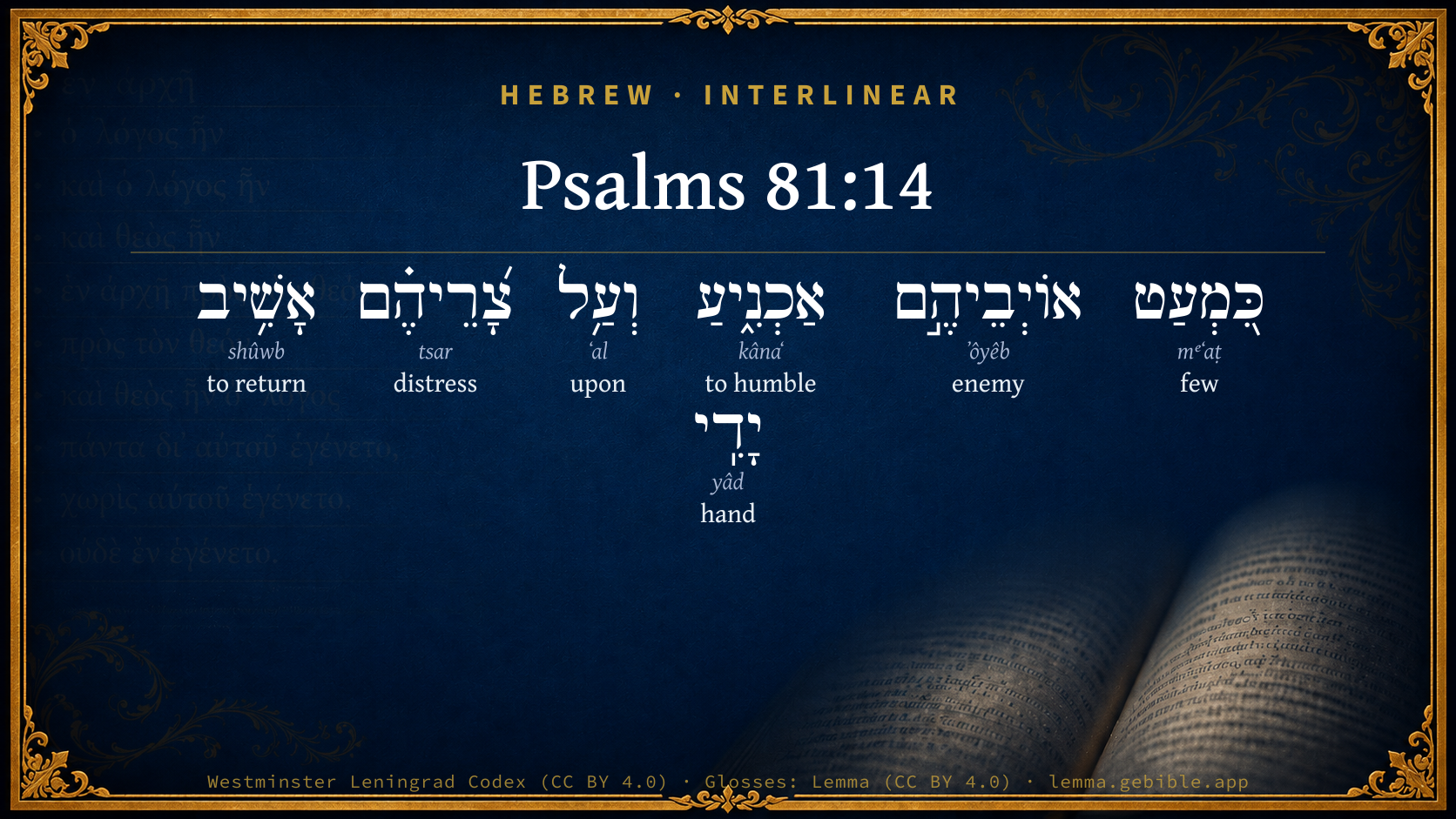
Hebrew (Westminster Leningrad Codex) Psalms 81:14 appears in the Hebrew Old Testament. The text above is from the Westminster Leningrad Codex. Each word links to its Strong’s number, a concise gloss, and parsing drawn from the Open Scriptures Hebrew Bible morphology. Click any word for its full Brown-Driver-Briggs (BDB) entry.
Download image
Cite this verse

Psalms 81:14 (World English Bible). Public Domain. Lemma interlinear Bible study tool, https://lemma.gebible.app/v/psalms/81/14.

Show BibTeX & RIS
BibTeX
RIS
English Translation
I would soon subdue their enemies, And turn my hand against their adversaries.
World English Bible · Public Domain
Download a study sheet

One document with this verse’s original text, its word-by-word gloss line, the meaning frame, cross-references with their text, attributed commentary, and full source and license credits — printable, and it pastes into notes with its structure intact.

This verse Autodidact and up

Study sheet (.html) Plain text (.txt)

A passage Seminary Student

Up to 50 verses in one chapter. A passage sheet keeps up to 6 commentary sources and 12 cross-references per verse, in the order this page ranks them, and says so on the sheet whenever that leaves anything out. Ask for a single verse and you get the Autodidact verse sheet above.

Everything on this page stays free to read, with no account — the sheet is a download of what is already on screen, not access to it.

Want to remove ads? Support Godless Engineer
Compare translations 3

The same verse in 3 English versions, stacked beneath the original-language interlinear above. Click any original word for its lexicon entry.

Each is an independent rendering of the whole verse — the interlinear is not word-aligned to these translations.

Highlighted words mark where these versions differ — a whole-verse word diff, not a word-by-word alignment.

  • World English Bible Public Domain
    I would soon subdue their enemies, And turn my hand against their adversaries.
  • King James Version Public Domain
    I should soon have subdued their enemies, and turned my hand against their adversaries.
  • unfoldingWord Literal Text CC BY-SA 4.0
    As a little I would subdue their enemies, and I would turn my hand against their adversaries.

unfoldingWord Literal Text — © unfoldingWord, licensed CC BY-SA 4.0. Word-aligned USFM3 via Door43 (git.door43.org/unfoldingWord/en_ult).

Versions to compare (up to 4)

3 of 4 selected

Show all 18 translations

Every available English version of this verse, each an independent rendering of the whole verse.

  • World English Bible Public Domain
    I would soon subdue their enemies, And turn my hand against their adversaries.
  • Berean Standard Bible Public Domain
    how soon I would subdue their enemies and turn My hand against their foes!
  • Majority Standard Bible Public Domain
    how soon I would subdue their enemies and turn My hand against their foes!
  • King James Version Public Domain
    I should soon have subdued their enemies, and turned my hand against their adversaries.
  • American Standard Version (1901) Public Domain
    I would soon subdue their enemies, And turn my hand against their adversaries.
  • Revised Version (1885) Public Domain
    I should soon subdue their enemies, and turn my hand against their adversaries.
  • Geneva Bible (1599) Public Domain
    I would soone haue humbled their enemies, and turned mine hand against their aduersaries.
  • Douay-Rheims (1899) Public Domain
    If my people had heard me: if Israel had walked in my ways:
  • Young's Literal Translation Public Domain
    As a little thing their enemies I cause to bow, And against their adversaries I turn back My hand,
  • Literal Standard Version CC BY-SA 4.0
    As a little thing I cause their enemies to bow, || And I turn back My hand against their adversaries,
  • Unlocked Literal Bible CC BY-SA 4.0
    Then I would quickly subdue their enemies and turn my hand against their oppressors.
  • unfoldingWord Literal Text CC BY-SA 4.0
    As a little I would subdue their enemies, and I would turn my hand against their adversaries.
  • Darby Bible Public Domain
    I would soon have subdued their enemies, and turned my hand against their adversaries.
  • World Messianic Bible Public Domain
    I would soon subdue their enemies, and turn my hand against their adversaries.
  • Webster's Bible Public Domain
    \\81:13\\O that my people had hearkened to me, and Israel had walked in my ways!
  • Free Bible Version CC BY-SA 4.0
    It wouldn't take me long to conquer their enemies, to strike down their foes.
  • Bible in Basic English Public Domain
    I would quickly overcome their haters: my hand would be turned against those who make war on them.
  • JPS Tanakh (1917) Public Domain
    (81-15) I would soon subdue their enemies, and turn My hand against their adversaries.

Literal Standard Version (2020), Covenant Press — licensed CC BY-SA 4.0. Text via the HelloAO Bible API (eBible.org). Unlocked Literal Bible (unfoldingWord) — licensed CC BY-SA 4.0. Text via the HelloAO Bible API (eBible.org). unfoldingWord Literal Text — © unfoldingWord, licensed CC BY-SA 4.0. Word-aligned USFM3 via Door43 (git.door43.org/unfoldingWord/en_ult). Free Bible Version, Dr. Jonathan Gallagher — licensed CC BY-SA 4.0. Text via the HelloAO Bible API (eBible.org).

Word by word

More ways to search: Search by grammar → Find every occurrence → Compare this word →

Practice this passage: Drill this verse → Learn its vocabulary →

אַכְנִ֑יעַ
kânaʻ
H3665
“to humble”
Verb, Hiphil, Imperfect, 1st Person, Common, Singular
Part of Speech
Verb
Stem
Hiphil
Form
Imperfect
Person
1st Person
Gender
Common
Number
Singular
Full BDB Definition

Origin: a primitive root

TWOT: 1001

to be humble, be humbled, be subdued, be brought down, be low, be under, be brought into subjection - (Niphal) - to humble oneself - to be humbled, be subdued - (Hiphil) - to humble - to subdue
  1. כִּ֭מְעַט mᵉʻaṭ H4592 “like/as · few” Preposition + Noun, Common, Masculine, Singular, Absolute
  2. אוֹיְבֵיהֶ֣ם ʼôyêb H341 “enemy · them” Verb, Qal, Participle Active, Masculine, Plural, Construct + Suffix, Personal, 3rd Person, Masculine, Plural
  3. וְעַ֥ל ʻal H5921 “and · upon” Conjunction + Preposition
  4. צָ֝רֵיהֶ֗ם tsar H6862 “distresses · their” Noun, Common, Masculine, Plural, Construct + Suffix, Personal, 3rd Person, Masculine, Plural
  5. אָשִׁ֥יב shûwb H7725 “to return” Verb, Hiphil, Imperfect, 1st Person, Common, Singular
  6. יָדִֽי yâd H3027 “hand · my” Noun, Common, Both, Singular, Construct + Suffix, Personal, 1st Person, Common, Singular

About this verse

These counts appear in no published source. They are computed here, from the morphology-tagged text and Lemma’s own curated glosses. What Lemma adds →

7
words
7
distinct lemmas
Wisdom
section

Shared distinctive vocabulary

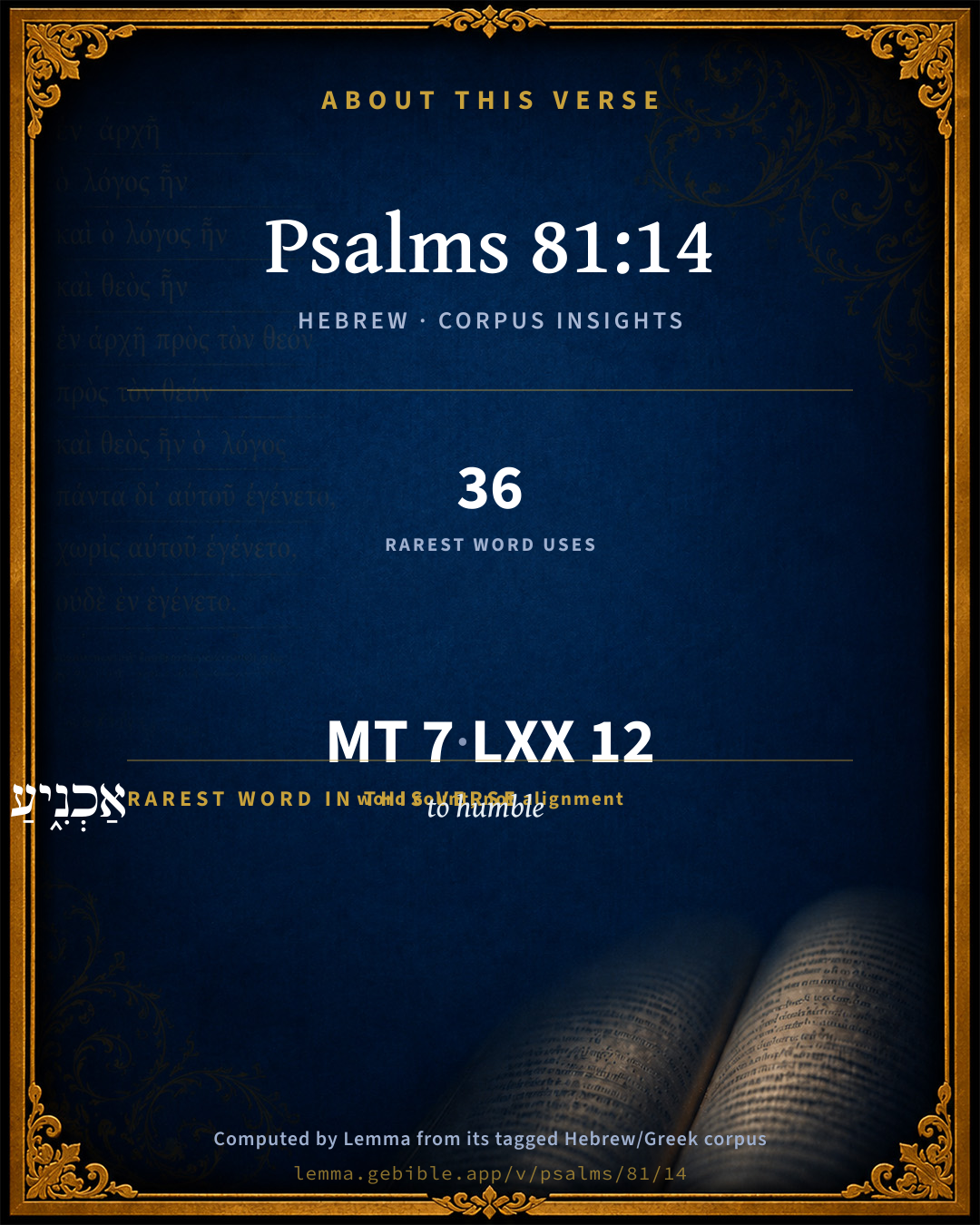
אַכְנִ֑יעַ to humble H3665 occurs in 32 verses of the Hebrew Bible. Also found in:

Grammatical profile

  • 3 verbs
  • 3 nouns
  • 1 preposition

Verb forms

  • אוֹיְבֵיהֶ֣ם Qal · Participle Active
  • אַכְנִ֑יעַ Hiphil · Imperfect
  • אָשִׁ֥יב Hiphil · Imperfect

Hebrew & Septuagint length

In English translation the verse runs 13 words from the Hebrew and 20 from the Septuagint (LXX English) — closely comparable.

A rough comparison of the two English renderings, which tokenize alike — not a word-level alignment.

Word counts can differ between the Hebrew and the Greek without any difference in meaning — e.g. the Hebrew direct-object marker אֵת has no separate Greek word, and Greek often adds the article ὁ.

In the original languages it is 7 Hebrew tokens and 12 Greek tokens — but the two are counted differently (Hebrew bundles its prefixes and suffixes into one token; the Greek is in lemma form), so that isn’t a like-for-like length.

Cross-references

7

Topical passages linked to Psalms 81:14 in the Treasury of Scripture Knowledge — connected by theme and wording, ordered by reader-vote popularity; previews shown in the World English Bible.

  • Judges 2:20–23 The anger of Yahweh was kindled against Israel; and he said, Because this nation have transgressed my covenant which I commanded their fathers, and have not listened to my voice;
  • Amos 1:8 I will cut off the inhabitant from Ashdod, And him who holds the scepter from Ashkelon; And I will turn my hand against Ekron; And the remnant of the Philistines will perish," says the Lord Yahweh.
  • Joshua 23:13 know for a certainty that Yahweh your God will no more drive these nations from out of your sight; but they shall be a snare and a trap to you, and a scourge in your sides, and thorns in your eyes, until you perish from off this good land which Yahweh your God has given you.
  • Numbers 14:9 Only don't rebel against Yahweh, neither fear the people of the land; for they are bread for us: their defense is removed from over them, and Yahweh is with us: don't fear them.
  • Numbers 14:45 Then the Amalekite came down, and the Canaanite who lived in that mountain, and struck them and beat them down, even to Hormah.
  • Psalms 47:3 He subdues nations under us, And peoples under our feet.
  • Zechariah 13:7 "Awake, sword, against my shepherd, And against the man who is close to me," says Yahweh of Hosts. Strike the shepherd, and the sheep will be scattered; And I will turn my hand against the little ones.

Cross-references courtesy of OpenBible.info (CC BY 4.0).

Hebrew and Greek witnesses Masoretic Hebrew ↔ Greek Septuagint

The same verse in the two great witnesses to the Old Testament, shown verse-for-verse.

You’re reading Greek Psalm 80 (Hebrew Psalm 81). The Septuagint counts the superscription, so verse numbers can differ from the Hebrew — chapter-level alignment, not verse-by-verse. Numbering follows Rahlfs.

These are two independent witnesses, not word-aligned to each other, and the Septuagint is shown in lemma (dictionary) form.

Hebrew Psalms 81:14 Masoretic · Westminster Leningrad Codex

כִּ֭מְעַט אוֹיְבֵיהֶ֣ם אַכְנִ֑יעַ וְעַ֥ל צָ֝רֵיהֶ֗ם אָשִׁ֥יב יָדִֽי

I would soon subdue their enemies, And turn my hand against their adversaries.

World English Bible · Public Domain

Greek LXX Greek Psalm 80:14 Septuagint · lemma form

εἰ ὁ λαός ἐγώ ἀκούω ἐγώ ἰσραήλ ὁ ὁδός ἐγώ εἰ πορεύομαι

I should have put down their enemies very quickly, and should have laid my hand upon those that afflicted them.

LXX2012 (modern English Septuagint) · Public Domain

Hebrew: Westminster Leningrad Codex (CC BY 4.0). Greek: Septuagint (public domain); English from LXX2012 (modern English Septuagint) (Public Domain). How the Septuagint differs from the Hebrew →

Commentary

Notes on Psalms 81:14 from classic Christian and Jewish commentators (each source and its license shown beneath its notes). The classic Christian expositions comment on the surrounding passage and are grouped to its opening verse, so a note may address several verses; the Jewish commentaries on the Tanakh (Rashi and others) are per-verse, so they appear only where the commentator wrote on this verse.

Lemma curates 59 commentaries, every one of them public domain or Creative Commons licensed, each selected and text-cleaned for this edition rather than reprinted as found. About our sources →

Trapp's Complete Commentary

John Trapp

Psa 81:14 I should soon have subdued their enemies, and turned my hand against their adversaries.

Ver. 14. I should soon have subdued] I would have turned the scales, and made them as much overweight to their enemies as they were to them.

And turned my hand, &c.] God, with a turn of his hand, can overturn his enemies, and relieve his little ones, Zec 13:7. If he but spread forth his hands, as a swimmer spreadeth forth his hands to swim, he shall bring down the pride of oppressors together, Isa 25:11.

John Trapp, A Commentary or Exposition upon All the Books of the Old and New Testament (1647–1656) — public domain. Text from a community e-Sword module.

Joseph Benson's Commentary

Psa 81:14-15. I would soon have subdued their enemies — Both those remaining Canaanites, whom now, for their unbelief and apostacy, I have left in the land, to be snares and plagues to them, and also all their encroaching and vexatious neighbours, who have so often invaded and laid waste their country. The haters of the Lord — The enemies of God’s people, such as the neighbouring nations were; should have submitted themselves — Should have owned and professed their subjection to them, if not also have become proselytes to the true religion. He terms them haters of the Lord, partly because they hated the Israelites for God’s sake, and on account of the singularity of their worship, as the heathen often declared; and partly to show the close union and solemn league and covenant which were between God and them, by virtue of which God had declared he would account their friends to be his friends, and their enemies to be his enemies. But their time — That is, Israel’s time, meaning, either, 1st, Their happy time, life being often put for a happy life or state; or, rather, 2d, The duration of their commonwealth; should have endured for ever — Should have lasted for a long time; whereas now their latter and doleful end is hastening toward them. It may be proper to observe here the original expression, rendered, should have submitted themselves to him, is, יכחשׁו לו, jecachashu lo, which, as we have more than once had occasion to observe, signifies, should have lied unto him, that is, spoken fair, fawned, and pretended great respect to the Jewish people and their God, though in reality they hated them both. In this sense the words are understood by Bishop Patrick, whose paraphrase upon the verse is well worth transcribing. “All that maligned their prosperity,” (the prosperity of Israel,) “and set themselves against the design of the Lord, to make them victorious over their enemies, should have been so daunted, that they should have dissembled their inward hatred, and been forced, at least, to counterfeit submission; but his people should have seen blessed days, and have enjoyed a substantial and durable happiness without any interruption.”

Joseph Benson's Commentary on the Old and New Testaments (1811–1818) — public domain. Text from a community e-Sword module.

J. A. Alexander on Psalms

Joseph Addison Alexander

15. (Psa 81:14) Soon would I bow clown their enemies, and on their foes bring back my hand. The first Hebrew phrase strictly means like a little, but is used like the English yet a little, i.e. in a little while. See above, on Psa 2:12, and compare Psa 73:2. To draw back the hand, in Psa 74:11, means to withdraw or withhold it from action; but in this connection it conveys the opposite idea of bringing it again into action, with specific reference, as some suppose, to its use in former exigencies, Psa 81:7. The phrase itself denotes mere action; the idea of hostile or destructive action is suggested by the context. See my note on Isa 1:25.

Joseph Addison Alexander, The Psalms Translated and Explained (1850) — public domain. Text from a community e-Sword module.

Geneva Bible (1599)

Geneva Bible translators

If their sins had not letted.

Geneva Bible (1599) marginal notes — public domain. Text via Bolls.life.

Adam Clarke's Commentary

Verse 14. I should soon have subdued] If God's promise appeared to fail in behalf of his people, it was because they rejected his counsel, and walked in their own. While they were faithful, they prospered; and not one jot or tittle of God's word failed to them.

Adam Clarke's Commentary on the Bible (1810–1826) — public domain. Text from a community e-Sword/MySword module.

John Calvin's Commentaries

14. I would soon have brought their enemies low. Here the Israelites are taught, that all the calamities which had befallen them were to be imputed to their own sins; for their enemies did not fight against them with any other strength than that with which they were supplied from above. God had promised that under his leading the chosen people would prove victorious over all their enemies; and now to take away all ground for charging him with violating his word, he affirms that he would not have failed to enable them to do this had he not been prevented by their sins. He doubtless intends tacitly to remind them that the victories which they had formerly achieved were not owing to their own military valor, but to Him under whose conduct they had been placed. Now, he tells them that he was not only kept back by their sins from putting forth his power to defend them, but that he was also compelled by their perverseness to rush against them with the sword in his hand, while he left their enemies to remain in undisturbed tranquillity.

John Calvin's Commentaries (1540-1563) — public domain. Text from the Calvin Translation Society English edition (1840s-50s) via the Christian Classics Ethereal Library (ccel.org). Calvin's coverage is partial (roughly two-thirds of the Bible); uncommented books and verses are honest gaps, never fabricated. The 19th-century editor's footnotes and remarks are omitted so the notes are faithfully Calvin's own voice.

The Cambridge Bible for Schools and Colleges

gen. ed. J. J. S. Perowne

14. I should soon subdue their enemies,

And turn my hand against their adversaries.

In my ways is the contrast to in their own counsels. (Jer_7:23-24.) The hand which is now turned against Israel in chastisement would be turned against their enemies.

The Cambridge Bible for Schools and Colleges (gen. ed. J. J. S. Perowne; Cambridge University Press, 1878–1918) — public domain. Text from a community e-Sword module.

John Gill's Exposition

The haters of the Lord should have submitted themselves unto him,.... Or, "lied unto him" (h); feignedly submitted to him, flattered him, pretended friendship to him, and entered into a league with him; either Israel, mentioned Psa 81:13, our God, whom and whose worship and people they hated; as every natural man is an hater of God, and all that is good, and enmity itself unto him; but these shall all submit to Christ, sooner or later, in one way or another, and acknowledge him Lord, and that he is superior to them, and themselves not a match for him; as Julian the emperor when wounded, said, Thou hast overcome me, O Galilean:

but their time should have endured for ever; which Jarchi and Aben Ezra interpret of the calamities and vengeance that should come upon the haters of God, who will be punished with everlasting destruction; their worm will never die, nor their fire be quenched; it is everlasting, and the smoke of their torment will ascend for ever and ever; in which sense the word is used, Isa 13:22 or rather this is to be understood of the time, or happy state and condition, of the Israelites, which would have been of long continuance, had they hearkened to the Lord, and walked in his ways; particularly, they would have long enjoyed the land of Canaan, which was given to Abraham and his seed for an everlasting possession, and which they held by the tenure of their obedience, Gen 17:8, and so all truly gracious souls, that hearken to the voice of Christ, and walk in his ways, are in a happy state, which will endure for ever; they are blessed with all spiritual blessings, and those are for ever; the heavenly land of Canaan they shall dwell in for ever; their mansions or habitations in Christ's Father's house are everlasting; their house, not made with hands, is eternal in the heavens; their estate, possession, and inheritance is an eternal one; it is incorruptible, and fades not away; their being with Christ is for ever; and their happiness is often expressed by eternal life and eternal glory.

(h) "mentientur", Montanus; "mentiti fuissent", Vatablus; "mentirentur", Musculus, Cocceius, Gejerus; "mendaciter se dedissent", Junius & Tremellius, Piscator.

John Gill's Exposition of the Whole Bible (1746–1763) — public domain (CC PDM 1.0). Text via the HelloAO Bible API.

Albert Barnes' Notes on the Bible

I should soon have subdued their enemies - This is one of the consequences which, it is said, would have followed if they had been obedient to the laws of God. The phrase rendered soon means literally like a little; that is, as we might say, in a little, to wit, in a little time. The word rendered subdued means to bow down; to be curved or bent; and the idea is, that he would have caused them to bow down, to wit, by submission before them. Compare Deu 32:29-30.

And turned my hand against their adversaries - Against those who oppressed and wronged them. The act of turning the hand against one is significant of putting him away - repelling him - disowning him - as when we would thrust one away from us with aversion.

Albert Barnes' Notes on the Bible (1834–1885) — public domain. Text from a community e-Sword/MySword module.

Matthew Poole's English Annotations

Those remainders of the Canaanites whom now for their unbelief and apostacy I have left in the land to be snares and plagues to them.

Matthew Poole's English Annotations on the Holy Bible (1683–1685) — public domain. Text from a community e-Sword/MySword module.

The Treasury of David

Charles H. Spurgeon

Ver. 14. I should soon have subdued their enemies. As he did in Egypt overthrow Pharaoh, so would he have baffled every enemy.

And turned my hand against their adversaries. He would have smitten them once, and then have dealt them a return blow with the back of his hand. See what we lose by sin. Our enemies find the sharpest weapons against us in the armoury of our transgressions. They could never overthrow us if we did not first overthrow ourselves. Sin strips a man of his armour, and leaves him naked to his enemies. Our doubts and fears would long ago have been slain if we had been more faithful to our God. Ten thousand evils which afflict us now would have been driven far from us if we had been more jealous of holiness in our walk and conversation. We ought to consider not only what sin takes from our present stock, but what it prevents our gaining: reflections will soon show us that sin always costs us dear. If we depart from God, our inward corruptions are sure to make a rebellion. Satan will assail us, the world will worry us, doubts will annoy us, and all through our own fault. Solomon's departure from God raised up enemies against him, and it will be so with us, but if our ways please the Lord he will make even our enemies to be at peace with us.

Ver. 14. Turned my hand. God expresseth the utter overthrow of the enemies of his people, but by the turning of a hand: if God do but turn his hand, they are all gone presently, soon subdued. If he do but touch the might, the pomp, the greatness, the riches and the power of all those in the world that are opposers of his church, presently they fall to the ground: a touch from the hand of God will end our wars. Joseph Caryl.

Ver. 14. Spiritual enemies best combatted by an obedient life.

Psalms 81:15*

Charles H. Spurgeon's The Treasury of David (1869–1885) — public domain. Psalms only. Text from a community e-Sword/MySword module.

Whedon's Commentary on the Bible

Daniel D. Whedon

14. I should soon—In a little time, quickly. So near were they to a happy consummation, had they hearkened to God, and trustingly gone forward.

Turned my hand against their adversaries—But disobedience reversed the order, and the judgments which might have held their enemies in awe, or swept them from the earth, were turned against themselves.

Daniel D. Whedon (gen. ed.), Commentary on the Old and New Testaments (1874–1909) — public domain. Text from a community e-Sword module.

The Pulpit Commentary

I should soon have subdued (rather, I should won subdue) their enemies. Israel is still surrounded by enemies, anxious for his destruction. God could subdue them and sweep them away in a moment, if he pleased; and would do so, if Israel would repent and return to him. The appeal is to the living Israel the Israel of the psalmist"s time, which is given one more chance of triumph over its enemies. And turned my hand against their adversaries. Logically, the two clauses should have been inverted, since the subjugation of Israel"s enemies would be the effect of God"s hand being turned against them.

The Pulpit Commentary (1880–1919), ed. H.D.M. Spence-Jones & Joseph S. Exell — public domain. Text from a community e-Sword module.

Rashi

Rabbi Shlomo Yitzchaki (Rashi)

If only My people would hearken to Me Still, if they desired to return to Me and to hearken to Me...

Rashi on the Tanakh — English translations: “The Judaica Press complete Tanach with Rashi, translated by A. J. Rosenberg” (CC BY 4.0); “Pentateuch with Rashi's commentary by M. Rosenbaum and A.M. Silbermann, 1929-1934” (public domain); “The Metsudah Tanach series, Lakewood, N.J” (CC BY 4.0); and “The Book of Joshua, Metsudah Publications, 1997” (CC BY 4.0). Text via Sefaria.

Lesson kit

Teaching starters — assembled from the data on this page, not authored interpretation. Every prompt links to the verse data it draws on. Edit before teaching.

Psalms, in the Wisdom, opens this verse with 7 words (7 distinct Hebrew lemmas). Its most distinctive word is kânaʻ (“to humble”). A historical commentator’s framing appears above. Read the whole chapter for the surrounding context.

Discussion questions

  1. What does “to humble” (kânaʻ) contribute to the verse as a whole?
  2. Leviticus 26:41 shares the word «to humble» with this verse. How do the two illuminate each other?
  3. These translations render this verse differently. What is at stake in choosing one wording over another?
  4. The verb «אוֹיְבֵיהֶ֣ם» is Qal Participle Active. How does its form color the action?
  5. Reading how Trapp's Complete Commentary and Joseph Benson's Commentary read this verse, where do the two commentators agree and where do they part?

Things to notice

Reading settings

Reading text

Shown beneath each verse's original-language words.

Old Testament
Old Testament edition

Read the OT as the Masoretic Hebrew (MT) or the Greek Septuagint (LXX).

English shown for the Greek Septuagint (in the Hebrew ↔ Greek comparison).

Comparing translations? Open the Compare panel on any verse page to stack up to four side by side.