
Psalms 80:6

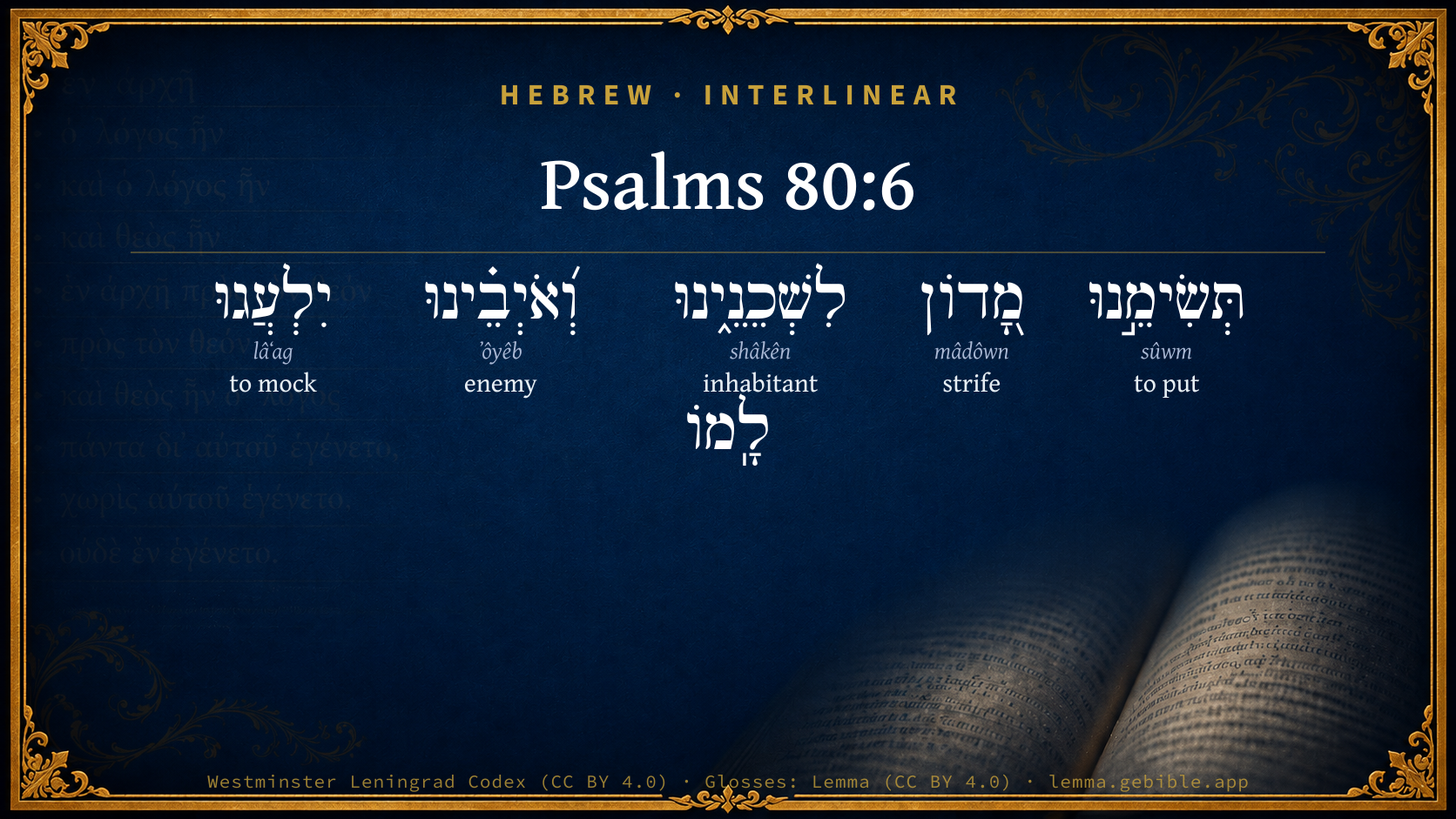
Hebrew (Westminster Leningrad Codex) Psalms 80:6 appears in the Hebrew Old Testament. The text above is from the Westminster Leningrad Codex. Each word links to its Strong’s number, a concise gloss, and parsing drawn from the Open Scriptures Hebrew Bible morphology. Click any word for its full Brown-Driver-Briggs (BDB) entry.
Download image
Cite this verse

Psalms 80:6 (World English Bible). Public Domain. Lemma interlinear Bible study tool, https://lemma.gebible.app/v/psalms/80/6.

Show BibTeX & RIS
BibTeX
RIS
English Translation
You make us a source of contention to our neighbors. Our enemies laugh among themselves.
World English Bible · Public Domain
Highlights
  • 1 first appearance in the Hebrew Bible
Full analysis ↓
Download a study sheet

One document with this verse’s original text, its word-by-word gloss line, the meaning frame, cross-references with their text, attributed commentary, and full source and license credits — printable, and it pastes into notes with its structure intact.

This verse Autodidact and up

Study sheet (.html) Plain text (.txt)

A passage Seminary Student

Up to 50 verses in one chapter. A passage sheet keeps up to 6 commentary sources and 12 cross-references per verse, in the order this page ranks them, and says so on the sheet whenever that leaves anything out. Ask for a single verse and you get the Autodidact verse sheet above.

Everything on this page stays free to read, with no account — the sheet is a download of what is already on screen, not access to it.

Want to remove ads? Support Godless Engineer
Compare translations 3

The same verse in 3 English versions, stacked beneath the original-language interlinear above. Click any original word for its lexicon entry.

Each is an independent rendering of the whole verse — the interlinear is not word-aligned to these translations.

Highlighted words mark where these versions differ — a whole-verse word diff, not a word-by-word alignment.

  • World English Bible Public Domain
    You make us a source of contention to our neighbors. Our enemies laugh among themselves.
  • King James Version Public Domain
    Thou makest us a strife unto our neighbours: and our enemies laugh among themselves.
  • unfoldingWord Literal Text CC BY-SA 4.0
    You have made us strife to our neighbors, and our enemies mock among themselves.

unfoldingWord Literal Text — © unfoldingWord, licensed CC BY-SA 4.0. Word-aligned USFM3 via Door43 (git.door43.org/unfoldingWord/en_ult).

Versions to compare (up to 4)

3 of 4 selected

Show all 18 translations

Every available English version of this verse, each an independent rendering of the whole verse.

  • World English Bible Public Domain
    You make us a source of contention to our neighbors. Our enemies laugh among themselves.
  • Berean Standard Bible Public Domain
    You make us contend with our neighbors; our enemies mock us.
  • Majority Standard Bible Public Domain
    You make us contend with our neighbors; our enemies mock us.
  • King James Version Public Domain
    Thou makest us a strife unto our neighbours: and our enemies laugh among themselves.
  • American Standard Version (1901) Public Domain
    Thou makest us a strife unto our neighbors; And our enemies laugh among themselves.
  • Revised Version (1885) Public Domain
    Thou makest us a strife unto our neighbours: and our enemies laugh among themselves.
  • Geneva Bible (1599) Public Domain
    Thou hast made vs a strife vnto our neighbours, and our enemies laugh at vs among themselues.
  • Douay-Rheims (1899) Public Domain
    How long wilt thou feed us with the bread of tears: and give us for our drink tears in measure?
  • Young's Literal Translation Public Domain
    Thou makest us a strife to our neighbors, And our enemies mock at it.
  • Literal Standard Version CC BY-SA 4.0
    You make us a strife to our neighbors, || And our enemies mock at it.
  • Unlocked Literal Bible CC BY-SA 4.0
    You make us something for our neighbors to argue over, and our enemies laugh about us among themselves.
  • unfoldingWord Literal Text CC BY-SA 4.0
    You have made us strife to our neighbors, and our enemies mock among themselves.
  • Darby Bible Public Domain
    Thou hast made us a strife unto our neighbours, and our enemies mock among themselves.
  • World Messianic Bible Public Domain
    You make us a source of contention to our neighbors. Our enemies laugh among themselves.
  • Webster's Bible Public Domain
    \\80:5\\Thou feedest them with the bread of tears; and givest them tears to drink in great measure.
  • Free Bible Version CC BY-SA 4.0
    You turn us into victims our neighbors fight over; our enemies mock us.
  • Bible in Basic English Public Domain
    You make us a cause of war among our neighbours; our haters are laughing at us among themselves.
  • JPS Tanakh (1917) Public Domain
    (80-7) Thou makest us a strife unto our neighbours; and our enemies mock as they please.

Literal Standard Version (2020), Covenant Press — licensed CC BY-SA 4.0. Text via the HelloAO Bible API (eBible.org). Unlocked Literal Bible (unfoldingWord) — licensed CC BY-SA 4.0. Text via the HelloAO Bible API (eBible.org). unfoldingWord Literal Text — © unfoldingWord, licensed CC BY-SA 4.0. Word-aligned USFM3 via Door43 (git.door43.org/unfoldingWord/en_ult). Free Bible Version, Dr. Jonathan Gallagher — licensed CC BY-SA 4.0. Text via the HelloAO Bible API (eBible.org).

Word by word

More ways to search: Search by grammar → Find every occurrence → Compare this word →

Practice this passage: Drill this verse → Learn its vocabulary →

About this verse

These counts appear in no published source. They are computed here, from the morphology-tagged text and Lemma’s own curated glosses. What Lemma adds →

6
words
5
distinct lemmas
Wisdom
section

Notable vocabulary

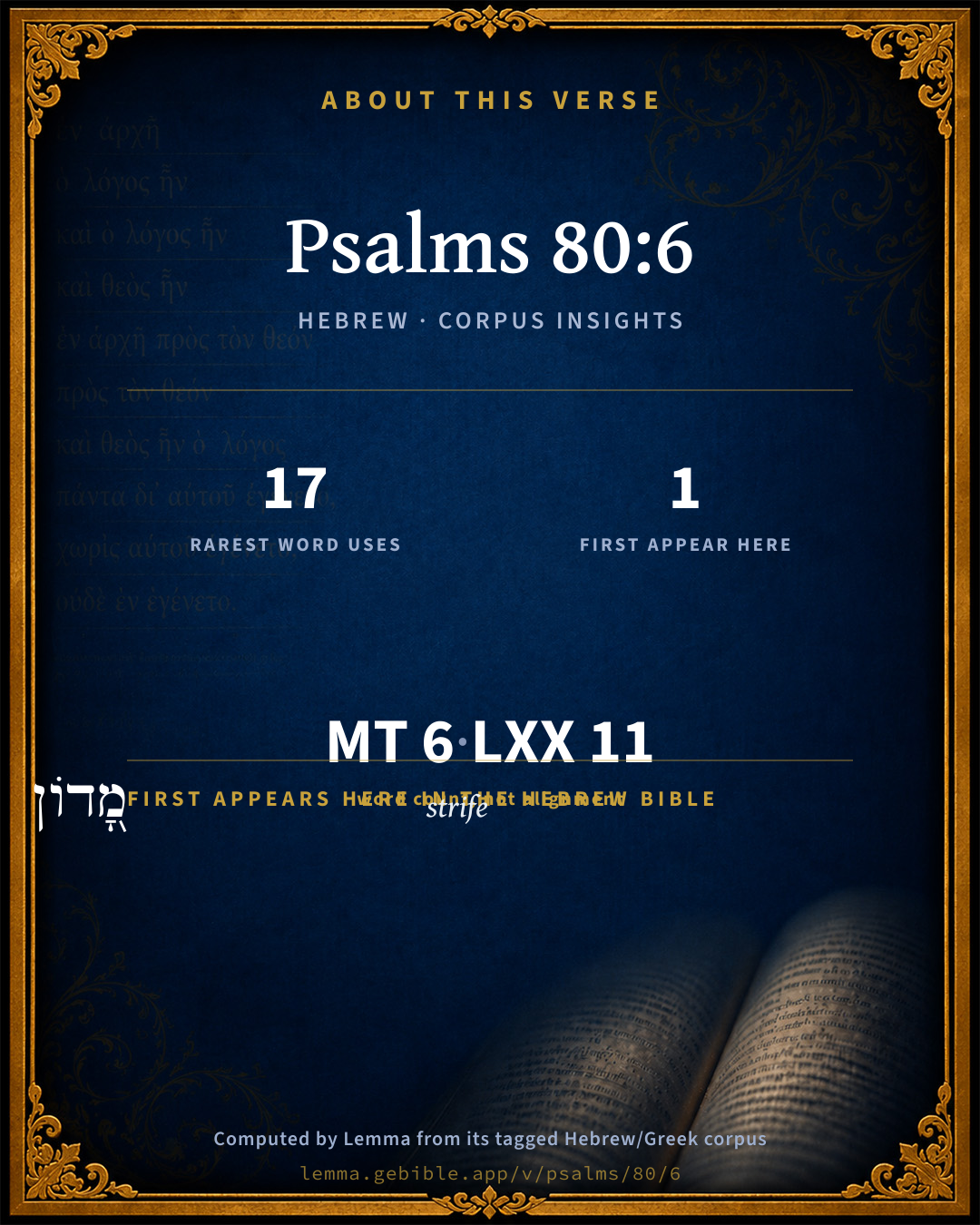
The rarest word here is מָ֭דוֹן strife H4066 — appearing just 17 times in the whole Hebrew Bible.

First appearance in Scripture

This word makes its first canonical appearance in the Hebrew Bible here:

  • מָ֭דוֹן strife H4066

Shared distinctive vocabulary

מָ֭דוֹן strife H4066 occurs in 17 verses of the Hebrew Bible. Also found in:

Grammatical profile

  • 3 verbs
  • 1 noun
  • 1 adjective
  • 1 preposition

Verb forms

  • תְּשִׂימֵ֣נוּ Qal · Imperfect
  • וְ֝אֹיְבֵ֗ינוּ Qal · Participle Active
  • יִלְעֲגוּ Qal · Imperfect

Hebrew & Septuagint length

In English translation the verse runs 15 words from the Hebrew and 16 from the Septuagint (LXX English) — closely comparable.

A rough comparison of the two English renderings, which tokenize alike — not a word-level alignment.

Word counts can differ between the Hebrew and the Greek without any difference in meaning — e.g. the Hebrew direct-object marker אֵת has no separate Greek word, and Greek often adds the article ὁ.

In the original languages it is 6 Hebrew tokens and 11 Greek tokens — but the two are counted differently (Hebrew bundles its prefixes and suffixes into one token; the Greek is in lemma form), so that isn’t a like-for-like length.

Cross-references

10

Topical passages linked to Psalms 80:6 in the Treasury of Scripture Knowledge — connected by theme and wording, ordered by reader-vote popularity; previews shown in the World English Bible.

  • Psalms 79:4 We have become a reproach to our neighbors, A scoffing and derision to those who are around us.
  • Judges 16:25 It happened, when their hearts were merry, that they said, Call for Samson, that he may make us sport. They called for Samson out of the prison-house; and he made sport before them. They set him between the pillars:
  • Psalms 44:13–14 You make us a reproach to our neighbors, A scoffing and a derision to those who are around us.
  • Isaiah 36:8 Now therefore, please give pledges to my master the king of Assyria, and I will give you two thousand horses, if you are able on your part to set riders on them.
  • Isaiah 36:12–20 But Rabshakeh said, Has my master sent me to your master, and to you, to speak these words? [has he] not [sent me] to the men who sit on the wall, to eat their own dung, and to drink their own water with you?
  • Isaiah 37:23 Whom have you defied and blasphemed? and against whom have you exalted your voice and lifted up your eyes on high? [even] against the Holy One of Israel.
  • Jeremiah 15:10 Woe is me, my mother, that you have borne me a man of strife and a man of contention to the whole earth! I have not lent, neither have men lent to me; [yet] everyone of them does curse me.
  • Jeremiah 48:27 For wasn't Israel a derision to you? was he found among thieves? for as often as you speak of him, you wag the head.
  • Ezekiel 36:4 therefore, you mountains of Israel, hear the word of the Lord Yahweh: Thus says the Lord Yahweh to the mountains and to the hills, to the watercourses and to the valleys, to the desolate wastes and to the cities that are forsaken, which are become a prey and derision to the residue of the nations that are round about;
  • Revelation 11:10 Those who dwell on the earth rejoice over them, and they will be glad. They will give gifts to one another, because these two prophets tormented those who dwell on the earth.

Cross-references courtesy of OpenBible.info (CC BY 4.0).

Hebrew and Greek witnesses Masoretic Hebrew ↔ Greek Septuagint

The same verse in the two great witnesses to the Old Testament, shown verse-for-verse.

You’re reading Greek Psalm 79 (Hebrew Psalm 80). The Septuagint counts the superscription, so verse numbers can differ from the Hebrew — chapter-level alignment, not verse-by-verse. Numbering follows Rahlfs.

These are two independent witnesses, not word-aligned to each other, and the Septuagint is shown in lemma (dictionary) form.

Hebrew Psalms 80:6 Masoretic · Westminster Leningrad Codex

תְּשִׂימֵ֣נוּ מָ֭דוֹן לִשְׁכֵנֵ֑ינוּ וְ֝אֹיְבֵ֗ינוּ יִלְעֲגוּ לָֽמוֹ

You make us a source of contention to our neighbors. Our enemies laugh among themselves.

World English Bible · Public Domain

Greek LXX Greek Psalm 79:6 Septuagint · lemma form

ψωμίζω ἐγώ ἄρτος δάκρυ καί ποτίζω ἐγώ ἐν δάκρυ ἐν μέτρον

You have made us a strife to our neighbors; and our enemies have mocked at us.

LXX2012 (modern English Septuagint) · Public Domain

On this verse, Ellicott's Commentary for English Readers discusses the Septuagint’s reading. Read the note in Commentary ↓

Hebrew: Westminster Leningrad Codex (CC BY 4.0). Greek: Septuagint (public domain); English from LXX2012 (modern English Septuagint) (Public Domain). How the Septuagint differs from the Hebrew →

Commentary

Notes on Psalms 80:6 from classic Christian and Jewish commentators (each source and its license shown beneath its notes). The classic Christian expositions comment on the surrounding passage and are grouped to its opening verse, so a note may address several verses; the Jewish commentaries on the Tanakh (Rashi and others) are per-verse, so they appear only where the commentator wrote on this verse.

Lemma curates 59 commentaries, every one of them public domain or Creative Commons licensed, each selected and text-cleaned for this edition rather than reprinted as found. About our sources →

Trapp's Complete Commentary

John Trapp

Psa 80:6 Thou makest us a strife unto our neighbours: and our enemies laugh among themselves.

Ver. 6. Thou makest us a strife unto our neighbours] We have as many enemies as neighbours, all striving to enslave us. We are crushed between them as corn is between millstones.

And our enemies laugh among themselves] Make them merry in our misery, revel in our ruins.

John Trapp, A Commentary or Exposition upon All the Books of the Old and New Testament (1647–1656) — public domain. Text from a community e-Sword module.

J. A. Alexander on Psalms

Joseph Addison Alexander

7. (Psa 80:6) Thou makest us a strife unto our neighbours, and our enemies amuse themselves (at our expense). The future verbs imply a probable continuance of this humiliating treatment unless God interpose to put an end to it, and thus suggest a reason for his doing so. Makest us, literally puttest, settest up. See above, on Psa 44:13. A strife, a subject of contention, perhaps in reference to the emulous desire of their neighbours to insult and aggravate their sufferings. Here, as in Psa 44:13; Psa 79:4, these neighbours are the circumjacent nations, who always triumphed in the time of Israel's calamities (Amo 1:9; Amo 1:11, Oba 1:12). The literal translation of the last words is will mock (or scoff) for them, i.e. for themselves, for their own gratification, and at their own discretion, as they will.

Joseph Addison Alexander, The Psalms Translated and Explained (1850) — public domain. Text from a community e-Sword module.

Geneva Bible (1599)

Geneva Bible translators

Our neighbors have continual strife and war against us.

Geneva Bible (1599) marginal notes — public domain. Text via Bolls.life.

Adam Clarke's Commentary

Verse 6. Thou makest us a strife] The neighbouring districts have a controversy about us; we are a subject of contention to them. A people so wonderfully preserved, and so wonderfully punished, is a mystery to them. They see in us both the goodness and severity of God. Or, all the neighbouring nations join together to malign and execrate us. We are hated by all; derided and cursed by all.

Adam Clarke's Commentary on the Bible (1810–1826) — public domain. Text from a community e-Sword/MySword module.

Ellicott's Commentary for English Readers

(6) A strife—i.e., an object of contention. In no other sense could Israel be a strife to neighbouring nations. For the bearing of this on the date of the psalm see its Introduction.

Laugh among themselves.—Literally, for themselves. But LXX. and Vulg. read, “at us.”

A Bible Commentary for English Readers, edited by Charles John Ellicott (1878–1897) — public domain. Text from a community e-Sword module.

The Cambridge Bible for Schools and Colleges

gen. ed. J. J. S. Perowne

6. a strife &c.] An object of contention (Jer_15:10): the petty states round about (Psa_79:4; Psa_79:12), Edomites, Arabians, and the like, quarrel among themselves for our territory. Lagarde conjectures that we should read mânôd, shaking (of the head), for mâdôn, strife, as in Psa_44:14, which would suit the parallelism better.

laugh among themselves] Rather, to their heart’s content, so, laugh scornfully. Cp. Psa_79:4.

P.B.V. ‘laugh us to scorn’ follows LXX, Vulg., Jer.

The Cambridge Bible for Schools and Colleges (gen. ed. J. J. S. Perowne; Cambridge University Press, 1878–1918) — public domain. Text from a community e-Sword module.

John Gill's Exposition

Thou makest us a strife unto our neighbours,.... Either obliges us to contend with them for our defence and safety; or having given us into their hands, they strive and contend one with another about dividing the spoil:

and our enemies laugh among themselves; at us, and because there is no help for us in God, as they imagine; or at God himself, as Kimchi, saying he cannot save as.

John Gill's Exposition of the Whole Bible (1746–1763) — public domain (CC PDM 1.0). Text via the HelloAO Bible API.

Albert Barnes' Notes on the Bible

Thou makest us a strife - An occasion of strife or wrangling; that is, of strife among themselves, to see who will get the most of our spoils; or of contention, to see which could do most to aggravate their sufferings, and to bring disgrace and contempt upon them. They were emulous with each other in the work of desolation and ruin.

Unto our neighbors - The surrounding nations. See Psa 79:4.

And our enemies laugh among themselves - Over our calamities. They exult; they glory; they triumph in our ruin.

Albert Barnes' Notes on the Bible (1834–1885) — public domain. Text from a community e-Sword/MySword module.

Matthew Poole's English Annotations

A strife, i.e. the object or matter of their strife or contention; either,

1. They strive one with another who shrill do us most mischief, or take our spoils to themselves; or,

2. They are perpetually quarrelling with us, and seeking occasions against us. Our neighbours, who used and ought to live peaceably and kindly with us. Laugh among themselves; insult over us, and take pleasure in our miseries.

Matthew Poole's English Annotations on the Holy Bible (1683–1685) — public domain. Text from a community e-Sword/MySword module.

The Treasury of David

Charles H. Spurgeon

Ver. 6. "Thou makest us a strife unto our neighbours." Always jealous and malicious, Edom and Moab exulted over Israel's troubles, and then fell to disputing about their share of the spoil. A neighbour's jeer is ever most cutting, especially if a man has been superior to them, and claimed to possess more grace. None are unneighbourly as envious neighbours.

"And our enemies laugh among themselves." They find mirth in our misery, comedy in our tragedy, salt for their wit in the brine of our tears, amusement in our amazement. It is devilish to sport with another's griefs; but it is the constant habit of the world which lieth in the wicked one to make merry with the saints' tribulations; the seed of the serpent follow their progenitor and rejoice in evil.

None.

None.

Psalms 80:7*

Charles H. Spurgeon's The Treasury of David (1869–1885) — public domain. Psalms only. Text from a community e-Sword/MySword module.

Whedon's Commentary on the Bible

Daniel D. Whedon

6. Thou makest us a strife unto our neighbours—Thou makest us an object, or butt, of contention. We appear to our neighbours as though thou hadst a controversy with us. Or, it may mean, that by not coming to their help, and turning them back to a better state, God held up to the scorn and derision of the neighbouring nations the intestine quarrels of the Hebrew family, thus prolonging the shame of their dissensions. But whether the “strife” lay between the people and their God, or between the different branches of their own brotherhood, the petty nations around them, who always wished them evil, looked on and laughed among themselves. So is it ever with the world when the Church is distracted with divisions and factions.

Daniel D. Whedon (gen. ed.), Commentary on the Old and New Testaments (1874–1909) — public domain. Text from a community e-Sword module.

The Pulpit Commentary

Thou makest us a strife unto our neighbours. A great invasion, Assyrian or Babylonian, was always a signal to the near neighbours of Israel Syria, Moab, Ammon, Edom to indulge in hostilities. (see 2Ki_24:2) And our enemies laugh among themselves. (comp. Psa_44:13 Psa_79:4)

The Pulpit Commentary (1880–1919), ed. H.D.M. Spence-Jones & Joseph S. Exell — public domain. Text from a community e-Sword module.

Rashi

Rabbi Shlomo Yitzchaki (Rashi)

You have fed them bread of tears in Egypt.

and You have given them to drink tears in large measure Heb. שליש. In Babylon, where they were for seventy years, a third (שליש) of the two hundred and ten of Egypt. I learned this from the work of Rabbi Moshe Hadarshan. It may also be interpreted as regards the kingdom of Greece, which represents the third trouble. If you ask, is that [not] the fourth, because Persia and Media came before, all the seventy years of the Babylonian exile are only one exile. Menachem (p. 175) interprets שליש as the name of a drinking vessel. So he explained (Isa. 40:12): “and He measured with a ‘shalish’ the dust of the earth.” Our Sages explained it (Mid. Ps. 80: 4) as referring to the three tears that Esau shed, concerning whom it is said (Gen. 27:34): “and he cried a cry.” That is one. “A great one.” That is two. “And a bitter one.” That is three. Because of them, he merited to live by his sword, as it is said (Gen. 27:40): “and it will come to pass when you complain, etc.”

Rashi on the Tanakh — English translations: “The Judaica Press complete Tanach with Rashi, translated by A. J. Rosenberg” (CC BY 4.0); “Pentateuch with Rashi's commentary by M. Rosenbaum and A.M. Silbermann, 1929-1934” (public domain); “The Metsudah Tanach series, Lakewood, N.J” (CC BY 4.0); and “The Book of Joshua, Metsudah Publications, 1997” (CC BY 4.0). Text via Sefaria.

Lesson kit

Teaching starters — assembled from the data on this page, not authored interpretation. Every prompt links to the verse data it draws on. Edit before teaching.

Psalms, in the Wisdom, opens this verse with 6 words (5 distinct Hebrew lemmas). Its most distinctive word is mâdôwn (“strife”). A historical commentator’s framing appears above. Read the whole chapter for the surrounding context.

Discussion questions

  1. What does “strife” (mâdôwn) contribute to the verse as a whole?
  2. The word “strife” first appears here in Scripture. What is being introduced at this debut?
  3. Proverbs 6:14 shares the word «strife» with this verse. How do the two illuminate each other?
  4. These translations render this verse differently. What is at stake in choosing one wording over another?
  5. The verb «תְּשִׂימֵ֣נוּ» is Qal Imperfect. How does its form color the action?
  6. Reading how Trapp's Complete Commentary and J. A. Alexander on Psalms read this verse, where do the two commentators agree and where do they part?

Things to notice

Reading settings

Reading text

Shown beneath each verse's original-language words.

Old Testament
Old Testament edition

Read the OT as the Masoretic Hebrew (MT) or the Greek Septuagint (LXX).

English shown for the Greek Septuagint (in the Hebrew ↔ Greek comparison).

Comparing translations? Open the Compare panel on any verse page to stack up to four side by side.