
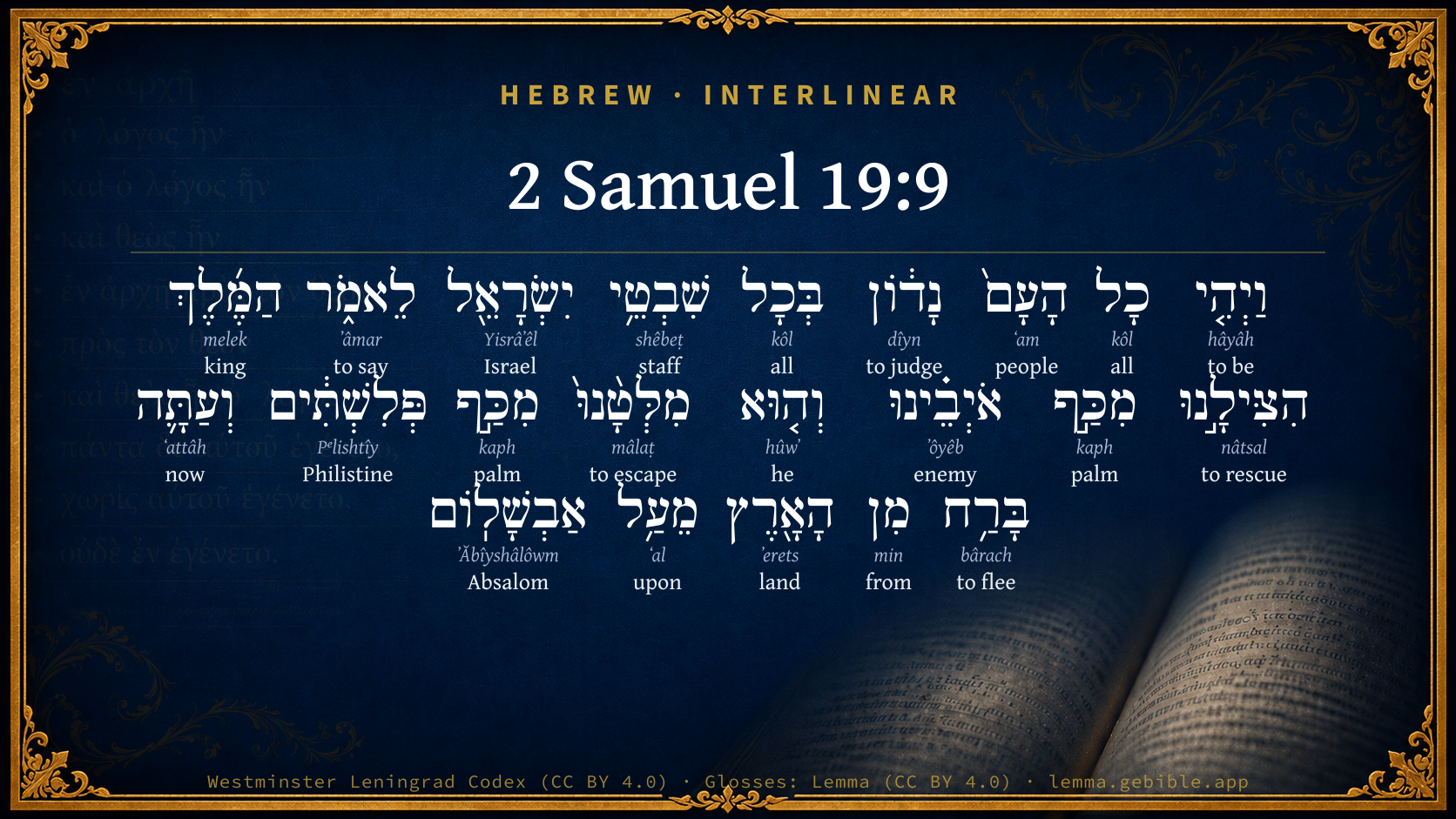
2 Samuel 19:9

Hebrew (Westminster Leningrad Codex) 2 Samuel 19:9 appears in the Hebrew Old Testament. The text above is from the Westminster Leningrad Codex. Each word links to its Strong’s number, a concise gloss, and parsing drawn from the Open Scriptures Hebrew Bible morphology. Click any word for its full Brown-Driver-Briggs (BDB) entry.
Download image
Cite this verse

2 Samuel 19:9 (World English Bible). Public Domain. Lemma interlinear Bible study tool, https://lemma.gebible.app/v/2-samuel/19/9.

Show BibTeX & RIS
BibTeX
RIS
English Translation
All the people were at strife throughout all the tribes of Israel, saying, The king delivered us out of the hand of our enemies, and he saved us out of the hand of the Philistines; and now he is fled out of the land from Absalom.
World English Bible · Public Domain
Download a study sheet

One document with this verse’s original text, its word-by-word gloss line, the meaning frame, cross-references with their text, attributed commentary, and full source and license credits — printable, and it pastes into notes with its structure intact.

This verse Autodidact and up

Study sheet (.html) Plain text (.txt)

A passage Seminary Student

Up to 50 verses in one chapter. A passage sheet keeps up to 6 commentary sources and 12 cross-references per verse, in the order this page ranks them, and says so on the sheet whenever that leaves anything out. Ask for a single verse and you get the Autodidact verse sheet above.

Everything on this page stays free to read, with no account — the sheet is a download of what is already on screen, not access to it.

Want to remove ads? Support Godless Engineer
Compare translations 3

The same verse in 3 English versions, stacked beneath the original-language interlinear above. Click any original word for its lexicon entry.

Each is an independent rendering of the whole verse — the interlinear is not word-aligned to these translations.

Highlighted words mark where these versions differ — a whole-verse word diff, not a word-by-word alignment.

  • World English Bible Public Domain
    All the people were at strife throughout all the tribes of Israel, saying, The king delivered us out of the hand of our enemies, and he saved us out of the hand of the Philistines; and now he is fled out of the land from Absalom.
  • King James Version Public Domain
    And all the people were at strife throughout all the tribes of Israel, saying, The king saved us out of the hand of our enemies, and he delivered us out of the hand of the Philistines; and now he is fled out of the land for Absalom.
  • unfoldingWord Literal Text CC BY-SA 4.0
    And it happened, all of the people were contending in all of the tribes of Israel, saying, “The king delivered us from the palm of our enemies, and he, he rescued us from the palm of the Philistines. But now he has fled from the land, away from Absalom.

unfoldingWord Literal Text — © unfoldingWord, licensed CC BY-SA 4.0. Word-aligned USFM3 via Door43 (git.door43.org/unfoldingWord/en_ult).

Versions to compare (up to 4)

3 of 4 selected

Show all 18 translations

Every available English version of this verse, each an independent rendering of the whole verse.

  • World English Bible Public Domain
    All the people were at strife throughout all the tribes of Israel, saying, The king delivered us out of the hand of our enemies, and he saved us out of the hand of the Philistines; and now he is fled out of the land from Absalom.
  • Berean Standard Bible Public Domain
    And all the people throughout the tribes of Israel were arguing, “The king rescued us from the hand of our enemies and delivered us from the hand of the Philistines, but now he has fled the land because of Absalom.
  • Majority Standard Bible Public Domain
    And all the people throughout the tribes of Israel were arguing, “The king rescued us from the hand of our enemies and delivered us from the hand of the Philistines, but now he has fled the land because of Absalom.
  • King James Version Public Domain
    And all the people were at strife throughout all the tribes of Israel, saying, The king saved us out of the hand of our enemies, and he delivered us out of the hand of the Philistines; and now he is fled out of the land for Absalom.
  • American Standard Version (1901) Public Domain
    And all the people were at strife throughout all the tribes of Israel, saying, The king delivered us out of the hand of our enemies, and he saved us out of the hand of the Philistines; and now he is fled out of the land from Absalom.
  • Revised Version (1885) Public Domain
    And all the people were at strife throughout all the tribes of Israel, saying, The king delivered us out of the hand of our enemies, and he saved us out of the hand of the Philistines; and now he is fled out of the land from Absalom.
  • Geneva Bible (1599) Public Domain
    Then all the people were at strife thorowout all the tribes of Israel, saying, The King saued vs out of the hand of our enemies, and he deliuered vs out of the hande of the Philistims, and nowe he is fled out of the lande for Absalom.
  • Douay-Rheims (1899) Public Domain
    And all the people were at strife in all the tribes of Israel, saying: The king delivered us out of the hand of our enemies, and he saved us out of the hand of the Philistines: and now he is fled out of the land for Absalom.
  • Young's Literal Translation Public Domain
    And it cometh to pass, all the people are contending through all the tribes of Israel, saying, `The king delivered us out of the hand of our enemies, yea, he himself delivered us out of the hand of the Philistines, and now he hath fled out of the land because of Absalom,
  • Literal Standard Version CC BY-SA 4.0
    And it comes to pass, all the people are contending through all the tribes of Israel, saying, “The king delivered us out of the hand of our enemies, indeed, he himself delivered us out of the hand of the Philistines, and now he has fled out of the land because of Absalom,
  • Unlocked Literal Bible CC BY-SA 4.0
    All the people were arguing with each other throughout all the tribes of Israel saying, “The king rescued us out of the hand of our enemies, and he saved us out of the hand of the Philistines, but now he has run out of the land because of Absalom.
  • unfoldingWord Literal Text CC BY-SA 4.0
    And it happened, all of the people were contending in all of the tribes of Israel, saying, “The king delivered us from the palm of our enemies, and he, he rescued us from the palm of the Philistines. But now he has fled from the land, away from Absalom.
  • Darby Bible Public Domain
    And all the people were at strife throughout the tribes of Israel, saying, The king delivered us out of the hand of our enemies, and he saved us out of the hand of the Philistines; and now he is fled out of the land because of Absalom.
  • World Messianic Bible Public Domain
    All the people were at strife throughout all the tribes of Israel, saying, “The king delivered us out of the hand of our enemies, and he saved us out of the hand of the Philistines; and now he has fled out of the land from Absalom.
  • Webster's Bible Public Domain
    And all the people were at strife throughout all the tribes of Israel, saying, The king saved us from the hand of our enemies, and he delivered us from the hand of the Philistines; and now he hath fled out of the land for Absalom.
  • Free Bible Version CC BY-SA 4.0
    Everyone among the tribes of Israel were arguing with each other, saying, “The king rescued us from the persecution of our enemies, he saved us from the Philistines, but now he's had to run from the country because of Absalom.
  • Bible in Basic English Public Domain
    And through all the tribes of Israel the people were having arguments, saying, The king made us safe from the hands of those who were against us and made us free from the hands of the Philistines; and now he has gone in flight from the land, because of Absalom.
  • JPS Tanakh (1917) Public Domain
    (19-10) And all the people were at strife throughout all the tribes of Israel, saying: 'The king delivered us out of the hand of our enemies, and he saved us out of the hand of the Philistines; and now he is fled out of the land from Absalom.

Literal Standard Version (2020), Covenant Press — licensed CC BY-SA 4.0. Text via the HelloAO Bible API (eBible.org). Unlocked Literal Bible (unfoldingWord) — licensed CC BY-SA 4.0. Text via the HelloAO Bible API (eBible.org). unfoldingWord Literal Text — © unfoldingWord, licensed CC BY-SA 4.0. Word-aligned USFM3 via Door43 (git.door43.org/unfoldingWord/en_ult). Free Bible Version, Dr. Jonathan Gallagher — licensed CC BY-SA 4.0. Text via the HelloAO Bible API (eBible.org).

Word by word

More ways to search: Search by grammar → Find every occurrence → Compare this word →

Practice this passage: Drill this verse → Learn its vocabulary →

נָד֔וֹן
dîyn
H1777
“judging”
Verb, Niphal, Participle Active, Masculine, Singular, Absolute
Part of Speech
Verb
Stem
Niphal
Form
Participle Active
Gender
Masculine
Number
Singular
State
Absolute
Full BDB Definition

Origin: a primitive root [comp. H113 ]

TWOT: 426

to judge, contend, plead - (Qal) - to act as judge, minister judgment - to plead a cause - to execute judgment, requite, vindicate - to govern - to contend, strive - (Niphal) to be at strife, quarrel
  1. וַיְהִ֤י hâyâh H1961 “and · to be” Conjunction + Verb, Qal, Sequential Imperfect, 3rd Person, Masculine, Singular
  2. כָל kôl H3605 “all of” Noun, Common, Masculine, Singular, Construct
  3. הָעָם֙ ʻam H5971 “the · people” Particle, Definite Article + Noun, Common, Masculine, Singular, Absolute
  4. בְּכָל kôl H3605 “in/at · all of” Preposition + Noun, Common, Masculine, Singular, Construct
  5. שִׁבְטֵ֥י shêbeṭ H7626 “staffs of” Noun, Common, Masculine, Plural, Construct
  6. יִשְׂרָאֵ֖ל Yisrâʼêl H3478 “Israel” Noun, Proper
  7. לֵאמֹ֑ר ʼâmar H559 “to say” Preposition + Verb, Qal, Infinitive Construct
  8. הַמֶּ֜לֶךְ melek H4428 “the · king” Particle, Definite Article + Noun, Common, Masculine, Singular, Absolute
  9. הִצִּילָ֣נוּ nâtsal H5337 “to rescue · us” Verb, Hiphil, Perfect, 3rd Person, Masculine, Singular + Suffix, Personal, 1st Person, Common, Plural
  10. מִכַּ֣ף kaph H3709 “from · palm of” Preposition + Noun, Common, Feminine, Singular, Construct
  11. אֹיְבֵ֗ינוּ ʼôyêb H341 “enemy · us” Verb, Qal, Participle Active, Masculine, Plural, Construct + Suffix, Personal, 1st Person, Common, Plural
  12. וְה֤וּא hûwʼ H1931 “and · he” Conjunction + Pronoun, Personal, 3rd Person, Masculine, Singular
  13. מִלְּטָ֨נוּ֙ mâlaṭ H4422 “to escape · us” Verb, Piel, Perfect, 3rd Person, Masculine, Singular + Suffix, Personal, 1st Person, Common, Plural
  14. מִכַּ֣ף kaph H3709 “from · palm of” Preposition + Noun, Common, Feminine, Singular, Construct
  15. פְּלִשְׁתִּ֔ים Pᵉlishtîy H6430 “Philistines” Noun, Gentilic, Masculine, Plural, Absolute
  16. וְעַתָּ֛ה ʻattâh H6258 “and · now” Conjunction + Adverb
  17. בָּרַ֥ח bârach H1272 “to flee” Verb, Qal, Perfect, 3rd Person, Masculine, Singular
  18. מִן min H4480 “from” Preposition
  19. הָאָ֖רֶץ ʼerets H776 “the · land” Particle, Definite Article + Noun, Common, Both, Singular, Absolute
  20. מֵעַ֥ל ʻal H5921 “from · upon” Preposition + Preposition
  21. אַבְשָׁלֽוֹם ʼĂbîyshâlôwm H53 “Absalom” Noun, Proper

About this verse

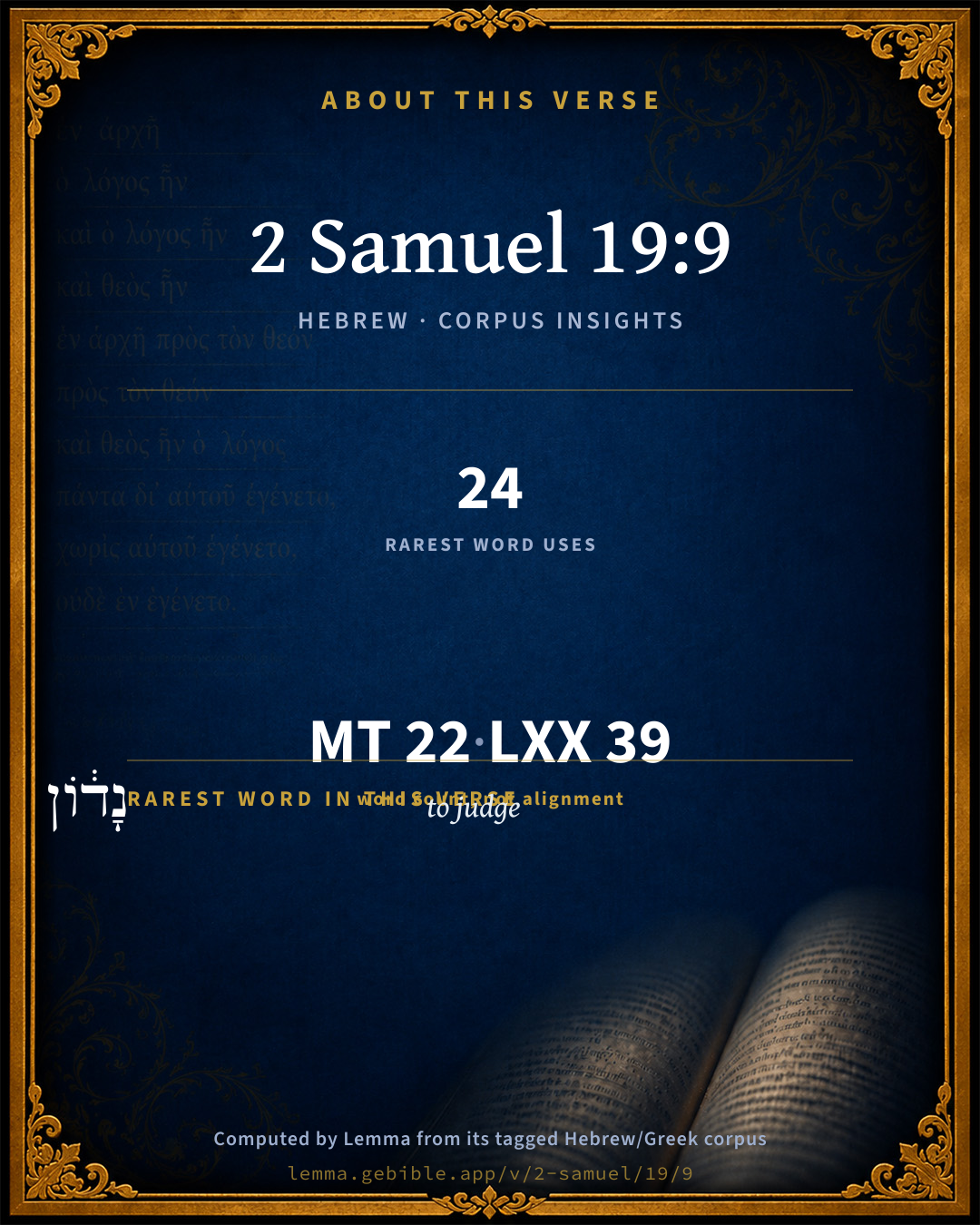
These counts appear in no published source. They are computed here, from the morphology-tagged text and Lemma’s own curated glosses. What Lemma adds →

22
words
20
distinct lemmas
Historical
section

Notable vocabulary

The rarest word here is נָד֔וֹן to judge H1777 — appearing just 24 times in the whole Hebrew Bible.

Shared distinctive vocabulary

נָד֔וֹן to judge H1777 occurs in 24 verses of the Hebrew Bible. Also found in:

Grammatical profile

  • 7 verbs
  • 11 nouns
  • 1 pronoun
  • 2 prepositions
  • 1 adverb

Verb forms

  • וַיְהִ֤י Qal · Sequential Imperfect
  • נָד֔וֹן Niphal · Participle Active
  • לֵאמֹ֑ר Qal · Infinitive Construct
  • הִצִּילָ֣נוּ Hiphil · Perfect
  • אֹיְבֵ֗ינוּ Qal · Participle Active
  • מִלְּטָ֨נוּ֙ Piel · Perfect
  • בָּרַ֥ח Qal · Perfect

Repetition

Words recur within this verse — often emphatic in Hebrew:

  • כָל all H3605 ×2
  • מִכַּ֣ף palm H3709 ×2

Hebrew & Septuagint length

In English translation the verse runs 46 words from the Hebrew and 45 from the Septuagint (LXX English) — closely comparable.

A rough comparison of the two English renderings, which tokenize alike — not a word-level alignment.

Word counts can differ between the Hebrew and the Greek without any difference in meaning — e.g. the Hebrew direct-object marker אֵת has no separate Greek word, and Greek often adds the article ὁ.

In the original languages it is 22 Hebrew tokens and 39 Greek tokens — but the two are counted differently (Hebrew bundles its prefixes and suffixes into one token; the Greek is in lemma form), so that isn’t a like-for-like length.

Cross-references

10

Topical passages linked to 2 Samuel 19:9 in the Treasury of Scripture Knowledge — connected by theme and wording, ordered by reader-vote popularity; previews shown in the World English Bible.

  • 2 Samuel 15:14 David said to all his servants who were with him at Jerusalem, Arise, and let us flee; for else none of us shall escape from Absalom: make speed to depart, lest he overtake us quickly, and bring down evil on us, and strike the city with the edge of the sword.
  • Genesis 3:12–13 The man said, "The woman whom you gave to be with me, she gave me of the tree, and I ate."
  • 2 Samuel 8:1–14 After this it happened that David struck the Philistines, and subdued them: and David took the bridle of the mother city out of the hand of the Philistines.
  • Exodus 32:24 I said to them, 'Whoever has any gold, let them take it off:' so they gave it me; and I threw it into the fire, and out came this calf."
  • 1 Samuel 17:50 So David prevailed over the Philistine with a sling and with a stone, and struck the Philistine, and killed him; but there was no sword in the hand of David.
  • 1 Samuel 18:5–7 David went out wherever Saul sent him, [and] behaved himself wisely: and Saul set him over the men of war, and it was good in the sight of all the people, and also in the sight of Saul's servants.
  • 1 Samuel 18:25 Saul said, Thus shall you tell David, The king desires no dowry except one hundred foreskins of the Philistines, to be avenged of the king's enemies. Now Saul thought to make David fall by the hand of the Philistines.
  • 1 Samuel 19:5 for he put his life in his hand, and struck the Philistine, and Yahweh worked a great victory for all Israel: you saw it, and did rejoice; why then will you sin against innocent blood, to kill David without a cause?
  • 2 Samuel 5:20 David came to Baal Perazim, and David struck them there; and he said, Yahweh has broken my enemies before me, like the breach of waters. Therefore he called the name of that place Baal Perazim.
  • James 3:14–16 But if you have bitter jealousy and selfish ambition in your heart, don't boast and don't lie against the truth.

Cross-references courtesy of OpenBible.info (CC BY 4.0).

Hebrew and Greek witnesses Masoretic Hebrew ↔ Greek Septuagint

The same verse in the two great witnesses to the Old Testament, shown verse-for-verse.

These are two independent witnesses, not word-aligned to each other, and the Septuagint is shown in lemma (dictionary) form.

Hebrew 2 Samuel 19:9 Masoretic · Westminster Leningrad Codex

וַיְהִ֤י כָל הָעָם֙ נָד֔וֹן בְּכָל שִׁבְטֵ֥י יִשְׂרָאֵ֖ל לֵאמֹ֑ר הַמֶּ֜לֶךְ הִצִּילָ֣נוּ מִכַּ֣ף אֹיְבֵ֗ינוּ וְה֤וּא מִלְּטָ֨נוּ֙ מִכַּ֣ף פְּלִשְׁתִּ֔ים וְעַתָּ֛ה בָּרַ֥ח מִן הָאָ֖רֶץ מֵעַ֥ל אַבְשָׁלֽוֹם

All the people were at strife throughout all the tribes of Israel, saying, The king delivered us out of the hand of our enemies, and he saved us out of the hand of the Philistines; and now he is fled out of the land from Absalom.

World English Bible · Public Domain

Greek LXX 2 Samuel 19:9 Septuagint · lemma form

καί ἀναἵστημι ὁ βασιλεύς καί καταἵζω ἐν ὁ πύλη καί πᾶς ὁ λαός ἀναἀγγέλλω λέγω ἰδού ὁ βασιλεύς καταἧμαι ἐν ὁ πύλη καί εἰςἔρχομαι πᾶς ὁ λαός κατά πρόσωπον ὁ βασιλεύς καί ἰσραήλ φεύγω ἀνήρ εἰς ὁ σκήνωμα αὐτός

And all the people disputed among all the tribes of Israel, saying, King David delivered us from all our enemies, and he rescued us from the hand of the Philistines: and now he has fled from the land, and from his kingdom, and from Abessalom.

LXX2012 (modern English Septuagint) · Public Domain

Hebrew: Westminster Leningrad Codex (CC BY 4.0). Greek: Septuagint (public domain); English from LXX2012 (modern English Septuagint) (Public Domain). How the Septuagint differs from the Hebrew →

Targum (Aramaic paraphrase)

1

The Targum is the ancient Jewish Aramaic paraphrase of the Hebrew Scriptures — an interpretive translation, not the Hebrew text itself. Onkelos (literal) and Pseudo-Jonathan (expansive) render the Torah, and Jonathan the Prophets. Coverage is partial: where no permissively-licensed English translation exists for a verse, only the Aramaic is shown. This is verse-level text, not a word-by-word alignment to the Hebrew.

  1. Targum Jonathan Prophets (Joshua–Malachi)
    וְקָם מַלְכָּא וִיתֵיב בְּתַרְעָא וּלְכָל עַמָא חַוִיאוּ לְמֵימַר הָא מַלְכָּא יָתֵיב בְּתַרְעָא וַאֲתָא כָל עַמָא לָקֳדָם מַלְכָּא וְיִשְׂרָאֵל אַפִּיךְ גְבַר לְקִרְווֹהִי:

    (no public-domain English translation for this verse)

    Targum Jonathan — Aramaic: “Mikraot Gedolot” (public domain). English: “Sefaria Community Translation” (CC0 1.0 (public-domain dedication)); “London "Chaldee Paraphrase," 1871” (public domain). Text via Sefaria.

Commentary

Notes on 2 Samuel 19:9 from classic Christian and Jewish commentators (each source and its license shown beneath its notes). The classic Christian expositions comment on the surrounding passage and are grouped to its opening verse, so a note may address several verses; the Jewish commentaries on the Tanakh (Rashi and others) are per-verse, so they appear only where the commentator wrote on this verse.

Lemma curates 59 commentaries, every one of them public domain or Creative Commons licensed, each selected and text-cleaned for this edition rather than reprinted as found. About our sources →

Matthew Henry's Commentary

It is strange that David did not immediately upon the defeat and dispersion of Absalom's forces march with all expedition back to Jerusalem, to regain the possession of his capital city, while the rebels were in confusion and before they could rally again. What occasion was there to bring him back? Could not he himself go back with the victorious army he had with him in Gilead? He could, no doubt; but, 1. He would go back as a prince, with the consent and unanimous approbation of the people, and not as a conqueror forcing his way: he would restore their liberties, and not take occasion to seize them, or encroach upon them. 2. He would go back in peace and safety, and be sure that he should meet with no difficulty or opposition in his return, and therefore would be satisfied that the people were well-affected to have him before he would stir. 3. He would go back in honour, and like himself, and therefore would go back, not at the head of his forces, but in the arms of his subjects; for the prince that has wisdom and goodness enough to make himself his people's darling, without doubt, looks greater and makes a much better figure than the prince that has strength enough to make himself his people's terror. It is resolved therefore that David must be brought back to Jerusalem his own city, and his own house there, with some ceremony, and here we have that matter concerted.

I. The men of Israel (that is, the ten tribes) were the first that talked of it, Sa2 19:9, Sa2 19:10. The people were at strife about it; it was the great subject of discourse and dispute throughout all the country. Some perhaps opposed it: "Let him either come back himself or stay where he is;" others appeared zealous for it, and reasoned as follows here, to further the design, 1. That David had formerly helped them, had fought their battles, subdued their enemies, and done them much service, and therefore it was a shame that he should continue banished from their country who had been so great a benefactor to it. Note, Good services done to the public, though they may be forgotten for a while, yet will be remembered again when men come to their right minds. 2. That Absalom had now disappointed them. "We were foolishly sick of the cedar, and chose the branch to reign over us; but we have had enough of him: he is consumed, and we narrowly escaped being consumed with him. Let us therefore return to our allegiance, and think of bringing the king back." Perhaps this was all the strife among them, not a dispute whether the king should be brought back or no (all agreed it was to be done), but whose fault is was that it was not done. As is usual in such cases, every one justified himself and blamed his neighbour. The people laid the fault on the elders, and the elders on the people, and one tribe upon another. Mutual excitements to the doing of a good work are laudable, but not mutual accusations for the not doing of it; for usually when public services are neglected all sides must share in the blame; every one might do more than he does, in the reformation of manners, the healing of divisions, and the like.

II. The men of Judah, by David's contrivance, were the first that did it. It is strange that they, being David's own tribe, were not so forward as the rest. David had intelligence of the good disposition of all the rest towards him, but nothing from Judah, though he had always been particularly careful of them. But we do not always find the most kindness from those from whom we have most reason to expect it. Yet David would not return till he knew the sense of his own tribe. Judah was his lawgiver, Psa 60:7. That his way home might be the more clear, 1. He employed Zadok and Abiathar, the two chief priests, to treat with the elders of Judah, and to excite them to give the king an invitation back to his house, even to his house, which was the glory of their tribe, Sa2 19:11, Sa2 19:12. No men more proper to negociate this affair than the two priests, who were firm to David's interest, were prudent men, and had great influence with the people. Perhaps the men of Judah were remiss and careless, and did it not, because nobody put them on to do it, and then it was proper to stir them up to it. Many will follow in a good work who will not lead: it is a pity that they should continue idle for want of being spoken to. Or perhaps they were so sensible of the greatness of the provocation they had given to David, by joining with Absalom, that they were afraid to bring him back, despairing of his favour; he therefore warrants his agents to assure them of it, with this reason: "You are my brethren, my bone and my flesh, and therefore I cannot be severe with you." The Son of David has been pleased to call us brethren, his bone and his flesh, which encourages us to hope that we shall find favour with him. Or perhaps they were willing to see what the rest of the tribes would do before they stirred, with which they are here upbraided: "The speech of all Israel has come to the king to invite him back, and shall Judah be the last, that should have been the first? Where is now the celebrated bravery of that royal tribe? Where is its loyalty?" Note, We should be stirred up to that which is great and good by the examples both of our ancestors and of our neighbours, and by the consideration of our rank. Let not the first in dignity be last in duty. 2. He particularly courted into his interest Amasa, who had been Absalom's general, but was his own nephew as well as Joab, Sa2 19:13. He owns him for his kinsman, and promises him that, if he will appear for him now, he will make him captain-general of all his forces in the room of Joab, will not only pardon him (which, it may be, Amasa questioned), but prefer him. Sometimes there is nothing lost in purchasing the friendship of one that has been an enemy. Amasa's interest might do David good service at this juncture. But, if David did wisely for himself in designating Amasa for this post (Joab having now grown intolerably haughty), he did not do kindly by Amasa in letting his design be known, for it occasioned his death by Joab's hand, Sa2 20:10. 3. The point was hereby gained. He bowed the heart of the men of Judah to pass a vote, nemine contradicente - unanimously, for the recall of the king, Sa2 19:14. God's providence, by the priests' persuasions and Amasa's interest, brought them to this resolve. David stirred not till he received this invitation, and then he came as far back as Jordan, at which river they were to meet him, Sa2 19:15. Our Lord Jesus will rule in those that invite him to the throne in their hearts and not till he be invited. He first bows the heart and makes it willing in the day of his power, and then rules in the midst of his enemies, Psa 110:2, Psa 110:3.

Matthew Henry's Commentary on the Whole Bible (1708–1710) — public domain (CC PDM 1.0). Text via the HelloAO Bible API.

Jamieson, Fausset & Brown

Robert Jamieson, A. R. Fausset & David Brown

THE ISRAELITES BRING THE KING BACK. (2Sa. 19:9-43)

all the people were at strife throughout all the tribes of Israel--The kingdom was completely disorganized. The sentiments of three different parties are represented in Sa2 19:9-10 : the royalists, the adherents of Absalom who had been very numerous, and those who were indifferent to the Davidic dynasty. In these circumstances the king was right in not hastening back, as a conqueror, to reascend his throne. A re-election was, in some measure, necessary. He remained for some time on the other side of Jordan, in expectation of being invited back. That invitation was given without, however, the concurrence of Judah. David, disappointed and vexed by his own tribe's apparent lukewarmness, despatched the two high priests to rouse the Judahites to take a prominent interest in his cause. It was the act of a skilful politician. Hebron having been the seat of the rebellion, it was graceful on his part to encourage their return to allegiance and duty; it was an appeal to their honor not to be the last of the tribes. But this separate message, and the preference given to them, occasioned an outburst of jealousy among the other tribes that was nearly followed by fatal consequences [see Sa2 19:40-43].

Jamieson, Fausset & Brown — Commentary Critical and Explanatory on the Whole Bible (1871) — public domain (CC PDM 1.0). Text via the HelloAO Bible API.

Trapp's Complete Commentary

John Trapp

2Sa 19:9 And all the people were at strife throughout all the tribes of Israel, saying, The king saved us out of the hand of our enemies, and he delivered us out of the hand of the Philistines; and now he is fled out of the land for Absalom.

Ver. 9. And all the people were at strife.] Hereby it appeareth that David was not readmitted without some dispute, some great thoughts of heart: the devil doubtless stickled hard to have hindered it.

Saying, The king saved us.] The prevailing and better part said so.

John Trapp, A Commentary or Exposition upon All the Books of the Old and New Testament (1647–1656) — public domain. Text from a community e-Sword module.

Joseph Benson's Commentary

2Sa 19:9-10. All the people were at strife throughout all the tribes — Either, 1st, Striving who should be most forward to bring back the king, and blaming one another’s slackness in the business: or, 2d, Censuring and quarrelling one with another, as the authors and abetters of this shameful rebellion, and discoursing privately and publicly of David’s high merits, which God, being now reconciled to him, brings afresh to their memories. Now, therefore, why speak ye not a word, &c. — The people of Israel speak thus to their elders, as appears by comparing this verse with the next. Seeing their designs for raising Absalom to the throne disappointed, they now repented of that undertaking, and were willing to testify this by their forwardness to bring David back, and re-establish him.

Joseph Benson's Commentary on the Old and New Testaments (1811–1818) — public domain. Text from a community e-Sword module.

Whedon's Commentary on the Bible

Daniel D. Whedon

RIVALRY BETWEEN ISRAEL AND JUDAH OVER DAVID’S RETURN, 2Sa_19:9-14.

“Absalom is dead. David is victorious. What more has the king to do but to cross the Jordan, march to Jerusalem, and take possession of his throne! This had been ill speed — it had been too abrupt. David is much to be commended for the delicacy with which he acted. Seeing that the defection of the people and the preference of Absalom had been so general among the tribes west of the Jordan, he feared even the appearance of forcing himself upon them, or seeming to recover possession of his throne as a conqueror. He therefore tarried beyond the river, waiting to be invited back. There was some delay in giving this invitation; perhaps because the king’s wish and his motive in delaying to move westward were not at first understood.” — Kitto.

9. Were at strife — נדון, Were casting reproaches at one another. They felt that in following Absalom they had been guilty of insurrection against the king, and were under obligations to secure his return from Mahanaim. From 2Sa_19:11 we learn that their words were reported to David.

Daniel D. Whedon (gen. ed.), Commentary on the Old and New Testaments (1874–1909) — public domain. Text from a community e-Sword module.

Keil & Delitzsch

C. F. Keil & F. Delitzsch

Preliminaries to the return of David to Jerusalem. - Sa2 19:9, Sa2 19:10. As the rebellion was entirely crushed by Absalom's death, and the dispersion of his followers to their respective homes, there arose a movement among all the tribes in favour of David. "All the people were disputing (נדון, casting reproaches at one another) in all the tribes of Israel, saying, The king has saved us out of the hand of our enemies, ... and now he is fled out of the land before Absalom. But Absalom, whom we anointed over us, is dead in battle; and now why do ye keep still, to bring back the king?" This movement arose from the consciousness of having done an injustice to the king, in rising up in support of Absalom.

Keil & Delitzsch — Biblical Commentary on the Old Testament (1861–1891) — public domain (CC PDM 1.0). Text via the HelloAO Bible API. (Old Testament only.)

Tyndale Open Study Notes

Tyndale Open Resources

19:9-10 The argument among the tribes of Israel (possibly referring only to the northern tribes) resulted in the consensus that they should ask David to come back, perhaps instead of going back to the semiautonomy of the era of the judges (cp. 20:1).

Tyndale Open Study Notes — © Tyndale Open Resources, licensed CC BY-SA 4.0. Text via the HelloAO Bible API.

Geneva Bible (1599)

Geneva Bible translators

Everyone blamed another and strove who should first bring him home.

Geneva Bible (1599) marginal notes — public domain. Text via Bolls.life.

Ellicott's Commentary for English Readers

(9) The king saved us.—With the collapse of the rebellion the accompanying infatuation passed away, and the people began to remember how much they owed to David. There seems to have been a general disposition among the people to return to their allegiance, yet the movement was without organisation or leadership.

A Bible Commentary for English Readers, edited by Charles John Ellicott (1878–1897) — public domain. Text from a community e-Sword module.

John Gill's Exposition

And all the people were at strife through all the tribes of Israel,.... Excepting the tribe of Judah; they blamed and reproved one another for taking part with Absalom in the rebellion, and especially for their coldness and backwardness in bringing back David to Jerusalem:

saying, the king saved us out of the hand of our enemies; exposed his life to danger, fought our battles for us, and gained us victory over our enemies, and saved us from them, especially those next mentioned:

and he delivered us out of the hand of the Philistines; in the times of Saul, and since; which were benefits which ought to have endeared him to them, and were aggravations of the crime of those who had been concerned in the late rebellion; and were such as ought not to be buried in oblivion, and were proper arguments to engage them to return to their allegiance to him, and abide by it:

and now he is fled out of the land for Absalom; being obliged to quit Jerusalem, and the land of Judea on this side Jordan, and to pass that river; not from a spirit of cowardice, but from tenderness to his son, he did not choose to fight against; and from a concern for his metropolis Jerusalem, lest that should be hurt, as well as for the safety of his person.

John Gill's Exposition of the Whole Bible (1746–1763) — public domain (CC PDM 1.0). Text via the HelloAO Bible API.

Matthew Poole's English Annotations

All the people were at strife; quarrelling one with another, as the authors or abettors of this shameful and cursed rebellion, discoursing privately and publicly of David’s high merits, which God, being now reconciled to David, brings afresh to their memories, and reneweth the sense of their obligations to their king, which they had lately shaken off. Thus the crowns of kings sit faster or looser upon their heads, as God is pleased to dispose of the thoughts and hearts of their people, which he can turn in an instant which way he will.

Now he is fled out of the land for Absalom: now we come to reflect upon our own actions, we are sensible of our folly and unworthiness in adhering to Absalom, and thereby forcing David to flee out of the land of Canaan to the parts beyond Jordan for his security.

Matthew Poole's English Annotations on the Holy Bible (1683–1685) — public domain. Text from a community e-Sword/MySword module.

The Pulpit Commentary

Late reflection and appreciation.

The rebels against King David having been defeated, and their chosen leader slain, they bethink themselves of their position and of the claims of their injured sovereign; and begin to stir up each other to obtain his return and reinstatement. Their words are obviously true; but the facts they now recognize were as truly facts when they rose in rebellion. It was only their feeling with respect to them that had changed. So it is commonly. Under the excitement of sinful feeling, the most obvious truths are forgotten and neglected. Well is it when there is a reawakening to their significance, and a consequent return to the path of duty. Especially desirable is it that all who are living without any due feeling of the claims of their great King should become sensible of them, and begin to render them a practical recognition.

I THE ACTUAL AND ABIDING CLAIMS OF CHRIST TO BE ACCEPTED AND OBEYED AS KING.

1. His nature. Divine and human; including all qualifications for rule.

2. His Divine appointment. Signified in manifold ways.

3. The deliverance he has wrought. It is here said of David, "The king saved us," etc. Our Lord has saved us in a more marvellous way, from enemies more to be dreaded than the heathen that harassed Israel. He has conquered, in personal conflict and through suffering unto death, Satan, the world, sin, and death. He has thus "saved us out of the hand of our enemies," including those that, like the Philistines in relation to Israel, are nearest to us and most ready and able to harass us our own special besetting sins. True, the deliverance is not yet completely accomplished in actual experience; but it is assured, and as really ours, if we are Christ"s, as if we were already perfectly freed from all evil

II THE INSENSIBILITY TO THESE CLAIMS WHICH COMMONLY PREVAILS. Looking at the lives of most men, even where Christ is made known, it is painfully manifest that they have no due sense of his rights and their duty to him; for they do not submit their minds, hearts, and lives to his government.

1. Causes of such insensibility.

(1) A depraved nature, whose spiritual sensibilities are further suppressed and benumbed by the practice of sin.

(2) Absorption in worldly pursuits. Leaving no opportunity for higher matters to attract attention, no time to think of them.

(3) Unconcern as to the enemies from whom Christ delivers. No conviction of sin; no sense of the evil of it; no desire for rescue from its guilt or power. The Deliverer, therefore, excites no real interest.

(4) Familiarity with the truth. The habit of hearing, or reading, or even repeating it, without accepting it; or of assenting to it without really believing it; or of accepting (in a sense) the atonement, and relying on Jesus for pardon, without receiving him as King. The process also of indulging feeling and sentiment about Christ, without rendering obedience; and of resisting the feelings which prompt to obedience, thus resisting and grieving the Holy Spirit. In this way the gospel becomes a means of hardening the heart against itself.

(5) The attractions of some pretender to the throne. As Absalom "stole the hearts of the men of Israel" (2Sa_15:6) by his youth, beauty, activity, assiduous attentions, insinuating address, and hints as to the defects of his father"s government, and the improvements which he would make if he were in power; so the hearts of many are withdrawn from the Lord Jesus by the attractions of some newly revived system of error in philosophy or religion, or anti-religion, of which the novelty (to them) is charming, and the representations of human nature more flattering, and the demands less exacting. The old king comes to be regarded and treated as worn out, quite unsuited to the needs of an enlightened and scientific age; and the young pretenders are welcomed, one by one class, and another by another, with shouts of joy and paeans of anticipated victory.

2. Effects of such insensibility.

(1) Negatively, in the prevention of faith and love, loyal obedience and active service.

(2) Positively, by leading to disaffection and active rebellion; as in the case of Israel and David.

III THE HAPPY AWAKENING WHICH IS OFTEN EXPERIENCED. As in the case of the Israelites in respect to David. This may be produced:

1. By calamity. As the Israelites were awakened by defeat and disaster. Troubles stir the conscience, lead the soul to look around for support, throw an unusual light on objects, reveal the vanity of cherished dependencies, prepare for due appreciation of those which are solid and satisfying; and so lead to a right appreciation of Christ.

2. By impressive presentation of forgotten facts. As by the tribes of Israel to each other, reminding of their obligations to David, and the ill requital he had received from them. It may be a sermon heard with unaccustomed interest, or some part of the Holy Book read with a new perception of the significance and importance of its teaching, or the appeals, of a friend, or the statements of a tract, or words of parents or teachers long ago, recurring with new power to the mind; whatever it be that stirs the heart to consideration and renders it sensible of the rights and worth of Christ, blessed are the means, blessed the moment when such effects are produced.

3. Always by the enlightening and convincing Spirit. Whose work it is to reveal and glorify the Son of God. (Joh_16:14)

IV THE CHANGE PRODUCED BY THIS AWAKENING. Similar to that in the text.

1. In conduct.

(1) Return to allegiance, loyalty, and service to the rightful Sovereign. Incitement of others to return.

2. In position. The returning rebels are accepted, and restored to the privileges of faithful subjects. Not because the heavenly King is, like David, dependent on his subjects, needing them as much as they him, but of pure grace. However long they may have been insensible and rebellious, on coming to a sense of their duty, and seeking forgiveness, they are pardoned and restored to favour.

Lastly, the awakening may come too late, producing terror and remorse, but not repentance, and importunate prayers which are unavailing. G.W. (see Luk_13:24-28)

The Pulpit Commentary (1880–1919), ed. H.D.M. Spence-Jones & Joseph S. Exell — public domain. Text from a community e-Sword module.

John Wesley's Explanatory Notes

At strife - Quarrelling one with another as the authors or abettors of this shameful rebellion, and discoursing privately and publickly of David's high merits, which God, being now reconciled to David, brings afresh to their memories.

John Wesley, Explanatory Notes Upon the Whole Bible (1754–1765) — public domain. Text via the GEBible commentary corpus.

unfoldingWord translationNotes

Door43 World Missions Community

out of the hand of our enemies

Here "hand" means control. AT: "from under the control of our enemies" or "from our enemies' control" (See: Metonymy)

out of the hand of the Philistines

Here "hand" means control. AT: "from under the control of the Philistines" or "from the Philistines' control" (See: Metonymy)

out of the land because of Absalom

This means that he had left the country fleeing from Absalom. This can be stated clearly. AT: "out of the country fleeing from Absalom" (See: Assumed Knowledge and Implicit Information)

why do you say nothing about bringing the king back?

This means they should consider bringing David back now that Absalom was dead. The question may be written as a statement. AT: "we should be talking about bringing the king back." (See: Rhetorical Question)

the king

This refers to David.

translationWords

tribe

Israel

hand

Philistines

anoint

die

unfoldingWord translationNotes — © Distant Shores Media and the Door43 World Missions Community, licensed CC BY-SA 4.0. Source: git.door43.org/Door43/en_tn.

Rashi

Rabbi Shlomo Yitzchaki (Rashi)

[As the people of] Yisroel fled. Those people that were with Avsholom.

Rashi on the Tanakh — English translations: “The Judaica Press complete Tanach with Rashi, translated by A. J. Rosenberg” (CC BY 4.0); “Pentateuch with Rashi's commentary by M. Rosenbaum and A.M. Silbermann, 1929-1934” (public domain); “The Metsudah Tanach series, Lakewood, N.J” (CC BY 4.0); and “The Book of Joshua, Metsudah Publications, 1997” (CC BY 4.0). Text via Sefaria.

Lesson kit

Teaching starters — assembled from the data on this page, not authored interpretation. Every prompt links to the verse data it draws on. Edit before teaching.

2 Samuel, in the Historical, opens this verse with 22 words (20 distinct Hebrew lemmas). Its most distinctive word is dîyn (“to judge”). A historical commentator’s framing appears above. Read the whole chapter for the surrounding context.

Discussion questions

  1. The word dîyn carries the sense “to judge.” How does it shape the verse?
  2. Genesis 6:3 shares the word «to judge» with this verse. How do the two illuminate each other?
  3. “all” occurs 2× in this one verse. What is the effect of the repetition?
  4. These translations render this verse differently. What is at stake in choosing one wording over another?
  5. The verb «וַיְהִ֤י» is Qal Sequential Imperfect. How does its form color the action?
  6. Reading how Matthew Henry's Commentary and Jamieson, Fausset & Brown read this verse, where do the two commentators agree and where do they part?

Things to notice

Reading settings

Reading text

Shown beneath each verse's original-language words.

Old Testament
Old Testament edition

Read the OT as the Masoretic Hebrew (MT) or the Greek Septuagint (LXX).

English shown for the Greek Septuagint (in the Hebrew ↔ Greek comparison).

Comparing translations? Open the Compare panel on any verse page to stack up to four side by side.