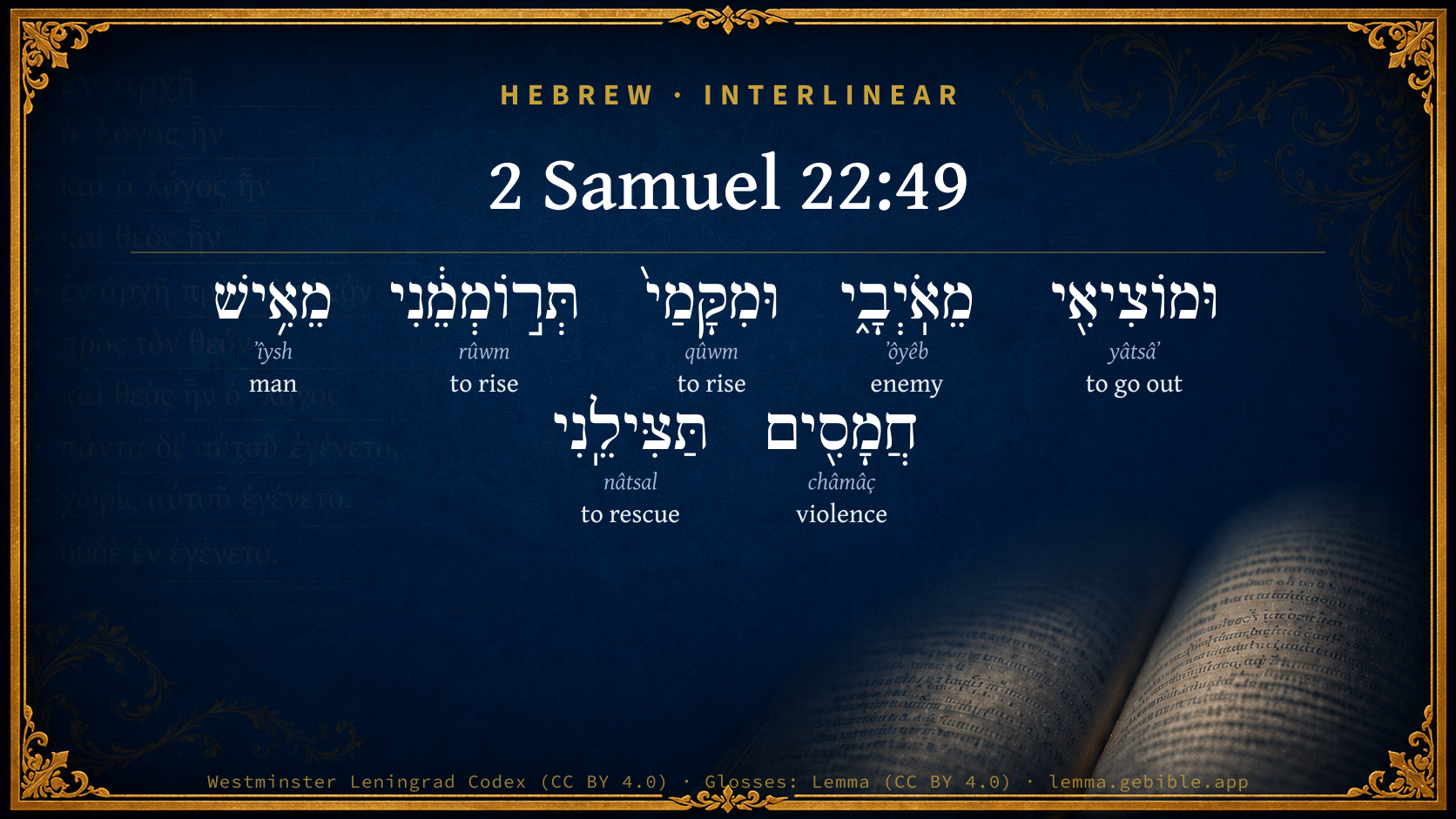
2 Samuel 22:49

Hebrew (Westminster Leningrad Codex) 2 Samuel 22:49 appears in the Hebrew Old Testament. The text above is from the Westminster Leningrad Codex. Each word links to its Strong’s number, a concise gloss, and parsing drawn from the Open Scriptures Hebrew Bible morphology. Click any word for its full Brown-Driver-Briggs (BDB) entry.
Download image
Cite this verse

2 Samuel 22:49 (World English Bible). Public Domain. Lemma interlinear Bible study tool, https://lemma.gebible.app/v/2-samuel/22/49.

Show BibTeX & RIS
BibTeX
RIS
English Translation
Who brings me forth from my enemies: Yes, you lift me up above those who rise up against me; You deliver me from the violent man.
World English Bible · Public Domain
Download a study sheet

One document with this verse’s original text, its word-by-word gloss line, the meaning frame, cross-references with their text, attributed commentary, and full source and license credits — printable, and it pastes into notes with its structure intact.

This verse Autodidact and up

Study sheet (.html) Plain text (.txt)

A passage Seminary Student

Up to 50 verses in one chapter. A passage sheet keeps up to 6 commentary sources and 12 cross-references per verse, in the order this page ranks them, and says so on the sheet whenever that leaves anything out. Ask for a single verse and you get the Autodidact verse sheet above.

Everything on this page stays free to read, with no account — the sheet is a download of what is already on screen, not access to it.

Want to remove ads? Support Godless Engineer
Compare translations 3

The same verse in 3 English versions, stacked beneath the original-language interlinear above. Click any original word for its lexicon entry.

Each is an independent rendering of the whole verse — the interlinear is not word-aligned to these translations.

Highlighted words mark where these versions differ — a whole-verse word diff, not a word-by-word alignment.

  • World English Bible Public Domain
    Who brings me forth from my enemies: Yes, you lift me up above those who rise up against me; You deliver me from the violent man.
  • King James Version Public Domain
    And that bringeth me forth from mine enemies: thou also hast lifted me up on high above them that rose up against me: thou hast delivered me from the violent man.
  • unfoldingWord Literal Text CC BY-SA 4.0
    and bringing me out from my enemies. And from the ones arising me, you lift me up; from a man of violences, you deliver me.

unfoldingWord Literal Text — © unfoldingWord, licensed CC BY-SA 4.0. Word-aligned USFM3 via Door43 (git.door43.org/unfoldingWord/en_ult).

Versions to compare (up to 4)

3 of 4 selected

Show all 18 translations

Every available English version of this verse, each an independent rendering of the whole verse.

  • World English Bible Public Domain
    Who brings me forth from my enemies: Yes, you lift me up above those who rise up against me; You deliver me from the violent man.
  • Berean Standard Bible Public Domain
    who frees me from my enemies. You exalt me above my foes; You rescue me from violent men.
  • Majority Standard Bible Public Domain
    who frees me from my enemies. You exalt me above my foes; You rescue me from violent men.
  • King James Version Public Domain
    And that bringeth me forth from mine enemies: thou also hast lifted me up on high above them that rose up against me: thou hast delivered me from the violent man.
  • American Standard Version (1901) Public Domain
    And that bringeth me forth from mine enemies: Yea, thou liftest me up above them that rise up against me; Thou deliverest me from the violent man.
  • Revised Version (1885) Public Domain
    And that bringeth me forth from mine enemies: yea, thou liftest me up above them that rise up against me: thou deliverest me from the violent man.
  • Geneva Bible (1599) Public Domain
    And rescueth me from mine enemies: (thou also hast lift me vp from them that rose against me, thou hast deliuered me from the cruell man.
  • Douay-Rheims (1899) Public Domain
    Who bringest me forth from my enemies, and liftest me up from them that resist me: from the wicked man thou shalt deliver me.
  • Young's Literal Translation Public Domain
    And bringing me forth from mine enemies, Yea, above my withstanders Thou raisest me up. From a man of violence Thou deliverest me.
  • Literal Standard Version CC BY-SA 4.0
    And bringing me forth from my enemies, || Indeed, You raise me up above my withstanders. You deliver me from a man of violence.
  • Unlocked Literal Bible CC BY-SA 4.0
    He sets me free from my enemies. Indeed, you lifted me up above those who rose up against me. You rescue me from violent men.
  • unfoldingWord Literal Text CC BY-SA 4.0
    and bringing me out from my enemies. And from the ones arising me, you lift me up; from a man of violences, you deliver me.
  • Darby Bible Public Domain
    He brought me forth from mine enemies: Yea, thou hast lifted me up above them that rose up against me; From the man of violence hast thou delivered me.
  • World Messianic Bible Public Domain
    who brings me away from my enemies. Yes, you lift me up above those who rise up against me. You deliver me from the violent man.
  • Webster's Bible Public Domain
    And that bringeth me forth from my enemies: thou also hast lifted me up on high above them that rose up against me: thou hast delivered me from the violent man.
  • Free Bible Version CC BY-SA 4.0
    He frees me from those who hate me. You keep me safe from those who rebel against me, you save me from violent men.
  • Bible in Basic English Public Domain
    He makes me free from my haters: I am lifted up over those who come up against me: you have made me free from the violent man.
  • JPS Tanakh (1917) Public Domain
    And that bringeth me forth from mine enemies; yea, Thou liftest me up above them that rise up against me; Thou deliverest me from the violent man.

Literal Standard Version (2020), Covenant Press — licensed CC BY-SA 4.0. Text via the HelloAO Bible API (eBible.org). Unlocked Literal Bible (unfoldingWord) — licensed CC BY-SA 4.0. Text via the HelloAO Bible API (eBible.org). unfoldingWord Literal Text — © unfoldingWord, licensed CC BY-SA 4.0. Word-aligned USFM3 via Door43 (git.door43.org/unfoldingWord/en_ult). Free Bible Version, Dr. Jonathan Gallagher — licensed CC BY-SA 4.0. Text via the HelloAO Bible API (eBible.org).

Word by word

More ways to search: Search by grammar → Find every occurrence → Compare this word →

Practice this passage: Drill this verse → Learn its vocabulary →

חֲמָסִ֖ים
châmâç
H2555
“violence”
Noun, Common, Masculine, Plural, Absolute
Part of Speech
Noun
Type
Common
Gender
Masculine
Number
Plural
State
Absolute
Full BDB Definition

Origin: from H2554

TWOT: TWOT- 678a

violence, wrong, cruelty, injustice
  1. וּמוֹצִיאִ֖י yâtsâʼ H3318 “and · going out · me” Conjunction + Verb, Hiphil, Participle Active, Masculine, Singular, Construct + Suffix, Personal, 1st Person, Common, Singular
  2. מֵאֹֽיְבָ֑י ʼôyêb H341 “from · enemy · me” Preposition + Verb, Qal, Participle Active, Masculine, Plural, Construct + Suffix, Personal, 1st Person, Common, Singular
  3. וּמִקָּמַי֙ qûwm H6965 “and · from · rising · me” Conjunction + Preposition + Verb, Qal, Participle Active, Masculine, Plural, Construct + Suffix, Personal, 1st Person, Common, Singular
  4. תְּר֣וֹמְמֵ֔נִי rûwm H7311 “to rise · me” Verb, Polel, Imperfect, 2nd Person, Masculine, Singular + Suffix, Personal, 1st Person, Common, Singular
  5. מֵאִ֥ישׁ ʼîysh H376 “from · man of” Preposition + Noun, Common, Masculine, Singular, Construct
  6. תַּצִּילֵֽנִי nâtsal H5337 “to rescue · me” Verb, Hiphil, Imperfect, 2nd Person, Masculine, Singular + Suffix, Personal, 1st Person, Common, Singular

About this verse

These counts appear in no published source. They are computed here, from the morphology-tagged text and Lemma’s own curated glosses. What Lemma adds →

7
words
7
distinct lemmas
Historical
section

Shared distinctive vocabulary

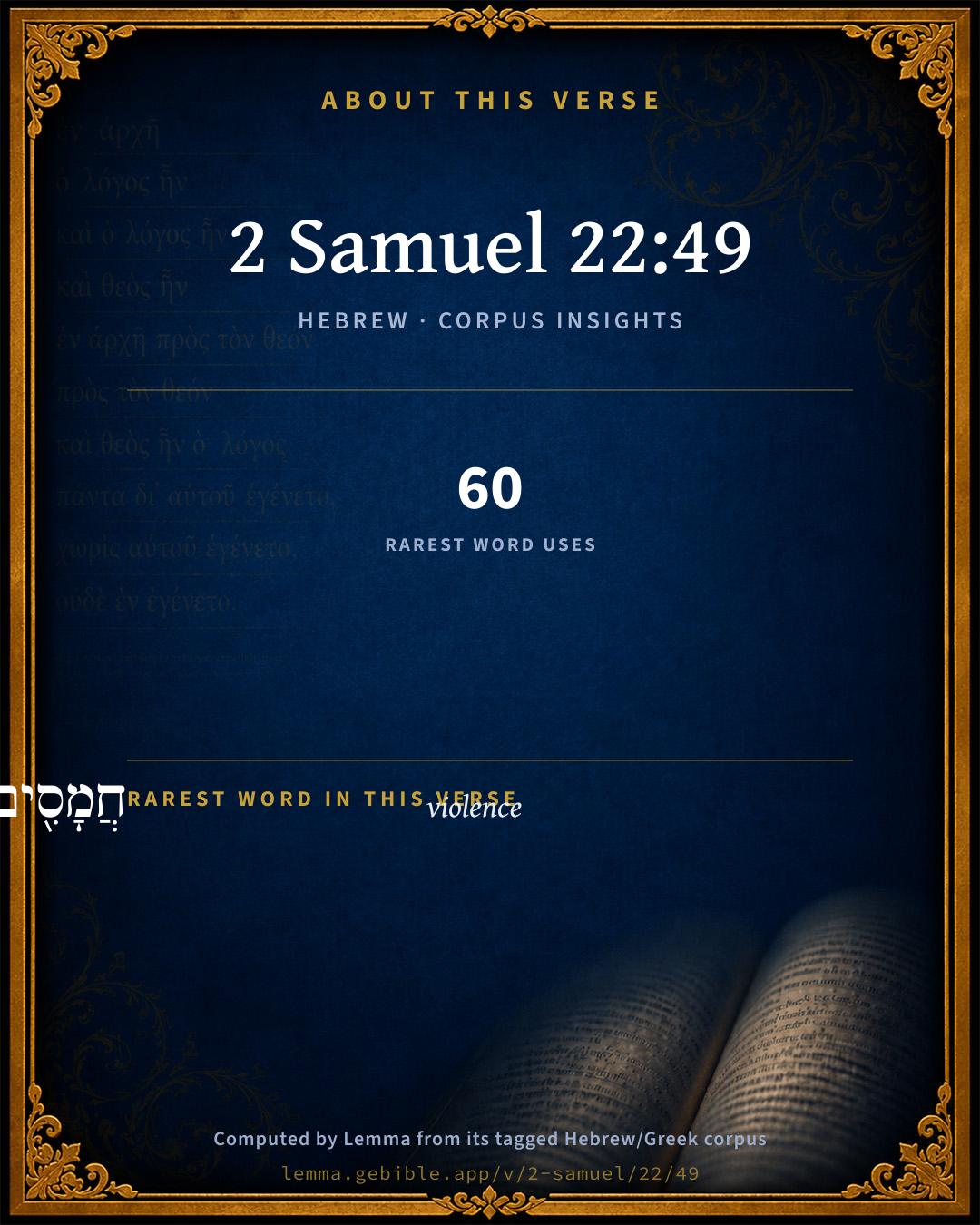
חֲמָסִ֖ים violence H2555 occurs in 59 verses of the Hebrew Bible. Also found in:

Grammatical profile

  • 5 verbs
  • 2 nouns

Verb forms

  • וּמוֹצִיאִ֖י Hiphil · Participle Active
  • מֵאֹֽיְבָ֑י Qal · Participle Active
  • וּמִקָּמַי֙ Qal · Participle Active
  • תְּר֣וֹמְמֵ֔נִי Polel · Imperfect
  • תַּצִּילֵֽנִי Hiphil · Imperfect

Hebrew & Septuagint length

In English translation the verse runs 26 words from the Hebrew and 30 from the Septuagint (LXX English) — closely comparable.

A rough comparison of the two English renderings, which tokenize alike — not a word-level alignment.

Word counts can differ between the Hebrew and the Greek without any difference in meaning — e.g. the Hebrew direct-object marker אֵת has no separate Greek word, and Greek often adds the article ὁ.

Cross-references

9

Topical passages linked to 2 Samuel 22:49 in the Treasury of Scripture Knowledge — connected by theme and wording, ordered by reader-vote popularity; previews shown in the World English Bible.

  • Psalms 140:1 Deliver me, Yahweh, from the evil man. Preserve me from the violent man;
  • Numbers 24:7 Water shall flow from his buckets, His seed shall be in many waters, His king shall be higher than Agag, His kingdom shall be exalted.
  • Numbers 24:17–19 I see him, but not now; I see him, but not near: There shall come forth a star out of Jacob, A scepter shall rise out of Israel, Shall strike through the corners of Moab, Break down all the sons of tumult.
  • 1 Samuel 2:8 He raises up the poor out of the dust, He lifts up the needy from the dunghill, To make them sit with princes, Inherit the throne of glory: For the pillars of the earth are Yahweh's, He has set the world on them.
  • 2 Samuel 5:12 David perceived that Yahweh had established him king over Israel, and that he had exalted his kingdom for his people Israel's sake.
  • 2 Samuel 7:8–9 Now therefore thus shall you tell my servant David, Thus says Yahweh of Hosts, I took you from the sheep pen, from following the sheep, that you should be prince over my people, over Israel;
  • Psalms 18:48 He rescues me from my enemies. Yes, you lift me up above those who rise up against me. You deliver me from the violent man.
  • Psalms 52:1 Why do you boast of mischief, mighty man? God's loving kindness endures continually.
  • Psalms 140:4 Yahweh, keep me from the hands of the wicked. Preserve me from the violent men who have determined to trip my feet.

Cross-references courtesy of OpenBible.info (CC BY 4.0).

Hebrew and Greek witnesses Masoretic Hebrew ↔ Greek Septuagint

The same verse in the two great witnesses to the Old Testament, shown verse-for-verse.

These are two independent witnesses, not word-aligned to each other, and the Septuagint is shown in lemma (dictionary) form.

Hebrew 2 Samuel 22:49 Masoretic · Westminster Leningrad Codex

וּמוֹצִיאִ֖י מֵאֹֽיְבָ֑י וּמִקָּמַי֙ תְּר֣וֹמְמֵ֔נִי מֵאִ֥ישׁ חֲמָסִ֖ים תַּצִּילֵֽנִי

Who brings me forth from my enemies: Yes, you lift me up above those who rise up against me; You deliver me from the violent man.

World English Bible · Public Domain

Greek LXX 2 Samuel 22:49 Septuagint · lemma form

καί ἐκἄγω ἐγώ ἐκ ἐχθρός ἐγώ καί ἐκ ὁ ἐπιἐγείρω ἐγώ ὑψόω ἐγώ ἐκ ἀνήρ ἀδίκημα ῥύομαι ἐγώ

and bringing me out from my enemies: and you shall set me on high from among those that rise up against me: you shall deliver me from the violent man.

LXX2012 (modern English Septuagint) · Public Domain

Hebrew: Westminster Leningrad Codex (CC BY 4.0). Greek: Septuagint (public domain); English from LXX2012 (modern English Septuagint) (Public Domain). How the Septuagint differs from the Hebrew →

Targum (Aramaic paraphrase)

1

The Targum is the ancient Jewish Aramaic paraphrase of the Hebrew Scriptures — an interpretive translation, not the Hebrew text itself. Onkelos (literal) and Pseudo-Jonathan (expansive) render the Torah, and Jonathan the Prophets. Coverage is partial: where no permissively-licensed English translation exists for a verse, only the Aramaic is shown. This is verse-level text, not a word-by-word alignment to the Hebrew.

  1. Targum Jonathan Prophets (Joshua–Malachi)
    וּפַרְקִי מִסַנְאַי וְעַל דְקַיְימִין לְאַבְאָשָׁא לִי תַּגְבְּרִינַנִי מִגוֹג וּמִמַשִׁירְיַת עַמְמִין חֲטוּפִין דְעִימֵיהּ תְּשֵׁיזְבִינַנִי:

    (no public-domain English translation for this verse)

    Targum Jonathan — Aramaic: “Mikraot Gedolot” (public domain). English: “Sefaria Community Translation” (CC0 1.0 (public-domain dedication)); “London "Chaldee Paraphrase," 1871” (public domain). Text via Sefaria.

Commentary

Notes on 2 Samuel 22:49 from classic Christian and Jewish commentators (each source and its license shown beneath its notes). The classic Christian expositions comment on the surrounding passage and are grouped to its opening verse, so a note may address several verses; the Jewish commentaries on the Tanakh (Rashi and others) are per-verse, so they appear only where the commentator wrote on this verse.

Lemma curates 59 commentaries, every one of them public domain or Creative Commons licensed, each selected and text-cleaned for this edition rather than reprinted as found. About our sources →

The Biblical Illustrator

Joseph S. Exell

2Sa_22:49-50

And that bringeth me forth from mine enemies.

Passing through an opposing medium

Those meteoric stones, which sometimes fall to the earth, but which much more frequently, at certain seasons of the year, are seen shooting across the midnight sky, may also be fragments of the aforesaid world which has perished. These blocks of meteoric matter are flying through space, and when they get within the range of our atmosphere, there is an opposing medium, they have to drive through it at an enormous rapidity, and so they become burning hot, and thus they become visible. And, in like manner, I believe that there are plenty of good men in the world who are invisible till they get to be opposed, and being opposed, and having the love of God driving them on with tremendous momentum, they become red-hot with holy fervour, they overcome all opposition, and then they become visible to the eye of mankind. For my part, I rather like to pass through an opposing medium. I think that we all want to travel in that kind of atmosphere just to give us the sacred friction that will fully develop the powers with which we have been entrusted. If God has given us force, it is not at all a bad thing for us to be put where there is opposition, because we shall not be stopped by it, but shall by that very process be made to shine all the brighter as lights in the world. (The Sciences as Sources of Illustration.)

.

The Biblical Illustrator, edited by Joseph S. Exell (c. 1880s–1900s) — public domain. Text from a community e-Sword module.

The Cambridge Bible for Schools and Colleges

gen. ed. J. J. S. Perowne

49. bringeth me forth] The opposite of “shutting him up into the hand of his enemies” (Psa_31:8). Cp. 2Sa_22:20; 2Sa_22:37.

the violent man] This may mean men of violence in general, but as Saul is named in the title, it is natural to see a definite reference to him in particular. Cp. Psa_140:1; Psa_140:4; Psa_140:11.

The Cambridge Bible for Schools and Colleges (gen. ed. J. J. S. Perowne; Cambridge University Press, 1878–1918) — public domain. Text from a community e-Sword module.

Whedon's Commentary on the Bible

Daniel D. Whedon

49. Man of violence — A special allusion to Saul, but including all his savage foes.

Daniel D. Whedon (gen. ed.), Commentary on the Old and New Testaments (1874–1909) — public domain. Text from a community e-Sword module.

Lesson kit

Teaching starters — assembled from the data on this page, not authored interpretation. Every prompt links to the verse data it draws on. Edit before teaching.

2 Samuel, in the Historical, opens this verse with 7 words (7 distinct Hebrew lemmas). Its most distinctive word is châmâç (“violence”). A historical commentator’s framing appears above. Read the whole chapter for the surrounding context.

Discussion questions

  1. What does “violence” (châmâç) contribute to the verse as a whole?
  2. Genesis 6:11 shares the word «violence» with this verse. How do the two illuminate each other?
  3. These translations render this verse differently; the difference is in the English rendering, not the original. What questions does that raise?
  4. The verb «וּמוֹצִיאִ֖י» is Hiphil Participle Active. How does its form color the action?
  5. Reading how The Biblical Illustrator and The Cambridge Bible for Schools and Colleges read this verse, where do the two commentators agree and where do they part?

Things to notice

Reading settings

Reading text

Shown beneath each verse's original-language words.

Old Testament
Old Testament edition

Read the OT as the Masoretic Hebrew (MT) or the Greek Septuagint (LXX).

English shown for the Greek Septuagint (in the Hebrew ↔ Greek comparison).

Comparing translations? Open the Compare panel on any verse page to stack up to four side by side.