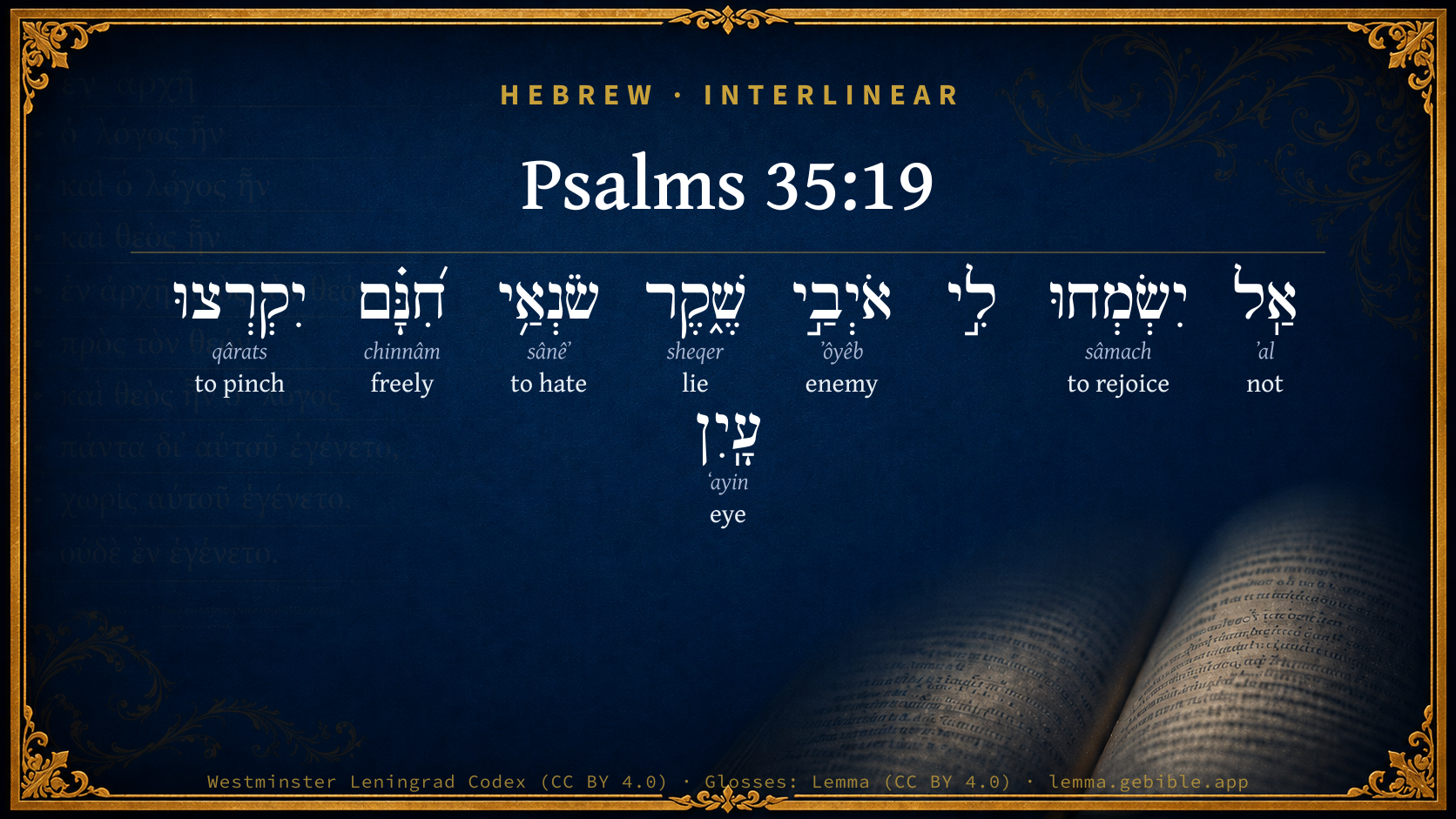
Psalms 35:19

Hebrew (Westminster Leningrad Codex) Psalms 35:19 appears in the Hebrew Old Testament. The text above is from the Westminster Leningrad Codex. Each word links to its Strong’s number, a concise gloss, and parsing drawn from the Open Scriptures Hebrew Bible morphology. Click any word for its full Brown-Driver-Briggs (BDB) entry.
Download image
Cite this verse

Psalms 35:19 (World English Bible). Public Domain. Lemma interlinear Bible study tool, https://lemma.gebible.app/v/psalms/35/19.

Show BibTeX & RIS
BibTeX
RIS
English Translation
Don't let those who are my enemies wrongfully rejoice over me; Neither let them wink with the eye who hate me without a cause.
World English Bible · Public Domain
Download a study sheet

One document with this verse’s original text, its word-by-word gloss line, the meaning frame, cross-references with their text, attributed commentary, and full source and license credits — printable, and it pastes into notes with its structure intact.

This verse Autodidact and up

Study sheet (.html) Plain text (.txt)

A passage Seminary Student

Up to 50 verses in one chapter. A passage sheet keeps up to 6 commentary sources and 12 cross-references per verse, in the order this page ranks them, and says so on the sheet whenever that leaves anything out. Ask for a single verse and you get the Autodidact verse sheet above.

Everything on this page stays free to read, with no account — the sheet is a download of what is already on screen, not access to it.

Want to remove ads? Support Godless Engineer
Compare translations 3

The same verse in 3 English versions, stacked beneath the original-language interlinear above. Click any original word for its lexicon entry.

Each is an independent rendering of the whole verse — the interlinear is not word-aligned to these translations.

Highlighted words mark where these versions differ — a whole-verse word diff, not a word-by-word alignment.

  • World English Bible Public Domain
    Don't let those who are my enemies wrongfully rejoice over me; Neither let them wink with the eye who hate me without a cause.
  • King James Version Public Domain
    Let not them that are mine enemies wrongfully rejoice over me: neither let them wink with the eye that hate me without a cause.
  • unfoldingWord Literal Text CC BY-SA 4.0
    Do not let my deceitful enemies rejoice over me; let the haters of me without cause wink the eye.

unfoldingWord Literal Text — © unfoldingWord, licensed CC BY-SA 4.0. Word-aligned USFM3 via Door43 (git.door43.org/unfoldingWord/en_ult).

Versions to compare (up to 4)

3 of 4 selected

Show all 18 translations

Every available English version of this verse, each an independent rendering of the whole verse.

  • World English Bible Public Domain
    Don't let those who are my enemies wrongfully rejoice over me; Neither let them wink with the eye who hate me without a cause.
  • Berean Standard Bible Public Domain
    Let not my enemies gloat over me without cause, nor those who hate me without reason wink in malice.
  • Majority Standard Bible Public Domain
    Let not my enemies gloat over me without cause, nor those who hate me without reason wink in malice.
  • King James Version Public Domain
    Let not them that are mine enemies wrongfully rejoice over me: neither let them wink with the eye that hate me without a cause.
  • American Standard Version (1901) Public Domain
    Let not them that are mine enemies wrongfully rejoice over me; Neither let them wink with the eye that hate me without a cause.
  • Revised Version (1885) Public Domain
    Let not them that are mine enemies wrongfully rejoice over me: neither let them wink with the eye that hate me without a cause.
  • Geneva Bible (1599) Public Domain
    Let not them that are mine enemies, vniustly reioyce ouer mee, neyther let them winke with the eye, that hate mee without a cause.
  • Douay-Rheims (1899) Public Domain
    Let not them that are my enemies wrongfully rejoice over me: who have hated me without cause, and wink with the eyes.
  • Young's Literal Translation Public Domain
    Mine enemies rejoice not over me `with' falsehood, Those hating me without cause wink the eye.
  • Literal Standard Version CC BY-SA 4.0
    Do not let my enemies rejoice over me [with] falsehood, || Those hating me without cause wink the eye.
  • Unlocked Literal Bible CC BY-SA 4.0
    Do not let my deceitful enemies rejoice over me; do not let them carry out their wicked schemes.
  • unfoldingWord Literal Text CC BY-SA 4.0
    Do not let my deceitful enemies rejoice over me; let the haters of me without cause wink the eye.
  • Darby Bible Public Domain
    Let not them that are wrongfully mine enemies rejoice over me; let them not wink with the eye that hate me without cause.
  • World Messianic Bible Public Domain
    Don’t let those who are my enemies wrongfully rejoice over me; neither let those who hate me without a cause wink their eyes.
  • Webster's Bible Public Domain
    Let not them that are my enemies wrongfully rejoice over me: neither let them wink with the eye that hate me without a cause.
  • Free Bible Version CC BY-SA 4.0
    Don't let my enemies take pleasure in my troubles, those people who hate me and tell lies about me, gloating over me for no reason.
  • Bible in Basic English Public Domain
    Do not let my haters be glad over me falsely; let not those who are against me without cause make sport of me.
  • JPS Tanakh (1917) Public Domain
    Let not them that are wrongfully mine enemies rejoice over me; neither let them wink with the eye that hate me without a cause.

Literal Standard Version (2020), Covenant Press — licensed CC BY-SA 4.0. Text via the HelloAO Bible API (eBible.org). Unlocked Literal Bible (unfoldingWord) — licensed CC BY-SA 4.0. Text via the HelloAO Bible API (eBible.org). unfoldingWord Literal Text — © unfoldingWord, licensed CC BY-SA 4.0. Word-aligned USFM3 via Door43 (git.door43.org/unfoldingWord/en_ult). Free Bible Version, Dr. Jonathan Gallagher — licensed CC BY-SA 4.0. Text via the HelloAO Bible API (eBible.org).

Word by word

More ways to search: Search by grammar → Find every occurrence → Compare this word →

Practice this passage: Drill this verse → Learn its vocabulary →

About this verse

These counts appear in no published source. They are computed here, from the morphology-tagged text and Lemma’s own curated glosses. What Lemma adds →

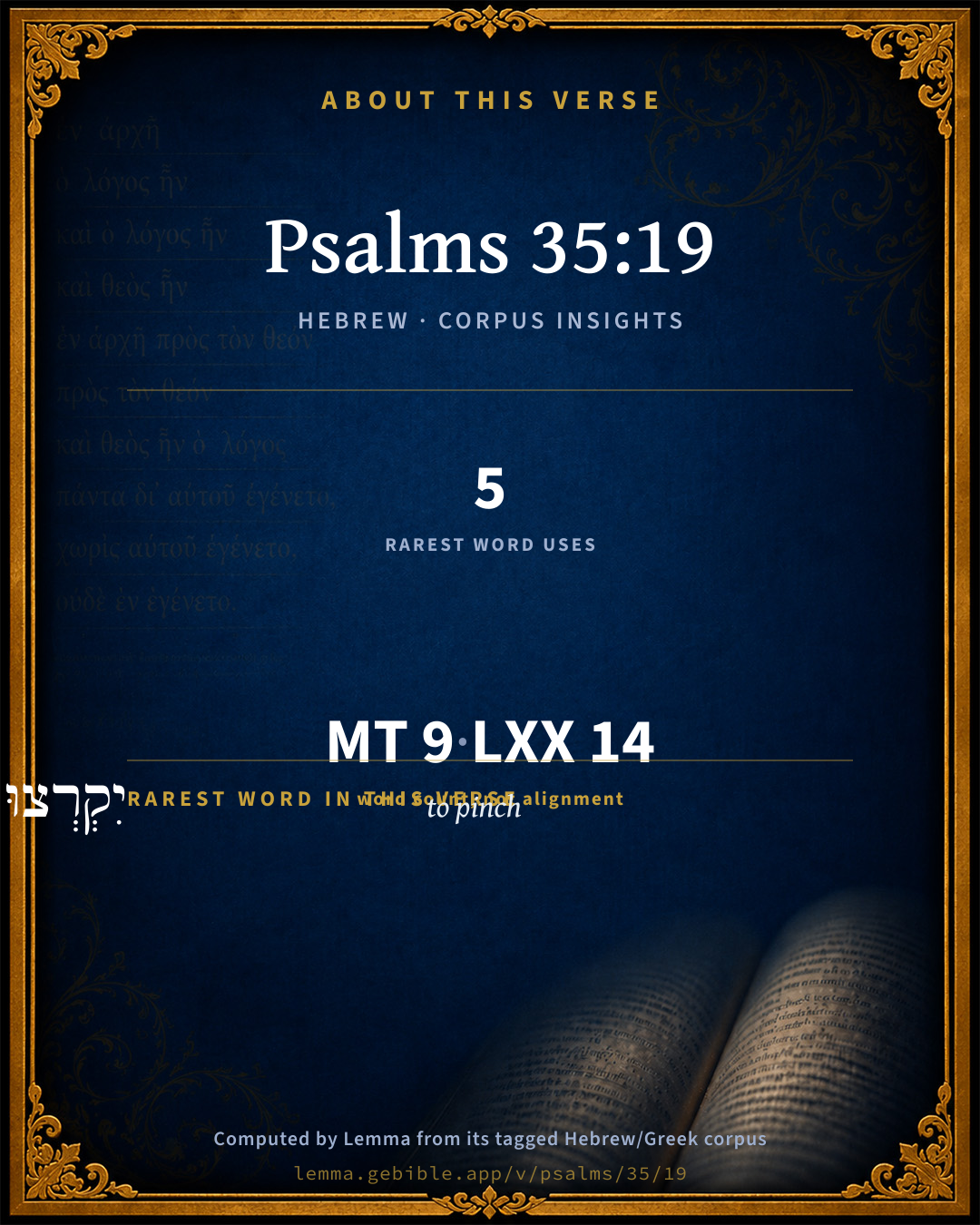
9
words
8
distinct lemmas
Wisdom
section

Notable vocabulary

The rarest word here is יִקְרְצוּ to pinch H7169 — appearing just 5 times in the whole Hebrew Bible.

Shared distinctive vocabulary

יִקְרְצוּ to pinch H7169 occurs in 5 verses of the Hebrew Bible. Also found in:

Grammatical profile

  • 4 verbs
  • 2 nouns
  • 1 preposition
  • 1 adverb
  • 1 particle

Verb forms

  • יִשְׂמְחוּ Qal · Jussive
  • אֹיְבַ֣י Qal · Participle Active
  • שֹׂנְאַ֥י Qal · Participle Active
  • יִקְרְצוּ Qal · Imperfect

Hebrew & Septuagint length

In English translation the verse runs 24 words from the Hebrew and 23 from the Septuagint (LXX English) — closely comparable.

A rough comparison of the two English renderings, which tokenize alike — not a word-level alignment.

Word counts can differ between the Hebrew and the Greek without any difference in meaning — e.g. the Hebrew direct-object marker אֵת has no separate Greek word, and Greek often adds the article ὁ.

In the original languages it is 9 Hebrew tokens and 14 Greek tokens — but the two are counted differently (Hebrew bundles its prefixes and suffixes into one token; the Greek is in lemma form), so that isn’t a like-for-like length.

Cross-references

16

Topical passages linked to Psalms 35:19 in the Treasury of Scripture Knowledge — connected by theme and wording, ordered by reader-vote popularity; previews shown in the World English Bible.

  • Psalms 69:4 Those who hate me without a cause are more than the hairs of my head. Those who want to cut me off, being my enemies wrongfully, are mighty. I have to restore what I didn't take away.
  • John 15:25 But this happened so that the word may be fulfilled which was written in their law, 'They hated me without a cause.'
  • Proverbs 6:13 Who winks with his eyes, who signals with his feet, Who motions with his fingers;
  • Psalms 13:4 Lest my enemy say, "I have prevailed against him;" Lest my adversaries rejoice when I fall.
  • Psalms 38:19 But my enemies are vigorous and many. Those who hate me without reason are numerous.
  • Proverbs 10:10 One winking with the eye causes sorrow, But a chattering fool will fall.
  • Psalms 38:16 For I said, "Don't let them gloat over me, Or exalt themselves over me when my foot slips."
  • Psalms 109:3 They have also surrounded me with words of hatred, And fought against me without a cause.
  • John 16:20–22 Most assuredly I tell you, that you will weep and lament, but the world will rejoice. You will be sorrowful, but your sorrow will be turned into joy.
  • 1 Samuel 24:11–12 Moreover, my father, behold, yes, see the skirt of your robe in my hand; for in that I cut off the skirt of your robe, and didn't kill you, know you and see that there is neither evil nor disobedience in my hand, and I have not sinned against you, though you hunt after my life to take it.
  • Job 15:12 Why does your heart carry you away? Why do your eyes flash,
  • Psalms 25:2 My God, I have trusted in you, Don't let me be shamed. Don't let my enemies triumph over me.
  • Psalms 35:15 But in my adversity, they rejoiced, and gathered themselves together. The attackers gathered themselves together against me, and I didn't know it. They tore at me, and didn't cease.
  • Psalms 119:161 Princes have persecuted me without a cause, But my heart stands in awe of your words.
  • Lamentations 3:52 They have chased me sore like a bird, those who are my enemies without cause.
  • Revelation 11:7–10 When they have finished their testimony, the beast that comes up out of the abyss will make war with them, and overcome them, and kill them.

Cross-references courtesy of OpenBible.info (CC BY 4.0).

Hebrew and Greek witnesses Masoretic Hebrew ↔ Greek Septuagint

The same verse in the two great witnesses to the Old Testament, shown verse-for-verse.

You’re reading Greek Psalm 34 (Hebrew Psalm 35). The Septuagint counts the superscription, so verse numbers can differ from the Hebrew — chapter-level alignment, not verse-by-verse. Numbering follows Rahlfs.

These are two independent witnesses, not word-aligned to each other, and the Septuagint is shown in lemma (dictionary) form.

Hebrew Psalms 35:19 Masoretic · Westminster Leningrad Codex

אַֽל יִשְׂמְחוּ לִ֣י אֹיְבַ֣י שֶׁ֑קֶר שֹׂנְאַ֥י חִ֝נָּ֗ם יִקְרְצוּ עָֽיִן

Don't let those who are my enemies wrongfully rejoice over me; Neither let them wink with the eye who hate me without a cause.

World English Bible · Public Domain

Greek LXX Greek Psalm 34:19 Septuagint · lemma form

μή ἐπιχαίρω ἐγώ ὁ ἐχθραίνω ἐγώ ἀδίκως ὁ μισέω ἐγώ δωρεά καί διανεύω ὀφθαλμός

Let not them that are my enemies without a cause rejoice against me; who hate me for nothing, and wink with their eyes.

LXX2012 (modern English Septuagint) · Public Domain

Hebrew: Westminster Leningrad Codex (CC BY 4.0). Greek: Septuagint (public domain); English from LXX2012 (modern English Septuagint) (Public Domain). How the Septuagint differs from the Hebrew →

Commentary

Notes on Psalms 35:19 from classic Christian and Jewish commentators (each source and its license shown beneath its notes). The classic Christian expositions comment on the surrounding passage and are grouped to its opening verse, so a note may address several verses; the Jewish commentaries on the Tanakh (Rashi and others) are per-verse, so they appear only where the commentator wrote on this verse.

Lemma curates 59 commentaries, every one of them public domain or Creative Commons licensed, each selected and text-cleaned for this edition rather than reprinted as found. About our sources →

Trapp's Complete Commentary

John Trapp

Psa 35:19 Let not them that are mine enemies wrongfully rejoice over me: [neither] let them wink with the eye that hate me without a cause.

Ver. 19. Neither let them wink with the eye] Which is the gesture of a malicious scoffer, Pro 6:13; Pro 10:10. Ne amarulenter ludificentur me (Trem.).

John Trapp, A Commentary or Exposition upon All the Books of the Old and New Testament (1647–1656) — public domain. Text from a community e-Sword module.

Joseph Benson's Commentary

Psa 35:19-21. Neither let them wink with the eye — That is, mock me, or insult over me, as this phrase signifies. For they speak not peace — They are enemies to all peaceable counsels; they breathe out nothing but threatenings and war. They devise deceitful matters — They use, not only open violence, but deceit and subtle artifices; against them that are quiet in the land — Against me and my followers, who desire nothing more than to live quietly and peaceably under Saul’s government. They opened their mouth wide — To pour forth whole floods of scoffs, slanders, and contumelies. Or, to devour me. It is a metaphor taken from wild beasts, when they come within reach of their prey. And said, Aha, Aha! — An expression of joy and triumph. Our eye hath seen it — Namely, what we have long desired and hoped for. Or, as Bishop Patrick paraphrases it, “So, so, we have found him out; his treasonable practices are discovered; we ourselves are eye-witnesses of it.”

Joseph Benson's Commentary on the Old and New Testaments (1811–1818) — public domain. Text from a community e-Sword module.

Keil & Delitzsch

C. F. Keil & F. Delitzsch

I the third part, Psa 35:19 the description of the godlessness of his enemies is renewed; but the soul of the praying psalmist has become more tranquil, and accordingly the language also is more clear and moves on with its accustomed calmness. שׁקר and חנּם are genitives, having an attributive sense (vid., on Sa2 22:23). The verb קרץ signifies both to pinch = nip, Job 33:6 (cf. the Arabic karada, to cut off), and to pinch together, compress = to wink, generally used of the eyes, but also of the lips, Pro 16:30, and always as an insidiously malicious gesture. אל rules over both members of the verse as in Psa 75:6, and frequently. שׁלום in Psa 35:20 is the word for whatever proceeds from good intentions and aims at the promotion or restoration of a harmonious relationship. רגעי־ארץ (from רגע, cf. ענוי־ארץ, Psa 76:10, Zep 2:3, צפוּניך, Psa 83:4) are those who quietly and unostentatiously walk in the ways of God. Against such they devise mischievous, lying slanders and accusations. And with wide-opened mouth, i.e., haughty scorn, they cry, as they carouse in sight of the misfortune of those they have persecuted: now we have that which we have longed to see. האח (composed of ההּ and אח) is a cry of joy, and more especially of malignant joy at another's hurt (cf. Eze 25:3).

Keil & Delitzsch — Biblical Commentary on the Old Testament (1861–1891) — public domain (CC PDM 1.0). Text via the HelloAO Bible API. (Old Testament only.)

J. A. Alexander on Psalms

Joseph Addison Alexander

19. (Psa 35:19) Let them not rejoice respecting me, my enemies of falsehood, (and let not) my haters without cause wink the eye. Respecting me, at my expense, or, in this and similar connections, over me, although this idea is not so much expressed in the text as suggested by the context. See above, Psa 25:2, and below, Psa 35:24, Psa 38:7 (16). Let them not rejoice, let them have no occasion so to do.—My enemies of falsehood, my false enemies, who gratify their spite by calumny and slander.—My haters without cause, those who hate me gratuitously, out of sheer spite, without any reasonable ground or even colourable pretext. This is a favourite description of the enemies of the righteous—see above, on Psa 7:5 (4), Psa 25:3—and was pre-eminently true of the enemies of Christ, to whom it is applied in the New Testament (Joh 15:25). The negation of the first clause is to be repeated in the other, as in Psa 9:19 (18). Winking is here referred to as a gesture of mutual congratulation among accomplices in guilt. Compare Pro 6:13; Pro 10:10.

Joseph Addison Alexander, The Psalms Translated and Explained (1850) — public domain. Text from a community e-Sword module.

Tyndale Open Study Notes

Tyndale Open Resources

35:19-25 In this prayer for vindication, the psalmist’s crisis looms so large that a resolution must be found in the Lord. The psalmist has taken the high road, believing that vengeance belongs to the Lord. God’s patience hardens the hearts of the wicked and gives them reasons to justify their evil lifestyle.

35:19 John applied this claim of innocence (see also 69:4) to Jesus (John 15:25).

Tyndale Open Study Notes — © Tyndale Open Resources, licensed CC BY-SA 4.0. Text via the HelloAO Bible API.

Geneva Bible (1599)

Geneva Bible translators

In token of contempt and mocking.

Geneva Bible (1599) marginal notes — public domain. Text via Bolls.life.

Jamieson, Fausset & Brown

Robert Jamieson, A. R. Fausset & David Brown

enemies wrongfully--by false and slanderous imputations.

wink with the eye--an insulting gesture (Pro 6:13).

without a cause--manifests more malice than having a wrong cause.

Jamieson, Fausset & Brown — Commentary Critical and Explanatory on the Whole Bible (1871) — public domain (CC PDM 1.0). Text via the HelloAO Bible API.

Adam Clarke's Commentary

Verse 19. That are mine enemies] Saul and his courtiers.

Adam Clarke's Commentary on the Bible (1810–1826) — public domain. Text from a community e-Sword/MySword module.

John Calvin's Commentaries

19. Let not those who are my enemies wrongfully rejoice over me. Because David’s enemies already exulted in the hope of seeing his overthrow and destruction, he prays that God would not suffer them to realize a desire so wicked. In order to render God favorable to his cause, he again protests that they hated him without any fault or occasion on his part, and that it was their own malice which urged them to such cruelty against him; for in order to secure the help of God, it is necessary to come before him with the testimony of a good conscience.

The Hebrew word שקר, sheker, which we have rendered wrongfully, is by some translated deceitfully, as if David meant that his enemies lay in wait for him. But this is to reason with too much subtilty. Besides, the repetition which immediately follows shows that he complains of their wilful hatred, inasmuch as of their own accord, and from deliberate design, they persecuted a man who had given them no cause of offense, but was their friend and benefactor. The Hebrew word קרף, karats, here signifies to wink with the eyes askance in mockery, as in Psalm 22:8, it denotes, to wag the head, and to shoot out the lip.

John Calvin's Commentaries (1540-1563) — public domain. Text from the Calvin Translation Society English edition (1840s-50s) via the Christian Classics Ethereal Library (ccel.org). Calvin's coverage is partial (roughly two-thirds of the Bible); uncommented books and verses are honest gaps, never fabricated. The 19th-century editor's footnotes and remarks are omitted so the notes are faithfully Calvin's own voice.

Ellicott's Commentary for English Readers

(19) Wink.—Pro_6:13; Pro_10:10; a common gesture of agreement among confederates.

A Bible Commentary for English Readers, edited by Charles John Ellicott (1878–1897) — public domain. Text from a community e-Sword module.

The Cambridge Bible for Schools and Colleges

gen. ed. J. J. S. Perowne

19. wrongfully] Lit., falsely (Psa_38:19; Psa_69:4); the grounds they allege for their enmity being untrue.

neither let them wink] The insertion of the negative is grammatically justifiable, and probably right; though the clause may also be rendered, they wink &c., describing the confederates’ malicious signals of satisfaction at his misfortune (Pro_6:13; Pro_10:10).

that hate me without a cause] Cp. Psa_69:4. Our Lord refers to these words as ‘fulfilled’ in Himself (Joh_15:25).

19–28. Renewed prayer in a somewhat calmer tone.

The Cambridge Bible for Schools and Colleges (gen. ed. J. J. S. Perowne; Cambridge University Press, 1878–1918) — public domain. Text from a community e-Sword module.

John Gill's Exposition

Let not them that are mine enemies wrongfully rejoice over me,.... The word "wrongfully" is to be joined not to the word "rejoice", but to the word "enemies"; and the sense is, that they were his enemies wrongfully, for false reasons, unjust causes, or without any cause that was just; as follows;

neither let them wink with the eye that hate me without a cause; such were David's enemies, particularly Saul, Psa 7:4; and such were the enemies of Christ: this last clause is thought to be referred to by him, and applied to himself, Joh 15:25; and the whole of this is said him and by him, Psa 69:4; see also Psa 109:3. These were the Jews, of whom he came, among whom he was, and who had no reason to be his enemies, and to hate him; since he was harmless and inoffensive in his life and conversation among them; went about doing a great deal of good to them, both for soul and body, and always expressed the most tender concern for them: they had reasons for their hatred and rejection of him, but not justifiable ones; such as the meanness of his person and state in their view, the doctrines he preached relating to his deity, divine sonship, and the distinguishing grace of God; and his inveighing against the sins and vices which prevailed among them; and such are the enemies of his people, who hate them, though they are the quiet in the land, as is said in Psa 35:20; and are harmless and inoffensive in their behaviour towards men: these are hated for Christ's sake; and because he has chosen and called them out of the world; and because of their principles, which are distinguishing, and their practices, which are good: now the psalmist entreats that such might not be suffered to go on rejoicing over him, and at his calamities, but that he might be delivered out of all troubles, and out of their hands; and that they might not have any reason to wink with their eyes in a scornful and deriding way to him, and as expressing their pleasure to one an other at his distresses; see Pro 1:12.

John Gill's Exposition of the Whole Bible (1746–1763) — public domain (CC PDM 1.0). Text via the HelloAO Bible API.

Albert Barnes' Notes on the Bible

Let not them that are mine enemies wrongfully rejoice over me - Margin, “falsely.” Literally, “My enemies of falsehood;” that is, who are “falsely” my foes; who have no just cause for being opposed to me. Compare Mat 5:11. David was conscious that he had done them no wrong, or that he had given no occasion for their conduct toward him, and hence, his prayer is simply a request that justice might be done.

Neither let them wink with the eye - Compare the notes at Job 15:12. See also Pro 6:13; Pro 10:10. The word rendered “wink” means properly to tear or cut asunder; and then, to cut with the teeth, to bite; and hence, the phrase “to bite the lips,” as an expression of malice, or mischief-making: Pro 16:30; and to bite or pinch the eyes, that is, to press the eyelids together in the manner of biting the lips - also a gesture of malice or mischief. So Gesenius, Lexicon. But perhaps the more probable meaning is that of “winking” literally; or giving a significant wink of the eyes as an expression of triumph over anyone. In this sense the term is often used now.

That hate me without a cause - To whom I have given no occasion for opposition. In the case under consideration the psalmist regarded himself as entirely innocent in this respect.

Albert Barnes' Notes on the Bible (1834–1885) — public domain. Text from a community e-Sword/MySword module.

Matthew Poole's English Annotations

Wink with their eye, i.e. mock me, or insult over me, as this phrase signifies, Pro 6:13; 10:10.

Matthew Poole's English Annotations on the Holy Bible (1683–1685) — public domain. Text from a community e-Sword/MySword module.

The Treasury of David

Charles H. Spurgeon

Verse 19. He earnestly prays that as they have no cause for their enmity, they may have no cause for triumph either in his folly, sin, or overthrow. ["Neither let them wink with the eye that hate me without a cause."] The winking of the eye was the low-bred sign of congratulation at the ruin of their victim, and it may also have been one of their scornful gestures as they gazed upon him whom they despised. To cause hatred is the mark of the wicked, to suffer it causelessly is the lot of the righteous. God is the natural Protector of all who are wronged, and he is the enemy of all oppressors.

[Verse] 19. ["Wink with the eye."] Showing pleasure in their eyes because of my evil. [Francis Vatablus,] 1545

[Verse] 19. ["Wink the eye."] This was a sign which malicious persons made to each other when the object of their malice was gained, scornfully twisting their eyes together. The Hebrew word here has no sufficiently expressive substitute in English. [Benjamin Weiss.]

None.

Charles H. Spurgeon's The Treasury of David (1869–1885) — public domain. Psalms only. Text from a community e-Sword/MySword module.

Whedon's Commentary on the Bible

Daniel D. Whedon

19. Hate me without a cause—Quoted by Christ and applied to himself, Joh_15:25. The closing strophe is more chastened and calm, yet prayer against his enemies prevails. For wink with the eye, as a silent token of agreement, see Pro_6:13; Pro_10:10

Daniel D. Whedon (gen. ed.), Commentary on the Old and New Testaments (1874–1909) — public domain. Text from a community e-Sword module.

The Pulpit Commentary

Vers. 19-28. The main element of this, the third section of the psalm, is prayer. Complaint finds a voice in vers. 20, 21, and thanksgiving in ver. 28; but with these exceptions, the strophe is one long strain of prayer. The prayer is, first, negative: "Let not mine enemies rejoice" (ver. 19); "Keep not silence" (ver. 22); "Be not far from me" (ver. 22). But after this it becomes mainly positive: "Stir up thyself, and awake to judgment" (ver. 23); "Judge me, O Lord" (ver. 24); "Let them be ashamed and brought to confusion that rejoice at my hurt" (ver. 26); "Let them shout for joy, and be glad, that favour my righteous cause" (ver. 27); "Let the Lord be magnified, which hath pleasure in my prosperity" (ver. 27).

Let not them that are mine enemies wrongfully rejoice over me. (comp. Psa_38:19, where David says that those who "hated him wrongfully" were "multiplied David feels that no one had any reason to hate him, since he had always sought the good of all with whom he came into contact (see ver. 12). Neither let them wink with the eye that hate me without a cause; i.e. let them not have cause to wink to each other in self-congratulation on their having triumphed over me completely.

Vers. 19-28. Pleas for triumph.

The substance of this third division is a continuous prayer that God would give him to triumph over his enemies; and the plans on which the prayer is grounded.

I HE PRAYS THAT THE CAUSE OF UNRIGHTEOUSNESS MAY NOT TRIUMPH.

1. The enmity of his enemies was without just cause. (Ver. 19) To be unjustly accused wounds a good man very deeply.

2. He was the champion of public order and peace: and therefore they opposed him. (Ver. 20) Employed deceitful words and schemes to disturb and overthrow the public peace. Bad men therefore.

3. God himself was the witness of their injustice and wickedness. (Ver. 21) And cannot but interpose of his own righteous will.

4. He appeals to God on the ground of his personal righteousness. (Vers. 23, 24) Not on the ground of his perfection; but he appeals to his upright aim and just purpose and general rectitude. The righteous God must therefore overthrow his enemies. God"s righteousness, and his own could not both be defeated. Their just retribution was to be clothed with confusion and dishonour. The psalmist is so sure that his prayer will be answered and his enemies punished, that we have next.

II A GRATEFUL ANTICIPATION OF THE VICTORY.

1. He calls upon all who love righteousness to magnify the work of God. (Ver. 27, "who have pleasure in my justification, or righteousness.") The victory of the psalmist over his wicked enemies.

2. He himself will sing of the righteousness of God for ever. (Ver. 28, "all the day long.") We should praise God for ever as the Author of all our moral and spiritual victories. "Not unto us, but unto thy Name, O Lord," etc. S.

The Pulpit Commentary (1880–1919), ed. H.D.M. Spence-Jones & Joseph S. Exell — public domain. Text from a community e-Sword module.

Kretzmann's Popular Commentary

Paul E. Kretzmann

Earnest Prayer for Relief

v. 19. Let not them that are mine enemies wrongfully rejoice over me, by their false and slanderous accusations; neither let them wink with the eye, in a gesture of cunning and contempt, that hate me without a cause, while he is wholly innocent.

v. 20. For they speak not peace, their aim is not to bring quiet and happiness to the country; but they devise deceitful matters against them that are quiet in the land, against those who really love peace and seek the welfare of the country.

v. 21. Yea, they opened their mouth wide against me, in a gesture of contempt, and said, Aha, aha! our eye hath seen it, namely, the gratification of their hopes that the believer would be in trouble.

v. 22. This Thou hast seen, O Lord, the manner in which the enemies acted. Keep not silence; O Lord, be not far from me! in this great emergency, where He alone could provide help.

v. 23. Stir up Thyself, rousing Himself, as though from sleep, making ready for energetic action, and awake to my judgment, even unto my cause, namely, to establish it as just, to vindicate him, my God and my Lord.

v. 24. Judge me, O Lord, my God, according to Thy righteousness; and let them not rejoice over me.

v. 25. Let them not say in their hearts, in their greed to devour, in their desire to destroy, Ah, so would we have it! Let them not say, We have swallowed him up.

v. 26. Let them be ashamed and brought to confusion together, with all their evil intentions utterly frustrated, that rejoice at mine hurt. Let them be clothed with shame and dishonor that magnify themselves, puffing themselves up, against me. The righteous government of God is the only hope of the pious and the terror of the wicked.

v. 27. Let them shout for joy and be glad that favor my righteous cause, or, who delight in my righteousness, glad that he should have his right; yea, let them say continually, Let the Lord be, magnified, which hath pleasure in the prosperity of His servant, delighting in showing him His divine blessings.

v. 28. And my tongue shall speak of Thy righteousness, in praising God’s righteous government, and of Thy praise all the day long. God is the Champion of all those who are oppressed among His children, and they, in turn, make it their business to make known the honor of His holy name at all times.

Paul E. Kretzmann, Popular Commentary of the Bible (1921–1924) — public domain. Text from a community e-Sword module.

unfoldingWord translationNotes

Door43 World Missions Community

Do not let my deceitful enemies

"Do not let my enemies, who tell lies about me,"

their wicked schemes

"their evil plans"

they do not speak peace

The abstract noun "peace" can be stated as "peacefully." AT: "they do not speak peacefully to people" (See: Abstract Nouns)

devise deceitful words

"look for ways to tell lies"

those in our land who live in peace

"those who live peacefully in our land"

live in peace

The abstract noun "peace" can be stated in other forms. AT: "live peacefully with others" or "do no harm to anyone" (See: Abstract Nouns)

translationWords

adversary

joy

evil

peace

deceive

word

unfoldingWord translationNotes — © Distant Shores Media and the Door43 World Missions Community, licensed CC BY-SA 4.0. Source: git.door43.org/Door43/en_tn.

Rashi

Rabbi Shlomo Yitzchaki (Rashi)

those who are my enemies for an unjust cause who hate me because of a false matter, that they testify against me what never entered my mind. Let them not rejoice at my downfall.

who hate me Let those who hate me not wink their eyes at me, to mock my downfall with their eyes.

יקרצו means seynt in Old French, signal.

Rashi on the Tanakh — English translations: “The Judaica Press complete Tanach with Rashi, translated by A. J. Rosenberg” (CC BY 4.0); “Pentateuch with Rashi's commentary by M. Rosenbaum and A.M. Silbermann, 1929-1934” (public domain); “The Metsudah Tanach series, Lakewood, N.J” (CC BY 4.0); and “The Book of Joshua, Metsudah Publications, 1997” (CC BY 4.0). Text via Sefaria.

Lesson kit

Teaching starters — assembled from the data on this page, not authored interpretation. Every prompt links to the verse data it draws on. Edit before teaching.

Psalms, in the Wisdom, opens this verse with 9 words (8 distinct Hebrew lemmas). Its most distinctive word is qârats (“to pinch”). A historical commentator’s framing appears above. Read the whole chapter for the surrounding context.

Discussion questions

  1. The word qârats carries the sense “to pinch.” How does it shape the verse?
  2. Job 33:6 shares the word «to pinch» with this verse. How do the two illuminate each other?
  3. These translations render this verse differently; the difference is in the English rendering, not the original. What questions does that raise?
  4. The verb «יִשְׂמְחוּ» is Qal Jussive. How does its form color the action?
  5. Reading how Trapp's Complete Commentary and Joseph Benson's Commentary read this verse, where do the two commentators agree and where do they part?

Things to notice

Reading settings

Reading text

Shown beneath each verse's original-language words.

Old Testament
Old Testament edition

Read the OT as the Masoretic Hebrew (MT) or the Greek Septuagint (LXX).

English shown for the Greek Septuagint (in the Hebrew ↔ Greek comparison).

Comparing translations? Open the Compare panel on any verse page to stack up to four side by side.