Psalms 27:6

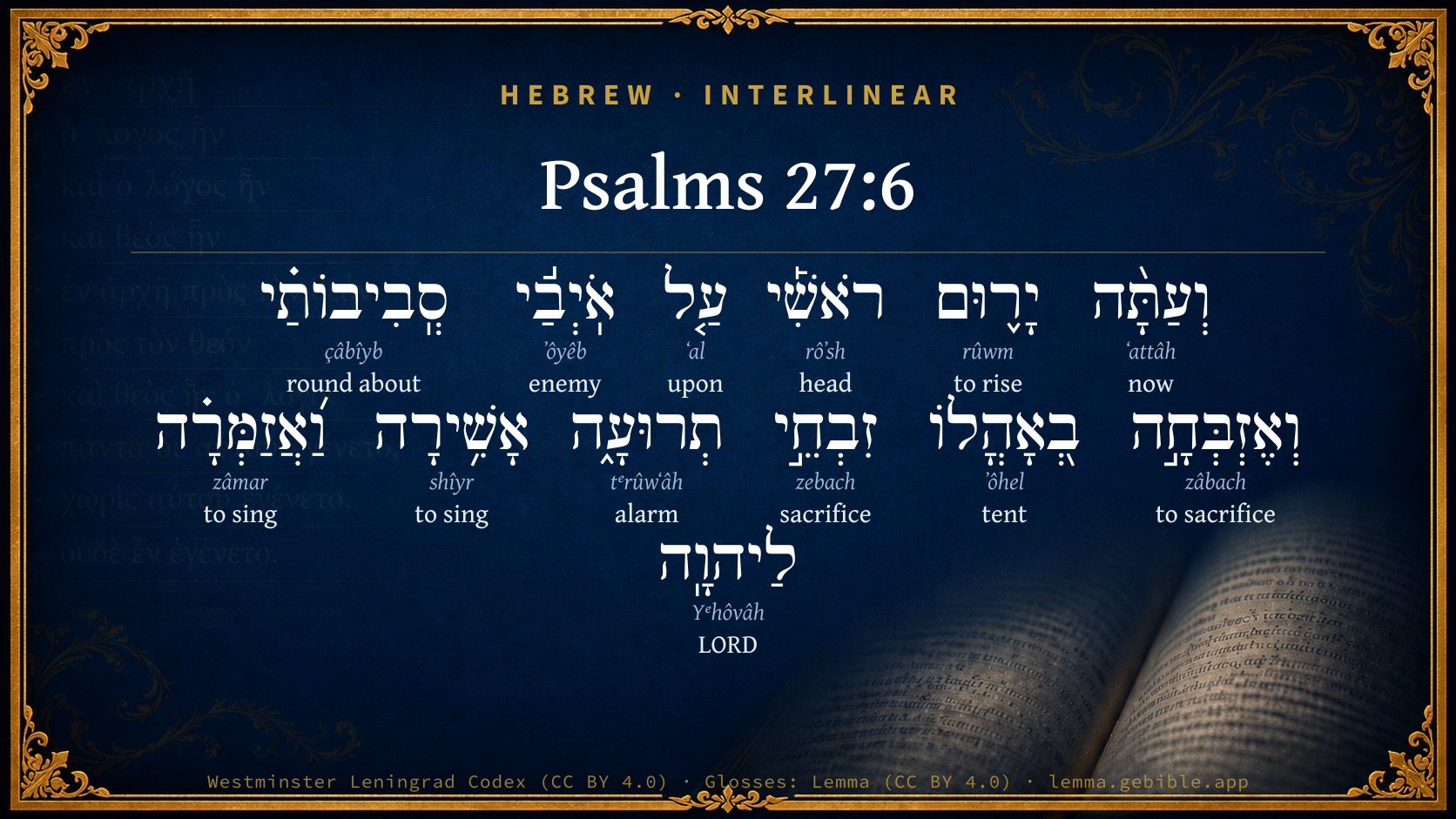
Hebrew (Westminster Leningrad Codex) Psalms 27:6 appears in the Hebrew Old Testament. The text above is from the Westminster Leningrad Codex. Each word links to its Strong’s number, a concise gloss, and parsing drawn from the Open Scriptures Hebrew Bible morphology. Click any word for its full Brown-Driver-Briggs (BDB) entry.
Download image
Cite this verse

Psalms 27:6 (World English Bible). Public Domain. Lemma interlinear Bible study tool, https://lemma.gebible.app/v/psalms/27/6.

Show BibTeX & RIS
BibTeX
RIS
English Translation
Now my head will be lifted up above my enemies around me. I will offer sacrifices of joy in his tent. I will sing, yes, I will sing praises to Yahweh.
World English Bible · Public Domain
Download a study sheet

One document with this verse’s original text, its word-by-word gloss line, the meaning frame, cross-references with their text, attributed commentary, and full source and license credits — printable, and it pastes into notes with its structure intact.

This verse Autodidact and up

Study sheet (.html) Plain text (.txt)

A passage Seminary Student

Up to 50 verses in one chapter. A passage sheet keeps up to 6 commentary sources and 12 cross-references per verse, in the order this page ranks them, and says so on the sheet whenever that leaves anything out. Ask for a single verse and you get the Autodidact verse sheet above.

Everything on this page stays free to read, with no account — the sheet is a download of what is already on screen, not access to it.

Want to remove ads? Support Godless Engineer
Compare translations 3

The same verse in 3 English versions, stacked beneath the original-language interlinear above. Click any original word for its lexicon entry.

Each is an independent rendering of the whole verse — the interlinear is not word-aligned to these translations.

Highlighted words mark where these versions differ — a whole-verse word diff, not a word-by-word alignment.

  • World English Bible Public Domain
    Now my head will be lifted up above my enemies around me. I will offer sacrifices of joy in his tent. I will sing, yes, I will sing praises to Yahweh.
  • King James Version Public Domain
    And now shall mine head be lifted up above mine enemies round about me: therefore will I offer in his tabernacle sacrifices of joy; I will sing, yea, I will sing praises unto the LORD.
  • unfoldingWord Literal Text CC BY-SA 4.0
    And now my head will be lifted up above the ones being hostile to me all around me, and I will sacrifice in his tent sacrifices of a shout of joy. I will sing and make music to Yahweh!

unfoldingWord Literal Text — © unfoldingWord, licensed CC BY-SA 4.0. Word-aligned USFM3 via Door43 (git.door43.org/unfoldingWord/en_ult).

Versions to compare (up to 4)

3 of 4 selected

Show all 18 translations

Every available English version of this verse, each an independent rendering of the whole verse.

  • World English Bible Public Domain
    Now my head will be lifted up above my enemies around me. I will offer sacrifices of joy in his tent. I will sing, yes, I will sing praises to Yahweh.
  • Berean Standard Bible Public Domain
    Then my head will be held high above my enemies around me. At His tabernacle I will offer sacrifices with shouts of joy; I will sing and make music to the LORD.
  • Majority Standard Bible Public Domain
    Then my head will be held high above my enemies around me. At His tabernacle I will offer sacrifices with shouts of joy; I will sing and make music to the LORD.
  • King James Version Public Domain
    And now shall mine head be lifted up above mine enemies round about me: therefore will I offer in his tabernacle sacrifices of joy; I will sing, yea, I will sing praises unto the LORD.
  • American Standard Version (1901) Public Domain
    And now shall my head be lifted up above mine enemies round about me. And I will offer in his tabernacle sacrifices of joy; I will sing, yea, I will sing praises unto Jehovah.
  • Revised Version (1885) Public Domain
    And now shall mine head be lifted up above mine enemies round about me; and I will offer in his tabernacle sacrifices of joy; I will sing, yea, I will sing praises unto the LORD.
  • Geneva Bible (1599) Public Domain
    And nowe shall hee lift vp mine head aboue mine enemies rounde about mee: therefore wil I offer in his Tabernacle sacrifices of ioy: I wil sing and praise the Lord.
  • Douay-Rheims (1899) Public Domain
    He hath exalted me upon a rock: and now he hath lifted up my head above my enemies. I have gone round, and have offered up in his tabernacle a sacrifice of jubilation: I will sing, and recite a psalm to the Lord.
  • Young's Literal Translation Public Domain
    And now, lifted up is my head, Above my enemies -- my surrounders, And I sacrifice in His tent sacrifices of shouting, I sing, yea, I sing praise to Jehovah.
  • Literal Standard Version CC BY-SA 4.0
    And now my head is lifted up, || Above my enemies—my surrounders, || And I sacrifice in His tent sacrifices of shouting, || I sing, indeed, I sing praise to YHWH.
  • Unlocked Literal Bible CC BY-SA 4.0
    Then my head will be lifted up above my enemies all around me, and I will offer sacrifices of joy in his tent! I will sing and make songs to Yahweh!
  • unfoldingWord Literal Text CC BY-SA 4.0
    And now my head will be lifted up above the ones being hostile to me all around me, and I will sacrifice in his tent sacrifices of a shout of joy. I will sing and make music to Yahweh!
  • Darby Bible Public Domain
    And now shall my head be lifted up above mine enemies round about me; and I will offer in his tent sacrifices of shouts of joy: I will sing, yea, I will sing psalms unto Jehovah.
  • World Messianic Bible Public Domain
    Now my head will be lifted up above my enemies around me. I will offer sacrifices of joy in his tent. I will sing, yes, I will sing praises to the LORD.
  • Webster's Bible Public Domain
    And now shall my head be lifted above my enemies around me: therefore will I offer in his tabernacle sacrifices of joy; I will sing, yes, I will sing praises to the LORD.
  • Free Bible Version CC BY-SA 4.0
    He will hold my head high over my enemies who are all around me. I shall offer sacrifices in his house with shouts of joy, and I will sing praises to the Lord.
  • Bible in Basic English Public Domain
    And now my head will be lifted up higher than my haters who are round me: because of this I will make offerings of joy in his tent; I will make a song, truly I will make a song of praise to the Lord.
  • JPS Tanakh (1917) Public Domain
    And now shall my head be lifted up above mine enemies round about me; and I will offer in His tabernacle sacrifices with trumpet-sound; I will sing, yea, I will sing praises unto the LORD.

Literal Standard Version (2020), Covenant Press — licensed CC BY-SA 4.0. Text via the HelloAO Bible API (eBible.org). Unlocked Literal Bible (unfoldingWord) — licensed CC BY-SA 4.0. Text via the HelloAO Bible API (eBible.org). unfoldingWord Literal Text — © unfoldingWord, licensed CC BY-SA 4.0. Word-aligned USFM3 via Door43 (git.door43.org/unfoldingWord/en_ult). Free Bible Version, Dr. Jonathan Gallagher — licensed CC BY-SA 4.0. Text via the HelloAO Bible API (eBible.org).

Word by word

More ways to search: Search by grammar → Find every occurrence → Compare this word →

Practice this passage: Drill this verse → Learn its vocabulary →

תְרוּעָ֑ה
tᵉrûwʻâh
H8643
“alarm”
Noun, Common, Feminine, Singular, Absolute
Part of Speech
Noun
Type
Common
Gender
Feminine
Number
Singular
State
Absolute
Full BDB Definition

Origin: from H7321

TWOT: 2135b

alarm, signal, sound of tempest, shout, shout or blast of war or alarm or joy - alarm of war, war-cry, battle-cry - blast (for march) - shout of joy (with religious impulse) - shout of joy (in general)
  1. וְעַתָּ֨ה ʻattâh H6258 “and · now” Conjunction + Adverb
  2. יָר֪וּם rûwm H7311 “to rise” Verb, Qal, Imperfect, 3rd Person, Masculine, Singular
  3. רֹאשִׁ֡י rôʼsh H7218 “head · my” Noun, Common, Masculine, Singular, Construct + Suffix, Personal, 1st Person, Common, Singular
  4. עַ֤ל ʻal H5921 “upon” Preposition
  5. אֹֽיְבַ֬י ʼôyêb H341 “enemy · me” Verb, Qal, Participle Active, Masculine, Plural, Construct + Suffix, Personal, 1st Person, Common, Singular
  6. סְֽבִיבוֹתַ֗י çâbîyb H5439 “surroundings · my” Noun, Common, Both, Plural, Construct + Suffix, Personal, 1st Person, Common, Singular
  7. וְאֶזְבְּחָ֣ה zâbach H2076 “and · to sacrifice” Conjunction + Verb, Qal, Cohortative, 1st Person, Common, Singular
  8. בְ֭אָהֳלוֹ ʼôhel H168 “in/at · tent · his” Preposition + Noun, Common, Masculine, Singular, Construct + Suffix, Personal, 3rd Person, Masculine, Singular
  9. זִבְחֵ֣י zebach H2077 “sacrifices of” Noun, Common, Masculine, Plural, Construct
  10. אָשִׁ֥ירָה shîyr H7891 “to sing” Verb, Qal, Cohortative, 1st Person, Common, Singular
  11. וַ֝אֲזַמְּרָ֗ה zâmar H2167 “and · to sing” Conjunction + Verb, Piel, Cohortative, 1st Person, Common, Singular
  12. לַיהוָֽה Yᵉhôvâh H3068 “to/for · LORD” Preposition + Noun, Proper

About this verse

These counts appear in no published source. They are computed here, from the morphology-tagged text and Lemma’s own curated glosses. What Lemma adds →

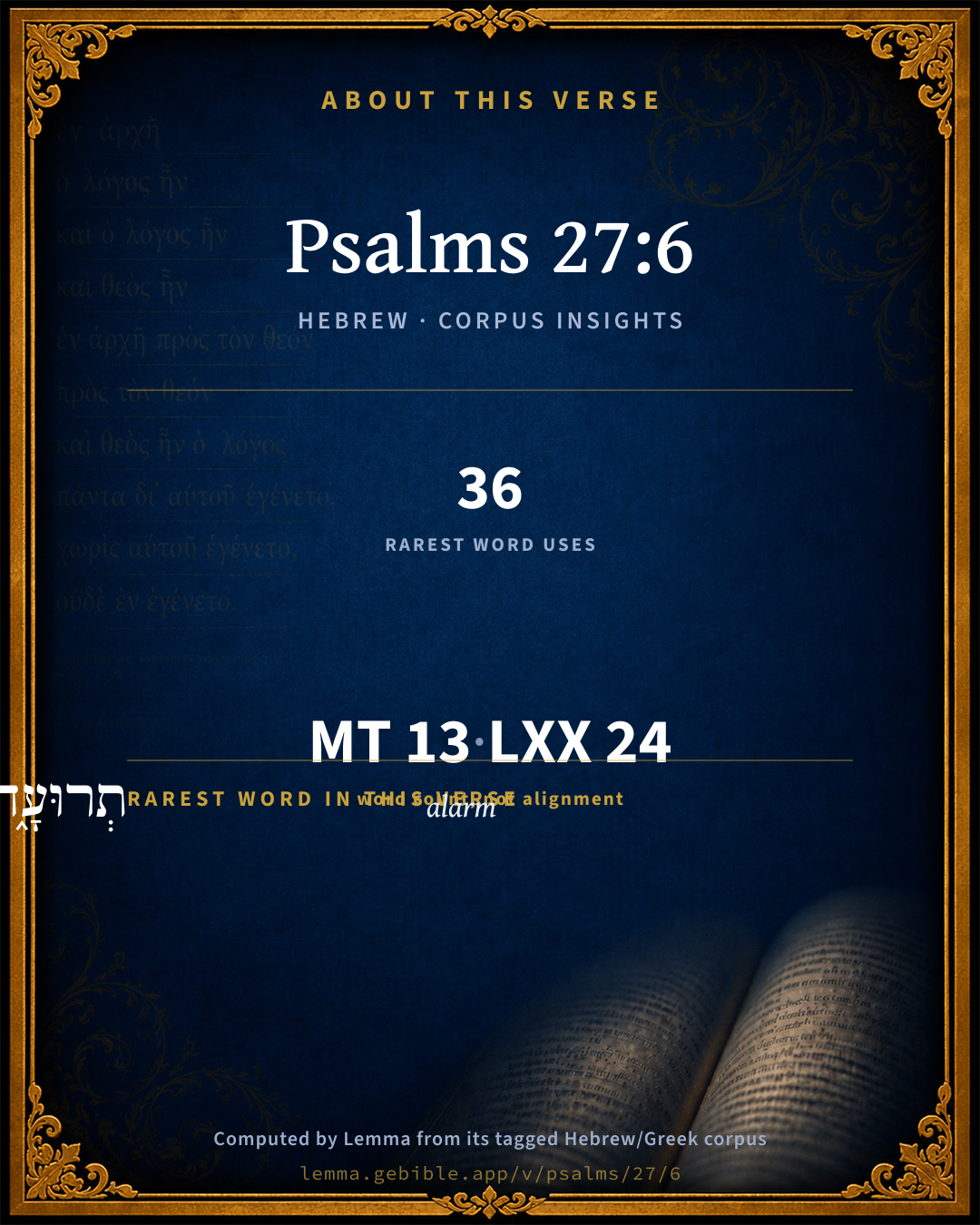
13
words
13
distinct lemmas
Wisdom
section

Shared distinctive vocabulary

תְרוּעָ֑ה alarm H8643 occurs in 33 verses of the Hebrew Bible. Also found in:

Grammatical profile

  • 5 verbs
  • 6 nouns
  • 1 preposition
  • 1 adverb

Verb forms

  • יָר֪וּם Qal · Imperfect
  • אֹֽיְבַ֬י Qal · Participle Active
  • וְאֶזְבְּחָ֣ה Qal · Cohortative
  • אָשִׁ֥ירָה Qal · Cohortative
  • וַ֝אֲזַמְּרָ֗ה Piel · Cohortative

Hebrew & Septuagint length

In English translation the verse runs 31 words from the Hebrew and 33 from the Septuagint (LXX English) — closely comparable.

A rough comparison of the two English renderings, which tokenize alike — not a word-level alignment.

Word counts can differ between the Hebrew and the Greek without any difference in meaning — e.g. the Hebrew direct-object marker אֵת has no separate Greek word, and Greek often adds the article ὁ.

In the original languages it is 13 Hebrew tokens and 24 Greek tokens — but the two are counted differently (Hebrew bundles its prefixes and suffixes into one token; the Greek is in lemma form), so that isn’t a like-for-like length.

Cross-references

35

Topical passages linked to Psalms 27:6 in the Treasury of Scripture Knowledge — connected by theme and wording, ordered by reader-vote popularity; previews shown in the World English Bible.

  • Psalms 3:3 But you, Yahweh, are a shield around me, My glory, and the one who lifts up my head.
  • Hebrews 13:15 Through him, then, let us offer up a sacrifice of praise to God continually, that is, the fruit of lips which make confession to his name.
  • 2 Samuel 22:49 Who brings me forth from my enemies: Yes, you lift me up above those who rise up against me; You deliver me from the violent man.
  • Psalms 107:22 Let them offer the sacrifices of thanksgiving, And declare his works with singing.
  • Isaiah 12:6 Cry aloud and shout, you inhabitant of Zion; for great in the midst of you is the Holy One of Israel!"
  • Ephesians 5:19–20 speaking to one another in psalms, hymns, and spiritual songs; singing, and singing praises in your heart to the Lord;
  • Revelation 5:9 They sang a new song, saying, "You are worthy to take the book, And to open its seals: For you were killed, And bought us for God with your blood, Out of every tribe, language, people, and nation,
  • Jeremiah 33:11 the voice of joy and the voice of gladness, the voice of the bridegroom and the voice of the bride, the voice of those who say, Give thanks to Yahweh of Hosts, for Yahweh is good, for his loving kindness endures forever; [and of them] who bring [sacrifices of] thanksgiving into the house of Yahweh. For I will cause the captivity of the land to return as at the first, says Yahweh.
  • Zechariah 9:9 Rejoice greatly, daughter of Zion! Shout, daughter of Jerusalem! Behold, your king comes to you! He is righteous, and having salvation; Lowly, and riding on a donkey, Even on a colt, the foal of a donkey.
  • Revelation 15:3 They sang the song of Moses, the servant of God, and the song of the Lamb, saying, "Great and marvelous are your works, Lord God, the Almighty; Righteous and true are your ways, you King of the nations.
  • 1 Peter 2:5 You also, as living stones, are built up as a spiritual house, to be a holy priesthood, to offer up spiritual sacrifices, acceptable to God through Jesus Christ.
  • 2 Samuel 7:9 and I have been with you wherever you went, and have cut off all your enemies from before you; and I will make you a great name, like the name of the great ones who are in the earth.
  • 2 Chronicles 30:21–26 The children of Israel who were present at Jerusalem kept the feast of unleavened bread seven days with great gladness; and the Levites and the priests praised Yahweh day by day, [singing] with loud instruments to Yahweh.
  • Ezra 3:11–13 They sang one to another in praising and giving thanks to Yahweh, [saying], For he is good, for his loving kindness endures forever toward Israel. All the people shouted with a great shout, when they praised Yahweh, because the foundation of the house of Yahweh was laid.
  • Psalms 22:22–25 I will declare your name to my brothers. In the midst of the assembly, I will praise you.
  • Psalms 26:6–7 I will wash my hands in innocence, So I will go about your altar, Yahweh;
  • Psalms 43:3–4 Oh, send out your light and your truth. Let them lead me. Let them bring me to your holy hill, To your tents.
  • Psalms 95:1 Oh come, let's sing to Yahweh. Let's shout aloud to the rock of our salvation!
  • Psalms 100:1–2 Shout for joy to Yahweh, all you lands!
  • Genesis 40:13 Within three more days, Pharaoh will lift up your head, and restore you to your office. You will give Pharaoh's cup into his hand, the way you did when you were his cupbearer.
  • 2 Samuel 22:1 David spoke to Yahweh the words of this song in the day that Yahweh delivered him out of the hand of all his enemies, and out of the hand of Saul:
  • 2 Kings 25:27 It happened in the seven and thirtieth year of the captivity of Jehoiachin king of Judah, in the twelfth month, on the seven and twentieth day of the month, that Evilmerodach king of Babylon, in the year that he began to reign, did lift up the head of Jehoiachin king of Judah out of prison;
  • 1 Chronicles 22:18 Isn't Yahweh your God with you? Hasn't he given you rest on every side? for he has delivered the inhabitants of the land into my hand; and the land is subdued before Yahweh, and before his people.
  • Psalms 21:1 The king rejoices in your strength, Yahweh! How greatly he rejoices in your salvation!
  • Psalms 21:13 Be exalted, Yahweh, in your strength, So we will sing and praise your power.
  • Psalms 47:1 Oh clap your hands, all you nations. Shout to God with the voice of triumph!
  • Psalms 66:13–16 I will come into your temple with burnt offerings. I will pay my vows to you,
  • Psalms 81:1 Sing aloud to God, our strength! Make a joyful shout to the God of Jacob!
  • Psalms 110:7 He will drink of the brook in the way; Therefore he will lift up his head.
  • Psalms 116:17–19 I will offer to you the sacrifice of thanksgiving, And will call on the name of Yahweh.
  • Psalms 138:5 Yes, they will sing of the ways of Yahweh; For great is Yahweh's glory.
  • Jeremiah 31:7 For thus says Yahweh, Sing with gladness for Jacob, and shout for the chief of the nations: publish you, praise you, and say, Yahweh, save your people, the remnant of Israel.
  • Luke 19:37–38 As he was now getting near, at the descent of the Mount of Olives, the whole multitude of the disciples began to rejoice and praise God with a loud voice for all the mighty works which they had seen,
  • Genesis 40:20 It happened the third day, which was Pharaoh's birthday, that he made a feast for all his servants, and he lifted up the head of the chief cupbearer and the head of the chief baker among his servants.
  • Zephaniah 3:14–15 Sing, daughter of Zion! Shout, Israel! Be glad and rejoice with all your heart, daughter of Jerusalem.

Cross-references courtesy of OpenBible.info (CC BY 4.0).

Hebrew and Greek witnesses Masoretic Hebrew ↔ Greek Septuagint

The same verse in the two great witnesses to the Old Testament, shown verse-for-verse.

You’re reading Greek Psalm 26 (Hebrew Psalm 27). The Septuagint counts the superscription, so verse numbers can differ from the Hebrew — chapter-level alignment, not verse-by-verse. Numbering follows Rahlfs.

These are two independent witnesses, not word-aligned to each other, and the Septuagint is shown in lemma (dictionary) form.

Hebrew Psalms 27:6 Masoretic · Westminster Leningrad Codex

וְעַתָּ֨ה יָר֪וּם רֹאשִׁ֡י עַ֤ל אֹֽיְבַ֬י סְֽבִיבוֹתַ֗י וְאֶזְבְּחָ֣ה בְ֭אָהֳלוֹ זִבְחֵ֣י תְרוּעָ֑ה אָשִׁ֥ירָה וַ֝אֲזַמְּרָ֗ה לַיהוָֽה

Now my head will be lifted up above my enemies around me. I will offer sacrifices of joy in his tent. I will sing, yes, I will sing praises to Yahweh.

World English Bible · Public Domain

Greek LXX Greek Psalm 26:6 Septuagint · lemma form

καί νῦν ἰδού ὑψόω ὁ κεφαλή ἐγώ ἐπί ἐχθρός ἐγώ κυκλόω καί θύω ἐν ὁ σκηνή αὐτός θυσία ἀλαλαγμός ᾄδω καί ψάλλω ὁ κύριος

And now, behold, he has lifted up my head over my enemies: I went round and offered in his tabernacle the sacrifice of joy; I will sing even sing psalms to the Lord.

LXX2012 (modern English Septuagint) · Public Domain

On this verse, Ellicott's Commentary for English Readers discusses the Septuagint’s reading. Read the note in Commentary ↓

Hebrew: Westminster Leningrad Codex (CC BY 4.0). Greek: Septuagint (public domain); English from LXX2012 (modern English Septuagint) (Public Domain). How the Septuagint differs from the Hebrew →

Commentary

Notes on Psalms 27:6 from classic Christian and Jewish commentators (each source and its license shown beneath its notes). The classic Christian expositions comment on the surrounding passage and are grouped to its opening verse, so a note may address several verses; the Jewish commentaries on the Tanakh (Rashi and others) are per-verse, so they appear only where the commentator wrote on this verse.

Lemma curates 59 commentaries, every one of them public domain or Creative Commons licensed, each selected and text-cleaned for this edition rather than reprinted as found. About our sources →

Trapp's Complete Commentary

John Trapp

Psa 27:6 And now shall mine head be lifted up above mine enemies round about me: therefore will I offer in his tabernacle sacrifices of joy; I will sing, yea, I will sing praises unto the LORD.

Ver. 6. And now shall mine head be lifted up] See Psa 3:4, and take notice how clear David was upon his prayer, of the possession of the promise, that he should both get the better of his enemies, and enjoy the public ordinances.

Sacrifices of joy] Heb. of loud shouting, hoc est sacrificia cum canticis, saith R. Solomon. Sacrifices with triumph, alarm, or jubilation to the Lord; not with profane triumphings, as the manner of the world is, as if by mine own strength or prudence I had gotten the victory. So at the battle of Agincourt, when our Henry V had beaten the French, the honour of the day was, by the king’s command, ascribed only to God. He would not suffer his broken crown or bruised armour to be borne before him in show; or any ballads to be set forth or sung in his honour, &c. (Speed. Daniel).

John Trapp, A Commentary or Exposition upon All the Books of the Old and New Testament (1647–1656) — public domain. Text from a community e-Sword module.

J. A. Alexander on Psalms

Joseph Addison Alexander

6. (Psa 27:6) And now shall my head be high above my enemies around me, and I will sacrifice in his tabernacle sacrifices of joyful noise; I will sing and make music to Jehovah. And now may either be a formula of logical resumption, as in Psa 2:10; Psa 39:8 (7), or be taken in its strict sense, as denoting that he not only hopes for future safety, but is ready in the mean time, even now, to thank him publicly for his protection as already realised. The first clause merely amplifies the last of the preceding verse. The next adds the promise of a thank-offering at the tabernacle, which implies an assured hope of deliverance and prosperity. By a joyful noise some understand the blowing of trumpets which accompanied certain offerings (Num 10:10; Num 29:1); but as this is never mentioned in connection with private sacrifices, it seems more advisable to rest in the general sense of the expression.

Joseph Addison Alexander, The Psalms Translated and Explained (1850) — public domain. Text from a community e-Sword module.

Tyndale Open Study Notes

Tyndale Open Resources

27:6 hold my head high: A sign of victory. • The granting of the request of 27:4 prompts sacrifices with shouts of joy.

Tyndale Open Study Notes — © Tyndale Open Resources, licensed CC BY-SA 4.0. Text via the HelloAO Bible API.

Geneva Bible (1599)

Geneva Bible translators

David assured himself by the Spirit of prophecy that he should overcome his enemies, and serve God in his Tabernacle.

Geneva Bible (1599) marginal notes — public domain. Text via Bolls.life.

Jamieson, Fausset & Brown

Robert Jamieson, A. R. Fausset & David Brown

head be lifted up--I shall be placed beyond the reach of my enemies. Hence he avows his purpose of rendering joyful thank offerings.

Jamieson, Fausset & Brown — Commentary Critical and Explanatory on the Whole Bible (1871) — public domain (CC PDM 1.0). Text via the HelloAO Bible API.

Adam Clarke's Commentary

Verse 6. Now shall mine head be lifted up] We shall most assuredly be redeemed from this captivity, and restored to our own land, and to the worship of our God in his own temple. There shall we offer sacrifices of joy; we will sing praises unto the Lord, and acknowledge that it is by his might and mercy alone that we have been delivered.

Adam Clarke's Commentary on the Bible (1810–1826) — public domain. Text from a community e-Sword/MySword module.

John Calvin's Commentaries

6. And I will offer sacrifices of triumph “Sacrificia jubili.” — Lat. “Sacrifice de triomphe.” — Fr. Ainsworth reads, “Sacrifices of shouting, or of triumph, of joyful sounding and alarm.” “This,” says he, “hath respect to the law which appointed over the sacrifices trumpets to be sounded, Numbers 10:10, whose chiefest, most loud, joyful, and triumphant sound was called trughnah, [or תרועה, truah, the word here used,] ‘triumph,’ ‘alarm,’ or ‘jubilation,’ Numbers 10:5-7.”

John Calvin's Commentaries (1540-1563) — public domain. Text from the Calvin Translation Society English edition (1840s-50s) via the Christian Classics Ethereal Library (ccel.org). Calvin's coverage is partial (roughly two-thirds of the Bible); uncommented books and verses are honest gaps, never fabricated. The 19th-century editor's footnotes and remarks are omitted so the notes are faithfully Calvin's own voice.

Ellicott's Commentary for English Readers

(6) Sacrifices of joy.—Literally, of shouting; so LXX. and Vulg., hostiam vociferationis. The custom of blowing trumpets (Num_10:10; comp. Sir_1:16-18) at the time of the burnt offering illustrates this expression even if there is no direct allusion to it.

I will sing, yea.—Better, I will sing and play.

A Bible Commentary for English Readers, edited by Charles John Ellicott (1878–1897) — public domain. Text from a community e-Sword module.

The Cambridge Bible for Schools and Colleges

gen. ed. J. J. S. Perowne

6. And now &c.] In the immediate future he anticipates not protection only but triumphant victory. Cp. Psa_3:3; Psa_110:7.

in his tabernacle] Lit. in his tent, as in the preceding verse. There it may simply mean dwelling, in a general figurative sense; but here in connexion with the offering of sacrifice, it would seem that the tent which David pitched for the Ark on Mount Zion (2Sa_6:17) must be meant.

sacrifices of joy] A bold expression for sacrifices of thanksgiving. Joy may mean the jubilant shouting with which religious festivities were celebrated (2Sa_6:15; Psa_33:3; Psa_47:5); or trumpet-sound, such as accompanied certain sacrifices (Num_10:10); here probably the former.

The Cambridge Bible for Schools and Colleges (gen. ed. J. J. S. Perowne; Cambridge University Press, 1878–1918) — public domain. Text from a community e-Sword module.

John Gill's Exposition

And now shall mine head be lifted up,.... That is, when brought into the house of the Lord, hid in the secret of his tabernacle, and set upon the rock Christ; by this phrase he means, either that he should be then restored to his former happy and comfortable condition, as it is used in Gen 40:13; or that he should overcome all his enemies, and triumph over them, being exalted, as he adds,

above mine enemies round about me; so that not only they should not be able to come at him, but should be subdued under him;

therefore will I offer in his tabernacle sacrifices of joy: attended with shouting and sounding of trumpets: in allusion to the blowing of trumpets at the time of sacrifice, Num 10:10; Sacrifices of praise and thanksgiving, with a joyful heart, for mercies received, offered up publicly in the house of the Lord, are here intended;

I will sing, yea, I will sing praises unto the Lord; for whom praise waits in Zion, to whom it is due; he being the Father of mercies, the God of all comfort, and the author and giver of all blessings, temporal and spiritual.

John Gill's Exposition of the Whole Bible (1746–1763) — public domain (CC PDM 1.0). Text via the HelloAO Bible API.

Albert Barnes' Notes on the Bible

And now shall mine head - Now shall I be exalted. So we say that in affliction a person bows down his head; in prosperity he lifts it up. This verse expresses the confident expectation that he would be enabled to triumph over all his foes, and a firm purpose on his part, as the result of this, to offer sacrifices of praise to his great Deliverer.

Above mine enemies round about me - All my enemies, though they seem even to encompass me on every side.

Therefore will I offer in his tabernacle - In His tent, His dwelling-place: referring here, undoubtedly, to “the tabernacle” as a place where God was worshipped.

Sacrifices of joy - Margin, as in the Hebrew, of “shouting.” That is, he would offer sacrifices accompanied with loud sounds of praise and thanksgiving. There is nothing wrong in shouting for joy when a person is delivered from imminent danger, nothing wrong in doing so when he feels that he is rescued from the peril of eternal ruin.

I will sing, yea, I will sing praises unto the Lord - This language is that which comes from a full heart. He is not contented with saying merely that he would “sing.” He repeats the idea; he dwells upon it. With a heart overflowing with gratitude he would go and give utterance to his joy. He would repeat, and dwell upon, the language of thanksgiving.

Albert Barnes' Notes on the Bible (1834–1885) — public domain. Text from a community e-Sword/MySword module.

Matthew Poole's English Annotations

Mine head shall be lifted up above mine enemies; he will advance me above them, and give me a complete victory over them.

Sacrifices of joy, or of shouting or resounding, i.e. of thanksgiving; which were accompanied with the sound of trumpets and other instruments, Num 10:10; 1Ch 16:41,42; Psa 33:3.

Matthew Poole's English Annotations on the Holy Bible (1683–1685) — public domain. Text from a community e-Sword/MySword module.

The Treasury of David

Charles H. Spurgeon

Ver. 6. And now shall mine head be lifted up above mine enemies round about me. He is quite sure of it. Godly men of old prayed in faith, nothing wavering, and spoke of their answer to their prayers as a certainty. David was by faith so sure of a glorious victory over all those who beset him, that he arranged in his own heart what he would do when his foes lay all prostrate before him; that arrangement was such as gratitude suggested. Therefore will I offer in his tabernacle sacrifices of joy. That place for which he longed in his conflict, should see his thankful joy in his triumphant return. He does not speak of jubilations to be offered in his palace, and feastings in his banqueting halls, but holy mirth he selects as most fitting for so divine a deliverance. I will sing. This is the most natural mode of expressing thankfulness. Yea, I will sing praises unto the Lord. The vow is confirmed by repetition, and explained by addition, which addition vows all the praise unto Jehovah. Let who will be silent, the believer when his prayer is heard, must and will make his praise to be heard also; and let who will sing unto the vanities of the world, the believer reserves his music for the Lord alone.

Ver. 6. Now shall mine head be lifted up above mine enemies round about me. A man cannot drown so long as his head is above water. Now, it is the proper office of hope to do this for the Christian in times of any danger. Lu 21:28. "When these things begin to come to pass, then look up, and lift up your heads: for your redemption draweth nigh." A strange time, one would think, for Christ then to bid his disciples lift up their heads in, when they see other men's hearts failing them for fear, and for looking after those things which are coming on the earth Lu 21:26; yet now is the time of the rising of their sun, when others' is setting, and the blackness of darkness is overtaking others; because now the Christian's feast is coming, for which hope hath saved its stomach so long. "Your redemption draweth nigh." Two things make the head hang downfear and shame; hope eases the Christian's heart of both these, and so forbids him to give any sign of a desponding mind by a dejected countenance. William Gurnall.

Ver. 6. Therefore will I offer in his tabernacle sacrifices of joy. "Surely, "some may say, "he could have called on God beyond the precincts of the temple. Wherever he wandered as an exile, he carried with him the precious promise of God, so that he needed not to put so great a value upon the sight of the external edifice. He appears, by some gross imagination or other, to suppose that God could be enclosed by wood and stones." But if we examine the words more carefully, it will be easy to see, that his object was altogether different from a mere sight of the noble building and its ornaments, however costly. He speaks, indeed, of the temple, but he places that beauty not so much in the goodliness that was to be seen by the eye, as in its being the celestial pattern which was shown to Moses, as it is written in Ex 25:40: "And look that thou make them after their pattern, which was showed thee in the mount." As the fashion of the temple was not framed according to the wisdom of man, but was an image of spiritual things, the prophet directed his eyes and all his affections to this object. Their madness is, therefore, truly detestable who wrest this place in favour of pictures and images, which, instead of deserving to be numbered among temple ornaments, are rather like the dung and filth, defiling all the purity of holy things. John Calvin.

Ver. 6. The saint's present triumph over his spiritual foes, his practical gratitude, and his vocal praises.

Psalms 27:7*

Charles H. Spurgeon's The Treasury of David (1869–1885) — public domain. Psalms only. Text from a community e-Sword/MySword module.

Whedon's Commentary on the Bible

Daniel D. Whedon

6. Now shall mine head be lifted up—His faith sees the coming exaltation and restoration to his throne.

In his tabernacle—His acknowledgments for deliverance should not be private merely, but in the most public manner.

Sacrifices of joy—Sacrifices of jubilation, or shouting, are such as were witnessed on the great occasions of their annual feasts, with full choirs of singers and bands of instruments.

Daniel D. Whedon (gen. ed.), Commentary on the Old and New Testaments (1874–1909) — public domain. Text from a community e-Sword module.

The Pulpit Commentary

And now shall mine head be lifted up above mine enemies round about me. A further and final triumph is confidently anticipated. God will complete his work. He will repulse the "host" by which David is about to be attacked (ver. 3), give him victory over it, bring him back from exile, and grant him once more free access to the sanctuary. Therefore, says the psalmist, will I offer in his tabernacle sacrifices of joy; or, "sacrifices of joyful sound," accompanied with singing and instrumental music. (comp. Psa_89:15) I will sing, yea, I will sing praises unto the Lord. (comp. Eph_5:19)

The Pulpit Commentary (1880–1919), ed. H.D.M. Spence-Jones & Joseph S. Exell — public domain. Text from a community e-Sword module.

Keil & Delitzsch

C. F. Keil & F. Delitzsch

With ועתּה the poet predicts inferentially (cf. Psa 2:10) the fulfilment of what he fervently desires, the guarantee of which lies in his very longing itself. זבחי תּרוּעה do not mean sacrifices in connection with which the trumpets are blown by the priests; for this was only the case in connection with the sacrifices of the whole congregation (Num 10:10), not with those of individuals. תּרוּעה is a synonym of תּודה, Psa 26:7; and זבחי תּרוּעה is a stronger form of expression for זבחי תודה (Psa 107:22), i.e., (cf. זבחי צדק, Psa 4:6; 51:21) sacrifices of jubilant thanksgiving: he will offer sacrifices in which his gratitude plays a prominent part, and will sing songs of thanksgiving, accompanied by the playing of stringed instruments, to his Deliverer, who has again and so gloriously verified His promises.

Keil & Delitzsch — Biblical Commentary on the Old Testament (1861–1891) — public domain (CC PDM 1.0). Text via the HelloAO Bible API. (Old Testament only.)

Rashi

Rabbi Shlomo Yitzchaki (Rashi)

sacrifices with joyous song Sacrifices over which a song is recited.

Rashi on the Tanakh — English translations: “The Judaica Press complete Tanach with Rashi, translated by A. J. Rosenberg” (CC BY 4.0); “Pentateuch with Rashi's commentary by M. Rosenbaum and A.M. Silbermann, 1929-1934” (public domain); “The Metsudah Tanach series, Lakewood, N.J” (CC BY 4.0); and “The Book of Joshua, Metsudah Publications, 1997” (CC BY 4.0). Text via Sefaria.

Lesson kit

Teaching starters — assembled from the data on this page, not authored interpretation. Every prompt links to the verse data it draws on. Edit before teaching.

Psalms, in the Wisdom, opens this verse with 13 words (13 distinct Hebrew lemmas). Its most distinctive word is tᵉrûwʻâh (“alarm”). A historical commentator’s framing appears above. Read the whole chapter for the surrounding context.

Discussion questions

  1. How does “alarm” (tᵉrûwʻâh) shape what this verse is saying?
  2. How does Leviticus 23:24, which shares the word «alarm», read alongside this verse?
  3. These translations render this verse differently. What is at stake in choosing one wording over another?
  4. «יָר֪וּם» is a Qal Imperfect verb. How does that grammatical form shape the action described?
  5. Compare how Trapp's Complete Commentary and J. A. Alexander on Psalms read this verse. Where do they agree or differ?

Things to notice

Reading settings

Reading text

Shown beneath each verse's original-language words.

Old Testament
Old Testament edition

Read the OT as the Masoretic Hebrew (MT) or the Greek Septuagint (LXX).

English shown for the Greek Septuagint (in the Hebrew ↔ Greek comparison).

Comparing translations? Open the Compare panel on any verse page to stack up to four side by side.