
Lamentations 2:16

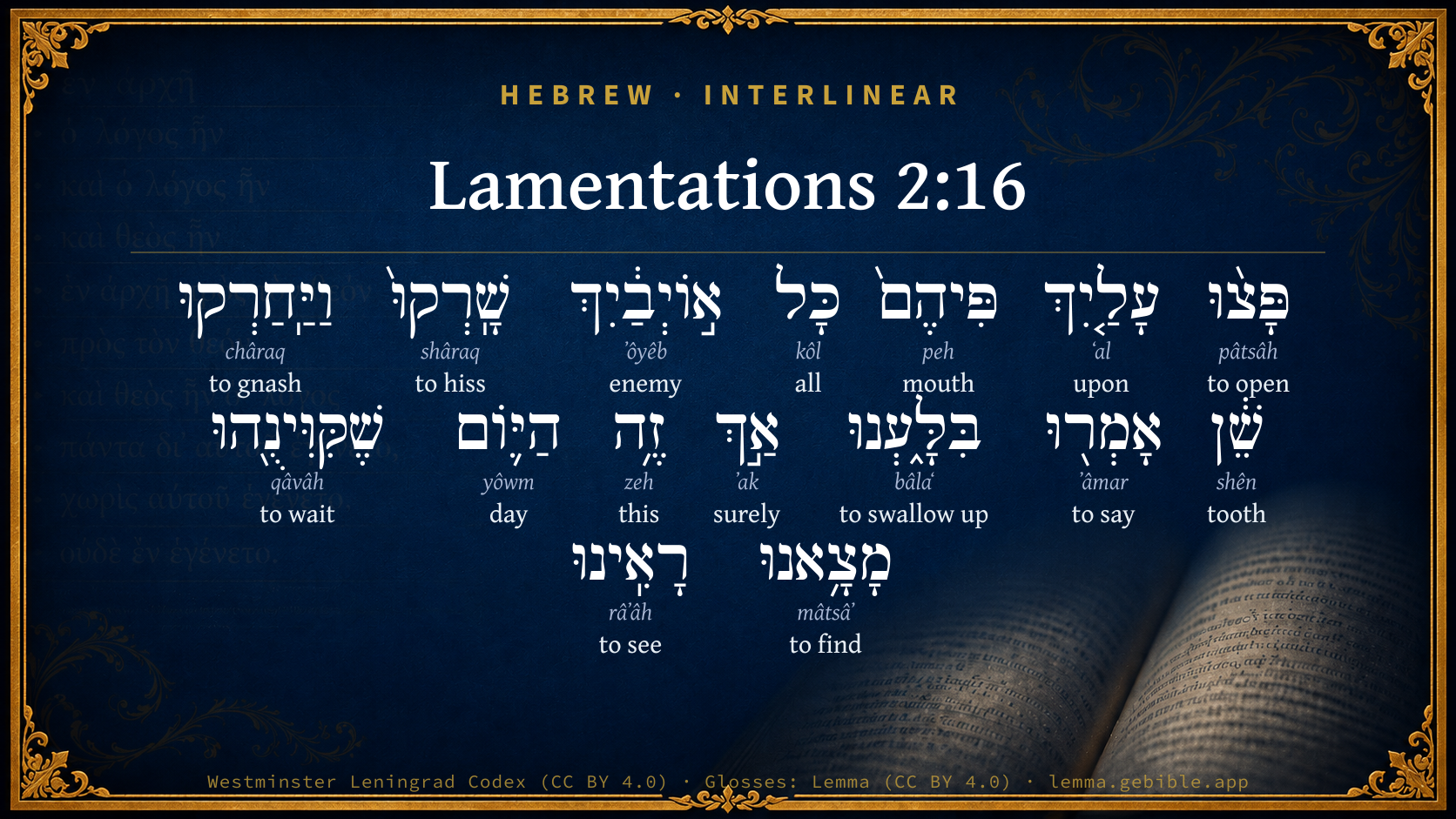
Hebrew (Westminster Leningrad Codex) Lamentations 2:16 appears in the Hebrew Old Testament. The text above is from the Westminster Leningrad Codex. Each word links to its Strong’s number, a concise gloss, and parsing drawn from the Open Scriptures Hebrew Bible morphology. Click any word for its full Brown-Driver-Briggs (BDB) entry.
Download image
Cite this verse

Lamentations 2:16 (World English Bible). Public Domain. Lemma interlinear Bible study tool, https://lemma.gebible.app/v/lamentations/2/16.

Show BibTeX & RIS
BibTeX
RIS
English Translation
All your enemies have opened their mouth wide against you; They hiss and gnash the teeth; they say, We have swallowed her up; Certainly this is the day that we looked for; we have found, we have seen it.
World English Bible · Public Domain
Download a study sheet

One document with this verse’s original text, its word-by-word gloss line, the meaning frame, cross-references with their text, attributed commentary, and full source and license credits — printable, and it pastes into notes with its structure intact.

This verse Autodidact and up

Study sheet (.html) Plain text (.txt)

A passage Seminary Student

Up to 50 verses in one chapter. A passage sheet keeps up to 6 commentary sources and 12 cross-references per verse, in the order this page ranks them, and says so on the sheet whenever that leaves anything out. Ask for a single verse and you get the Autodidact verse sheet above.

Everything on this page stays free to read, with no account — the sheet is a download of what is already on screen, not access to it.

Want to remove ads? Support Godless Engineer
Compare translations 3

The same verse in 3 English versions, stacked beneath the original-language interlinear above. Click any original word for its lexicon entry.

Each is an independent rendering of the whole verse — the interlinear is not word-aligned to these translations.

Highlighted words mark where these versions differ — a whole-verse word diff, not a word-by-word alignment.

  • World English Bible Public Domain
    All your enemies have opened their mouth wide against you; They hiss and gnash the teeth; they say, We have swallowed her up; Certainly this is the day that we looked for; we have found, we have seen it.
  • King James Version Public Domain
    All thine enemies have opened their mouth against thee: they hiss and gnash the teeth: they say, We have swallowed her up: certainly this is the day that we looked for; we have found, we have seen it.
  • unfoldingWord Literal Text CC BY-SA 4.0
    All your enemies have opened their mouths against you. They hiss and gnash teeth; they say, “We have swallowed up! Surely this is the day we waited for; we have found it, we have seen it!” PE

unfoldingWord Literal Text — © unfoldingWord, licensed CC BY-SA 4.0. Word-aligned USFM3 via Door43 (git.door43.org/unfoldingWord/en_ult).

Versions to compare (up to 4)

3 of 4 selected

Show all 18 translations

Every available English version of this verse, each an independent rendering of the whole verse.

  • World English Bible Public Domain
    All your enemies have opened their mouth wide against you; They hiss and gnash the teeth; they say, We have swallowed her up; Certainly this is the day that we looked for; we have found, we have seen it.
  • Berean Standard Bible Public Domain
    All your enemies open their mouths against you. They hiss and gnash their teeth, saying, “We have swallowed her up. This is the day for which we have waited. We have lived to see it!”
  • Majority Standard Bible Public Domain
    All your enemies open their mouths against you. They hiss and gnash their teeth, saying, “We have swallowed her up. This is the day for which we have waited. We have lived to see it!”
  • King James Version Public Domain
    All thine enemies have opened their mouth against thee: they hiss and gnash the teeth: they say, We have swallowed her up: certainly this is the day that we looked for; we have found, we have seen it.
  • American Standard Version (1901) Public Domain
    All thine enemies have opened their mouth wide against thee; They hiss and gnash the teeth; they say, We have swallowed her up; Certainly this is the day that we looked for; we have found, we have seen it.
  • Revised Version (1885) Public Domain
    All thine enemies have opened their mouth wide against thee; they hiss and gnash the teeth; they say, We have swallowed her up; certainly this is the day that we looked for; we have found, we have seen it.
  • Geneva Bible (1599) Public Domain
    All thine enemies haue opened their mouth against thee: they hisse and gnashe the teeth, saying, Let vs deuoure it: certainely this is the day that we looked for: we haue founde and seene it.
  • Douay-Rheims (1899) Public Domain
    Phe. All thy enemies have opened their mouth against thee: they have hissed, and gnashed with the teeth, and have said: We will swallow her up: lo, this is the day which we looked for: we have found it, we have seen it.
  • Young's Literal Translation Public Domain
    Opened against thee their mouth have all thine enemies, They have hissed, yea, they gnash the teeth, They have said: `We have swallowed `her' up, Surely this `is' the day that we looked for, We have found -- we have seen.'
  • Literal Standard Version CC BY-SA 4.0
    Opened against you their mouth have all your enemies, || They have hissed, indeed, they gnash the teeth, || They have said: “We have swallowed [her] up, || Surely this [is] the day that we looked for, || We have found—we have seen.”
  • Unlocked Literal Bible CC BY-SA 4.0
    All your enemies open their mouths against you. They sneer and grind their teeth in rage and say, “We have swallowed her up! This is the day we have waited for! We have lived to see it!”
  • unfoldingWord Literal Text CC BY-SA 4.0
    All your enemies have opened their mouths against you. They hiss and gnash teeth; they say, “We have swallowed up! Surely this is the day we waited for; we have found it, we have seen it!” PE
  • Darby Bible Public Domain
    All thine enemies open their mouth against thee, they hiss and gnash the teeth: they say, We have swallowed [her] up; this is forsooth the day that we looked for: we have found, we have seen [it].
  • World Messianic Bible Public Domain
    All your enemies have opened their mouth wide against you. They hiss and gnash their teeth. They say, “We have swallowed her up. Certainly this is the day that we looked for. We have found it. We have seen it.”
  • Webster's Bible Public Domain
    All thy enemies have opened their mouth against thee: they hiss and gnash the teeth: they say, We have swallowed her up: certainly this is the day that we looked for; we have found, we have seen it.
  • Free Bible Version CC BY-SA 4.0
    All your enemies open their mouths at you, hissing and gnashing their teeth, “We've swallowed her up! This is the day we've been waiting for. Now it's here and we've seen it happen!”
  • Bible in Basic English Public Domain
    All your haters are opening their mouths wide against you; making hisses and whistling through their teeth, they say, We have made a meal of her: certainly this is the day we have been looking for; it has come, we have seen it.
  • JPS Tanakh (1917) Public Domain
    All thine enemies have opened their mouth wide against thee; they hiss and gnash the teeth; they say: 'We have swallowed her up; certainly this is the day that we looked for; we have found, we have seen it.'

Literal Standard Version (2020), Covenant Press — licensed CC BY-SA 4.0. Text via the HelloAO Bible API (eBible.org). Unlocked Literal Bible (unfoldingWord) — licensed CC BY-SA 4.0. Text via the HelloAO Bible API (eBible.org). unfoldingWord Literal Text — © unfoldingWord, licensed CC BY-SA 4.0. Word-aligned USFM3 via Door43 (git.door43.org/unfoldingWord/en_ult). Free Bible Version, Dr. Jonathan Gallagher — licensed CC BY-SA 4.0. Text via the HelloAO Bible API (eBible.org).

Word by word

More ways to search: Search by grammar → Find every occurrence → Compare this word →

Practice this passage: Drill this verse → Learn its vocabulary →

וַיַּֽחַרְקוּ
châraq
H2786
“and · to gnash”
Conjunction + Verb, Qal, Sequential Imperfect, 3rd Person, Masculine, Plural
Part of Speech
Conjunction + Verb
Stem
Qal
Form
Sequential Imperfect
Person
3rd Person
Gender
Masculine
Number
Plural
Full BDB Definition

Origin: a primitive root

TWOT: 755

(Qal) to gnash, grind (the teeth)
  1. פָּצ֨וּ pâtsâh H6475 “to open” Verb, Qal, Perfect, 3rd Person, Common, Plural
  2. עָלַ֤יִךְ ʻal H5921 “upon · you” Preposition + Suffix, Personal, 2nd Person, Feminine, Singular
  3. פִּיהֶם֙ peh H6310 “mouth · their” Noun, Common, Masculine, Singular, Construct + Suffix, Personal, 3rd Person, Masculine, Plural
  4. כָּל kôl H3605 “all of” Noun, Common, Masculine, Singular, Construct
  5. א֣וֹיְבַ֔יִךְ ʼôyêb H341 “enemy · you” Verb, Qal, Participle Active, Masculine, Plural, Construct + Suffix, Personal, 2nd Person, Feminine, Singular
  6. שָֽׁרְקוּ֙ shâraq H8319 “to hiss” Verb, Qal, Perfect, 3rd Person, Common, Plural
  7. שֵׁ֔ן shên H8127 “tooth” Noun, Common, Both, Singular, Absolute
  8. אָמְר֖וּ ʼâmar H559 “to say” Verb, Qal, Perfect, 3rd Person, Common, Plural
  9. בִּלָּ֑עְנוּ bâlaʻ H1104 “to swallow up” Verb, Piel, Perfect, 1st Person, Common, Plural
  10. אַ֣ךְ ʼak H389 “surely” Particle, Accusative
  11. זֶ֥ה zeh H2088 “this” Pronoun, Demonstrative, Masculine, Singular
  12. הַיּ֛וֹם yôwm H3117 “the · day” Particle, Definite Article + Noun, Common, Masculine, Singular, Absolute
  13. שֶׁקִּוִּינֻ֖הוּ qâvâh H6960 “who/which · to wait · him” Particle, Relative + Verb, Piel, Perfect, 1st Person, Common, Plural + Suffix, Personal, 3rd Person, Masculine, Singular
  14. מָצָ֥אנוּ mâtsâʼ H4672 “to find” Verb, Qal, Perfect, 1st Person, Common, Plural
  15. רָאִֽינוּ râʼâh H7200 “to see” Verb, Qal, Perfect, 1st Person, Common, Plural

About this verse

These counts appear in no published source. They are computed here, from the morphology-tagged text and Lemma’s own curated glosses. What Lemma adds →

16
words
16
distinct lemmas
Prophets
section

Notable vocabulary

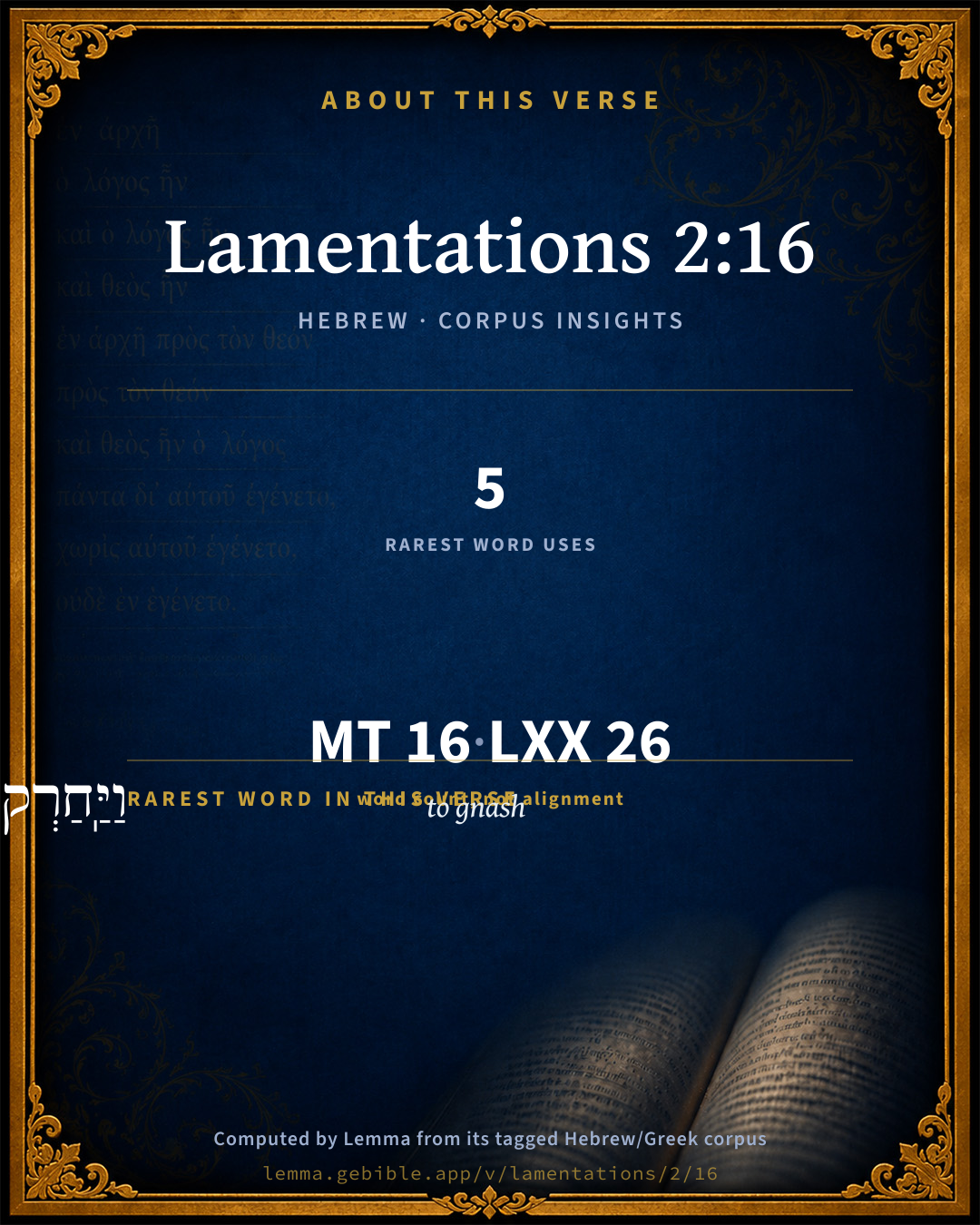
The rarest word here is וַיַּֽחַרְקוּ to gnash H2786 — appearing just 5 times in the whole Hebrew Bible.

Shared distinctive vocabulary

וַיַּֽחַרְקוּ to gnash H2786 occurs in 5 verses of the Hebrew Bible. Also found in:

Grammatical profile

  • 9 verbs
  • 4 nouns
  • 1 pronoun
  • 1 preposition
  • 1 particle

Verb forms

  • פָּצ֨וּ Qal · Perfect
  • א֣וֹיְבַ֔יִךְ Qal · Participle Active
  • שָֽׁרְקוּ֙ Qal · Perfect
  • וַיַּֽחַרְקוּ Qal · Sequential Imperfect
  • אָמְר֖וּ Qal · Perfect
  • בִּלָּ֑עְנוּ Piel · Perfect
  • שֶׁקִּוִּינֻ֖הוּ Piel · Perfect
  • מָצָ֥אנוּ Qal · Perfect
  • רָאִֽינוּ Qal · Perfect

Hebrew & Septuagint length

In English translation the verse runs 39 words from the Hebrew and 41 from the Septuagint (LXX English) — closely comparable.

A rough comparison of the two English renderings, which tokenize alike — not a word-level alignment.

Word counts can differ between the Hebrew and the Greek without any difference in meaning — e.g. the Hebrew direct-object marker אֵת has no separate Greek word, and Greek often adds the article ὁ.

In the original languages it is 16 Hebrew tokens and 26 Greek tokens — but the two are counted differently (Hebrew bundles its prefixes and suffixes into one token; the Greek is in lemma form), so that isn’t a like-for-like length.

Cross-references

24

Topical passages linked to Lamentations 2:16 in the Treasury of Scripture Knowledge — connected by theme and wording, ordered by reader-vote popularity; previews shown in the World English Bible.

  • Psalms 35:21 Yes, they opened their mouth wide against me. They said, "Aha! Aha! Our eye has seen it!"
  • Psalms 37:12 The wicked plots against the just, And gnashes at him with his teeth.
  • Lamentations 3:46 All our enemies have opened their mouth wide against us.
  • Job 16:9–10 He has torn me in his wrath, and persecuted me; He has gnashed on me with his teeth: My adversary sharpens his eyes on me.
  • Psalms 56:2 My enemies want to swallow me up all day long, For they are many who fight proudly against me.
  • Psalms 22:13 They open their mouths wide against me, Lions tearing prey and roaring.
  • Psalms 35:16 Like the profane mockers in feasts, They gnashed their teeth at me.
  • Psalms 124:3 Then they would have swallowed us up alive, When their wrath was kindled against us;
  • Jeremiah 51:34 Nebuchadrezzar the king of Babylon has devoured me, he has crushed me, he has made me an empty vessel, he has, like a monster, swallowed me up, he has filled his maw with my delicacies; he has cast me out.
  • Psalms 41:8 "An evil disease," they say, "has afflicted him. Now that he lies he shall rise up no more."
  • Psalms 57:3 He will send from heaven, and save me, He rebukes the one who is pursuing me. Selah. God will send out his loving kindness and his truth.
  • Psalms 109:2 For they have opened the mouth of the wicked and the mouth of deceit against me. They have spoken to me with a lying tongue.
  • Psalms 112:10 The wicked will see it, and be grieved. He shall gnash with his teeth, and melt away. The desire of the wicked will perish.
  • Isaiah 49:19 For, as for your waste and your desolate places, and your land that has been destroyed, surely now shall you be too small for the inhabitants, and those who swallowed you up shall be far away.
  • Jeremiah 50:7 All who found them have devoured them; and their adversaries said, We are not guilty, because they have sinned against Yahweh, the habitation of righteousness, even Yahweh, the hope of their fathers.
  • Jeremiah 50:17 Israel is a hunted sheep; the lions have driven him away: first, the king of Assyria devoured him; and now at last Nebuchadrezzar king of Babylon has broken his bones.
  • Ezekiel 25:3 and tell the children of Ammon, Hear the word of the Lord Yahweh: Thus says the Lord Yahweh, Because you said, Aha, against my sanctuary, when it was profaned; and against the land of Israel, when it was made desolate; and against the house of Judah, when they went into captivity:
  • Ezekiel 25:6 For thus says the Lord Yahweh: Because you have clapped your hands, and stamped with the feet, and rejoiced with all the despite of your soul against the land of Israel;
  • Ezekiel 25:15 Thus says the Lord Yahweh: Because the Philistines have dealt by revenge, and have taken vengeance with despite of soul to destroy with perpetual enmity;
  • Ezekiel 36:3 therefore prophesy, and say, Thus says the Lord Yahweh: Because, even because they have made you desolate, and swallowed you up on every side, that you might be a possession to the residue of the nations, and you are taken up in the lips of talkers, and the evil report of the people;
  • Hosea 8:8 Israel is swallowed up. Now they are among the nations like a worthless thing.
  • Obadiah 1:12–16 But don't look down on your brother in the day of his disaster, and don't rejoice over the children of Judah in the day of their destruction. Don't speak proudly in the day of distress.
  • Zephaniah 2:8–10 I have heard the reproach of Moab, and the insults of the children of Ammon, with which they have reproached my people, and magnified themselves against their border.
  • Acts 7:54 Now when they heard these things, they were cut to the heart, and they gnashed at him with their teeth.

Cross-references courtesy of OpenBible.info (CC BY 4.0).

Hebrew and Greek witnesses Masoretic Hebrew ↔ Greek Septuagint

The same verse in the two great witnesses to the Old Testament, shown verse-for-verse.

These are two independent witnesses, not word-aligned to each other, and the Septuagint is shown in lemma (dictionary) form.

Hebrew Lamentations 2:16 Masoretic · Westminster Leningrad Codex

פָּצ֨וּ עָלַ֤יִךְ פִּיהֶם֙ כָּל א֣וֹיְבַ֔יִךְ שָֽׁרְקוּ֙ וַיַּֽחַרְקוּ שֵׁ֔ן אָמְר֖וּ בִּלָּ֑עְנוּ אַ֣ךְ זֶ֥ה הַיּ֛וֹם שֶׁקִּוִּינֻ֖הוּ מָצָ֥אנוּ רָאִֽינוּ

All your enemies have opened their mouth wide against you; They hiss and gnash the teeth; they say, We have swallowed her up; Certainly this is the day that we looked for; we have found, we have seen it.

World English Bible · Public Domain

Greek LXX Lamentations 2:16 Septuagint · lemma form

δια ἀναοἴγω ἐπί σύ στόμα αὐτός πᾶς ὁ ἐχθρός σύ συρίζω καί βρύχω ὀδούς εἶπον καταπίνω αὐτός πλήν οὗτος ὁ ἡμέρα ὅς προςδοκάω εὑρίσκω αὐτός ὁράω

AIN. All your enemies have opened their mouth against you: they have hissed and gnashed their teeth, and said, We have swallowed her up: moreover this is the day which we looked for; we have found it, we have seen it.

LXX2012 (modern English Septuagint) · Public Domain

Hebrew: Westminster Leningrad Codex (CC BY 4.0). Greek: Septuagint (public domain); English from LXX2012 (modern English Septuagint) (Public Domain). How the Septuagint differs from the Hebrew →

Commentary

Notes on Lamentations 2:16 from classic Christian and Jewish commentators (each source and its license shown beneath its notes). The classic Christian expositions comment on the surrounding passage and are grouped to its opening verse, so a note may address several verses; the Jewish commentaries on the Tanakh (Rashi and others) are per-verse, so they appear only where the commentator wrote on this verse.

Lemma curates 59 commentaries, every one of them public domain or Creative Commons licensed, each selected and text-cleaned for this edition rather than reprinted as found. About our sources →

Jamieson, Fausset & Brown

Robert Jamieson, A. R. Fausset & David Brown

For the transposition of Hebrew letters (Pe and Ain, Lam 2:16-17) in the order of verses, see Introduction.

opened . . . mouth--as ravening, roaring wild beasts (Job 16:9-10; Psa 22:13). Herein Jerusalem was a type of Messiah.

gnash . . . teeth--in vindictive malice.

we have seen it-- (Psa 35:21).

Jamieson, Fausset & Brown — Commentary Critical and Explanatory on the Whole Bible (1871) — public domain (CC PDM 1.0). Text via the HelloAO Bible API.

Trapp's Complete Commentary

John Trapp

Lam 2:16 All thine enemies have opened their mouth against thee: they hiss and gnash the teeth: they say, We have swallowed [her] up: certainly this [is] the day that we looked for; we have found, we have seen [it].

Ver. 16. All thine enemies opened their mouths against thee.] They speak largely and freely to thy dishonour, the very banks of blasphemy being broken down, as it were.

We have swallowed her up.] But shall find her to be hard meat, such as they shall digest in hell. See Lam 2:2; Lam 2:5.

Certainly this is the day that we look for.] Pray we that the Papists may never see here their longlooked for day, as they have long called it.

John Trapp, A Commentary or Exposition upon All the Books of the Old and New Testament (1647–1656) — public domain. Text from a community e-Sword module.

Joseph Benson's Commentary

Lam 2:16-17. All thine enemies have opened their mouths against thee — As if they were ready to devour thee: see the margin. Or they have opened them in scoffs, reproaches, and insults. They hiss and gnash their teeth — In scorn and derision. They say, We have swallowed her up — Namely, Jerusalem. They triumph in their success against her, and in the rich prey they have got in making themselves masters of her. Certainly, this is the day we have looked for — Which we have expected and longed to see. Thus the enemies of the church are apt to take its disasters for its ruin, and to triumph in them accordingly; but they will find themselves deceived, for the gates of hell shall not prevail against it. The Lord hath done that which he had devised — Our destroyers could have had no power against us, unless it had been given them from above: they were but the sword in God’s hand. And he hath not surprised us by these providences: he gave us notice before hand what he would do if we were disobedient, and he hath done no more than what he threatened long since. He hath fulfilled his word which he had commanded — Hath verified and made good his declarations uttered in days of old — Namely, by Moses, Lev 26:16-31; Deu 28:15-49. He hath set up the horn of thine adversaries — Hath advanced their power and glory.

Joseph Benson's Commentary on the Old and New Testaments (1811–1818) — public domain. Text from a community e-Sword module.

Tyndale Open Study Notes

Tyndale Open Resources

2:16 Their enemies were glad that Jerusalem was defeated.

Tyndale Open Study Notes — © Tyndale Open Resources, licensed CC BY-SA 4.0. Text via the HelloAO Bible API.

Adam Clarke's Commentary

Verse 16. This is the day that we looked for] Jerusalem was the envy of the surrounding nations: they longed for its destruction, and rejoiced when it took place.

Adam Clarke's Commentary on the Bible (1810–1826) — public domain. Text from a community e-Sword/MySword module.

John Calvin's Commentaries

Here, also, the Prophet introduces enemies as insolently exulting over the miseries of the people. He first says, that they had opened the mouth, even that they might loudly upbraid them; for he is not said to open the mouth who only speaks, but who insolently and freely utters his calumnies. God is, indeed, sometimes said emphatically to open his mouth, when he announces something that deserves special notice; and so Matthew says, that Christ opened his mouth when he spoke of true happiness. (Matthew 5:2.) But in this place and in others the enemy is said to open his mouth, who, with a full mouth, so to speak, taunts him whom he sees worn out with evils. Hence, he refers to petulance or insolence, when he says, that enemies had opened their mouth

He then adds, that they had hissed. By hissing he no doubt means scoffing or taunting; for it immediately follows, that they had gnashed with their teeth, as though he had said, that enemies not only blamed and condemned them, but had also given tokens of extreme hatred; for he who gnashes with his teeth thus shews the bitterness of his mind, and even fury; for to gnash the teeth is what belongs to a wild beast. The Prophet then says, that enemies had not only harassed the people with taunts and scoffs, but had also cruelly and even furiously treated them. Now we know that to men of ingenuous minds, such a treatment is harder than death itself: for it is deemed by many a hard thing to fall in battle — and we see how men of war expose themselves to the greatest danger; but a disgraceful death is far more bitter. The Prophet, then, no doubt, amplifies the miseries of the people by this circumstance, that they had been harassed on every side by taunts. And he mentions this on purpose, because reproofs by the prophets had not been received by them; for we know how perversely the Jews had rebelled against the prophets, when they reproved them in God’s name. As, then, they would not have borne the paternal reproofs of God, they were thus constrained to bear the reproaches of enemies, and to receive the just reward of their pride and presumption. Nor is there a doubt, as I have said, but that the Prophet related reproaches of this kind, and the scoffs of enemies, that the people might at length know that they had been exposed to such evils, because they had proudly rejected the reproofs given them by the prophets.

He says, that enemies spoke thus, We have devoured; surely this is the day which we have expected; as though they triumphed when they saw that they got the victory, and that they could do with the people as they pleased. And as I have said, this in itself was a very bitter thing to the people; but. when the Prophet related, as in the person of the enemies, what was already sufficiently known to them, the people ought to have called to mind the reason why they had been so severely afflicted; and this is what the Prophet clearly sets forth in the next verse; for he, adds, —

John Calvin's Commentaries (1540-1563) — public domain. Text from the Calvin Translation Society English edition (1840s-50s) via the Christian Classics Ethereal Library (ccel.org). Calvin's coverage is partial (roughly two-thirds of the Bible); uncommented books and verses are honest gaps, never fabricated. The 19th-century editor's footnotes and remarks are omitted so the notes are faithfully Calvin's own voice.

Ellicott's Commentary for English Readers

(16) All thine enemies.—The exultation of the enemies is expressed by every feature in the physiognomy of malignant hate, the wide mouth, the hissing, the gnashing of the teeth. They exult, as in half-broken utterances, in the thought that they have brought about the misery at which they mock. It is what they had long looked for; they had at last seen it.

A Bible Commentary for English Readers, edited by Charles John Ellicott (1878–1897) — public domain. Text from a community e-Sword module.

The Cambridge Bible for Schools and Colleges

gen. ed. J. J. S. Perowne

16. For the inverted order of the initial letters in the Heb. of this and the next v., see Intr., p. 321.

All thine enemies … against thee] almost identical with Lam_3:46. Löhr refers for the expression to Psa_22:13; Psa_35:21.

gnash the teeth] in fierce hatred. Cp. Psa_35:16; Psa_37:12. For a parallel to the last words of this v., see Psa_35:21.

The Cambridge Bible for Schools and Colleges (gen. ed. J. J. S. Perowne; Cambridge University Press, 1878–1918) — public domain. Text from a community e-Sword module.

John Gill's Exposition

All thine enemies have opened their mouth against thee,.... Or "widened" (x) them; stretched them out as far as they could, to reproach, blaspheme, and insult; or, like gaping beasts, to swallow up and devour:

they hiss and gnash their teeth; hiss like serpents, and gnash their teeth in wrath and fury; all expressing their extreme hatred and abhorrence of the Jews, and the delight they took in their ruin and destruction:

they say, we have swallowed her up; all her wealth and riches were corns into their hands, and were all their own; as well as they thought these were all their own doings, owing to their wisdom and skill, courage and strength; not seeing and knowing the hand of God in all this. These words seem to be the words of the Chaldeans particularly:

certainly this is the day that we have looked for; we have found, we have seen it: this day of Jerusalem's destruction, which they had long looked for, and earnestly desired; and now it was come; and they had what they so much wished for; and express it with the utmost pleasure. In this verse the order of the alphabet is not observed the letter "pe", being set before the letter "ain", which should be first, according to the constant order of the alphabet; and which was so before the times of Jeremiah, even in David's time, as appears by the ninety ninth Psalm, and others. Grotius thinks it is after the manner of the Chaldeans; but the order of the Hebrew and Chaldee alphabets is the same Dr Lightfoot thinks (y) the prophet, by this charge, hints at the seventy years that Jerusalem should be desolate, which were now begun; the letter "ain", in numbers, denoting seventy. So Mr. Bedford (z), who observes, that the transposition of these letters seems to show the confusion in which the prophet was, when he considered that this captivity should last seventy years. Jarchi (a) says one is put before the other, because they spoke with their mouths what they saw not with their eyes; "pe" signifying the mouth, and "ain" an eye.

(x) "dilatant", Junius & Tremellius, Piscator. (y) Vol. 1. p. 129. (z) Scripture Chronology, p. 685. (a) E Talmud Bab. Sanhedrin, fol. 104. 2.

John Gill's Exposition of the Whole Bible (1746–1763) — public domain (CC PDM 1.0). Text via the HelloAO Bible API.

Albert Barnes' Notes on the Bible

Seen it - Omit “it.” The intensity of the enemy’s exultation is shown by the heaping up of unconnected words. We have found what we sought, have seen what we looked for.

Albert Barnes' Notes on the Bible (1834–1885) — public domain. Text from a community e-Sword/MySword module.

Haydock's Catholic Bible Commentary

Mouth, with scorn, Isaias lvii. 4., and Psalm xxxiv. 21.

George Leo Haydock (1774–1849), Haydock's Catholic Family Bible and Commentary, 1859 edition — public domain. Excludes Psalms (Douay-Rheims chapter numbering differs from Protestant) and Deuterocanonical books (Catholic canon only).

Matthew Poole's English Annotations

As strangers that had no quarrels with nor prejudices against the Jews, passing by their country, and their great city Jerusalem, despised and scorned it; so their enemies with whom they had former quarrels, and who had taker up prejudices against them, they reproached and abused them, and triumphed in their ruin, and in the success of their arms against them, and blessed themselves, as having now seen the day they had looked and wished for.

Matthew Poole's English Annotations on the Holy Bible (1683–1685) — public domain. Text from a community e-Sword/MySword module.

The Pulpit Commentary

Vers. 16, 17. On the transposition of the initial letters in these verses, see Introduction.

Have opened their mouth against thee. As against the innocent sufferer of Ps 22 (ver. 13). Gnash the teeth. In token of rage, as Psa_35:16 Psa_37:12. We have seen it. (comp. Psa_35:21)

The triumph of the foe.

I THE TRIUMPH OF THE FOE OVER JERUSALEM. Strangers mock with scorn and derision, enemies vent their rage with hissing, gnashing of teeth, and a spiteful satisfaction that the day they have locked for has come. Why should these cruel feelings be roused against the prostrate city? Her previous condition must have provoked them.

1. Great prosperity. This excites envy in the less prosperous, and envy soon sours into hatred. Jealous and selfish natures have a positive pleasure in seeing the loss of special privileges in the more favoured, although that loss may bring no advantage to themselves.

2. High pretensions. Jerusalem claimed to be especially favoured and blessed by God. She looked down with scorn on her neighbours. Such an attitude was galling to them and led to an outburst of delight when the proud city lay grovelling in the dust. Contempt provokes enmity. No calamity receives less pity than the downfall of pride.

3. Reserved isolation. Jerusalem kept herself apart from other cities. She felt that she had a peculiar vocation. Such exclusiveness would excite dislike. The unsocial are unpitied. It may be that the separation is inevitable or conscientious. Still, it incurs not the least aversion.

II THE TRIUMPH OF THE FOE OVER THE CHURCH. The fall of Jerusalem was the fall of the Church. The enemies of the Eternal rejoiced in the destruction of his temple and the scattering of his people. There are always adversaries on the look out for disaster in the Church of Christ. The evil spirit of the world is vexed and shamed by the standing rebuke of a pure Church. Corrupt men see in her an example contrasting with their own conduct and thereby condemning it. Thus there arise dislike and enmity. The shame of the Church is a relief to this worldly opposition. There have been times when the Name of God has been insulted through this evil pleasure of the wicked in the shame that the sin and failure of his people have brought upon his cause. Here is a motive for preserving the sanctity of the Christian Church. The loss of it will not merely involve suffering to the Church herself; it will encourage the foes of Christ by giving them the elation of victory, and it will dishonour his Name by making his work appear to fail.

III THE TRIUMPH OF THE FOE OVER A SOUL. There are spiritual enemies watching for every slip that a soul may make, enemies that are confounded by its growing purity and faithfulness, but rendered insolent and jubilant by its fall. Whenever we sin we afford a triumph to the evil one. We think that we are pleasing ourselves. But there must be some mistake or our sin would not give so much satisfaction to our enemy. The laugh of Mephistopheles should have been a warning to Faust. Perhaps the most stinging smart of future retribution will be the devilish glee with which the miserable lost soul will be welcomed into the place of darkness.

The Pulpit Commentary (1880–1919), ed. H.D.M. Spence-Jones & Joseph S. Exell — public domain. Text from a community e-Sword module.

Keil & Delitzsch

C. F. Keil & F. Delitzsch

The enemy in triumph express their joy over the fall of Jerusalem. The opening of the mouth (as in Psa 35:21; Job 16:10), taken in connection with what follows, is also a gesture peculiar to scornful speech. The gnashing of the teeth (Psa 35:16; Psa 37:12; Job 16:9) is here an expression of rage that has burst out. The object of "we have swallowed" is to be derived from the context ("against thee"), viz., the city of Jerusalem. Surely this" is a strong asseveration - "this is the very day." The asyndetic collection of the three verbs accords with the impassioned character of the enemy's speech. "To see" is here equivalent to living to see.

Keil & Delitzsch — Biblical Commentary on the Old Testament (1861–1891) — public domain (CC PDM 1.0). Text via the HelloAO Bible API. (Old Testament only.)

Rashi

Rabbi Shlomo Yitzchaki (Rashi)

All your enemies have opened their mouths wide against you Why did Scripture place the “pey” before the “ayin”? Because they were saying with their mouths (פֶּה) what they did not see with their eyes (עַיִן).

Rashi on the Tanakh — English translations: “The Judaica Press complete Tanach with Rashi, translated by A. J. Rosenberg” (CC BY 4.0); “Pentateuch with Rashi's commentary by M. Rosenbaum and A.M. Silbermann, 1929-1934” (public domain); “The Metsudah Tanach series, Lakewood, N.J” (CC BY 4.0); and “The Book of Joshua, Metsudah Publications, 1997” (CC BY 4.0). Text via Sefaria.

Lesson kit

Teaching starters — assembled from the data on this page, not authored interpretation. Every prompt links to the verse data it draws on. Edit before teaching.

Lamentations, in the Prophets, opens this verse with 16 words (16 distinct Hebrew lemmas). Its most distinctive word is châraq (“to gnash”). A historical commentator’s framing appears above. Read the whole chapter for the surrounding context.

Discussion questions

  1. What does “to gnash” (châraq) contribute to the verse as a whole?
  2. Job 16:9 shares the word «to gnash» with this verse. How do the two illuminate each other?
  3. These translations render this verse differently; the difference is in the English rendering, not the original. What questions does that raise?
  4. The verb «פָּצ֨וּ» is Qal Perfect. How does its form color the action?
  5. Reading how Jamieson, Fausset & Brown and Trapp's Complete Commentary read this verse, where do the two commentators agree and where do they part?

Things to notice

Reading settings

Reading text

Shown beneath each verse's original-language words.

Old Testament
Old Testament edition

Read the OT as the Masoretic Hebrew (MT) or the Greek Septuagint (LXX).

English shown for the Greek Septuagint (in the Hebrew ↔ Greek comparison).

Comparing translations? Open the Compare panel on any verse page to stack up to four side by side.