
Psalms 72:9

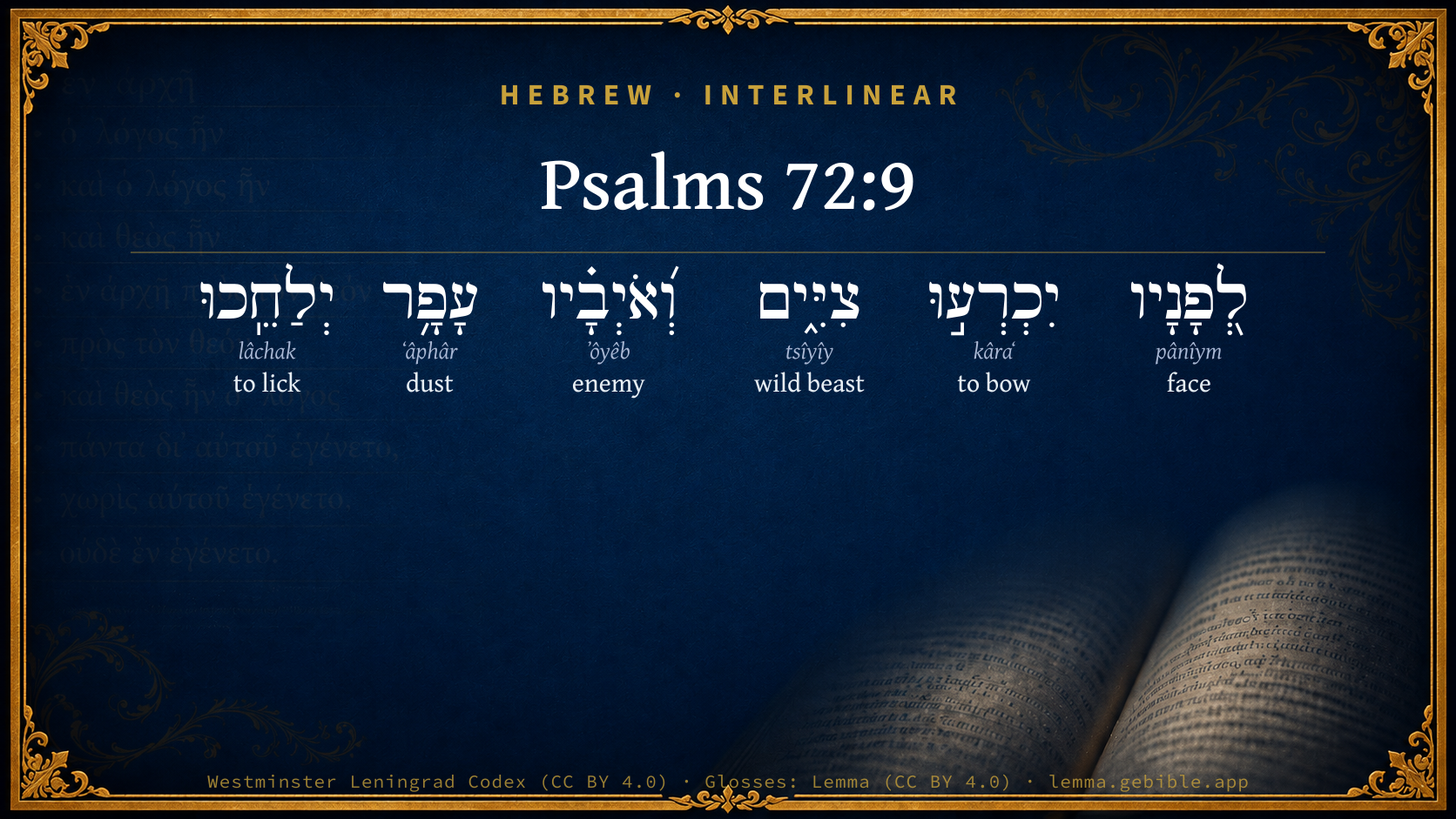
Hebrew (Westminster Leningrad Codex) Psalms 72:9 appears in the Hebrew Old Testament. The text above is from the Westminster Leningrad Codex. Each word links to its Strong’s number, a concise gloss, and parsing drawn from the Open Scriptures Hebrew Bible morphology. Click any word for its full Brown-Driver-Briggs (BDB) entry.
Download image
Cite this verse

Psalms 72:9 (World English Bible). Public Domain. Lemma interlinear Bible study tool, https://lemma.gebible.app/v/psalms/72/9.

Show BibTeX & RIS
BibTeX
RIS
English Translation
Those who dwell in the wilderness shall bow before him. His enemies shall lick the dust.
World English Bible · Public Domain
Highlights
  • 1 first appearance in the Hebrew Bible
Full analysis ↓
Download a study sheet

One document with this verse’s original text, its word-by-word gloss line, the meaning frame, cross-references with their text, attributed commentary, and full source and license credits — printable, and it pastes into notes with its structure intact.

This verse Autodidact and up

Study sheet (.html) Plain text (.txt)

A passage Seminary Student

Up to 50 verses in one chapter. A passage sheet keeps up to 6 commentary sources and 12 cross-references per verse, in the order this page ranks them, and says so on the sheet whenever that leaves anything out. Ask for a single verse and you get the Autodidact verse sheet above.

Everything on this page stays free to read, with no account — the sheet is a download of what is already on screen, not access to it.

Want to remove ads? Support Godless Engineer
Compare translations 3

The same verse in 3 English versions, stacked beneath the original-language interlinear above. Click any original word for its lexicon entry.

Each is an independent rendering of the whole verse — the interlinear is not word-aligned to these translations.

Highlighted words mark where these versions differ — a whole-verse word diff, not a word-by-word alignment.

  • World English Bible Public Domain
    Those who dwell in the wilderness shall bow before him. His enemies shall lick the dust.
  • King James Version Public Domain
    They that dwell in the wilderness shall bow before him; and his enemies shall lick the dust.
  • unfoldingWord Literal Text CC BY-SA 4.0
    May desert-dwellers kneel to his face, and may his enemies lick the dust.

unfoldingWord Literal Text — © unfoldingWord, licensed CC BY-SA 4.0. Word-aligned USFM3 via Door43 (git.door43.org/unfoldingWord/en_ult).

Versions to compare (up to 4)

3 of 4 selected

Show all 18 translations

Every available English version of this verse, each an independent rendering of the whole verse.

  • World English Bible Public Domain
    Those who dwell in the wilderness shall bow before him. His enemies shall lick the dust.
  • Berean Standard Bible Public Domain
    May the nomads bow before him, and his enemies lick the dust.
  • Majority Standard Bible Public Domain
    May the nomads bow before him, and his enemies lick the dust.
  • King James Version Public Domain
    They that dwell in the wilderness shall bow before him; and his enemies shall lick the dust.
  • American Standard Version (1901) Public Domain
    They that dwell in the wilderness shall bow before him; And his enemies shall lick the dust.
  • Revised Version (1885) Public Domain
    They that dwell in the wilderness shall bow before him; and his enemies shall lick the dust.
  • Geneva Bible (1599) Public Domain
    They that dwell in ye wildernes, shall kneele before him, and his enemies shall licke the dust.
  • Douay-Rheims (1899) Public Domain
    Before him the Ethiopians shall fall down: and his enemies shall lick the ground.
  • Young's Literal Translation Public Domain
    Before him bow do the inhabitants of the dry places, And his enemies lick the dust.
  • Literal Standard Version CC BY-SA 4.0
    Desert-dwellers bow before Him, || And His enemies lick the dust.
  • Unlocked Literal Bible CC BY-SA 4.0
    May those who live in the wilderness bow down before him; may his enemies lick the dust.
  • unfoldingWord Literal Text CC BY-SA 4.0
    May desert-dwellers kneel to his face, and may his enemies lick the dust.
  • Darby Bible Public Domain
    The dwellers in the desert shall bow before him, and his enemies shall lick the dust.
  • World Messianic Bible Public Domain
    Those who dwell in the wilderness shall bow before him. His enemies shall lick the dust.
  • Webster's Bible Public Domain
    They that dwell in the wilderness shall bow before him; and his enemies shall lick the dust.
  • Free Bible Version CC BY-SA 4.0
    Desert tribes will kneel before him; and his enemies will bite the dust.
  • Bible in Basic English Public Domain
    Let those who are against him go down before him; and let his haters be low in the dust.
  • JPS Tanakh (1917) Public Domain
    Let them that dwell in the wilderness bow before him; and his enemies lick the dust.

Literal Standard Version (2020), Covenant Press — licensed CC BY-SA 4.0. Text via the HelloAO Bible API (eBible.org). Unlocked Literal Bible (unfoldingWord) — licensed CC BY-SA 4.0. Text via the HelloAO Bible API (eBible.org). unfoldingWord Literal Text — © unfoldingWord, licensed CC BY-SA 4.0. Word-aligned USFM3 via Door43 (git.door43.org/unfoldingWord/en_ult). Free Bible Version, Dr. Jonathan Gallagher — licensed CC BY-SA 4.0. Text via the HelloAO Bible API (eBible.org).

Word by word

More ways to search: Search by grammar → Find every occurrence → Compare this word →

Practice this passage: Drill this verse → Learn its vocabulary →

About this verse

These counts appear in no published source. They are computed here, from the morphology-tagged text and Lemma’s own curated glosses. What Lemma adds →

6
words
6
distinct lemmas
Wisdom
section

Notable vocabulary

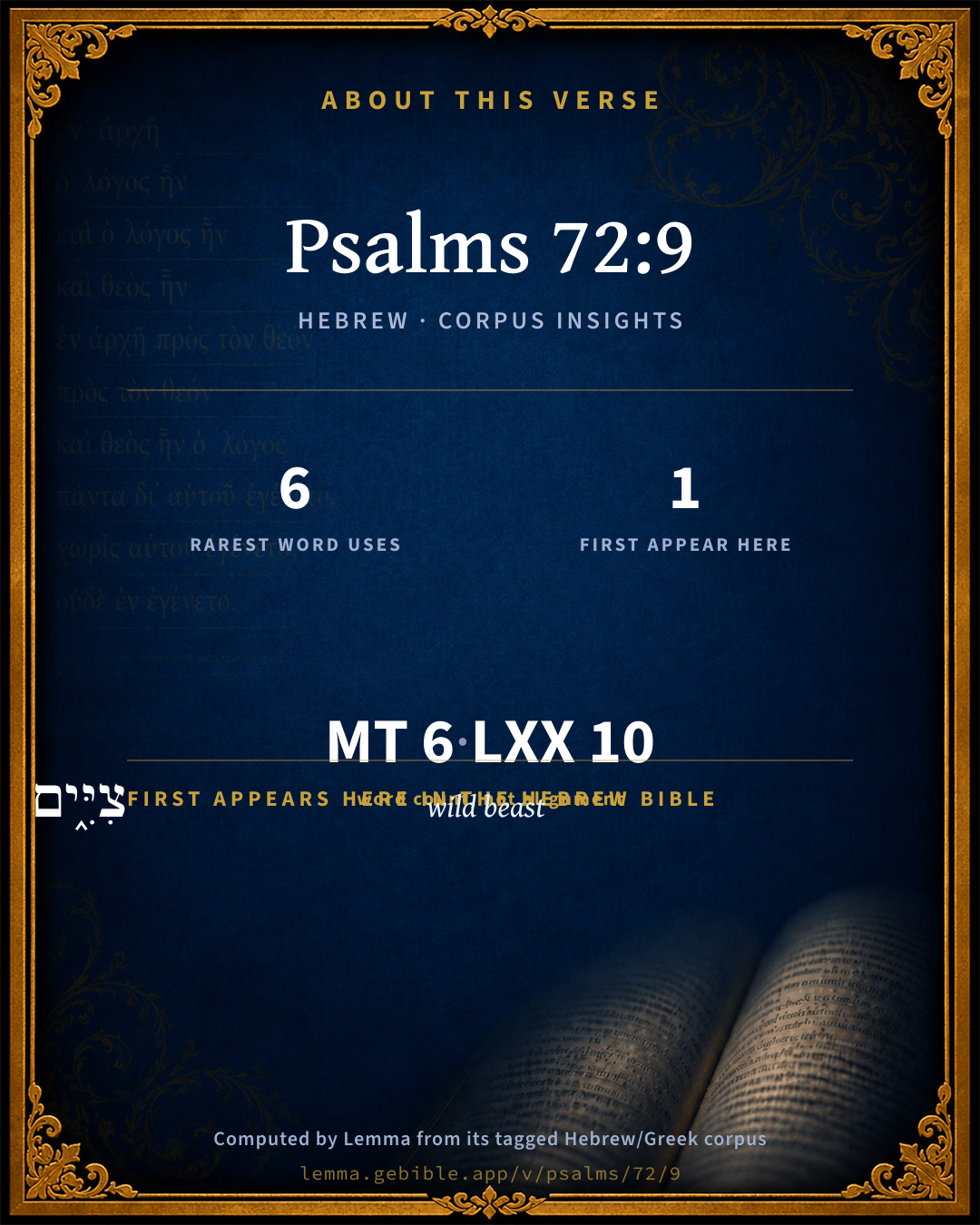
The rarest word here is צִיִּ֑ים wild beast H6728 — appearing just 6 times in the whole Hebrew Bible.

First appearance in Scripture

This word makes its first canonical appearance in the Hebrew Bible here:

  • צִיִּ֑ים wild beast H6728

Shared distinctive vocabulary

צִיִּ֑ים wild beast H6728 occurs in 6 verses of the Hebrew Bible. Also found in:

Grammatical profile

  • 3 verbs
  • 3 nouns

Verb forms

  • יִכְרְע֣וּ Qal · Imperfect
  • וְ֝אֹיְבָ֗יו Qal · Participle Active
  • יְלַחֵֽכוּ Piel · Imperfect

Hebrew & Septuagint length

In English translation the verse runs 16 words from the Hebrew and 14 from the Septuagint (LXX English) — closely comparable.

A rough comparison of the two English renderings, which tokenize alike — not a word-level alignment.

Word counts can differ between the Hebrew and the Greek without any difference in meaning — e.g. the Hebrew direct-object marker אֵת has no separate Greek word, and Greek often adds the article ὁ.

In the original languages it is 6 Hebrew tokens and 10 Greek tokens — but the two are counted differently (Hebrew bundles its prefixes and suffixes into one token; the Greek is in lemma form), so that isn’t a like-for-like length.

Cross-references

11

Topical passages linked to Psalms 72:9 in the Treasury of Scripture Knowledge — connected by theme and wording, ordered by reader-vote popularity; previews shown in the World English Bible.

  • Isaiah 49:23 Kings shall be your nursing fathers, and their queens your nursing mothers: they shall bow down to you with their faces to the earth, and lick the dust of your feet; and you shall know that I am Yahweh; and those who wait for me shall not be disappointed.
  • Micah 7:17 They will lick the dust like a serpent. Like crawling things of the earth they shall come trembling out of their dens. They will come with fear to Yahweh our God, And will be afraid because of you.
  • 1 Kings 9:18 and Baalath, and Tamar in the wilderness, in the land,
  • 1 Kings 9:20–21 As for all the people who were left of the Amorites, the Hittites, the Perizzites, the Hivites, and the Jebusites, who were not of the children of Israel;
  • Psalms 2:9 You shall break them with a rod of iron. You shall dash them in pieces like a potter's vessel."
  • Psalms 21:8–9 Your hand will find out all of your enemies. Your right hand will find out those who hate you.
  • Psalms 22:29 All the rich ones of the earth shall eat and worship. All those who go down to the dust shall bow before him, Even he who can't keep his soul alive.
  • Psalms 110:1 Yahweh says to my Lord, "Sit at my right hand, Until I make your enemies your footstool for your feet."
  • Psalms 110:6 He will judge among the nations. He will heap up dead bodies. He will crush the ruler of the whole earth.
  • Isaiah 35:1–2 The wilderness and the dry land shall be glad; and the desert shall rejoice, and blossom as the rose.
  • Luke 19:27 But bring those enemies of mine who didn't want me to reign over them here, and kill them before me.'"

Cross-references courtesy of OpenBible.info (CC BY 4.0).

Hebrew and Greek witnesses Masoretic Hebrew ↔ Greek Septuagint

The same verse in the two great witnesses to the Old Testament, shown verse-for-verse.

You’re reading Greek Psalm 71 (Hebrew Psalm 72). The Septuagint counts the superscription, so verse numbers can differ from the Hebrew — chapter-level alignment, not verse-by-verse. Numbering follows Rahlfs.

These are two independent witnesses, not word-aligned to each other, and the Septuagint is shown in lemma (dictionary) form.

Hebrew Psalms 72:9 Masoretic · Westminster Leningrad Codex

לְ֭פָנָיו יִכְרְע֣וּ צִיִּ֑ים וְ֝אֹיְבָ֗יו עָפָ֥ר יְלַחֵֽכוּ

Those who dwell in the wilderness shall bow before him. His enemies shall lick the dust.

World English Bible · Public Domain

Greek LXX Greek Psalm 71:9 Septuagint · lemma form

ἐνώπιον αὐτός προπίπτω αἰθίοψ καί ὁ ἐχθρός αὐτός χοῦς λείχω

The Ethiopians shall fall down before him; and his enemies shall lick the dust.

LXX2012 (modern English Septuagint) · Public Domain

On this verse, Adam Clarke's Commentary discusses the Septuagint’s reading. Read the note in Commentary ↓

Hebrew: Westminster Leningrad Codex (CC BY 4.0). Greek: Septuagint (public domain); English from LXX2012 (modern English Septuagint) (Public Domain). How the Septuagint differs from the Hebrew →

Commentary

Notes on Psalms 72:9 from classic Christian and Jewish commentators (each source and its license shown beneath its notes). The classic Christian expositions comment on the surrounding passage and are grouped to its opening verse, so a note may address several verses; the Jewish commentaries on the Tanakh (Rashi and others) are per-verse, so they appear only where the commentator wrote on this verse.

Lemma curates 59 commentaries, every one of them public domain or Creative Commons licensed, each selected and text-cleaned for this edition rather than reprinted as found. About our sources →

Trapp's Complete Commentary

John Trapp

Psa 72:9 They that dwell in the wilderness shall bow before him; and his enemies shall lick the dust.

Ver. 9. They that dwell in the wilderness] Wild, barbarous, rude people; such as were the ancient Britons our progenitors, till Christ, the Sun of righteousness, shone upon them, till they were brought to the obedience of faith; Tunc enim sensim evanuit feritas, indies exulavit immanitas, corruit crudelitas, &c., for then it was otherwise (Bond in Horat.).

And his enemies shall lick the dust] A ceremony much in use among the easterlings. Prostrati adorant honoratiorem, saith Herodotus of the Persians; they worship their betters, by falling to the ground before them; and how Tiridates, king of Parthians, worshipped Nero, is to be read in Dio Cassius. Christ’s foes shall all be made his footstool.

John Trapp, A Commentary or Exposition upon All the Books of the Old and New Testament (1647–1656) — public domain. Text from a community e-Sword module.

The Biblical Illustrator

Joseph S. Exell

Psa_72:9

His enemies shall lick the dust.

The enemies of Christ subdued

I. Who are the enemies of Christ?

1. Those who maintain sentiments contrary to the Gospel of Christ.

2. Those who endeavour to subvert His influence over His peoples hearts.

3. Those who refuse submission to His Gospel.

II. What will be the result of the conflict?

1. Over some He will triumph by His grace.

2. But those who reject all His overtures of mercy He will break in pieces like a potters vessel.

III. What assurance we have that such shall be the issue of the conflict.

1. His own resistless power.

2. His unimpeachable veracity. (Evangelical Preacher.)

The Biblical Illustrator, edited by Joseph S. Exell (c. 1880s–1900s) — public domain. Text from a community e-Sword module.

The Treasury of David

Charles H. Spurgeon

Ver. 9. They that dwell in the wilderness shall bow before him. Unconquered by arms, they shall be subdued by love. Wild and lawless as they have been, they shall gladly wear his easy yoke; then shall their deserts be made glad, yea, they shall rejoice and blossom as the rose.

And his enemies shall lick the dust. If they will not be his friends, they shall be utterly broken and humbled. Dust shall be the serpent's meat; the seed of the serpent shall be filled therewith. Homage among Orientals is often rendered in the most abject manner, and truly no sign is too humiliating to denote the utter discomfiture and subjugation of Messiah's foes. Tongues which rail at the Redeemer deserve to lick the dust. Those who will not joyfully bow to such a prince richly merit to be hurled down and laid prostrate; the dust is too good for them, since they trampled on the blood of Christ.

Ver. 9. They that dwell in the wilderness shall bow before him, etc. This is equivalent to saying, the wild Arabs, that the greatest conquerors could never tame, shall bow before him, or become his vassals; nay, his enemies, and, consequently, these Arabs among the rest, shall lick the dust, or court him with the most abject submissions. T. Harmer's Observations.

Ver. 9. His enemies shall lick the dust. Bear in mind that it was a custom with many nations that, when individuals approached their kings, they kissed the earth, and prostrated their whole body before them. This was the custom especially throughout Asia. No one was allowed to address the Persian kings, unless he prostrated himself on the ground and kissed the footsteps of the king, as Xenophon records. Thomas Le Blanc.

Ver. 9-10. Wilderness, Tarshish, Sheba. The most uncivilized, the most distant, and the most opulent nations shall pay their homage to him. Augustus F. Tholuck.

Ver 9-11. They that dwell in the wilderness shall bow before him; and his enemies shall lick the dust. They shall humble themselves under the mighty hand of Christ; they shall acknowledge and receive him as their Lord; they shall fear and reverence him as their King; they shall veil and bow to his sceptre: they shall put themselves, and all that is theirs, under Christ; they shall give themselves to the exaltation and setting up of Christ. The kings of Tarshish and of the isles shall bring presents: the kings of Sheba and Seba shall offer gifts. They shall consecrate their abilities to Christ's service; they shall communicate of their substance to the maintenance of Christ's church, and minister to the preservation and increase of Christ's kingdom. All kings shall fall down before him: all nations shall serve him. All shall adore and serve him as their king; all shall exalt and honour him, as loyal subjects, their heavenly sovereign; all persons, from the highest to the lowest, must serve the Lord Jesus, and study to make him glorious; grace works obedience in the hearts of princes, as well as in the hearts of beggars. The sun as well as the stars, did obeisance unto Christ, under his kingdom and gospel. Alexander Grosse(-1654), in "Sweet and Soul Persuading Inducements leading unto Christ." 1632.

Ver. 9 (last clause). The ignoble end of Christ's enemies.

Psalms 72:10*

Ver. 9-10. Wilderness, Tarshish, Sheba. See Psalms on "Ps 72:9" for further information.

Ver. 9-11. They that dwell in the wilderness shall bow before him; and his enemies shall lick the dust. See Psalms on "Ps 72:9" for further information.

Ver. 9-11. They that dwell in the wilderness shall bow before him; and his enemies shall lick the dust. See Psalms on "Ps 72:9" for further information.

None.

Psalms 72:12*

Charles H. Spurgeon's The Treasury of David (1869–1885) — public domain. Psalms only. Text from a community e-Sword/MySword module.

Joseph Benson's Commentary

Psa 72:9. They that dwell in the wilderness shall bow before him — That is, that inhabit solitary places. The Hebrew word, ציים, tziim, here used,

(from ציה, tziah siccitas, dryness, or a dry place,) is applied to barren grounds or deserts, parched up for want of springs and rains, and it here signifies the inhabitants of such countries, and particularly the people and kings of Arabia Deserta. These were tributary to Solomon, 1Ki 10:15, and great numbers of them submitted to Christ, and received his gospel. And his enemies shall lick the dust — Shall prostrate themselves to the ground in token of reverence and subjection to him, as was the custom of the eastern people.

Joseph Benson's Commentary on the Old and New Testaments (1811–1818) — public domain. Text from a community e-Sword module.

J. A. Alexander on Psalms

Joseph Addison Alexander

Psa 72:9. Before him shall crouch wild (men), and his enemies the dust shall lick. The first noun denotes dwellers in the wilderness, and is applied both to brutes (Isa 13:21; Isa 34:14, Jer 50:39) and men (Psa 74:14). The common version of the first verb (bow) is too weak in itself and in comparison with the parallel expression, lick the dust, implying the most unconditional and abject submission.

Joseph Addison Alexander, The Psalms Translated and Explained (1850) — public domain. Text from a community e-Sword module.

Adam Clarke's Commentary

Verse 9. They that dwell in the wilderness] The ציים tsiyim, termed Ethiopians by the Vulgate, Septuagint, AEthiopic, and Arabic. The Syriac terms them the islands. But it is likely that those who dwell by the sea-coasts, and support themselves by navigation and fishing, are here intended.

His enemies shall lick the dust.] Shall be so completely subdued, that they shall be reduced to the most abject state of vassalage, till they shall become proselytes to the Jewish faith.

Adam Clarke's Commentary on the Bible (1810–1826) — public domain. Text from a community e-Sword/MySword module.

Ellicott's Commentary for English Readers

(9) They that dwell in the wilderness. . . .—The Hebrew word in other places is used of “wild animals” (Psa_74:14; Isa_23:13). Here apparently it refers to the nomad tribes wandering over the desert. The LXX. and ancient versions generally have “Æthiopians.”

Lick the dust.—The allusion is to the Eastern etiquette of prostration before a sovereign.

A Bible Commentary for English Readers, edited by Charles John Ellicott (1878–1897) — public domain. Text from a community e-Sword module.

The Cambridge Bible for Schools and Colleges

gen. ed. J. J. S. Perowne

9. Let them that dwell in the wilderness bow down before him, And let his enemies lick the dust.

Even the wild Bedouin tribes that roam at large through the desert, the freest of the free, submit to his rule. LXX, Aq., Symm., Jer., render, Ethiopians, the Targ., Africans; but the term is quite general. There is no need to alter the text. Cp. Psa_74:14.

lick the dust] I.e. prostrate themselves with their faces on the ground in abject submission. Cp. Mic_7:17; Isa_49:23.

The Cambridge Bible for Schools and Colleges (gen. ed. J. J. S. Perowne; Cambridge University Press, 1878–1918) — public domain. Text from a community e-Sword module.

John Gill's Exposition

They that dwell in the wilderness shall bow before him,.... In token of subjection to him, reverence and worship of him, to whom every knee shall bow, Isa 45:23. The Septuagint version, and others, render the word "Ethiopians", who dwell in a dry land, parched and burnt with the sun; and so it is a prophecy of their conversion to Christ, as in Psa 68:31; of which there is an instance, Act 8:27; the word is used of the wild beasts of the field, in Isa 13:21; to which wicked men, for the malignity of their nature, may be compared; as they are to the wild ass, to lions, leopards, and bears; and yet these are so tamed by the power of divine grace as to be made subject to Christ. Kimchi explains it as we do, of the inhabitants of the wilderness; and so the word is rendered in Psa 74:14; and instances in the Kedarenes; and it may in particular design those that dwell in the deserts of Arabia; and in general the Gentiles, the wilderness of the people, who in Gospel times should be brought to the knowledge of Christ, and submission to him: and it fitly describes the people of God in an unregenerate state; when they are as barren and unfruitful as the dry and parched ground, and as the heath in the wilderness; are in want of provision, and have nothing but husks to feed upon; in perplexity of ways, and know not which to take, or whither they are going; and in very dangerous circumstances, destruction and misery being in all their ways: in this wilderness state the Lord finds them, as he did Israel of old, and leads them about, and brings them to Christ; when they submit to him as a Saviour, being willing to be saved by him, and him only, and to his righteousness, as their justifying righteousness before God, and to the sceptre of his kingdom, to his laws and commands, to his Gospel, and the ordinances of it; all which they do not by constraint, but willingly. The Targum and Jarchi interpret it, the one of governors of provinces; the other of companies of princes. The Syriac version is, "the isles shall bow before him"; the inhabitants of the islands: but this is expressed in Psa 72:10. Aben Ezra thinks masters of ships are meant;

and his enemies shall lick the dust; of the earth; which is an instance of their great subjection to him; see Isa 49:23; the allusion is to the custom of the eastern people, and which continues to this day with the Turks, that as soon as an ambassador sees the sultan, whether at the window, or elsewhere, he immediately falls down on his knees, and kisses the ground (a). The Jews particularly are the enemies of Christ, who rejected him, and would not have him to reign over them; and yet some of these became obedient to the faith of Christ, and more of them, even the whole nation, will in the latter day: all that are Christ's are, before conversion, enemies to him, to his people, to his Gospel and ordinances, to him as a King, and to all his laws and commands; but when his arrows are sharp in their hearts, they fall under him, and submit to him; throw off the yoke of sin, Satan, and the world, and own him, and obey him, as their King and Lawgiver.

(a) Mandevil. Itinerar. c. 7.

John Gill's Exposition of the Whole Bible (1746–1763) — public domain (CC PDM 1.0). Text via the HelloAO Bible API.

Albert Barnes' Notes on the Bible

They that dwell in the wilderness shall bow before him - The word rendered “they that dwell in the wilderness” - ציים tsı̂yı̂ym, means properly those who abide in deserts, dry places, solitudes; and it might be applied either to animals or to people. It is applied to the former in Isa 13:21 (see the notes at that place); Isa 23:13; Isa 34:14; Jer 50:39. In all these, except Isa 23:13, it is rendered “wild beasts of the desert,” denoting jackals, ostriches, etc.; but here, and in Psa 74:14, it is evidently applied to people, as denoting shepherds - nomadic tribes - people who have no permanent home, but who wander from place to place. The idea is, that these wild, wandering, unsettled hordes would become subject to him, or would bow down and acknowledge his authority. This can be fulfilled only under the Messiah.

And his enemies shall lick the dust - This is expressive of the most thorough submission and abject humiliation. It is language derived from what seems actually to occur in Oriental countries, where people prostrate themselves on their faces, and place their mouths on the ground, in token of reverence or submission. Rosenmuller (Morgenland, vol. ii., pp. 82, 83) quotes a passage from Hugh Boyd’s Account of his embassage to Candy in Ceylon, where he says that when he himself came to show respect to the king, it was by kneeling before him. But this, says he, was not the case with other ambassadors. “They almost literally licked the dust. They cast themselves on their faces on the stony ground, and stretched out their arms and legs; then they raised themselves upon their knees, and uttered certain forms of good wishes in the loudest tones - May the head of the king of kings reach above the sun; may he reign a thousand years.” Compare the notes at Isa 49:23.

Albert Barnes' Notes on the Bible (1834–1885) — public domain. Text from a community e-Sword/MySword module.

Matthew Poole's English Annotations

In the wilderness; in solitary places; even rude and barbarous people, who lived without order and government among themselves; of which sort great numbers submitted to Christ, and received the gospel.

Shall lick the dust, i.e. shall prostrate themselves to the ground, in token of reverence and subjection, as the custom of the Eastern people was. See Isa 49:23; Mic 7:17.

Matthew Poole's English Annotations on the Holy Bible (1683–1685) — public domain. Text from a community e-Sword/MySword module.

Whedon's Commentary on the Bible

Daniel D. Whedon

9. Wilderness—Of Arabia, as in Psa_74:14. The Arabian tribes, from immemorial ages, have been a wild, independent, and unconquerable people, and their willing submission is here a notable feature.

Daniel D. Whedon (gen. ed.), Commentary on the Old and New Testaments (1874–1909) — public domain. Text from a community e-Sword module.

The Pulpit Commentary

They that dwell in the wilderness shall how before him. (for the meaning here assigned to tsiyyim ( see Psa_74:14 Isa_23:13) The wild tribes of the Syrian and Arabian deserts areprobably intended. (comp. Isa_60:6, Isa_60:7) And his enemies shall lick the dust; i.e. , prostrate themselves at his feet with their faces in the dust. See the Assyrian representations of Oriental prostrations ("Ancient Monarchies," vol. 1, pp. 266, 502).

The Pulpit Commentary (1880–1919), ed. H.D.M. Spence-Jones & Joseph S. Exell — public domain. Text from a community e-Sword module.

Keil & Delitzsch

C. F. Keil & F. Delitzsch

This third strophe contains prospects, the ground of which is laid down in the fourth. The position of the futures here becomes a different one. The contemplation passes from the home relations of the new government to its foreign relations, and at the same time the wishes are changed into hopes. The awe-commanding dominion of the king shall stretch even into the most distant corners of the desert. ציּים is used both for the animals and the men who inhabit the desert, to be determined in each instance by the context; here they are men beyond all dispute, but in Psa 74:14; Isa 23:13, it is matter of controversy whether men or beasts are meant. Since the lxx, Aquila, Symmachus, and Jerome here, and the lxx and Jerome in Psa 74:14, render Αἰθίοπες, the nomadic tribes right and left of the Arabian Gulf seem traditionally to have been associated in the mind with this word, more particularly the so-called Ichthyophagi. These shall bend the knee reverentially before him, and those who contend against him shall be compelled at last to veil their face before him in the dust. The remotest west and south become subject and tributary to him, viz., the kings of Tartessus in the south of Spain, rich in silver, and of the islands of the Mediterranean and the countries on its coasts, that is to say, the kings of the Polynesian portion of Europe, and the kings of the Cushitish or of the Joktanitish שׁבא and of the Cushitish סבא, as, according to Josephus, the chief city of Meroכ was called (vid., Genesis, S. 206). It was a queen of that Joktanitish, and therefore South Arabian Sheba, - perhaps, however, more correctly (vid., Wetzstein in my Isaiah, ii. 529) of the Cushitish (Nubian) Sheba, - whom the fame of Solomon's wisdom drew towards him, 1 Kings 10. The idea of their wealth in gold and in other precious things is associated with both peoples. In the expression השׁיב מנחה (to pay tribute, Kg2 17:3, cf. Psa 3:4) the tribute is not conceived of as rendered in return for protection afforded (Maurer, Hengstenberg, and Olshausen), nor as an act repeated periodically (Rdiger, who refers to Ch2 27:5), but as a bringing back, i.e., repayment of a debt, referre s. reddere debitum (Hupfeld), after the same idea according to which obligatory incomings are called reditus (revenues). In the synonymous expression הקריב אשׁכּר the presentation appears as an act of sacrifice. אשׁכּר signifies in Eze 27:15 a payment made in merchandise, here a rent or tribute due, from שׂכר, which in blending with the Aleph prostheticum has passed over into שׂכר by means of a shifting of the sound after the Arabic manner, just as in אשׁכּל the verb שׂכל, to interweave, passes over into שׂכל (Rdiger in Gesenius' Thesaurus). In Psa 72:11 hope breaks through every bound: everything shall submit to his world-subduing sceptre.

Keil & Delitzsch — Biblical Commentary on the Old Testament (1861–1891) — public domain (CC PDM 1.0). Text via the HelloAO Bible API. (Old Testament only.)

Rashi

Rabbi Shlomo Yitzchaki (Rashi)

nobles Heb. ציים, companies of nobles, as (Num. 24:24): “and nobles (וצים) from the Kittites,” which the Targum renders: And companies will come around from the Romans.

Rashi on the Tanakh — English translations: “The Judaica Press complete Tanach with Rashi, translated by A. J. Rosenberg” (CC BY 4.0); “Pentateuch with Rashi's commentary by M. Rosenbaum and A.M. Silbermann, 1929-1934” (public domain); “The Metsudah Tanach series, Lakewood, N.J” (CC BY 4.0); and “The Book of Joshua, Metsudah Publications, 1997” (CC BY 4.0). Text via Sefaria.

Lesson kit

Teaching starters — assembled from the data on this page, not authored interpretation. Every prompt links to the verse data it draws on. Edit before teaching.

Psalms, in the Wisdom, opens this verse with 6 words (6 distinct Hebrew lemmas). Its most distinctive word is tsîyîy (“wild beast”). A historical commentator’s framing appears above. Read the whole chapter for the surrounding context.

Discussion questions

  1. The word tsîyîy carries the sense “wild beast.” How does it shape the verse?
  2. The word “wild beast” first appears here in Scripture. What is being introduced at this debut?
  3. Psalms 74:14 shares the word «wild beast» with this verse. How do the two illuminate each other?
  4. These translations render this verse differently. What is at stake in choosing one wording over another?
  5. The verb «יִכְרְע֣וּ» is Qal Imperfect. How does its form color the action?
  6. Reading how Trapp's Complete Commentary and The Biblical Illustrator read this verse, where do the two commentators agree and where do they part?

Things to notice

Reading settings

Reading text

Shown beneath each verse's original-language words.

Old Testament
Old Testament edition

Read the OT as the Masoretic Hebrew (MT) or the Greek Septuagint (LXX).

English shown for the Greek Septuagint (in the Hebrew ↔ Greek comparison).

Comparing translations? Open the Compare panel on any verse page to stack up to four side by side.