
Judges 11:36

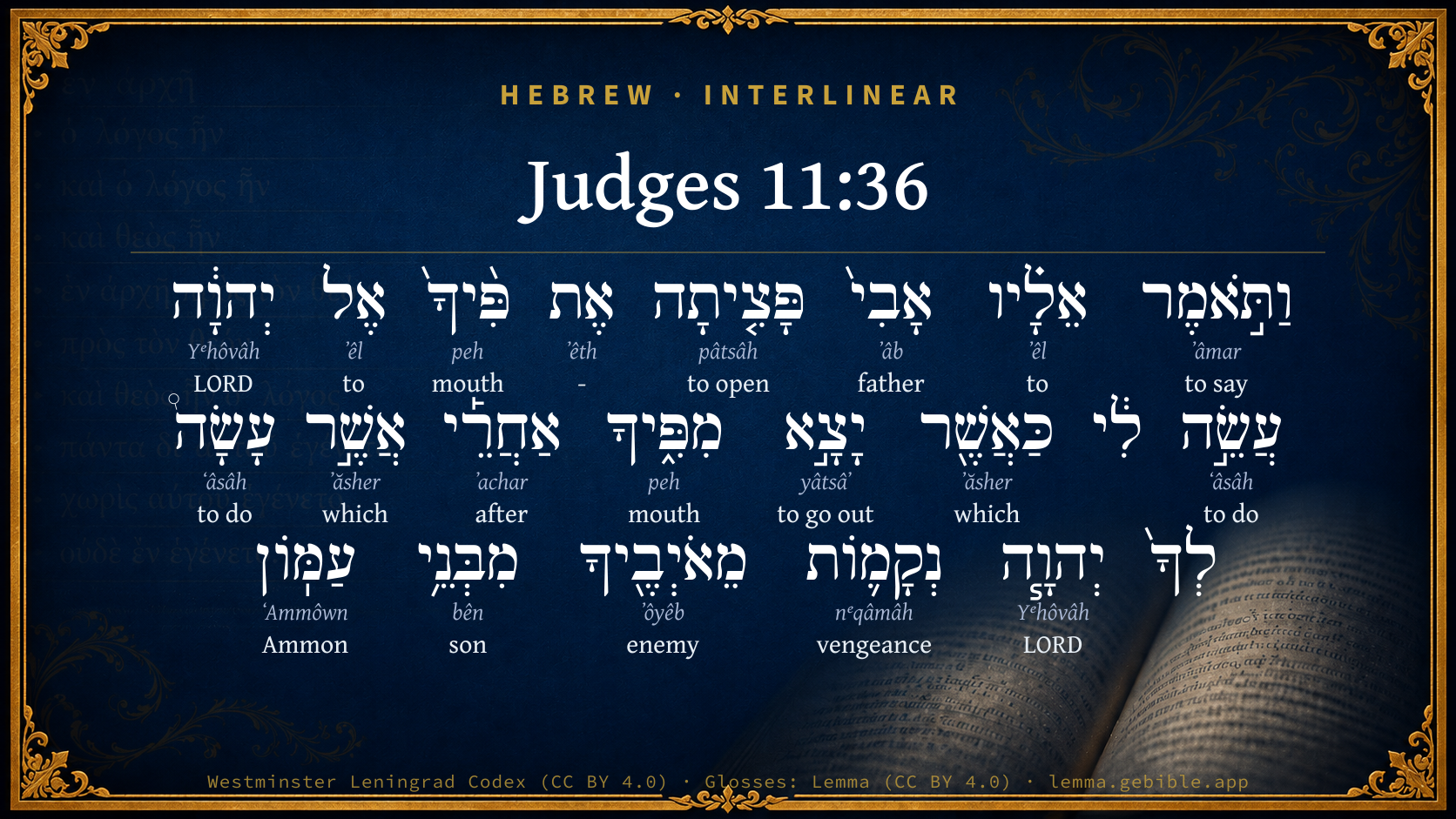
Hebrew (Westminster Leningrad Codex) Judges 11:36 appears in the Hebrew Old Testament. The text above is from the Westminster Leningrad Codex. Each word links to its Strong’s number, a concise gloss, and parsing drawn from the Open Scriptures Hebrew Bible morphology. Click any word for its full Brown-Driver-Briggs (BDB) entry.
Download image
Cite this verse

Judges 11:36 (World English Bible). Public Domain. Lemma interlinear Bible study tool, https://lemma.gebible.app/v/judges/11/36.

Show BibTeX & RIS
BibTeX
RIS
English Translation
She said to him, My father, you have opened your mouth to Yahweh; do to me according to that which has proceeded out of your mouth, because Yahweh has taken vengeance for you on your enemies, even on the children of Ammon.
World English Bible · Public Domain
Download a study sheet

One document with this verse’s original text, its word-by-word gloss line, the meaning frame, cross-references with their text, attributed commentary, and full source and license credits — printable, and it pastes into notes with its structure intact.

This verse Autodidact and up

Study sheet (.html) Plain text (.txt)

A passage Seminary Student

Up to 50 verses in one chapter. A passage sheet keeps up to 6 commentary sources and 12 cross-references per verse, in the order this page ranks them, and says so on the sheet whenever that leaves anything out. Ask for a single verse and you get the Autodidact verse sheet above.

Everything on this page stays free to read, with no account — the sheet is a download of what is already on screen, not access to it.

Want to remove ads? Support Godless Engineer
Compare translations 3

The same verse in 3 English versions, stacked beneath the original-language interlinear above. Click any original word for its lexicon entry.

Each is an independent rendering of the whole verse — the interlinear is not word-aligned to these translations.

Highlighted words mark where these versions differ — a whole-verse word diff, not a word-by-word alignment.

  • World English Bible Public Domain
    She said to him, My father, you have opened your mouth to Yahweh; do to me according to that which has proceeded out of your mouth, because Yahweh has taken vengeance for you on your enemies, even on the children of Ammon.
  • King James Version Public Domain
    And she said unto him, My father, if thou hast opened thy mouth unto the LORD, do to me according to that which hath proceeded out of thy mouth; forasmuch as the LORD hath taken vengeance for thee of thine enemies, even of the children of Ammon.
  • unfoldingWord Literal Text CC BY-SA 4.0
    But she said to him, “My father, you have opened your mouth to Yahweh. Do to me according to what came forth from your mouth, after what Yahweh has done for you: vengeances against your enemies, against the sons of Ammon.”

unfoldingWord Literal Text — © unfoldingWord, licensed CC BY-SA 4.0. Word-aligned USFM3 via Door43 (git.door43.org/unfoldingWord/en_ult).

Versions to compare (up to 4)

3 of 4 selected

Show all 18 translations

Every available English version of this verse, each an independent rendering of the whole verse.

  • World English Bible Public Domain
    She said to him, My father, you have opened your mouth to Yahweh; do to me according to that which has proceeded out of your mouth, because Yahweh has taken vengeance for you on your enemies, even on the children of Ammon.
  • Berean Standard Bible Public Domain
    “My father,” she replied, “you have given your word to the LORD. Do to me as you have said, for the LORD has avenged you of your enemies, the Ammonites.”
  • Majority Standard Bible Public Domain
    “My father,” she replied, “you have given your word to the LORD. Do to me as you have said, for the LORD has avenged you of your enemies, the Ammonites.”
  • King James Version Public Domain
    And she said unto him, My father, if thou hast opened thy mouth unto the LORD, do to me according to that which hath proceeded out of thy mouth; forasmuch as the LORD hath taken vengeance for thee of thine enemies, even of the children of Ammon.
  • American Standard Version (1901) Public Domain
    And she said unto him, My father, thou hast opened thy mouth unto Jehovah; do unto me according to that which hath proceeded out of thy mouth, forasmuch as Jehovah hath taken vengeance for thee on thine enemies, even on the children of Ammon.
  • Revised Version (1885) Public Domain
    And she said unto him, My father, thou hast opened thy mouth unto the LORD; do unto me according to that which hath proceeded out of thy mouth; forasmuch as the LORD hath taken vengeance for thee of thine enemies, even of the children of Ammon.
  • Geneva Bible (1599) Public Domain
    And she said vnto him, My father, if thou hast opened thy mouth vnto the Lord, doe with me as thou hast promised, seeing that the Lord hath auenged thee of thine enemies the children of Ammon.
  • Douay-Rheims (1899) Public Domain
    And she answered him: My father, if thou hast opened thy mouth to the Lord, do unto me whatsoever thou hast promised, since the victory hath been granted to thee, and revenge of thy enemies.
  • Young's Literal Translation Public Domain
    And she saith unto him, `My father -- thou hast opened thy mouth unto Jehovah, do to me as it hath gone out from thy mouth, after that Jehovah hath done for thee vengeance on thine enemies, on the Bene-Ammon.'
  • Literal Standard Version CC BY-SA 4.0
    And she says to him, “My father, you have opened your mouth to YHWH, do to me as it has gone out from your mouth, after that YHWH has done vengeance for you on your enemies, on the sons of Ammon.”
  • Unlocked Literal Bible CC BY-SA 4.0
    She said to him, “My father, you have made a vow to Yahweh, do to me everything you promised, because Yahweh has taken vengeance for you against your enemies, the Ammonites.”
  • unfoldingWord Literal Text CC BY-SA 4.0
    But she said to him, “My father, you have opened your mouth to Yahweh. Do to me according to what came forth from your mouth, after what Yahweh has done for you: vengeances against your enemies, against the sons of Ammon.”
  • Darby Bible Public Domain
    And she said to him, "My father, if you have opened your mouth to the LORD, do to me according to what has gone forth from your mouth, now that the LORD has avenged you on your enemies, on the Ammonites."
  • World Messianic Bible Public Domain
    She said to him, “My father, you have opened your mouth to the LORD; do to me according to that which has proceeded out of your mouth, because the LORD has taken vengeance for you on your enemies, even on the children of Ammon.”
  • Webster's Bible Public Domain
    And she said to him, My father, if thou hast opened thy mouth to the LORD, do to me according to that which hath proceeded out of thy mouth; forasmuch as the LORD hath taken vengeance for thee of thy enemies, even of the children of Ammon.
  • Free Bible Version CC BY-SA 4.0
    She replied, “Father, you have made a solemn promise to the Lord. Do to me what you promised, for the Lord gave you victory over your enemies, the Ammonites.”
  • Bible in Basic English Public Domain
    And she said to him, My father, you have made an oath to the Lord; do then to me whatever you have said; for the Lord has sent a full reward on your haters, on the children of Ammon.
  • JPS Tanakh (1917) Public Domain
    And she said unto him: 'My father, thou hast opened thy mouth unto the LORD; do unto me according to that which hath proceeded out of thy mouth; forasmuch as the LORD hath taken vengeance for thee of thine enemies, even of the children of Ammon.'

Literal Standard Version (2020), Covenant Press — licensed CC BY-SA 4.0. Text via the HelloAO Bible API (eBible.org). Unlocked Literal Bible (unfoldingWord) — licensed CC BY-SA 4.0. Text via the HelloAO Bible API (eBible.org). unfoldingWord Literal Text — © unfoldingWord, licensed CC BY-SA 4.0. Word-aligned USFM3 via Door43 (git.door43.org/unfoldingWord/en_ult). Free Bible Version, Dr. Jonathan Gallagher — licensed CC BY-SA 4.0. Text via the HelloAO Bible API (eBible.org).

Word by word

More ways to search: Search by grammar → Find every occurrence → Compare this word →

Practice this passage: Drill this verse → Learn its vocabulary →

פָּצִ֤יתָה
pâtsâh
H6475
“to open”
Verb, Qal, Perfect, 2nd Person, Masculine, Singular
Part of Speech
Verb
Stem
Qal
Form
Perfect
Person
2nd Person
Gender
Masculine
Number
Singular
Full BDB Definition

Origin: a primitive root

TWOT: 1795

to part, open, separate, set free - (Qal) - to open (mouth), utter - to snatch away, set free
  1. וַתֹּ֣אמֶר ʼâmar H559 “and · to say” Conjunction + Verb, Qal, Sequential Imperfect, 3rd Person, Feminine, Singular
  2. אֵלָ֗יו ʼêl H413 “to · him” Preposition + Suffix, Personal, 3rd Person, Masculine, Singular
  3. אָבִי֙ ʼâb H1 “father · my” Noun, Common, Masculine, Singular, Construct + Suffix, Personal, 1st Person, Common, Singular
  4. אֶת ʼêth H853 “-” Particle, Direct Object
  5. פִּ֨יךָ֙ peh H6310 “mouth · your” Noun, Common, Masculine, Singular, Construct + Suffix, Personal, 2nd Person, Masculine, Singular
  6. אֶל ʼêl H413 “to” Preposition
  7. יְהוָ֔ה Yᵉhôvâh H3068 “LORD” Noun, Proper
  8. עֲשֵׂ֣ה ʻâsâh H6213 “do” Verb, Qal, Imperative, 2nd Person, Masculine, Singular
  9. כַּאֲשֶׁ֖ר ʼăsher H834 “like/as · which” Preposition + Particle, Relative
  10. יָצָ֣א yâtsâʼ H3318 “to go out” Verb, Qal, Perfect, 3rd Person, Masculine, Singular
  11. מִפִּ֑יךָ peh H6310 “from · mouth · your” Preposition + Noun, Common, Masculine, Singular, Construct + Suffix, Personal, 2nd Person, Masculine, Singular
  12. אַחֲרֵ֡י ʼachar H310 “after” Preposition
  13. אֲשֶׁ֣ר ʼăsher H834 “which” Particle, Relative
  14. עָשָׂה֩ ʻâsâh H6213 “to do” Verb, Qal, Perfect, 3rd Person, Masculine, Singular
  15. יְהוָ֧ה Yᵉhôvâh H3068 “LORD” Noun, Proper
  16. נְקָמ֛וֹת nᵉqâmâh H5360 “vengeance” Noun, Common, Feminine, Plural, Absolute
  17. מֵאֹיְבֶ֖יךָ ʼôyêb H341 “from · enemy · you” Preposition + Verb, Qal, Participle Active, Masculine, Plural, Construct + Suffix, Personal, 2nd Person, Masculine, Singular
  18. מִבְּנֵ֥י bên H1121 “from · sons of” Preposition + Noun, Common, Masculine, Plural, Construct
  19. עַמּֽוֹן ʻAmmôwn H5983 “Ammon” Noun, Proper

About this verse

These counts appear in no published source. They are computed here, from the morphology-tagged text and Lemma’s own curated glosses. What Lemma adds →

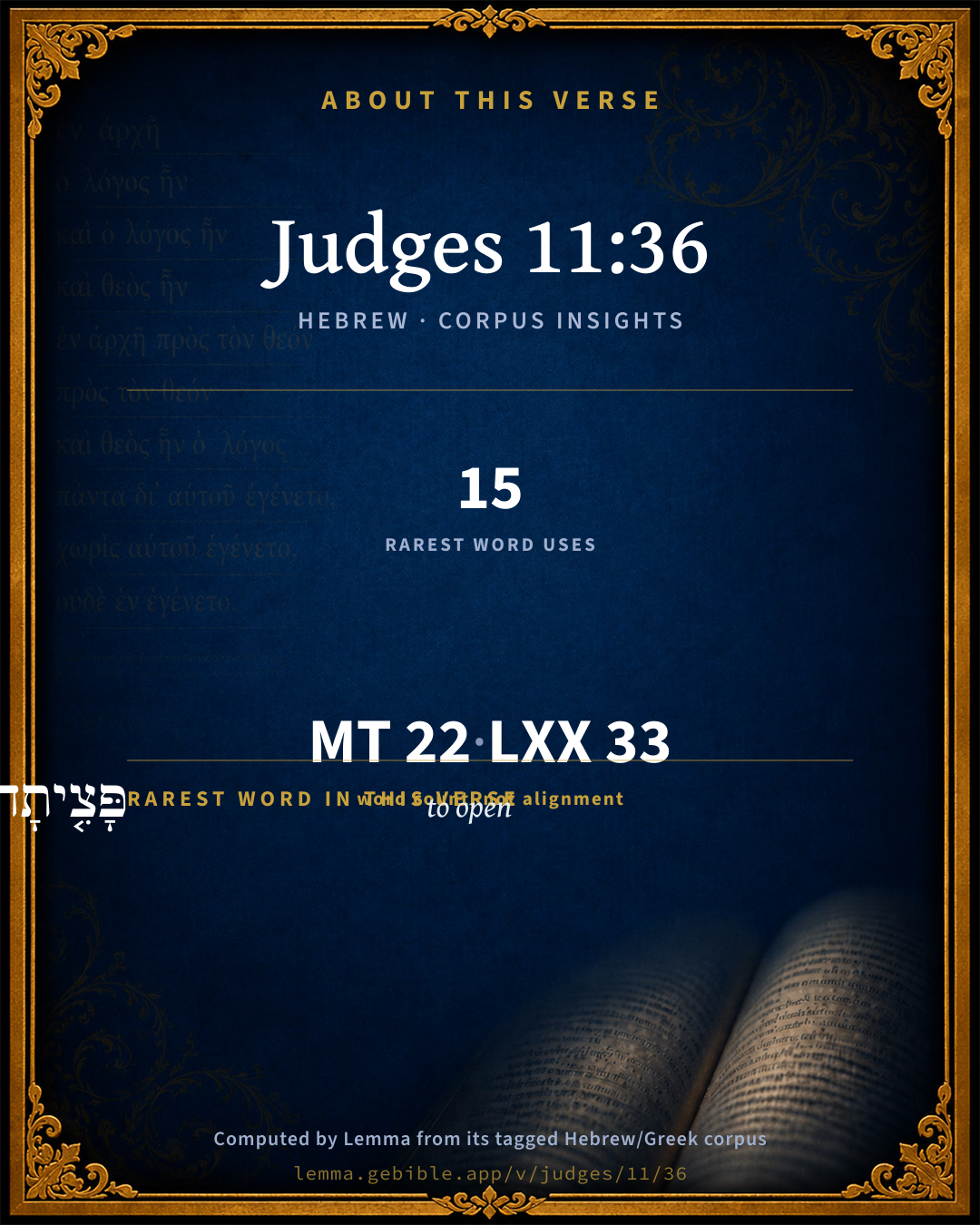
22
words
15
distinct lemmas
Historical
section

Notable vocabulary

The rarest word here is פָּצִ֤יתָה to open H6475 — appearing just 15 times in the whole Hebrew Bible.

Shared distinctive vocabulary

פָּצִ֤יתָה to open H6475 occurs in 15 verses of the Hebrew Bible. Also found in:

Grammatical profile

  • 6 verbs
  • 8 nouns
  • 5 prepositions
  • 3 particles

Verb forms

  • וַתֹּ֣אמֶר Qal · Sequential Imperfect
  • פָּצִ֤יתָה Qal · Perfect
  • עֲשֵׂ֣ה Qal · Imperative
  • יָצָ֣א Qal · Perfect
  • עָשָׂה֩ Qal · Perfect
  • מֵאֹיְבֶ֖יךָ Qal · Participle Active

Repetition

Words recur within this verse — often emphatic in Hebrew:

  • פִּ֨יךָ֙ mouth H6310 ×2
  • יְהוָ֔ה LORD H3068 ×2
  • עֲשֵׂ֣ה to do H6213 ×2
  • אֵלָ֗יו to H413 ×2
  • כַּאֲשֶׁ֖ר which H834 ×2

Hebrew & Septuagint length

In English translation the verse runs 42 words from the Hebrew and 43 from the Septuagint (LXX English) — closely comparable.

A rough comparison of the two English renderings, which tokenize alike — not a word-level alignment.

Word counts can differ between the Hebrew and the Greek without any difference in meaning — e.g. the Hebrew direct-object marker אֵת has no separate Greek word, and Greek often adds the article ὁ.

In the original languages it is 22 Hebrew tokens and 33 Greek tokens — but the two are counted differently (Hebrew bundles its prefixes and suffixes into one token; the Greek is in lemma form), so that isn’t a like-for-like length.

Cross-references

8

Topical passages linked to Judges 11:36 in the Treasury of Scripture Knowledge — connected by theme and wording, ordered by reader-vote popularity; previews shown in the World English Bible.

  • Acts 21:13 Then Paul answered, "What are you doing, weeping and breaking my heart? For I am ready not only to be bound, but also to die at Jerusalem for the name of the Lord Jesus."
  • 2 Samuel 18:19 Then said Ahimaaz the son of Zadok, Let me now run, and bear the king news, how that Yahweh has avenged him of his enemies.
  • Romans 16:4 who for my life, laid down their own necks; to whom not only I give thanks, but also all the assemblies of the Gentiles.
  • Philippians 2:30 because for the work of Christ he came near to death, risking his life to supply that which was lacking in your service toward me.
  • Judges 16:28–30 Samson called to Yahweh, and said, Lord Yahweh, remember me, Please, and strengthen me, Please, only this once, God, that I may be at once avenged of the Philistines for my two eyes.
  • 2 Samuel 18:31 Behold, the Cushite came; and the Cushite said, News for my lord the king; for Yahweh has avenged you this day of all those who rose up against you.
  • 2 Samuel 19:30 Mephibosheth said to the king, yes, let him take all, because my lord the king is come in peace to his own house.
  • Acts 20:24 But these things don't count; nor do I hold my life dear to myself, so that I may finish my race with joy, and the ministry which I received from the Lord Jesus, to fully testify to the Gospel of the grace of God.

Cross-references courtesy of OpenBible.info (CC BY 4.0).

Hebrew and Greek witnesses Masoretic Hebrew ↔ Greek Septuagint

The same verse in the two great witnesses to the Old Testament, shown verse-for-verse.

These are two independent witnesses, not word-aligned to each other, and the Septuagint is shown in lemma (dictionary) form.

Hebrew Judges 11:36 Masoretic · Westminster Leningrad Codex

וַתֹּ֣אמֶר אֵלָ֗יו אָבִי֙ פָּצִ֤יתָה אֶת פִּ֨יךָ֙ אֶל יְהוָ֔ה עֲשֵׂ֣ה לִ֔י כַּאֲשֶׁ֖ר יָצָ֣א מִפִּ֑יךָ אַחֲרֵ֡י אֲשֶׁ֣ר עָשָׂה֩ לְךָ֙ יְהוָ֧ה נְקָמ֛וֹת מֵאֹיְבֶ֖יךָ מִבְּנֵ֥י עַמּֽוֹן

She said to him, My father, you have opened your mouth to Yahweh; do to me according to that which has proceeded out of your mouth, because Yahweh has taken vengeance for you on your enemies, even on the children of Ammon.

World English Bible · Public Domain

Greek LXX Judges 11:36 Septuagint · lemma form

ὁ δέ εἶπον πρός αὐτός πατήρ ἀναοἴγω ὁ στόμα σύ πρός κύριος ποιέω ἐγώ ὅς τρόπος ἐκἔρχομαι ἐκ στόμα σύ ἐν ὁ ποιέω σύ κύριος ἐκδίκησις ἀπό ὁ ἐχθρός σύ ἀπό υἱός αμμων

And she said to him, Father, have you opened your mouth to the Lord? Do to me accordingly as the word went out of your mouth, in that the Lord has wrought vengeance for you on your enemies of the children of Ammon.

LXX2012 (modern English Septuagint) · Public Domain

On this verse, Ellicott's Commentary for English Readers discusses the Septuagint’s reading. Read the note in Commentary ↓

Hebrew: Westminster Leningrad Codex (CC BY 4.0). Greek: Septuagint (public domain); English from LXX2012 (modern English Septuagint) (Public Domain). How the Septuagint differs from the Hebrew →

Targum (Aramaic paraphrase)

1

The Targum is the ancient Jewish Aramaic paraphrase of the Hebrew Scriptures — an interpretive translation, not the Hebrew text itself. Onkelos (literal) and Pseudo-Jonathan (expansive) render the Torah, and Jonathan the Prophets. Coverage is partial: where no permissively-licensed English translation exists for a verse, only the Aramaic is shown. This is verse-level text, not a word-by-word alignment to the Hebrew.

  1. Targum Jonathan Prophets (Joshua–Malachi)
    וַאֲמָרַת לֵיהּ אַבָּא פְּתַחְתָּא יַת פּוּמָךְ בִּנְדַר קֳדָם יְיָ ָעֲבֵיד לִי כְמָא דִי נְפַק מִפּוּמָךְ בָּתַר דַעֲבַד לָךְ יְיָ פּוּרְעָנוּתָא מִבַּעֲלֵי דְבָבָךְ מִבְּנֵי עַמוֹן:

    (no public-domain English translation for this verse)

    Targum Jonathan — Aramaic: “Mikraot Gedolot” (public domain). English: “Sefaria Community Translation” (CC0 1.0 (public-domain dedication)); “London "Chaldee Paraphrase," 1871” (public domain). Text via Sefaria.

Commentary

Notes on Judges 11:36 from classic Christian and Jewish commentators (each source and its license shown beneath its notes). The classic Christian expositions comment on the surrounding passage and are grouped to its opening verse, so a note may address several verses; the Jewish commentaries on the Tanakh (Rashi and others) are per-verse, so they appear only where the commentator wrote on this verse.

Lemma curates 59 commentaries, every one of them public domain or Creative Commons licensed, each selected and text-cleaned for this edition rather than reprinted as found. About our sources →

Trapp's Complete Commentary

John Trapp

Jdg 11:36 And she said unto him, My father, [if] thou hast opened thy mouth unto the LORD, do to me according to that which hath proceeded out of thy mouth; forasmuch as the LORD hath taken vengeance for thee of thine enemies, [even] of the children of Ammon.

Ver. 36. Do to me according.] A generous virgin this was, and a most morigerous [dutiful] daughter: only she should have admonished her father to advise with the priests about such an unwonted sacrifice; for sometimes both grace and wit are asleep in the holiest and wariest breasts.

John Trapp, A Commentary or Exposition upon All the Books of the Old and New Testament (1647–1656) — public domain. Text from a community e-Sword module.

Joseph Benson's Commentary

Jdg 11:36. Do to me according, &c. — Do not for my sake make thyself a transgressor; I freely give my consent to thy vow. Forasmuch as the Lord hath taken vengeance, &c. — What a generous, noble, and pious answer is this of this virgin! It expresses such a noble love for her country, such true piety and filial obedience, as can scarcely be exceeded.

Joseph Benson's Commentary on the Old and New Testaments (1811–1818) — public domain. Text from a community e-Sword module.

Adam Clarke's Commentary

Verse 36. And she said unto him] What a pattern of filial piety and obedience! She was at once obedient, pious, and patriotic. A woman to have no offspring was considered to be in a state of the utmost degradation among the Hebrews; but she is regardless of all this, seeing her father is in safety, and her country delivered.

Adam Clarke's Commentary on the Bible (1810–1826) — public domain. Text from a community e-Sword/MySword module.

Ellicott's Commentary for English Readers

(36) And she said unto him.—To explain this the LXX. add the words, “I have opened my mouth to the Lord against or concerning thee.” There is, however, no need for the addition. His words would fatally explain themselves, even if he added nothing more.

If thou hast opened thy mouth unto the Lord.—The needless and incorrect insertion of the if in the English Version a little weakens the noble heroism of her answer.

Do to me according to that which hath proceeded out of thy mouth.—While Jephthah, living in times of ignorance which “God winked at,” must not be judged for that terrible ignorance of God’s nature which led him to offer a sacrifice which, as Josephus says, was “neither lawful nor acceptable to God,” we may well rejoice in the gleam of sunlight which is flung upon the sacred page by his faithfulness in not going back from his vow, though it were to his own hurt (Psa_15:4), and in the beautiful devotion of his daughter, cheerfully acquiescing in her own sacrifice for the good of her country. Compare the examples of Iphigenia; of Macaria (Pausan. i. 32); of Au-churus, the son of Midas; of Curtius; of the Decii; of Marius offering his daughter for victory over the Cimbri; and of the Romans during more than one national panic. Our modern poets have happily seized this aspect of the event (see Dante, Parad. v. 66):—

“Though the virgins of Salem lament,

Be the judge and the hero unbent;

I have won the great battle for thee,

And my father and country are free.”—Byron.

“When the next moon was rolled into the sky,

Strength came to me that equall’d my desire.

How beautiful a thing it was to die

For God and for my sire! “—Tennyson.

“It was not a human sacrifice in the gross sense of the word, not a slaughter of an unwilling victim, but the willing offering of a devoted heart, to free, as she supposed, her father and her country from a terrible obligation . . . The heroism of father and daughter are to be admired and loved in the midst of the fierce superstition round which it plays like a sunbeam on a stormy sea.”

A Bible Commentary for English Readers, edited by Charles John Ellicott (1878–1897) — public domain. Text from a community e-Sword module.

The Cambridge Bible for Schools and Colleges

gen. ed. J. J. S. Perowne

36. The daughter has her share of the hero’s blood, and a larger share of the heroic temper: ‘My God, my land, my father’! Tennyson, ‘A Dream of Fair Women.’

The Cambridge Bible for Schools and Colleges (gen. ed. J. J. S. Perowne; Cambridge University Press, 1878–1918) — public domain. Text from a community e-Sword module.

John Gill's Exposition

And he said, go,.... He granted her request at once:

and he sent her away for two months; as she desired:

and she went with her companions, and bewailed her virginity upon the mountains; for the space of two months: the Jewish commentators make mention of an allegorical exposition of a writer (i) of theirs, who by mountains understands the sanhedrim, to whom she proposed to go, who perhaps might find a way for the loosing of the vow; but it is a question whether there was such a court then in Israel; and had there been one, and either she or her father had applied to it, in this case the priests would have pointed out what was to be done, and especially if the vow had any regard to the sacrifice of his daughter; and even to her virginity, which he had no power to oblige her to; but the literal sense is no doubt to be followed.

(i) Tanchuma.

John Gill's Exposition of the Whole Bible (1746–1763) — public domain (CC PDM 1.0). Text via the HelloAO Bible API.

Albert Barnes' Notes on the Bible

The touching submission of Jephthah’s daughter to an inevitable fate shows how deeply-rooted at that time was the pagan notion of the propriety of human sacrifice.

Albert Barnes' Notes on the Bible (1834–1885) — public domain. Text from a community e-Sword/MySword module.

Matthew Poole's English Annotations

Do to me according to that which hath proceeded out of thy mouth; do not for my sake make thyself a transgressor; I freely give my consent to thy vow; wherewith, and with the success of his arms, he had now acquainted her, though it be not here expressed.

Forasmuch as the Lord hath taken vengeance for thee of thine enemies; I am willing to bear my burden, being abundantly satisfied with the great deliverance which God hath given to his people by thy hands.

Matthew Poole's English Annotations on the Holy Bible (1683–1685) — public domain. Text from a community e-Sword/MySword module.

Whedon's Commentary on the Bible

Daniel D. Whedon

36. My father — Her mission and devotion were in the highest degree touching and beautiful.

Forasmuch as the Lord hath taken vengeance for thee — Here was a point of view from which hers would be a sublime and enviable death. It was dying for her father, her country, and her God, inasmuch as her memory would be associated sublimely with one of Israel’s greatest national triumphs.

Daniel D. Whedon (gen. ed.), Commentary on the Old and New Testaments (1874–1909) — public domain. Text from a community e-Sword module.

The Pulpit Commentary

My father, etc. See Num_32:2. The touching submission of Jephthah"s daughter to her unnatural and terrible fate, while it reveals a most lovable character, seems also to show that the idea of a human sacrifice was not so strange to her mind as it is to ours. The sacrifice of his eldest son as a burnt offering by the king of Moab, some 300 years later, as related 2Ki_3:27; the intended sacrifices of Iphigenia and of Phrixus in Greek mythology; the sacrifices of children to Moloch, so often spoken of in Scripture; the question in Mic_6:7, "Shall I give my first-born for my transgression, the fruit of my body for the sin of my soul?" the Phoenician custom mentioned by Sanchoniatho (quoted by Porphyry), of sacrificing to Saturn one of those most dear to them in times of war, pestilence, or drought; the yearly sacrifice at Carthage of a boy chosen by lot ("Sil. Italicus," 4, 765), and many other examples, prove the prevalence of human sacrifices in early times, and in heathen lands. This must be borne in mind in reading the history of Jephthah.

The Pulpit Commentary (1880–1919), ed. H.D.M. Spence-Jones & Joseph S. Exell — public domain. Text from a community e-Sword module.

John Wesley's Explanatory Notes

Do to me - Do not for my sake make thyself a transgressor; I freely give my consent to thy vow.

John Wesley, Explanatory Notes Upon the Whole Bible (1754–1765) — public domain. Text via the GEBible commentary corpus.

Keil & Delitzsch

C. F. Keil & F. Delitzsch

The daughter, observing that the vow had reference to her (as her father in fact had, no doubt, distinctly told her, though the writer has passed this over because he had already given the vow itself in Jdg 11:31), replied, "Do to me as has gone out of thy mouth (i.e., do to me what thou hast vowed), since Jehovah has procured the vengeance upon thine enemies the Ammonites." She then added (Jdg 11:37), "Let this thing be done for me (equivalent to, Let this only be granted me); let me alone two months and I will go," i.e., only give me two months to go, "that I may go down to the mountains (i.e., from Mizpeh, which stood upon an eminence, to the surrounding mountains and their valleys) and bewail my virginity, I and my friends." בּתוּלים does not mean "youth" (נעוּרים), but the condition of virginity (see Lev 21:13). The Kethibh רעיתי is a less common form of רעותי (Keri).

Keil & Delitzsch — Biblical Commentary on the Old Testament (1861–1891) — public domain (CC PDM 1.0). Text via the HelloAO Bible API. (Old Testament only.)

unfoldingWord translationNotes

Door43 World Missions Community

has taken vengeance for you against your enemies, the Ammonites

Yahweh has taken vengence for him by defeating his enemies. The meaning of this can be made explicit. AT: "has taken vengeance for you against your enemies, the Ammonites, by defeating them" (See: Assumed Knowledge and Implicit Information)

Let this promise be kept for me

This can be stated in an active form. AT: "Keep this promise for me" or "Keep this promise concerning me" (See: Active or Passive)

grieve over my virginity

"weep because I am a virgin" or "cry because I will never be married"

translationWords

vow

Yahweh

avenge

Ammon

virgin

companion

unfoldingWord translationNotes — © Distant Shores Media and the Door43 World Missions Community, licensed CC BY-SA 4.0. Source: git.door43.org/Door43/en_tn.

Lesson kit

Teaching starters — assembled from the data on this page, not authored interpretation. Every prompt links to the verse data it draws on. Edit before teaching.

Judges, in the Historical, opens this verse with 22 words (15 distinct Hebrew lemmas). Its most distinctive word is pâtsâh (“to open”). A historical commentator’s framing appears above. Read the whole chapter for the surrounding context.

Discussion questions

  1. What does “to open” (pâtsâh) contribute to the verse as a whole?
  2. How does Genesis 4:11, which shares the word «to open», read alongside this verse?
  3. What does the repetition of “mouth” (2× in this one verse) do in this verse?
  4. The translations on this page render this verse differently — a whole-verse word diff, not a word-by-word alignment. What might account for the different wordings?
  5. «וַתֹּ֣אמֶר» is a Qal Sequential Imperfect verb. How does that grammatical form shape the action described?
  6. Compare how Trapp's Complete Commentary and Joseph Benson's Commentary read this verse. Where do they agree or differ?

Things to notice

Reading settings

Reading text

Shown beneath each verse's original-language words.

Old Testament
Old Testament edition

Read the OT as the Masoretic Hebrew (MT) or the Greek Septuagint (LXX).

English shown for the Greek Septuagint (in the Hebrew ↔ Greek comparison).

Comparing translations? Open the Compare panel on any verse page to stack up to four side by side.