
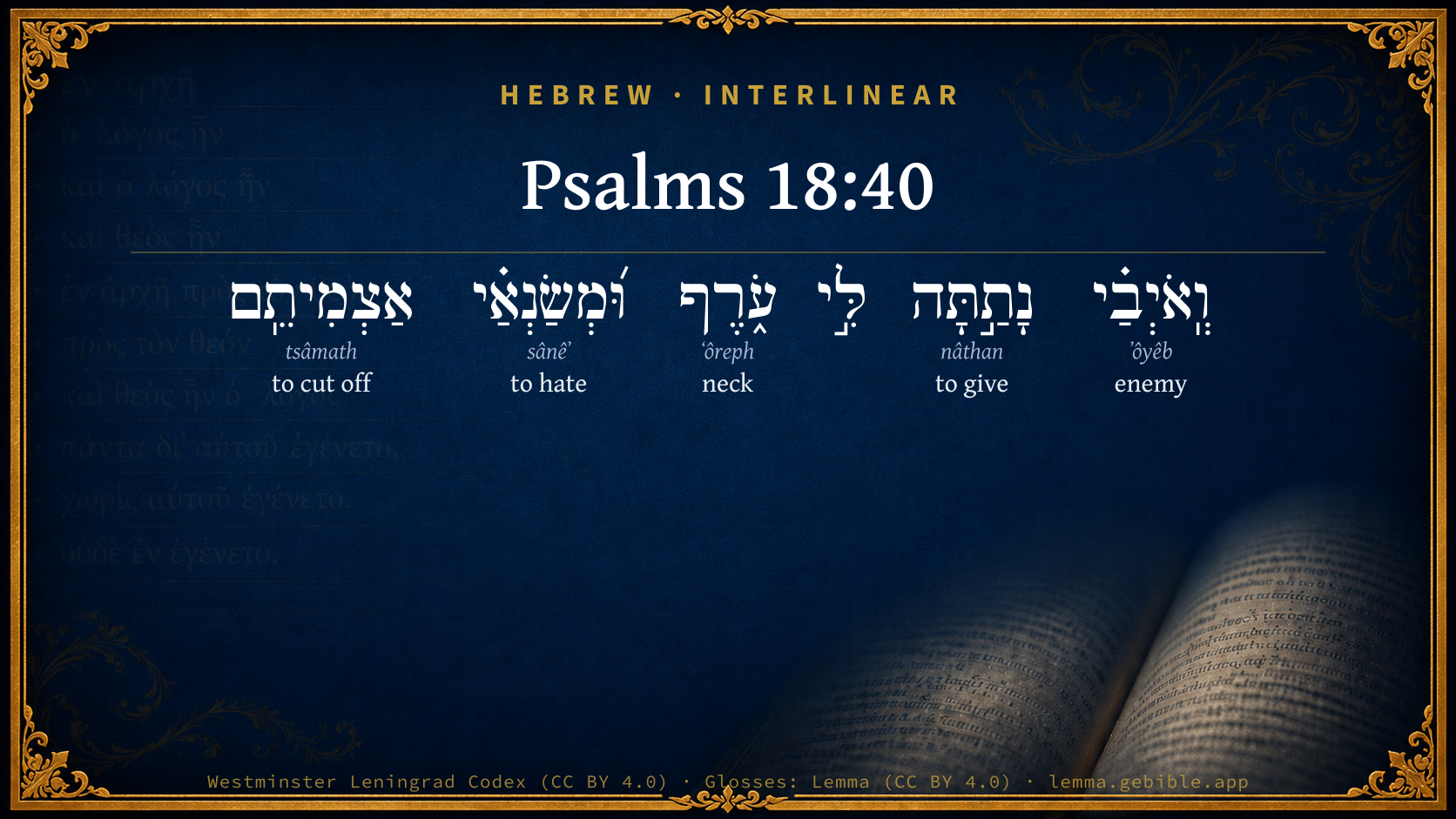
Psalms 18:40

Hebrew (Westminster Leningrad Codex) Psalms 18:40 appears in the Hebrew Old Testament. The text above is from the Westminster Leningrad Codex. Each word links to its Strong’s number, a concise gloss, and parsing drawn from the Open Scriptures Hebrew Bible morphology. Click any word for its full Brown-Driver-Briggs (BDB) entry.
Download image
Cite this verse

Psalms 18:40 (World English Bible). Public Domain. Lemma interlinear Bible study tool, https://lemma.gebible.app/v/psalms/18/40.

Show BibTeX & RIS
BibTeX
RIS
English Translation
You have also made my enemies turn their backs to me, That I might cut off those who hate me.
World English Bible · Public Domain
Download a study sheet

One document with this verse’s original text, its word-by-word gloss line, the meaning frame, cross-references with their text, attributed commentary, and full source and license credits — printable, and it pastes into notes with its structure intact.

This verse Autodidact and up

Study sheet (.html) Plain text (.txt)

A passage Seminary Student

Up to 50 verses in one chapter. A passage sheet keeps up to 6 commentary sources and 12 cross-references per verse, in the order this page ranks them, and says so on the sheet whenever that leaves anything out. Ask for a single verse and you get the Autodidact verse sheet above.

Everything on this page stays free to read, with no account — the sheet is a download of what is already on screen, not access to it.

Want to remove ads? Support Godless Engineer
Compare translations 3

The same verse in 3 English versions, stacked beneath the original-language interlinear above. Click any original word for its lexicon entry.

Each is an independent rendering of the whole verse — the interlinear is not word-aligned to these translations.

Highlighted words mark where these versions differ — a whole-verse word diff, not a word-by-word alignment.

  • World English Bible Public Domain
    You have also made my enemies turn their backs to me, That I might cut off those who hate me.
  • King James Version Public Domain
    Thou hast also given me the necks of mine enemies; that I might destroy them that hate me.
  • unfoldingWord Literal Text CC BY-SA 4.0
    And my enemies, you give to me the back of neck; the ones hating me, I destroyed them.

unfoldingWord Literal Text — © unfoldingWord, licensed CC BY-SA 4.0. Word-aligned USFM3 via Door43 (git.door43.org/unfoldingWord/en_ult).

Versions to compare (up to 4)

3 of 4 selected

Show all 18 translations

Every available English version of this verse, each an independent rendering of the whole verse.

  • World English Bible Public Domain
    You have also made my enemies turn their backs to me, That I might cut off those who hate me.
  • Berean Standard Bible Public Domain
    You have made my enemies retreat before me; I put an end to those who hated me.
  • Majority Standard Bible Public Domain
    You have made my enemies retreat before me; I destroyed those who hated me.
  • King James Version Public Domain
    Thou hast also given me the necks of mine enemies; that I might destroy them that hate me.
  • American Standard Version (1901) Public Domain
    Thou hast also made mine enemies turn their backs unto me, That I might cut off them that hate me.
  • Revised Version (1885) Public Domain
    Thou hast also made mine enemies turn their backs unto me, that I might cut off them that hate me.
  • Geneva Bible (1599) Public Domain
    And thou hast giuen me the neckes of mine enemies, that I might destroy them that hate me.
  • Douay-Rheims (1899) Public Domain
    And thou hast girded me with strength unto battle; and hast subdued under me them that rose up against me.
  • Young's Literal Translation Public Domain
    As to mine enemies -- Thou hast given to me the neck, As to those hating me -- I cut them off.
  • Literal Standard Version CC BY-SA 4.0
    As for my enemies—You have given to me the neck, || As for those hating me—I cut them off.
  • Unlocked Literal Bible CC BY-SA 4.0
    You gave me the back of my enemies' necks; I annihilated those who hated me.
  • unfoldingWord Literal Text CC BY-SA 4.0
    And my enemies, you give to me the back of neck; the ones hating me, I destroyed them.
  • Darby Bible Public Domain
    And mine enemies didst thou make to turn their backs unto me, and those that hated me I destroyed.
  • World Messianic Bible Public Domain
    You have also made my enemies turn their backs to me, that I might cut off those who hate me.
  • Webster's Bible Public Domain
    \\18:39\\For thou hast girded me with strength to battle: thou hast subdued under me those that rose up against me.
  • Free Bible Version CC BY-SA 4.0
    You made my enemies run away; I destroyed all my enemies.
  • Bible in Basic English Public Domain
    By you their backs are turned in flight, so that my haters are cut off.
  • JPS Tanakh (1917) Public Domain
    (18-41) Thou hast also made mine enemies turn their backs unto me, and I did cut off them that hate me.

Literal Standard Version (2020), Covenant Press — licensed CC BY-SA 4.0. Text via the HelloAO Bible API (eBible.org). Unlocked Literal Bible (unfoldingWord) — licensed CC BY-SA 4.0. Text via the HelloAO Bible API (eBible.org). unfoldingWord Literal Text — © unfoldingWord, licensed CC BY-SA 4.0. Word-aligned USFM3 via Door43 (git.door43.org/unfoldingWord/en_ult). Free Bible Version, Dr. Jonathan Gallagher — licensed CC BY-SA 4.0. Text via the HelloAO Bible API (eBible.org).

Word by word

More ways to search: Search by grammar → Find every occurrence → Compare this word →

Practice this passage: Drill this verse → Learn its vocabulary →

אַצְמִיתֵֽם
tsâmath
H6789
“to cut off · them”
Verb, Hiphil, Imperfect, 1st Person, Common, Singular + Suffix, Personal, 3rd Person, Masculine, Plural
Part of Speech
Verb
Stem
Hiphil
Form
Imperfect
Person
1st Person
Gender
Common
Number
Singular
Full BDB Definition

Origin: a primitive root

TWOT: 1932

to put an end to, cut off, destroy, exterminate, extirpate - (Qal) to put an end to, terminate - (Niphal) to be ended, be annihilated, be exterminated - (Piel) to put an end to - (Pilel) to be exterminated, be annihilated - (Hiphil) to exterminate, annihilate
  1. וְֽאֹיְבַ֗י ʼôyêb H341 “and · enemy · me” Conjunction + Verb, Qal, Participle Active, Masculine, Plural, Construct + Suffix, Personal, 1st Person, Common, Singular
  2. נָתַ֣תָּה nâthan H5414 “to give” Verb, Qal, Perfect, 2nd Person, Masculine, Singular
  3. עֹ֑רֶף ʻôreph H6203 “neck” Noun, Common, Masculine, Singular, Absolute
  4. וּ֝מְשַׂנְאַ֗י sânêʼ H8130 “and · hating · me” Conjunction + Verb, Piel, Participle Active, Masculine, Plural, Construct + Suffix, Personal, 1st Person, Common, Singular

About this verse

These counts appear in no published source. They are computed here, from the morphology-tagged text and Lemma’s own curated glosses. What Lemma adds →

6
words
5
distinct lemmas
Wisdom
section

Notable vocabulary

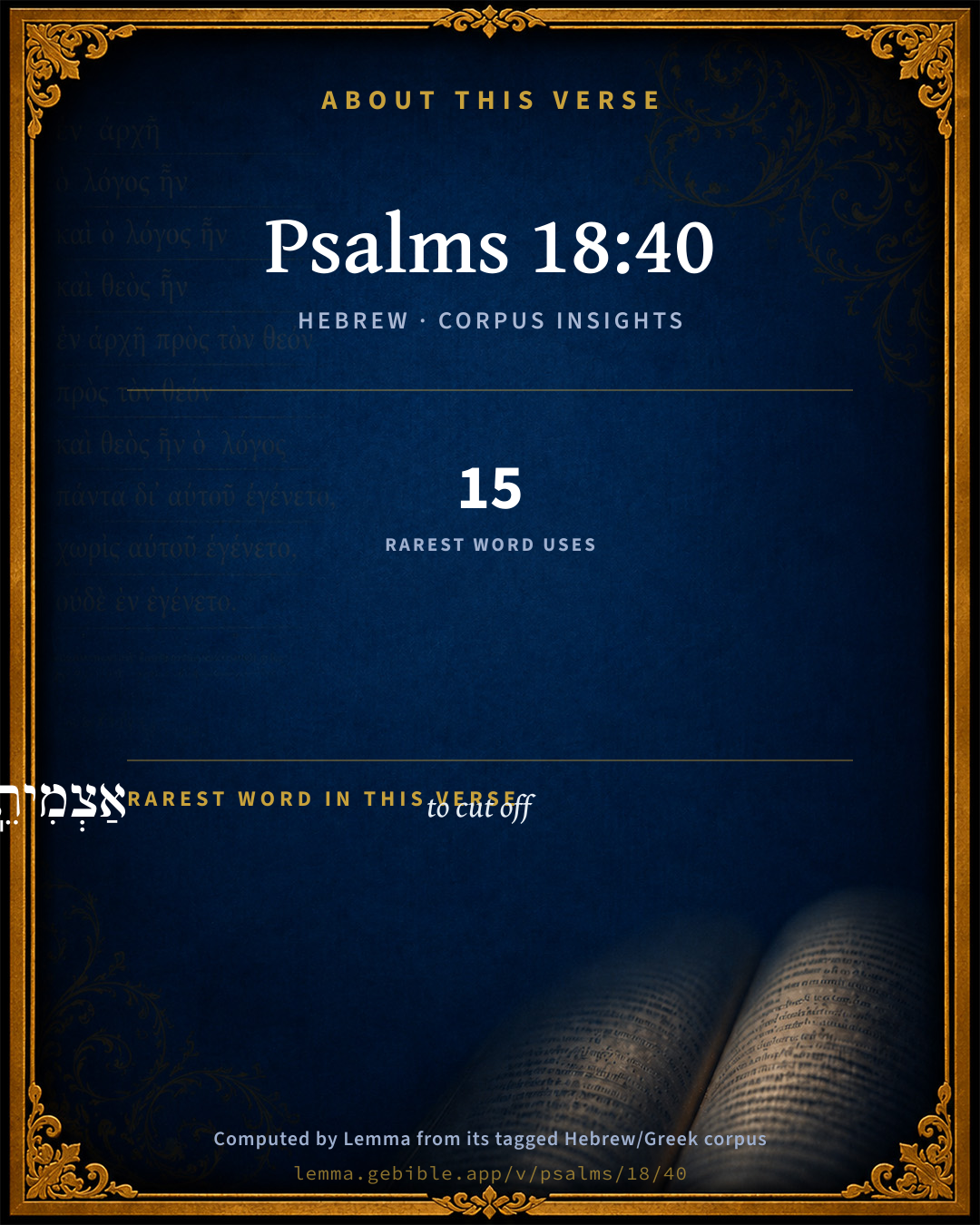
The rarest word here is אַצְמִיתֵֽם to cut off H6789 — appearing just 15 times in the whole Hebrew Bible.

Shared distinctive vocabulary

אַצְמִיתֵֽם to cut off H6789 occurs in 14 verses of the Hebrew Bible. Also found in:

Grammatical profile

  • 4 verbs
  • 1 noun
  • 1 preposition

Verb forms

  • וְֽאֹיְבַ֗י Qal · Participle Active
  • נָתַ֣תָּה Qal · Perfect
  • וּ֝מְשַׂנְאַ֗י Piel · Participle Active
  • אַצְמִיתֵֽם Hiphil · Imperfect

Hebrew & Septuagint length

In English translation the verse runs 20 words from the Hebrew and 19 from the Septuagint (LXX English) — closely comparable.

A rough comparison of the two English renderings, which tokenize alike — not a word-level alignment.

Word counts can differ between the Hebrew and the Greek without any difference in meaning — e.g. the Hebrew direct-object marker אֵת has no separate Greek word, and Greek often adds the article ὁ.

Cross-references

2

Topical passages linked to Psalms 18:40 in the Treasury of Scripture Knowledge — connected by theme and wording, ordered by reader-vote popularity; previews shown in the World English Bible.

  • Psalms 21:12 For you will make them turn their back, When you aim drawn bows at their face.
  • Psalms 94:23 He has brought on them their own iniquity, And will cut them off in their own wickedness. Yahweh, our God, will cut them off.

Cross-references courtesy of OpenBible.info (CC BY 4.0).

Hebrew and Greek witnesses Masoretic Hebrew ↔ Greek Septuagint

The same verse in the two great witnesses to the Old Testament, shown verse-for-verse.

You’re reading Greek Psalm 17 (Hebrew Psalm 18). The Septuagint counts the superscription, so verse numbers can differ from the Hebrew — chapter-level alignment, not verse-by-verse. Numbering follows Rahlfs.

These are two independent witnesses, not word-aligned to each other, and the Septuagint is shown in lemma (dictionary) form.

Hebrew Psalms 18:40 Masoretic · Westminster Leningrad Codex

וְֽאֹיְבַ֗י נָתַ֣תָּה לִּ֣י עֹ֑רֶף וּ֝מְשַׂנְאַ֗י אַצְמִיתֵֽם

You have also made my enemies turn their backs to me, That I might cut off those who hate me.

World English Bible · Public Domain

Greek LXX Greek Psalm 17:40 Septuagint · lemma form

καί περιζώννυμι ἐγώ δύναμις εἰς πόλεμος συνποδίζω πᾶς ὁ ἐπι ἀναἱστάνω ἐπί ἐγώ ὑποκάτω ἐγώ

And you have made my enemies turn their backs before me; and you have destroyed them that hated me.

LXX2012 (modern English Septuagint) · Public Domain

On this verse, Joseph Benson's Commentary discusses the Septuagint’s reading. Read the note in Commentary ↓

Hebrew: Westminster Leningrad Codex (CC BY 4.0). Greek: Septuagint (public domain); English from LXX2012 (modern English Septuagint) (Public Domain). How the Septuagint differs from the Hebrew →

Commentary

Notes on Psalms 18:40 from classic Christian and Jewish commentators (each source and its license shown beneath its notes). The classic Christian expositions comment on the surrounding passage and are grouped to its opening verse, so a note may address several verses; the Jewish commentaries on the Tanakh (Rashi and others) are per-verse, so they appear only where the commentator wrote on this verse.

Lemma curates 59 commentaries, every one of them public domain or Creative Commons licensed, each selected and text-cleaned for this edition rather than reprinted as found. About our sources →

Trapp's Complete Commentary

John Trapp

Psa 18:40 Thou hast also given me the necks of mine enemies; that I might destroy them that hate me.

Ver. 40. Thou hast given me the necks of mine enemies] sc. To chop them off at my pleasure; or to cut the throats.

John Trapp, A Commentary or Exposition upon All the Books of the Old and New Testament (1647–1656) — public domain. Text from a community e-Sword module.

Joseph Benson's Commentary

Psa 18:40-42. Thou hast given me the necks, &c. — That I might put my yoke upon their necks, or bring them into subjection. But Houbigant and some others render the clause, more agreeably to the Hebrew, As for my enemies, thou givest, or hast given, me their back: that is, hast made them turn their backs and flee from me. For the word ערŠ, gnoreph, here rendered neck, signifies the back part of the neck, and therefore is put for the back, as the LXX. translate it, and as it is rendered Exo 23:27; Jos 7:8; Jos 7:12, and elsewhere. That I might destroy them that hate me — That I might have opportunity to destroy them. They cried unto the Lord — He speaks of his Israelitish enemies, who in their distresses prayed to God for help against him. I did beat them small as dust — These are hyperbolical expressions, signifying that his enemies had been perfectly subdued, and deprived of all power to make any further resistance. I did cast them out as dirt, &c. — As the mire in the streets I trampled them down. — Chandler.

Joseph Benson's Commentary on the Old and New Testaments (1811–1818) — public domain. Text from a community e-Sword module.

J. A. Alexander on Psalms

Joseph Addison Alexander

41. (Psa 18:40). And my enemies—thou hast given to me the back—and my haters—I will destroy them. Each clause begins with an absolute nominative which might be rendered, as to my enemies, as to my haters. The remainder of the first clause is highly idiomatic in its form, and scarcely admits of an exact translation. The word translated back properly means the back of the neck, but is frequently used in such connections. The meaning of the whole phrase is, thou hast given me their back, i.e. made them to turn it towards me by putting them to flight. This is also a Mosaic form of speech. See Exo 23:27, and compare Jos 7:8, 2Ch 29:6. Psa 21:13 (12).

Joseph Addison Alexander, The Psalms Translated and Explained (1850) — public domain. Text from a community e-Sword module.

Tyndale Open Study Notes

Tyndale Open Resources

18:40 Placing a foot on the necks of the enemy represents total victory (see Josh 10:23-26).

Tyndale Open Study Notes — © Tyndale Open Resources, licensed CC BY-SA 4.0. Text via the HelloAO Bible API.

Geneva Bible (1599)

Geneva Bible translators

Thou hast given them into mine hands to be slain.

Geneva Bible (1599) marginal notes — public domain. Text via Bolls.life.

Jamieson, Fausset & Brown

Robert Jamieson, A. R. Fausset & David Brown

given me the necks--literally, "backs of the necks"; made them retreat (Exo 23:27; Jos 7:8).

Jamieson, Fausset & Brown — Commentary Critical and Explanatory on the Whole Bible (1871) — public domain (CC PDM 1.0). Text via the HelloAO Bible API.

Adam Clarke's Commentary

Verse 40. The necks of mine enemies] Thou hast made me a complete conqueror. Treading on the neck of an enemy was the triumph of the conqueror, and the utmost disgrace of the vanquished.

Adam Clarke's Commentary on the Bible (1810–1826) — public domain. Text from a community e-Sword/MySword module.

Ellicott's Commentary for English Readers

(40) Thou hast also given.—Literally, and as to mine enemies, thou gavest to me the back, which either means “turned to flight so that only their backs were visible” (Jer_18:17 and Psa_21:12), or alludes to the common symbolism of defeat—trampling on an enemy’s neck.

A Bible Commentary for English Readers, edited by Charles John Ellicott (1878–1897) — public domain. Text from a community e-Sword module.

The Cambridge Bible for Schools and Colleges

gen. ed. J. J. S. Perowne

40. Yea mine enemies hast thou made to turn their backs unto me,

And as for them that hated me, I cut them off.

The first line means that his enemies were put to flight before him Exo_23:27), not (as the A.V. seems to imply) that he planted his foot on their necks in token of triumph (Jos_10:24).

The Cambridge Bible for Schools and Colleges (gen. ed. J. J. S. Perowne; Cambridge University Press, 1878–1918) — public domain. Text from a community e-Sword module.

John Gill's Exposition

They cried, but there was none to save them,.... It is in Sa2 22:42; "they looked"; that is, they looked round about, here and there, to see if there were any near at hand to help and deliver them; they cried in their distress, and because of the anguish of their spirits, and for help and assistance, but in vain; they cried, as Jarchi thinks, to their idols, as Jonah's mariners cried everyone to their god; and, if so, it is no wonder there was none to save; for such are gods that cannot save: but it follows,

even unto the Lord, but he answered them not; as Saul, for instance, Sa1 28:6; so God deals with wicked men, often by way of righteous retaliation; see Pro 1:28.

John Gill's Exposition of the Whole Bible (1746–1763) — public domain (CC PDM 1.0). Text via the HelloAO Bible API.

Albert Barnes' Notes on the Bible

Thou hast also given me the necks of mine enemies - Their necks to tread upon, as the result of victory; or their necks to be subject to me, as the neck of the ox is to his owner. The phrase is sometimes used in this latter sense to denote subjection (compare Jer 27:12); but it is more commonly, when applied to war, used in the former sense, as denoting complete triumph or conquest. It was not uncommon to trample on the necks of those who were overcome in battle. See Jos 10:24; Eze 21:2; Gen 49:8. The word used here - ערף ‛ôreph - means properly neck, nape, the back of the neck; and hence, to give the neck means sometimes to turn the back, as in flight; and the phrase would admit of that meaning here. So Gesenius (Lexicon) understands it. So also DeWette: “Thou turnest my enemies to flight.” It seems to me, however, that the more probable interpretation is that of complete subjection - as when the conqueror places his foot on the necks of his foes. This is confirmed by the next member of the sentence, where the psalmist speaks of the complete destruction of those who hated him.

That I might destroy them that hate me - That have pursued and persecuted me in this manner. The idea is that of utterly overcoming them; of putting an end to their power, and to their ability to injure him.

Albert Barnes' Notes on the Bible (1834–1885) — public domain. Text from a community e-Sword/MySword module.

Matthew Poole's English Annotations

Either,

1. That I might smite or behead them. Or,

2. That I might put my yoke upon their necks, or bring them into subjection. Or rather thus, Thou hast made them turn their backs to me, i.e. flee away from me; for so this very phrase is used and rendered, Exo 23:27; Jos 7:8,12, and elsewhere. So far are they mistaken, that say this Hebrew word oreph is only used for the neck, and not for the back. That I might destroy them; that I might have opportunity to destroy them.

Matthew Poole's English Annotations on the Holy Bible (1683–1685) — public domain. Text from a community e-Sword/MySword module.

Whedon's Commentary on the Bible

Daniel D. Whedon

40. Given me the necks of mine enemies—To “turn the neck” in battle is to be put to flight. See Jos_7:8, where “backs” should read necks, so elsewhere. To put the foot upon the neck of an enemy denotes his complete and abject submission. Jos_10:24. See note on Psa_110:1

Daniel D. Whedon (gen. ed.), Commentary on the Old and New Testaments (1874–1909) — public domain. Text from a community e-Sword module.

The Pulpit Commentary

Thou hast also given me the necks of mine enemies; i.e. "thou hast made them turn their backs upon me in flight". (comp. Ex 23 Ex 27, where the same expression is used) That I might destroy them that hate me. David must not be supposed to speak from personal animosity. He expresses himself as the king of God"s people, bound to do his utmost to protect them, and to deliver them from the enemies who "hate" him only because he is the leader and champion of his countrymen. The neighbouring nations in David"s time seem to have been bent on the total extirpation of the Hebrew people.

The Pulpit Commentary (1880–1919), ed. H.D.M. Spence-Jones & Joseph S. Exell — public domain. Text from a community e-Sword module.

unfoldingWord translationNotes

Door43 World Missions Community

You gave me the back of my enemies' necks

This represents God giving David victory over his enemies. AT: "You gave me victory over my enemies" (See: Metonymy)

You gave me the back of my enemies' necks

This represents God giving David victory over his enemies. Possible images are 1) David could cut his enemies' heads off at the neck or 2) David could put his foot down on his enemies' necks or 3) David could see his enemies' backs when they ran away from him. (See: Metonymy)

I annihilated those who hated me

"I defeated those who hated me" or "I destroyed completely those who hated me"

but he did not answer them

This means Yahweh did not provide any help. AT: "but he did not help them" (See: Idiom)

I beat them into fine pieces like dust before the wind

The psalmists enemies are compared to dust to show how defeated they are. (See: Simile)

I threw them out like mud in the streets

The psalmist's enemies are compared to mud in the streets to show how defeated they are. (See: Simile)

translationWords

cry

save

Yahweh

unfoldingWord translationNotes — © Distant Shores Media and the Door43 World Missions Community, licensed CC BY-SA 4.0. Source: git.door43.org/Door43/en_tn.

Lesson kit

Teaching starters — assembled from the data on this page, not authored interpretation. Every prompt links to the verse data it draws on. Edit before teaching.

Psalms, in the Wisdom, opens this verse with 6 words (5 distinct Hebrew lemmas). Its most distinctive word is tsâmath (“to cut off”). A historical commentator’s framing appears above. Read the whole chapter for the surrounding context.

Discussion questions

  1. What does “to cut off” (tsâmath) contribute to the verse as a whole?
  2. How does 2 Samuel 22:41, which shares the word «to cut off», read alongside this verse?
  3. The translations on this page render this verse differently — a whole-verse word diff, not a word-by-word alignment. What might account for the different wordings?
  4. «וְֽאֹיְבַ֗י» is a Qal Participle Active verb. How does that grammatical form shape the action described?
  5. Compare how Trapp's Complete Commentary and Joseph Benson's Commentary read this verse. Where do they agree or differ?

Things to notice

Reading settings

Reading text

Shown beneath each verse's original-language words.

Old Testament
Old Testament edition

Read the OT as the Masoretic Hebrew (MT) or the Greek Septuagint (LXX).

English shown for the Greek Septuagint (in the Hebrew ↔ Greek comparison).

Comparing translations? Open the Compare panel on any verse page to stack up to four side by side.