
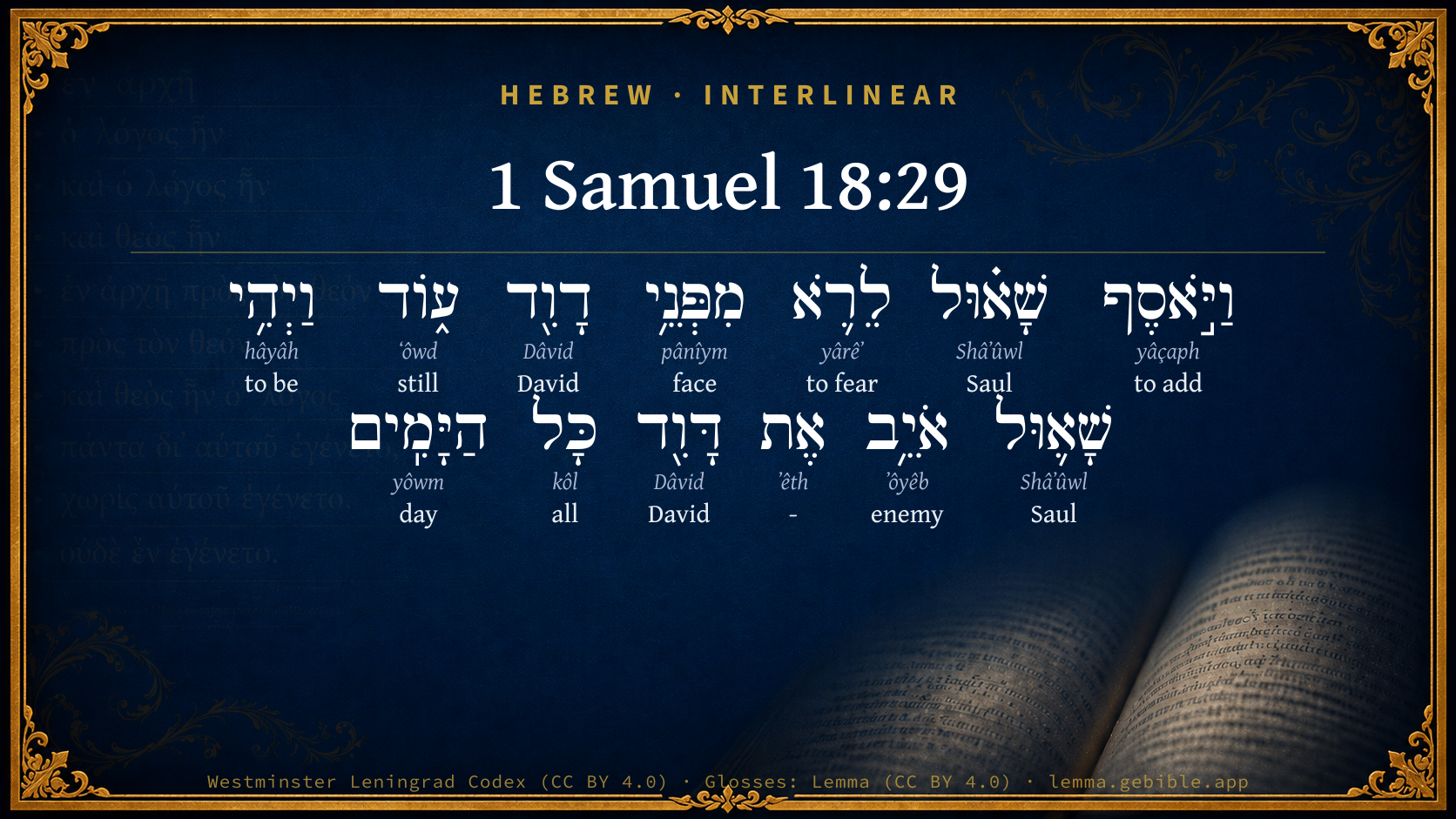
1 Samuel 18:29

Hebrew (Westminster Leningrad Codex) 1 Samuel 18:29 appears in the Hebrew Old Testament. The text above is from the Westminster Leningrad Codex. Each word links to its Strong’s number, a concise gloss, and parsing drawn from the Open Scriptures Hebrew Bible morphology. Click any word for its full Brown-Driver-Briggs (BDB) entry.
Download image
Cite this verse

1 Samuel 18:29 (World English Bible). Public Domain. Lemma interlinear Bible study tool, https://lemma.gebible.app/v/1-samuel/18/29.

Show BibTeX & RIS
BibTeX
RIS
English Translation
Saul was yet the more afraid of David; and Saul was David's enemy continually.
World English Bible · Public Domain
Download a study sheet

One document with this verse’s original text, its word-by-word gloss line, the meaning frame, cross-references with their text, attributed commentary, and full source and license credits — printable, and it pastes into notes with its structure intact.

This verse Autodidact and up

Study sheet (.html) Plain text (.txt)

A passage Seminary Student

Up to 50 verses in one chapter. A passage sheet keeps up to 6 commentary sources and 12 cross-references per verse, in the order this page ranks them, and says so on the sheet whenever that leaves anything out. Ask for a single verse and you get the Autodidact verse sheet above.

Everything on this page stays free to read, with no account — the sheet is a download of what is already on screen, not access to it.

Want to remove ads? Support Godless Engineer
Compare translations 3

The same verse in 3 English versions, stacked beneath the original-language interlinear above. Click any original word for its lexicon entry.

Each is an independent rendering of the whole verse — the interlinear is not word-aligned to these translations.

Highlighted words mark where these versions differ — a whole-verse word diff, not a word-by-word alignment.

  • World English Bible Public Domain
    Saul was yet the more afraid of David; and Saul was David's enemy continually.
  • King James Version Public Domain
    And Saul was yet the more afraid of David; and Saul became David's enemy continually.
  • unfoldingWord Literal Text CC BY-SA 4.0
    and Saul added to be more afraid from the face of David. And Saul was opposing David all of the days.

unfoldingWord Literal Text — © unfoldingWord, licensed CC BY-SA 4.0. Word-aligned USFM3 via Door43 (git.door43.org/unfoldingWord/en_ult).

Versions to compare (up to 4)

3 of 4 selected

Show all 18 translations

Every available English version of this verse, each an independent rendering of the whole verse.

  • World English Bible Public Domain
    Saul was yet the more afraid of David; and Saul was David's enemy continually.
  • Berean Standard Bible Public Domain
    he grew even more afraid of David. So from then on Saul was David’s enemy.
  • Majority Standard Bible Public Domain
    he grew even more afraid of David. So from then on Saul was David’s enemy.
  • King James Version Public Domain
    And Saul was yet the more afraid of David; and Saul became David's enemy continually.
  • American Standard Version (1901) Public Domain
    And Saul was yet the more afraid of David; and Saul was David's enemy continually.
  • Revised Version (1885) Public Domain
    And Saul was yet the more afraid of David; and Saul was David’s enemy continually.
  • Geneva Bible (1599) Public Domain
    Then Saul was more and more afrayde of Dauid, and Saul became alway Dauids enemie.
  • Douay-Rheims (1899) Public Domain
    And Saul began to fear David more: and Saul became David's enemy continually.
  • Young's Literal Translation Public Domain
    and Saul addeth to be afraid of the presence of David yet; and Saul is an enemy with David all the days.
  • Literal Standard Version CC BY-SA 4.0
    and Saul adds to be afraid of the presence of David still; and Saul is an enemy of David [for] all the days.
  • Unlocked Literal Bible CC BY-SA 4.0
    Saul was even more afraid of David. Saul was continually David's enemy.
  • unfoldingWord Literal Text CC BY-SA 4.0
    and Saul added to be more afraid from the face of David. And Saul was opposing David all of the days.
  • Darby Bible Public Domain
    And Saul was yet the more afraid of David; and Saul was David's enemy continually.
  • World Messianic Bible Public Domain
    Saul was even more afraid of David; and Saul was David’s enemy continually.
  • Webster's Bible Public Domain
    And Saul was yet the more afraid of David; and Saul became David's enemy continually.
  • Free Bible Version CC BY-SA 4.0
    and so he became even more afraid of David, and was David's enemy for the rest of his life.
  • Bible in Basic English Public Domain
    And Saul's fear of David became all the greater, and he went on hating him, day by day.
  • JPS Tanakh (1917) Public Domain
    And Saul was yet the more afraid of David; and Saul was David's enemy continually.

Literal Standard Version (2020), Covenant Press — licensed CC BY-SA 4.0. Text via the HelloAO Bible API (eBible.org). Unlocked Literal Bible (unfoldingWord) — licensed CC BY-SA 4.0. Text via the HelloAO Bible API (eBible.org). unfoldingWord Literal Text — © unfoldingWord, licensed CC BY-SA 4.0. Word-aligned USFM3 via Door43 (git.door43.org/unfoldingWord/en_ult). Free Bible Version, Dr. Jonathan Gallagher — licensed CC BY-SA 4.0. Text via the HelloAO Bible API (eBible.org).

Word by word

More ways to search: Search by grammar → Find every occurrence → Compare this word →

Practice this passage: Drill this verse → Learn its vocabulary →

וַיֹּ֣אסֶף
yâçaph
H3254
“and · to add”
Conjunction + Verb, Hiphil, Sequential Imperfect, 3rd Person, Masculine, Singular
Part of Speech
Conjunction + Verb
Stem
Hiphil
Form
Sequential Imperfect
Person
3rd Person
Gender
Masculine
Number
Singular
Full BDB Definition

Origin: a primitive root

TWOT: 876

to add, increase, do again - (Qal) to add, increase, do again - (Niphal) - to join, join oneself to - to be joined, be added to - (Hiphil) - to cause to add, increase - to do more, do again
  1. שָׁא֗וּל Shâʼûwl H7586 “Saul” Noun, Proper
  2. לֵרֹ֛א yârêʼ H3372 “to fear” Preposition + Verb, Qal, Infinitive Construct
  3. מִפְּנֵ֥י pânîym H6440 “from · face(s) of” Preposition + Noun, Common, Both, Plural, Construct
  4. דָוִ֖ד Dâvid H1732 “David” Noun, Proper
  5. ע֑וֹד ʻôwd H5750 “still” Adverb
  6. וַיְהִ֥י hâyâh H1961 “and · to be” Conjunction + Verb, Qal, Sequential Imperfect, 3rd Person, Masculine, Singular
  7. שָׁא֛וּל Shâʼûwl H7586 “Saul” Noun, Proper
  8. אֹיֵ֥ב ʼôyêb H341 “enemy” Verb, Qal, Participle Active, Masculine, Singular, Absolute
  9. אֶת ʼêth H853 “-” Particle, Direct Object
  10. דָּוִ֖ד Dâvid H1732 “David” Noun, Proper
  11. כָּל kôl H3605 “all of” Noun, Common, Masculine, Singular, Construct
  12. הַיָּמִֽים yôwm H3117 “the · days” Particle, Definite Article + Noun, Common, Masculine, Plural, Absolute

About this verse

These counts appear in no published source. They are computed here, from the morphology-tagged text and Lemma’s own curated glosses. What Lemma adds →

13
words
11
distinct lemmas
Historical
section

Grammatical profile

  • 4 verbs
  • 7 nouns
  • 1 adverb
  • 1 particle

Verb forms

  • וַיֹּ֣אסֶף Hiphil · Sequential Imperfect
  • לֵרֹ֛א Qal · Infinitive Construct
  • וַיְהִ֥י Qal · Sequential Imperfect
  • אֹיֵ֥ב Qal · Participle Active

Repetition

Words recur within this verse — often emphatic in Hebrew:

  • שָׁא֗וּל Saul H7586 ×2
  • דָוִ֖ד David H1732 ×2

Hebrew & Septuagint length

In English translation the verse runs 14 words from the Hebrew and 8 from the Septuagint (LXX English) — the Septuagint runs noticeably shorter here. See the side-by-side →

A rough comparison of the two English renderings, which tokenize alike — not a word-level alignment.

Word counts can differ between the Hebrew and the Greek without any difference in meaning — e.g. the Hebrew direct-object marker אֵת has no separate Greek word, and Greek often adds the article ὁ.

Cross-references

8

Topical passages linked to 1 Samuel 18:29 in the Treasury of Scripture Knowledge — connected by theme and wording, ordered by reader-vote popularity; previews shown in the World English Bible.

  • Ecclesiastes 4:4 Then I saw all the labor and achievement that is the envy of a man's neighbor. This also is vanity and a striving after wind.
  • Genesis 4:4–8 Abel also brought some of the firstborn of his flock and of the fat of it. Yahweh respected Abel and his offering,
  • 1 Samuel 18:12 Saul was afraid of David, because Yahweh was with him, and was departed from Saul.
  • 1 Samuel 18:15 When Saul saw that he behaved himself very wisely, he stood in awe of him.
  • Psalms 37:12–14 The wicked plots against the just, And gnashes at him with his teeth.
  • John 11:53 So from that day forward they took counsel that they might put him to death.
  • James 2:19 You believe that God is one. You do well. The demons also believe, and shudder.
  • 1 John 3:12–15 unlike Cain, who was of the evil one, and killed his brother. Why did he kill him? Because his works were evil, and his brother's righteous.

Cross-references courtesy of OpenBible.info (CC BY 4.0).

Hebrew and Greek witnesses Masoretic Hebrew ↔ Greek Septuagint

The same verse in the two great witnesses to the Old Testament, shown verse-for-verse.

Here the Septuagint runs noticeably shorter than the Hebrew — LXX2012 (modern English Septuagint) 8 words vs World English Bible 14. A rough length comparison of the two English translations, not a word-level alignment — read both below.

These are two independent witnesses, not word-aligned to each other, and the Septuagint is shown in lemma (dictionary) form.

Hebrew 1 Samuel 18:29 Masoretic · Westminster Leningrad Codex

וַיֹּ֣אסֶף שָׁא֗וּל לֵרֹ֛א מִפְּנֵ֥י דָוִ֖ד ע֑וֹד וַיְהִ֥י שָׁא֛וּל אֹיֵ֥ב אֶת דָּוִ֖ד כָּל הַיָּמִֽים

Saul was yet the more afraid of David; and Saul was David's enemy continually.

World English Bible · Public Domain

Greek LXX 1 Samuel 18:29 Septuagint · lemma form
And he was yet more afraid of David.

LXX2012 (modern English Septuagint) · Public Domain

Hebrew: Westminster Leningrad Codex (CC BY 4.0). Greek: Septuagint (public domain); English from LXX2012 (modern English Septuagint) (Public Domain). How the Septuagint differs from the Hebrew →

Targum (Aramaic paraphrase)

1

The Targum is the ancient Jewish Aramaic paraphrase of the Hebrew Scriptures — an interpretive translation, not the Hebrew text itself. Onkelos (literal) and Pseudo-Jonathan (expansive) render the Torah, and Jonathan the Prophets. Coverage is partial: where no permissively-licensed English translation exists for a verse, only the Aramaic is shown. This is verse-level text, not a word-by-word alignment to the Hebrew.

  1. Targum Jonathan Prophets (Joshua–Malachi)
    וְאוֹסִיף שָׁאוּל לְמִדְחַל מִן קֳדָם דָוִד עוֹד וַהֲוָה שָׁאוּל בְּעֵיל דְבַב לְדָוִד כָּל יוֹמַיָא:

    (no public-domain English translation for this verse)

    Targum Jonathan — Aramaic: “Mikraot Gedolot” (public domain). English: “Sefaria Community Translation” (CC0 1.0 (public-domain dedication)); “London "Chaldee Paraphrase," 1871” (public domain). Text via Sefaria.

Commentary

Notes on 1 Samuel 18:29 from classic Christian and Jewish commentators (each source and its license shown beneath its notes). The classic Christian expositions comment on the surrounding passage and are grouped to its opening verse, so a note may address several verses; the Jewish commentaries on the Tanakh (Rashi and others) are per-verse, so they appear only where the commentator wrote on this verse.

Lemma curates 59 commentaries, every one of them public domain or Creative Commons licensed, each selected and text-cleaned for this edition rather than reprinted as found. About our sources →

Trapp's Complete Commentary

John Trapp

1Sa 18:29 And Saul was yet the more afraid of David; and Saul became David’s enemy continually.

Ver. 29. And Saul was yet the more afraid.] As considering that this marriage with his daughter would be a fair step to the kingdom.

John Trapp, A Commentary or Exposition upon All the Books of the Old and New Testament (1647–1656) — public domain. Text from a community e-Sword module.

The Biblical Illustrator

Joseph S. Exell

1Sa_18:29

And Saul became Davids enemy continually.

The evil of enmity

1. The possible doings of one sinful feeling. Jealousy was first awakened in the heart of Saul on that day when Hebrew females sung the praises of the young conqueror of Goliath. Jealousy is cruel as the grave. So it proved. At that moment when the dark feeling rose to consciousness it might not seem as if the new guest were endowed with any special capacities. But it soon swelled out to a proportion which dwarfed and overshadowed all the rest. What tremendous energies of evil lurk in our fallen natural. If God judicially let one slip, and cease to hedge it round with inward remonstrances and providential restraints, it will quickly grow to a tyranny beyond resistance, that shall desolate the soul, and sweep away before it the scruples of conscience, the dictates of prudence, the lingering power of affection, friendly counsels, and the pleadings of honour, interest, or decency. Oh, there are within us materials enough to make earthquakes and volcanoes of the soul! Let us pray that they be not set on fire of hell. Think not that you are not in danger because neither Sauls circumstances nor special tendencies are yours. Jealousy is one of a gang. Envy, pride, lust, intemperance, love of money, are notorious confederates. They operate singly or in company. Often quarrelling, they are horribly unanimous in destroying the souls purity and joy. O for Heavens healing hand to keep them down, to preserve the soul in holy equipoise, to stablish it in self-governing power, and impel it by restraining love.

2. The reality of an invisible power of evil. This is affirmed plainly and frequently. The Spirit of the Lord departed from Saul, and an evil spirit from the Lord troubled him. The Holy Spirit who had been striving with him for good was provoked away. His deserted soul was occupied by an evil spirit. And how untiring! The foul and cruel inspiration was no passing breath. It prompted many efforts. It suggested many varieties of operation. It absorbed all other energies into one lordly passion. And all this is sustained for years, in growing power, in spite of many obstacles. How awful this persistent malevolence! O what shall break the spell of this terrible witchery? Who shall put an end to this terrible possession? What power shall awaken fear, and bestow a scrupulous caution, and inspire a holy ardour to be free from the galling thraldom, and endow with a holy strength to resist it and to shut up all those avenues of indulgence through which on-waiting spirits of evil issue from their dwelling of darkness! Thanks be unto God, which giveth us the victory through our Lord Jesus Christ. He hath destroyed the works of the devil.

3. The beautiful character to which Divine grace can frame the human soul. I suppose it will be regarded as sober truth to say that the worlds annals present no parallel to the character which the great persecution developes in David. Whence came that marvellous self-government, which kept him equally from despair and violence? The power that girt up all his faculties was from above. Men speak of virtue and its endurance, of heroism and its daring deeds. Both are good--but in the balance of the sanctuary they are electroplate, and nothing more. To be even ideally complete, a human character must have godliness as its central power. Practically to reach the highest level of what men call the virtues is impossible without the mighty presence of supreme regard to God, maintained by His own quickening Spirit. This it was that nerved the heart of the Hebrew outlaw with an enduring vigour that bore him on amid floods of sorrow, and formed his heart to a fortitude beside which the models of Greece and Rome look dim. Did ever Stoic endure so much with meekness so conspicuous? Did ever Epicurean show a sensibility so delicate and so pure as that which wept on the neck of Jonathan? Did the worlds men of honour ever spare an enemy as David did the tyrant who thirsted for his blood? I trow not. Such triumphs of noble feeling are wrought only by heavenly grace.

4. The opposition between the Church and the World. It will not be questioned that Saul belonged to the latter and David to the former. Nor, on reflection, will it be doubted that this is the secret of Sauls irreconciliable enmity. The two are ranged on opposite sides. Grace would have quenched the smouldering embers of jealousy. Had the feeling not been rooted in an unsanctified nature, prayer and pains would have dug it up to wither on the surface. And in the bitter, impious and unrelenting nature of this persecution we may see mirrored forth in fearful clearness the worlds irreconciliable opposition to the Church. The circumstances of Saul give us the advantage of seeing this feeling honestly displayed. He did not fear God; and as an absolute monarch he did not need to regard men. But, one way or other, the body of believers may count on meeting the worlds opposition, aye and until the conflict ceases by the everlasting separation of the parties. Every step of her earthly way lies through a wilderness haunted by enemies, whose hostility is sincere and operative, whether they strive to corrupt her like Midian, or meet her boldly with the Amorite.

5. Gods benignant care of His people. To one who looked only on the surface, and took into view nothing more than ordinary human probabilities, it would no doubt have appeared a hopeless folly for David to seek escape from Saul. A private man against a king; a Solitary man against one who had a nations forces at his back; a scrupulous man, whose conscience forbad violent resistance, against a reckless man, under the impulse of an over-mastering passion. Davids life lay constantly in the vicinity of death. He walked as if on a narrow ledge, over a frowning gulf. That he was preserved from falling is attributable to nothing but an over-ruling care which could not be surprised, defeated, or wearied out. Almighty energy, working in the service of love, wove the tangled texture of events round the living David, and secured his perfect safety. (P. Richardson, B. A.)

.

The Biblical Illustrator, edited by Joseph S. Exell (c. 1880s–1900s) — public domain. Text from a community e-Sword module.

Tyndale Open Study Notes

Tyndale Open Resources

18:29 even more afraid: Saul’s fear was unfounded. Although he made himself David’s enemy, David consistently honored Saul as king (see chs 24, 26).

Tyndale Open Study Notes — © Tyndale Open Resources, licensed CC BY-SA 4.0. Text via the HelloAO Bible API.

Geneva Bible (1599)

Geneva Bible translators

To be deprived of his kingdom.

Geneva Bible (1599) marginal notes — public domain. Text via Bolls.life.

Jamieson, Fausset & Brown

Robert Jamieson, A. R. Fausset & David Brown

Saul was yet the more afraid of David--because Providence had visibly favored him, by not only defeating the conspiracy against his life, but through his royal alliance paving his way to the throne.

Next: 1 Samuel Chapter 19

Jamieson, Fausset & Brown — Commentary Critical and Explanatory on the Whole Bible (1871) — public domain (CC PDM 1.0). Text via the HelloAO Bible API.

John Gill's Exposition

And Saul was yet the more afraid of David,.... Because the Lord was with him, and his wife loved him; so that he feared he should never be able to accomplish his designs, and that this marriage, which he intended as the means of his ruin, would pave the way for his ascending the throne:

and Saul became David's enemy continually; was every day giving fresh evidence of his enmity against him; before it was by fits, and at certain times, there were some intervals; but now enmity was rooted and habituated, and was constant and continually showing itself.

John Gill's Exposition of the Whole Bible (1746–1763) — public domain (CC PDM 1.0). Text via the HelloAO Bible API.

Matthew Poole's English Annotations

Because he both lost his design against David’s life, and had now paved a way for him to the throne.

Matthew Poole's English Annotations on the Holy Bible (1683–1685) — public domain. Text from a community e-Sword/MySword module.

Whedon's Commentary on the Bible

Daniel D. Whedon

29. Saul became David’s enemy continually — By the circumstances here recorded the king’s enmity became deep and settled, and the historian has thus prepared the way for his readers to understand the further history of Saul’s conduct towards David.

Daniel D. Whedon (gen. ed.), Commentary on the Old and New Testaments (1874–1909) — public domain. Text from a community e-Sword module.

The Pulpit Commentary

Vers. 29, 30.

David proved and tried.

I EXEMPLARY CONDUCT UNDER TRIAL. One can hardly imagine a course of events more likely to turn a young man"s head and make him giddy with elation than the rapid promotion of the youthful David. Brought at once from comparative obscurity into the full blaze of public admiration as a national hero, appointed as an officer of high rank in the army, made son-in-law to the king, and at the same time trusted and honoured by the people, the son of Jesse had much to tempt him to self-complacence. It is a sign that the Lord was with him that he bore himself meekly, circumspectly, and with "sublime repression of himself." A man who is conscious of fitness for a great position can afford to wait. It must come to him, if he lives long enough; and if he is not to live, why should he fret his few years with an idle ambition? David had something better than such a consciousness; he knew himself to be anointed and ordained of God to fill an eminent place in his service. True, that nothing seems to have been said about the kingship at the private anointing in Bethlehem; and David"s gift of sacred song seemed to point him out as successor of Samuel rather than of Saul. But kings, not prophets, were anointed; and the thought of being king, especially after the exploit at Elah, must have passed and repassed through the young hero"s mind. Yet because he believed God he did not make haste. If the high and perilous seat of a king of Israel was destined for him, let it come; but he would not grasp it, or climb into it by dispossessing its first occupant. Not by him would Saul be dethroned, or any dishonour done to a head which had received a holy anointing. God would give what he pleased, as and when he might see fit. Enough that David should act wisely and justly in the station to which he was assigned. This was no fatalism. The history shows that David used all lawful (and some rather questionable) endeavours to preserve his own life, and that he missed no opportunity to advance his public interest. He was far from inferring that, as God had marked out for him a destiny, he must not give any heed to his way or to his safety, because God would bring his own purpose to pass. On the contrary, he knew that the fulfilment of the destiny must be through his own discretion, valour, and proved fitness for the royal dignity. Therefore, while David would not push his way ambitiously to the throne, he was careful to do nothing that would make such promotion impossible. In fact David took the course which may be recommended to every young man who desires to rise in the esteem and confidence of others. He did well whatever was given him to do. He behaved himself wisely as a minstrel, as a soldier, as a prince. The historian marks the steps of his advance "wisely," "very wisely," "more wisely than all the servants of Saul" (vers. 14, 15, 30). If we read "prospered," "prospered exceedingly," prospered more, the lesson remains the same. We are reminded of the youthful Joseph, always prosperous in administration, whether in Potiphar"s house, in charge of the prison, or in the government of Egypt. It was because the Lord was with him. (Gen_39:2, Gen_39:23) Yet the promotion of Joseph was through his well approved discretion and fidelity winning for him more and more confidence. (Ge 39) So David prospered; every step of his elevation bringing out more clearly to view his fine combination of boldness and discretion, and his consequent fitness to rise yet higher, and to be the leader and ruler of all Israel. Happy the nation where such proved fitness counts for more than the highest birth or the strongest interest! If survival of the fittest be a rule in nature, selection of the fittest is the true principle for the public service. Not that every one who holds an inferior position well is fit to hold a higher and rise toward the highest. Men have their range, beyond which they are ill at ease and incapable. But this is certain, that men who ale fit for a leading position will reveal their capacity while serving in a subordinate place. Only in judging of this account must be taken not of brain power and acquired knowledge merely, but of character, and that moral influence which character and conduct give. Is it not on this principle that God promotes the heirs of glory? All who have received his grace are anointed ones; but they have to serve before they rule, and to be tested in labours and patience before they can reign with Christ. Has not our Saviour taught in parables that his people must be servants till he returns, and that only good and faithful servants are to enter into the joy of their Lord? Has not St. Paul spoken of eternal life as given to those "who by patient continuance in well doing seek for glory, honour, and immortality"? Behold the way to "the honour that comes from God only." Behave wisely in the present sphere of duty. Do well, and do it with patience. Make not your advancement in this world, or even in the world to come, a matter of passionate anxiety. Foster and obey the sense of duty, attend conscientiously to the obligations of your present station, and fear not but the Lord will give you as much elevation as is good for you in this present time, and in the age to come a place and a portion with the King and with his saints.

II THE IMPRESSION WHICH DAVID PRODUCED.

1. On the people. They were captivated by his gallantry and his discretion. Both in martial skill and in civil administration he surpassed all the public men of his country, and was fast becoming a popular idol. It is too true that, notwithstanding this, Saul was able to drive him into exile, and found soldiers enough to pursue him for his life. Popular favour did not protect him from such outrage. Yet two facts are worth noting.

(1) That David gave clear evidence of a man who could, and therefore should, sooner or later, lead his countrymen. This early approval of himself to all observers, however obscured or disparaged during the days of his persecution, was not forgotten by the people, and helped his ultimate elevation to the throne.

(2) That, though many turned against him at the bidding of Saul, David from this very time drew to himself friends that would not forsake him, for they saw in him the hope of Israel; and, following him to the caves among the rocks of Judah, and even to the land of the Philistines, were the companions, first of his tribulation, and then of his kingdom and glory.

2. On the king. The effect of David"s well doing on Saul was sinister and shameful. The good points which had once appeared in this unhappy man now recede from view, and the bad points of his character come out in strong relief under the baleful influence of jealousy. When he was himself the sole hero, and the eyes of all Israel turned to him, he could be gracious and even humble in his bearing. But elevation had made him proud; power had made him wilful; and a bad conscience made him hate and fear a well doer near the throne. He felt that this youth from Bethlehem was far the better man, and he suspected that the nation thought so too. Envy completed the moral ruin of Saul. As the worm seeks out the best fruit to eat the heart of it, so envy fastens on the best and noblest persons to hate and hurt them. It goes by quick steps to injury even to murder. "Saul spake to Jonathan his son, and to all his servants, that they should kill David." O cursed envy! O hideous ingratitude! O foul and furious jealousy!

III THE TREATMENT OF JESUS CHRIST FORSHADOWED. The Son of David lived unblamably, answered discreetly, behaved himself wisely. The people gathered to him in multitudes, with eyes and ears of admiration. They judged him worthy to be made their king. It is true that the fickle populace took part with their rulers against our Lord, just as the fickle subjects of Saul took part with him against the son of Jesse. But, in the one case as in the other, some hearts clave to the persecuted One. And as all the malice that pursued David failed to keep him from the kingdom to which God had destined him and for which God had fitted him, so the rejection, betrayal, and crucifixion of Jesus could not keep him from the throne far above all principality and power which was his in virtue of an eternal covenant. The rulers bated him without a cause; his very wisdom and goodness irritated them, and they took counsel together how they might slay him. For envy they delivered him up to judgment, and demanded that he should be crucified. At the period described in our text a crisis had arrived in Israel. Men were forced to choose between Saul and David, for these were contrary the one to the other, and could not live in unity. We know what side such a man as Doeg took. But David had his friends, who dared everything rather than renounce his cause. Better, in their opinion, to be exiles and pilgrims with him than to remain with the moody tyrant from whom the Lord had departed. So, in the days of his showing to Israel, many refused Jesus, but some clave to him. Better, in their opinion, to be cast out of the synagogues, to go forth without the gate, bearing his reproach, than to take part with the world that hated him, especially with that hard and gloomy Judaism from which the Lord had departed. The crisis continues. Before all men the alternative lies for Christ, or against him. Oh, receive him whom the world has rejected; give him your hearts; identify and associate yourselves with the "once despised Jesus. F.

The Pulpit Commentary (1880–1919), ed. H.D.M. Spence-Jones & Joseph S. Exell — public domain. Text from a community e-Sword module.

Rashi

Rabbi Shlomo Yitzchaki (Rashi)

To fear. To fear.

Rashi on the Tanakh — English translations: “The Judaica Press complete Tanach with Rashi, translated by A. J. Rosenberg” (CC BY 4.0); “Pentateuch with Rashi's commentary by M. Rosenbaum and A.M. Silbermann, 1929-1934” (public domain); “The Metsudah Tanach series, Lakewood, N.J” (CC BY 4.0); and “The Book of Joshua, Metsudah Publications, 1997” (CC BY 4.0). Text via Sefaria.

Lesson kit

Teaching starters — assembled from the data on this page, not authored interpretation. Every prompt links to the verse data it draws on. Edit before teaching.

1 Samuel, in the Historical, opens this verse with 13 words (11 distinct Hebrew lemmas). Its most distinctive word is yâçaph (“to add”). The Greek Septuagint runs shorter here. A historical commentator’s framing appears above. Read the whole chapter for the surrounding context.

Discussion questions

  1. What does “to add” (yâçaph) contribute to the verse as a whole?
  2. Ecclesiastes 4:4 shares this passage’s theme. How do the two illuminate each other?
  3. “Saul” occurs 2× in this one verse. What is the effect of the repetition?
  4. Compared with the Hebrew, the Septuagint runs shorter here. What questions does that raise?
  5. These translations render this verse differently. What is at stake in choosing one wording over another?
  6. The verb «וַיֹּ֣אסֶף» is Hiphil Sequential Imperfect. How does its form color the action?
  7. Reading how Trapp's Complete Commentary and The Biblical Illustrator read this verse, where do the two commentators agree and where do they part?

Things to notice

Reading settings

Reading text

Shown beneath each verse's original-language words.

Old Testament
Old Testament edition

Read the OT as the Masoretic Hebrew (MT) or the Greek Septuagint (LXX).

English shown for the Greek Septuagint (in the Hebrew ↔ Greek comparison).

Comparing translations? Open the Compare panel on any verse page to stack up to four side by side.