
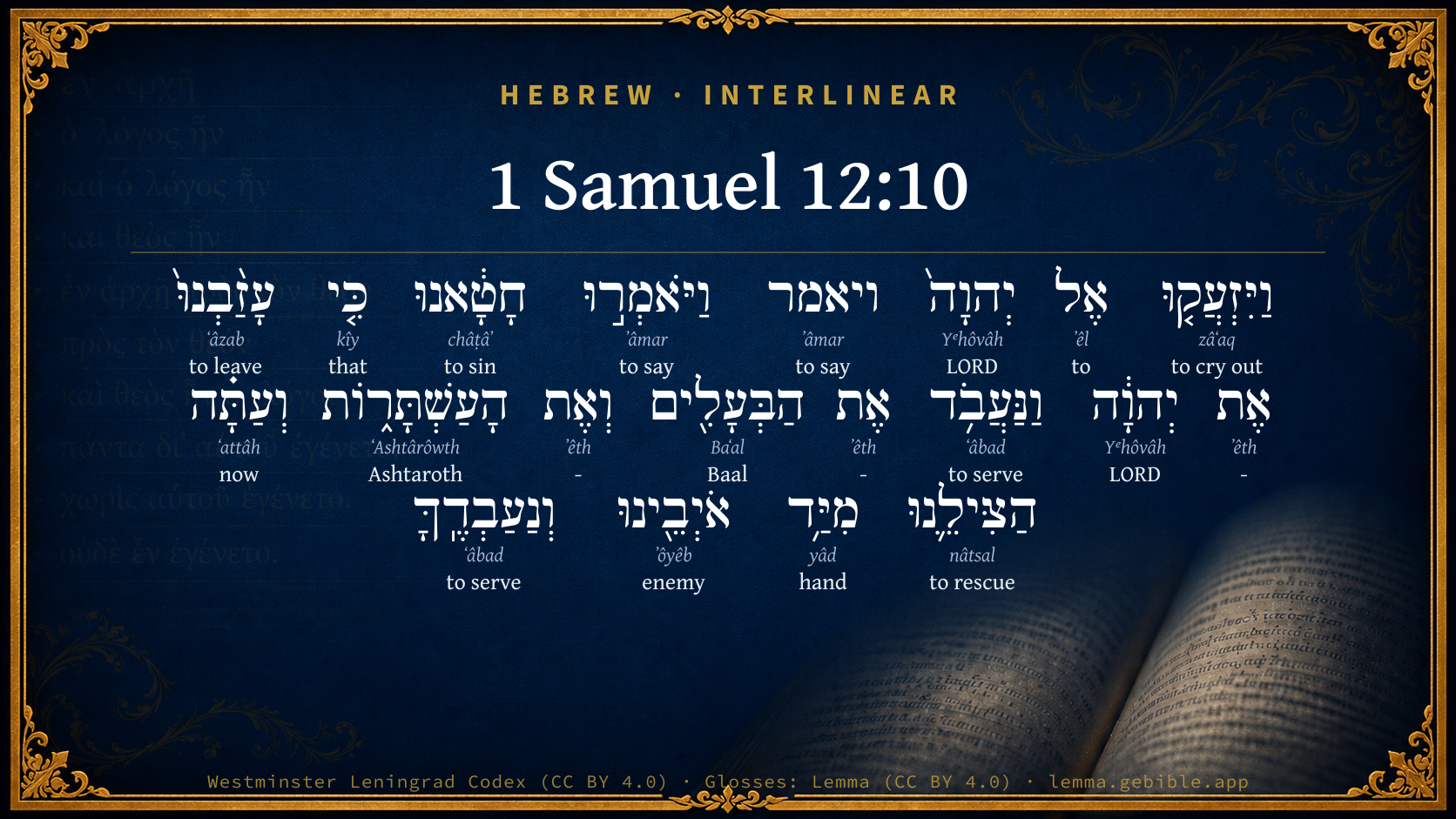
1 Samuel 12:10

Hebrew (Westminster Leningrad Codex) 1 Samuel 12:10 appears in the Hebrew Old Testament. The text above is from the Westminster Leningrad Codex. Each word links to its Strong’s number, a concise gloss, and parsing drawn from the Open Scriptures Hebrew Bible morphology. Click any word for its full Brown-Driver-Briggs (BDB) entry.
Download image
Cite this verse

1 Samuel 12:10 (World English Bible). Public Domain. Lemma interlinear Bible study tool, https://lemma.gebible.app/v/1-samuel/12/10.

Show BibTeX & RIS
BibTeX
RIS
English Translation
They cried to Yahweh, and said, We have sinned, because we have forsaken Yahweh, and have served the Baals and the Ashtaroth: but now deliver us out of the hand of our enemies, and we will serve you.
World English Bible · Public Domain
Download a study sheet

One document with this verse’s original text, its word-by-word gloss line, the meaning frame, cross-references with their text, attributed commentary, and full source and license credits — printable, and it pastes into notes with its structure intact.

This verse Autodidact and up

Study sheet (.html) Plain text (.txt)

A passage Seminary Student

Up to 50 verses in one chapter. A passage sheet keeps up to 6 commentary sources and 12 cross-references per verse, in the order this page ranks them, and says so on the sheet whenever that leaves anything out. Ask for a single verse and you get the Autodidact verse sheet above.

Everything on this page stays free to read, with no account — the sheet is a download of what is already on screen, not access to it.

Want to remove ads? Support Godless Engineer
Compare translations 3

The same verse in 3 English versions, stacked beneath the original-language interlinear above. Click any original word for its lexicon entry.

Each is an independent rendering of the whole verse — the interlinear is not word-aligned to these translations.

Highlighted words mark where these versions differ — a whole-verse word diff, not a word-by-word alignment.

  • World English Bible Public Domain
    They cried to Yahweh, and said, We have sinned, because we have forsaken Yahweh, and have served the Baals and the Ashtaroth: but now deliver us out of the hand of our enemies, and we will serve you.
  • King James Version Public Domain
    And they cried unto the LORD, and said, We have sinned, because we have forsaken the LORD, and have served Baalim and Ashtaroth: but now deliver us out of the hand of our enemies, and we will serve thee.
  • unfoldingWord Literal Text CC BY-SA 4.0
    Then they cried out to Yahweh and said, ‘We have sinned, for we have forsaken Yahweh and have served the Baals and the Ashtoreths. And now, deliver us from the hand of our enemies, and we will serve you.’

unfoldingWord Literal Text — © unfoldingWord, licensed CC BY-SA 4.0. Word-aligned USFM3 via Door43 (git.door43.org/unfoldingWord/en_ult).

Versions to compare (up to 4)

3 of 4 selected

Show all 18 translations

Every available English version of this verse, each an independent rendering of the whole verse.

  • World English Bible Public Domain
    They cried to Yahweh, and said, We have sinned, because we have forsaken Yahweh, and have served the Baals and the Ashtaroth: but now deliver us out of the hand of our enemies, and we will serve you.
  • Berean Standard Bible Public Domain
    Then they cried out to the LORD and said, ‘We have sinned, for we have forsaken the LORD and served the Baals and Ashtoreths. Now deliver us from the hands of our enemies, that we may serve You.’
  • Majority Standard Bible Public Domain
    Then they cried out to the LORD and said, ‘We have sinned, for we have forsaken the LORD and served the Baals and Ashtoreths. Now deliver us from the hands of our enemies, that we may serve You.’
  • King James Version Public Domain
    And they cried unto the LORD, and said, We have sinned, because we have forsaken the LORD, and have served Baalim and Ashtaroth: but now deliver us out of the hand of our enemies, and we will serve thee.
  • American Standard Version (1901) Public Domain
    And they cried unto Jehovah, and said, We have sinned, because we have forsaken Jehovah, and have served the Baalim and the Ashtaroth: but now deliver us out of the hand of our enemies, and we will serve thee.
  • Revised Version (1885) Public Domain
    And they cried unto the LORD, and said, We have sinned, because we have forsaken the LORD, and have served the Baalim and the Ashtaroth: but now deliver us out of the hand of our enemies, and we will serve thee.
  • Geneva Bible (1599) Public Domain
    And they cried vnto the Lord, and saide, We haue sinned, because we haue forsaken the Lord, and haue serued Baalim and Ashtaroth. Nowe therefore deliuer vs out of the handes of our enemies, and we will serue thee.
  • Douay-Rheims (1899) Public Domain
    But afterwards they cried to the Lord, and said: We have sinned, because we have forsaken the Lord, and have served Baalim and Astaroth: but now deliver us from the hand of our enemies, and we will serve thee.
  • Young's Literal Translation Public Domain
    and they cry unto Jehovah, and say, We have sinned, because we have forsaken Jehovah, and serve the Baalim, and Ashtaroth, and now, deliver us out of the hand of our enemies, and we serve Thee.
  • Literal Standard Version CC BY-SA 4.0
    and they cry to YHWH, and say, We have sinned, because we have forsaken YHWH, and serve the Ba‘alim, and Ashtaroth, and now, deliver us out of the hand of our enemies, and we serve You.
  • Unlocked Literal Bible CC BY-SA 4.0
    They cried out to Yahweh and said, 'We have sinned, because we have forsaken Yahweh and have served the Baals and the Ashtoreths. But now rescue us from the hand of our enemies, and we will serve you.'
  • unfoldingWord Literal Text CC BY-SA 4.0
    Then they cried out to Yahweh and said, ‘We have sinned, for we have forsaken Yahweh and have served the Baals and the Ashtoreths. And now, deliver us from the hand of our enemies, and we will serve you.’
  • Darby Bible Public Domain
    And they cried to Jehovah and said, We have sinned, because we have forsaken Jehovah, and have served the Baals and the Ashtoreths; and now deliver us out of the hand of our enemies, and we will serve thee.
  • World Messianic Bible Public Domain
    They cried to the LORD, and said, ‘We have sinned, because we have forsaken the LORD and have served the Baals and the Ashtaroth; but now deliver us out of the hand of our enemies, and we will serve you.’
  • Webster's Bible Public Domain
    And they cried to the LORD, and said, We have sinned, because we have forsaken the LORD, and have served Baalim and Ashtaroth: but now deliver us from the hand of our enemies, and we will serve thee.
  • Free Bible Version CC BY-SA 4.0
    They cried out to the Lord for help and said, ‘We have sinned, for we have rejected the Lord and worshiped the Baals and Ashtoreths. Please save us from the hands of our enemies, and we will worship you.’
  • Bible in Basic English Public Domain
    Then crying out to the Lord, they said, We have done evil, because we have been turned away from the Lord, worshipping the Baals and the Astartes: but now, make us safe from those who are against us and we will be your servants.
  • JPS Tanakh (1917) Public Domain
    And they cried unto the LORD, and said: We have sinned, because we have forsaken the LORD, and have served the Baalim and the Ashtaroth; but now deliver us out of the hand of our enemies, and we will serve Thee.

Literal Standard Version (2020), Covenant Press — licensed CC BY-SA 4.0. Text via the HelloAO Bible API (eBible.org). Unlocked Literal Bible (unfoldingWord) — licensed CC BY-SA 4.0. Text via the HelloAO Bible API (eBible.org). unfoldingWord Literal Text — © unfoldingWord, licensed CC BY-SA 4.0. Word-aligned USFM3 via Door43 (git.door43.org/unfoldingWord/en_ult). Free Bible Version, Dr. Jonathan Gallagher — licensed CC BY-SA 4.0. Text via the HelloAO Bible API (eBible.org).

Word by word

More ways to search: Search by grammar → Find every occurrence → Compare this word →

Practice this passage: Drill this verse → Learn its vocabulary →

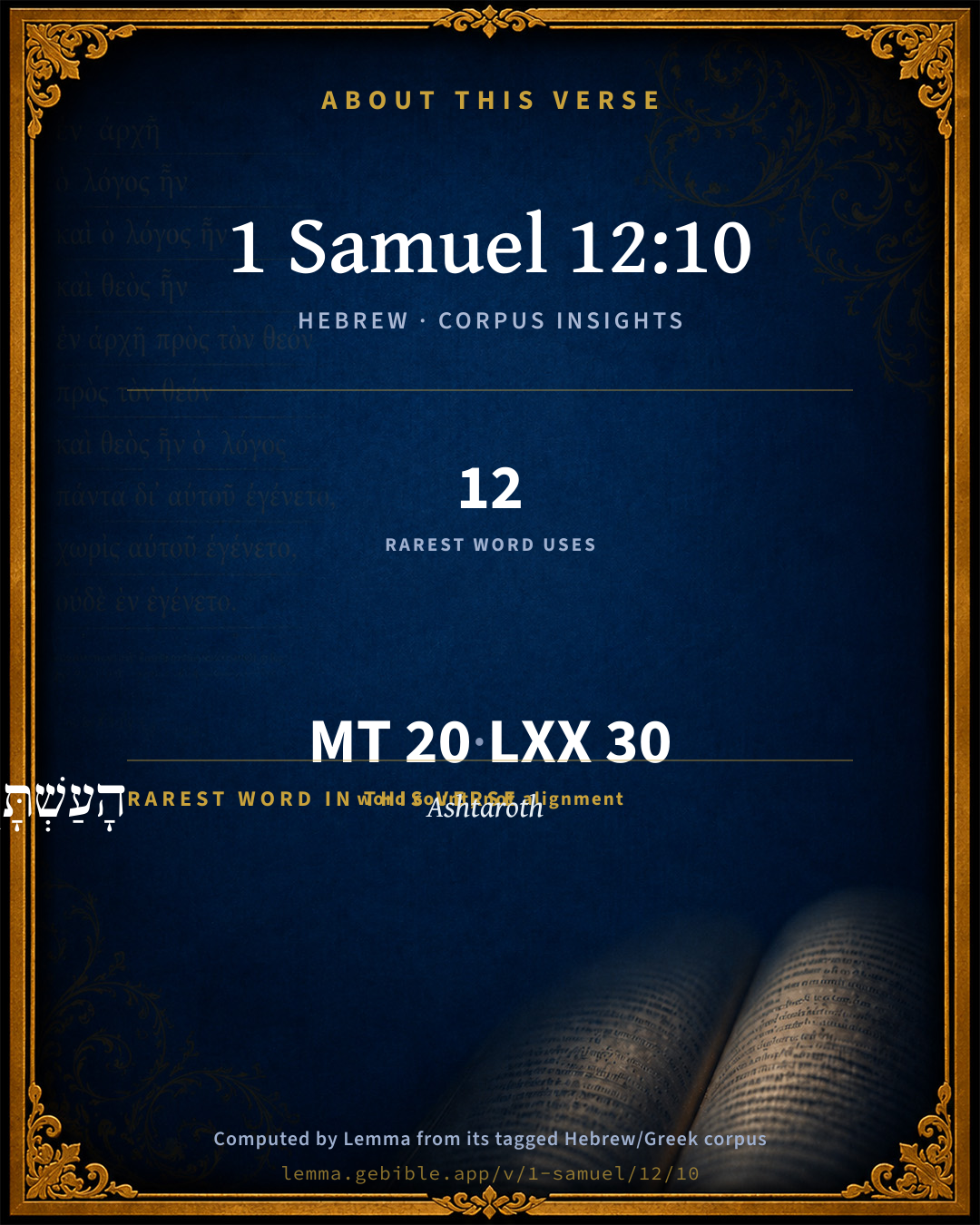
הָעַשְׁתָּר֑וֹת
ʻAshtârôwth
H6252
“the · Ashtaroth”
Particle, Definite Article + Noun, Proper
Part of Speech
Particle + Noun
Type
Proper
Full BDB Definition

Origin: pl. of H6251

TWOT: 1718b

Ashtaroth or Astaroth = "star" - false goddesses in the Canaanite religion, usually related to fertility cult (noun proper feminine deity) - a city in Bashan east of the Jordan given to Manasseh (noun proper locative)
  1. וַיִּזְעֲק֤וּ zâʻaq H2199 “and · to cry out” Conjunction + Verb, Qal, Sequential Imperfect, 3rd Person, Masculine, Plural
  2. אֶל ʼêl H413 “to” Preposition
  3. יְהוָה֙ Yᵉhôvâh H3068 “LORD” Noun, Proper
  4. ויאמר ʼâmar H559 “and · to say” Conjunction + Verb, Qal, Sequential Imperfect, 3rd Person, Masculine, Singular
  5. וַיֹּאמְר֣וּ ʼâmar H559 “and · to say” Conjunction + Verb, Qal, Sequential Imperfect, 3rd Person, Masculine, Plural
  6. חָטָ֔אנוּ châṭâʼ H2398 “to sin” Verb, Qal, Perfect, 1st Person, Common, Plural
  7. כִּ֤י kîy H3588 “that” Conjunction
  8. עָזַ֨בְנוּ֙ ʻâzab H5800 “to leave” Verb, Qal, Perfect, 1st Person, Common, Plural
  9. אֶת ʼêth H853 “-” Particle, Direct Object
  10. יְהוָ֔ה Yᵉhôvâh H3068 “LORD” Noun, Proper
  11. וַנַּעֲבֹ֥ד ʻâbad H5647 “and · to serve” Conjunction + Verb, Qal, Sequential Imperfect, 1st Person, Common, Plural
  12. אֶת ʼêth H853 “-” Particle, Direct Object
  13. הַבְּעָלִ֖ים Baʻal H1168 “the · Baal” Particle, Definite Article + Noun, Proper
  14. וְאֶת ʼêth H853 “and · -” Conjunction + Particle, Direct Object
  15. וְעַתָּ֗ה ʻattâh H6258 “and · now” Conjunction + Adverb
  16. הַצִּילֵ֛נוּ nâtsal H5337 “rescue · us” Verb, Hiphil, Imperative, 2nd Person, Masculine, Singular + Suffix, Personal, 1st Person, Common, Plural
  17. מִיַּ֥ד yâd H3027 “from · hand of” Preposition + Noun, Common, Both, Singular, Construct
  18. אֹיְבֵ֖ינוּ ʼôyêb H341 “enemy · us” Verb, Qal, Participle Active, Masculine, Plural, Construct + Suffix, Personal, 1st Person, Common, Plural
  19. וְנַעַבְדֶֽךָּ ʻâbad H5647 “and · to serve · you” Conjunction + Verb, Qal, Imperfect, 1st Person, Common, Plural + Suffix, Personal, 2nd Person, Masculine, Singular

About this verse

These counts appear in no published source. They are computed here, from the morphology-tagged text and Lemma’s own curated glosses. What Lemma adds →

20
words
15
distinct lemmas
Historical
section

Notable vocabulary

The rarest word here is הָעַשְׁתָּר֑וֹת Ashtaroth H6252 — appearing just 12 times in the whole Hebrew Bible.

Shared distinctive vocabulary

הָעַשְׁתָּר֑וֹת Ashtaroth H6252 occurs in 12 verses of the Hebrew Bible. Also found in:

Grammatical profile

  • 9 verbs
  • 5 nouns
  • 1 preposition
  • 1 conjunction
  • 1 adverb
  • 3 particles

Verb forms

  • וַיִּזְעֲק֤וּ Qal · Sequential Imperfect
  • ויאמר Qal · Sequential Imperfect
  • וַיֹּאמְר֣וּ Qal · Sequential Imperfect
  • חָטָ֔אנוּ Qal · Perfect
  • עָזַ֨בְנוּ֙ Qal · Perfect
  • וַנַּעֲבֹ֥ד Qal · Sequential Imperfect
  • הַצִּילֵ֛נוּ Hiphil · Imperative
  • אֹיְבֵ֖ינוּ Qal · Participle Active
  • וְנַעַבְדֶֽךָּ Qal · Imperfect

Repetition

Words recur within this verse — often emphatic in Hebrew:

  • יְהוָה֙ LORD H3068 ×2
  • ויאמר to say H559 ×2
  • וַנַּעֲבֹ֥ד to serve H5647 ×2

Hebrew & Septuagint length

In English translation the verse runs 38 words from the Hebrew and 40 from the Septuagint (LXX English) — closely comparable.

A rough comparison of the two English renderings, which tokenize alike — not a word-level alignment.

Word counts can differ between the Hebrew and the Greek without any difference in meaning — e.g. the Hebrew direct-object marker אֵת has no separate Greek word, and Greek often adds the article ὁ.

In the original languages it is 20 Hebrew tokens and 30 Greek tokens — but the two are counted differently (Hebrew bundles its prefixes and suffixes into one token; the Greek is in lemma form), so that isn’t a like-for-like length.

Cross-references

15

Topical passages linked to 1 Samuel 12:10 in the Treasury of Scripture Knowledge — connected by theme and wording, ordered by reader-vote popularity; previews shown in the World English Bible.

  • Judges 2:13 They forsook Yahweh, and served Baal and the Ashtaroth.
  • Judges 10:10 The children of Israel cried to Yahweh, saying, We have sinned against you, even because we have forsaken our God, and have served the Baals.
  • Judges 3:7 The children of Israel did that which was evil in the sight of Yahweh, and forgot Yahweh their God, and served the Baals and the Asheroth.
  • Judges 3:9 When the children of Israel cried to Yahweh, Yahweh raised up a savior to the children of Israel, who saved them, even Othniel the son of Kenaz, Caleb's younger brother.
  • Judges 10:15–16 The children of Israel said to Yahweh, We have sinned: do you to us whatever seems good to you; only deliver us, we pray you, this day.
  • Judges 3:15 But when the children of Israel cried to Yahweh, Yahweh raised them up a savior, Ehud the son of Gera, the Benjamite, a man left-handed. The children of Israel sent tribute by him to Eglon the king of Moab.
  • Judges 4:3 The children of Israel cried to Yahweh: for he had nine hundred chariots of iron; and twenty years he mightily oppressed the children of Israel.
  • Judges 6:7 It happened, when the children of Israel cried to Yahweh because of Midian,
  • 1 Samuel 7:2 It happened, from the day that the ark abode in Kiriath Jearim, that the time was long; for it was twenty years: and all the house of Israel lamented after Yahweh.
  • Psalms 78:34–35 When he killed them, then they inquired after him. They returned and sought God earnestly.
  • Psalms 106:44 Nevertheless he regarded their distress, When he heard their cry.
  • Isaiah 26:16 Yahweh, in trouble have they visited you; they poured out a prayer [when] your chastening was on them.
  • Isaiah 33:22 For Yahweh is our judge, Yahweh is our lawgiver, Yahweh is our king; he will save us.
  • Luke 1:74–75 To grant to us that we, being delivered out of the hand of our enemies, should serve him without fear,
  • 2 Corinthians 5:14–15 For the love of Christ constrains us; because we judge thus, that one died for all, therefore all died.

Cross-references courtesy of OpenBible.info (CC BY 4.0).

Hebrew and Greek witnesses Masoretic Hebrew ↔ Greek Septuagint

The same verse in the two great witnesses to the Old Testament, shown verse-for-verse.

These are two independent witnesses, not word-aligned to each other, and the Septuagint is shown in lemma (dictionary) form.

Hebrew 1 Samuel 12:10 Masoretic · Westminster Leningrad Codex

וַיִּזְעֲק֤וּ אֶל יְהוָה֙ ויאמר וַיֹּאמְר֣וּ חָטָ֔אנוּ כִּ֤י עָזַ֨בְנוּ֙ אֶת יְהוָ֔ה וַנַּעֲבֹ֥ד אֶת הַבְּעָלִ֖ים וְאֶת הָעַשְׁתָּר֑וֹת וְעַתָּ֗ה הַצִּילֵ֛נוּ מִיַּ֥ד אֹיְבֵ֖ינוּ וְנַעַבְדֶֽךָּ

They cried to Yahweh, and said, We have sinned, because we have forsaken Yahweh, and have served the Baals and the Ashtaroth: but now deliver us out of the hand of our enemies, and we will serve you.

World English Bible · Public Domain

Greek LXX 1 Samuel 12:10 Septuagint · lemma form

καί βοάω πρός κύριος καί λέγω ἁμαρτάνω ὅτι ἐν καταλείπω ὁ κύριος καί δουλεύω ὁ βααλιμ καί ὁ ἄλσος καί νῦν ἐκαἱρέω ἐγώ ἐκ χείρ ἐχθρός ἐγώ καί δουλεύω σύ

And they cried to the Lord, and said, We have sinned, for we have forsaken the Lord, and have served Baalim and the groves: and now deliver us out of the hand of our enemies, and we will serve you.

LXX2012 (modern English Septuagint) · Public Domain

Hebrew: Westminster Leningrad Codex (CC BY 4.0). Greek: Septuagint (public domain); English from LXX2012 (modern English Septuagint) (Public Domain). How the Septuagint differs from the Hebrew →

Targum (Aramaic paraphrase)

1

The Targum is the ancient Jewish Aramaic paraphrase of the Hebrew Scriptures — an interpretive translation, not the Hebrew text itself. Onkelos (literal) and Pseudo-Jonathan (expansive) render the Torah, and Jonathan the Prophets. Coverage is partial: where no permissively-licensed English translation exists for a verse, only the Aramaic is shown. This is verse-level text, not a word-by-word alignment to the Hebrew.

  1. Targum Jonathan Prophets (Joshua–Malachi)
    וּזְעִיקוּ קֳדָם יְיָ וַאֲמַרוּ חַבְנָא אֲרֵי שְׁבַקְנָא יַת פּוּלְחָנָא דַייָ וּפְלַחְנָא יַת בְּעָלַיָא וְיַת עַשְׁתְּרָתָא וּכְעַן שֵׁיזְבָנָא מִיַד בַּעֲלֵי דְבָבָנָא וְנִפְלַח קֳדָמָךְ:

    (no public-domain English translation for this verse)

    Targum Jonathan — Aramaic: “Mikraot Gedolot” (public domain). English: “Sefaria Community Translation” (CC0 1.0 (public-domain dedication)); “London "Chaldee Paraphrase," 1871” (public domain). Text via Sefaria.

Commentary

Notes on 1 Samuel 12:10 from classic Christian and Jewish commentators (each source and its license shown beneath its notes). The classic Christian expositions comment on the surrounding passage and are grouped to its opening verse, so a note may address several verses; the Jewish commentaries on the Tanakh (Rashi and others) are per-verse, so they appear only where the commentator wrote on this verse.

Lemma curates 59 commentaries, every one of them public domain or Creative Commons licensed, each selected and text-cleaned for this edition rather than reprinted as found. About our sources →

Trapp's Complete Commentary

John Trapp

1Sa 12:10 And they cried unto the LORD, and said, We have sinned, because we have forsaken the LORD, and have served Baalim and Ashtaroth: but now deliver us out of the hand of our enemies, and we will serve thee.

Ver. 10. And they cried unto the Lord.] Lachrymas angustiae exprimit Crux; lachrymas poenitentiae Peccatum. Misery is the best art of memory; God whippeth his stragglers home by weeping cross.

John Trapp, A Commentary or Exposition upon All the Books of the Old and New Testament (1647–1656) — public domain. Text from a community e-Sword module.

Tyndale Open Study Notes

Tyndale Open Resources

12:10 Then they cried to the Lord: Sometimes only suffering turns people’s hearts toward God. During the period of the judges, Israel repeatedly went through cycles of sin, oppression, repentance, and rescue. • Baal and Ashtoreth: When people turn away from God, they inevitably turn to idols (see 7:3; Judg 2:13; 10:6). • An attitude such as if you will rescue us turns worship into a debased bargain, in which God must perform some action to a person’s liking. God deserves obedience and worship because he is God, not because of favors he can perform.

Tyndale Open Study Notes — © Tyndale Open Resources, licensed CC BY-SA 4.0. Text via the HelloAO Bible API.

Ellicott's Commentary for English Readers

(10) And they cried unto the Lord.—As soon as they were convinced of their sin and rebellion, and accused themselves, and returned to their old allegiance, their invisible King, ever full of pity and tender compassion, forgave them, and sent them quick deliverance.

And have served Baalim and Ashtaroth.—Baal and Ashtaroth were the well-known leading Phœnician deities; the worship, with most of its details, was imported probably from Carthage, the great Phœnician centre. The temple of Baal-shemesh, the Sun god, at Carthage, was renowned in that luxurious and splendid city. (For a detailed and picturesque account of the worship and ritual of Baal at Carthage, see M. Gustave Flaubert’s romance of Salômbo.) Baal and Ashtaroth, the Greek Astarté, were probably originally worshipped simply as the sun and moon. The plural form refers to the various personifications and different titles of the god and goddess.

A Bible Commentary for English Readers, edited by Charles John Ellicott (1878–1897) — public domain. Text from a community e-Sword module.

The Cambridge Bible for Schools and Colleges

gen. ed. J. J. S. Perowne

10. And they cried unto the Lord] The resemblance of the language to Jdg_10:10 is so close as to lead us to suppose that the compiler of Samuel had the book of Judges before him, or at any rate that the words are derived from a common source. Cp. also Jdg_2:18; Jdg_3:15; Jdg_4:3; Jdg_6:7.

Baalim and Ashtaroth] See note on 1Sa_7:3.

The Cambridge Bible for Schools and Colleges (gen. ed. J. J. S. Perowne; Cambridge University Press, 1878–1918) — public domain. Text from a community e-Sword module.

John Gill's Exposition

And they cried unto the Lord,.... When in the hands of their enemies, and in bondage to them, and cruelly oppressed by them:

and said, we have sinned; the word for "said" is in the Cetib, or written text, singular, and in the Keri, or marginal reading, plural; and may signify, that everyone of them had a sense of their sin, and made acknowledgment of it; their confession was universal, as their sin was:

because we have forsaken the Lord; the Word of the Lord, as the Targum:

and have served Baalim and Ashtaroth; See Gill on Jdg 2:11; see Gill on Jdg 2:13.

but now deliver us out of the hand of our enemies, and we will serve thee; they did not ask for a king to go before them, and fight their battles, as they did now, but applied to the Lord for deliverance, promising to serve him as their King and their God.

John Gill's Exposition of the Whole Bible (1746–1763) — public domain (CC PDM 1.0). Text via the HelloAO Bible API.

The Pulpit Commentary

We have served the Baalim and the Ashtaroth. I.e. the numerous Baals and Astartes, which were worshipped under various titles by the heathen. For though representing the same power, each people had their own epithets for their own particular personification of the god. (see 1Sa_7:4)

The Pulpit Commentary (1880–1919), ed. H.D.M. Spence-Jones & Joseph S. Exell — public domain. Text from a community e-Sword module.

unfoldingWord translationNotes

Door43 World Missions Community

They cried out to Yahweh

"They" refers to the nation of Israel.

Jerub Baal

This is sometimes translated Jerubbaal. This is a name of godly honor and strength to fight the false god.

Yahweh sent ... and gave you victory

Samuel is telling the story of what God did after the people's confession of sin and plea for help. (See: Assumed Knowledge and Implicit Information)

Jerub Baal, Bedan, Jephthah, and Samuel

These are the names of some judges that God raised up. Samuel included himself in this list. (See: How to Translate Names)

have served the Baals and the Ashtoreths

Serving here is referring to acting worshipful towards the false gods. AT: "have worshiped false gods and goddesses" (See: Metonymy)

the hand of our enemies

This statement is using "hand" to refer to power. AT: "the power or control of our enemies" (See: Metonymy)

translationWords

Yahweh

sin

forsake

servant

Baal

adversary

send

life

unfoldingWord translationNotes — © Distant Shores Media and the Door43 World Missions Community, licensed CC BY-SA 4.0. Source: git.door43.org/Door43/en_tn.

Lesson kit

Teaching starters — assembled from the data on this page, not authored interpretation. Every prompt links to the verse data it draws on. Edit before teaching.

1 Samuel, in the Historical, opens this verse with 20 words (15 distinct Hebrew lemmas). Its most distinctive word is ʻAshtârôwth (“Ashtaroth”). A historical commentator’s framing appears above. Read the whole chapter for the surrounding context.

Discussion questions

  1. The word ʻAshtârôwth carries the sense “Ashtaroth.” How does it shape the verse?
  2. Deuteronomy 1:4 shares the word «Ashtaroth» with this verse. How do the two illuminate each other?
  3. “LORD” occurs 2× in this one verse. What is the effect of the repetition?
  4. These translations render this verse differently; the difference is in the English rendering, not the original. What questions does that raise?
  5. The verb «וַיִּזְעֲק֤וּ» is Qal Sequential Imperfect. How does its form color the action?
  6. Reading how Trapp's Complete Commentary and Tyndale Open Study Notes read this verse, where do the two commentators agree and where do they part?

Things to notice

Reading settings

Reading text

Shown beneath each verse's original-language words.

Old Testament
Old Testament edition

Read the OT as the Masoretic Hebrew (MT) or the Greek Septuagint (LXX).

English shown for the Greek Septuagint (in the Hebrew ↔ Greek comparison).

Comparing translations? Open the Compare panel on any verse page to stack up to four side by side.