
Psalms 18:37

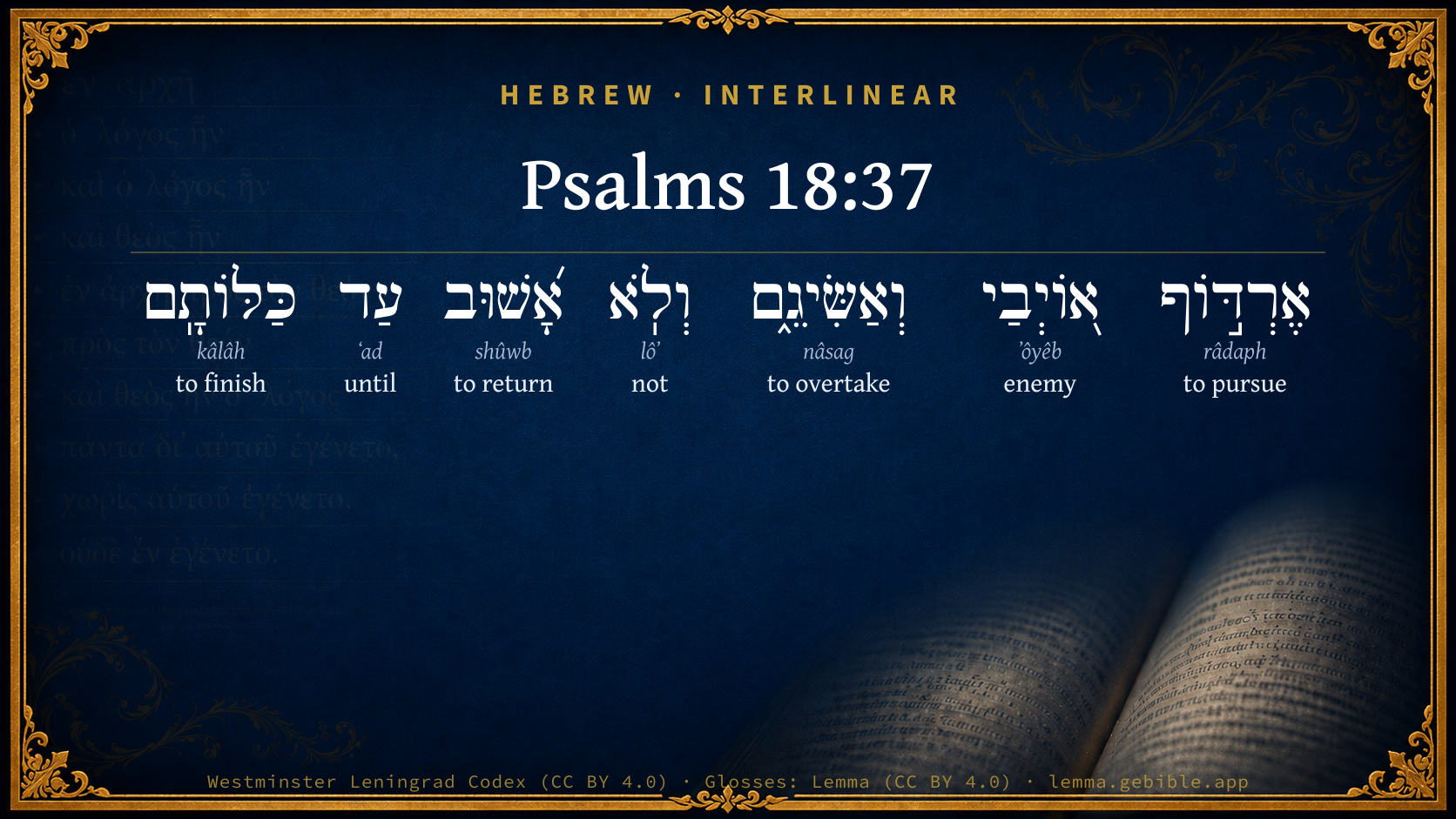
Hebrew (Westminster Leningrad Codex) Psalms 18:37 appears in the Hebrew Old Testament. The text above is from the Westminster Leningrad Codex. Each word links to its Strong’s number, a concise gloss, and parsing drawn from the Open Scriptures Hebrew Bible morphology. Click any word for its full Brown-Driver-Briggs (BDB) entry.
Download image
Cite this verse

Psalms 18:37 (World English Bible). Public Domain. Lemma interlinear Bible study tool, https://lemma.gebible.app/v/psalms/18/37.

Show BibTeX & RIS
BibTeX
RIS
English Translation
I will pursue my enemies, and overtake them. Neither will I turn again until they are consumed.
World English Bible · Public Domain
Download a study sheet

One document with this verse’s original text, its word-by-word gloss line, the meaning frame, cross-references with their text, attributed commentary, and full source and license credits — printable, and it pastes into notes with its structure intact.

This verse Autodidact and up

Study sheet (.html) Plain text (.txt)

A passage Seminary Student

Up to 50 verses in one chapter. A passage sheet keeps up to 6 commentary sources and 12 cross-references per verse, in the order this page ranks them, and says so on the sheet whenever that leaves anything out. Ask for a single verse and you get the Autodidact verse sheet above.

Everything on this page stays free to read, with no account — the sheet is a download of what is already on screen, not access to it.

Want to remove ads? Support Godless Engineer
Compare translations 3

The same verse in 3 English versions, stacked beneath the original-language interlinear above. Click any original word for its lexicon entry.

Each is an independent rendering of the whole verse — the interlinear is not word-aligned to these translations.

Highlighted words mark where these versions differ — a whole-verse word diff, not a word-by-word alignment.

  • World English Bible Public Domain
    I will pursue my enemies, and overtake them. Neither will I turn again until they are consumed.
  • King James Version Public Domain
    I have pursued mine enemies, and overtaken them: neither did I turn again till they were consumed.
  • unfoldingWord Literal Text CC BY-SA 4.0
    I pursue my enemies, and I destroy them, and I do not return until I have ended them.

unfoldingWord Literal Text — © unfoldingWord, licensed CC BY-SA 4.0. Word-aligned USFM3 via Door43 (git.door43.org/unfoldingWord/en_ult).

Versions to compare (up to 4)

3 of 4 selected

Show all 18 translations

Every available English version of this verse, each an independent rendering of the whole verse.

  • World English Bible Public Domain
    I will pursue my enemies, and overtake them. Neither will I turn again until they are consumed.
  • Berean Standard Bible Public Domain
    I pursued my enemies and overtook them; I did not turn back until they were consumed.
  • Majority Standard Bible Public Domain
    I pursued my enemies and overtook them; I did not turn back until they were consumed.
  • King James Version Public Domain
    I have pursued mine enemies, and overtaken them: neither did I turn again till they were consumed.
  • American Standard Version (1901) Public Domain
    I will pursue mine enemies, and overtake them; Neither will I turn again till they are consumed.
  • Revised Version (1885) Public Domain
    I will pursue mine enemies, and overtake them: neither will I turn again till they are consumed.
  • Geneva Bible (1599) Public Domain
    I haue pursued mine enemies, and taken them, and haue not turned againe till I had consumed them.
  • Douay-Rheims (1899) Public Domain
    Thou hast enlarged my steps under me; and my feet are not weakened.
  • Young's Literal Translation Public Domain
    I pursue mine enemies, and overtake them, And turn back not till they are consumed.
  • Literal Standard Version CC BY-SA 4.0
    I pursue my enemies, and overtake them, || And do not turn back until they are consumed.
  • Unlocked Literal Bible CC BY-SA 4.0
    I pursued my enemies and caught them; I did not turn back until they were destroyed.
  • unfoldingWord Literal Text CC BY-SA 4.0
    I pursue my enemies, and I destroy them, and I do not return until I have ended them.
  • Darby Bible Public Domain
    I pursued mine enemies, and overtook them; and I turned not again till they were consumed.
  • World Messianic Bible Public Domain
    I will pursue my enemies, and overtake them. I won’t turn away until they are consumed.
  • Webster's Bible Public Domain
    \\18:36\\Thou hast enlarged my steps under me, that my feet did not slip.
  • Free Bible Version CC BY-SA 4.0
    I chased my enemies, and caught up with them. I did not turn around until I had destroyed them.
  • Bible in Basic English Public Domain
    I go after my haters and overtake them; not turning back till they are all overcome.
  • JPS Tanakh (1917) Public Domain
    (18-38) I have pursued mine enemies, and overtaken them; neither did I turn back till they were consumed.

Literal Standard Version (2020), Covenant Press — licensed CC BY-SA 4.0. Text via the HelloAO Bible API (eBible.org). Unlocked Literal Bible (unfoldingWord) — licensed CC BY-SA 4.0. Text via the HelloAO Bible API (eBible.org). unfoldingWord Literal Text — © unfoldingWord, licensed CC BY-SA 4.0. Word-aligned USFM3 via Door43 (git.door43.org/unfoldingWord/en_ult). Free Bible Version, Dr. Jonathan Gallagher — licensed CC BY-SA 4.0. Text via the HelloAO Bible API (eBible.org).

Word by word

More ways to search: Search by grammar → Find every occurrence → Compare this word →

Practice this passage: Drill this verse → Learn its vocabulary →

וְאַשִּׂיגֵ֑ם
nâsag
H5381
“and · to overtake · them”
Conjunction + Verb, Hiphil, Imperfect, 1st Person, Common, Singular + Suffix, Personal, 3rd Person, Masculine, Plural
Part of Speech
Conjunction + Verb
Stem
Hiphil
Form
Imperfect
Person
1st Person
Gender
Common
Number
Singular
Full BDB Definition

Origin: a primitive root

TWOT: 1422

to reach, overtake, take hold upon - (Hiphil) - to overtake - to reach, attain to, cause to reach - to be able to secure, reach, have enough
  1. אֶרְדּ֣וֹף râdaph H7291 “to pursue” Verb, Qal, Imperfect, 1st Person, Common, Singular
  2. א֭וֹיְבַי ʼôyêb H341 “enemy · me” Verb, Qal, Participle Active, Masculine, Plural, Construct + Suffix, Personal, 1st Person, Common, Singular
  3. וְלֹֽא lôʼ H3808 “and · not” Conjunction + Particle, Negative
  4. אָ֝שׁוּב shûwb H7725 “to return” Verb, Qal, Imperfect, 1st Person, Common, Singular
  5. עַד ʻad H5704 “until” Preposition
  6. כַּלּוֹתָֽם kâlâh H3615 “to finish · them” Verb, Piel, Infinitive Construct + Suffix, Personal, 3rd Person, Masculine, Plural

About this verse

These counts appear in no published source. They are computed here, from the morphology-tagged text and Lemma’s own curated glosses. What Lemma adds →

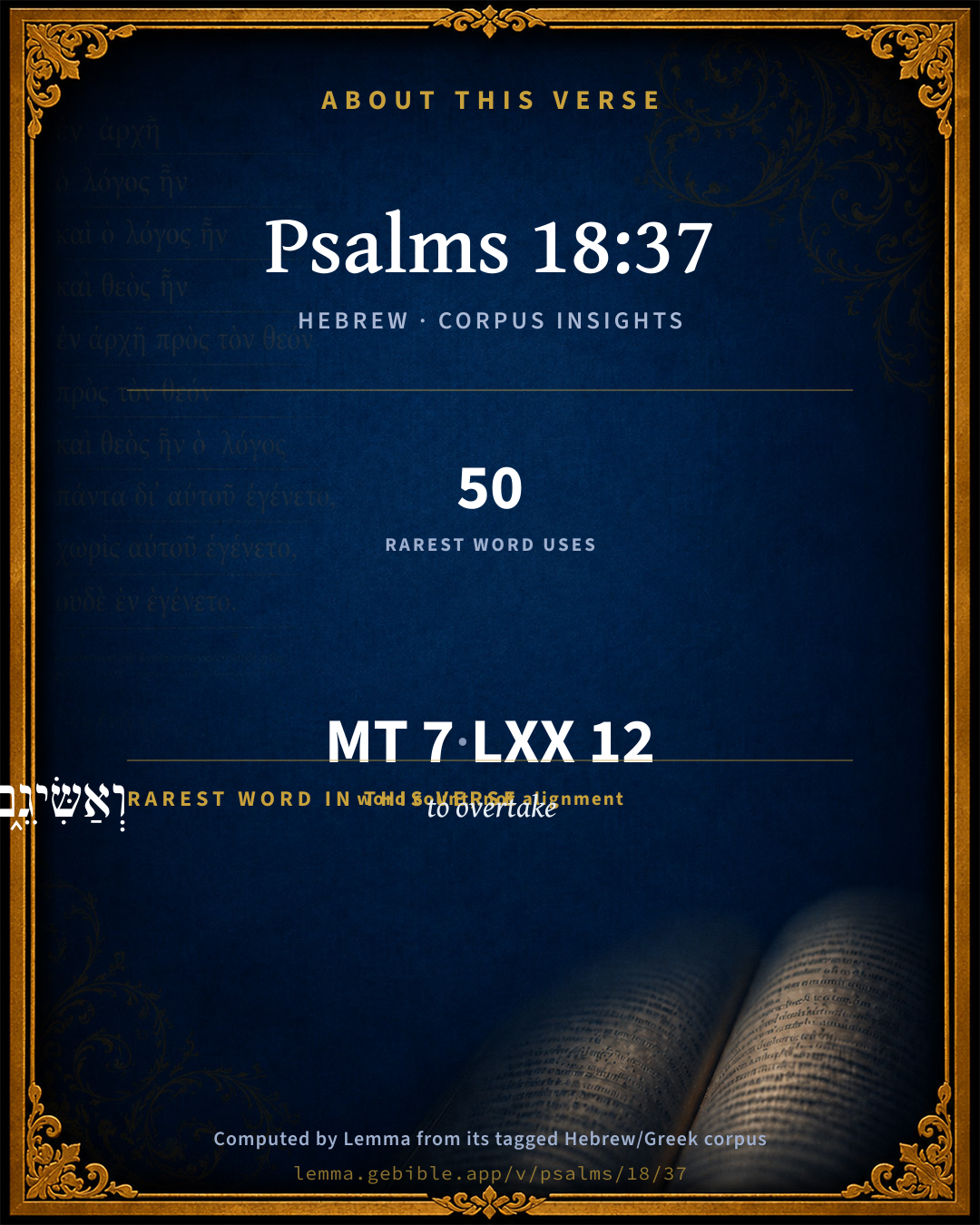
7
words
7
distinct lemmas
Wisdom
section

Shared distinctive vocabulary

וְאַשִּׂיגֵ֑ם to overtake H5381 occurs in 47 verses of the Hebrew Bible. Also found in:

Grammatical profile

  • 5 verbs
  • 1 preposition
  • 1 particle

Verb forms

  • אֶרְדּ֣וֹף Qal · Imperfect
  • א֭וֹיְבַי Qal · Participle Active
  • וְאַשִּׂיגֵ֑ם Hiphil · Imperfect
  • אָ֝שׁוּב Qal · Imperfect
  • כַּלּוֹתָֽם Piel · Infinitive Construct

Hebrew & Septuagint length

In English translation the verse runs 17 words from the Hebrew and 18 from the Septuagint (LXX English) — closely comparable.

A rough comparison of the two English renderings, which tokenize alike — not a word-level alignment.

Word counts can differ between the Hebrew and the Greek without any difference in meaning — e.g. the Hebrew direct-object marker אֵת has no separate Greek word, and Greek often adds the article ὁ.

In the original languages it is 7 Hebrew tokens and 12 Greek tokens — but the two are counted differently (Hebrew bundles its prefixes and suffixes into one token; the Greek is in lemma form), so that isn’t a like-for-like length.

Cross-references

12

Topical passages linked to Psalms 18:37 in the Treasury of Scripture Knowledge — connected by theme and wording, ordered by reader-vote popularity; previews shown in the World English Bible.

  • Psalms 44:5 Through you, will we push down our adversaries. Through your name, will we tread them under who rise up against us.
  • Isaiah 53:10–12 Yet it pleased Yahweh to bruise him; he has put him to grief: when you shall make his soul an offering for sin, he shall see [his] seed, he shall prolong his days, and the pleasure of Yahweh shall prosper in his hand.
  • Numbers 24:17–19 I see him, but not now; I see him, but not near: There shall come forth a star out of Jacob, A scepter shall rise out of Israel, Shall strike through the corners of Moab, Break down all the sons of tumult.
  • Psalms 3:7 Arise, Yahweh! Save me, my God! For you have struck all of my enemies on the cheek bone. You have broken the teeth of the wicked.
  • Psalms 9:3 When my enemies turn back, They stumble and perish in your presence.
  • Psalms 35:2 Take hold of shield and buckler, And stand up for my help.
  • Psalms 35:5 Let them be as chaff before the wind, Yahweh's angel driving them on.
  • Psalms 37:20 But the wicked shall perish. The enemies of Yahweh shall be like the beauty of the fields. They will vanish-- Vanish like smoke.
  • Psalms 118:11–12 They surrounded me, yes, they surrounded me. In the name of Yahweh I indeed cut them off.
  • Isaiah 63:1–6 Who is this who comes from Edom, with dyed garments from Bozrah? this who is glorious in his clothing, marching in the greatness of his strength? I who speak in righteousness, mighty to save.
  • Revelation 6:2 And behold, a white horse, and he who sat on it had a bow. A crown was given to him, and he came forth conquering, and to conquer.
  • Revelation 19:19–20 I saw the beast, and the kings of the earth, and their armies, gathered together to make war against him who sat on the horse, and against his army.

Cross-references courtesy of OpenBible.info (CC BY 4.0).

Hebrew and Greek witnesses Masoretic Hebrew ↔ Greek Septuagint

The same verse in the two great witnesses to the Old Testament, shown verse-for-verse.

You’re reading Greek Psalm 17 (Hebrew Psalm 18). The Septuagint counts the superscription, so verse numbers can differ from the Hebrew — chapter-level alignment, not verse-by-verse. Numbering follows Rahlfs.

These are two independent witnesses, not word-aligned to each other, and the Septuagint is shown in lemma (dictionary) form.

Hebrew Psalms 18:37 Masoretic · Westminster Leningrad Codex

אֶרְדּ֣וֹף א֭וֹיְבַי וְאַשִּׂיגֵ֑ם וְלֹֽא אָ֝שׁוּב עַד כַּלּוֹתָֽם

I will pursue my enemies, and overtake them. Neither will I turn again until they are consumed.

World English Bible · Public Domain

Greek LXX Greek Psalm 17:37 Septuagint · lemma form

πλατύνω ὁ διάβημα ἐγώ ὑποκάτω ἐγώ καί οὐ ἀσθενέω ὁ ἴχνος ἐγώ

I will pursue my enemies, and overtake them; and I will not turn back until they are consumed.

LXX2012 (modern English Septuagint) · Public Domain

Hebrew: Westminster Leningrad Codex (CC BY 4.0). Greek: Septuagint (public domain); English from LXX2012 (modern English Septuagint) (Public Domain). How the Septuagint differs from the Hebrew →

Commentary

Notes on Psalms 18:37 from classic Christian and Jewish commentators (each source and its license shown beneath its notes). The classic Christian expositions comment on the surrounding passage and are grouped to its opening verse, so a note may address several verses; the Jewish commentaries on the Tanakh (Rashi and others) are per-verse, so they appear only where the commentator wrote on this verse.

Lemma curates 59 commentaries, every one of them public domain or Creative Commons licensed, each selected and text-cleaned for this edition rather than reprinted as found. About our sources →

John Gill's Exposition

I have wounded them, that they were not able to rise,.... Which was not only true of the Amalekites, but of all with whom David engaged in war;

they are fallen under my feet; either dead, or become subject and tributaries to him; as the Philistines, Moabites, Syrians, and Edomites; see Sa2 8:1. This, with Psa 18:37, may very well be accommodated to David's antitype, and be expressive of the entire victory he has obtained over all his and his people's enemies; he wounded the heads over many countries, Psa 110:6. Satan and his principalities and powers, whose head is broke, whose works are destroyed; yea, he himself, which had the power of death, so as not to be able to rise more against Christ, who has led captivity captive: he has also finished and made an end of sin, and overcome the world; nor did he turn back from this work he engaged in until he had made a complete conquest; and moreover he has likewise made his people more than conquerors, through him, over these same enemies; so that the words are also applicable to them.

John Gill's Exposition of the Whole Bible (1746–1763) — public domain (CC PDM 1.0). Text via the HelloAO Bible API.

Trapp's Complete Commentary

John Trapp

Psa 18:37 I have pursued mine enemies, and overtaken them: neither did I turn again till they were consumed.

Ver. 37. I have pursued mine enemies, and overtaken them, &c.] Of David we may say, as one did of Julius Caesar, you may perceive him to have been an excellent soldier by his very language; for he wrote with the same spirit he fought. In eo tanta vis, id acumen, ea concitatio, saith Quintilian concerning Caesar’s Commentaries, ut illum eodem animo dixisse appareat quo bellavit.

John Trapp, A Commentary or Exposition upon All the Books of the Old and New Testament (1647–1656) — public domain. Text from a community e-Sword module.

J. A. Alexander on Psalms

Joseph Addison Alexander

38. (Psa 18:37). I am to pursue my enemies and overtake them, and not to turn back until I destroy them. This is not a threat of vengeance, but a confident anticipation of perpetual triumphs, either in his own person or in that of his descendants. The form of expression in the first clause is borrowed from the Song of Moses, Exo 15:9. See above on Psa 7:6 (5), where the same two verbs are combined. The reference of all these future forms to past time would be not only gratuitous but ungrammatical.

Joseph Addison Alexander, The Psalms Translated and Explained (1850) — public domain. Text from a community e-Sword module.

Tyndale Open Study Notes

Tyndale Open Resources

18:37-42 With help from the Divine Warrior, the psalmist experienced victory over his enemies.

Tyndale Open Study Notes — © Tyndale Open Resources, licensed CC BY-SA 4.0. Text via the HelloAO Bible API.

Geneva Bible (1599)

Geneva Bible translators

David declareth that he did nothing besides his vocation, but was stirred up by God’s Spirit to execute his judgments.

Geneva Bible (1599) marginal notes — public domain. Text via Bolls.life.

Jamieson, Fausset & Brown

Robert Jamieson, A. R. Fausset & David Brown

In actual conflict, with God's aid, the defeat of his enemies is certain. A present and continued success is expressed.

Jamieson, Fausset & Brown — Commentary Critical and Explanatory on the Whole Bible (1871) — public domain (CC PDM 1.0). Text via the HelloAO Bible API.

John Calvin's Commentaries

The point on which David insists so much is, that of showing from the effect or issue, that all his victories were to be traced to the favor of God; and from this it follows that his cause was good and just. God, no doubt, sometimes grants successes even to the ungodly and wicked; but he at length shows by the issue, that he was all the while opposed to them and their enemy. It is his servants alone who experience such tokens of his favor as he shewed towards David, and he intends by these to testify that they are approved and accepted by him. We are apt to think that David here speaks too much after the manner of a soldier, in declaring that he will not cease from the work of slaughter until he has destroyed all his enemies; or rather that he has forgotten the gentleness and meekness which ought to shine in all true believers, and in which they should resemble their heavenly Father; but as he attempted nothing without the command of God, and as his affections were governed and regulated by the Holy Spirit, we may be assured that these are not the words of a man who was cruel, and who took pleasure in shedding blood, but of a man who faithfully executed the judgment which God had committed to him. And, indeed, we know that he was so distinguished for gentleness of disposition as to abhor the shedding of even a single drop of blood, except in so far as duty and the necessity of his office required. We must, therefore, take into consideration David’s vocation, and also his pure zeal, which was free from all perturbation of the flesh. Moreover, it should be particularly attended to that the Psalmist here calls those his enemies whose indomitable and infatuated obstinacy merited and called forth such vengeance from God. As he represented the person of Christ, he inflicted the punishment of death only on those who were so inflexible that they could not be reduced to order by the exercise of a mild and humane authority; and this of itself shows, that there was nothing in which he more delighted than to pardon those who repented and reformed themselves. He thus resembled Christ, who gently allures all men to repentance, but breaks in pieces, with his iron rod, those who obstinately resist him to the last. The sum of these verses is, that David, as he fought under the authority of God, being chosen king by him, and engaging in no undertaking without his warrant, was assisted by him, and rendered invincible against the assaults of all his enemies, and enabled even to discomfit vast and very powerful armies. Farther, let us remember, that under this type there is shadowed forth the invincible character and condition of the kingdom of Christ, who, trusting to, and sustained by, the power of God, overthrows and destroys his enemies, — who, in every encounter, uniformly comes off victorious, — and who continues king in spite of all the resistance which the world makes to his authority and power. And as the victories secured to him involve a security of similar victories to us, it follows that there is here promised us an impregnable defense against all the efforts of Satan, all the machinations of sin, and all the temptations of the flesh. Although, therefore, Christ can only obtain a tranquil kingdom by fighting, let us not on that account be troubled, but let it be enough to satisfy us, that the hand of God is always ready to be stretched forth for its preservation. David was, for a time, a fugitive, so that it was with difficulty he could save his life, by taking shelter in the dens of wild beasts; but God, at length, made his enemies turn their backs, and not only put them to flight, but also delivered them over to him, that he might pursue and utterly discomfit them. In like manner, our enemies for a time may be, as it were, just ready to put the knife to our throat “Comme tous prests a nous mettre le cousteau sur la gorge.” — Fr.

John Calvin's Commentaries (1540-1563) — public domain. Text from the Calvin Translation Society English edition (1840s-50s) via the Christian Classics Ethereal Library (ccel.org). Calvin's coverage is partial (roughly two-thirds of the Bible); uncommented books and verses are honest gaps, never fabricated. The 19th-century editor's footnotes and remarks are omitted so the notes are faithfully Calvin's own voice.

Ellicott's Commentary for English Readers

(37-40) Another retrospective glance of the poet over his past wars. Notice slight variations in Samuel.

A Bible Commentary for English Readers, edited by Charles John Ellicott (1878–1897) — public domain. Text from a community e-Sword module.

The Cambridge Bible for Schools and Colleges

gen. ed. J. J. S. Perowne

37. Cp. Exo_15:9. 2 Sam. reads destroyed for overtaken.

The Cambridge Bible for Schools and Colleges (gen. ed. J. J. S. Perowne; Cambridge University Press, 1878–1918) — public domain. Text from a community e-Sword module.

Albert Barnes' Notes on the Bible

I have pursued mine enemies, and overtaken them - He had not only routed them, but had had strength to pursue them; he had not only pursued them, but he had been enabled to come up to them. The idea is that of complete success and absolute triumph.

Neither did I turn again - I was not driven back, nor was I weary and exhausted, and compelled to give over the pursuit.

Till they were consumed - Until they were all either slain or made captive, so that the hostile forces vanished. None of my enemies were left.

Albert Barnes' Notes on the Bible (1834–1885) — public domain. Text from a community e-Sword/MySword module.

Whedon's Commentary on the Bible

Daniel D. Whedon

37-42. In these verses David describes his victories and the stirring scenes of the battle field. Calvin says, “David seems to speak too soldierlike.” But his expressions have a Messianic outlook upon the triumphs of the cross, like Rev_19:17-21, through the literal imagery of war.

Daniel D. Whedon (gen. ed.), Commentary on the Old and New Testaments (1874–1909) — public domain. Text from a community e-Sword module.

The Pulpit Commentary

I have pursued mine enemies and overtaken them. (see 1Sa_30:8-17 2Sa_8:1-13 2Sa_10:6-18) Neither did I turn again till they were consumed. The greatest severities exercised by David seem to have been those against Edom (1Ki_11:15, 1Ki_11:16) and Ammon. (2Sa_12:29-31) Otherwise he would seem not to have used, with any great harshness, his rights as a conqueror.

The Pulpit Commentary (1880–1919), ed. H.D.M. Spence-Jones & Joseph S. Exell — public domain. Text from a community e-Sword module.

Keil & Delitzsch

C. F. Keil & F. Delitzsch

(Heb.: 18:38-41) Thus in God's strength, with the armour of God, and by God's assistance in fight, he smote, cast down, and utterly destroyed all his foes in foreign and in civil wars. According to the Hebrew syntax the whole of this passage is a retrospect. The imperfect signification of the futures in Psa 18:38, Psa 18:39 is made clear from the aorist which appears in Psa 18:40, and from the perfects and futures in what follows it. The strophe begins with an echo of Exo 15:9 (cf. supra Psa 7:6). The poet calls his opponents קמי, as in Psa 18:49, Psa 44:6; Psa 74:23, cf. קימנוּ Job 22:20, inasmuch as קוּם by itself has the sense of rising up in hostility and consequently one can say קמי instead of עלי קמים (קומים Kg2 16:7).

(Note: In the language of the Beduins kôm is war, feud, and kômānı̂ (denominative from kōm) my enemy (hostis); kōm also has the signification of a collective of kōmānı̂, and one can equally well say: entum waijânâ kôm, you and we are enemies, and: bênâtnâ kôm, there is war between us.)

The frequent use of this phrase (e.g., Ps 36:13, Lam 1:14) shows that קום in Psa 18:39 does not mean "to stand (resist)," but "to rise (again)." The phrase נתן ערף, however, which in other passages has those fleeing as its subject (Ch2 29:6), is here differently applied: Thou gavest, or madest me mine enemies a back, i.e., those who turn back, as in Exo 23:27. From Psa 21:13 (תּשׁיתמו שׁכם, Symm. τάξεις αὐτοὺς ἀποστρόφους) it becomes clear that ערף is not an accusative of the member beside the accusative of the person (as e.g., in Deu 33:11), but an accusative of the factitive object according to Ges. 139, 2.

Keil & Delitzsch — Biblical Commentary on the Old Testament (1861–1891) — public domain (CC PDM 1.0). Text via the HelloAO Bible API. (Old Testament only.)

unfoldingWord translationNotes

Door43 World Missions Community

I smashed them

"I crushed them" or "I broke them to pieces"

unable to rise

"unable to stand"

they have fallen under my feet

This idiom means the Psalmist has defeated his enemies. AT: "I have defeated all of them" (See: Idiom)

put strength on me like a belt

The Psalmist says that Yahweh has given him strength that surrounds and supports him like a belt. See how you translated this in Psalms 18:32. (See: Simile)

you put under me

Here the Psalmist speaks of the defeat of his enemies as if he were standing on them. AT: "you defeat for me" (See: Idiom)

those who rise up against me

This refers to those who oppose the Psalmist. AT: "those who are my enemies" (See: Idiom)

translationWords

adversary

raise

unfoldingWord translationNotes — © Distant Shores Media and the Door43 World Missions Community, licensed CC BY-SA 4.0. Source: git.door43.org/Door43/en_tn.

Rashi

Rabbi Shlomo Yitzchaki (Rashi)

You have enlarged my step[s] beneath me One who widens his steps does not fall easily. Similarly, Scripture states (in Prov. 4:12): “When you walk, your steps will not be hampered (יצר).”

slipped Heb. מעדו aluverjert in Old French, to slip.

my ankles Heb. קרסלי. They are the feet from the ankle which is called keville (cheville) in Old Frenchand below [to the heel].

Rashi on the Tanakh — English translations: “The Judaica Press complete Tanach with Rashi, translated by A. J. Rosenberg” (CC BY 4.0); “Pentateuch with Rashi's commentary by M. Rosenbaum and A.M. Silbermann, 1929-1934” (public domain); “The Metsudah Tanach series, Lakewood, N.J” (CC BY 4.0); and “The Book of Joshua, Metsudah Publications, 1997” (CC BY 4.0). Text via Sefaria.

Lesson kit

Teaching starters — assembled from the data on this page, not authored interpretation. Every prompt links to the verse data it draws on. Edit before teaching.

Psalms, in the Wisdom, opens this verse with 7 words (7 distinct Hebrew lemmas). Its most distinctive word is nâsag (“to overtake”). A historical commentator’s framing appears above. Read the whole chapter for the surrounding context.

Discussion questions

  1. The word nâsag carries the sense “to overtake.” How does it shape the verse?
  2. How does Genesis 31:25, which shares the word «to overtake», read alongside this verse?
  3. The translations on this page render this verse differently — a whole-verse word diff, not a word-by-word alignment. What might account for the different wordings?
  4. «אֶרְדּ֣וֹף» is a Qal Imperfect verb. How does that grammatical form shape the action described?
  5. Compare how John Gill's Exposition and Trapp's Complete Commentary read this verse. Where do they agree or differ?

Things to notice

Reading settings

Reading text

Shown beneath each verse's original-language words.

Old Testament
Old Testament edition

Read the OT as the Masoretic Hebrew (MT) or the Greek Septuagint (LXX).

English shown for the Greek Septuagint (in the Hebrew ↔ Greek comparison).

Comparing translations? Open the Compare panel on any verse page to stack up to four side by side.