
Deuteronomy 23:9

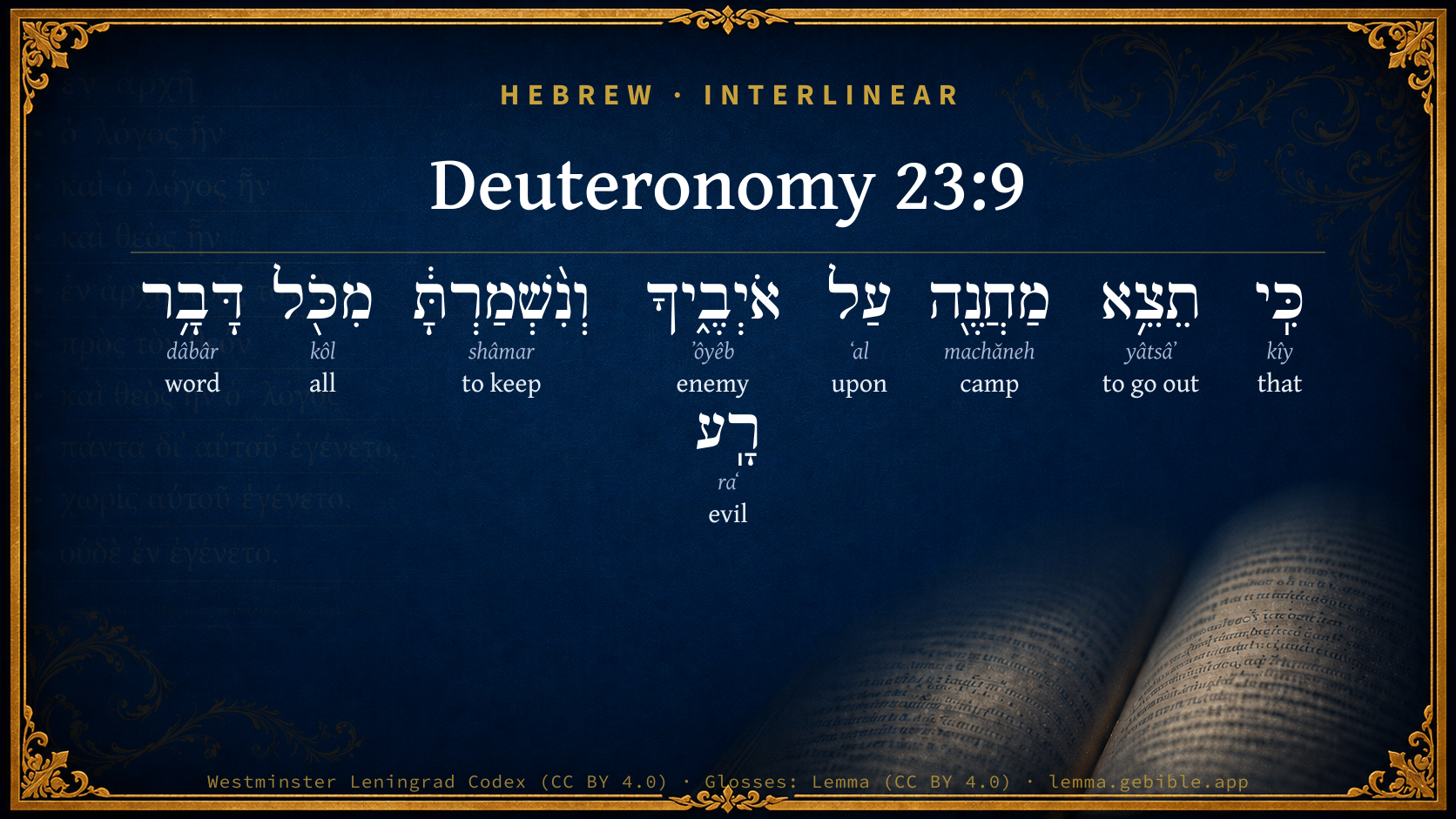
Hebrew (Westminster Leningrad Codex) Deuteronomy 23:9 appears in the Hebrew Old Testament. The text above is from the Westminster Leningrad Codex. Each word links to its Strong’s number, a concise gloss, and parsing drawn from the Open Scriptures Hebrew Bible morphology. Click any word for its full Brown-Driver-Briggs (BDB) entry.
Download image
Cite this verse

Deuteronomy 23:9 (World English Bible). Public Domain. Lemma interlinear Bible study tool, https://lemma.gebible.app/v/deuteronomy/23/9.

Show BibTeX & RIS
BibTeX
RIS
English Translation
When you go forth in camp against your enemies, then you shall keep you from every evil thing.
World English Bible · Public Domain
Download a study sheet

One document with this verse’s original text, its word-by-word gloss line, the meaning frame, cross-references with their text, attributed commentary, and full source and license credits — printable, and it pastes into notes with its structure intact.

This verse Autodidact and up

Study sheet (.html) Plain text (.txt)

A passage Seminary Student

Up to 50 verses in one chapter. A passage sheet keeps up to 6 commentary sources and 12 cross-references per verse, in the order this page ranks them, and says so on the sheet whenever that leaves anything out. Ask for a single verse and you get the Autodidact verse sheet above.

Everything on this page stays free to read, with no account — the sheet is a download of what is already on screen, not access to it.

Want to remove ads? Support Godless Engineer
Compare translations 3

The same verse in 3 English versions, stacked beneath the original-language interlinear above. Click any original word for its lexicon entry.

Each is an independent rendering of the whole verse — the interlinear is not word-aligned to these translations.

Highlighted words mark where these versions differ — a whole-verse word diff, not a word-by-word alignment.

  • World English Bible Public Domain
    When you go forth in camp against your enemies, then you shall keep you from every evil thing.
  • King James Version Public Domain
    When the host goeth forth against thine enemies, then keep thee from every wicked thing.
  • unfoldingWord Literal Text CC BY-SA 4.0
    When you go out in camp against your enemies, then you shall keep from every evil thing.

unfoldingWord Literal Text — © unfoldingWord, licensed CC BY-SA 4.0. Word-aligned USFM3 via Door43 (git.door43.org/unfoldingWord/en_ult).

Versions to compare (up to 4)

3 of 4 selected

Show all 18 translations

Every available English version of this verse, each an independent rendering of the whole verse.

  • World English Bible Public Domain
    When you go forth in camp against your enemies, then you shall keep you from every evil thing.
  • Berean Standard Bible Public Domain
    When you are encamped against your enemies, then you shall keep yourself from every wicked thing.
  • Majority Standard Bible Public Domain
    When you are encamped against your enemies, then you shall keep yourself from every wicked thing.
  • King James Version Public Domain
    When the host goeth forth against thine enemies, then keep thee from every wicked thing.
  • American Standard Version (1901) Public Domain
    When thou goest forth in camp against thine enemies, then thou shalt keep thee from every evil thing.
  • Revised Version (1885) Public Domain
    When thou goest forth in camp against thine enemies, then thou shalt keep thee from every evil thing.
  • Geneva Bible (1599) Public Domain
    When thou goest out with the host against thine enemies, keepe thee then from all wickednesse.
  • Douay-Rheims (1899) Public Domain
    When thou goest out to war against thy enemies, thou shalt keep thyself from every evil thing.
  • Young's Literal Translation Public Domain
    `When a camp goeth out against thine enemies, then thou hast kept from every evil thing.
  • Literal Standard Version CC BY-SA 4.0
    When a camp goes out against your enemies, then you have kept from every evil thing.
  • Unlocked Literal Bible CC BY-SA 4.0
    When you march out as an army against your enemies, then you must keep yourselves from every evil thing.
  • unfoldingWord Literal Text CC BY-SA 4.0
    When you go out in camp against your enemies, then you shall keep from every evil thing.
  • Darby Bible Public Domain
    When thou goest forth into camp against thine enemies, then keep thee from every evil thing.
  • World Messianic Bible Public Domain
    When you go out and camp against your enemies, then you shall keep yourselves from every evil thing.
  • Webster's Bible Public Domain
    When the host goeth forth against thy enemies, then keep thee from every wicked thing.
  • Free Bible Version CC BY-SA 4.0
    When you are in an army camp during a war with your enemies, make sure you avoid anything wrong.
  • Bible in Basic English Public Domain
    When you go out to war and put your tents in position, keep from every evil thing.
  • JPS Tanakh (1917) Public Domain
    (23-10) When thou goest forth in camp against thine enemies, then thou shalt keep thee from every evil thing.

Literal Standard Version (2020), Covenant Press — licensed CC BY-SA 4.0. Text via the HelloAO Bible API (eBible.org). Unlocked Literal Bible (unfoldingWord) — licensed CC BY-SA 4.0. Text via the HelloAO Bible API (eBible.org). unfoldingWord Literal Text — © unfoldingWord, licensed CC BY-SA 4.0. Word-aligned USFM3 via Door43 (git.door43.org/unfoldingWord/en_ult). Free Bible Version, Dr. Jonathan Gallagher — licensed CC BY-SA 4.0. Text via the HelloAO Bible API (eBible.org).

Word by word

More ways to search: Search by grammar → Find every occurrence → Compare this word →

Practice this passage: Drill this verse → Learn its vocabulary →

About this verse

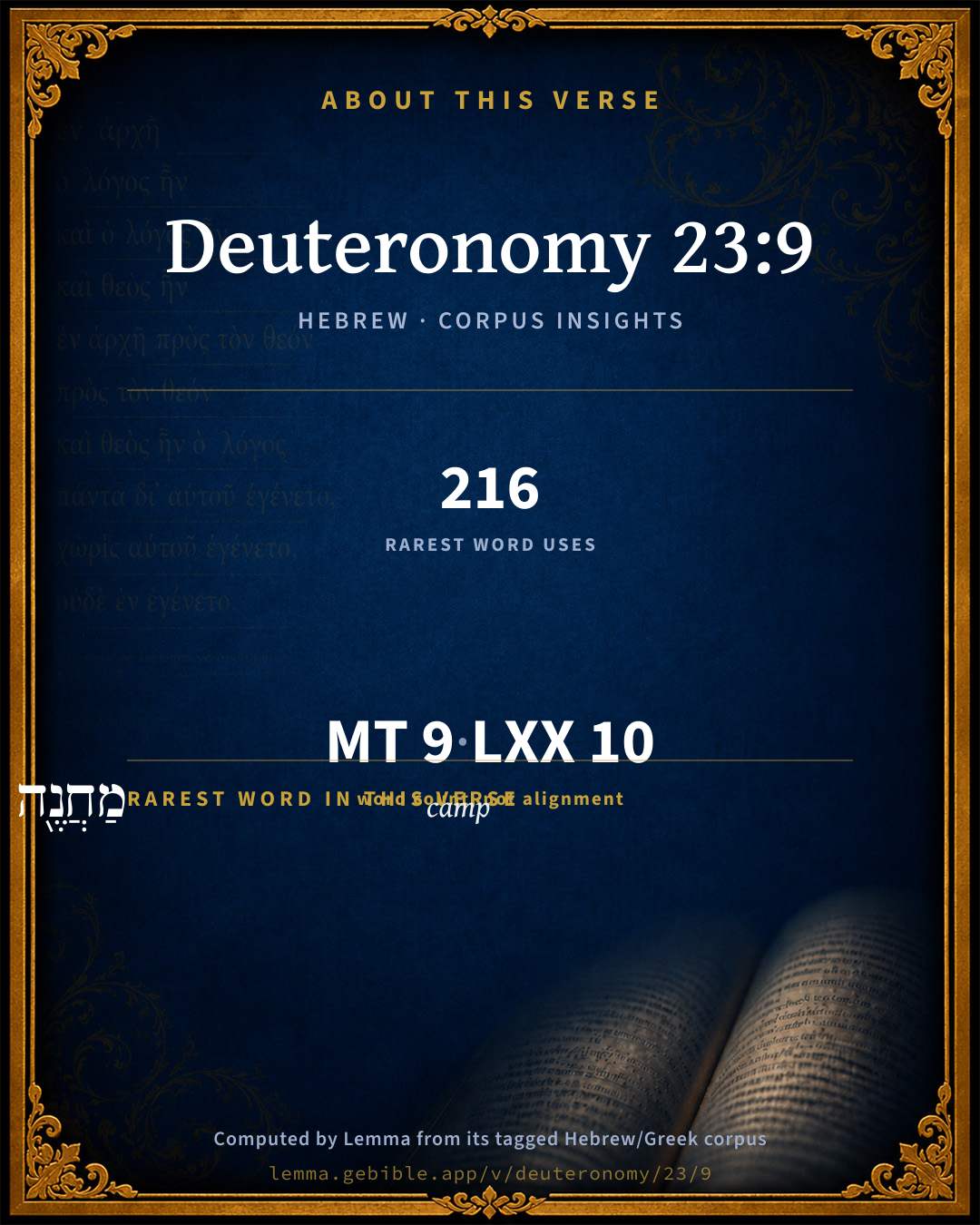
These counts appear in no published source. They are computed here, from the morphology-tagged text and Lemma’s own curated glosses. What Lemma adds →

9
words
9
distinct lemmas
Pentateuch
section

Grammatical profile

  • 3 verbs
  • 3 nouns
  • 1 adjective
  • 1 preposition
  • 1 conjunction

Verb forms

  • תֵצֵ֥א Qal · Imperfect
  • אֹיְבֶ֑יךָ Qal · Participle Active
  • וְנִ֨שְׁמַרְתָּ֔ Niphal · Sequential Perfect

Hebrew & Septuagint length

In English translation the verse runs 18 words from the Hebrew and 20 from the Septuagint (LXX English) — closely comparable.

A rough comparison of the two English renderings, which tokenize alike — not a word-level alignment.

Word counts can differ between the Hebrew and the Greek without any difference in meaning — e.g. the Hebrew direct-object marker אֵת has no separate Greek word, and Greek often adds the article ὁ.

In the original languages it is 9 Hebrew tokens and 10 Greek tokens — but the two are counted differently (Hebrew bundles its prefixes and suffixes into one token; the Greek is in lemma form), so that isn’t a like-for-like length.

Cross-references

7

Topical passages linked to Deuteronomy 23:9 in the Treasury of Scripture Knowledge — connected by theme and wording, ordered by reader-vote popularity; previews shown in the World English Bible.

  • Joshua 6:18 But as for you, only keep yourselves from the devoted thing, lest when you have devoted it, you take of the devoted thing; so would you make the camp of Israel accursed, and trouble it.
  • Revelation 19:11–14 I saw the heaven opened, and behold, a white horse, and he who sat on it is called Faithful and True. In righteousness he judges and makes war.
  • Joshua 7:11–13 Israel has sinned; yes, they have even transgressed my covenant which I commanded them: yes, they have even taken of the devoted thing, and have also stolen, and dissembled also; and they have even put it among their own stuff.
  • Judges 20:26 Then all the children of Israel, and all the people, went up, and came to Bethel, and wept, and sat there before Yahweh, and fasted that day until even; and they offered burnt-offerings and peace-offerings before Yahweh.
  • 2 Chronicles 19:4 Jehoshaphat lived at Jerusalem: and he went out again among the people from Beersheba to the hill-country of Ephraim, and brought them back to Yahweh, the God of their fathers.
  • 2 Chronicles 20:3–13 Jehoshaphat feared, and set himself to seek to Yahweh; and he proclaimed a fast throughout all Judah.
  • 2 Chronicles 31:20–32:22 Thus did Hezekiah throughout all Judah; and he worked that which was good and right and faithful before Yahweh his God.

Cross-references courtesy of OpenBible.info (CC BY 4.0).

Hebrew and Greek witnesses Masoretic Hebrew ↔ Greek Septuagint

The same verse in the two great witnesses to the Old Testament, shown verse-for-verse.

These are two independent witnesses, not word-aligned to each other, and the Septuagint is shown in lemma (dictionary) form.

Hebrew Deuteronomy 23:9 Masoretic · Westminster Leningrad Codex

כִּֽי תֵצֵ֥א מַחֲנֶ֖ה עַל אֹיְבֶ֑יךָ וְנִ֨שְׁמַרְתָּ֔ מִכֹּ֖ל דָּבָ֥ר רָֽע

When you go forth in camp against your enemies, then you shall keep you from every evil thing.

World English Bible · Public Domain

Greek LXX Deuteronomy 23:9 Septuagint · lemma form

υἱός ἐάν γίγνομαι αὐτός γενεά τρίτος εἰςἔρχομαι εἰς ἐκκλησία κύριος

And if you should go forth to engage with your enemies, then you shall keep you from every wicked thing.

LXX2012 (modern English Septuagint) · Public Domain

On this verse, Ellicott's Commentary for English Readers discusses the Septuagint’s reading. Read the note in Commentary ↓

Hebrew: Westminster Leningrad Codex (CC BY 4.0). Greek: Septuagint (public domain); English from LXX2012 (modern English Septuagint) (Public Domain). How the Septuagint differs from the Hebrew →

Targum (Aramaic paraphrase)

2

The Targum is the ancient Jewish Aramaic paraphrase of the Hebrew Scriptures — an interpretive translation, not the Hebrew text itself. Onkelos (literal) and Pseudo-Jonathan (expansive) render the Torah, and Jonathan the Prophets. Coverage is partial: where no permissively-licensed English translation exists for a verse, only the Aramaic is shown. This is verse-level text, not a word-by-word alignment to the Hebrew.

  1. Targum Onkelos Torah (Genesis–Deuteronomy)
    בְּנִין דִי יִתְיְלִידוּ לְהוֹן דָרָא תְלִיתָאָה יִדְכֵּי לְהוֹן לְמֵעַל בִּקְהָלָה דַיְיָ

    (no public-domain English translation for this verse)

    Targum Onkelos — Aramaic: “Onkelos Genesis” (public domain); “Onkelos Exodus” (public domain); “Onkelos Leviticus” (public domain); “Onkelos Numbers” (public domain); “Onkelos Deuteronomy” (public domain). English: “Sefaria Community Translation” (CC0 1.0 (public-domain dedication)); “J.W. Etheridge. The Targums of Onkelos and Jonathan Ben Uzziel on the Pentateuch. London: Longmans, Green, 1862” (public domain). Text via Sefaria.

  2. Targum Pseudo-Jonathan Torah (Genesis–Deuteronomy)
    בְּנִין דְּמִתְיַלְדִין לְהוֹן דַּר תְּלִיתָאָה יִדְכּוּן לְמִסְבָּא מֵעַם קְהָלָה דַיְיָ

    The children who are born to them in the third generation shalt be fit to take wives from the people of the congregation of the Lord.

    Targum Pseudo-Jonathan — Aramaic: “Targum Jonathan on Genesis” (public domain); “Targum Jonathan on Exodus” (public domain); “Targum Jonathan on Leviticus” (public domain); “Targum Jonathan on Numbers” (public domain); “Targum Jonathan on Deuteronomy” (public domain). English: “The Targum of Jonathan ben Uzziel, trans. J. W. Etheridge, London, 1862” (public domain). Text via Sefaria.

Commentary

Notes on Deuteronomy 23:9 from classic Christian and Jewish commentators (each source and its license shown beneath its notes). The classic Christian expositions comment on the surrounding passage and are grouped to its opening verse, so a note may address several verses; the Jewish commentaries on the Tanakh (Rashi and others) are per-verse, so they appear only where the commentator wrote on this verse.

Lemma curates 59 commentaries, every one of them public domain or Creative Commons licensed, each selected and text-cleaned for this edition rather than reprinted as found. About our sources →

Matthew Henry's Commentary

Israel was now encamped, and this vast army was just entering upon action, which was likely to keep them together for a long time, and therefore it was fit to give them particular directions for the good ordering of their camp. And the charge is in one word to be clean. They must take care to keep their camp pure from moral, ceremonial, and natural pollution.

I. From moral pollution (Deu 23:9): When the host goes forth against thy enemy then look upon thyself as in a special manner engaged to keep thyself from every evil thing. 1. The soldiers themselves must take heed of sin, for sin takes off the edge of valour; guilt makes men cowards. Those that put their lives in their hands are concerned to make and keep their peace with God, and preserve a conscience void of offence; then may they look death in the face without terror. Soldiers, in executing their commission, must keep themselves from gratifying the lusts of malice, covetousness, or uncleanness, for these are wicked things - must keep themselves from the idols, or accursed things, they found in the camps they plundered. 2. Even those that tarried at home, the body of the people, and every particular person, must at that time especially keep from every wicked thing, lest by sin they provoke God to withdraw his presence from the host, and give victory to the enemy for the correcting of his own people. Times of war should be times of reformation, else how can we expect God should hear and answer our prayers for success? Psa 66:18. See Sa1 7:3.

II. From ceremonial pollution, which might befal a person when unconscious of it, for which he was bound to wash his flesh in water, and look upon himself as unclean until the evening, Lev 15:16. A soldier, notwithstanding the constant service and duty he had to do in the camp, must be so far from looking upon himself as discharged from the observance of this ceremony that more was required from him than at another time; had he been at his own house, he needed only to wash his flesh, but, being in the army, he must go abroad out of the camp, as one concerned to keep it pure and ashamed of his own impurity, and not return till after sunset, Deu 23:10, Deu 23:11. By this trouble and reproach, which even involuntary pollutions exposed men to, they were taught to keep up a very great dread of all fleshly lusts. It were well if military men would consider this.

III. From natural pollution; the camp of the Lord must have nothing offensive in it, Deu 23:12-14. It is strange that the divine law, or at least the solemn order and direction of Moses, should extend to a thing of this nature; but the design of it was to teach them, 1. Modesty and decorum; nature itself teaches them thus to distinguish themselves from beasts that know no shame. 2. Cleanliness, and, though not niceness, yet neatness, even in their camp. Filthiness is offensive to the senses God has endued us with, prejudicial to the health, a wrong to the comfort of human life, and an evidence of a careless slothful temper of mind. 3. Purity from the pollutions of sin; if there must be this care taken to preserve the body clean and sweet, much more should we be solicitous to keep the mind so. 4. A reverence of the divine majesty. This is the reason here given: For the Lord thy God walketh by his ark, the special token of his presence, in the midst of thy camp; with respect to that external symbol this external purity is required, which (though not insisted on in the letter when that reason ceases) teaches us to preserve inward purity of soul, in consideration of the eye of God, which is always upon us. By this expression of respect to the presence of God among them, they were taught both to fortify themselves against sin and to encourage themselves against their enemies with the consideration of that presence. 5. A regard one to another. The filthiness of one is noisome to many; this law of cleanliness therefore teaches us not to do that which will be justly offensive to our brethren and grieve them. It is a law against nuisances.

Matthew Henry's Commentary on the Whole Bible (1708–1710) — public domain (CC PDM 1.0). Text via the HelloAO Bible API.

Ellicott's Commentary for English Readers

Deu_23:9-14. PURITY OF THE CAMP.

(9) When the host goeth forth against thine enemies . . . keep thee.—“Because Satan maketh his accusations in the hour of danger” (Rashi).

(10) Uncleanness that chanceth him by night. As in Lev_15:16.

(11) When the sun is down.—“No man is clean (after ceremonial uncleanness) except at the going down of the sun” (Rashi).

(12) Without the camp.—It must not be forgotten that this is the camp of the army, not the whole encampment of Israel in the wilderness. The entire passage is continuous from Deu_23:9. Hence the whole discussion raised, after the appearance of Dr. Colenso’s work, on the size of the camp of Israel and the possibility of obeying this rule, was simply waste of words, and arose out of a misunderstanding of the matter under consideration. The sanitary value of the rule has been abundantly demonstrated in our own day.

(13) A paddle—rather, a pin, or spike, like that with which Jael slew Sisera. The word for “weapon” does not occur elsewhere. The LXX. translates it “a pin or tent-peg at thy girdle;” the Hebrew word (âzên) being like the Greek (ζώνη). But both Targums interpret the word as “weapon,” connecting it with the Hebrew zayin, which has that meaning. The hinder end of the spear in Abner’s hand was sharp enough to strike Asahel a fatal blow when he followed him (2Sa_2:23). Saul’s spear also was “stuck in the ground at his bolster” (1Sa_26:7), probably with its point upwards, by the same spike.

(14) For the Lord thy God walketh in the midst of . . . thee.—A most beautiful argument for purity in every sense. It was evidently present to St. Paul’s mind in 2Co_6:16 to 2Co_7:1, “God hath said, I will dwell in them, and walk in them. . . . Having therefore these promises . . . let us cleanse ourselves from all filthiness of the flesh and spirit, perfecting holiness in the fear of God.”

A Bible Commentary for English Readers, edited by Charles John Ellicott (1878–1897) — public domain. Text from a community e-Sword module.

Trapp's Complete Commentary

John Trapp

Deu 23:9 When the host goeth forth against thine enemies, then keep thee from every wicked thing.

Ver. 9. Then keep thee from every wicked thing.] Walk accurately, as carrying thy life in thy hand; for "the sword devoureth one as well as another," {2Sa 11:25} it spares neither lord nor losel, as they say. Every soldier therefore should be a saint, ready pressed to meet the Lord, who hath said, "I will be sanctified in all them that draw near unto me." {Lev 10:3}

John Trapp, A Commentary or Exposition upon All the Books of the Old and New Testament (1647–1656) — public domain. Text from a community e-Sword module.

Joseph Benson's Commentary

Deu 23:9. Keep from every wicked thing — Then especially take heed, because that is a time of confusion and licentiousness; when the laws of God and man cannot be heard for the noise of arms; because the success of thy arms depends upon God’s blessing, which wicked men have no reason to expect; and because thou dost carry thy life in thy hand, and therefore hast need to be well prepared for death and judgment.

Joseph Benson's Commentary on the Old and New Testaments (1811–1818) — public domain. Text from a community e-Sword module.

Lange's Commentary on the Holy Scriptures

Israel in Camp

Deu_23:9-14

9When the host goeth forth against [upon] thine enemies, then keep thee from every wicked thing. 10If there be among you any man that is not clean by reason of uncleanness that chanceth him by night [clean from accident by], then shall Hebrews 11 go abroad out of [beyond] the camp, he shall not come within the camp: But [And] it shall be, when evening1 cometh on, he shall wash himself with water: and when the sun is down, he shall come into the camp again. 12Thou shalt have a place [room—literally hand] also without the camp, whither thou shalt go forth abroad: 13And thou shalt have a paddle upon thy weapon2 [beside thy weapon]; and it shall be when thou wilt ease thyself3 abroad, thou shalt dig therewith, and shalt turn back, and cover that which cometh from thee: 14For the Lord thy God walketh in the midst of thy camp, to deliver thee, and to give up thine enemies before thee; therefore shall thy camp [and thy camp shall] be holy: that he see no4 [and he shall not see] unclean thing in thee, and turn away from thee.

EXEGETICAL AND CRITICAL

The civil sanctity of Israel has its corresponding manifestation, and indeed first of all in the field, Deu_23:9, upon the march to war. It must then be so, more than in Num_5:2 sq., since they then stand opposed to the heathen, and indeed in their noblest manhood (chap. 20). דבר רע, comp. Deu_17:1, here defilement, Deu_23:10, as explained Lev_15:16 sq. (1Sa_20:26). No further specification, because sufficiently clear from the earlier law-giving. Deu_23:11. (Gen_24:63.) At sunset he might come into the camp. Deu_23:12 respects not only cleanliness, but stands as a representative of purity in every sense. “Not everywhere, and still less in the camp.” Knobel. Deu_23:13. יָתֵד, the fixed, stable, hence the wooden nail, the tent-peg, but also to fix fast; hence the thrusting, penetrating instrument. אָזֵן, furniture, war-weapon or utensil. Deu_23:14. The presence of Jehovah is the reason for the sanctity, and therefore for the sanctification of the camp, Deu_20:1; Deu_20:4; Deu_1:8 (2Co_6:16).—Unclean (nakedness, from ערה) of a thing, i.e. any nakedness, which could not exist without destroying or injuring the reverence for Jehovah.

HOMILETICAL AND PRACTICAL

Deu_23:9. Times of war are usually times of girdled, straitened life. Randglosse: “That you may not be censurable, and so lose the victory, as a punishment, as at the time of Eli and Saul.” Piscator: “How can we contend successfully with our enemies? When the soldiers put away evil from themselves.” [Bib. Com.: “The ordinary rules of religion and morality were relaxed in times of war among other nations; but Israel must then shun every wicked thing.” Wordsworth: “The Lord of battles walks in the midst of camps; the soldier’s life should be a holy and religious one. Our unholiness makes our enemies powerful against us.”—A. G.]

Deu_23:10. Starke: “Soldiers should cultivate assiduously every virtue, especially that of purity.” Deu_23:11. Starke: “Without real purity and holiness no one can enter the heavenly camp, Eph_5:5.” Deu_23:12-13. Schultz: “Since heedlessness, indeed rudeness with respect to the community, manifests itself in these trifling and most external things, as well as in those which are greater, the ordinance is of great importance even now, although the conduct in the physical region may not now be regarded as a preparatory exercise with respect to moral conduct.” Deu_23:14. Starke: “He who is not ashamed before men, disgraces himself before God.” Berl. Bib.: “We have here a sensible representation of the militant Church of God.” Piscator: “The Christian Church is a holy camp of the eternal sons of God wherein God dwells, and nothing disgraceful should be seen.” [Wordsworth: “The Lord Christ dwelleth and walketh in the midst of us, and preaches to us all: ‘Be ye holy, for I am holy,’ Rev_1:13.”—A. G.]

Footnotes:

[1][Deu_23:11. Marg.: turning toward, literally at the turning of the evening.—A. G.].

[2][Deu_23:13. Sept. and Vulg.: upon thy girdle. Heb.: sharp-pointed utensil. Some MSS. have the plural: among thy utensils. So Gesenius.—A. G.].

[3][Deu_23:13. Marg. literally: thou sittest down or in thy sitting down.—A. G.].

[4][Deu_23:14. Schroeder as the Marg.: nakedness of a thing.—A. G.].

Lange's Commentary on the Holy Scriptures (Critical, Doctrinal, and Homiletical), ed. John Peter Lange, English translation edited by Philip Schaff (1864–1880) — public domain. Text from a community e-Sword module.

Jamieson, Fausset & Brown

Robert Jamieson, A. R. Fausset & David Brown

When the host goeth forth against thine enemies, then keep thee from every wicked thing--from the excesses incident to camp life, as well as from habits of personal neglect and impurity.

Jamieson, Fausset & Brown — Commentary Critical and Explanatory on the Whole Bible (1871) — public domain (CC PDM 1.0). Text via the HelloAO Bible API.

John Gill's Exposition

When the host goeth forth against thine enemies,.... An army of soldiers march in order to meet the enemy and fight him:

then keep thee from every wicked thing; the Targum of Jonathan adds, by way of explanation,"from strange worship, uncovering of nakedness, and from shedding innocent blood;''that is, from idolatry, uncleanness of every sort, and murder; and all other wickednesses ought to be abstained from at all times by all persons, but especially by soldiers in such a circumstance, just going to battle; since sin committed weakens natural courage, as it loads the conscience with guilt; and since victory and success, which depend upon the blessing of God on arms, cannot be reasonably expected, where vices of all sorts are indulged and abound; and especially seeing such are about to expose their lives to the utmost danger, and know not but that in a few hours they must exchange this life for another, and appear before God, the Judge of all, against whom they sin; and yet how little are these things thought of by such in common! it was the wisdom of the Jewish legislature, which was of God, to inculcate such things into the minds of their soldiers.

John Gill's Exposition of the Whole Bible (1746–1763) — public domain (CC PDM 1.0). Text via the HelloAO Bible API.

Albert Barnes' Notes on the Bible

The whole passage refers not to the encampments of the nation while passing from Egypt through the wilderness, but to future warlike expeditions seat out from Canaan.

Albert Barnes' Notes on the Bible (1834–1885) — public domain. Text from a community e-Sword/MySword module.

Haydock's Catholic Bible Commentary

Thing, rapine, libertinage, &c., which are but too common among soldiers. (Calmet) --- We know what instructions St. John the baptist gave to those who followed that lawful profession, Luke iii. 14. (Haydock)

George Leo Haydock (1774–1849), Haydock's Catholic Family Bible and Commentary, 1859 edition — public domain. Excludes Psalms (Douay-Rheims chapter numbering differs from Protestant) and Deuterocanonical books (Catholic canon only).

Matthew Poole's English Annotations

Then especially take heed, because that is a time and state of confusion and licentiousness, when, as one said, the laws of God and man cannot be heard for the noise of arms; and because the success of thy arms and enterprises depends upon God’s blessing, which wicked men have no reason to expect; and because thou dost then carry thy life in thy hand, and therefore hast need to be well prepared for death and judgment.

Matthew Poole's English Annotations on the Holy Bible (1683–1685) — public domain. Text from a community e-Sword/MySword module.

Whedon's Commentary on the Bible

Daniel D. Whedon

9-14. When the host goeth forth — The purity of life in the camp, when they shall be engaged in future wars, is provided for in this passage.

Daniel D. Whedon (gen. ed.), Commentary on the Old and New Testaments (1874–1909) — public domain. Text from a community e-Sword module.

The Pulpit Commentary

Vers. 9-11 When the people went forth to war, all impurity and defilement was to be kept out of their comp. When the host goeth forth; literally, when thou goest forth as a camp or host. As in the wilderness the camp was to be kept pure, (Num_5:2, etc.) so also in the future, when they went out to war, all defilement was to be removed from their host. Every wicked thing; rather, every evil thing, evil in the sense of blemish or uncleanness. (cf. Deu_17:1)

Vers. 9-14Cleanliness a religious duty.

The Law of Moses may be regarded as fourfold moral, ritual, civil, and sanitary. The precepts in this paragraph are an example of the last-named part thereof. They refer to the inculcation of cleanliness, both in camp and in person. And not only so, but to the observance thereof in time of war. While, perhaps, at such times special evils would result from the neglect of such regulations, yet, on the other hand, it would be precisely when movements were irregular, uncertain, and attended with much excitement, that there would be the strongest tendency to fail in their observance. But no amount of war-pressure would be any excuse for uncleanliness. We get here, moreover, an illustration of that which so often occurs in the Law of Moses, viz. that duties of the lowest, humblest, and most common order are urged on the people by the highest and noblest sanctions; and many a teacher may find reason for urging to cleanliness of habit from such a text as ver. 14, "The Lord thy God walketh in the midst of thy comp... therefore shall thy camp be holy." The precise application of the text must, of course, vary with locality and circumstance; but the principle of it includes the following.

1. The presence of the Lord God is everywhere.

2. He is in the "camp" of his people as a special light and guard.

3. Hence every such home may be regarded as a temple of God, the palace of the Great King.

4. In such homes the most menial acts may be acts of service done for God; common work may be dignified by great motives.

5. It will be regarded by a wise Christian man as a part of his duty which is by no means to be neglected, to maintain order and unsullied cleanliness in person and home. This will be part of his life-worship the living translation of laborare est orare." This duty needs special enforcement in some quarters. Many a humble Christian cottager elevates his home and all therein, by having it so beautifully clean that, on every piece of furniture, on every wall, on every floor, it seems as if the words were graven, Holiness to the Lord.

Vers. 9-14. Purity in the comp.

The camp was to be free from:

1. Moral pollution (ver. 9).

2. Ceremonial pollution (vers.10, 11).

3. Natural pollution (vers. 12, 13) M. Henry.

This, because God was in its midst. He was there to work for their deliverance and for the confusion of their enemies. We are taught

I THAT MILITARY LIFE IS NO EXCUSE FOR LAXITY IN MORALS, OR FOR A LOWERED STANDARD OF PROPRIETY IN CONDUCT. The opposite opinion too commonly prevails. Immoralities are winked at in soldiers and sailors which would not be tolerated in ordinary society; nay, are sometimes half justified as a necessity of their situation. When public opinion is in this easy state, we cannot wonder that the individuals themselves are not very strict about their behavior. They find Acts passed, e.g. to protect them in their evil courses, and they naturally suppose that they have a kind of sanction for their immorality. Officers do not always set the men the best example. This is in every sense to be deplored. Immorality does not change its nature in the barrack-room or on the march. Rather, when "the host goes forth" we should try to put away from us "every wicked thing." Only then can we confidently expect God"s presence to go with us, or look to him for aid in battle. Compare Carlyle"s account of Cromwell"s army ("Cromwell," vol. 2., at end), and the "prayer-meeting" of the leaders. See also Baillie"s account of the encampment of the Scotch Covenanters at Dunse Law ("Letters," 1:211).

II THAT PURITY IS REQUIRED IN THE CAMP OF THE CHURCH, IF HER WARFARE IS TO BE SUCCESSFULLY ACCOMPLISHED. In spiritual conflicts, above all, we must look to spiritual conditions. The Church is an army of Christ. She is organized for aggressive and defensive warfare. Her only hope of success lies in the presence of the Lord with her. But can she hope for this presence if she is not careful to maintain her internal purity? True, she has no commission to search the heart, and must be content to allow tares to mingle with the wheat. (Mat_13:24-31) But it is within her province, in the exercise of discipline, to remove obvious scandals, and by rebuke and censure, as well as by positive teaching and persuasion, to keep down worldliness, irreligion, and sensuality, when these make their appearance m her midst. She ought to pray, labor, and use her authority for the maintenance of her purity. The purer she is internally the more resistless will she be in her assaults on evil without. J.O.

Vers. 9-14. A pure camp for a pure King.

After insisting on purity giving power in war (ver. 9), and giving direction to men about putting away uncleanness which may be due to natural causes, Moses urges the precaution, because the All-seeing One walketh through the camp, Inspector of all their ways (ver. 14). The directions here given might have been urged on sanitary grounds, but Moses puts them deliberately upon religious. For the experience among Orientals and Occidentals is that something more than sanitary reasons is needed to overcome man"s indolence and keep him clean.

I CLEANLINESS MAY BE RAISED INTO A PHASE OF GODLINESS. In the proverb it is said to be next to godliness; but here Moses makes it a part of godliness. Religion comes to the aid of science, and helps by its sanctions the wise regulations suggested by science. Witness how painfully slow remedial and sanitary measures are in getting adopted. It would be well if religion could aid the civil power in making sanitation a sacred thing in the eyes of the people,

The reason why cleanliness is not more sacred than it is, is a latent Manichaeanism, which seems to lurk in human nature; as if matter were essentially unholy, and could not be made sacred. But the religion of Christ lays hold of body as well as soul, and urges amens sana in corpore sago, and promises the perfection of its idea in a bodily resurrection. There is, consequently, a physical side to our religion, which should find expression in the consecration of cleanliness, and divers washings, and food and drink; all that religion may be a more manly and efficient thing. We believe thoroughly in the religious duty of denouncing dirt.

II RELIGION IS LIFE SPENT IN THE REALIZED PRESENCE OF GOD. "Thou God seest me" is the watchword of religion. When all our life is brought under his eye, when we believe that the commonest and most trivial things are not beneath his notice, when we desire to hide nothing from him by night or by day, then the light of his pure being illumines and regulates all, and the highest purity is reached. "Muscular Christianity" is a good idea, if by it we mean that Christianity has a physical as well,as spiritual sphere. No efforts of our own, muscular or otherwise, will ever save us; but, being saved by Divine grace, our whole being, muscles and all, is at God"s service. Religion in everything is the sense of God all through, and this should be our aim.

III GOD IS THE CAPTAIN ONLY OF THE PURE. A holy camp is the preliminary to God leading Israel successfully against the enemy (ver. 14). The pure in heart see God and follow him to victory. It is the state of the camp of Israel, not the state of their enemies, that is all important. If Israel is impure, it will soon prove impotent. The pure are, in the long run, the powerful. God is on the side, not of the heaviest, but of the purest battalions. Really religious men are ultimately, under God, victorious. R.M.E.

The Pulpit Commentary (1880–1919), ed. H.D.M. Spence-Jones & Joseph S. Exell — public domain. Text from a community e-Sword module.

John Wesley's Explanatory Notes

Keep from every wicked thing - Then especially take heed, because that is a time of confusion and licentiousness; when the laws of God and man cannot be heard for the noise of arms; because the success of thy arms depends upon God's blessing, which wicked men have no reason to expect; and because thou dost carry thy life in thy hand, and therefore hast need to be well prepared for death and judgment.

John Wesley, Explanatory Notes Upon the Whole Bible (1754–1765) — public domain. Text via the GEBible commentary corpus.

Keil & Delitzsch

C. F. Keil & F. Delitzsch

Preservation of the Purity of the Camp in Time of War. - The bodily appearance of the people was also to correspond to the sacredness of Israel as the congregation of the Lord, especially when they gathered in hosts around their God. "When thou marchest out as a camp against thine enemies, beware of every evil thing." What is meant by an "evil thing" is stated in Deu 23:10-13, viz., uncleanness, and uncleanliness of the body.

Deu 23:10-11

The person who had become unclean through a nightly occurrence, was to go out of the camp and remain there till he had cleansed himself in the evening. On the journey through the desert, none but those who were affected with uncleanness of a longer duration were to be removed from the camp (Num 5:2) but when they were encamped, this law was to apply to even lighter defilements.

Deu 23:12-13

The camp of war was also not to be defiled with the dirt of excrements. Outside the camp there was to be a space or place (יד, as in Num 2:17) for the necessities of nature, and among their implements they were to have a spade, with which they were to dig when they sat down, and then cover it up again. יתד, generally a plug, here a tool for sticking in, i.e., for digging into the ground.

Deu 23:14

For the camp was to be (to be kept) holy, because Jehovah walked in the midst of it, in order that He might not see "nakedness of a thing," i.e., anything to be ashamed of (see at Deu 24:1) in the people, "and turn away from thee." There was nothing shameful in the excrement itself; but the want of reverence, which the people would display through not removing it, would offend the Lord and drive Him out of the camp of Israel.

Keil & Delitzsch — Biblical Commentary on the Old Testament (1861–1891) — public domain (CC PDM 1.0). Text via the HelloAO Bible API. (Old Testament only.)

Kretzmann's Popular Commentary

Paul E. Kretzmann

Personal Cleanliness During Campaigns of War

v. 9. When the host, the army of Israel as represented by its camp of soldiers, goeth forth against thine enemies, then keep thee from every wicked thing, namely, from defilement and uncleanness of the body.

v. 10. If there be among you any man that is not clean by reason of uncleanness that chanceth him by night, Lev 15:16, then shall he go abroad out of the camp, he shall not come within the camp, go out and stay out;

v. 11. but it shall be when evening cometh on, when the day turns toward evening, he shall wash himself with water; and when the sun is down, he shall come into the camp again.

v. 12. Thou shalt have a place also without the camp whither thou shalt go forth abroad;

v. 13. and thou shalt have a paddle, a small spade, upon thy weapon, among the accoutrements or instruments of war which belonged to the outfit of every soldier; and it shall be when thou wilt ease thyself abroad, at the designated place, thou shalt dig therewith, and shalt turn back and cover that which cometh from thee, as a measure of sanitary precaution;

v. 14. for the Lord, thy God, walketh in the midst of thy camp to deliver thee and to give up thine enemies before thee; therefore shall thy camp be holy; that he see no unclean thing in thee and turn away from thee, not as though the easement in itself and the excrement were shameful, but its open presence could not be tolerated without destroying or injuring the reverence for Jehovah. Propriety and decency also in the matters here broached should be observed as a requirement of nature.

Paul E. Kretzmann, Popular Commentary of the Bible (1921–1924) — public domain. Text from a community e-Sword module.

unfoldingWord translationNotes

Door43 World Missions Community

When you march out as an army against your enemies, then you must keep yourselves

Moses speaks here to the Israelites as if they were one man, so the words "you" and "your" are singular. (See: Forms of You)

against your enemies

"to fight against your enemies"

keep yourselves from every evil thing

"keep yourselves away from all bad things"

any man who is unclean because of what happened to him at night

This is a polite way of saying that he had an emission of semen. AT: "any man who is unclean because he had an emission of semen while he was asleep" (See: Euphemism)

translationWords

evil

clean

unfoldingWord translationNotes — © Distant Shores Media and the Door43 World Missions Community, licensed CC BY-SA 4.0. Source: git.door43.org/Door43/en_tn.

Rashi

Rabbi Shlomo Yitzchaki (Rashi)

בנים אשר יולדו להם דור שלישי וגומר THE CHILDREN THAT ARE BORN UNTO THEM [MAY COME INTO THE ASSEMBLY] IN THEIR THIRD GENERATION — other nations, however, since they did not sin against you may be admitted at once if they acknowledge the tenets of Judaim. — Thus you learn that he who causes a man to sin does him greater harm than if he kills him, for he who kills him, kills him only as regards this world, while he who causes him to sin puts him out of this world and the world to come. Therefore Edom, though he met them with the sword was not to be abhorred utterly, and similarly the Egyptians who drowned them (their male children), while those (the Ammonites and Moabites) who caused them to sin were to be utterly abhorred (Sifrei Devarim 252:3).

Rashi on the Tanakh — English translations: “The Judaica Press complete Tanach with Rashi, translated by A. J. Rosenberg” (CC BY 4.0); “Pentateuch with Rashi's commentary by M. Rosenbaum and A.M. Silbermann, 1929-1934” (public domain); “The Metsudah Tanach series, Lakewood, N.J” (CC BY 4.0); and “The Book of Joshua, Metsudah Publications, 1997” (CC BY 4.0). Text via Sefaria.

Lesson kit

Teaching starters — assembled from the data on this page, not authored interpretation. Every prompt links to the verse data it draws on. Edit before teaching.

Deuteronomy, in the Pentateuch, opens this verse with 9 words (9 distinct Hebrew lemmas). Its most distinctive word is machăneh (“camp”). A historical commentator’s framing appears above. Read the whole chapter for the surrounding context.

Discussion questions

  1. The word machăneh carries the sense “camp.” How does it shape the verse?
  2. How does Joshua 6:18, which shares this passage’s theme, read alongside this verse?
  3. These translations render this verse differently. What is at stake in choosing one wording over another?
  4. «תֵצֵ֥א» is a Qal Imperfect verb. How does that grammatical form shape the action described?
  5. Compare how Matthew Henry's Commentary and Ellicott's Commentary for English Readers read this verse. Where do they agree or differ?

Things to notice

Reading settings

Reading text

Shown beneath each verse's original-language words.

Old Testament
Old Testament edition

Read the OT as the Masoretic Hebrew (MT) or the Greek Septuagint (LXX).

English shown for the Greek Septuagint (in the Hebrew ↔ Greek comparison).

Comparing translations? Open the Compare panel on any verse page to stack up to four side by side.