
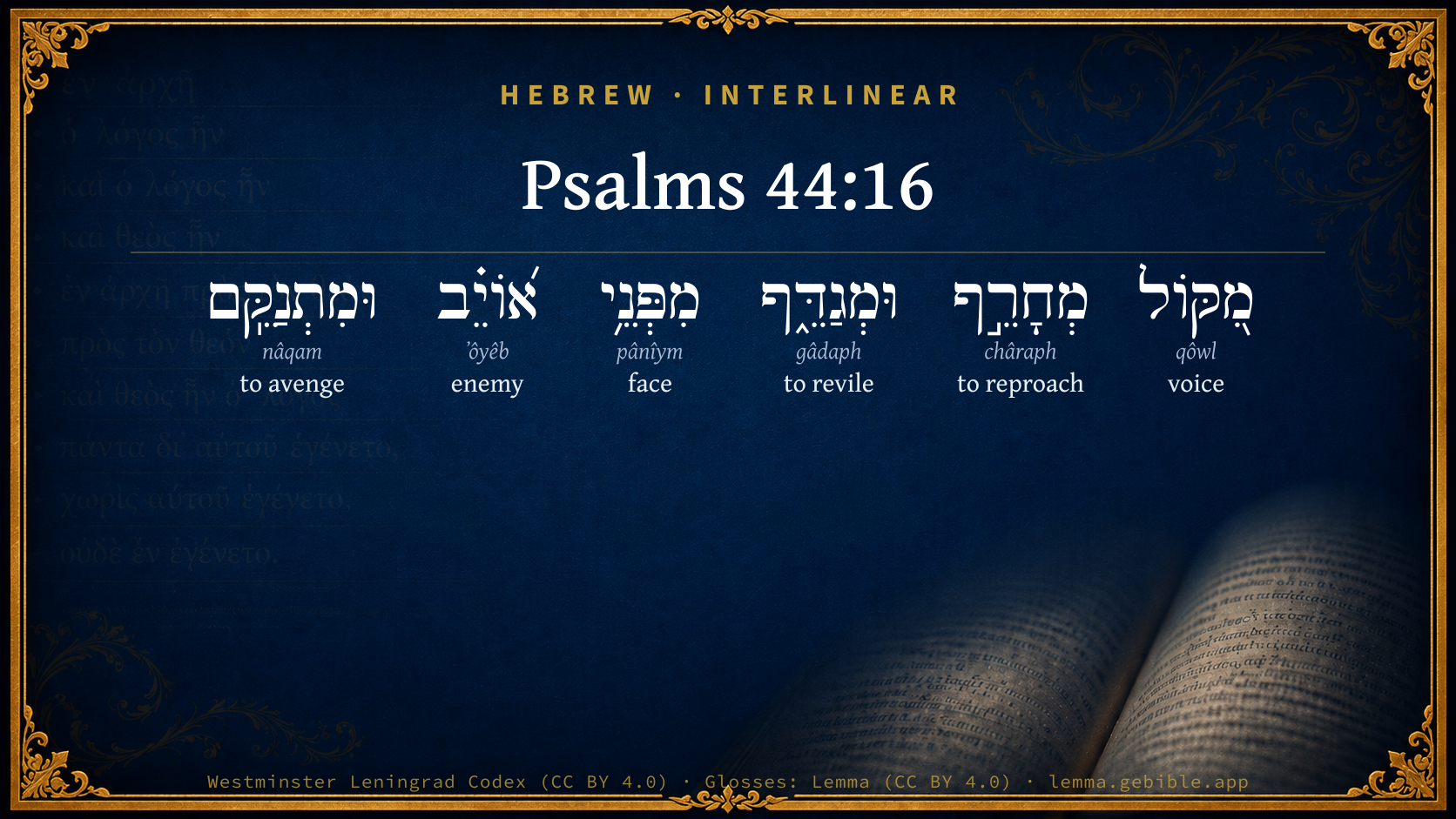
Psalms 44:16

Hebrew (Westminster Leningrad Codex) Psalms 44:16 appears in the Hebrew Old Testament. The text above is from the Westminster Leningrad Codex. Each word links to its Strong’s number, a concise gloss, and parsing drawn from the Open Scriptures Hebrew Bible morphology. Click any word for its full Brown-Driver-Briggs (BDB) entry.
Download image
Cite this verse

Psalms 44:16 (World English Bible). Public Domain. Lemma interlinear Bible study tool, https://lemma.gebible.app/v/psalms/44/16.

Show BibTeX & RIS
BibTeX
RIS
English Translation
At the taunt of one who reproaches and verbally abuses, Because of the enemy and the avenger.
World English Bible · Public Domain
Download a study sheet

One document with this verse’s original text, its word-by-word gloss line, the meaning frame, cross-references with their text, attributed commentary, and full source and license credits — printable, and it pastes into notes with its structure intact.

This verse Autodidact and up

Study sheet (.html) Plain text (.txt)

A passage Seminary Student

Up to 50 verses in one chapter. A passage sheet keeps up to 6 commentary sources and 12 cross-references per verse, in the order this page ranks them, and says so on the sheet whenever that leaves anything out. Ask for a single verse and you get the Autodidact verse sheet above.

Everything on this page stays free to read, with no account — the sheet is a download of what is already on screen, not access to it.

Want to remove ads? Support Godless Engineer
Compare translations 3

The same verse in 3 English versions, stacked beneath the original-language interlinear above. Click any original word for its lexicon entry.

Each is an independent rendering of the whole verse — the interlinear is not word-aligned to these translations.

Highlighted words mark where these versions differ — a whole-verse word diff, not a word-by-word alignment.

  • World English Bible Public Domain
    At the taunt of one who reproaches and verbally abuses, Because of the enemy and the avenger.
  • King James Version Public Domain
    For the voice of him that reproacheth and blasphemeth; by reason of the enemy and avenger.
  • unfoldingWord Literal Text CC BY-SA 4.0
    from the voice of one reproaching and one reviling, from the face of an enemy and one avenging.

unfoldingWord Literal Text — © unfoldingWord, licensed CC BY-SA 4.0. Word-aligned USFM3 via Door43 (git.door43.org/unfoldingWord/en_ult).

Versions to compare (up to 4)

3 of 4 selected

Show all 18 translations

Every available English version of this verse, each an independent rendering of the whole verse.

  • World English Bible Public Domain
    At the taunt of one who reproaches and verbally abuses, Because of the enemy and the avenger.
  • Berean Standard Bible Public Domain
    at the voice of the scorner and reviler, because of the enemy, bent on revenge.
  • Majority Standard Bible Public Domain
    at the voice of the scorner and reviler, because of the enemy, bent on revenge.
  • King James Version Public Domain
    For the voice of him that reproacheth and blasphemeth; by reason of the enemy and avenger.
  • American Standard Version (1901) Public Domain
    For the voice of him that reproacheth and blasphemeth, By reason of the enemy and the avenger.
  • Revised Version (1885) Public Domain
    For the voice of him that reproacheth and blasphemeth; by reason of the enemy and the avenger.
  • Geneva Bible (1599) Public Domain
    For the voyce of the slaunderer and rebuker, for the enemie and auenger.
  • Douay-Rheims (1899) Public Domain
    All the day long my shame is before me: and the confusion of my face hath covered me,
  • Young's Literal Translation Public Domain
    Because of the voice of a reproacher and reviler, Because of an enemy and a self-avenger.
  • Literal Standard Version CC BY-SA 4.0
    Because of the voice of a reproacher and reviler, || Because of an enemy and a self-avenger.
  • Unlocked Literal Bible CC BY-SA 4.0
    because of the voice of him who rebukes and insults, because of the enemy and the avenger.
  • unfoldingWord Literal Text CC BY-SA 4.0
    from the voice of one reproaching and one reviling, from the face of an enemy and one avenging.
  • Darby Bible Public Domain
    Because of the voice of him that reproacheth and blasphemeth; by reason of the enemy and the avenger.
  • World Messianic Bible Public Domain
    at the taunt of one who reproaches and verbally abuses, because of the enemy and the avenger.
  • Webster's Bible Public Domain
    \\44:15\\My confusion is continually before me, and the shame of my face hath covered me,
  • Free Bible Version CC BY-SA 4.0
    because of all the insults from the people mocking us, because our vengeful enemies are right in front of us.
  • Bible in Basic English Public Domain
    Because of the voice of him who says sharp and bitter words; because of the hater and him who is the instrument of punishment.
  • JPS Tanakh (1917) Public Domain
    (44-17) For the voice of him that taunteth and blasphemeth; by reason of the enemy and the revengeful.

Literal Standard Version (2020), Covenant Press — licensed CC BY-SA 4.0. Text via the HelloAO Bible API (eBible.org). Unlocked Literal Bible (unfoldingWord) — licensed CC BY-SA 4.0. Text via the HelloAO Bible API (eBible.org). unfoldingWord Literal Text — © unfoldingWord, licensed CC BY-SA 4.0. Word-aligned USFM3 via Door43 (git.door43.org/unfoldingWord/en_ult). Free Bible Version, Dr. Jonathan Gallagher — licensed CC BY-SA 4.0. Text via the HelloAO Bible API (eBible.org).

Word by word

More ways to search: Search by grammar → Find every occurrence → Compare this word →

Practice this passage: Drill this verse → Learn its vocabulary →

About this verse

These counts appear in no published source. They are computed here, from the morphology-tagged text and Lemma’s own curated glosses. What Lemma adds →

6
words
6
distinct lemmas
Wisdom
section

Notable vocabulary

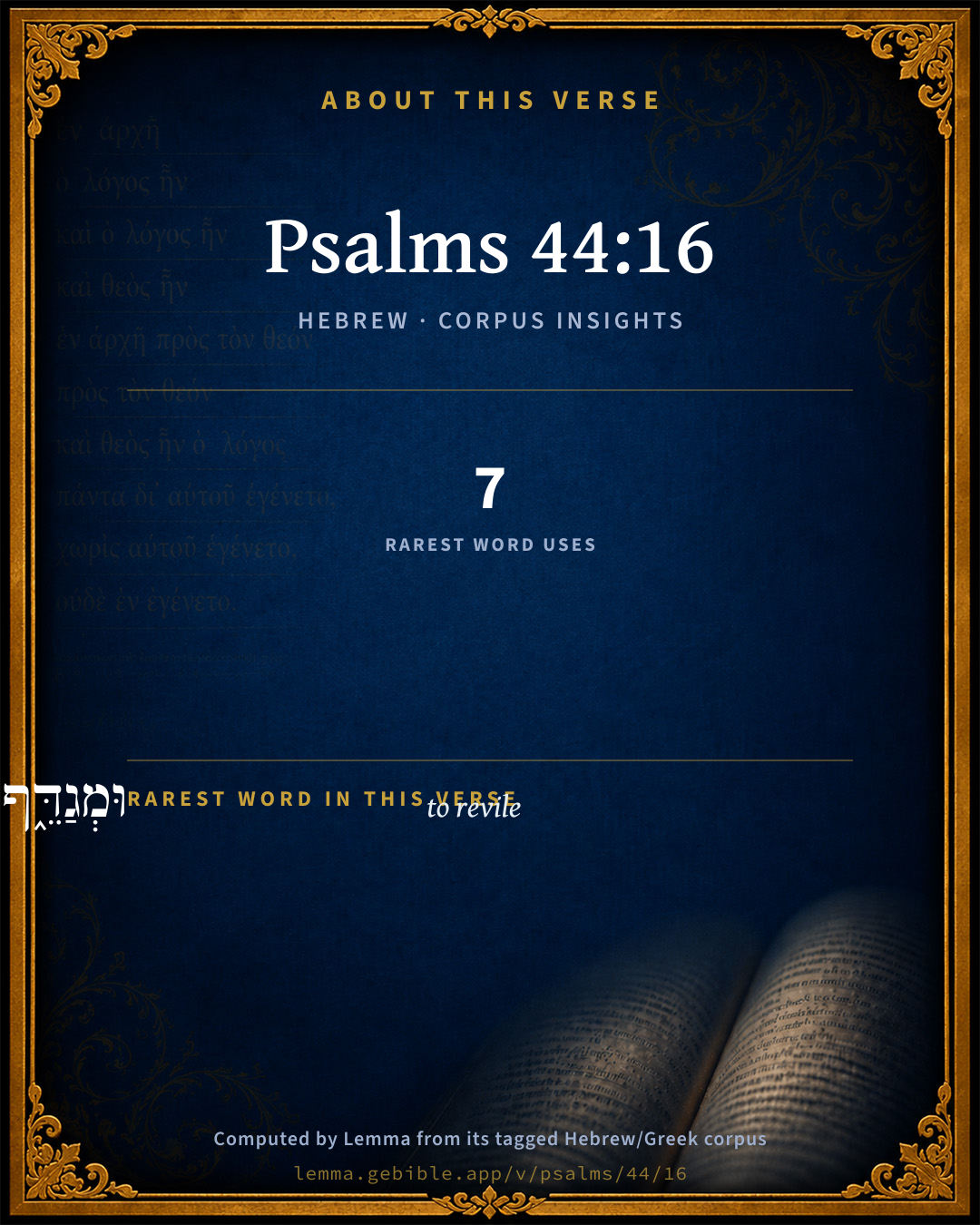
The rarest word here is וּמְגַדֵּ֑ף to revile H1442 — appearing just 7 times in the whole Hebrew Bible.

Shared distinctive vocabulary

וּמְגַדֵּ֑ף to revile H1442 occurs in 7 verses of the Hebrew Bible. Also found in:

Grammatical profile

  • 4 verbs
  • 2 nouns

Verb forms

  • מְחָרֵ֣ף Piel · Participle Active
  • וּמְגַדֵּ֑ף Piel · Participle Active
  • א֝וֹיֵ֗ב Qal · Participle Active
  • וּמִתְנַקֵּֽם Hithpael · Participle Active

Hebrew & Septuagint length

In English translation the verse runs 17 words from the Hebrew and 15 from the Septuagint (LXX English) — closely comparable.

A rough comparison of the two English renderings, which tokenize alike — not a word-level alignment.

Word counts can differ between the Hebrew and the Greek without any difference in meaning — e.g. the Hebrew direct-object marker אֵת has no separate Greek word, and Greek often adds the article ὁ.

Cross-references

8

Topical passages linked to Psalms 44:16 in the Treasury of Scripture Knowledge — connected by theme and wording, ordered by reader-vote popularity; previews shown in the World English Bible.

  • Psalms 8:2 From the lips of babes and infants you have established strength, Because of your adversaries, that you might silence the enemy and the avenger.
  • Psalms 74:10 How long, God, shall the adversary reproach? Shall the enemy blaspheme your name forever?
  • Psalms 74:18 Remember this, that the enemy has mocked you, Yahweh. Foolish people have blasphemed your name.
  • Psalms 74:22–23 Arise, God! Plead your own cause. Remember how the foolish man mocks you all day.
  • Psalms 79:12 Pay back to our neighbors seven times into their bosom Their reproach with which they have reproached you, Lord.
  • Isaiah 37:3–4 They said to him, Thus says Hezekiah, This day is a day of trouble, and of rebuke, and of rejection; for the children have come to the birth, and there is no strength to bring forth.
  • Isaiah 37:17 Turn your ear, Yahweh, and hear; open your eyes, Yahweh, and behold; and hear all the words of Sennacherib, who has sent to defy the living God.
  • Isaiah 37:23–24 Whom have you defied and blasphemed? and against whom have you exalted your voice and lifted up your eyes on high? [even] against the Holy One of Israel.

Cross-references courtesy of OpenBible.info (CC BY 4.0).

Hebrew and Greek witnesses Masoretic Hebrew ↔ Greek Septuagint

The same verse in the two great witnesses to the Old Testament, shown verse-for-verse.

You’re reading Greek Psalm 43 (Hebrew Psalm 44). The Septuagint counts the superscription, so verse numbers can differ from the Hebrew — chapter-level alignment, not verse-by-verse. Numbering follows Rahlfs.

These are two independent witnesses, not word-aligned to each other, and the Septuagint is shown in lemma (dictionary) form.

Hebrew Psalms 44:16 Masoretic · Westminster Leningrad Codex

מִ֭קּוֹל מְחָרֵ֣ף וּמְגַדֵּ֑ף מִפְּנֵ֥י א֝וֹיֵ֗ב וּמִתְנַקֵּֽם

At the taunt of one who reproaches and verbally abuses, Because of the enemy and the avenger.

World English Bible · Public Domain

Greek LXX Greek Psalm 43:16 Septuagint · lemma form

ὅλος ὁ ἡμέρα ὁ ἐντροπή ἐγώ κατεναντιόν ἐγώ εἰμί καί ὁ αἰσχύνη ὁ πρόσωπον ἐγώ καλύπτω ἐγώ

because of the voice of the slanderer and reviler; because of the enemy and avenger.

LXX2012 (modern English Septuagint) · Public Domain

Hebrew: Westminster Leningrad Codex (CC BY 4.0). Greek: Septuagint (public domain); English from LXX2012 (modern English Septuagint) (Public Domain). How the Septuagint differs from the Hebrew →

Commentary

Notes on Psalms 44:16 from classic Christian and Jewish commentators (each source and its license shown beneath its notes). The classic Christian expositions comment on the surrounding passage and are grouped to its opening verse, so a note may address several verses; the Jewish commentaries on the Tanakh (Rashi and others) are per-verse, so they appear only where the commentator wrote on this verse.

Lemma curates 59 commentaries, every one of them public domain or Creative Commons licensed, each selected and text-cleaned for this edition rather than reprinted as found. About our sources →

Trapp's Complete Commentary

John Trapp

Psa 44:16 For the voice of him that reproacheth and blasphemeth; by reason of the enemy and avenger.

Ver. 16. For the voice of him that reproacheth and blasphemeth] Reproacheth religion, blasphemeth God and his people, as if he eared not what became of them; and his dispensation seemeth to say as much: this reflecteth upon the saints, and maketh them cry out -

- Pudet haec opprobria nobis,

Et dici potuisse, et non potuisse refelli.

John Trapp, A Commentary or Exposition upon All the Books of the Old and New Testament (1647–1656) — public domain. Text from a community e-Sword module.

J. A. Alexander on Psalms

Joseph Addison Alexander

17. (Psa 44:16). From the voice of slanderer and reviler, from the face of enemy and avenger. The preposition indicates the source or the occasion of the shame described in the preceding verse. Face may here mean either presence or the expression of the countenance. The last word is properly a participle, and means taking vengeance or avenging one's self. Here, as in Psa 8:3 (2), it denotes a spiteful and revengeful enemy.

Joseph Addison Alexander, The Psalms Translated and Explained (1850) — public domain. Text from a community e-Sword module.

Geneva Bible (1599)

Geneva Bible translators

Meaning, the proud and cruel tyrant.

Geneva Bible (1599) marginal notes — public domain. Text via Bolls.life.

Jamieson, Fausset & Brown

Robert Jamieson, A. R. Fausset & David Brown

Its cause, the taunts and presence of malignant enemies (Psa 8:2).

Jamieson, Fausset & Brown — Commentary Critical and Explanatory on the Whole Bible (1871) — public domain (CC PDM 1.0). Text via the HelloAO Bible API.

The Cambridge Bible for Schools and Colleges

gen. ed. J. J. S. Perowne

16. For the voice of him that reproacheth and blasphemeth] The word reproach is frequently used of a heathen enemy’s scornful defiance or mocking derision of Israel and Israelites, and by consequence of Israel’s God, as though He were unable or unwilling to defend His people (Psa_42:10; Psa_74:10; Psa_74:18; Psa_74:22; Psa_79:4; Psa_79:12; 1Sa_17:10 ff.); but the two words are found in combination elsewhere only of Sennacherib’s blasphemous defiance (Isa_37:6; Isa_37:23 = 2Ki_19:6; 2Ki_19:22).

by reason of] Render for the looks of, or, for the presence of, as a better parallelism to for the voice of. Isaiah alludes to the terror inspired by the grim looks of the Assyrian invaders (Psa_33:19); and for voice cp. Isa_37:23; Nah_2:13.

the enemy and the avenger] Cp. Psa_8:2. The Heb. word for avenger suggests the idea of one who is taking a selfish vengeance, usurping, in his own interests, a function which belongs to God alone (Deu_32:35).

The Cambridge Bible for Schools and Colleges (gen. ed. J. J. S. Perowne; Cambridge University Press, 1878–1918) — public domain. Text from a community e-Sword module.

John Gill's Exposition

For the voice, of him that reproacheth and blasphemeth,.... That is, antichrist, to whom a mouth speaking blasphemies has been given, and which he has opened in blasphemy against God, attributing that to himself which belongs to God; blaspheming his name, his tabernacle, and them that well in heaven; see Rev 13:5;

by reason of the enemy and avenger; which are very proper characters of antichrist, who is the enemy of Christ and of his people, and breathes out vengeance against them; as the same titles are also given to the Scribes and Pharisees, the implacable enemies of Christ, Psa 8:2.

John Gill's Exposition of the Whole Bible (1746–1763) — public domain (CC PDM 1.0). Text via the HelloAO Bible API.

Albert Barnes' Notes on the Bible

For the voice of him ... - That is, Because I hear the voice of him that reproaches and blasphemes. The word rendered blasphemeth, means properly to use cutting words; then, to reproach or revile. It may be applied either to people or to God. In the former case, it means reproach or reviling; in the latter, blasphemy in the usual sense of that term, denoting reproachful words concerning God. The word may be used here in both these senses, as it is evident that not only were the people the subject of reproach, but that God was also.

By reason of the enemy - That is, the foreign enemies, or those who had invaded the land.

And avenger - Of him who had come to take vengeance. Here the word refers to the foreign enemies of the nation, and to the spirit by which they were actuated; their purposes to avenge themselves of what they regarded as wrongs, or take vengeance on a nation which they had long hated. Compare the notes at Psa 8:2.

Albert Barnes' Notes on the Bible (1834–1885) — public domain. Text from a community e-Sword/MySword module.

Matthew Poole's English Annotations

That reproacheth and blasphemeth; that doth not only reproach me, which I could better bear; but blaspheme God and our religion for our sakes, which is intolerable to me.

The enemy and avenger; who executeth both God’s and his own vengeance upon me, persecuting me with a despiteful hatred, and with great cruelty.

Matthew Poole's English Annotations on the Holy Bible (1683–1685) — public domain. Text from a community e-Sword/MySword module.

The Treasury of David

Charles H. Spurgeon

Ver. 16. For the voice of him that reproacheth and blasphemeth. It seems that from mocking the people of God, the adversaries advanced to reviling God himself, they proceeded from persecution to the sin which is next of kin, namely blasphemy. By reason of the enemy and avenger. The enemy boasted of avenging the defeats of their forefathers; they took revenge for the ancient victories of Israel, by insulting over the now fallen people. Here was a sad plight for a nation to be placed in, but it was by no means a hopeless case, for the Lord who brought all this evil upon them could with equal ease release them from it. So long as Israel looked alone to her God, and not to her own arm, no foe could retain her beneath his foot; she must arise, for God was on her side.

None.

None.

Psalms 44:17*

Charles H. Spurgeon's The Treasury of David (1869–1885) — public domain. Psalms only. Text from a community e-Sword/MySword module.

The Pulpit Commentary

For the voice of him that re-proacheth and blasphemeth. The reproaches of the heathen were most commonly "blasphemies," since they consisted very mainly of contemptuous expressions against the God of Israel. (see the comment on ver. 13; and comp. Isa_37:3, Isa_37:23) By reason of the enemy and avenger. The persons by whom the blasphemous reproaches were uttered Israel"s enemies bent on avenging former losses and defeats.

The Pulpit Commentary (1880–1919), ed. H.D.M. Spence-Jones & Joseph S. Exell — public domain. Text from a community e-Sword module.

John Wesley's Explanatory Notes

Avenger - Who executeth both God's and his own vengeance upon me.

John Wesley, Explanatory Notes Upon the Whole Bible (1754–1765) — public domain. Text via the GEBible commentary corpus.

Lesson kit

Teaching starters — assembled from the data on this page, not authored interpretation. Every prompt links to the verse data it draws on. Edit before teaching.

Psalms, in the Wisdom, opens this verse with 6 words (6 distinct Hebrew lemmas). Its most distinctive word is gâdaph (“to revile”). A historical commentator’s framing appears above. Read the whole chapter for the surrounding context.

Discussion questions

  1. How does “to revile” (gâdaph) shape what this verse is saying?
  2. How does Numbers 15:30, which shares the word «to revile», read alongside this verse?
  3. The translations on this page render this verse differently — a whole-verse word diff, not a word-by-word alignment. What might account for the different wordings?
  4. «מְחָרֵ֣ף» is a Piel Participle Active verb. How does that grammatical form shape the action described?
  5. Compare how Trapp's Complete Commentary and J. A. Alexander on Psalms read this verse. Where do they agree or differ?

Things to notice

Reading settings

Reading text

Shown beneath each verse's original-language words.

Old Testament
Old Testament edition

Read the OT as the Masoretic Hebrew (MT) or the Greek Septuagint (LXX).

English shown for the Greek Septuagint (in the Hebrew ↔ Greek comparison).

Comparing translations? Open the Compare panel on any verse page to stack up to four side by side.