
Deuteronomy 25:19

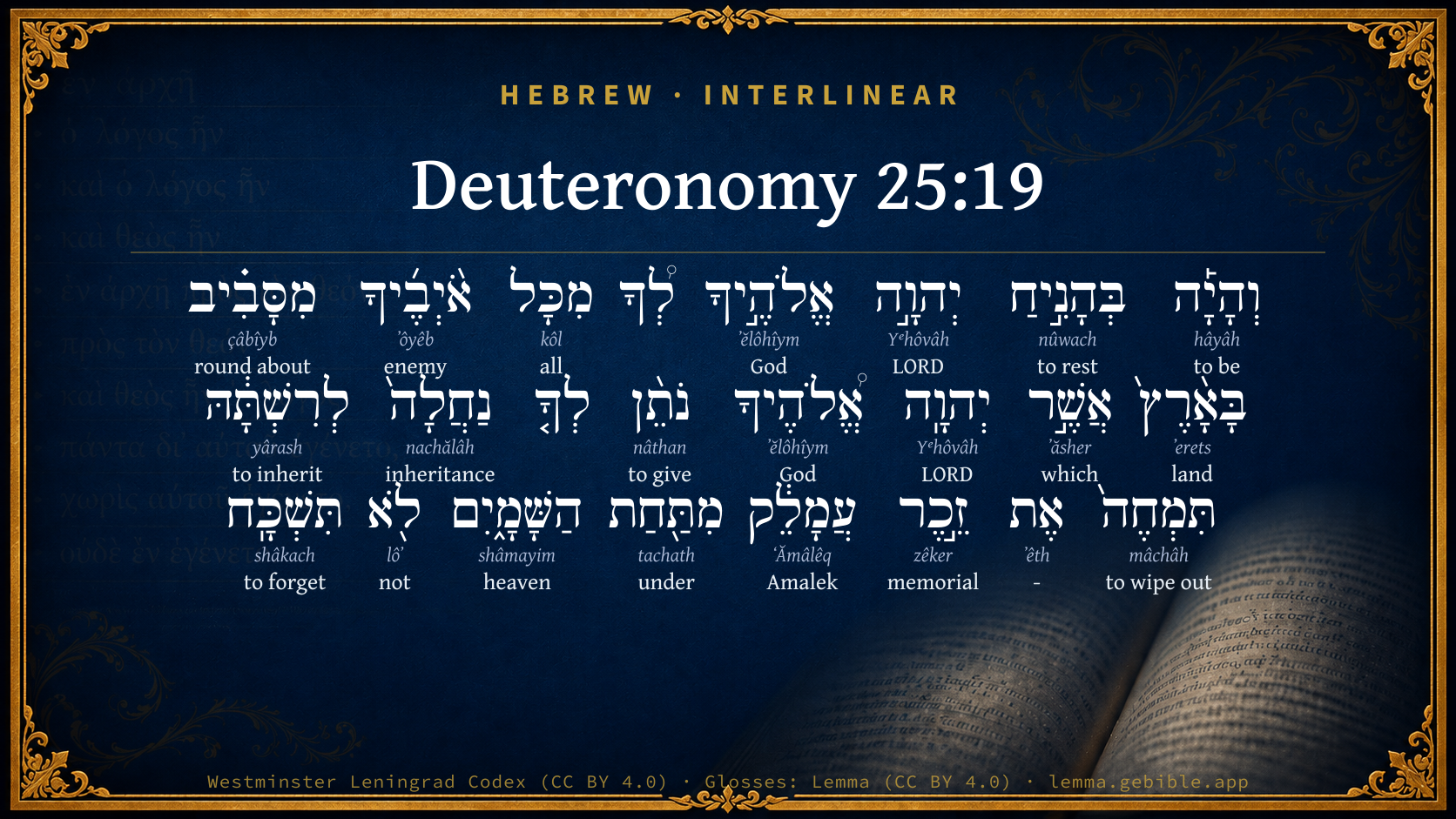
Hebrew (Westminster Leningrad Codex) Deuteronomy 25:19 appears in the Hebrew Old Testament. The text above is from the Westminster Leningrad Codex. Each word links to its Strong’s number, a concise gloss, and parsing drawn from the Open Scriptures Hebrew Bible morphology. Click any word for its full Brown-Driver-Briggs (BDB) entry.
Download image
Cite this verse

Deuteronomy 25:19 (World English Bible). Public Domain. Lemma interlinear Bible study tool, https://lemma.gebible.app/v/deuteronomy/25/19.

Show BibTeX & RIS
BibTeX
RIS
English Translation
Therefore it shall be, when Yahweh your God has given you rest from all your enemies round about, in the land which Yahweh your God gives you for an inheritance to possess it, that you shall blot out the memory of Amalek from under the sky; you shall not forget.
World English Bible · Public Domain
Download a study sheet

One document with this verse’s original text, its word-by-word gloss line, the meaning frame, cross-references with their text, attributed commentary, and full source and license credits — printable, and it pastes into notes with its structure intact.

This verse Autodidact and up

Study sheet (.html) Plain text (.txt)

A passage Seminary Student

Up to 50 verses in one chapter. A passage sheet keeps up to 6 commentary sources and 12 cross-references per verse, in the order this page ranks them, and says so on the sheet whenever that leaves anything out. Ask for a single verse and you get the Autodidact verse sheet above.

Everything on this page stays free to read, with no account — the sheet is a download of what is already on screen, not access to it.

Want to remove ads? Support Godless Engineer
Compare translations 3

The same verse in 3 English versions, stacked beneath the original-language interlinear above. Click any original word for its lexicon entry.

Each is an independent rendering of the whole verse — the interlinear is not word-aligned to these translations.

Highlighted words mark where these versions differ — a whole-verse word diff, not a word-by-word alignment.

  • World English Bible Public Domain
    Therefore it shall be, when Yahweh your God has given you rest from all your enemies round about, in the land which Yahweh your God gives you for an inheritance to possess it, that you shall blot out the memory of Amalek from under the sky; you shall not forget.
  • King James Version Public Domain
    Therefore it shall be, when the LORD thy God hath given thee rest from all thine enemies round about, in the land which the LORD thy God giveth thee for an inheritance to possess it, that thou shalt blot out the remembrance of Amalek from under heaven; thou shalt not forget it.
  • unfoldingWord Literal Text CC BY-SA 4.0
    And it will happen, when Yahweh your God has given to you rest from all your surrounding enemies, in the land that Yahweh your God is giving to you to possess an inheritance, you shall wipe out the memory of Amalek from under the heavens; you shall not forget.

unfoldingWord Literal Text — © unfoldingWord, licensed CC BY-SA 4.0. Word-aligned USFM3 via Door43 (git.door43.org/unfoldingWord/en_ult).

Versions to compare (up to 4)

3 of 4 selected

Show all 18 translations

Every available English version of this verse, each an independent rendering of the whole verse.

  • World English Bible Public Domain
    Therefore it shall be, when Yahweh your God has given you rest from all your enemies round about, in the land which Yahweh your God gives you for an inheritance to possess it, that you shall blot out the memory of Amalek from under the sky; you shall not forget.
  • Berean Standard Bible Public Domain
    When the LORD your God gives you rest from the enemies around you in the land that He is giving you to possess as an inheritance, you are to blot out the memory of Amalek from under heaven. Do not forget!
  • Majority Standard Bible Public Domain
    When the LORD your God gives you rest from the enemies around you in the land that He is giving you to possess as an inheritance, you are to blot out the memory of Amalek from under heaven. Do not forget!
  • King James Version Public Domain
    Therefore it shall be, when the LORD thy God hath given thee rest from all thine enemies round about, in the land which the LORD thy God giveth thee for an inheritance to possess it, that thou shalt blot out the remembrance of Amalek from under heaven; thou shalt not forget it.
  • American Standard Version (1901) Public Domain
    Therefore it shall be, when Jehovah thy God hath given thee rest from all thine enemies round about, in the land which Jehovah thy God giveth thee for an inheritance to possess it, that thou shalt blot out the remembrance of Amalek from under heaven; thou shalt not forget.
  • Revised Version (1885) Public Domain
    Therefore it shall be, when the LORD thy God hath given thee rest from all thine enemies round about, in the land which the LORD thy God giveth thee for an inheritance to possess it, that thou shalt blot out the remembrance of Amalek from under heaven; thou shalt not forget.
  • Geneva Bible (1599) Public Domain
    Therefore, when the Lord thy God hath giuen thee rest from all thine enemies round about in the land, which the Lord thy God giueth thee for an inheritance to possesse it, then thou shalt put out the remembrance of Amalek from vnder heauen: forget not.
  • Douay-Rheims (1899) Public Domain
    Therefore when the Lord thy God shall give thee rest, and shall have subdued all the nations round about in the land which he hath promised thee: thou shalt blot out his name from under heaven. See thou forget it not.
  • Young's Literal Translation Public Domain
    And it hath been, in Jehovah thy God's giving rest to thee, from all thine enemies round about, in the land which Jehovah thy God is giving to thee -- an inheritance to possess it -- thou dost blot out the rememberance of Amalek from under the heavens -- thou dost not forget.
  • Literal Standard Version CC BY-SA 4.0
    And it has been, in your God YHWH giving rest to you from all your surrounding enemies, in the land which your God YHWH is giving to you [for] an inheritance to possess it, you blot out the remembrance of Amalek from under the heavens—you do not forget.”
  • Unlocked Literal Bible CC BY-SA 4.0
    Therefore, when Yahweh your God has given you rest from all your enemies round about, in the land that Yahweh your God is giving you to possess as an inheritance, you must not forget that you must blot out the remembrance of Amalek from under heaven.
  • unfoldingWord Literal Text CC BY-SA 4.0
    And it will happen, when Yahweh your God has given to you rest from all your surrounding enemies, in the land that Yahweh your God is giving to you to possess an inheritance, you shall wipe out the memory of Amalek from under the heavens; you shall not forget.
  • Darby Bible Public Domain
    And it shall be, when Jehovah thy God shall have given thee rest from all thine enemies round about, in the land that Jehovah thy God giveth thee for an inheritance to possess it, that thou shalt blot out the remembrance of Amalek from under the heavens; thou shalt not forget it.
  • World Messianic Bible Public Domain
    Therefore it shall be, when the LORD your God has given you rest from all your enemies all around, in the land which the LORD your God gives you for an inheritance to possess it, that you shall blot out the memory of Amalek from under the sky. You shall not forget.
  • Webster's Bible Public Domain
    Therefore it shall be, when the LORD thy God hath given thee rest from all thy enemies on all sides, in the land which the LORD thy God giveth thee for an inheritance to possess it, that thou shalt blot out the remembrance of Amalek from under heaven; thou shalt not forget it.
  • Free Bible Version CC BY-SA 4.0
    Once the Lord your God gives you peace after fighting your enemies in the country that he's giving you to take over and own, you are to wipe out even the memory of the Amalekites from the earth. Don't forget!
  • Bible in Basic English Public Domain
    So when the Lord your God has given you rest from all who are against you on every side, in the land which the Lord your God is giving you for your heritage, see to it that the memory of Amalek is cut off from the earth; keep this in mind.
  • JPS Tanakh (1917) Public Domain
    Therefore it shall be, when the LORD thy God hath given thee rest from all thine enemies round about, in the land which the LORD thy God giveth thee for an inheritance to possess it, that thou shalt blot out the remembrance of Amalek from under heaven; thou shalt not forget.

Literal Standard Version (2020), Covenant Press — licensed CC BY-SA 4.0. Text via the HelloAO Bible API (eBible.org). Unlocked Literal Bible (unfoldingWord) — licensed CC BY-SA 4.0. Text via the HelloAO Bible API (eBible.org). unfoldingWord Literal Text — © unfoldingWord, licensed CC BY-SA 4.0. Word-aligned USFM3 via Door43 (git.door43.org/unfoldingWord/en_ult). Free Bible Version, Dr. Jonathan Gallagher — licensed CC BY-SA 4.0. Text via the HelloAO Bible API (eBible.org).

Word by word

More ways to search: Search by grammar → Find every occurrence → Compare this word →

Practice this passage: Drill this verse → Learn its vocabulary →

זֵ֣כֶר
zêker
H2143
“memorial of”
Noun, Common, Masculine, Singular, Construct
Part of Speech
Noun
Type
Common
Gender
Masculine
Number
Singular
State
Construct
Full BDB Definition

Origin: from H2142

TWOT: 551a

memorial, remembrance - remembrance, memory - memorial
  1. וְהָיָ֡ה hâyâh H1961 “and · to be” Conjunction + Verb, Qal, Sequential Perfect, 3rd Person, Masculine, Singular
  2. בְּהָנִ֣יחַ nûwach H5117 “in/at · to rest” Preposition + Verb, Hiphil, Infinitive Construct
  3. יְהוָ֣ה Yᵉhôvâh H3068 “LORD” Noun, Proper
  4. אֱלֹהֶ֣יךָ ʼĕlôhîym H430 “God(s) · your” Noun, Common, Masculine, Plural, Construct + Suffix, Personal, 2nd Person, Masculine, Singular
  5. מִכָּל kôl H3605 “from · all of” Preposition + Noun, Common, Masculine, Singular, Construct
  6. אֹ֨יְבֶ֜יךָ ʼôyêb H341 “enemy · you” Verb, Qal, Participle Active, Masculine, Plural, Construct + Suffix, Personal, 2nd Person, Masculine, Singular
  7. מִסָּבִ֗יב çâbîyb H5439 “from · round about” Preposition + Noun, Common, Both, Singular, Absolute
  8. בָּאָ֨רֶץ֙ ʼerets H776 “in/at the · land” Preposition, Determined + Noun, Common, Both, Singular, Absolute
  9. אֲשֶׁ֣ר ʼăsher H834 “which” Particle, Relative
  10. יְהוָֽה Yᵉhôvâh H3068 “LORD” Noun, Proper
  11. אֱ֠לֹהֶיךָ ʼĕlôhîym H430 “God(s) · your” Noun, Common, Masculine, Plural, Construct + Suffix, Personal, 2nd Person, Masculine, Singular
  12. נֹתֵ֨ן nâthan H5414 “giving” Verb, Qal, Participle Active, Masculine, Singular, Absolute
  13. נַחֲלָה֙ nachălâh H5159 “inheritance” Noun, Common, Feminine, Singular, Absolute
  14. לְרִשְׁתָּ֔הּ yârash H3423 “to inherit · her” Preposition + Verb, Qal, Infinitive Construct + Suffix, Personal, 3rd Person, Feminine, Singular
  15. תִּמְחֶה֙ mâchâh H4229 “to wipe out” Verb, Qal, Imperfect, 2nd Person, Masculine, Singular
  16. אֶת ʼêth H853 “-” Particle, Direct Object
  17. עֲמָלֵ֔ק ʻĂmâlêq H6002 “Amalek” Noun, Proper
  18. מִתַּ֖חַת tachath H8478 “from · under” Preposition + Preposition
  19. הַשָּׁמָ֑יִם shâmayim H8064 “the · heaven(s)” Particle, Definite Article + Noun, Common, Masculine, Plural, Absolute
  20. לֹ֖א lôʼ H3808 “not” Particle, Negative
  21. תִּשְׁכָּֽח shâkach H7911 “to forget” Verb, Qal, Imperfect, 2nd Person, Masculine, Singular

About this verse

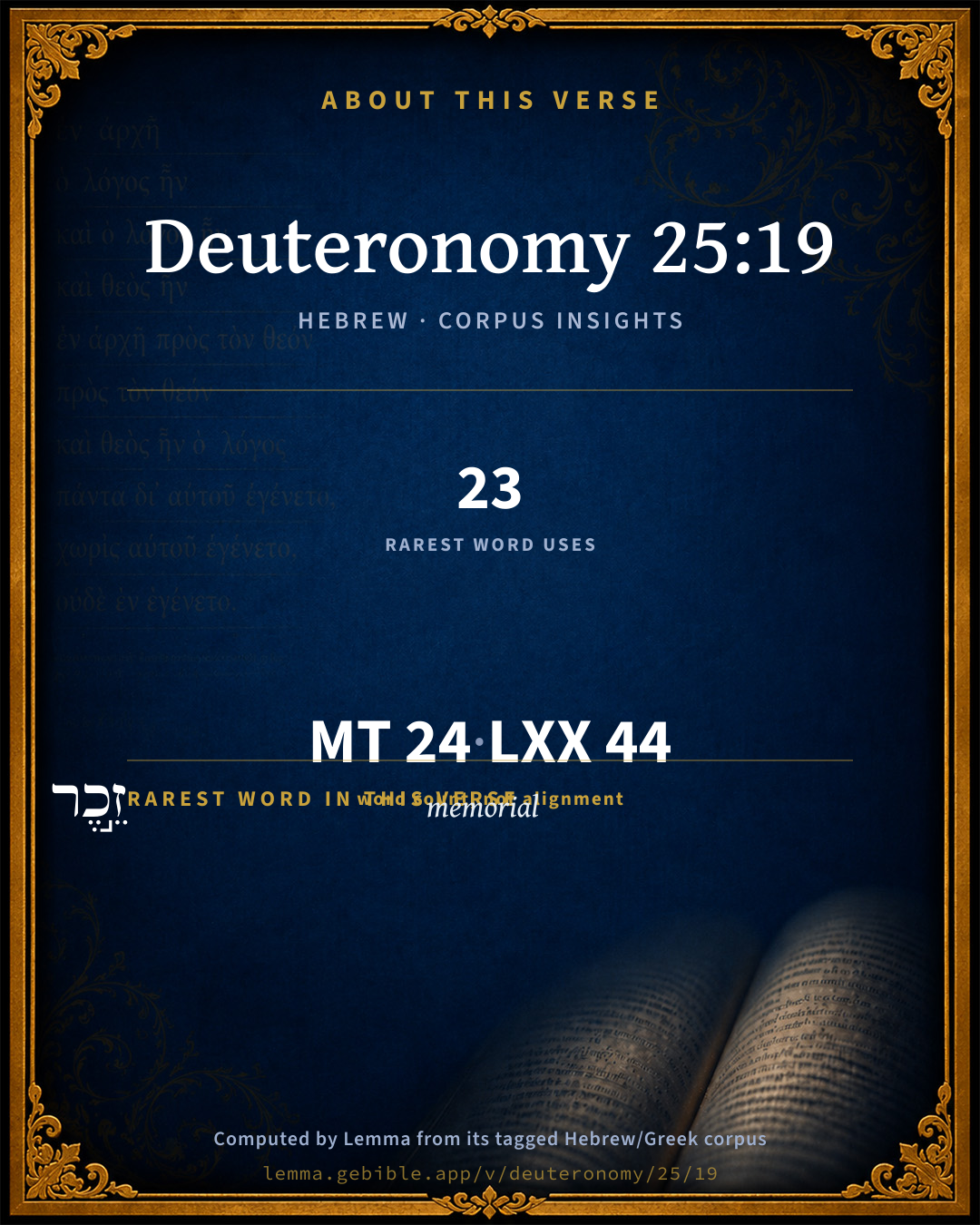
These counts appear in no published source. They are computed here, from the morphology-tagged text and Lemma’s own curated glosses. What Lemma adds →

24
words
20
distinct lemmas
Pentateuch
section

Notable vocabulary

The rarest word here is זֵ֣כֶר memorial H2143 — appearing just 23 times in the whole Hebrew Bible.

Shared distinctive vocabulary

זֵ֣כֶר memorial H2143 occurs in 23 verses of the Hebrew Bible. Also found in:

Grammatical profile

  • 7 verbs
  • 11 nouns
  • 3 prepositions
  • 3 particles

Verb forms

  • וְהָיָ֡ה Qal · Sequential Perfect
  • בְּהָנִ֣יחַ Hiphil · Infinitive Construct
  • אֹ֨יְבֶ֜יךָ Qal · Participle Active
  • נֹתֵ֨ן Qal · Participle Active
  • לְרִשְׁתָּ֔הּ Qal · Infinitive Construct
  • תִּמְחֶה֙ Qal · Imperfect
  • תִּשְׁכָּֽח Qal · Imperfect

Repetition

Words recur within this verse — often emphatic in Hebrew:

  • יְהוָ֣ה LORD H3068 ×2
  • אֱלֹהֶ֣יךָ God H430 ×2

Hebrew & Septuagint length

In English translation the verse runs 50 words from the Hebrew and 53 from the Septuagint (LXX English) — closely comparable.

A rough comparison of the two English renderings, which tokenize alike — not a word-level alignment.

Word counts can differ between the Hebrew and the Greek without any difference in meaning — e.g. the Hebrew direct-object marker אֵת has no separate Greek word, and Greek often adds the article ὁ.

In the original languages it is 24 Hebrew tokens and 44 Greek tokens — but the two are counted differently (Hebrew bundles its prefixes and suffixes into one token; the Greek is in lemma form), so that isn’t a like-for-like length.

Cross-references

16

Topical passages linked to Deuteronomy 25:19 in the Treasury of Scripture Knowledge — connected by theme and wording, ordered by reader-vote popularity; previews shown in the World English Bible.

  • Exodus 17:14 Yahweh said to Moses, "Write this for a memorial in a book, and rehearse it in the ears of Joshua: that I will utterly blot out the memory of Amalek from under the sky."
  • Exodus 17:16 He said, "Yah has sworn: 'Yahweh will have war with Amalek from generation to generation.'"
  • Deuteronomy 9:14 let me alone, that I may destroy them, and blot out their name from under the sky; and I will make of you a nation mightier and greater than they.
  • 1 Samuel 14:48 He did valiantly, and struck the Amalekites, and delivered Israel out of the hands of those who despoiled them.
  • Joshua 6:3 You shall compass the city, all the men of war, going about the city once. Thus shall you do six days.
  • Joshua 7:12 Therefore the children of Israel can't stand before their enemies; they turn their backs before their enemies, because they are become accursed: I will not be with you any more, except you destroy the devoted thing from among you.
  • Joshua 7:22–25 So Joshua sent messengers, and they ran to the tent; and, behold, it was hid in his tent, and the silver under it.
  • Joshua 23:1 It happened after many days, when Yahweh had given rest to Israel from all their enemies round about, and Joshua was old and well stricken in years;
  • 1 Samuel 15:1–35 Samuel said to Saul, Yahweh sent me to anoint you to be king over his people, over Israel: now therefore listen you to the voice of the words of Yahweh.
  • 1 Samuel 27:8 David and his men went up, and made a raid on the Geshurites, and the Girzites, and the Amalekites; for those [nations] were the inhabitants of the land, who were of old, as you go to Shur, even to the land of Egypt.
  • 1 Samuel 30:1–7 It happened, when David and his men were come to Ziklag on the third day, that the Amalekites had made a raid on the South, and on Ziklag, and had struck Ziklag, and burned it with fire,
  • 1 Chronicles 4:43 They struck the remnant of the Amalekites who escaped, and have lived there to this day.
  • Esther 3:1 After these things did king Ahasuerus promote Haman the son of Hammedatha the Agagite, and advanced him, and set his seat above all the princes who were with him.
  • Esther 7:10 So they hanged Haman on the gallows that he had prepared for Mordecai. Then was the king's wrath pacified.
  • Esther 9:7–10 Parshandatha, and Dalphon, and Aspatha,
  • Psalms 83:7–17 Gebal, Ammon, and Amalek; Philistia with the inhabitants of Tyre;

Cross-references courtesy of OpenBible.info (CC BY 4.0).

Hebrew and Greek witnesses Masoretic Hebrew ↔ Greek Septuagint

The same verse in the two great witnesses to the Old Testament, shown verse-for-verse.

These are two independent witnesses, not word-aligned to each other, and the Septuagint is shown in lemma (dictionary) form.

Hebrew Deuteronomy 25:19 Masoretic · Westminster Leningrad Codex

וְהָיָ֡ה בְּהָנִ֣יחַ יְהוָ֣ה אֱלֹהֶ֣יךָ לְ֠ךָ מִכָּל אֹ֨יְבֶ֜יךָ מִסָּבִ֗יב בָּאָ֨רֶץ֙ אֲשֶׁ֣ר יְהוָֽה אֱ֠לֹהֶיךָ נֹתֵ֨ן לְךָ֤ נַחֲלָה֙ לְרִשְׁתָּ֔הּ תִּמְחֶה֙ אֶת זֵ֣כֶר עֲמָלֵ֔ק מִתַּ֖חַת הַשָּׁמָ֑יִם לֹ֖א תִּשְׁכָּֽח

Therefore it shall be, when Yahweh your God has given you rest from all your enemies round about, in the land which Yahweh your God gives you for an inheritance to possess it, that you shall blot out the memory of Amalek from under the sky; you shall not forget.

World English Bible · Public Domain

Greek LXX Deuteronomy 25:19 Septuagint · lemma form

καί εἰμί ἡνίκα ἐάν καταπαύω σύ κύριος ὁ θεός σύ ἀπό πᾶς ὁ ἐχθρός σύ ὁ κύκλος σύ ἐν ὁ γῆ ὅς κύριος ὁ θεός σύ δίδωμι σύ ἐν κλῆρος κατακληρονομέω ἐκἀλείφω ὁ ὄνομα αμαληκ ἐκ ὁ ὑπό ὁ οὐρανός καί οὐ μή ἐπιλανθάνω

And it shall come to pass whenever the Lord your God shall have given you rest from all your enemies round about you, in the land which the Lord your God gives you to inherit, you shall blot out the name of Amalec from under heaven, and shall not forget to do it.

LXX2012 (modern English Septuagint) · Public Domain

Hebrew: Westminster Leningrad Codex (CC BY 4.0). Greek: Septuagint (public domain); English from LXX2012 (modern English Septuagint) (Public Domain). How the Septuagint differs from the Hebrew →

Targum (Aramaic paraphrase)

2

The Targum is the ancient Jewish Aramaic paraphrase of the Hebrew Scriptures — an interpretive translation, not the Hebrew text itself. Onkelos (literal) and Pseudo-Jonathan (expansive) render the Torah, and Jonathan the Prophets. Coverage is partial: where no permissively-licensed English translation exists for a verse, only the Aramaic is shown. This is verse-level text, not a word-by-word alignment to the Hebrew.

  1. Targum Onkelos Torah (Genesis–Deuteronomy)
    וִיהֵי כַּד יְנִיחַ יְיָ אֱלָהָךְ לָךְ מִכָּל בַּעֲלֵי דְבָבָךְ מִסְחוֹר סְחוֹר בְּאַרְעָא דִי יְיָ אֱלָהָךְ יָהֵב לָךְ אַחֲסָנָא לְמֵירְתַהּ תִּמְחֵי יָת דוּכְרָנָא דַעֲמָלֵק מִתְּחוֹת שְׁמַיָא לָא תִּתִּנְשֵׁי

    (no public-domain English translation for this verse)

    Targum Onkelos — Aramaic: “Onkelos Genesis” (public domain); “Onkelos Exodus” (public domain); “Onkelos Leviticus” (public domain); “Onkelos Numbers” (public domain); “Onkelos Deuteronomy” (public domain). English: “Sefaria Community Translation” (CC0 1.0 (public-domain dedication)); “J.W. Etheridge. The Targums of Onkelos and Jonathan Ben Uzziel on the Pentateuch. London: Longmans, Green, 1862” (public domain). Text via Sefaria.

  2. Targum Pseudo-Jonathan Torah (Genesis–Deuteronomy)
    וִיהֵי כַּד יָנִיחַ יְיָ אֱלָהָכוֹן לְכוֹן מִן כָּל בַּעֲלֵי דְבָבֵיכוֹן מִן חֲזוֹר חֲזוֹר בְּאַרְעָא דַיְיָ אֱלָהָכוֹן יָהֵיב לְכוֹן אַחֲסָנָא לְמֵירְתָהּ תִּמְחוּן יַת דּוּכְרָנָא דַעֲמָלֵק מִתְּחוֹת שְׁמַיָא וַאֲפִילוּ לְיוֹמֵי מַלְכָּא מְשִׁיחָא לָא תִתְנְשֵׁי

    Therefore, when the Lord hath given you rest from all your enemies round about in the land that the Lord Your God giveth you to inherit for a possession, you shall blot out the memory of Amalek from under the heavens; but of the days of the King Meshiha you shall not be unmindful.

    Targum Pseudo-Jonathan — Aramaic: “Targum Jonathan on Genesis” (public domain); “Targum Jonathan on Exodus” (public domain); “Targum Jonathan on Leviticus” (public domain); “Targum Jonathan on Numbers” (public domain); “Targum Jonathan on Deuteronomy” (public domain). English: “The Targum of Jonathan ben Uzziel, trans. J. W. Etheridge, London, 1862” (public domain). Text via Sefaria.

Commentary

Notes on Deuteronomy 25:19 from classic Christian and Jewish commentators (each source and its license shown beneath its notes). The classic Christian expositions comment on the surrounding passage and are grouped to its opening verse, so a note may address several verses; the Jewish commentaries on the Tanakh (Rashi and others) are per-verse, so they appear only where the commentator wrote on this verse.

Lemma curates 59 commentaries, every one of them public domain or Creative Commons licensed, each selected and text-cleaned for this edition rather than reprinted as found. About our sources →

Trapp's Complete Commentary

John Trapp

Deu 25:19 Therefore it shall be, when the LORD thy God hath given thee rest from all thine enemies round about, in the land which the LORD thy God giveth thee [for] an inheritance to possess it, [that] thou shalt blot out the remembrance of Amalek from under heaven; thou shalt not forget [it].

Ver. 19. Thou shalt not forget it.] Neither did they. Saul should have utterly destroyed them, {1Sa 15:18-19} but wherein he failed, God stirred up the Simeonites in Hezekiah’s days to smite the rest of the Amalekites that were escaped. {1Ch 4:42-43} It is ill angering the Ancient of days. His wrath lasts longer than hot coals of juniper, {Psa 120:4} his judgments are severe and durable: as we use to say of winter frosts, they never rot in the sky, but shall fall, if late, yet surely, yet seasonably. God’s forbearance is no quittance.

John Trapp, A Commentary or Exposition upon All the Books of the Old and New Testament (1647–1656) — public domain. Text from a community e-Sword module.

Tyndale Open Study Notes

Tyndale Open Resources

25:19 destroy: God authorized war against his enemies. Later, Samuel commanded Saul to completely destroy the Amalekites, something he only partially accomplished (1 Sam 15). As a result, God rejected Saul as king. • from under heaven: The Amalekites were to be obliterated completely (see study note on Deut 2:34).

Tyndale Open Study Notes — © Tyndale Open Resources, licensed CC BY-SA 4.0. Text via the HelloAO Bible API.

Geneva Bible (1599)

Geneva Bible translators

This was partly accomplished by Saul, about 450 years afterward.

Geneva Bible (1599) marginal notes — public domain. Text via Bolls.life.

The Cambridge Bible for Schools and Colleges

gen. ed. J. J. S. Perowne

19. hath given thee rest] See on Deu_12:9 f.

in the land which, etc.] Deu_4:21.

thou shalt blot out the remembrance of Amalek, etc.] E, Exo_17:14 : I will utterly blot out, etc. God’s will is now Israel’s duty.

thou shalt not forget] Deu_9:7.

The Cambridge Bible for Schools and Colleges (gen. ed. J. J. S. Perowne; Cambridge University Press, 1878–1918) — public domain. Text from a community e-Sword module.

John Gill's Exposition

Therefore it shall be, when the Lord thy God hath given thee rest from all thine enemies round about,.... Not only when they had subdued the Canaanites, and got possession of their land, but when they were clear and free from all their neighbouring nations, Moabites, Midianites, Edomites, Ammonites, and Philistines; wherefore it may be observed, that this did not take place, as not immediately after the conquest of Canaan, so neither in the times of the judges, when they were harassed frequently by their neighbours, and not until the times of Saul, the first king of Israel:

in the land which the Lord thy God giveth thee for an inheritance to possess it; the sense is, when they were in the full possession of the land given them by the Lord, as an inheritance to be enjoyed by them and theirs; and were at an entire rest from all enemies, and so had their hands at liberty to employ against Amalek:

that thou shalt blot out the remembrance of Amalek from under heaven: that is, utterly destroy them, so that there should be none left of them any where, to put in mind that there ever were such a people on earth; men, women, children, cattle of all sorts, were to be destroyed, and nothing left that belonged unto them; that it might not be said this beast was Amalek's, as Jarchi, and to the same purpose Aben Ezra; see the order for this renewed, and the accomplishment of it, at least in part, Sa1 15:2, &c.

thou shall not forget it; neither the unkindness of Amalek, nor this order to destroy him. The Targum of Jonathan adds,"and even in the days of the King Messiah it shall not be forgotten.''

Next: Deuteronomy Chapter 26

John Gill's Exposition of the Whole Bible (1746–1763) — public domain (CC PDM 1.0). Text via the HelloAO Bible API.

Haydock's Catholic Bible Commentary

CHAPTER XV.

Heaven. Destroy him entirely, a sentence which Saul was ordered to put in execution, 1 Kings xv. (Haydock)

George Leo Haydock (1774–1849), Haydock's Catholic Family Bible and Commentary, 1859 edition — public domain. Excludes Psalms (Douay-Rheims chapter numbering differs from Protestant) and Deuterocanonical books (Catholic canon only).

Matthew Poole's English Annotations

Blot out the remembrance of Amalek; which was in great measure done afterward. See 1Sa 15; 27:8; 30:1,17; 1Ch 4:43; Est 9:12,13.

Matthew Poole's English Annotations on the Holy Bible (1683–1685) — public domain. Text from a community e-Sword/MySword module.

Rashi

Rabbi Shlomo Yitzchaki (Rashi)

תמחה את זכר עמלק THOU SHALT WIPE AWAY THE REMEMBRANCE OF AMALEK, — both man and woman, infant and suckling, ox and sheep (a quotation from I Samuel 15:3, stating how the Amalekites were to be destroyed), so that the name of Amalek should never again be mentioned even in connection with a beast, in that one could say: “This beast belonged to Amalek” (Pesikta Zutrata).

Rashi on the Tanakh — English translations: “The Judaica Press complete Tanach with Rashi, translated by A. J. Rosenberg” (CC BY 4.0); “Pentateuch with Rashi's commentary by M. Rosenbaum and A.M. Silbermann, 1929-1934” (public domain); “The Metsudah Tanach series, Lakewood, N.J” (CC BY 4.0); and “The Book of Joshua, Metsudah Publications, 1997” (CC BY 4.0). Text via Sefaria.

Lesson kit

Teaching starters — assembled from the data on this page, not authored interpretation. Every prompt links to the verse data it draws on. Edit before teaching.

Deuteronomy, in the Pentateuch, opens this verse with 24 words (20 distinct Hebrew lemmas). Its most distinctive word is zêker (“memorial”). A historical commentator’s framing appears above. Read the whole chapter for the surrounding context.

Discussion questions

  1. The word zêker carries the sense “memorial.” How does it shape the verse?
  2. Exodus 3:15 shares the word «memorial» with this verse. How do the two illuminate each other?
  3. “LORD” occurs 2× in this one verse. What is the effect of the repetition?
  4. These translations render this verse differently. What is at stake in choosing one wording over another?
  5. The verb «וְהָיָ֡ה» is Qal Sequential Perfect. How does its form color the action?
  6. Reading how Trapp's Complete Commentary and Tyndale Open Study Notes read this verse, where do the two commentators agree and where do they part?

Things to notice

Reading settings

Reading text

Shown beneath each verse's original-language words.

Old Testament
Old Testament edition

Read the OT as the Masoretic Hebrew (MT) or the Greek Septuagint (LXX).

English shown for the Greek Septuagint (in the Hebrew ↔ Greek comparison).

Comparing translations? Open the Compare panel on any verse page to stack up to four side by side.