
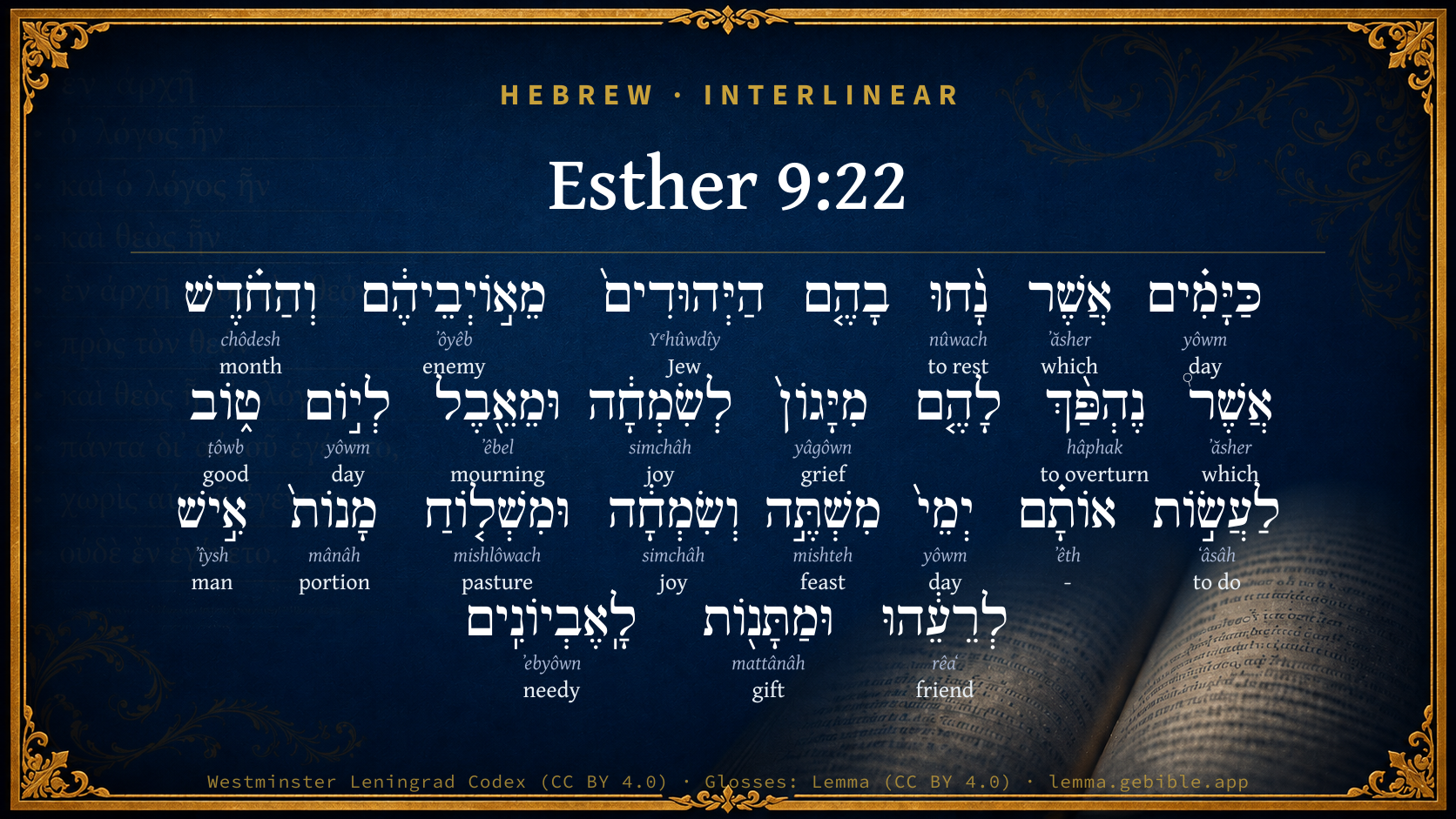
Esther 9:22

Hebrew (Westminster Leningrad Codex) Esther 9:22 appears in the Hebrew Old Testament. The text above is from the Westminster Leningrad Codex. Each word links to its Strong’s number, a concise gloss, and parsing drawn from the Open Scriptures Hebrew Bible morphology. Click any word for its full Brown-Driver-Briggs (BDB) entry.
Download image
Cite this verse

Esther 9:22 (World English Bible). Public Domain. Lemma interlinear Bible study tool, https://lemma.gebible.app/v/esther/9/22.

Show BibTeX & RIS
BibTeX
RIS
English Translation
as the days in which the Jews had rest from their enemies, and the month which was turned to them from sorrow to gladness, and from mourning into a good day; that they should make them days of feasting and gladness, and of sending portions one to another, and gifts to the needy.
World English Bible · Public Domain
Download a study sheet

One document with this verse’s original text, its word-by-word gloss line, the meaning frame, cross-references with their text, attributed commentary, and full source and license credits — printable, and it pastes into notes with its structure intact.

This verse Autodidact and up

Study sheet (.html) Plain text (.txt)

A passage Seminary Student

Up to 50 verses in one chapter. A passage sheet keeps up to 6 commentary sources and 12 cross-references per verse, in the order this page ranks them, and says so on the sheet whenever that leaves anything out. Ask for a single verse and you get the Autodidact verse sheet above.

Everything on this page stays free to read, with no account — the sheet is a download of what is already on screen, not access to it.

Want to remove ads? Support Godless Engineer
Compare translations 3

The same verse in 3 English versions, stacked beneath the original-language interlinear above. Click any original word for its lexicon entry.

Each is an independent rendering of the whole verse — the interlinear is not word-aligned to these translations.

Highlighted words mark where these versions differ — a whole-verse word diff, not a word-by-word alignment.

  • World English Bible Public Domain
    as the days in which the Jews had rest from their enemies, and the month which was turned to them from sorrow to gladness, and from mourning into a good day; that they should make them days of feasting and gladness, and of sending portions one to another, and gifts to the needy.
  • King James Version Public Domain
    As the days wherein the Jews rested from their enemies, and the month which was turned unto them from sorrow to joy, and from mourning into a good day: that they should make them days of feasting and joy, and of sending portions one to another, and gifts to the poor.
  • unfoldingWord Literal Text CC BY-SA 4.0
    as the days when the Jews rested on them from their enemies and as the month when it had turned for them from sorrow into joy and from mourning into a good day, in order to make them days of feasting and rejoicing and sending of gifts, a man to his friend and gifts to the needy.

unfoldingWord Literal Text — © unfoldingWord, licensed CC BY-SA 4.0. Word-aligned USFM3 via Door43 (git.door43.org/unfoldingWord/en_ult).

Versions to compare (up to 4)

3 of 4 selected

Show all 18 translations

Every available English version of this verse, each an independent rendering of the whole verse.

  • World English Bible Public Domain
    as the days in which the Jews had rest from their enemies, and the month which was turned to them from sorrow to gladness, and from mourning into a good day; that they should make them days of feasting and gladness, and of sending portions one to another, and gifts to the needy.
  • Berean Standard Bible Public Domain
    as the days on which the Jews gained rest from their enemies and the month in which their sorrow turned to joy and their mourning into a holiday. He wrote that these were to be days of feasting and joy, of sending gifts to one another and to the poor.
  • Majority Standard Bible Public Domain
    as the days on which the Jews gained rest from their enemies and the month in which their sorrow turned to joy and their mourning into a holiday. He wrote that these were to be days of feasting and joy, of sending gifts to one another and to the poor.
  • King James Version Public Domain
    As the days wherein the Jews rested from their enemies, and the month which was turned unto them from sorrow to joy, and from mourning into a good day: that they should make them days of feasting and joy, and of sending portions one to another, and gifts to the poor.
  • American Standard Version (1901) Public Domain
    as the days wherein the Jews had rest from their enemies, and the month which was turned unto them from sorrow to gladness, and from mourning into a good day; that they should make them days of feasting and gladness, and of sending portions one to another, and gifts to the poor.
  • Revised Version (1885) Public Domain
    as the days wherein the Jews had rest from their enemies, and the month which was turned unto them from sorrow to gladness, and from mourning into a good day: that they should make them days of feasting and gladness, and of sending portions one to another, and gifts to the poor.
  • Geneva Bible (1599) Public Domain
    According to the dayes wherein the Iewes rested from their enemies, and the moneth which was turned vnto them from sorowe to ioy, and from mourning into a ioyfull day, to keepe them the dayes of feasting, and ioy, and to sende presents euery man to his neyghbour, and giftes to the poore.
  • Douay-Rheims (1899) Public Domain
    Because on those days the Jews revenged themselves of their enemies, and their mourning and sorrow were turned into mirth and joy, and that these should be days of feasting and gladness, in which they should send one to another portions of meats; and should give gifts to the poor.
  • Young's Literal Translation Public Domain
    as days on which the Jews have rested from their enemies, and the month that hath been turned to them from sorrow to joy, and from mourning to a good day, to make them days of banquet and of joy, and of sending portions one to another, and gifts to the needy.
  • Literal Standard Version CC BY-SA 4.0
    as days on which the Jews have rested from their enemies, and the month that has been turned to them from sorrow to joy, and from mourning to a good day, to make them days of banquet and of joy, and of sending portions to one another, and gifts to the needy.
  • Unlocked Literal Bible CC BY-SA 4.0
    These were the days when the Jews got relief from their enemies, and the month when their sorrow turned to joy, and mourning into a day of celebration. They were to make them days of feasting and gladness, and of sending gifts of food to one another, and gifts to the poor.
  • unfoldingWord Literal Text CC BY-SA 4.0
    as the days when the Jews rested on them from their enemies and as the month when it had turned for them from sorrow into joy and from mourning into a good day, in order to make them days of feasting and rejoicing and sending of gifts, a man to his friend and gifts to the needy.
  • Darby Bible Public Domain
    as the days on which the Jews rested from their enemies, and the month that was turned to them from sorrow to joy, and from mourning into a good day; that they should make them days of feasting and joy, and of sending portions one to another, and gifts to the poor.
  • World Messianic Bible Public Domain
    as the days in which the Jews had rest from their enemies, and the month which was turned to them from sorrow to gladness, and from mourning into a holiday; that they should make them days of feasting and gladness, and of sending presents of food to one another, and gifts to the needy.
  • Webster's Bible Public Domain
    As the days in which the Jews rested from their enemies, and the month which was turned to them from sorrow to joy, and from mourning into a good day, that they should make them days of feasting and joy, and of sending portions one to another, and gifts to the poor.
  • Free Bible Version CC BY-SA 4.0
    as the time when the Jews rested from their victory over their enemies, and as the month when their sadness was turned into joy and their mourning into a time of celebration. He wrote them to observe the days as days of feasting and joy and giving gifts of food to one another and presents to the poor.
  • Bible in Basic English Public Domain
    As days on which the Jews had rest from their haters, and the month which for them was turned from sorrow to joy, and from weeping to a good day: and that they were to keep them as days of feasting and joy, of sending offerings to one another and good things to the poor.
  • JPS Tanakh (1917) Public Domain
    the days wherein the Jews had rest from their enemies, and the month which was turned unto them from sorrow to gladness, and from mourning into a good day; that they should make them days of feasting and gladness, and of sending portions one to another, and gifts to the poor.

Literal Standard Version (2020), Covenant Press — licensed CC BY-SA 4.0. Text via the HelloAO Bible API (eBible.org). Unlocked Literal Bible (unfoldingWord) — licensed CC BY-SA 4.0. Text via the HelloAO Bible API (eBible.org). unfoldingWord Literal Text — © unfoldingWord, licensed CC BY-SA 4.0. Word-aligned USFM3 via Door43 (git.door43.org/unfoldingWord/en_ult). Free Bible Version, Dr. Jonathan Gallagher — licensed CC BY-SA 4.0. Text via the HelloAO Bible API (eBible.org).

Word by word

More ways to search: Search by grammar → Find every occurrence → Compare this word →

Practice this passage: Drill this verse → Learn its vocabulary →

וּמִשְׁל֤וֹחַ
mishlôwach
H4916
“and · pasture of”
Conjunction + Noun, Common, Masculine, Singular, Construct
Part of Speech
Conjunction + Noun
Type
Common
Gender
Masculine
Number
Singular
State
Construct
Full BDB Definition

Origin: from H7971

TWOT: 2394d , 2394e

outstretching, sending, sending forth - outstretching, undertaking (that to which one stretches out the hand), place of letting or turning loose, pasture (place where animals are let free)
  1. כַּיָּמִ֗ים yôwm H3117 “like/as the · days” Preposition, Determined + Noun, Common, Masculine, Plural, Absolute
  2. אֲשֶׁר ʼăsher H834 “which” Particle, Relative
  3. נָ֨חוּ nûwach H5117 “to rest” Verb, Qal, Perfect, 3rd Person, Common, Plural
  4. הַיְּהוּדִים֙ Yᵉhûwdîy H3064 “the · Jews” Particle, Definite Article + Noun, Gentilic, Masculine, Plural, Absolute
  5. מֵא֣וֹיְבֵיהֶ֔ם ʼôyêb H341 “from · enemy · them” Preposition + Verb, Qal, Participle Active, Masculine, Plural, Construct + Suffix, Personal, 3rd Person, Masculine, Plural
  6. וְהַחֹ֗דֶשׁ chôdesh H2320 “and · the · month” Conjunction + Particle, Definite Article + Noun, Common, Masculine, Singular, Absolute
  7. אֲשֶׁר֩ ʼăsher H834 “which” Particle, Relative
  8. נֶהְפַּ֨ךְ hâphak H2015 “to overturn” Verb, Niphal, Perfect, 3rd Person, Masculine, Singular
  9. מִיָּגוֹן֙ yâgôwn H3015 “from · grief” Preposition + Noun, Common, Masculine, Singular, Absolute
  10. לְשִׂמְחָ֔ה simchâh H8057 “to/for · joy” Preposition + Noun, Common, Feminine, Singular, Absolute
  11. וּמֵאֵ֖בֶל ʼêbel H60 “and · from · mourning” Conjunction + Preposition + Noun, Common, Masculine, Singular, Absolute
  12. לְי֣וֹם yôwm H3117 “to/for · day” Preposition + Noun, Common, Masculine, Singular, Absolute
  13. ט֑וֹב ṭôwb H2896 “good” Adjective, Adjective, Masculine, Singular, Absolute
  14. לַעֲשׂ֣וֹת ʻâsâh H6213 “to do” Preposition + Verb, Qal, Infinitive Construct
  15. אוֹתָ֗ם ʼêth H853 “- · them” Particle, Direct Object + Suffix, Personal, 3rd Person, Masculine, Plural
  16. יְמֵי֙ yôwm H3117 “days of” Noun, Common, Masculine, Plural, Construct
  17. מִשְׁתֶּ֣ה mishteh H4960 “feast” Noun, Common, Masculine, Singular, Absolute
  18. וְשִׂמְחָ֔ה simchâh H8057 “and · joy” Conjunction + Noun, Common, Feminine, Singular, Absolute
  19. מָנוֹת֙ mânâh H4490 “portions” Noun, Common, Feminine, Plural, Absolute
  20. אִ֣ישׁ ʼîysh H376 “man” Noun, Common, Masculine, Singular, Absolute
  21. לְרֵעֵ֔הוּ rêaʻ H7453 “to/for · friend · his” Preposition + Noun, Common, Masculine, Singular, Construct + Suffix, Personal, 3rd Person, Masculine, Singular
  22. וּמַתָּנ֖וֹת mattânâh H4979 “and · gifts” Conjunction + Noun, Common, Feminine, Plural, Absolute
  23. לָֽאֶבְיוֹנִֽים ʼebyôwn H34 “to/for the · needy” Preposition, Determined + Adjective, Adjective, Masculine, Plural, Absolute

About this verse

These counts appear in no published source. They are computed here, from the morphology-tagged text and Lemma’s own curated glosses. What Lemma adds →

26
words
20
distinct lemmas
Historical
section

Notable vocabulary

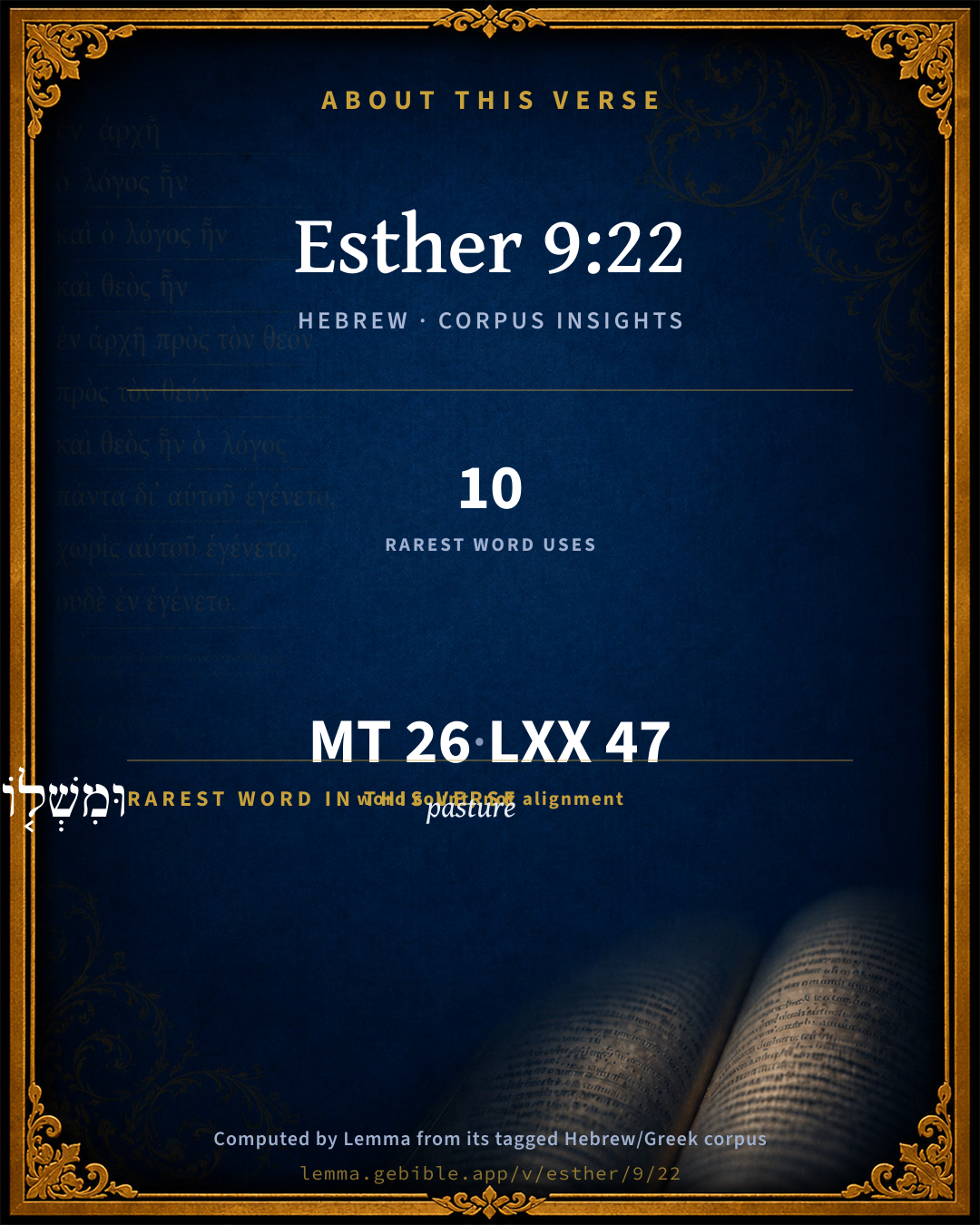
The rarest word here is וּמִשְׁל֤וֹחַ pasture H4916 — appearing just 10 times in the whole Hebrew Bible.

Shared distinctive vocabulary

וּמִשְׁל֤וֹחַ pasture H4916 occurs in 10 verses of the Hebrew Bible. Also found in:

Grammatical profile

  • 4 verbs
  • 15 nouns
  • 2 adjectives
  • 2 prepositions
  • 3 particles

Verb forms

  • נָ֨חוּ Qal · Perfect
  • מֵא֣וֹיְבֵיהֶ֔ם Qal · Participle Active
  • נֶהְפַּ֨ךְ Niphal · Perfect
  • לַעֲשׂ֣וֹת Qal · Infinitive Construct

Repetition

Words recur within this verse — often emphatic in Hebrew:

  • כַּיָּמִ֗ים day H3117 ×3
  • לְשִׂמְחָ֔ה joy H8057 ×2
  • אֲשֶׁר which H834 ×2

Hebrew & Septuagint length

In English translation the verse runs 53 words from the Hebrew and 60 from the Septuagint (LXX English) — closely comparable.

A rough comparison of the two English renderings, which tokenize alike — not a word-level alignment.

Word counts can differ between the Hebrew and the Greek without any difference in meaning — e.g. the Hebrew direct-object marker אֵת has no separate Greek word, and Greek often adds the article ὁ.

In the original languages it is 26 Hebrew tokens and 47 Greek tokens — but the two are counted differently (Hebrew bundles its prefixes and suffixes into one token; the Greek is in lemma form), so that isn’t a like-for-like length.

Cross-references

13

Topical passages linked to Esther 9:22 in the Treasury of Scripture Knowledge — connected by theme and wording, ordered by reader-vote popularity; previews shown in the World English Bible.

  • Psalms 30:11 You have turned my mourning into dancing for me. You have removed my sackcloth, and clothed me with gladness,
  • Esther 9:19 Therefore do the Jews of the villages, who dwell in the unwalled towns, make the fourteenth day of the month Adar [a day of] gladness and feasting, and a good day, and of sending portions one to another.
  • Isaiah 12:1–2 In that day you will say, "I will give thanks to you, Yahweh; for though you were angry with me, your anger has turned away and you comfort me.
  • Isaiah 14:3 It shall happen in the day that Yahweh shall give you rest from your sorrow, and from your trouble, and from the hard service in which you were made to serve,
  • Esther 3:12–13 Then were the king's scribes called in the first month, on the thirteenth day of it; and there was written according to all that Haman commanded to the king's satraps, and to the governors who were over every province, and to the princes of every people, to every province according to the writing of it, and to every people after their language; in the name of king Ahasuerus was it written, and it was sealed with the king's ring.
  • Galatians 2:10 They only asked us to remember the poor--which very thing I was also zealous to do.
  • Exodus 13:3–8 Moses said to the people, "Remember this day, in which you came out from Egypt, out of the house of bondage; for by strength of hand Yahweh brought you out from this place. No leavened bread shall be eaten.
  • Nehemiah 8:10–12 Then he said to them, Go your way, eat the fat, and drink the sweet, and send portions to him for whom nothing is prepared; for this day is holy to our Lord: neither be you grieved; for the joy of Yahweh is your strength.
  • Psalms 103:2 Praise Yahweh, my soul, And don't forget all his benefits;
  • Matthew 5:4 Blessed are those who mourn, For they shall be comforted.
  • John 16:20–22 Most assuredly I tell you, that you will weep and lament, but the world will rejoice. You will be sorrowful, but your sorrow will be turned into joy.
  • Acts 2:44–46 All who believed were together, and had all things in common.
  • Luke 11:41 But give for gifts to the needy those things which are within, and behold, all things will be clean to you.

Cross-references courtesy of OpenBible.info (CC BY 4.0).

Hebrew and Greek witnesses Masoretic Hebrew ↔ Greek Septuagint

The same verse in the two great witnesses to the Old Testament, shown verse-for-verse.

These are two independent witnesses, not word-aligned to each other, and the Septuagint is shown in lemma (dictionary) form.

Hebrew Esther 9:22 Masoretic · Westminster Leningrad Codex

כַּיָּמִ֗ים אֲשֶׁר נָ֨חוּ בָהֶ֤ם הַיְּהוּדִים֙ מֵא֣וֹיְבֵיהֶ֔ם וְהַחֹ֗דֶשׁ אֲשֶׁר֩ נֶהְפַּ֨ךְ לָהֶ֤ם מִיָּגוֹן֙ לְשִׂמְחָ֔ה וּמֵאֵ֖בֶל לְי֣וֹם ט֑וֹב לַעֲשׂ֣וֹת אוֹתָ֗ם יְמֵי֙ מִשְׁתֶּ֣ה וְשִׂמְחָ֔ה וּמִשְׁל֤וֹחַ מָנוֹת֙ אִ֣ישׁ לְרֵעֵ֔הוּ וּמַתָּנ֖וֹת לָֽאֶבְיוֹנִֽים

as the days in which the Jews had rest from their enemies, and the month which was turned to them from sorrow to gladness, and from mourning into a good day; that they should make them days of feasting and gladness, and of sending portions one to another, and gifts to the needy.

World English Bible · Public Domain

Greek LXX Esther 9:22 Septuagint · lemma form

ἐν γάρ οὗτος ὁ ἡμέρα ἀναπαύω ὁ ἰουδαῖος ἀπό ὁ ἐχθρός αὐτός καί ὁ μήν ἐν ὅς στρέφω αὐτός ὅς εἰμί αδαρ ἀπό πένθος εἰς χαρά καί ἀπό ὀδύνη εἰς ἀγαθός ἡμέρα ἄγω ὅλος ἀγαθός ἡμέρα γάμος καί εὐφροσύνη ἐκ ἀποστέλλω μερίς ὁ φίλος καί ὁ πτωχός

for on these days the Jews obtained rest from their enemies; and as to the month, which was Adar, in which a change was made for them, from mourning to joy, and from sorrow to a good day, to spend the whole of it in good days of feasting and gladness, sending portions to their friends, and to the poor.

LXX2012 (modern English Septuagint) · Public Domain

Hebrew: Westminster Leningrad Codex (CC BY 4.0). Greek: Septuagint (public domain); English from LXX2012 (modern English Septuagint) (Public Domain). How the Septuagint differs from the Hebrew →

Commentary

Notes on Esther 9:22 from classic Christian and Jewish commentators (each source and its license shown beneath its notes). The classic Christian expositions comment on the surrounding passage and are grouped to its opening verse, so a note may address several verses; the Jewish commentaries on the Tanakh (Rashi and others) are per-verse, so they appear only where the commentator wrote on this verse.

Lemma curates 59 commentaries, every one of them public domain or Creative Commons licensed, each selected and text-cleaned for this edition rather than reprinted as found. About our sources →

Trapp's Complete Commentary

John Trapp

Est 9:22 As the days wherein the Jews rested from their enemies, and the month which was turned unto them from sorrow to joy, and from mourning into a good day: that they should make them days of feasting and joy, and of sending portions one to another, and gifts to the poor.

Ver. 22. As the days wherein the Jews rested from their enemies] And therefore they in thankfulness would consecrate the same as a holy rest unto the Lord, calling the fourteenth day, Festurn sortium minus, the lesser festivity of lots; and the fifteenth day, Festum sortium maius, the greater festivity of lots, as Drusins telleth us.

And the month] They thought the better ever after of the month Adar, that magnificent month, wherein was that golden day of their deliverance. O dieculam illam, &c., dexter sane prae laetitia mihi salit oculus, said he. Oh that joyful day! Oh that the calendar of my life might be filled with such festivals!

Which was turned unto them from sorrow to joy] As God remembered poor Joseph, and turned his fetters into a chain of gold, his rags into robes, his stocks into a chariot, his prison into a palace, his brown bread and water into fine bread and wine; and as he had turned again the captivity of his people as the streams in the south, Psa 146:4; so here he had made a great alteration, bringing them from the jaws of death to the joys of a glorious deliverance; turning their sadness into gladness, their sighing into singing, their musing into music, their tears into triumph, luctum in laetitiam, saccum in sericum, ieiunium in epulum, manuum retortionem in applausum, &c. And this is no new thing in the Church.

John Trapp, A Commentary or Exposition upon All the Books of the Old and New Testament (1647–1656) — public domain. Text from a community e-Sword module.

Joseph Benson's Commentary

Est 9:22. As the days wherein the Jews rested — They did not keep the days on which they fought, but those on which they rested. On the fourteenth day the country Jews rested, and on the fifteenth those in Shushan, and these days they kept. The sabbath was appointed, not on the day when God finished his work, but on the day he rested from it. The month which was turned unto them — from mourning into a good day — A day of cheerfulness, praise, and thanksgiving. And of sending portions one to another — In token of mutual respect, and their being knit by this, and other public common dangers and deliverances, so much the closer to each other in love. And gifts to the poor — Which they were wont to give also on other days of thanksgiving, of which see Neh 8:10. It is not to our kinsmen and rich neighbours only that we ought to send tokens of our love and friendship at such times, but also and especially to the poor and the maimed, Luk 14:12-13. Thus they that have received mercy, must, in token of their gratitude, show mercy; and there never wants occasion, for the poor we have always with us. Thanksgiving and almsgiving should go together, that, when we are rejoicing and blessing God, the hearts of the poor may rejoice with us, and their loins may bless us.

Joseph Benson's Commentary on the Old and New Testaments (1811–1818) — public domain. Text from a community e-Sword module.

Geneva Bible (1599)

Geneva Bible translators

He setteth before our eyes the use of this feast, which was for the remembrance of God’s deliverance, the maintenance of mutual friendship and relief of the poor.

Geneva Bible (1599) marginal notes — public domain. Text via Bolls.life.

The Cambridge Bible for Schools and Colleges

gen. ed. J. J. S. Perowne

22. as the days … a good day] This has the character of a parenthesis, the preceding clause being taken up again in the words ‘that they should make them’ etc.

The Cambridge Bible for Schools and Colleges (gen. ed. J. J. S. Perowne; Cambridge University Press, 1878–1918) — public domain. Text from a community e-Sword module.

John Gill's Exposition

Because Haman the son of Hammedatha, the Agagite, the enemy of all the Jews, had devised against the Jews to destroy them,.... Had formed a design to exterminate them from the whole Persian empire in one day:

and had cast Pur, (that is, the lot,) to consume them, and to destroy them; had cast lots to find out what would be the most lucky day in the year for him to do it on, and the most unlucky and unfortunate to the Jews; and, according to the lot, the thirteenth of Adar was pitched upon; this and the following verse give the reasons for observing the above two days as festivals.

John Gill's Exposition of the Whole Bible (1746–1763) — public domain (CC PDM 1.0). Text via the HelloAO Bible API.

Matthew Poole's English Annotations

Which they used to give upon days of thanksgiving; of which see Neh 8:10.

Matthew Poole's English Annotations on the Holy Bible (1683–1685) — public domain. Text from a community e-Sword/MySword module.

The Pulpit Commentary

The month which was turned unto them from sorrow to joy. This was the key-note of Purina, the dominant idea, to which all else was secondary and sub-ordinate sorrow turned into joy, "mourning into dancing," utter destruction into a signal triumph. Ps 30 might well have been written at this time.

Sending portions and gifts.

This usage is quite a carrying out of the principle of the Divine law, which prescribed remembrance of the widow and fatherless upon those who were prosperous in Israel. We find an interesting parallel to the present passage in Nehemiah: when the law had been read and expounded in the hearing of the people, they "went their way to eat, and to drink, and to send portions, and to make great mirth." These presents were sent by the people to one another in friendship and courtesy; to the poor in charity. It is a usage which, though it may be carried too far and abused, has yet its advantages.

I IT TENDS TO CEMENT THE BONDS OF SOCIETY BY DISPOSING TO KINDLY THOUGHTS AND REGARDS. A neighbourly gift is, in some cases, better than a mere message of inquiry, or congratulation, or condolence.

II IT AFFORDS A PURE PLEASURE TO THE GIVER. To share the gifts of Providence with the less fortunate opens the heart and enlarges its sympathies. It is a check to natural selfishness.

III IT IS BENEFICIAL TO THE RECEIVER. A friend"s gift is a token of that friend"s remembrance and love. And many a poor household is, at Christmas-tide, made bright by the presents thought appropriate to the season. Children especially are pleased with such gifts, and their pleasure is worth our consideration.

IV GIFTS RESEMBLE, IN OUR POOR WAY, THE BENEFACTIONS OF PROVIDENCE, AND THE BENEFICENT MIRACLES OF OUR SAVIOUR. "He openeth his hand, and supplieth the wants of every living tiling." Christ gave bread to the hungry, and turned water into wine for the enjoyment of the guests at a wedding-feast.

V THE PRACTICE IS A RECOGNITION OF OUR COMMON DEPENDENCE UPON HEAVEN: AND OUR MUTUAL BROTHERHOOD. HOW much better to carry out such usages upon the suggestion of Christian motive, and in connection with Christian fellowship, than for worldly display, or policy, or from ordinary good-nature!

The Pulpit Commentary (1880–1919), ed. H.D.M. Spence-Jones & Joseph S. Exell — public domain. Text from a community e-Sword module.

Lesson kit

Teaching starters — assembled from the data on this page, not authored interpretation. Every prompt links to the verse data it draws on. Edit before teaching.

Esther, in the Historical, opens this verse with 26 words (20 distinct Hebrew lemmas). Its most distinctive word is mishlôwach (“pasture”). A historical commentator’s framing appears above. Read the whole chapter for the surrounding context.

Discussion questions

  1. How does “pasture” (mishlôwach) shape what this verse is saying?
  2. Deuteronomy 12:7 shares the word «pasture» with this verse. How do the two illuminate each other?
  3. “day” occurs 3× in this one verse. What is the effect of the repetition?
  4. These translations render this verse differently; the difference is in the English rendering, not the original. What questions does that raise?
  5. The verb «נָ֨חוּ» is Qal Perfect. How does its form color the action?
  6. Reading how Trapp's Complete Commentary and Joseph Benson's Commentary read this verse, where do the two commentators agree and where do they part?

Things to notice

Reading settings

Reading text

Shown beneath each verse's original-language words.

Old Testament
Old Testament edition

Read the OT as the Masoretic Hebrew (MT) or the Greek Septuagint (LXX).

English shown for the Greek Septuagint (in the Hebrew ↔ Greek comparison).

Comparing translations? Open the Compare panel on any verse page to stack up to four side by side.