
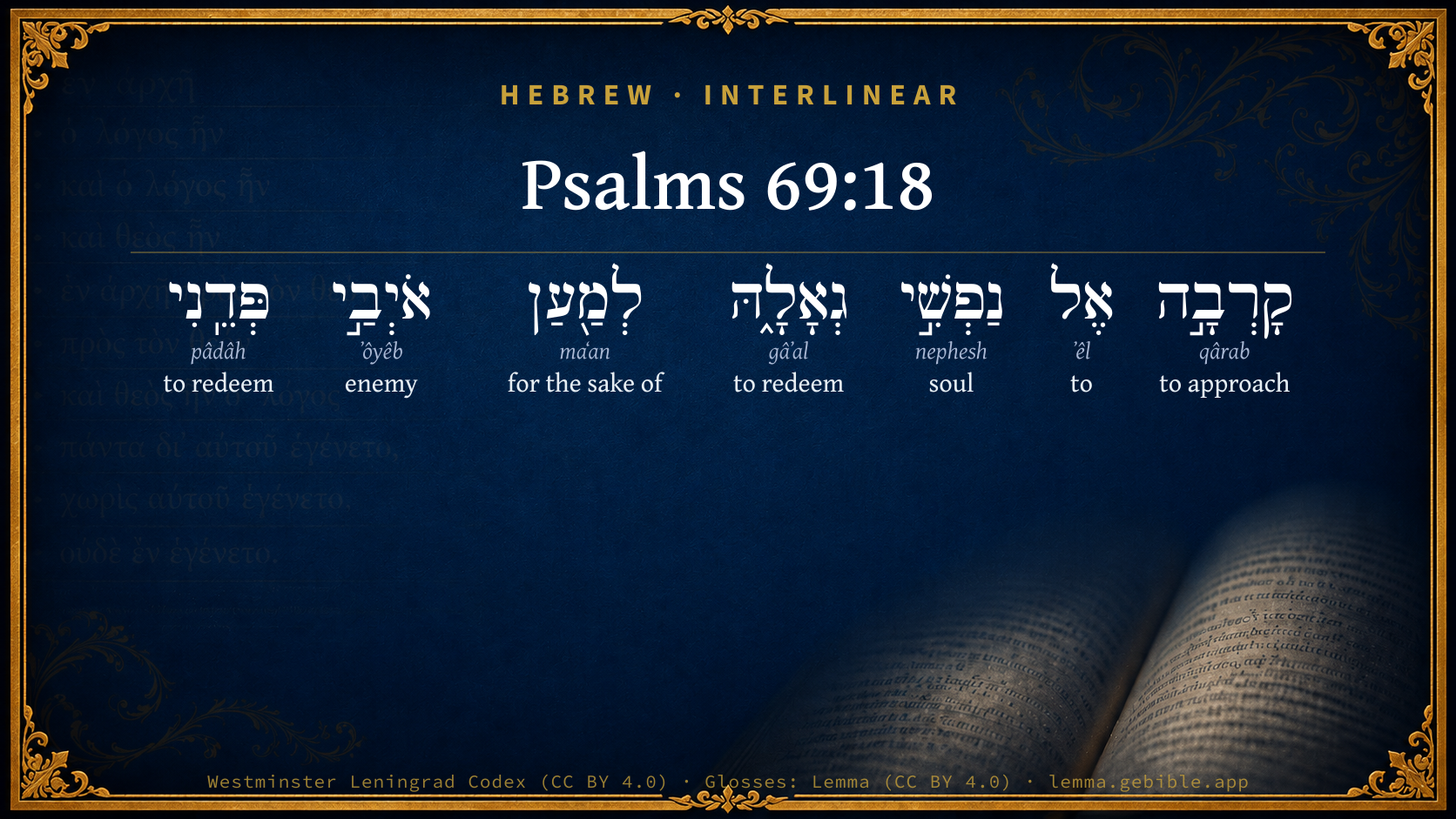
Psalms 69:18

Hebrew (Westminster Leningrad Codex) Psalms 69:18 appears in the Hebrew Old Testament. The text above is from the Westminster Leningrad Codex. Each word links to its Strong’s number, a concise gloss, and parsing drawn from the Open Scriptures Hebrew Bible morphology. Click any word for its full Brown-Driver-Briggs (BDB) entry.
Download image
Cite this verse

Psalms 69:18 (World English Bible). Public Domain. Lemma interlinear Bible study tool, https://lemma.gebible.app/v/psalms/69/18.

Show BibTeX & RIS
BibTeX
RIS
English Translation
Draw near to my soul, and redeem it. Ransom me because of my enemies.
World English Bible · Public Domain
Download a study sheet

One document with this verse’s original text, its word-by-word gloss line, the meaning frame, cross-references with their text, attributed commentary, and full source and license credits — printable, and it pastes into notes with its structure intact.

This verse Autodidact and up

Study sheet (.html) Plain text (.txt)

A passage Seminary Student

Up to 50 verses in one chapter. A passage sheet keeps up to 6 commentary sources and 12 cross-references per verse, in the order this page ranks them, and says so on the sheet whenever that leaves anything out. Ask for a single verse and you get the Autodidact verse sheet above.

Everything on this page stays free to read, with no account — the sheet is a download of what is already on screen, not access to it.

Want to remove ads? Support Godless Engineer
Compare translations 3

The same verse in 3 English versions, stacked beneath the original-language interlinear above. Click any original word for its lexicon entry.

Each is an independent rendering of the whole verse — the interlinear is not word-aligned to these translations.

Highlighted words mark where these versions differ — a whole-verse word diff, not a word-by-word alignment.

  • World English Bible Public Domain
    Draw near to my soul, and redeem it. Ransom me because of my enemies.
  • King James Version Public Domain
    Draw nigh unto my soul, and redeem it: deliver me because of mine enemies.
  • unfoldingWord Literal Text CC BY-SA 4.0
    Draw near to my soul, redeem it; because of my enemies, ransom me.

unfoldingWord Literal Text — © unfoldingWord, licensed CC BY-SA 4.0. Word-aligned USFM3 via Door43 (git.door43.org/unfoldingWord/en_ult).

Versions to compare (up to 4)

3 of 4 selected

Show all 18 translations

Every available English version of this verse, each an independent rendering of the whole verse.

  • World English Bible Public Domain
    Draw near to my soul, and redeem it. Ransom me because of my enemies.
  • Berean Standard Bible Public Domain
    Draw near to my soul and redeem me; ransom me because of my foes.
  • Majority Standard Bible Public Domain
    Draw near to my soul and redeem me; ransom me because of my foes.
  • King James Version Public Domain
    Draw nigh unto my soul, and redeem it: deliver me because of mine enemies.
  • American Standard Version (1901) Public Domain
    Draw nigh unto my soul, and redeem it: Ransom me because of mine enemies.
  • Revised Version (1885) Public Domain
    Draw nigh unto my soul, and redeem it: ransom me because of mine enemies.
  • Geneva Bible (1599) Public Domain
    Draw neere vnto my soule and redeeme it: deliuer me because of mine enemies.
  • Douay-Rheims (1899) Public Domain
    And turn not away thy face from thy servant: for I am in trouble, hear me speedily.
  • Young's Literal Translation Public Domain
    Be near unto my soul -- redeem it, Because of mine enemies ransom me.
  • Literal Standard Version CC BY-SA 4.0
    Be near to my soul—redeem it, || Ransom me because of my enemies.
  • Unlocked Literal Bible CC BY-SA 4.0
    Come to me and redeem me. Because of my enemies, ransom me.
  • unfoldingWord Literal Text CC BY-SA 4.0
    Draw near to my soul, redeem it; because of my enemies, ransom me.
  • Darby Bible Public Domain
    Draw nigh unto my soul, be its redeemer; ransom me because of mine enemies.
  • World Messianic Bible Public Domain
    Draw near to my soul and redeem it. Ransom me because of my enemies.
  • Webster's Bible Public Domain
    \\69:17\\And hide not thy face from thy servant; for I am in trouble: hear me speedily.
  • Free Bible Version CC BY-SA 4.0
    Come here and rescue me; set me free from my enemies.
  • Bible in Basic English Public Domain
    Come near to my soul, for its salvation: be my saviour, because of those who are against me.
  • JPS Tanakh (1917) Public Domain
    (69-19) Draw nigh unto my soul, and redeem it; ransom me because of mine enemies.

Literal Standard Version (2020), Covenant Press — licensed CC BY-SA 4.0. Text via the HelloAO Bible API (eBible.org). Unlocked Literal Bible (unfoldingWord) — licensed CC BY-SA 4.0. Text via the HelloAO Bible API (eBible.org). unfoldingWord Literal Text — © unfoldingWord, licensed CC BY-SA 4.0. Word-aligned USFM3 via Door43 (git.door43.org/unfoldingWord/en_ult). Free Bible Version, Dr. Jonathan Gallagher — licensed CC BY-SA 4.0. Text via the HelloAO Bible API (eBible.org).

Word by word

More ways to search: Search by grammar → Find every occurrence → Compare this word →

Practice this passage: Drill this verse → Learn its vocabulary →

About this verse

These counts appear in no published source. They are computed here, from the morphology-tagged text and Lemma’s own curated glosses. What Lemma adds →

7
words
7
distinct lemmas
Wisdom
section

Shared distinctive vocabulary

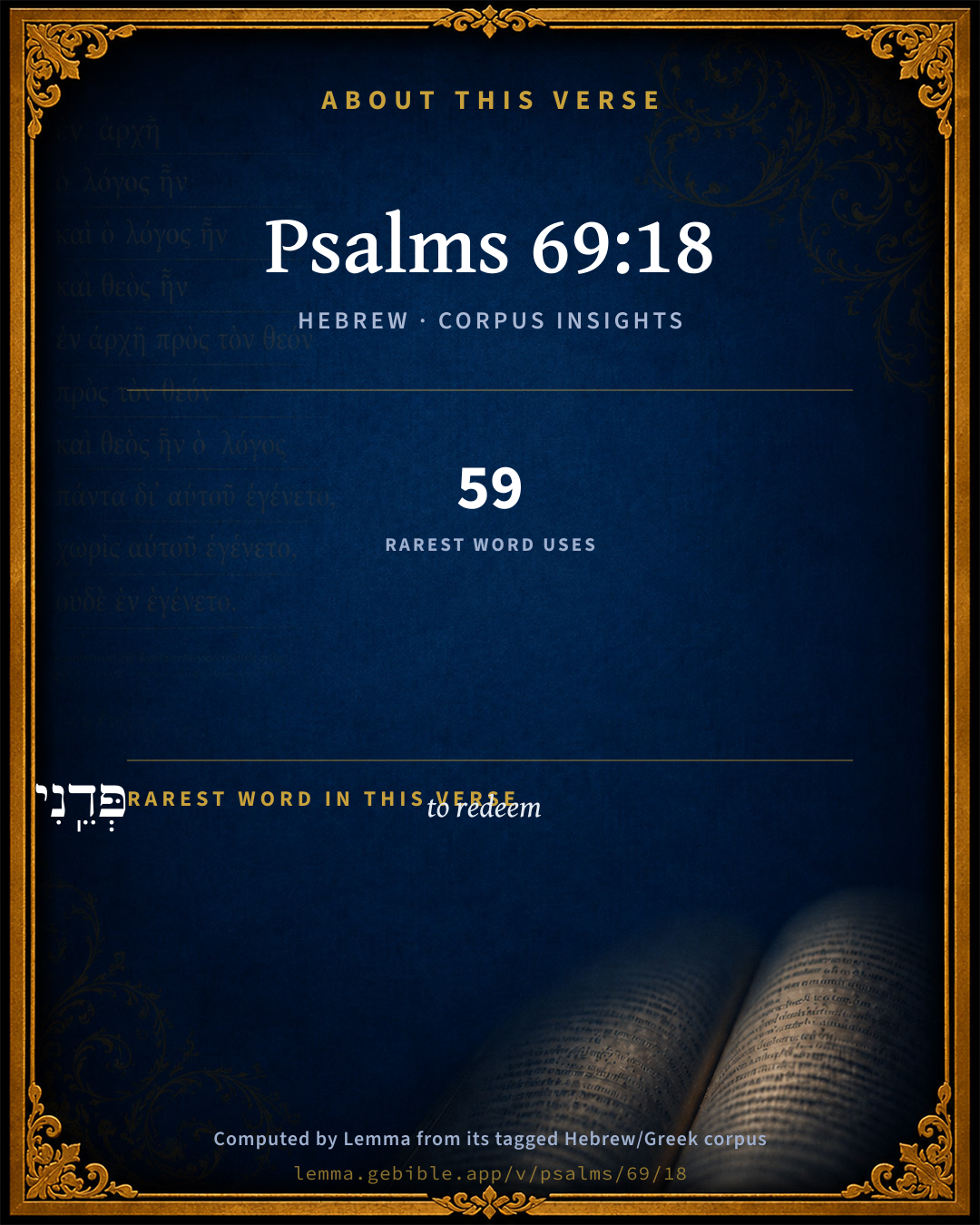
פְּדֵֽנִי to redeem H6299 occurs in 48 verses of the Hebrew Bible. Also found in:

Grammatical profile

  • 4 verbs
  • 1 noun
  • 2 prepositions

Verb forms

  • קָרְבָ֣ה Qal · Imperative
  • גְאָלָ֑הּ Qal · Imperative
  • אֹיְבַ֣י Qal · Participle Active
  • פְּדֵֽנִי Qal · Imperative

Hebrew & Septuagint length

In English translation the verse runs 14 words from the Hebrew and 14 from the Septuagint (LXX English) — the same length.

A rough comparison of the two English renderings, which tokenize alike — not a word-level alignment.

Word counts can differ between the Hebrew and the Greek without any difference in meaning — e.g. the Hebrew direct-object marker אֵת has no separate Greek word, and Greek often adds the article ὁ.

Cross-references

10

Topical passages linked to Psalms 69:18 in the Treasury of Scripture Knowledge — connected by theme and wording, ordered by reader-vote popularity; previews shown in the World English Bible.

  • Psalms 22:1 My God, my God, why have you forsaken me? Why are you so far from helping me, and from the words of my groaning?
  • Psalms 22:19 But don't be far off, Yahweh. You are my help: hurry to help me.
  • Psalms 111:9 He has sent redemption to his people. He has ordained his covenant forever. His name is holy and awesome!
  • Psalms 49:15 But God will redeem my soul from the power of Sheol, For he will receive me. Selah.
  • Deuteronomy 32:27 Were it not that I feared the provocation of the enemy, Lest their adversaries should judge wrongly, Lest they should say, Our hand is exalted, Yahweh has not done all this.
  • Joshua 7:9 For the Canaanites and all the inhabitants of the land will hear of it, and will compass us round, and cut off our name from the earth: and what will you do for your great name?
  • Job 6:23 Or, 'Deliver me from the adversary's hand?' Or, 'Redeem me from the hand of the oppressors?'
  • Psalms 10:1 Why do you stand far off, Yahweh? Why do you hide yourself in times of trouble?
  • Psalms 31:5 Into your hand I commend my spirit. You redeem me, Yahweh, God of truth.
  • Jeremiah 14:8 You hope of Israel, the Savior of it in the time of trouble, why should you be as a foreigner in the land, and as a wayfaring man who turns aside to stay for a night?

Cross-references courtesy of OpenBible.info (CC BY 4.0).

Hebrew and Greek witnesses Masoretic Hebrew ↔ Greek Septuagint

The same verse in the two great witnesses to the Old Testament, shown verse-for-verse.

You’re reading Greek Psalm 68 (Hebrew Psalm 69). The Septuagint counts the superscription, so verse numbers can differ from the Hebrew — chapter-level alignment, not verse-by-verse. Numbering follows Rahlfs.

These are two independent witnesses, not word-aligned to each other, and the Septuagint is shown in lemma (dictionary) form.

Hebrew Psalms 69:18 Masoretic · Westminster Leningrad Codex

קָרְבָ֣ה אֶל נַפְשִׁ֣י גְאָלָ֑הּ לְמַ֖עַן אֹיְבַ֣י פְּדֵֽנִי

Draw near to my soul, and redeem it. Ransom me because of my enemies.

World English Bible · Public Domain

Greek LXX Greek Psalm 68:18 Septuagint · lemma form

μή ἀποστρέφω ὁ πρόσωπον σύ ἀπό ὁ παῖς σύ ὅτι θλίβω ταχύς ἐπιἀκούω ἐγώ

Draw near to my soul and redeem it: deliver me because of my enemies.

LXX2012 (modern English Septuagint) · Public Domain

Hebrew: Westminster Leningrad Codex (CC BY 4.0). Greek: Septuagint (public domain); English from LXX2012 (modern English Septuagint) (Public Domain). How the Septuagint differs from the Hebrew →

Commentary

Notes on Psalms 69:18 from classic Christian and Jewish commentators (each source and its license shown beneath its notes). The classic Christian expositions comment on the surrounding passage and are grouped to its opening verse, so a note may address several verses; the Jewish commentaries on the Tanakh (Rashi and others) are per-verse, so they appear only where the commentator wrote on this verse.

Lemma curates 59 commentaries, every one of them public domain or Creative Commons licensed, each selected and text-cleaned for this edition rather than reprinted as found. About our sources →

Trapp's Complete Commentary

John Trapp

Psa 69:18 Draw nigh unto my soul, [and] redeem it: deliver me because of mine enemies.

Ver. 18. Draw nigh unto my soul] Who seemest to be afar off; so the flesh suggesteth when help is any whit deferred.

Because of mine enemies] Who else will excessively insult.

John Trapp, A Commentary or Exposition upon All the Books of the Old and New Testament (1647–1656) — public domain. Text from a community e-Sword module.

J. A. Alexander on Psalms

Joseph Addison Alexander

19. (Psa 69:18). Draw nigh unto my soul, to me whose soul or life is threatened, ransom it, rescue it from ruin; because (or for the sake) of my enemies, redeem me, so that they may not triumph in my fall. See above, on Psa 13:4, and with the first clause compare Psa 22:1.

Joseph Addison Alexander, The Psalms Translated and Explained (1850) — public domain. Text from a community e-Sword module.

Adam Clarke's Commentary

Verse 18. Deliver me because of mine enemies.] Probably they now began to think that the redemption of these captives was not an impossible thing; that it was not far off; and therefore they had great rage, because they found their time was but short.

Adam Clarke's Commentary on the Bible (1810–1826) — public domain. Text from a community e-Sword/MySword module.

John Calvin's Commentaries

18. Draw near to my soul, redeem it. David was doubtless fully persuaded by faith that God was near him; but as we are accustomed to measure the presence or absence of God by the effects, David here tacitly complains, judging according to the flesh, that he is far from him. By the expression, Draw near, he means, that in so far as could be gathered from his actual condition, God appeared to have no regard to his welfare. Again, by calling upon God to draw near to his life, which he seemed to have forsaken, he exhibits a striking proof of the strength of his faith. The more cruelly he is molested by the wicked and proud, the more does he trust that God will appear to deliver him. As has been elsewhere observed, it is always to be held as an undoubted truth, that since “God resisteth the proud” (James 4:6,) he must at length repress the insolence and pride of those who obstinately resist him, although he may seem to connive at them for a time.

John Calvin's Commentaries (1540-1563) — public domain. Text from the Calvin Translation Society English edition (1840s-50s) via the Christian Classics Ethereal Library (ccel.org). Calvin's coverage is partial (roughly two-thirds of the Bible); uncommented books and verses are honest gaps, never fabricated. The 19th-century editor's footnotes and remarks are omitted so the notes are faithfully Calvin's own voice.

The Cambridge Bible for Schools and Colleges

gen. ed. J. J. S. Perowne

18. Draw nigh] Cp. the acknowledgement of answered prayer in Lam_3:57-58, ‘Thou drewest nigh in the day when I called upon thee … thou redeemedst my life.”

deliver me] Or, as R.V., ransom me. Cp. Jer_15:21.

because of mine enemies] Who will triumph if I am abandoned to their malice, and by whose triumph the honour of the God whom I serve will suffer. Cp. Psa_13:4.

The Cambridge Bible for Schools and Colleges (gen. ed. J. J. S. Perowne; Cambridge University Press, 1878–1918) — public domain. Text from a community e-Sword module.

John Gill's Exposition

Draw nigh unto my soul,.... God his father, while he was suffering, stood afar off from him; wherefore he desires that he would draw nigh to him in the manifestations of his love and favour to him; which he did, when he made known to him the way of life, and made him full of joy with his countenance;

and redeem it: that is, from the power of the grave; not leave it there, but raise him from the dead, and give him glory, as he did;

deliver me, because of mine enemies; that they might not triumph over him, as if, being dead, he should rise no more; and so the Targum,

"that mine enemies might not lift up themselves against me.''

Or the meaning is, deliver me from the grave, raise me from the dead, that I may requite mine enemies, and take vengeance on them; see Psa 41:8.

John Gill's Exposition of the Whole Bible (1746–1763) — public domain (CC PDM 1.0). Text via the HelloAO Bible API.

Albert Barnes' Notes on the Bible

Draw nigh unto my soul - To me - for my life is in danger.

And redeem it - Ransom it; save it from ruin. See the notes at Isa 43:3; notes at Isa 44:22.

Deliver me, because of mine enemies - Because they are so numerous, so powerful, and so determined on my destruction. Compare Psa 13:4.

Albert Barnes' Notes on the Bible (1834–1885) — public domain. Text from a community e-Sword/MySword module.

Matthew Poole's English Annotations

Draw nigh unto my soul, to support and relieve it, O thou who seemest to be departed far away from me.

Because of mine enemies; partly because they persecute it, and greedily seek to destroy it; and partly because they are thine as well as mine enemies, and if they succeed, will triumph not only over me, but in some sort over thee, and over religion.

Matthew Poole's English Annotations on the Holy Bible (1683–1685) — public domain. Text from a community e-Sword/MySword module.

The Treasury of David

Charles H. Spurgeon

Ver. 18. Draw nigh unto my soul. The near approach of God is all the sufferer needs; one smile of heaven will still the rage of hell.

And redeem it. It shall be redemption to me if thou wilt appear to comfort me. This is a deeply spiritual prayer, and one very suitable for a deserted soul. It is in renewed communion that we shall find redemption realized.

Deliver me because of mine enemies, lest they should, in their vaunting, blaspheme thy name, and boast that thou art not able to rescue those who put their trust in thee. Jesus, in condescending to use such supplications, fulfils the request of his disciples: "Lord, teach us to pray."

None.

None.

Psalms 69:19*

Here we have a sad recapitulation of sorrows, with more especial reference to the persons concerned in their infliction.

Charles H. Spurgeon's The Treasury of David (1869–1885) — public domain. Psalms only. Text from a community e-Sword/MySword module.

The Pulpit Commentary

Draw nigh unto my soul, and redeem it. David often complains that God is far from him, (Psa_10:1 Psa_22:19 Psa_38:21 Psa_71:12, etc.) and prays that he will "draw nigh," the sense of distance and alienation being intolerable. Deliver me because of mine enemies; i.e. because of their plots and machinations (see ver. 4).

The Pulpit Commentary (1880–1919), ed. H.D.M. Spence-Jones & Joseph S. Exell — public domain. Text from a community e-Sword module.

Scofield Reference Notes

C. I. Scofield

redeem

Heb. goel, Redemp. (Kinsman type). (See Scofield "Isa 59:20").

The Scofield Reference Bible (1917 edition), notes by C. I. Scofield — public domain. Text from a community e-Sword module.

unfoldingWord translationNotes

Door43 World Missions Community

redeem me

The writer asks God to redeem him as if the writer were a slave whose freedom God could purchase. AT: "free me" (See: Metaphor)

ransom me

The writer asks God to ransom him as if the writer were a captive whose release could be paid for with money. AT: "rescue me" (See: Metaphor)

my rebuke, my shame, and my dishonor

These abstract nouns can be stated as actions. AT: "how people have rebuked me, shamed me, and dishonored me" (See: Abstract Nouns)

my adversaries are all before you

Here "before you" means that God sees and knows all about them. AT: "you know who all my enemies are" (See: Idiom)

translationWords

redeem

adversary

ransom

shame

dishonor

unfoldingWord translationNotes — © Distant Shores Media and the Door43 World Missions Community, licensed CC BY-SA 4.0. Source: git.door43.org/Door43/en_tn.

Lesson kit

Teaching starters — assembled from the data on this page, not authored interpretation. Every prompt links to the verse data it draws on. Edit before teaching.

Psalms, in the Wisdom, opens this verse with 7 words (7 distinct Hebrew lemmas). Its most distinctive word is pâdâh (“to redeem”). A historical commentator’s framing appears above. Read the whole chapter for the surrounding context.

Discussion questions

  1. How does “to redeem” (pâdâh) shape what this verse is saying?
  2. Exodus 13:13 shares the word «to redeem» with this verse. How do the two illuminate each other?
  3. These translations render this verse differently; the difference is in the English rendering, not the original. What questions does that raise?
  4. The verb «קָרְבָ֣ה» is Qal Imperative. How does its form color the action?
  5. Reading how Trapp's Complete Commentary and J. A. Alexander on Psalms read this verse, where do the two commentators agree and where do they part?

Things to notice

Reading settings

Reading text

Shown beneath each verse's original-language words.

Old Testament
Old Testament edition

Read the OT as the Masoretic Hebrew (MT) or the Greek Septuagint (LXX).

English shown for the Greek Septuagint (in the Hebrew ↔ Greek comparison).

Comparing translations? Open the Compare panel on any verse page to stack up to four side by side.