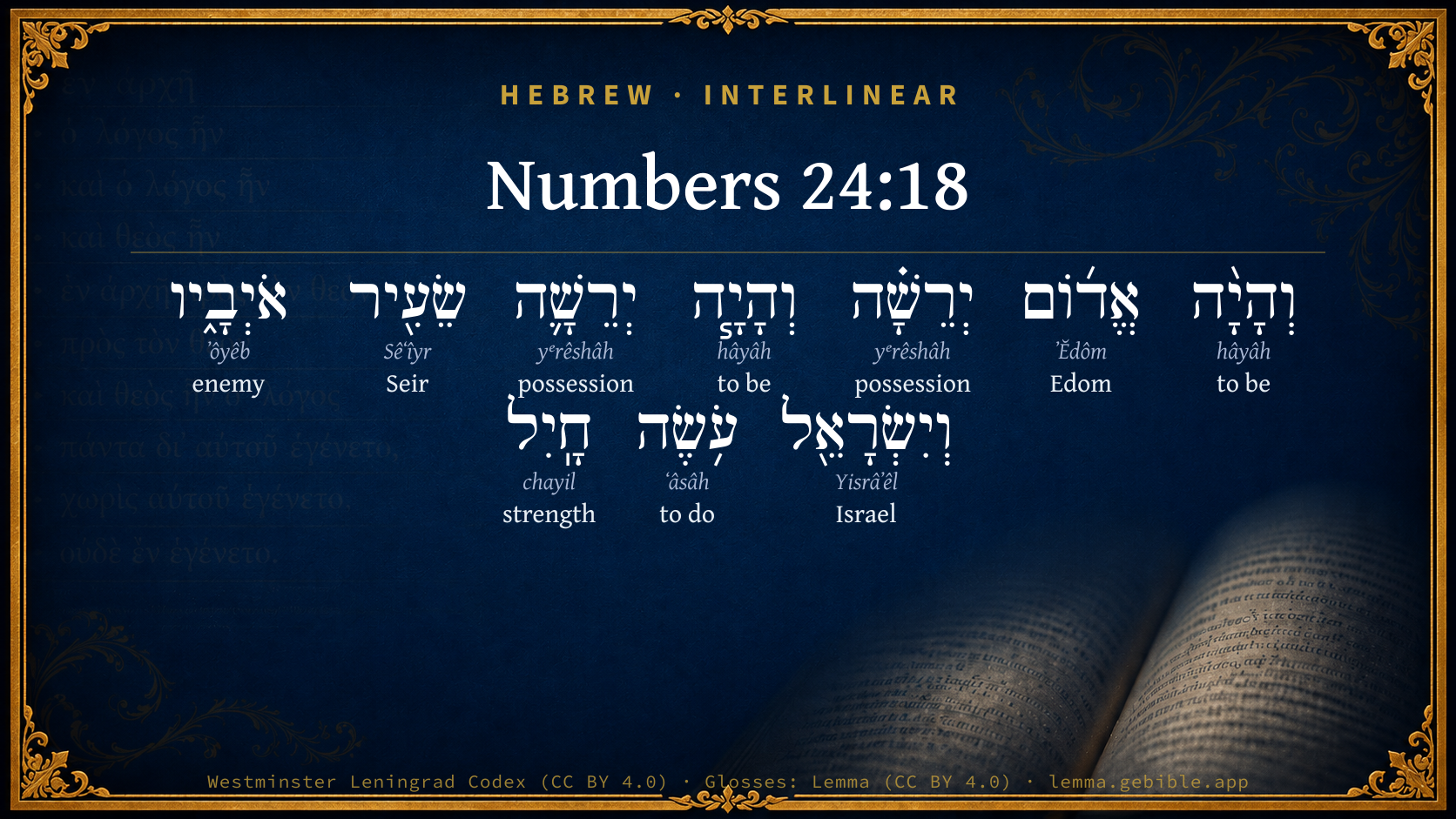
Numbers 24:18

Hebrew (Westminster Leningrad Codex) Numbers 24:18 appears in the Hebrew Old Testament. The text above is from the Westminster Leningrad Codex. Each word links to its Strong’s number, a concise gloss, and parsing drawn from the Open Scriptures Hebrew Bible morphology. Click any word for its full Brown-Driver-Briggs (BDB) entry.
Download image
Cite this verse

Numbers 24:18 (World English Bible). Public Domain. Lemma interlinear Bible study tool, https://lemma.gebible.app/v/numbers/24/18.

Show BibTeX & RIS
BibTeX
RIS
English Translation
Edom shall be a possession, Seir also shall be a possession, [who were] his enemies; While Israel does valiantly.
World English Bible · Public Domain
Highlights
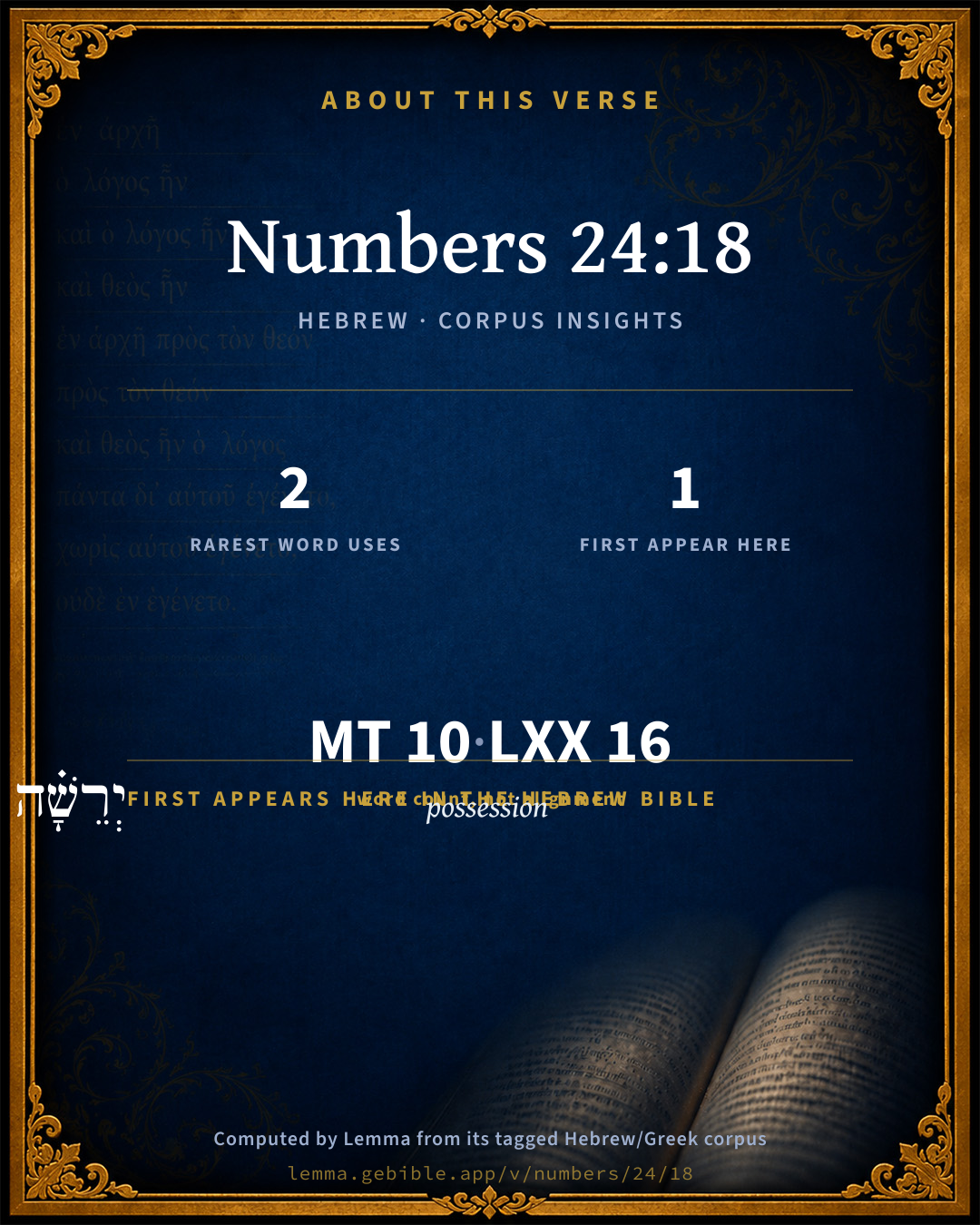
  • 1 first appearance in the Hebrew Bible
Full analysis ↓
Download a study sheet

One document with this verse’s original text, its word-by-word gloss line, the meaning frame, cross-references with their text, attributed commentary, and full source and license credits — printable, and it pastes into notes with its structure intact.

This verse Autodidact and up

Study sheet (.html) Plain text (.txt)

A passage Seminary Student

Up to 50 verses in one chapter. A passage sheet keeps up to 6 commentary sources and 12 cross-references per verse, in the order this page ranks them, and says so on the sheet whenever that leaves anything out. Ask for a single verse and you get the Autodidact verse sheet above.

Everything on this page stays free to read, with no account — the sheet is a download of what is already on screen, not access to it.

Want to remove ads? Support Godless Engineer
Compare translations 3

The same verse in 3 English versions, stacked beneath the original-language interlinear above. Click any original word for its lexicon entry.

Each is an independent rendering of the whole verse — the interlinear is not word-aligned to these translations.

Highlighted words mark where these versions differ — a whole-verse word diff, not a word-by-word alignment.

  • World English Bible Public Domain
    Edom shall be a possession, Seir also shall be a possession, [who were] his enemies; While Israel does valiantly.
  • King James Version Public Domain
    And Edom shall be a possession, Seir also shall be a possession for his enemies; and Israel shall do valiantly.
  • unfoldingWord Literal Text CC BY-SA 4.0
    And Edom will become a possession, and Seir will become a possession, his enemies. And Israel will act strongly.

unfoldingWord Literal Text — © unfoldingWord, licensed CC BY-SA 4.0. Word-aligned USFM3 via Door43 (git.door43.org/unfoldingWord/en_ult).

Versions to compare (up to 4)

3 of 4 selected

Show all 18 translations

Every available English version of this verse, each an independent rendering of the whole verse.

  • World English Bible Public Domain
    Edom shall be a possession, Seir also shall be a possession, [who were] his enemies; While Israel does valiantly.
  • Berean Standard Bible Public Domain
    Edom will become a possession, as will Seir, his enemy; but Israel will perform with valor.
  • Majority Standard Bible Public Domain
    Edom will become a possession, as will Seir, his enemy; but Israel will perform with valor.
  • King James Version Public Domain
    And Edom shall be a possession, Seir also shall be a possession for his enemies; and Israel shall do valiantly.
  • American Standard Version (1901) Public Domain
    And Edom shall be a possession, Seir also shall be a possession, `who were' his enemies; While Israel doeth valiantly.
  • Revised Version (1885) Public Domain
    And Edom shall be a possession, Seir also shall be a possession, which were his enemies; While Israel doeth valiantly.
  • Geneva Bible (1599) Public Domain
    And Edom shalbe possessed, and Seir shall be a possession to their enemies: but Israel shall do valiantly.
  • Douay-Rheims (1899) Public Domain
    And he shall possess Idumea: the inheritance of Seir shall come to their enemies, but Israel shall do manfully
  • Young's Literal Translation Public Domain
    And Edom hath been a possession, And Seir hath been a possession, `for' its enemies, And Israel is doing valiantly;
  • Literal Standard Version CC BY-SA 4.0
    And Edom has been a possession, || And Seir has been a possession [for] his enemies, || And Israel is doing valiantly;
  • Unlocked Literal Bible CC BY-SA 4.0
    Then Edom will become a possession of Israel, and Seir will also become their possession, enemies of Israel, whom Israel will conquer with force.
  • unfoldingWord Literal Text CC BY-SA 4.0
    And Edom will become a possession, and Seir will become a possession, his enemies. And Israel will act strongly.
  • Darby Bible Public Domain
    And Edom shall be a possession, and Seir a possession, -- they, his enemies; but Israel will do valiantly.
  • World Messianic Bible Public Domain
    Edom shall be a possession. Seir, his enemy, also shall be a possession, while Israel does valiantly.
  • Webster's Bible Public Domain
    And Edom shall be a possession, Seir also shall be a possession for his enemies; and Israel shall do valiantly.
  • Free Bible Version CC BY-SA 4.0
    The country of Edom will be conquered, his enemy Seir will be conquered, and the Israelites will be victorious.
  • Bible in Basic English Public Domain
    Edom will be his heritage, and he will put an end to the last of the people of Seir.
  • JPS Tanakh (1917) Public Domain
    And Edom shall be a possession, Seir also, even his enemies, shall be a possession; while Israel doeth valiantly.

Literal Standard Version (2020), Covenant Press — licensed CC BY-SA 4.0. Text via the HelloAO Bible API (eBible.org). Unlocked Literal Bible (unfoldingWord) — licensed CC BY-SA 4.0. Text via the HelloAO Bible API (eBible.org). unfoldingWord Literal Text — © unfoldingWord, licensed CC BY-SA 4.0. Word-aligned USFM3 via Door43 (git.door43.org/unfoldingWord/en_ult). Free Bible Version, Dr. Jonathan Gallagher — licensed CC BY-SA 4.0. Text via the HelloAO Bible API (eBible.org).

Word by word

More ways to search: Search by grammar → Find every occurrence → Compare this word →

Practice this passage: Drill this verse → Learn its vocabulary →

About this verse

These counts appear in no published source. They are computed here, from the morphology-tagged text and Lemma’s own curated glosses. What Lemma adds →

10
words
8
distinct lemmas
Pentateuch
section

Notable vocabulary

The rarest word here is יְרֵשָׁ֗ה possession H3424 — appearing just 2 times in the whole Hebrew Bible.

First appearance in Scripture

This word makes its first canonical appearance in the Hebrew Bible here:

  • יְרֵשָׁ֗ה possession H3424

Grammatical profile

  • 4 verbs
  • 6 nouns

Verb forms

  • וְהָיָ֨ה Qal · Sequential Perfect
  • וְהָיָ֧ה Qal · Sequential Perfect
  • אֹיְבָ֑יו Qal · Participle Active
  • עֹ֥שֶׂה Qal · Participle Active

Repetition

Words recur within this verse — often emphatic in Hebrew:

  • וְהָיָ֨ה to be H1961 ×2
  • יְרֵשָׁ֗ה possession H3424 ×2

Hebrew & Septuagint length

In English translation the verse runs 19 words from the Hebrew and 20 from the Septuagint (LXX English) — closely comparable.

A rough comparison of the two English renderings, which tokenize alike — not a word-level alignment.

Word counts can differ between the Hebrew and the Greek without any difference in meaning — e.g. the Hebrew direct-object marker אֵת has no separate Greek word, and Greek often adds the article ὁ.

In the original languages it is 10 Hebrew tokens and 16 Greek tokens — but the two are counted differently (Hebrew bundles its prefixes and suffixes into one token; the Greek is in lemma form), so that isn’t a like-for-like length.

Cross-references

9

Topical passages linked to Numbers 24:18 in the Treasury of Scripture Knowledge — connected by theme and wording, ordered by reader-vote popularity; previews shown in the World English Bible.

  • Amos 9:12 that they may possess the remnant of Edom, and all the nations who are called by my name," says Yahweh who does this.
  • Genesis 27:29 Let peoples serve you, Nations bow down to you. Be lord over your brothers, Let your mother's sons bow down to you. Cursed be everyone who curses you, Blessed be everyone who blesses you."
  • 2 Samuel 8:14 He put garrisons in Edom; throughout all Edom put he garrisons, and all the Edomites became servants to David. Yahweh gave victory to David wherever he went.
  • Genesis 27:40 By your sword will you live, and you will serve your brother. It will happen, when you will break loose, That you shall shake his yoke from off your neck."
  • Genesis 32:3 Jacob sent messengers in front of him to Esau, his brother, to the land of Seir, the field of Edom.
  • Psalms 60:1 God, you have rejected us. You have broken us down. You have been angry. Restore us, again.
  • Psalms 60:8–12 Moab is my wash basin. I will throw my shoe on Edom. I shout in triumph over Philistia."
  • Isaiah 34:5 For my sword has drunk its fill in the sky: behold, it shall come down on Edom, and on the people of my curse, to judgment.
  • Isaiah 63:1 Who is this who comes from Edom, with dyed garments from Bozrah? this who is glorious in his clothing, marching in the greatness of his strength? I who speak in righteousness, mighty to save.

Cross-references courtesy of OpenBible.info (CC BY 4.0).

Hebrew and Greek witnesses Masoretic Hebrew ↔ Greek Septuagint

The same verse in the two great witnesses to the Old Testament, shown verse-for-verse.

These are two independent witnesses, not word-aligned to each other, and the Septuagint is shown in lemma (dictionary) form.

Hebrew Numbers 24:18 Masoretic · Westminster Leningrad Codex

וְהָיָ֨ה אֱד֜וֹם יְרֵשָׁ֗ה וְהָיָ֧ה יְרֵשָׁ֛ה שֵׂעִ֖יר אֹיְבָ֑יו וְיִשְׂרָאֵ֖ל עֹ֥שֶׂה חָֽיִל

Edom shall be a possession, Seir also shall be a possession, [who were] his enemies; While Israel does valiantly.

World English Bible · Public Domain

Greek LXX Numbers 24:18 Septuagint · lemma form

καί εἰμί εδωμ κληρονομία καί εἰμί κληρονομία ησαυ ὁ ἐχθρός αὐτός καί ἰσραήλ ποιέω ἐν ἰσχύς

And Edom shall be an inheritance, and Esau his enemy shall be an inheritance of Israel, and Israel wrought valiantly.

LXX2012 (modern English Septuagint) · Public Domain

On this verse, The Pulpit Commentary discusses the Septuagint’s reading. Read the note in Commentary ↓

Hebrew: Westminster Leningrad Codex (CC BY 4.0). Greek: Septuagint (public domain); English from LXX2012 (modern English Septuagint) (Public Domain). How the Septuagint differs from the Hebrew →

Targum (Aramaic paraphrase)

2

The Targum is the ancient Jewish Aramaic paraphrase of the Hebrew Scriptures — an interpretive translation, not the Hebrew text itself. Onkelos (literal) and Pseudo-Jonathan (expansive) render the Torah, and Jonathan the Prophets. Coverage is partial: where no permissively-licensed English translation exists for a verse, only the Aramaic is shown. This is verse-level text, not a word-by-word alignment to the Hebrew.

  1. Targum Onkelos Torah (Genesis–Deuteronomy)
    וִיהֵי אֱדוֹם יְרוּתָּא וִיהֵי יְרוּתָּא שֵׂעִיר לְבַעֲלֵי דְבָבוֹהִי וְיִשְׂרָאֵל יַצְלַח בְּנִכְסִין

    (no public-domain English translation for this verse)

    Targum Onkelos — Aramaic: “Onkelos Genesis” (public domain); “Onkelos Exodus” (public domain); “Onkelos Leviticus” (public domain); “Onkelos Numbers” (public domain); “Onkelos Deuteronomy” (public domain). English: “Sefaria Community Translation” (CC0 1.0 (public-domain dedication)); “J.W. Etheridge. The Targums of Onkelos and Jonathan Ben Uzziel on the Pentateuch. London: Longmans, Green, 1862” (public domain). Text via Sefaria.

  2. Targum Pseudo-Jonathan Torah (Genesis–Deuteronomy)
    וִיהַווֹן אֱדוֹמָאֵי תְּרִיכִין וִיהוֹן תְּרִיכִין בְּנֵי דְגַבְלָא מִן קֳדָם יִשְרָאֵל סַנְאֵיהוֹן וְיִשְרָאֵל יִתְקְפוּן בְּנִכְסִין וְיִרְתוּנוּן

    And the Edomaee will be utterly driven out, even the sons of Gabela from before Israel their foes, and Israel will be strengthened with their riches and possess them.

    Targum Pseudo-Jonathan — Aramaic: “Targum Jonathan on Genesis” (public domain); “Targum Jonathan on Exodus” (public domain); “Targum Jonathan on Leviticus” (public domain); “Targum Jonathan on Numbers” (public domain); “Targum Jonathan on Deuteronomy” (public domain). English: “The Targum of Jonathan ben Uzziel, trans. J. W. Etheridge, London, 1862” (public domain). Text via Sefaria.

Commentary

Notes on Numbers 24:18 from classic Christian and Jewish commentators (each source and its license shown beneath its notes). The classic Christian expositions comment on the surrounding passage and are grouped to its opening verse, so a note may address several verses; the Jewish commentaries on the Tanakh (Rashi and others) are per-verse, so they appear only where the commentator wrote on this verse.

Lemma curates 59 commentaries, every one of them public domain or Creative Commons licensed, each selected and text-cleaned for this edition rather than reprinted as found. About our sources →

Trapp's Complete Commentary

John Trapp

Num 24:18 And Edom shall be a possession, Seir also shall be a possession for his enemies; and Israel shall do valiantly.

Ver. 18. And Edom shall be a possession.] This was literally fulfilled in David, {1Ch 18:13 Psa 60:8} but spiritually, and especially in Christ, {Isa 63:1-2, &c.} who shall shortly subdue the Romish Edomite. {2Th 2:8}

John Trapp, A Commentary or Exposition upon All the Books of the Old and New Testament (1647–1656) — public domain. Text from a community e-Sword module.

Joseph Benson's Commentary

Num 24:18. Edom shall be a possession — “This was also fulfilled by David; for throughout all Edom put he garrisons, and all they of Edom became David’s servants, 2Sa 8:14. David himself, in two of his Psalms, (Psa 60:8; and Psa 108:9;) hath mentioned together his conquest of Moab and Edom, as they are also joined together in this prophecy.” Seir is the name of the mountains of Edom, which were also possessed by David. Israel shall do valiantly — As they did, particularly under the command of David.

Joseph Benson's Commentary on the Old and New Testaments (1811–1818) — public domain. Text from a community e-Sword module.

Jamieson, Fausset & Brown

Robert Jamieson, A. R. Fausset & David Brown

Edom shall be a possession--This prophecy was accomplished by David (Sa2 8:14).

Seir--seen in the south, and poetically used for Edom. The double conquest of Moab and Edom is alluded to (Psa 60:8; Psa 108:9).

Jamieson, Fausset & Brown — Commentary Critical and Explanatory on the Whole Bible (1871) — public domain (CC PDM 1.0). Text via the HelloAO Bible API.

Adam Clarke's Commentary

Verse 18. And Edom shall be a possession] That is, to DAVID: as it is said: "And all they of Edom became David's servants;" 2Sa 8:14.

Seir also shall be a possession] That is, unto the king MESSIAH; as it is said: "And saviours shall come upon Mount Zion to judge the Mount of Esau; and the kingdom shall be the Lord's;" Obad., Ob 1:21. See Ainsworth.

Adam Clarke's Commentary on the Bible (1810–1826) — public domain. Text from a community e-Sword/MySword module.

Ellicott's Commentary for English Readers

(18) And Edom shall be a possession, Seir also . . . —Better, And Edom shall be a possession, and Seir shall be a possession, for his enemies (i.e., the enemies of Israel, or, rather, of the Ruler who was to rise out of Israel). The Hebrew word (oyebaiv) which is rendered “his enemies” appears to stand in apposition to Edom and Seir, as the word zaraiv (his enemies, or adversaries) in Num_24:8 to “the nations.” Edom was the name of the people, Seir of the country. (See Gen_32:3.) The prophecy received its primary accomplishment in the time of David (2Sa_8:14), but the ultimate accomplishment is to be found in the person and work of Christ (Isa_63:1-4).

And Israel shall do valiantly.—Or, shall acquire power or wealth. (Comp. Deu_8:17-18; Rth_4:11.)

A Bible Commentary for English Readers, edited by Charles John Ellicott (1878–1897) — public domain. Text from a community e-Sword module.

The Cambridge Bible for Schools and Colleges

gen. ed. J. J. S. Perowne

18. which were his enemies] Heb. has simply ‘his enemies,’ attached very awkwardly to the preceding words. Perhaps a word has been lost, and we should read ‘His enemies ——’ in contrast with the next clause: And Israel doeth valiantly.

The Cambridge Bible for Schools and Colleges (gen. ed. J. J. S. Perowne; Cambridge University Press, 1878–1918) — public domain. Text from a community e-Sword module.

John Gill's Exposition

Out of Jacob shall come he that shall have dominion,.... Meaning either David, or rather the Messiah; and so Jarchi interprets this of another ruler out of Jacob, even of the Messiah, of whom it is said, he shall have dominion from sea to sea; Psa 72:8,

and shall destroy him, that remaineth of the city; chief city of Edom, or of any of the cities of it, signifying that there should be none left, see Oba 1:18, this is also applied to the days of the Messiah, in the ancient writings of the Jews (q).

(q) Bemidbar Rabba, fol. 179. 3.

John Gill's Exposition of the Whole Bible (1746–1763) — public domain (CC PDM 1.0). Text via the HelloAO Bible API.

Albert Barnes' Notes on the Bible

Seir - The older name of the mountain-land, south of Moab, and east of the Arabah, which the Edomites inhabited Gen 32:3; Gen 36:8-9.

Albert Barnes' Notes on the Bible (1834–1885) — public domain. Text from a community e-Sword/MySword module.

Haydock's Catholic Bible Commentary

Idumea and Seir. The children of Esau shall acknowledge the dominion of Israel, from David to Josaphat, and again under Hircan, 3 Kings xi. 15., and 4 Kings iii. 20. (Josephus, [Antiquities?] xiii. 17.) (Calmet) --- Not only the faithful Israelites, but also the profane and headstrong sons of Esau, shall bend the knee before Christ, who will subdue them by the power of his grace, and by the preaching of his disciples. (Haydock)

George Leo Haydock (1774–1849), Haydock's Catholic Family Bible and Commentary, 1859 edition — public domain. Excludes Psalms (Douay-Rheims chapter numbering differs from Protestant) and Deuterocanonical books (Catholic canon only).

Matthew Poole's English Annotations

A possession; which was also foretold Gen 25:23, and in part fulfilled, 2Sa 8:14; 1Ch 18:13, but more fully by Christ, Amo 9:12; Oba 1:18; who shall subdue and possess all his enemies; here signified by the name of Edom; as Jacob or Israel, his brother, signifies all his church and people. Seir, a part and mountain of Edom, Gen 36:8, which may be here mentioned as the strongest part of Edom, to show that not only the rest of Edom, which is more accessible, but even the rocks and best munitions of it, shall be taken.

His enemies, the Israelites.

Do valiantly, or, gain power, or riches, or victory, all which are comprehended in this phrase.

Matthew Poole's English Annotations on the Holy Bible (1683–1685) — public domain. Text from a community e-Sword/MySword module.

Whedon's Commentary on the Bible

Daniel D. Whedon

18. Edom… a possession — As predicted in Gen_25:23, and fulfilled in 2Sa_8:14. As a kindred nation Edom might have had permanent peace with Israel, who was forbidden to war with them (Deu_2:4-5;) but their bitter hostility to God’s people caused their overthrow, which David began and his greater Son will finish in the “end of the days.” Psalms 110. Edom, after various insurrections, (1Ki_11:14-22; 2Ki_8:20; 2Ki_14:7; 2Ki_14:22, note; 2Ch_28:17; Eze_36:5; Oba_1:10; Oba_1:13; 1Ma_5:3; 1Ma_5:65; 2Ma_10:15; 2Ma_12:33,) was at last conquered by John Hyrcanus 129 B.C., and forced to submit to circumcision and to be merged in the Jewish state, there to rule in the persons of Antipater and the Herods till the overthrow of the Romans.

Seir — The mountain home of Esau. Gen_36:8-9.

Israel shall do valiantly — Quoted by David after the conquest of Edom, Psa_60:12.

Daniel D. Whedon (gen. ed.), Commentary on the Old and New Testaments (1874–1909) — public domain. Text from a community e-Sword module.

The Pulpit Commentary

Seir also shall be a possession for his enemies. Seir, (Gen_32:3) or Mount Seir, (Gen_36:8) was the old name, still retained as an alternative, of Edom. It is uncertain whether the rendering "for his (i.e., Edom"s) enemies" is correct. The Hebrew is simply wybyao, which may stand in apposition to Edom and Seir, "his enemies," i.e., the enemies of Israel. So the Septuagint, Hsau o ecyro . Shall do valiantly, or, "shall be prosperous". (cf. Deu_8:17 Rth_4:11)

The Pulpit Commentary (1880–1919), ed. H.D.M. Spence-Jones & Joseph S. Exell — public domain. Text from a community e-Sword module.

John Wesley's Explanatory Notes

A possession - Which was also foretold, Gen. xxv, 23, and in part fulfilled, 2 Sam. viii, 14; 1 Chron. xviii, 13, but more fully by Christ, Amos ix, 12 Obad. i, 18, who shall subdue and possess all his enemies; here signified by the name of Edom, as Jacob or Israel, his brother, signifies all his church and people. Seir - A part and, mountain of Edom.

John Wesley, Explanatory Notes Upon the Whole Bible (1754–1765) — public domain. Text via the GEBible commentary corpus.

Keil & Delitzsch

C. F. Keil & F. Delitzsch

"And Edom becomes a possession, and Seir becomes a possession, its enemies; but Israel acquires power." Whose possession Edom and Seir are to become, is not expressly stated; but it is evident from the context, and from איביו (its enemies), which is not a genitive dependent upon Seir, but is in apposition to Edom and Seir, just as צריו in Num 24:8 is in apposition to גּוים. Edom and Seir were his, i.e., Israel's enemies; therefore they were to be taken by the ruler who was to arise out of Israel. Edom is the name of the people, Seir of the country, just as in Gen 32:4; so that Seir is not to be understood as relating to the prae-Edomitish population of the land, which had been subjugated by the descendants of Esau, and had lost all its independence a long time before. In Moses' days the Israelites were not allowed to fight with the Edomites, even when they refused to allow them to pass peaceably through their territory (see Num 20:21), but were commanded to leave them in their possessions as a brother nation (Deu 2:4-5). In the future, however, their relation to one another was to be a very different one; because the hostility of Edom, already in existence, grew more and more into obstinate and daring enmity, which broke up all the ties of affection that Israel was to regard as holy, and thus brought about the destruction of the Edomites. - The fulfilment of this prophecy commenced with the subjugation of the Edomites by David (Sa2 8:14; Kg1 11:15-16; Ch1 18:12-13), but it will not be completed till "the end of the days," when all the enemies of God and His Church will be made the footstool of Christ (Psa 110:1.). That David did not complete the subjugation of Edom is evident, on the one hand, from the fact that the Edomites revolted again under Solomon, though without success (Kg1 11:14.); that they shook off the yoke imposed upon them under Joram (Kg2 8:20); and notwithstanding their defeat by Amaziah (Kg2 14:7; Ch2 25:11) and Uzziah (Kg2 14:22; Ch2 26:2), invaded Judah a second time under Ahaz (Ch2 28:17), and afterwards availed themselves of every opportunity to manifest their hostility to the kingdom of Judah and the Jews generally, - as for example at the conquest of Jerusalem by the Chaldeans (Eze 35:15; Eze 36:5; Oba 1:10 and Oba 1:13), and in the wars between the Maccabees and the Syrians (1 Macc. 5:3, 65; 2 Macc. 10:15; 12:38ff.), - until they were eventually conquered by John Hyrcanus in the year b.c. 129, and compelled to submit to circumcision, and incorporated in the Jewish state (Josephus, Ant. xiii. 9, 1, xv. 7, 9; Wars of the Jews, iv. 5, 5). But notwithstanding this, they got the government over the Jews into their own hands through Antipater and Herod (Josephus, Ant. xiv. 8, 5), and only disappeared from the stage of history with the destruction of the Jewish state by the Romans. On the other hand, the declarations of the prophets (Amo 9:12; Oba 1:17.), which foretell, with an unmistakeable allusion to this prophecy, the possession of the remnant of Edom by the kingdom of Israel, and the announcements in Isa 34 and Isa 63:1-6, Jer 49:7., Eze 25:12. and Eze 35:1-15, comp. with Psa 137:7 and Lam 4:21-22, prove still more clearly that Edom, as the leading foe of the kingdom of God, will only be utterly destroyed when the victory of the latter over the hostile power of the world has been fully and finally secured. - Whilst Edom falls, Israel will acquire power. חיל עשׂה, to acquire ability or power (Deu 8:17-18; Rut 4:11), not merely to show itself brave or strong. It is rendered correctly by Onkelos, "prosperabitur in opibus;" and Jonathan, "praevalebunt in opibus et possidebunt eos."

Keil & Delitzsch — Biblical Commentary on the Old Testament (1861–1891) — public domain (CC PDM 1.0). Text via the HelloAO Bible API. (Old Testament only.)

unfoldingWord translationNotes

Door43 World Missions Community

General Information:

Balaam finishes the first of his four prophecies.

Edom will become a possession of Israel

This can be stated in active form. AT: "The Israelites will occupy Edom" (See: Active or Passive)

Seir will also become their possession

Here "Seir" refers to the people who lived near Mount Seir. This can be stated in active form. AT: "Israel will also conquer the people of Seir" (See: Active or Passive and Metonymy)

Out of Jacob a king will come

Jacob was the ancestor of the Israelites. "Jacob" is a metonym that refers to the whole people group. (See: Metonymy)

of their city

This refers to the city of Ar where Balak met Balaam. (See: Assumed Knowledge and Implicit Information)

translationWords

Edom

possess

adversary

king

dominion

unfoldingWord translationNotes — © Distant Shores Media and the Door43 World Missions Community, licensed CC BY-SA 4.0. Source: git.door43.org/Door43/en_tn.

Rashi

Rabbi Shlomo Yitzchaki (Rashi)

והיה ירשה שעיר איביו SEIR ALSO SHALL BE A POSSESSION [FOR HIS ENEMIES] — for his enemy, Israel.

Rashi on the Tanakh — English translations: “The Judaica Press complete Tanach with Rashi, translated by A. J. Rosenberg” (CC BY 4.0); “Pentateuch with Rashi's commentary by M. Rosenbaum and A.M. Silbermann, 1929-1934” (public domain); “The Metsudah Tanach series, Lakewood, N.J” (CC BY 4.0); and “The Book of Joshua, Metsudah Publications, 1997” (CC BY 4.0). Text via Sefaria.

Ramban (Nachmanides)

Rabbi Moshe ben Nachman (Ramban / Nachmanides)

AND EDOM SHALL BE A POSSESSION, SEIR ALSO, EVEN HIS ENEMIES SHALL BE A POSSESSION. The downfall of Edom will be by the hand of the Messiah, because our present exile under the hand of Rome is considered Edom’s [exile], just as it is said: The punishment of thine iniquity is absolved, O daughter of Zion, He will no more carry thee away into captivity; He will punish thine iniquity, O ‘daughter of Edom,’ He will uncover thy sins — for G-d will not punish Edom until the sins of Zion are absolved, at the time when He will no more keep them in captivity. Therefore Balaam mentioned Edom, for it is he who disputes our [right to] kingdom, and about him it has been said, and the one people shall be stronger than the other. ). Balaam was thus prophesying that Edom will not completely fall until the time of the end [of the exile] by the hand of ‘the star’ [i.e., the Messiah] who will step forth out of Jacob [as stated in the previous verse].Seir also, even his enemies shall be a possession. This means that Seir will become a possession of his enemies [i.e., of Israel]. is to be interpreted as to his enemies. Or [the term] his enemies may refer to [Jacob’s enemies, i.e.,] Edom and Seir mentioned [previously in the verse], who are the enemies of Jacob, [and the meaning of the verse would thus be: “Edom, and Seir also, who are the enemies of Israel] will become a possession [of Israel].”

Ramban (Nachmanides) on the Tanakh — English translation: “Commentary on the Torah by Ramban (Nachmanides). Translated and annotated by Charles B. Chavel. New York, Shilo Pub. House, 1971-1976” (CC BY 4.0). Text via Sefaria.

Lesson kit

Teaching starters — assembled from the data on this page, not authored interpretation. Every prompt links to the verse data it draws on. Edit before teaching.

Numbers, in the Pentateuch, opens this verse with 10 words (8 distinct Hebrew lemmas). Its most distinctive word is yᵉrêshâh (“possession”). A historical commentator’s framing appears above. Read the whole chapter for the surrounding context.

Discussion questions

  1. What does “possession” (yᵉrêshâh) contribute to the verse as a whole?
  2. This is the first place “possession” appears in Scripture (first appears here). What does its debut here establish?
  3. How does Amos 9:12, which shares this passage’s theme, read alongside this verse?
  4. What does the repetition of “to be” (2× in this one verse) do in this verse?
  5. These translations render this verse differently. What is at stake in choosing one wording over another?
  6. «וְהָיָ֨ה» is a Qal Sequential Perfect verb. How does that grammatical form shape the action described?
  7. Compare how Trapp's Complete Commentary and Joseph Benson's Commentary read this verse. Where do they agree or differ?

Things to notice

Reading settings

Reading text

Shown beneath each verse's original-language words.

Old Testament
Old Testament edition

Read the OT as the Masoretic Hebrew (MT) or the Greek Septuagint (LXX).

English shown for the Greek Septuagint (in the Hebrew ↔ Greek comparison).

Comparing translations? Open the Compare panel on any verse page to stack up to four side by side.