
Judges 3:28

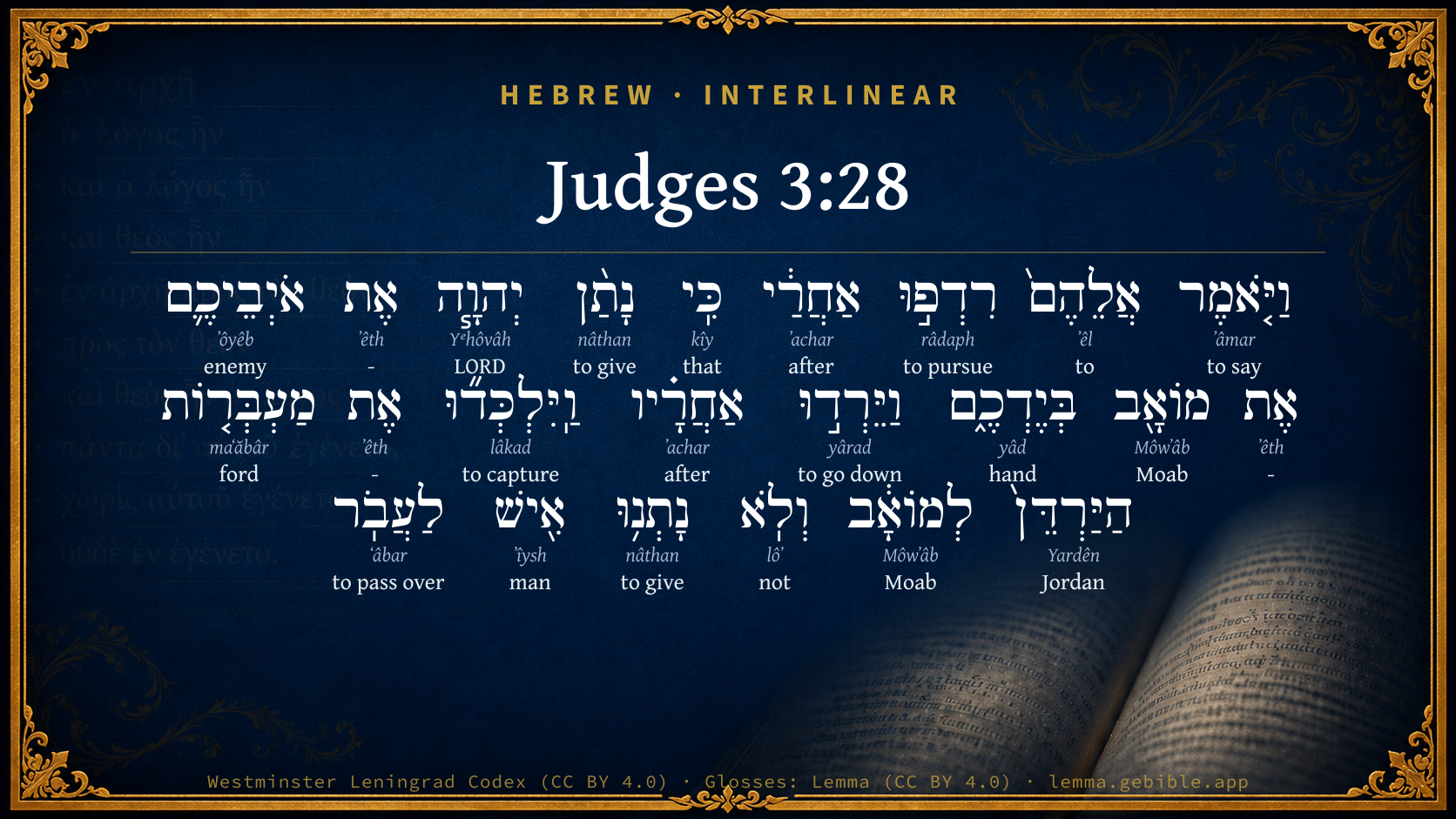
Hebrew (Westminster Leningrad Codex) Judges 3:28 appears in the Hebrew Old Testament. The text above is from the Westminster Leningrad Codex. Each word links to its Strong’s number, a concise gloss, and parsing drawn from the Open Scriptures Hebrew Bible morphology. Click any word for its full Brown-Driver-Briggs (BDB) entry.
Download image
Cite this verse

Judges 3:28 (World English Bible). Public Domain. Lemma interlinear Bible study tool, https://lemma.gebible.app/v/judges/3/28.

Show BibTeX & RIS
BibTeX
RIS
English Translation
He said to them, Follow after me; for Yahweh has delivered your enemies the Moabites into your hand. They went down after him, and took the fords of the Jordan against the Moabites, and didn't allow a man to pass over.
World English Bible · Public Domain
Download a study sheet

One document with this verse’s original text, its word-by-word gloss line, the meaning frame, cross-references with their text, attributed commentary, and full source and license credits — printable, and it pastes into notes with its structure intact.

This verse Autodidact and up

Study sheet (.html) Plain text (.txt)

A passage Seminary Student

Up to 50 verses in one chapter. A passage sheet keeps up to 6 commentary sources and 12 cross-references per verse, in the order this page ranks them, and says so on the sheet whenever that leaves anything out. Ask for a single verse and you get the Autodidact verse sheet above.

Everything on this page stays free to read, with no account — the sheet is a download of what is already on screen, not access to it.

Want to remove ads? Support Godless Engineer
Compare translations 3

The same verse in 3 English versions, stacked beneath the original-language interlinear above. Click any original word for its lexicon entry.

Each is an independent rendering of the whole verse — the interlinear is not word-aligned to these translations.

Highlighted words mark where these versions differ — a whole-verse word diff, not a word-by-word alignment.

  • World English Bible Public Domain
    He said to them, Follow after me; for Yahweh has delivered your enemies the Moabites into your hand. They went down after him, and took the fords of the Jordan against the Moabites, and didn't allow a man to pass over.
  • King James Version Public Domain
    And he said unto them, Follow after me: for the LORD hath delivered your enemies the Moabites into your hand. And they went down after him, and took the fords of Jordan toward Moab, and suffered not a man to pass over.
  • unfoldingWord Literal Text CC BY-SA 4.0
    Now he had said to them, “Follow after me, for Yahweh has given your enemies, Moab, into your hand.” So they went down after him and they captured the fords of the Jordan opposite Moab, and they did not allow anyone to cross over.

unfoldingWord Literal Text — © unfoldingWord, licensed CC BY-SA 4.0. Word-aligned USFM3 via Door43 (git.door43.org/unfoldingWord/en_ult).

Versions to compare (up to 4)

3 of 4 selected

Show all 18 translations

Every available English version of this verse, each an independent rendering of the whole verse.

  • World English Bible Public Domain
    He said to them, Follow after me; for Yahweh has delivered your enemies the Moabites into your hand. They went down after him, and took the fords of the Jordan against the Moabites, and didn't allow a man to pass over.
  • Berean Standard Bible Public Domain
    “Follow me,” he told them, “for the LORD has delivered your enemies the Moabites into your hand.” So they followed him down and seized the fords of the Jordan leading to Moab, and did not allow anyone to cross over.
  • Majority Standard Bible Public Domain
    “Follow me,” he told them, “for the LORD has delivered your enemies the Moabites into your hand.” So they followed him down and seized the fords of the Jordan leading to Moab, and they did not allow anyone to cross over.
  • King James Version Public Domain
    And he said unto them, Follow after me: for the LORD hath delivered your enemies the Moabites into your hand. And they went down after him, and took the fords of Jordan toward Moab, and suffered not a man to pass over.
  • American Standard Version (1901) Public Domain
    And he said unto them, Follow after me; for Jehovah hath delivered your enemies the Moabites into your hand. And they went down after him, and took the fords of the Jordan against the Moabites, and suffered not a man to pass over.
  • Revised Version (1885) Public Domain
    And he said unto them, Follow after me: for the LORD hath delivered your enemies the Moabites into your hand. And they went down after him, and took the fords of Jordan against the Moabites, and suffered not a man to pass over.
  • Geneva Bible (1599) Public Domain
    Then said he vnto them, Follow me: for the Lord hath deliuered your enemies, euen Moab into your hand. So they went downe after him, and tooke the passages of Iorden towarde Moab, and suffred not a man to passe ouer.
  • Douay-Rheims (1899) Public Domain
    And he said to them: Follow me: for the Lord hath delivered our enemies the Moabites into our hands. And they went down after him, and seized upon the fords of the Jordan, which are in the way to Moab: and they suffered no man to pass over.
  • Young's Literal Translation Public Domain
    and he saith unto them, `Pursue after me, for Jehovah hath given your enemies, the Moabites, into your hand;' and they go down after him, and capture the passages of the Jordan towards Moab, and have not permitted a man to pass over.
  • Literal Standard Version CC BY-SA 4.0
    and he says to them, “Pursue after me, for YHWH has given your enemies, the Moabites, into your hand”; and they go down after him, and capture the passages of the Jordan toward Moab, and have not permitted a man to pass over.
  • Unlocked Literal Bible CC BY-SA 4.0
    He said to them, “Follow me, for Yahweh is about to defeat your enemies, the Moabites.” They followed him and they captured the fords of the Jordan across from the Moabites, and they did not allow anyone to cross the river.
  • unfoldingWord Literal Text CC BY-SA 4.0
    Now he had said to them, “Follow after me, for Yahweh has given your enemies, Moab, into your hand.” So they went down after him and they captured the fords of the Jordan opposite Moab, and they did not allow anyone to cross over.
  • Darby Bible Public Domain
    And he said to them, "Follow after me; for the LORD has given your enemies the Moabites into your hand." So they went down after him, and seized the fords of the Jordan against the Moabites, and allowed not a man to pass over.
  • World Messianic Bible Public Domain
    He said to them, “Follow me; for the LORD has delivered your enemies the Moabites into your hand.” They followed him, and took the fords of the Jordan against the Moabites, and didn’t allow any man to pass over.
  • Webster's Bible Public Domain
    And he said to them, Follow me: for the LORD hath delivered your enemies the Moabites into your hand. And they went down after him, and took the fords of Jordan towards Moab, and suffered not a man to pass over.
  • Free Bible Version CC BY-SA 4.0
    He told them, “Follow me, for the Lord has handed Moab, your enemy, over to you.” So they followed him down and took control of the fords of the Jordan leading to Moab. They didn't let anyone cross.
  • Bible in Basic English Public Domain
    And he said to them, Come after me; for the Lord has given the Moabites, your haters, into your hands. So they went down after him and took the crossing-places of Jordan against Moab, and let no one go across.
  • JPS Tanakh (1917) Public Domain
    And he said unto them: 'Follow after me; for the LORD hath delivered your enemies the Moabites into your hand.' And they went down after him, and took the fords of the Jordan against the Moabites, and suffered not a man to pass over.

Literal Standard Version (2020), Covenant Press — licensed CC BY-SA 4.0. Text via the HelloAO Bible API (eBible.org). Unlocked Literal Bible (unfoldingWord) — licensed CC BY-SA 4.0. Text via the HelloAO Bible API (eBible.org). unfoldingWord Literal Text — © unfoldingWord, licensed CC BY-SA 4.0. Word-aligned USFM3 via Door43 (git.door43.org/unfoldingWord/en_ult). Free Bible Version, Dr. Jonathan Gallagher — licensed CC BY-SA 4.0. Text via the HelloAO Bible API (eBible.org).

Word by word

More ways to search: Search by grammar → Find every occurrence → Compare this word →

Practice this passage: Drill this verse → Learn its vocabulary →

מַעְבְּר֤וֹת
maʻăbâr
H4569
“fords of”
Noun, Common, Feminine, Plural, Construct
Part of Speech
Noun
Type
Common
Gender
Feminine
Number
Plural
State
Construct
Full BDB Definition

Origin: from H5674

TWOT: 1556h

ford, pass, passing - ford - pass - passing, sweep
  1. וַיֹּ֤אמֶר ʼâmar H559 “and · to say” Conjunction + Verb, Qal, Sequential Imperfect, 3rd Person, Masculine, Singular
  2. אֲלֵהֶם֙ ʼêl H413 “to · them” Preposition + Suffix, Personal, 3rd Person, Masculine, Plural
  3. רִדְפ֣וּ râdaph H7291 “pursue” Verb, Qal, Imperative, 2nd Person, Masculine, Plural
  4. אַחֲרַ֔י ʼachar H310 “after · me” Preposition + Suffix, Personal, 1st Person, Common, Singular
  5. כִּֽי kîy H3588 “that” Conjunction
  6. נָתַ֨ן nâthan H5414 “to give” Verb, Qal, Perfect, 3rd Person, Masculine, Singular
  7. יְהוָ֧ה Yᵉhôvâh H3068 “LORD” Noun, Proper
  8. אֶת ʼêth H853 “-” Particle, Direct Object
  9. אֹיְבֵיכֶ֛ם ʼôyêb H341 “enemy · you” Verb, Qal, Participle Active, Masculine, Plural, Construct + Suffix, Personal, 2nd Person, Masculine, Plural
  10. אֶת ʼêth H853 “-” Particle, Direct Object
  11. מוֹאָ֖ב Môwʼâb H4124 “Moab” Noun, Proper
  12. בְּיֶדְכֶ֑ם yâd H3027 “in/at · hand · your” Preposition + Noun, Common, Both, Singular, Construct + Suffix, Personal, 2nd Person, Masculine, Plural
  13. וַיֵּרְד֣וּ yârad H3381 “and · to go down” Conjunction + Verb, Qal, Sequential Imperfect, 3rd Person, Masculine, Plural
  14. אַחֲרָ֗יו ʼachar H310 “after · him” Preposition + Suffix, Personal, 3rd Person, Masculine, Singular
  15. וַֽיִּלְכְּד֞וּ lâkad H3920 “and · to capture” Conjunction + Verb, Qal, Sequential Imperfect, 3rd Person, Masculine, Plural
  16. אֶת ʼêth H853 “-” Particle, Direct Object
  17. הַיַּרְדֵּן֙ Yardên H3383 “the · Jordan” Particle, Definite Article + Noun, Proper
  18. לְמוֹאָ֔ב Môwʼâb H4124 “to/for · Moab” Preposition + Noun, Proper
  19. וְלֹֽא lôʼ H3808 “and · not” Conjunction + Particle, Negative
  20. נָתְנ֥וּ nâthan H5414 “to give” Verb, Qal, Perfect, 3rd Person, Common, Plural
  21. אִ֖ישׁ ʼîysh H376 “man” Noun, Common, Masculine, Singular, Absolute
  22. לַעֲבֹֽר ʻâbar H5674 “to pass over” Preposition + Verb, Qal, Infinitive Construct

About this verse

These counts appear in no published source. They are computed here, from the morphology-tagged text and Lemma’s own curated glosses. What Lemma adds →

23
words
18
distinct lemmas
Historical
section

Notable vocabulary

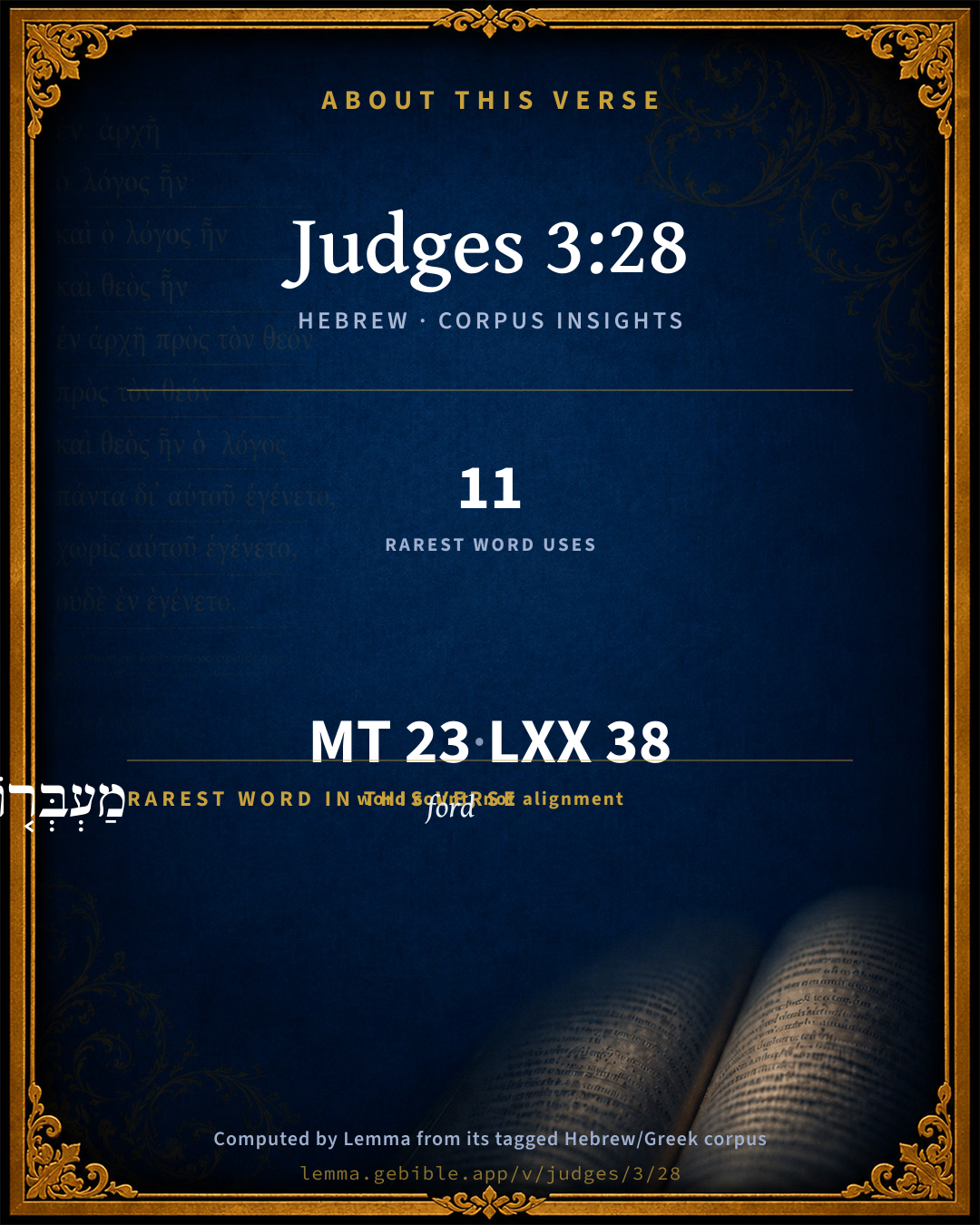
The rarest word here is מַעְבְּר֤וֹת ford H4569 — appearing just 11 times in the whole Hebrew Bible.

Shared distinctive vocabulary

מַעְבְּר֤וֹת ford H4569 occurs in 11 verses of the Hebrew Bible. Also found in:

Grammatical profile

  • 8 verbs
  • 7 nouns
  • 3 prepositions
  • 1 conjunction
  • 4 particles

Verb forms

  • וַיֹּ֤אמֶר Qal · Sequential Imperfect
  • רִדְפ֣וּ Qal · Imperative
  • נָתַ֨ן Qal · Perfect
  • אֹיְבֵיכֶ֛ם Qal · Participle Active
  • וַיֵּרְד֣וּ Qal · Sequential Imperfect
  • וַֽיִּלְכְּד֞וּ Qal · Sequential Imperfect
  • נָתְנ֥וּ Qal · Perfect
  • לַעֲבֹֽר Qal · Infinitive Construct

Repetition

Words recur within this verse — often emphatic in Hebrew:

  • אַחֲרַ֔י after H310 ×2
  • נָתַ֨ן to give H5414 ×2
  • מוֹאָ֖ב Moab H4124 ×2

Hebrew & Septuagint length

In English translation the verse runs 41 words from the Hebrew and 47 from the Septuagint (LXX English) — closely comparable.

A rough comparison of the two English renderings, which tokenize alike — not a word-level alignment.

Word counts can differ between the Hebrew and the Greek without any difference in meaning — e.g. the Hebrew direct-object marker אֵת has no separate Greek word, and Greek often adds the article ὁ.

In the original languages it is 23 Hebrew tokens and 38 Greek tokens — but the two are counted differently (Hebrew bundles its prefixes and suffixes into one token; the Greek is in lemma form), so that isn’t a like-for-like length.

Cross-references

8

Topical passages linked to Judges 3:28 in the Treasury of Scripture Knowledge — connected by theme and wording, ordered by reader-vote popularity; previews shown in the World English Bible.

  • Judges 12:5 The Gileadites took the fords of the Jordan against the Ephraimites. It was so, that when [any of] the fugitives of Ephraim said, Let me go over, the men of Gilead said to him, Are you an Ephraimite? If he said, No;
  • Joshua 2:7 The men pursued after them the way to the Jordan to the fords: and as soon as those who pursued after them were gone out, they shut the gate.
  • Judges 7:9 It happened the same night, that Yahweh said to him, Arise, get you down into the camp; for I have delivered it into your hand.
  • Judges 7:15 It was so, when Gideon heard the telling of the dream, and the interpretation of it, that he worshiped; and he returned into the camp of Israel, and said, Arise; for Yahweh has delivered into your hand the host of Midian.
  • 1 Samuel 17:47 and that all this assembly may know that Yahweh doesn't save with sword and spear: for the battle is Yahweh's, and he will give you into our hand.
  • Judges 7:24 Gideon sent messengers throughout all the hill-country of Ephraim, saying, Come down against Midian, and take before them the waters, as far as Beth Barah, even the Jordan. So all the men of Ephraim were gathered together, and took the waters as far as Beth Barah, even the Jordan.
  • Judges 4:10 Barak called Zebulun and Naphtali together to Kedesh; and there went up ten thousand men at his feet: and Deborah went up with him.
  • Judges 7:17 He said to them, Look on me, and do likewise: and, behold, when I come to the outermost part of the camp, it shall be that, as I do, so shall you do.

Cross-references courtesy of OpenBible.info (CC BY 4.0).

Hebrew and Greek witnesses Masoretic Hebrew ↔ Greek Septuagint

The same verse in the two great witnesses to the Old Testament, shown verse-for-verse.

These are two independent witnesses, not word-aligned to each other, and the Septuagint is shown in lemma (dictionary) form.

Hebrew Judges 3:28 Masoretic · Westminster Leningrad Codex

וַיֹּ֤אמֶר אֲלֵהֶם֙ רִדְפ֣וּ אַחֲרַ֔י כִּֽי נָתַ֨ן יְהוָ֧ה אֶת אֹיְבֵיכֶ֛ם אֶת מוֹאָ֖ב בְּיֶדְכֶ֑ם וַיֵּרְד֣וּ אַחֲרָ֗יו וַֽיִּלְכְּד֞וּ אֶת מַעְבְּר֤וֹת הַיַּרְדֵּן֙ לְמוֹאָ֔ב וְלֹֽא נָתְנ֥וּ אִ֖ישׁ לַעֲבֹֽר

He said to them, Follow after me; for Yahweh has delivered your enemies the Moabites into your hand. They went down after him, and took the fords of the Jordan against the Moabites, and didn't allow a man to pass over.

World English Bible · Public Domain

Greek LXX Judges 3:28 Septuagint · lemma form

καί εἶπον πρός αὐτός καταβαίνω ὀπίσω ἐγώ ὅτι παραδίδωμι κύριος ὁ θεός ὁ ἐχθρός ἐγώ ὁ μωαβ ἐν χείρ ἐγώ καί καταβαίνω ὀπίσω αὐτός καί προ καταλαμβάνω ὁ διάβασις ὁ ἰορδάνης ὁ μωαβ καί οὐ ἀποἵημι ἀνήρ διαβαίνω

And he said to them, Come down after me, for the Lord God has delivered our enemies, even Moab, into our hand; and they went down after him, and seized on the fords of Jordan before Moab, and he did not suffer a man to pass over.

LXX2012 (modern English Septuagint) · Public Domain

On this verse, The Cambridge Bible for Schools and Colleges discusses the Septuagint’s reading. Read the note in Commentary ↓

Hebrew: Westminster Leningrad Codex (CC BY 4.0). Greek: Septuagint (public domain); English from LXX2012 (modern English Septuagint) (Public Domain). How the Septuagint differs from the Hebrew →

Targum (Aramaic paraphrase)

1

The Targum is the ancient Jewish Aramaic paraphrase of the Hebrew Scriptures — an interpretive translation, not the Hebrew text itself. Onkelos (literal) and Pseudo-Jonathan (expansive) render the Torah, and Jonathan the Prophets. Coverage is partial: where no permissively-licensed English translation exists for a verse, only the Aramaic is shown. This is verse-level text, not a word-by-word alignment to the Hebrew.

  1. Targum Jonathan Prophets (Joshua–Malachi)
    וַאֲמַר לְהוֹן רְדִיפוּ בַתְרַי אֲרֵי מְסַר יְיָ יַת בַּעֲלֵי דְבָבֵיכוֹן יַת מוֹאֲבָאֵי בִּידֵיכוֹן וּנְחָתוּ בַתְרוֹהִי וַאֲחַדוּ יַת מְגִיזַת עָבְרָאֵי יַרְדְנָא עַל מוֹאָב וְלָא שְׁבַקוּ אֱנַשׁ לְמֶעְבַר:

    (no public-domain English translation for this verse)

    Targum Jonathan — Aramaic: “Mikraot Gedolot” (public domain). English: “Sefaria Community Translation” (CC0 1.0 (public-domain dedication)); “London "Chaldee Paraphrase," 1871” (public domain). Text via Sefaria.

Commentary

Notes on Judges 3:28 from classic Christian and Jewish commentators (each source and its license shown beneath its notes). The classic Christian expositions comment on the surrounding passage and are grouped to its opening verse, so a note may address several verses; the Jewish commentaries on the Tanakh (Rashi and others) are per-verse, so they appear only where the commentator wrote on this verse.

Lemma curates 59 commentaries, every one of them public domain or Creative Commons licensed, each selected and text-cleaned for this edition rather than reprinted as found. About our sources →

Trapp's Complete Commentary

John Trapp

Jdg 3:28 And he said unto them, Follow after me: for the LORD hath delivered your enemies the Moabites into your hand. And they went down after him, and took the fords of Jordan toward Moab, and suffered not a man to pass over.

Ver. 28. And he said unto them, Follow after me.] This was captain-like spoken. Caesar never said to his soldiers, Ite, Go ye, but Venite, Come along: I will lead you, neither shall ye go farther than ye have me before you. Hannibal was wont to be first in the battle, and last out. {a}

{a} Princeps proelium inibat: ultimus conserto proelio excedebat. - Liv.

John Trapp, A Commentary or Exposition upon All the Books of the Old and New Testament (1647–1656) — public domain. Text from a community e-Sword module.

Jamieson, Fausset & Brown

Robert Jamieson, A. R. Fausset & David Brown

they went down after him, and took the fords--(See on Jos 2:7). With the view of preventing all escape to the Moabite coast, and by the slaughter of ten thousand men [Jdg 3:29], Ehud rescued his country from a state of ignominious vassalage.

Jamieson, Fausset & Brown — Commentary Critical and Explanatory on the Whole Bible (1871) — public domain (CC PDM 1.0). Text via the HelloAO Bible API.

Adam Clarke's Commentary

Verse 28. Took the fords of Jordan] It is very likely that the Moabites, who were on the western side of Jordan, hearing of the death of Eglon, were panic-struck, and endeavoured to escape over Jordan at the fords near Jericho, when Ehud blew his trumpet in the mountains of Ephraim, and thus to get into the land of the Moabites, which lay on the east of Jordan; but Ehud and his men, seizing the only pass by which they could make their escape, slew ten thousand of them in their attempt to cross at those fords. What is called here the fords was doubtless the place where the Israelites had passed Jordan when they (under Joshua) took possession of the promised land.

Adam Clarke's Commentary on the Bible (1810–1826) — public domain. Text from a community e-Sword/MySword module.

Ellicott's Commentary for English Readers

(28) The Lord hath delivered your enemies the Moabites into your hand.—Comp. Jdg_7:9-15; 1Sa_17:47; 1Ki_22:12.

Took the fords of Jordan.—This was a matter of extreme importance. The fords of Jordan were few, and far distant from each other. (Jos_2:7.) The steep ravine through which it flows forms a natural barrier to Western Palestine, and by securing the fords they cut off from the Moabites all chance of succour. The vehement rapidity of Ehud’s movements had rendered their escape impossible.

Suffered not a man to passover.—Comp. Jdg_12:5-6. It was a massacre of vengeance, like the Sicilian Vespers, or the massacre of the English of the Pale in Ireland, or that of the Danes in England on St. Brice’s day.

A Bible Commentary for English Readers, edited by Charles John Ellicott (1878–1897) — public domain. Text from a community e-Sword module.

The Cambridge Bible for Schools and Colleges

gen. ed. J. J. S. Perowne

28. Follow after me] lit. pursue after me; the slight correction of the LXX come down after me, cf. clause b, is generally accepted.

against the Moabites] Cf. Jdg_7:24, Jdg_12:5, i.e. so as to prevent the Moabites on the west side of the river (Jdg_3:13) from crossing to their own country. Of the three fords near Jericho, the southernmost near Gilgal is probably meant; cf. Jos_2:7, 2Sa_19:15.

The Cambridge Bible for Schools and Colleges (gen. ed. J. J. S. Perowne; Cambridge University Press, 1878–1918) — public domain. Text from a community e-Sword module.

John Gill's Exposition

And they slew of Moab at that time about ten thousand men,.... Who had been sent into the land of Israel to keep it in subjection, or had settled themselves there for their better convenience, profit, and pleasure; it is very probable there were some of both sorts:

all lusty, and all men of valour; the word for "lusty" signifies "fat", living in ease for a long time, and in a plentiful country were grown fat; and, according to Ben Gersom, it signifies rich men, such as had acquired wealth by living in the land of Canaan; or who came over Jordan thither and settled about Jericho, because of the delightfulness of the place, and others were stout and valiant soldiers, whom the king of Moab had placed there to keep the land in subjection he had subdued, and to subdue what remained of it; but they were all destroyed:

and there escaped not a man; for there being no other way of getting into the land of Moab but at the fords of Jordan they fell into the hands of the Israelites possessed of them, as they made up unto them.

John Gill's Exposition of the Whole Bible (1746–1763) — public domain (CC PDM 1.0). Text via the HelloAO Bible API.

Albert Barnes' Notes on the Bible

Ehud “went down” from the mountain of Ephraim into the Jordan valley beneath it, straight to the Jordan fords Jos 2:7, so as to intercept all communication between the Moabites on the west side and their countrymen on the east.

Albert Barnes' Notes on the Bible (1834–1885) — public domain. Text from a community e-Sword/MySword module.

Haydock's Catholic Bible Commentary

Fords. That none, from the other side, might come to the assistance of the Moabites, (Menochius) who were at their prince’s court, in the territory of Jericho, and that none of these might make their escape. (Haydock)

George Leo Haydock (1774–1849), Haydock's Catholic Family Bible and Commentary, 1859 edition — public domain. Excludes Psalms (Douay-Rheims chapter numbering differs from Protestant) and Deuterocanonical books (Catholic canon only).

Matthew Poole's English Annotations

The fords, where they passed over Jordan, that neither the Moabites that were got into Canaan might escape, nor any more Moabites come over Jordan to their succour.

Matthew Poole's English Annotations on the Holy Bible (1683–1685) — public domain. Text from a community e-Sword/MySword module.

Whedon's Commentary on the Bible

Daniel D. Whedon

28. Took the fords of Jordan toward Moab — That is, the fords by which the Moabites stationed at Jericho must pass to escape to their own land, on the east of the Jordan. Eglon occupied Jericho, and had built a palace there, (see note on Jdg_3:13.) and had ten thousand men (Jdg_3:29) with him. It was of the first importance for the Israelites to get possession of these fords, and thus cut off the retreat of the Moabite army to the eastern side of the Jordan.

Daniel D. Whedon (gen. ed.), Commentary on the Old and New Testaments (1874–1909) — public domain. Text from a community e-Sword module.

John Wesley's Explanatory Notes

Fords of Jordan - Where they passed over Jordan, that neither the Moabites that were got into Canaan, might escape, nor any more Moabites come over Jordan to their succor.

John Wesley, Explanatory Notes Upon the Whole Bible (1754–1765) — public domain. Text via the GEBible commentary corpus.

unfoldingWord translationNotes

Door43 World Missions Community

General Information:

Ehud speaks to the people of Israel in Ephraim.

for Yahweh is about to defeat your enemies

Yahweh helping the Israelites to defeat their enemies is spoken of as if Yahweh were a warrior who would fight and defeat their enemies. (See: Metaphor)

captured the fords

"gained control of the fords"

fords

the areas of a river where it is shallow and easy to walk across to the other side

did not allow anyone to cross

"did not let anyone cross"

ten thousand men

"10,000 men" (See: Numbers)

capable men

"able men" or "men able to fight well"

Moab was subdued by the strength of Israel

This can be stated in active form. AT: "the Israelite army defeated the Moabites" (See: Active or Passive)

the strength of Israel

Here "strength" represents the Israelite army. (See: Metonymy)

the land had rest

Here "land" represents the people. AT: "the Israelites lived peacefully" (See: Metonymy)

eighty years

"80 years" (See: Numbers)

translationWords

Yahweh

adversary

Moab

Jordan River

Israel

unfoldingWord translationNotes — © Distant Shores Media and the Door43 World Missions Community, licensed CC BY-SA 4.0. Source: git.door43.org/Door43/en_tn.

Rashi

Rabbi Shlomo Yitzchaki (Rashi)

Charge behind me to wipe out all the Moabites on our side of the Yardein.

Took control of the Yardein passes so that the Moabites could not cross to escape and return to their country.

Rashi on the Tanakh — English translations: “The Judaica Press complete Tanach with Rashi, translated by A. J. Rosenberg” (CC BY 4.0); “Pentateuch with Rashi's commentary by M. Rosenbaum and A.M. Silbermann, 1929-1934” (public domain); “The Metsudah Tanach series, Lakewood, N.J” (CC BY 4.0); and “The Book of Joshua, Metsudah Publications, 1997” (CC BY 4.0). Text via Sefaria.

Lesson kit

Teaching starters — assembled from the data on this page, not authored interpretation. Every prompt links to the verse data it draws on. Edit before teaching.

Judges, in the Historical, opens this verse with 23 words (18 distinct Hebrew lemmas). Its most distinctive word is maʻăbâr (“ford”). A historical commentator’s framing appears above. Read the whole chapter for the surrounding context.

Discussion questions

  1. The word maʻăbâr carries the sense “ford.” How does it shape the verse?
  2. How does Genesis 32:22, which shares the word «ford», read alongside this verse?
  3. What does the repetition of “after” (2× in this one verse) do in this verse?
  4. These translations render this verse differently; the difference is in the English rendering, not the original. What questions does that raise?
  5. «וַיֹּ֤אמֶר» is a Qal Sequential Imperfect verb. How does that grammatical form shape the action described?
  6. Compare how Trapp's Complete Commentary and Jamieson, Fausset & Brown read this verse. Where do they agree or differ?

Things to notice

Reading settings

Reading text

Shown beneath each verse's original-language words.

Old Testament
Old Testament edition

Read the OT as the Masoretic Hebrew (MT) or the Greek Septuagint (LXX).

English shown for the Greek Septuagint (in the Hebrew ↔ Greek comparison).

Comparing translations? Open the Compare panel on any verse page to stack up to four side by side.