
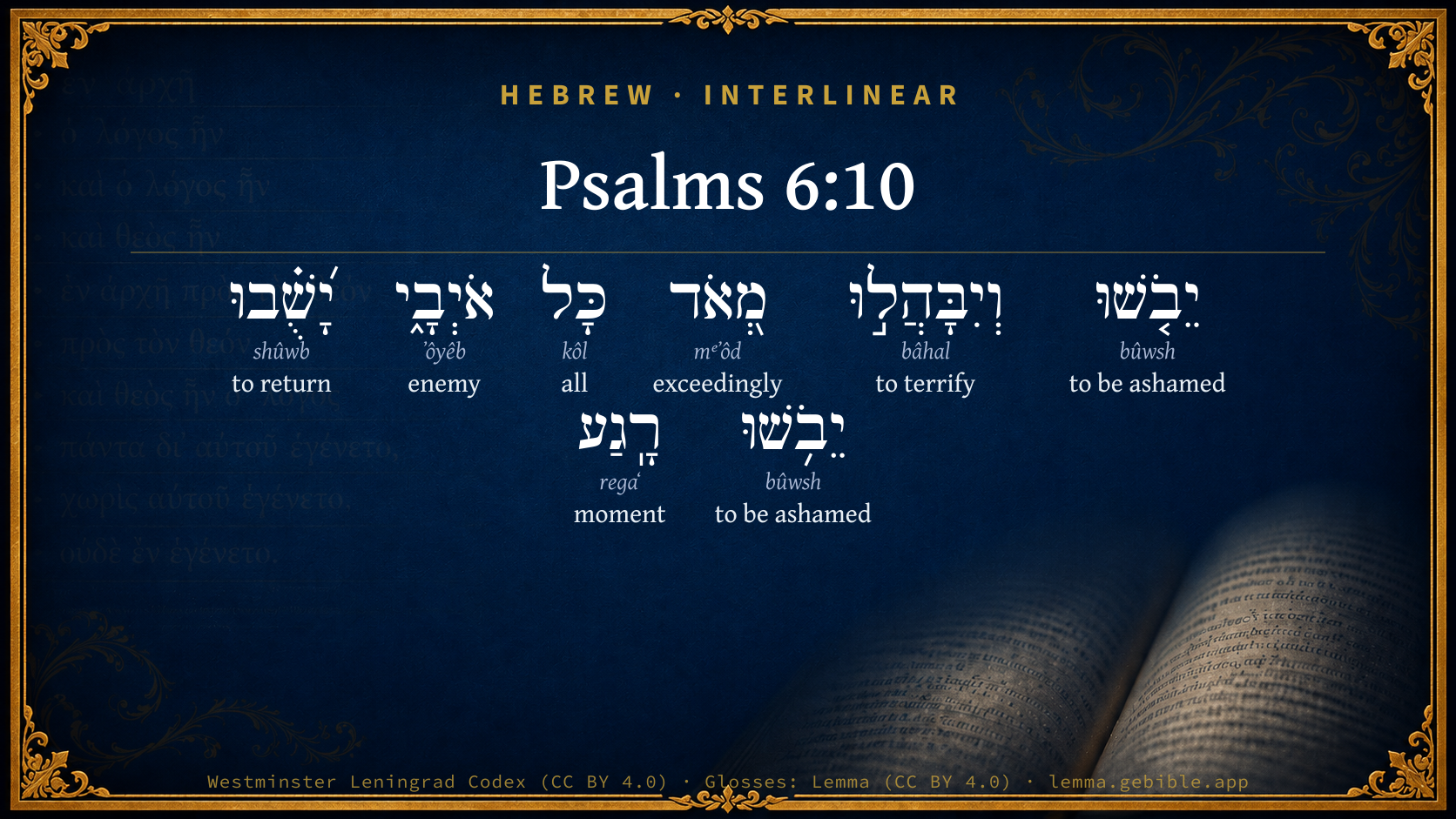
Psalms 6:10

Hebrew (Westminster Leningrad Codex) Psalms 6:10 appears in the Hebrew Old Testament. The text above is from the Westminster Leningrad Codex. Each word links to its Strong’s number, a concise gloss, and parsing drawn from the Open Scriptures Hebrew Bible morphology. Click any word for its full Brown-Driver-Briggs (BDB) entry.
Download image
Cite this verse

Psalms 6:10 (World English Bible). Public Domain. Lemma interlinear Bible study tool, https://lemma.gebible.app/v/psalms/6/10.

Show BibTeX & RIS
BibTeX
RIS
English Translation
May all my enemies be ashamed and dismayed. They shall turn back, they shall be disgraced suddenly.
World English Bible · Public Domain
Download a study sheet

One document with this verse’s original text, its word-by-word gloss line, the meaning frame, cross-references with their text, attributed commentary, and full source and license credits — printable, and it pastes into notes with its structure intact.

This verse Autodidact and up

Study sheet (.html) Plain text (.txt)

A passage Seminary Student

Up to 50 verses in one chapter. A passage sheet keeps up to 6 commentary sources and 12 cross-references per verse, in the order this page ranks them, and says so on the sheet whenever that leaves anything out. Ask for a single verse and you get the Autodidact verse sheet above.

Everything on this page stays free to read, with no account — the sheet is a download of what is already on screen, not access to it.

Want to remove ads? Support Godless Engineer
Compare translations 3

The same verse in 3 English versions, stacked beneath the original-language interlinear above. Click any original word for its lexicon entry.

Each is an independent rendering of the whole verse — the interlinear is not word-aligned to these translations.

Highlighted words mark where these versions differ — a whole-verse word diff, not a word-by-word alignment.

  • World English Bible Public Domain
    May all my enemies be ashamed and dismayed. They shall turn back, they shall be disgraced suddenly.
  • King James Version Public Domain
    Let all mine enemies be ashamed and sore vexed: let them return and be ashamed suddenly.
  • unfoldingWord Literal Text CC BY-SA 4.0
    Let all my enemies be shamed and greatly disturbed. Let them turn back. Let them be shamed an instant.

unfoldingWord Literal Text — © unfoldingWord, licensed CC BY-SA 4.0. Word-aligned USFM3 via Door43 (git.door43.org/unfoldingWord/en_ult).

Versions to compare (up to 4)

3 of 4 selected

Show all 18 translations

Every available English version of this verse, each an independent rendering of the whole verse.

  • World English Bible Public Domain
    May all my enemies be ashamed and dismayed. They shall turn back, they shall be disgraced suddenly.
  • Berean Standard Bible Public Domain
    All my enemies will be ashamed and dismayed; they will turn back in sudden disgrace.
  • Majority Standard Bible Public Domain
    All my enemies will be ashamed and dismayed; they will turn back in sudden disgrace.
  • King James Version Public Domain
    Let all mine enemies be ashamed and sore vexed: let them return and be ashamed suddenly.
  • American Standard Version (1901) Public Domain
    All mine enemies shall be put to shame and sore troubled: They shall turn back, they shall be put to shame suddenly. Psalm 7 Shiggaion of David, which he sang unto Jehova, concerning the words of Cush a Benjamite.
  • Revised Version (1885) Public Domain
    All mine enemies shall be ashamed and sore vexed: they shall turn back, they shall be ashamed suddenly.
  • Geneva Bible (1599) Public Domain
    All mine enemies shall be confounded and sore vexed: they shall be turned backe, and put to shame suddenly.
  • Douay-Rheims (1899) Public Domain
    The Lord hath heard my supplication: the Lord hath received my prayer.
  • Young's Literal Translation Public Domain
    Ashamed and troubled greatly are all mine enemies, They turn back -- ashamed `in' a moment!
  • Literal Standard Version CC BY-SA 4.0
    All my enemies are greatly ashamed and troubled, || They turn back—ashamed [in] a moment!
  • Unlocked Literal Bible CC BY-SA 4.0
    All my enemies will be ashamed and greatly troubled. They will turn back and be suddenly humiliated.
  • unfoldingWord Literal Text CC BY-SA 4.0
    Let all my enemies be shamed and greatly disturbed. Let them turn back. Let them be shamed an instant.
  • Darby Bible Public Domain
    All mine enemies shall be ashamed and tremble exceedingly; they will turn, they will be ashamed suddenly.
  • World Messianic Bible Public Domain
    May all my enemies be ashamed and dismayed. They shall turn back, they shall be disgraced suddenly.
  • Webster's Bible Public Domain
    \\6:9\\The LORD hath heard my supplication; the LORD will receive my prayer.
  • Free Bible Version CC BY-SA 4.0
    All who hate me will be shamefully defeated and terrified; they will run away in disgrace.
  • Bible in Basic English Public Domain
    Let all those who are against me be shamed and deeply troubled; let them be turned back and suddenly put to shame.
  • JPS Tanakh (1917) Public Domain
    (6-11) All mine enemies shall be ashamed and sore affrighted; they shall turn back, they shall be ashamed suddenly.

Literal Standard Version (2020), Covenant Press — licensed CC BY-SA 4.0. Text via the HelloAO Bible API (eBible.org). Unlocked Literal Bible (unfoldingWord) — licensed CC BY-SA 4.0. Text via the HelloAO Bible API (eBible.org). unfoldingWord Literal Text — © unfoldingWord, licensed CC BY-SA 4.0. Word-aligned USFM3 via Door43 (git.door43.org/unfoldingWord/en_ult). Free Bible Version, Dr. Jonathan Gallagher — licensed CC BY-SA 4.0. Text via the HelloAO Bible API (eBible.org).

Word by word

More ways to search: Search by grammar → Find every occurrence → Compare this word →

Practice this passage: Drill this verse → Learn its vocabulary →

About this verse

These counts appear in no published source. They are computed here, from the morphology-tagged text and Lemma’s own curated glosses. What Lemma adds →

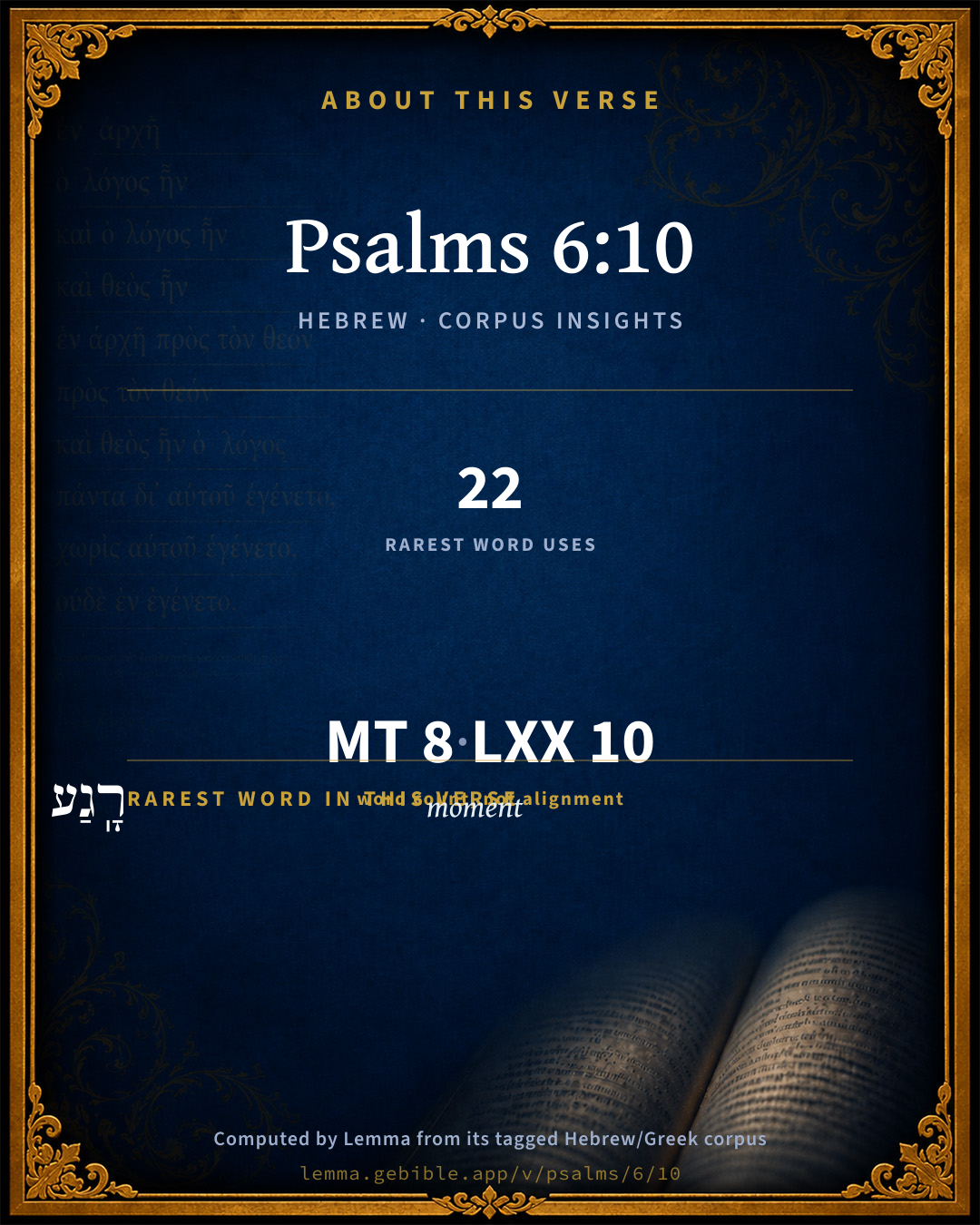
8
words
7
distinct lemmas
Wisdom
section

Notable vocabulary

The rarest word here is רָֽגַע moment H7281 — appearing just 22 times in the whole Hebrew Bible.

Shared distinctive vocabulary

רָֽגַע moment H7281 occurs in 22 verses of the Hebrew Bible. Also found in:

Grammatical profile

  • 5 verbs
  • 2 nouns
  • 1 adverb

Verb forms

  • יֵבֹ֤שׁוּ Qal · Imperfect
  • וְיִבָּהֲל֣וּ Niphal · Imperfect
  • אֹיְבָ֑י Qal · Participle Active
  • יָ֝שֻׁ֗בוּ Qal · Imperfect
  • יֵבֹ֥שׁוּ Qal · Imperfect

Repetition

A word recurs within this verse — often emphatic in Hebrew:

  • יֵבֹ֤שׁוּ to be ashamed H954 ×2

Hebrew & Septuagint length

In English translation the verse runs 17 words from the Hebrew and 22 from the Septuagint (LXX English) — closely comparable.

A rough comparison of the two English renderings, which tokenize alike — not a word-level alignment.

Word counts can differ between the Hebrew and the Greek without any difference in meaning — e.g. the Hebrew direct-object marker אֵת has no separate Greek word, and Greek often adds the article ὁ.

In the original languages it is 8 Hebrew tokens and 10 Greek tokens — but the two are counted differently (Hebrew bundles its prefixes and suffixes into one token; the Greek is in lemma form), so that isn’t a like-for-like length.

Cross-references

21

Topical passages linked to Psalms 6:10 in the Treasury of Scripture Knowledge — connected by theme and wording, ordered by reader-vote popularity; previews shown in the World English Bible.

  • Psalms 86:17 Show me a sign of your goodness, That those who hate me may see it, and be shamed, Because you, Yahweh, have helped me, and comforted me.
  • Jeremiah 20:11 But Yahweh is with me as an awesome mighty one: therefore my persecutors shall stumble, and they shall not prevail; they shall be utterly disappointed, because they have not dealt wisely, even with an everlasting dishonor which shall never be forgotten.
  • Malachi 3:18 Then you shall return and discern between the righteous and the wicked, between him who serves God and him who doesn't serve him.
  • Proverbs 29:1 He who is often rebuked and stiffens his neck Will be destroyed suddenly, with no remedy.
  • Psalms 7:6 Arise, Yahweh, in your anger. Lift up yourself against the rage of my adversaries. Awake for me. You have commanded judgment.
  • Psalms 25:3 Yes, no one who waits for you shall be shamed. They shall be shamed who deal treacherously without cause.
  • Psalms 35:26 Let them be disappointed and confounded together who rejoice at my calamity. Let them be clothed with shame and dishonor who magnify themselves against me.
  • Psalms 40:14–15 Let them be disappointed and confounded together who seek after my soul to destroy it. Let them be turned backward and brought to dishonor who delight in my hurt.
  • Psalms 71:13 Let my accusers be disappointed and consumed. Let them be covered with disgrace and scorn who want to harm me.
  • Psalms 71:24 My tongue will also talk about your righteousness all day long, For they are disappointed, and they are confounded, who want to harm me.
  • Psalms 73:19 How they are suddenly destroyed! They are completely swept away with terrors.
  • Psalms 83:16–17 Fill their faces with confusion, That they may seek your name, Yahweh.
  • Psalms 109:28–29 They may curse, but you bless. When they arise, they will be shamed, But your servant shall rejoice.
  • Psalms 112:10 The wicked will see it, and be grieved. He shall gnash with his teeth, and melt away. The desire of the wicked will perish.
  • Psalms 132:18 I will clothe his enemies with shame, But on himself, his crown will be resplendant."
  • Isaiah 26:11 Yahweh, your hand is lifted up, yet they don't see: but they shall see [your] zeal for the people, and be disappointed; yes, fire shall devour your adversaries.
  • Job 6:29 Please return. Let there be no injustice; Yes, return again, my cause is righteous.
  • Psalms 2:5 Then he will speak to them in his anger, And terrify them in his wrath:
  • Psalms 5:10 Hold them guilty, God. Let them fall by their own counsels; Thrust them out in the multitude of their transgressions, For they have rebelled against you.
  • Psalms 21:8–9 Your hand will find out all of your enemies. Your right hand will find out those who hate you.
  • 1 Thessalonians 5:3 For when they are saying, "Peace and safety," then sudden destruction will come on them, like birth pains on a pregnant woman; and they will in no way escape.

Cross-references courtesy of OpenBible.info (CC BY 4.0).

Hebrew and Greek witnesses Masoretic Hebrew ↔ Greek Septuagint

The same verse in the two great witnesses to the Old Testament, shown verse-for-verse.

You’re reading Greek Psalm 6 (Hebrew Psalm 6). The Septuagint counts the superscription, so verse numbers can differ from the Hebrew — chapter-level alignment, not verse-by-verse. Numbering follows Rahlfs.

These are two independent witnesses, not word-aligned to each other, and the Septuagint is shown in lemma (dictionary) form.

Hebrew Psalms 6:10 Masoretic · Westminster Leningrad Codex

יֵבֹ֤שׁוּ וְיִבָּהֲל֣וּ מְ֭אֹד כָּל אֹיְבָ֑י יָ֝שֻׁ֗בוּ יֵבֹ֥שׁוּ רָֽגַע

May all my enemies be ashamed and dismayed. They shall turn back, they shall be disgraced suddenly.

World English Bible · Public Domain

Greek LXX Greek Psalm 6:10 Septuagint · lemma form

εἰςἀκούω κύριος ὁ δέησις ἐγώ κύριος ὁ προσευχή ἐγώ προςδέχομαι

Let all my enemies be put to shame and sore troubled: let them be turned back and grievously put to shame speedily.

LXX2012 (modern English Septuagint) · Public Domain

Hebrew: Westminster Leningrad Codex (CC BY 4.0). Greek: Septuagint (public domain); English from LXX2012 (modern English Septuagint) (Public Domain). How the Septuagint differs from the Hebrew →

Commentary

Notes on Psalms 6:10 from classic Christian and Jewish commentators (each source and its license shown beneath its notes). The classic Christian expositions comment on the surrounding passage and are grouped to its opening verse, so a note may address several verses; the Jewish commentaries on the Tanakh (Rashi and others) are per-verse, so they appear only where the commentator wrote on this verse.

Lemma curates 59 commentaries, every one of them public domain or Creative Commons licensed, each selected and text-cleaned for this edition rather than reprinted as found. About our sources →

Trapp's Complete Commentary

John Trapp

Psa 6:10 Let all mine enemies be ashamed and sore vexed: let them return [and] be ashamed suddenly.

Ver. 10. Let all mine enemies be ashamed] When they see all their hopes of my death and downfall disappointed.

Let them return] Retrocedant et in terrain cadant, saith the Arabic interpreter, Let them go backward, and fall to the earth. Some make this a prayer, some a prophecy; it comes all to one.

And be ashamed suddenly] Let them be doubly ashamed, or deboshed, and that in a moment. These sudden and still revenges are very terrible. God usually premonisheth before he punisheth, but not always. Now as blessings, the more unexpected the more welcome; so judgments, the more sudden the more grievous.

John Trapp, A Commentary or Exposition upon All the Books of the Old and New Testament (1647–1656) — public domain. Text from a community e-Sword module.

The Biblical Illustrator

Joseph S. Exell

Psa_6:10

Let all mine enemies be ashamed and sore vexed.

The tolerance and intolerance of the gospel

A difficulty is often felt in reading or repeating these imprecations. These denunciations are appalling, withering. Are they not essentially personal, the breathing of a Jewish spirit of revenge, and in no sense Christian and universal?

1. I can find no difficulty in granting that the Old Testament spirit was a harder and a sterner spirit than that of the New. The emblem of the New Testament is the cross, which signifies passive endurance. The emblem of the Old Testament is the sword. As the Spirit of God freely uses individual thought, style and expression, overruling them so as to bring out His own higher meaning, I should not be surprised to find occasional phrases of a fiercer and an angrier complexion than any which occur in the New Testament, and which I should interpret with a different signification from that which their utterer designed. We need not consider these imprecatory Psalms as the utterance of Davids longing for personal revenge It is very singular that each of the Psalms in which the strongest imprecatory passages are found contains also gentle undertones, breathings of beneficent love.

2. When under the old covenant, earthly prosperity was the portion of the wicked, and earthly adversity of the pious, the whole moral government of God seemed to be veiled in clouds and darkness. Now, when all seems troubled, we can look up and behold by faith the glory that shall be revealed. God is patient because He is eternal. Man is impatient when he is not assured of his immortality.

3. We must interpret every book by the mind of the author. If so, we must apply this to the Bible and to the Psalms. The real author is the Holy Spirit. The prophet seems to speak as if in prayer--when he sees that which will certainly come--showing that the known counsel of God, which He has firmly and immutably fixed, should not displease us. Conceive a created spirit enlarged so as to embrace the will of God in relation to all the children of men--a spirit looking from the margin of an eternal world upon the petty histories of the past, purified from personal hatred, partiality, and prejudice, measuring all things by the counsels of God, such a spirit could say without a taint of personal revenge, let all mine enemies be ashamed. Turn to two passages of the New Testament (Luk_9:49, and sequel). We think of St. John as a man of angelic, or at least of feminine, gentleness. But in his nature, as in the blue sky of his native Galilee, there were sudden storms and fierce lightning flashes. As yet the brothers knew not Jesus thoroughly. They would build up by force the kingdom whose walls are cemented, not by blood and iron, but by love. Such is the spirit of intolerance, which would in one age offer to God the hideous thing called by a fearful profanation an auto-da-fe; which in another would rivet the chains of penal laws upon a population; in another, with the cant of toleration upon its lips, stamp out an unpopular minority by rubrics and definitions. Is there any intolerance in the gospel? For answer see 2Jn_1:10. To deny that Jesus was the God-Man was to question His legitimacy and impugn His truth. Pagan toleration has been invidiously compared with Christian intolerance. But pagan toleration is a conclusion drawn from the false premises that all religions are about equally true; while Christian persecution is a conclusion falsely drawn from the true principle of the exclusiveness of true religion. Commend the spirit of tolerance to all whom our Church tolerates. Amidst much that is depressing there is one happy sign of our times. There are tokens that Churches sundered hitherto are yearning to be one. A day is coming, even on the earth, when the inward unity of Christs redeemed shall manifest itself outwardly; when the prayer of our High priest shall he fulfilled, that they all may be one. (W. Alexander, D. D.)

.

Psa_7:1-17

The Biblical Illustrator, edited by Joseph S. Exell (c. 1880s–1900s) — public domain. Text from a community e-Sword module.

Joseph Benson's Commentary

Psa 6:10. Let all mine enemies be ashamed — Or, they shall be ashamed, of their vain confidence; and sore vexed — Because of their great and unexpected disappointment. Let them return — Namely, from their wicked ways, and from their hostile and malicious practices against me. Hebrew, ישׁבו, jeshubu, they shall return, turn back, or be converted; that is, repent of their sins and return to their obedience. And be ashamed suddenly — Sooner than I could hope, or they did expect, or believe. “Many mournful Psalms,” says Mr. Scott, “end thus triumphantly, for the encouragement of other mourners to hope and pray.”

Joseph Benson's Commentary on the Old and New Testaments (1811–1818) — public domain. Text from a community e-Sword module.

J. A. Alexander on Psalms

Joseph Addison Alexander

11. (Psa 6:10). Ashamed and confounded, i. e. disappointed and struck with terror, shall be all my enemies. The desire that they may be is not expressed, but involved in the confident anticipation that they will be. In the second verb there is an obvious allusion to its use in Psa 6:3-4 (2, 3). As he had been terror-stricken, so shall they be. As they filled him with consternation, so shall God fill them. They shall return, turn back from their assault repulsed; they shall be ashamed, filled with shame at their defeat; and that not hereafter, (in) a moment, instantaneously.

Joseph Addison Alexander, The Psalms Translated and Explained (1850) — public domain. Text from a community e-Sword module.

Geneva Bible (1599)

Geneva Bible translators

When the wicked think that the godly shall perish, God delivereth them suddenly, and destroyeth their enemies.

Geneva Bible (1599) marginal notes — public domain. Text via Bolls.life.

Jamieson, Fausset & Brown

Robert Jamieson, A. R. Fausset & David Brown

and knows they will be disappointed and in their turn (compare Psa 6:3) be terror-stricken or confounded.

Next: Psalms Chapter 7

Jamieson, Fausset & Brown — Commentary Critical and Explanatory on the Whole Bible (1871) — public domain (CC PDM 1.0). Text via the HelloAO Bible API.

Adam Clarke's Commentary

Verse 10. Ashamed and sore vexed] May they as deeply deplore their transgressions as I have done mine! May they return; may they be suddenly converted! The original will bear this meaning, and it is the most congenial to Christian principles.

ANALYSIS OF TEE SIXTH PSALM

The parts of this Psalm are TWO, in general: -

I. A petition to God for himself, contained in the first seven verses.

II. The account of his restoration, contained in the three last.

I. The petition consists of two parts: 1. Deprecation of evil; 2. Petition for good.

1. He prays to God to avert his wrath: "O Lord, rebuke me not," c.

2. He entreats to be partaker of God's favour: "Have mercy upon me," c. 1. To his BODY: "Heal me, O Lord." 2. To his SOUL: "Deliver my soul: O save me!"

He enforces his petition by divers weighty reasons:

1. From the quantity and degrees of his calamity, which he shows to be great from the effects. 1. In general he was in a languishing disease: "I am weak." 2. In particular 1. Pains in his bones: "My bones are vexed." 2. Trouble in his soul: "My soul also is troubled."

2. From the continuance of it. It was a long disease; a lingering sickness; and he found no ease, no, not from his God. The pain I could the better bear if I had comfort from heaven. "But thou, O Lord, how long?" Long hast thou withdrawn the light of thy countenance from thy servant.

3. From the consequence that was likely to follow; death, and the event upon it. It is my intention to celebrate and praise thy name; the living only can do this: therefore, let me live; for in death there is no remembrance of thee; in the grave who shall give thee thanks?

4. And that he was brought now to the gates of death, he shows by three apparent symptoms: 1. Sighs and groans, which had almost broken his heart; the companions of a perpetual grief: "I am weary of my groaning." 2. The abundance of his tears had dried and wasted his body: "He made his bed to swim, and watered his couch with his tears." 3. His eyes also melted away, and grew dim, so that he seemed old before his time: "My eye is consumed because of grief; it waxeth old."

6. That which added to his sorrow was, he had many ill-wishers who insulted over him: "Mine eye is waxen old because of mine enemies."

II. But at last receiving comfort and joy, he is enabled to look up; and then he turns upon his enemies, who were longing for his destruction: "Depart from me, all ye workers of iniquity."

He magnifies God's mercy; and mentions its manifestation thrice distinctly: 1. "The Lord hath heard the voice of my weeping." 2. "The Lord hath heard my supplication." 3. "The Lord will receive my prayer."

Then follows his prophetic declaration concerning them:

1. Shame and confusion to see their hope frustrated: "They shall be confounded."

2. Vexation, to see the object of their envy restored to health and prosperity: "They shall be sore vexed."

3. They shall return to their companions with shame, because their wishes and plots have miscarried.

4. He intimates that this shame and confusion shall be speedy: "They shall return, and be ashamed suddenly." Or, possibly, this may be a wish for their conversion, ישבו yashubu, let them be CONVERTED, רגע raga, suddenly, lest sudden destruction from the Lord should fall upon them. Thus the genuine follower of God prays, "That it may please thee to have mercy upon our enemies, persecutors, and slanderers; and to TURN their HEARTS." A Christian should take up every thing of this kind in a Christian sense.

Adam Clarke's Commentary on the Bible (1810–1826) — public domain. Text from a community e-Sword/MySword module.

Ellicott's Commentary for English Readers

(10) Let all mine enemies.—Better rendered either by the present or future. The Psalmist with the eye of faith sees the answer to his prayer.

Return—i.e., retire discomfited and in failure.

“My enemies shall all be blank, and dasht

With much confusion: then grow red with shame;

They shall return in haste the way they came,

And in a moment shall be quite abashed.”—

Milton’s trans.

A Bible Commentary for English Readers, edited by Charles John Ellicott (1878–1897) — public domain. Text from a community e-Sword module.

The Cambridge Bible for Schools and Colleges

gen. ed. J. J. S. Perowne

10. It is better to render the verbs as future:

All mine enemies shall be ashamed and sore vexed;

They shall turn back, they shall be ashamed in a moment.

The ‘dismay’, which he had felt to be a token of divine displeasure (Psa_6:2-3), is now retorted upon those who took a malicious delight in his misfortunes. When God returns to His servant, his assailants are repulsed in sudden and ignominious defeat. Cp. Psa_35:4; Psa_35:26, Psa_56:9, Psa_83:17.

The Cambridge Bible for Schools and Colleges (gen. ed. J. J. S. Perowne; Cambridge University Press, 1878–1918) — public domain. Text from a community e-Sword module.

John Gill's Exposition

Let all mine enemies be ashamed,.... Or "they shall be ashamed" (k); and so the following clauses may be rendered, and be considered as prophecies of what would be; though if this be considered as an imprecation, it is wishing no ill; wicked men are not ashamed of their abominations committed by them, neither can they blush; it would be well if they were ashamed of them, and brought to true repentance for them; and if they are not ashamed now, they will be hereafter, when the Judge of quick and dead appears;

and sore vexed; or "troubled" (l); as his bones had been vexed, and his soul had been sore vexed by them; as he knew they would be through disappointment at his recovery, and at his deliverance from the distresses and calamities he was now in, when he should sing for joy of heart, and they should howl for vexation of spirit;

let them return; meaning either from him, from pursuing after him; or to him, to seek his favour, and be reconciled to him, and be at peace with him, as Aben Ezra and Kimchi explain it; unless this word should only signify "again", as it sometimes does, and be read in connection with what follows;

and let them be again ashamed suddenly (m); intimating that his deliverance would be sudden, in a moment, in a very little time, and so would be their disappointment, shame, and confusion. Jarchi, from R. Jonathan and R. Samuel bar Nachmani, refers this to the shame of the wicked in the world to come.

(k) "pudore afficientur", Pagninus, Montanus; "pudefient", Coeceius, Schmidt; so Ainsworth. (l) "conturbantur", Junius & Tremellius, Piscator. (m) "iterum confundantur", Gejerus.

Next: Psalms Chapter 7

John Gill's Exposition of the Whole Bible (1746–1763) — public domain (CC PDM 1.0). Text via the HelloAO Bible API.

Albert Barnes' Notes on the Bible

Let all mine enemies be ashamed - Be so brought to see their folly that they shall be ashamed of their conduct. The wish is that they might be brought to see their own guilt - a wish certainly which it is right to cherish in regard to all evil-doers.

And sore vexed - Compare the notes at Psa 5:10. The same Hebrew word is used here which occurs in Psa 6:2-3, and rendered “vexed.” It is a word which denotes trouble, trembling, consternation; and the meaning here is, that the psalmist prayed that they might be confounded or disconcerted in their plans - a prayer which is certainly proper in regard to all the purposes of the wicked. No one should desire that the purposes of the wicked should prosper; and not to desire this is to desire that they may be foiled and overcome in their schemes. This must be the wish of every good man.

Let them return - Turn back, or be turned back; that is, let them be repulsed, and compelled to turn back from their present object.

And be ashamed suddenly - Hebrew, “In a moment;” instantaneously. He desired that there might be no delay, but that their defeat might be accomplished at once. As it was right to pray that this might occur, so it was right to pray that it might occur without delay, or as speedily as possible. The sooner the plans of sinners are confounded, the better.

Albert Barnes' Notes on the Bible (1834–1885) — public domain. Text from a community e-Sword/MySword module.

Matthew Poole's English Annotations

Ashamed of their vain hopes and confidence of conquering and destroying me. Or, they shall be ashamed, because of their great and unexpected disappointment.

Let them return, to wit, from their wicked ways, from their hostile and malicious practices against me, and let them come and submit to me, from whom they have revolted. Or, let them turn back, as it is expressed, Psa 56:9; let them be put to flight. Or, let them be converted, i.e. repent of their sins, and return to their obedience to me. Although it seems more probable, both from the foregoing and following words, that this turning or returning is rather penal than penitential. Or, they shall turn or return. Or this verb may be taken adverbially, and joined to the following verb, as it is frequently in other places, and both may be thus rendered, let them, or they shall, be again ashamed; clothed, as it were, with double shame. Suddenly; sooner than I could hope, or they did expect or believe.

Matthew Poole's English Annotations on the Holy Bible (1683–1685) — public domain. Text from a community e-Sword/MySword module.

The Treasury of David

Charles H. Spurgeon

Ver. 10. Let all mine enemies be ashamed and sore vexed. This is rather a prophecy than an imprecation, it may be read in the future, "All my enemies shall be ashamed and sore vexed." They shall return and be ashamed instantaneously,in a moment;their doom shall come upon them suddenly. Death's day is doom's day, and both are sure and may be sudden. The Romans were wont to say, "The feet of the avenging Deity are shod with wool." With noiseless footsteps vengeance nears its victim, and sudden and overwhelming shall be its destroying stroke. If this were an imprecation, we must remember that the language of the old dispensation is not that of the new. We pray for our enemies, not against them. God have mercy on them, and bring them into the right way.

Thus the Psalm, like those which preceed it, shews the different estates of the godly and the wicked. O Lord, let us be numbered with thy people, both now and forever!

Ver. 10. Let all mine enemies be ashamed, etc. If this were an imprecation, a malediction, yet it was medicinal, and had rationem boni, a charitable tincture and nature in it; he wished the men no harm as men. But it is rather predictorium, a prophetical vehemence, that if they will take no knowledge of God's declaring himself in the protection of his servants, if they would not consider that God had heard, and would hear, had rescued, and would rescue his children, but would continue their opposition against him, heavy judgments would certainly fall upon them; their punishment should be certain, but the effect should be uncertain; for God only knows whether his correction shall work upon his enemies to their mollifying, or to their obduration ... In the second word,

Let them be sore vexed, he wishes his enemies no worse than himself had been, for he had used the same word of himself before, Ossa turbata, My bones are vexed; and Anima turbata, My soul is vexed; and considering that David had found this vexation to be his way to God, it was no malicious imprecation to wish that enemy the same physic that he had taken, who was more sick of the same disease than he was. For this is like a troubled sea after a tempest; the danger is past, but yet the billow is great still; the danger was in the calm, in the security, or in the tempest, by misinterpreting God's correction to our obduration, and to a remorseless stupefication; but when a man is come to this holy vexation, to be troubled, to be shaken with the sense of the indignation of God, the storm is past, and the indignation of God is blown over. That soul is in a fair and near way of being restored to a calmness, and to reposed security of conscience that is come to this holy vexation. John Donne.

Ver. 10. Let all mine enemies or (all mine enemies shall) be ashamed, and sore vexed, etc. Many of the mournful Psalms end in this manner, to instruct the believer that he is continually to look forward, and solace himself with beholding that day, when his warfare shall be accomplished; when sin and sorrow shall be no more; when sudden and everlasting confusion shall cover the enemies of righteousness; when the sackcloth of the penitent shall be exchanged for a robe of glory, and every tear becomes a sparkling gem in his crown; when to sighs and groans shall succeed the songs of heaven, set to angels harps, and faith shall be resolved into the vision of the Almighty. George Horne.

Ver. 10. The shame reserved for the wicked.

Charles H. Spurgeon's The Treasury of David (1869–1885) — public domain. Psalms only. Text from a community e-Sword/MySword module.

Whedon's Commentary on the Bible

Daniel D. Whedon

10. The evil that he dreaded, which his enemies had prepared, shall now fall upon them. This was in strictest accordance with retributive justice. They shall be ashamed—Pale with disappointment. They shall be sore vexed—Terrified. See on Psa_6:3. They shall return—Retreat from their purpose and be marked as defeated men. They shall be ashamed suddenly—Literally, in a moment. Their judgment shall come in the twinkling of an eye. God will return to David, (Psa_6:4,) and this shall be the cause and signal of the return—the turning back, in shame and terror, and in a moment, of his enemies.

Daniel D. Whedon (gen. ed.), Commentary on the Old and New Testaments (1874–1909) — public domain. Text from a community e-Sword module.

The Pulpit Commentary

Let all mine enemies be ashamed and sore vexed; rather, all mine enemies shall be ashamed and sore vexed (Rosenmuller, Kay, and others). Shame will fall upon David"s enemies when their plots have failed, and deep vexation when they find him restored to health (ver. 4) and in the full enjoyment of the Divine favour. Lot them return; rather, they shall return; i.e. "retire... turn their backs," "take to flight." As Hengstenberg says, "David sees his enemies, who are gathered around him for the attack, all at once in alarm give way." And be ashamed suddenly. It is doubly shameful to have to fly when one has been the assailant.

The Pulpit Commentary (1880–1919), ed. H.D.M. Spence-Jones & Joseph S. Exell — public domain. Text from a community e-Sword module.

John Wesley's Explanatory Notes

Ashamed - Of their vain confidence. Return - Repent of their sins and return to their obedience.

John Wesley, Explanatory Notes Upon the Whole Bible (1754–1765) — public domain. Text via the GEBible commentary corpus.

Radak

Rabbi David Kimhi (Radak)

The Lord hath heard my supplication; The Lord will receive my prayer. – “He will” as though “He has received.” And the reason for He will (is): on this and every occasion when my prayer comes to Him, He will accept it with favour.

Radak on the Tanakh — English translations: “Sefaria Community Translation” (CC0 1.0 (public-domain dedication)); “Eliyahu Munk, HaChut Hameshulash” (CC BY 4.0); “Rabbi Mike Feuer, Jerusalem Anthology” (CC BY 4.0); and “R. David Kimhi on the first book of Psalms, Translated by R.G. Finch, London, 1919” (public domain). Text via Sefaria.

Lesson kit

Teaching starters — assembled from the data on this page, not authored interpretation. Every prompt links to the verse data it draws on. Edit before teaching.

Psalms, in the Wisdom, opens this verse with 8 words (7 distinct Hebrew lemmas). Its most distinctive word is regaʻ (“moment”). A historical commentator’s framing appears above. Read the whole chapter for the surrounding context.

Discussion questions

  1. The word regaʻ carries the sense “moment.” How does it shape the verse?
  2. How does Exodus 33:5, which shares the word «moment», read alongside this verse?
  3. What does the repetition of “to be ashamed” (2× in this one verse) do in this verse?
  4. The translations on this page render this verse differently — a whole-verse word diff, not a word-by-word alignment. What might account for the different wordings?
  5. «יֵבֹ֤שׁוּ» is a Qal Imperfect verb. How does that grammatical form shape the action described?
  6. Compare how Trapp's Complete Commentary and The Biblical Illustrator read this verse. Where do they agree or differ?

Things to notice

Reading settings

Reading text

Shown beneath each verse's original-language words.

Old Testament
Old Testament edition

Read the OT as the Masoretic Hebrew (MT) or the Greek Septuagint (LXX).

English shown for the Greek Septuagint (in the Hebrew ↔ Greek comparison).

Comparing translations? Open the Compare panel on any verse page to stack up to four side by side.