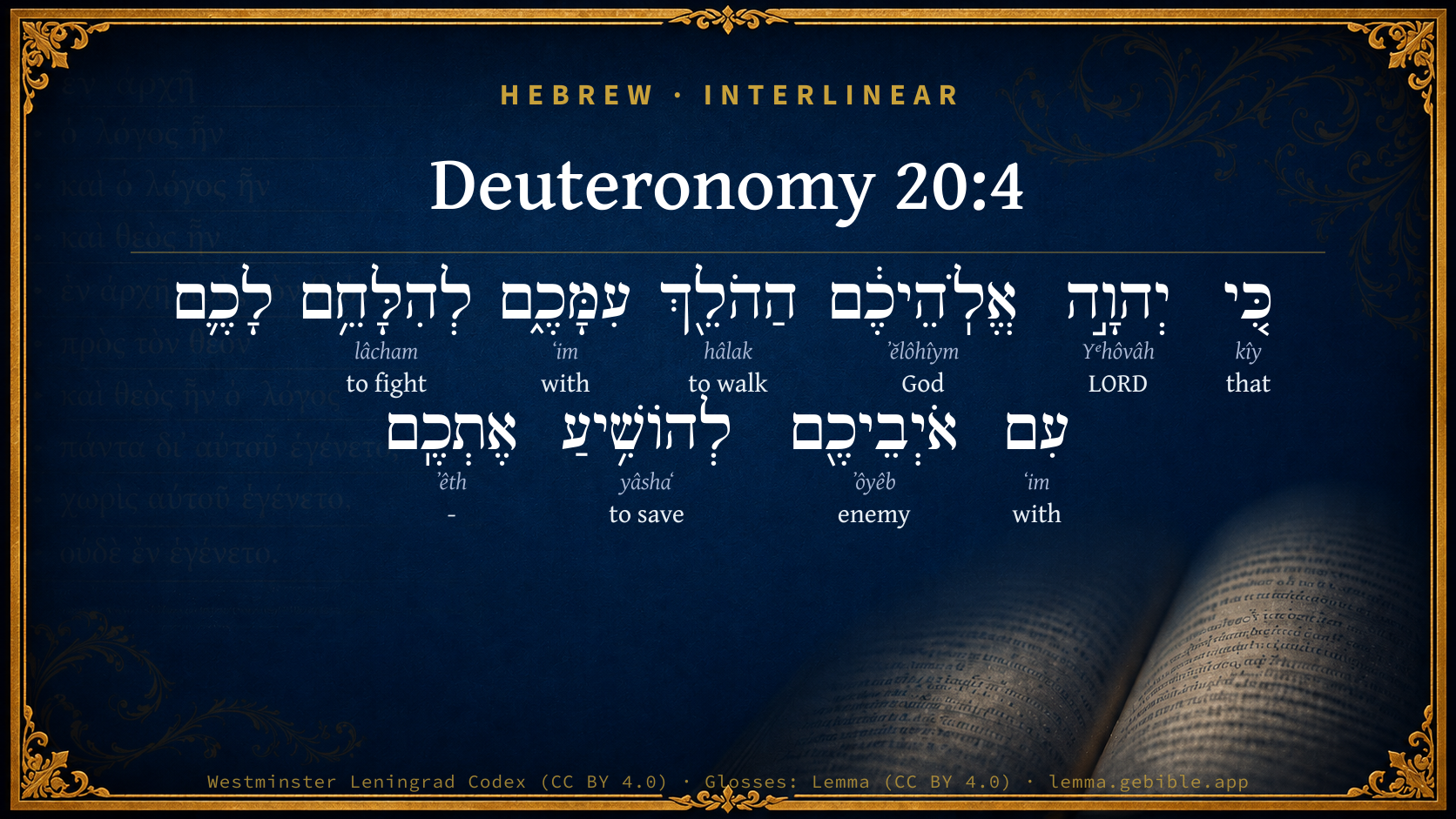
Deuteronomy 20:4

Hebrew (Westminster Leningrad Codex) Deuteronomy 20:4 appears in the Hebrew Old Testament. The text above is from the Westminster Leningrad Codex. Each word links to its Strong’s number, a concise gloss, and parsing drawn from the Open Scriptures Hebrew Bible morphology. Click any word for its full Brown-Driver-Briggs (BDB) entry.
Download image
Cite this verse

Deuteronomy 20:4 (World English Bible). Public Domain. Lemma interlinear Bible study tool, https://lemma.gebible.app/v/deuteronomy/20/4.

Show BibTeX & RIS
BibTeX
RIS
English Translation
for Yahweh your God is he who goes with you, to fight for you against your enemies, to save you.
World English Bible · Public Domain
Download a study sheet

One document with this verse’s original text, its word-by-word gloss line, the meaning frame, cross-references with their text, attributed commentary, and full source and license credits — printable, and it pastes into notes with its structure intact.

This verse Autodidact and up

Study sheet (.html) Plain text (.txt)

A passage Seminary Student

Up to 50 verses in one chapter. A passage sheet keeps up to 6 commentary sources and 12 cross-references per verse, in the order this page ranks them, and says so on the sheet whenever that leaves anything out. Ask for a single verse and you get the Autodidact verse sheet above.

Everything on this page stays free to read, with no account — the sheet is a download of what is already on screen, not access to it.

Want to remove ads? Support Godless Engineer
Compare translations 3

The same verse in 3 English versions, stacked beneath the original-language interlinear above. Click any original word for its lexicon entry.

Each is an independent rendering of the whole verse — the interlinear is not word-aligned to these translations.

Highlighted words mark where these versions differ — a whole-verse word diff, not a word-by-word alignment.

  • World English Bible Public Domain
    for Yahweh your God is he who goes with you, to fight for you against your enemies, to save you.
  • King James Version Public Domain
    For the LORD your God is he that goeth with you, to fight for you against your enemies, to save you.
  • unfoldingWord Literal Text CC BY-SA 4.0
    for Yahweh your God goes with you to fight for you against your enemies, to save you.’

unfoldingWord Literal Text — © unfoldingWord, licensed CC BY-SA 4.0. Word-aligned USFM3 via Door43 (git.door43.org/unfoldingWord/en_ult).

Versions to compare (up to 4)

3 of 4 selected

Show all 18 translations

Every available English version of this verse, each an independent rendering of the whole verse.

  • World English Bible Public Domain
    for Yahweh your God is he who goes with you, to fight for you against your enemies, to save you.
  • Berean Standard Bible Public Domain
    For the LORD your God goes with you to fight for you against your enemies, to give you the victory.”
  • Majority Standard Bible Public Domain
    For the LORD your God goes with you to fight for you against your enemies, to give you the victory.”
  • King James Version Public Domain
    For the LORD your God is he that goeth with you, to fight for you against your enemies, to save you.
  • American Standard Version (1901) Public Domain
    for Jehovah your God is he that goeth with you, to fight for you against your enemies, to save you.
  • Revised Version (1885) Public Domain
    for the LORD your God is he that goeth with you, to fight for you against your enemies, to save you.
  • Geneva Bible (1599) Public Domain
    For ye Lord your God goeth with you, to fight for you against your enemies, and to saue you
  • Douay-Rheims (1899) Public Domain
    Because the Lord your God is in the midst of you, and will fight for you against your enemies, to deliver you from danger.
  • Young's Literal Translation Public Domain
    for Jehovah your God `is' He who is going with you, to fight for you with your enemies -- to save you.
  • Literal Standard Version CC BY-SA 4.0
    for your God YHWH [is] He who is going with you, to fight for you with your enemies—to save you.
  • Unlocked Literal Bible CC BY-SA 4.0
    For Yahweh your God is the one who is going with you to fight for you against your enemies and to save you.'
  • unfoldingWord Literal Text CC BY-SA 4.0
    for Yahweh your God goes with you to fight for you against your enemies, to save you.’
  • Darby Bible Public Domain
    for Jehovah your God is he that goeth with you, to fight for you against your enemies, to save you.
  • World Messianic Bible Public Domain
    for the LORD your God is he who goes with you, to fight for you against your enemies, to save you.”
  • Webster's Bible Public Domain
    For the LORD your God is he that goeth with you, to fight for you against your enemies, to save you.
  • Free Bible Version CC BY-SA 4.0
    For the Lord your God is going with you to fight for you against your enemies, and he will give you the victory.”
  • Bible in Basic English Public Domain
    For the Lord your God goes with you, fighting for you to give you salvation from those who are against you.
  • JPS Tanakh (1917) Public Domain
    for the LORD your God is He that goeth with you, to fight for you against your enemies, to save you.'

Literal Standard Version (2020), Covenant Press — licensed CC BY-SA 4.0. Text via the HelloAO Bible API (eBible.org). Unlocked Literal Bible (unfoldingWord) — licensed CC BY-SA 4.0. Text via the HelloAO Bible API (eBible.org). unfoldingWord Literal Text — © unfoldingWord, licensed CC BY-SA 4.0. Word-aligned USFM3 via Door43 (git.door43.org/unfoldingWord/en_ult). Free Bible Version, Dr. Jonathan Gallagher — licensed CC BY-SA 4.0. Text via the HelloAO Bible API (eBible.org).

Word by word

More ways to search: Search by grammar → Find every occurrence → Compare this word →

Practice this passage: Drill this verse → Learn its vocabulary →

לְהִלָּחֵ֥ם
lâcham
H3898
“to fight”
Preposition + Verb, Niphal, Infinitive Construct
Part of Speech
Preposition + Verb
Stem
Niphal
Form
Infinitive Construct
Full BDB Definition

Origin: a primitive root

TWOT: 1104 , 1105

to fight, do battle, make war - (Qal) to fight, do battle - (Niphal) to engage in battle, wage war - (Qal) to eat, use as food
  1. כִּ֚י kîy H3588 “that” Conjunction
  2. יְהוָ֣ה Yᵉhôvâh H3068 “LORD” Noun, Proper
  3. אֱלֹֽהֵיכֶ֔ם ʼĕlôhîym H430 “God(s) · your” Noun, Common, Masculine, Plural, Construct + Suffix, Personal, 2nd Person, Masculine, Plural
  4. הַהֹלֵ֖ךְ hâlak H1980 “the · walking” Particle, Definite Article + Verb, Qal, Participle Active, Masculine, Singular, Absolute
  5. עִמָּכֶ֑ם ʻim H5973 “with · you” Preposition + Suffix, Personal, 2nd Person, Masculine, Plural
  6. עִם ʻim H5973 “with” Preposition
  7. אֹיְבֵיכֶ֖ם ʼôyêb H341 “enemy · you” Verb, Qal, Participle Active, Masculine, Plural, Construct + Suffix, Personal, 2nd Person, Masculine, Plural
  8. לְהוֹשִׁ֥יעַ yâshaʻ H3467 “to save” Preposition + Verb, Hiphil, Infinitive Construct
  9. אֶתְכֶֽם ʼêth H853 “- · you” Particle, Direct Object + Suffix, Personal, 2nd Person, Masculine, Plural

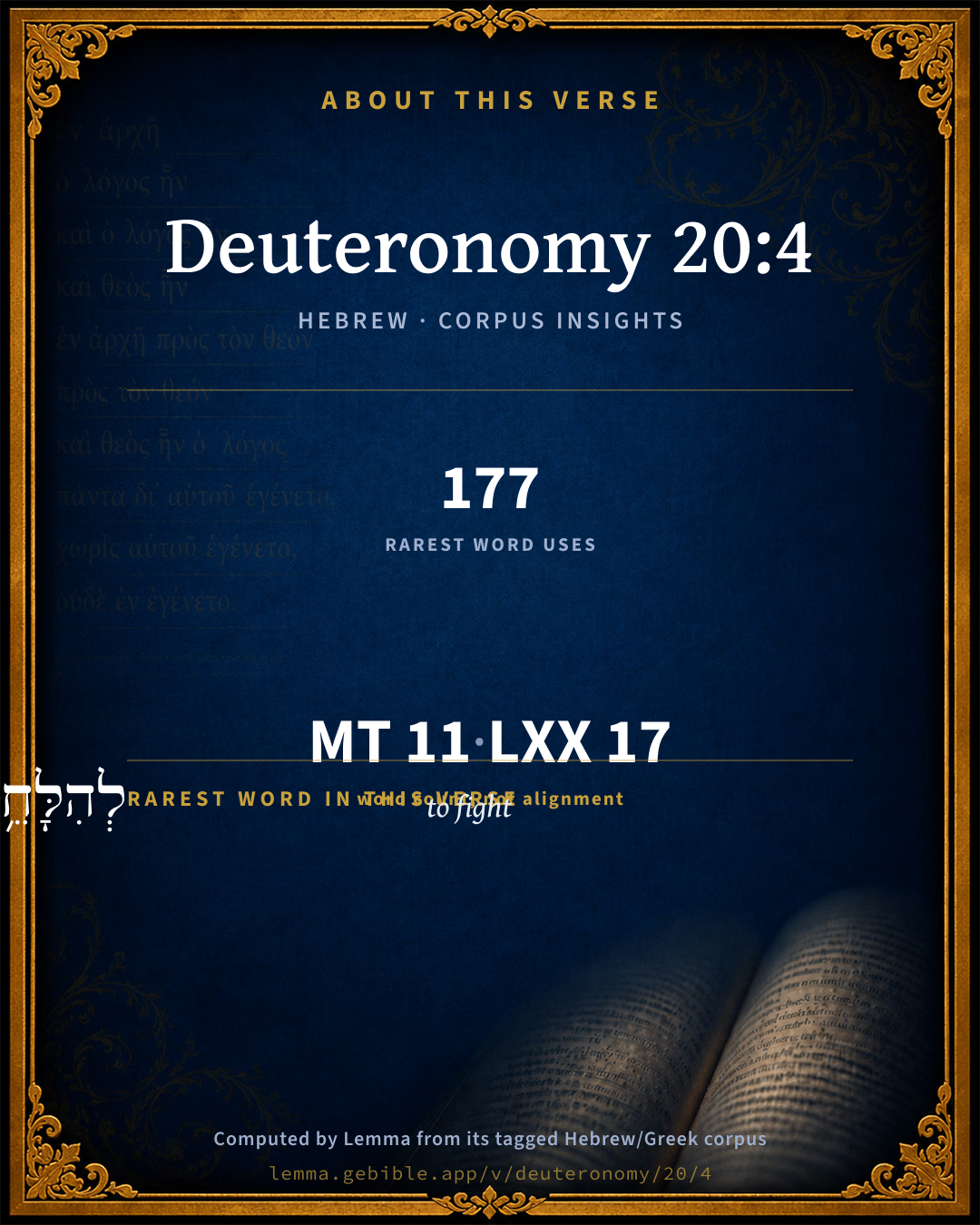
About this verse

These counts appear in no published source. They are computed here, from the morphology-tagged text and Lemma’s own curated glosses. What Lemma adds →

11
words
9
distinct lemmas
Pentateuch
section

Grammatical profile

  • 4 verbs
  • 2 nouns
  • 3 prepositions
  • 1 conjunction
  • 1 particle

Verb forms

  • הַהֹלֵ֖ךְ Qal · Participle Active
  • לְהִלָּחֵ֥ם Niphal · Infinitive Construct
  • אֹיְבֵיכֶ֖ם Qal · Participle Active
  • לְהוֹשִׁ֥יעַ Hiphil · Infinitive Construct

Repetition

A word recurs within this verse — often emphatic in Hebrew:

  • עִמָּכֶ֑ם with H5973 ×2

Hebrew & Septuagint length

In English translation the verse runs 20 words from the Hebrew and 22 from the Septuagint (LXX English) — closely comparable.

A rough comparison of the two English renderings, which tokenize alike — not a word-level alignment.

Word counts can differ between the Hebrew and the Greek without any difference in meaning — e.g. the Hebrew direct-object marker אֵת has no separate Greek word, and Greek often adds the article ὁ.

In the original languages it is 11 Hebrew tokens and 17 Greek tokens — but the two are counted differently (Hebrew bundles its prefixes and suffixes into one token; the Greek is in lemma form), so that isn’t a like-for-like length.

Cross-references

11

Topical passages linked to Deuteronomy 20:4 in the Treasury of Scripture Knowledge — connected by theme and wording, ordered by reader-vote popularity; previews shown in the World English Bible.

  • Exodus 14:14 Yahweh will fight for you, and you shall be still."
  • Deuteronomy 1:30 Yahweh your God who goes before you, he will fight for you, according to all that he did for you in Egypt before your eyes,
  • Deuteronomy 3:22 You shall not fear them; for Yahweh your God, he it is who fights for you.
  • Joshua 23:10 One man of you shall chase a thousand; for Yahweh your God, he it is who fights for you, as he spoke to you.
  • Deuteronomy 11:25 There shall no man be able to stand before you: Yahweh your God shall lay the fear of you and the dread of you on all the land that you shall tread on, as he has spoken to you.
  • Romans 8:37 No, in all these things, we are more than conquerors through him who loved us.
  • Psalms 144:1–2 Blessed be Yahweh, my rock, Who teaches my hands to war, And my fingers to battle:
  • Deuteronomy 32:30 How should one chase a thousand, Two put ten thousand to flight, Except their Rock had sold them, Yahweh had delivered them up?
  • 2 Chronicles 13:12 Behold, God is with us at our head, and his priests with the trumpets of alarm to sound an alarm against you. Children of Israel, don't you fight against Yahweh, the God of your fathers; for you shall not prosper.
  • 2 Chronicles 32:7–8 Be strong and of good courage, don't be afraid nor dismayed for the king of Assyria, nor for all the multitude who is with him; for there is a greater with us than with him:
  • Joshua 10:42 All these kings and their land did Joshua take at one time, because Yahweh, the God of Israel, fought for Israel.

Cross-references courtesy of OpenBible.info (CC BY 4.0).

Hebrew and Greek witnesses Masoretic Hebrew ↔ Greek Septuagint

The same verse in the two great witnesses to the Old Testament, shown verse-for-verse.

These are two independent witnesses, not word-aligned to each other, and the Septuagint is shown in lemma (dictionary) form.

Hebrew Deuteronomy 20:4 Masoretic · Westminster Leningrad Codex

כִּ֚י יְהוָ֣ה אֱלֹֽהֵיכֶ֔ם הַהֹלֵ֖ךְ עִמָּכֶ֑ם לְהִלָּחֵ֥ם לָכֶ֛ם עִם אֹיְבֵיכֶ֖ם לְהוֹשִׁ֥יעַ אֶתְכֶֽם

for Yahweh your God is he who goes with you, to fight for you against your enemies, to save you.

World English Bible · Public Domain

Greek LXX Deuteronomy 20:4 Septuagint · lemma form

ὅτι κύριος ὁ θεός σύ ὁ προπορεύομαι μετά σύ συν ἐκπολεμέω σύ ὁ ἐχθρός σύ διασώζω σύ

For it is the Lord your God who advances with you, to fight with you against your enemies, and to save you.

LXX2012 (modern English Septuagint) · Public Domain

Hebrew: Westminster Leningrad Codex (CC BY 4.0). Greek: Septuagint (public domain); English from LXX2012 (modern English Septuagint) (Public Domain). How the Septuagint differs from the Hebrew →

Targum (Aramaic paraphrase)

2

The Targum is the ancient Jewish Aramaic paraphrase of the Hebrew Scriptures — an interpretive translation, not the Hebrew text itself. Onkelos (literal) and Pseudo-Jonathan (expansive) render the Torah, and Jonathan the Prophets. Coverage is partial: where no permissively-licensed English translation exists for a verse, only the Aramaic is shown. This is verse-level text, not a word-by-word alignment to the Hebrew.

  1. Targum Onkelos Torah (Genesis–Deuteronomy)
    אֲרֵי יְיָ אֱלָהֲכוֹן דִמְדַבַּר קֳדָמֵיכוֹן לַאֲגָחָא לְכוֹן קְרָב עִם בַּעֲלֵי דְבָבֵיכוֹן לְמִפְרַק יָתְכוֹן

    (no public-domain English translation for this verse)

    Targum Onkelos — Aramaic: “Onkelos Genesis” (public domain); “Onkelos Exodus” (public domain); “Onkelos Leviticus” (public domain); “Onkelos Numbers” (public domain); “Onkelos Deuteronomy” (public domain). English: “Sefaria Community Translation” (CC0 1.0 (public-domain dedication)); “J.W. Etheridge. The Targums of Onkelos and Jonathan Ben Uzziel on the Pentateuch. London: Longmans, Green, 1862” (public domain). Text via Sefaria.

  2. Targum Pseudo-Jonathan Torah (Genesis–Deuteronomy)
    אֲרוּם יְיָ אֱלָהָכוֹן שְׁכִינְתֵּיהּ מַדְבָּרָא קֳדָמֵיכוֹן לְאַגָחָא מְטוּלְכוֹן עִם בַּעֲלֵי דְבָבֵיכוֹן לְמִפְרוֹק יַתְכוֹן

    for the Shekinah of the Lord your God goeth before you to fight for you against your enemies, and to save you.

    Targum Pseudo-Jonathan — Aramaic: “Targum Jonathan on Genesis” (public domain); “Targum Jonathan on Exodus” (public domain); “Targum Jonathan on Leviticus” (public domain); “Targum Jonathan on Numbers” (public domain); “Targum Jonathan on Deuteronomy” (public domain). English: “The Targum of Jonathan ben Uzziel, trans. J. W. Etheridge, London, 1862” (public domain). Text via Sefaria.

Commentary

Notes on Deuteronomy 20:4 from classic Christian and Jewish commentators (each source and its license shown beneath its notes). The classic Christian expositions comment on the surrounding passage and are grouped to its opening verse, so a note may address several verses; the Jewish commentaries on the Tanakh (Rashi and others) are per-verse, so they appear only where the commentator wrote on this verse.

Lemma curates 59 commentaries, every one of them public domain or Creative Commons licensed, each selected and text-cleaned for this edition rather than reprinted as found. About our sources →

Trapp's Complete Commentary

John Trapp

Deu 20:4 For the LORD your God [is] he that goeth with you, to fight for you against your enemies, to save you.

Ver. 5. And hath not dedicated it.] By prayers, hymns, and other holy solemnities then usual; {Neh 12:27 Psa 30:1 title} that "the house of David might be as God, as the Angel of the Lord before them." {Zec 12:8}

John Trapp, A Commentary or Exposition upon All the Books of the Old and New Testament (1647–1656) — public domain. Text from a community e-Sword module.

Tyndale Open Study Notes

Tyndale Open Resources

20:4 He will fight for you: This promise affirms that God initiates wars, carries them out, and brings them to successful conclusion against his enemies. The purpose of war initiated by God was to eradicate hopelessly unrepentant enemies and prevent them from contaminating his people (see 1:30).

Tyndale Open Study Notes — © Tyndale Open Resources, licensed CC BY-SA 4.0. Text via the HelloAO Bible API.

Geneva Bible (1599)

Geneva Bible translators

Is present to defend you with his grace and power.

Geneva Bible (1599) marginal notes — public domain. Text via Bolls.life.

Jamieson, Fausset & Brown

Robert Jamieson, A. R. Fausset & David Brown

your God is he that goeth with you, to fight for you against your enemies, to save you--According to Jewish writers, the ark was always taken into the field of combat. But there is no evidence of this in the sacred history; and it must have been a sufficient ground of encouragement to be assured that God was on their side.

Jamieson, Fausset & Brown — Commentary Critical and Explanatory on the Whole Bible (1871) — public domain (CC PDM 1.0). Text via the HelloAO Bible API.

Ellicott's Commentary for English Readers

(4) For the Lord your God is he that goeth with you.—“They come in the might of flesh and blood; but ye come in the might of the Eternal” (Rashi). So David to Goliath: “Thou comest to me with a sword and with a spear, and with a shield; but I come to thee in the name of the Lord of Hosts, the God of the armies of Israel, whom thou hast defied” (1Sa_17:45). And so the Psalmist: “Some trust in chariots, and some in horses: but we will remember the name of the Lord our God” (Psa_20:7).

A Bible Commentary for English Readers, edited by Charles John Ellicott (1878–1897) — public domain. Text from a community e-Sword module.

The Cambridge Bible for Schools and Colleges

gen. ed. J. J. S. Perowne

4. to save you] Better, to give you the victory.

The Cambridge Bible for Schools and Colleges (gen. ed. J. J. S. Perowne; Cambridge University Press, 1878–1918) — public domain. Text from a community e-Sword module.

John Gill's Exposition

For the Lord your God is he that goeth with you,.... To battle, and therefore they had no reason to fear and be dismayed, to be fainthearted, terrified, and tremble:

fear not, I am with thee,.... Isa 41:10, this, according to the Misnah (f), respects the ark, and so Jarchi, which was a symbol of the divine Presence, and went with them to battle; see Jos 6:4.

to fight for you against your enemies, to save you; to annoy and destroy the one, and to protect and save the other; thus far the anointed priest addressed the people in an oration to this purpose: the account Maimonides gives of it is, that"when they have set their ranks, and are near to a battle, the anointed of war stands on an high place, and all the ranks before him, and says to them in the holy tongue, "hear, O Israel", &c. unto to save you; and then another priest under him causes it to be heard by all the people with an high voice (g);''he repeated what the anointed of war had said, and expressed it with a loud voice, that all might hear.

(f) Ut supra. (Misn. Sotab, c. 8. sect. 1.) (g) Hilchot Melachim, c. 7. sect. 3.

John Gill's Exposition of the Whole Bible (1746–1763) — public domain (CC PDM 1.0). Text via the HelloAO Bible API.

Haydock's Catholic Bible Commentary

God. All must be done in his name, by the direction of his ministers. The Jews pretend that the ark was carried in the midst of the army. But this does not seem to have been generally the case. (Calmet) --- Of you. "We must co-operate, being assisted" by God, as St. Augustine (q. 30,) observes, in our spiritual conflicts. (Du Hamel)

George Leo Haydock (1774–1849), Haydock's Catholic Family Bible and Commentary, 1859 edition — public domain. Excludes Psalms (Douay-Rheims chapter numbering differs from Protestant) and Deuterocanonical books (Catholic canon only).

Rashi

Rabbi Shlomo Yitzchaki (Rashi)

כי ה׳ אלהיכם וגו׳ FOR THE LORD YOUR GOD [IS HE WHO GOETH WITH YOU] — They come to war relying on the conquering strength of human beings (lit., flesh and blood) but you come relying on the strength of the Omnipresent God! The Philistines once came to war relying on the strength of Goliath — what was his end? He fell and they fell with him (Sotah 42a).

ההלך עמכם [FOR THE LORD THY GOD] GOETH WITH THEE — this refers to the camp of the Holy Ark (the camp that has the Holy Ark in its midst, i.e. the camp of the Levites) (Sotah 42a).

Rashi on the Tanakh — English translations: “The Judaica Press complete Tanach with Rashi, translated by A. J. Rosenberg” (CC BY 4.0); “Pentateuch with Rashi's commentary by M. Rosenbaum and A.M. Silbermann, 1929-1934” (public domain); “The Metsudah Tanach series, Lakewood, N.J” (CC BY 4.0); and “The Book of Joshua, Metsudah Publications, 1997” (CC BY 4.0). Text via Sefaria.

Lesson kit

Teaching starters — assembled from the data on this page, not authored interpretation. Every prompt links to the verse data it draws on. Edit before teaching.

Deuteronomy, in the Pentateuch, opens this verse with 11 words (9 distinct Hebrew lemmas). Its most distinctive word is lâcham (“to fight”). A historical commentator’s framing appears above. Read the whole chapter for the surrounding context.

Discussion questions

  1. What does “to fight” (lâcham) contribute to the verse as a whole?
  2. How does Exodus 14:14, which shares this passage’s theme, read alongside this verse?
  3. What does the repetition of “with” (2× in this one verse) do in this verse?
  4. These translations render this verse differently. What is at stake in choosing one wording over another?
  5. «הַהֹלֵ֖ךְ» is a Qal Participle Active verb. How does that grammatical form shape the action described?
  6. Compare how Trapp's Complete Commentary and Tyndale Open Study Notes read this verse. Where do they agree or differ?

Things to notice

Reading settings

Reading text

Shown beneath each verse's original-language words.

Old Testament
Old Testament edition

Read the OT as the Masoretic Hebrew (MT) or the Greek Septuagint (LXX).

English shown for the Greek Septuagint (in the Hebrew ↔ Greek comparison).

Comparing translations? Open the Compare panel on any verse page to stack up to four side by side.