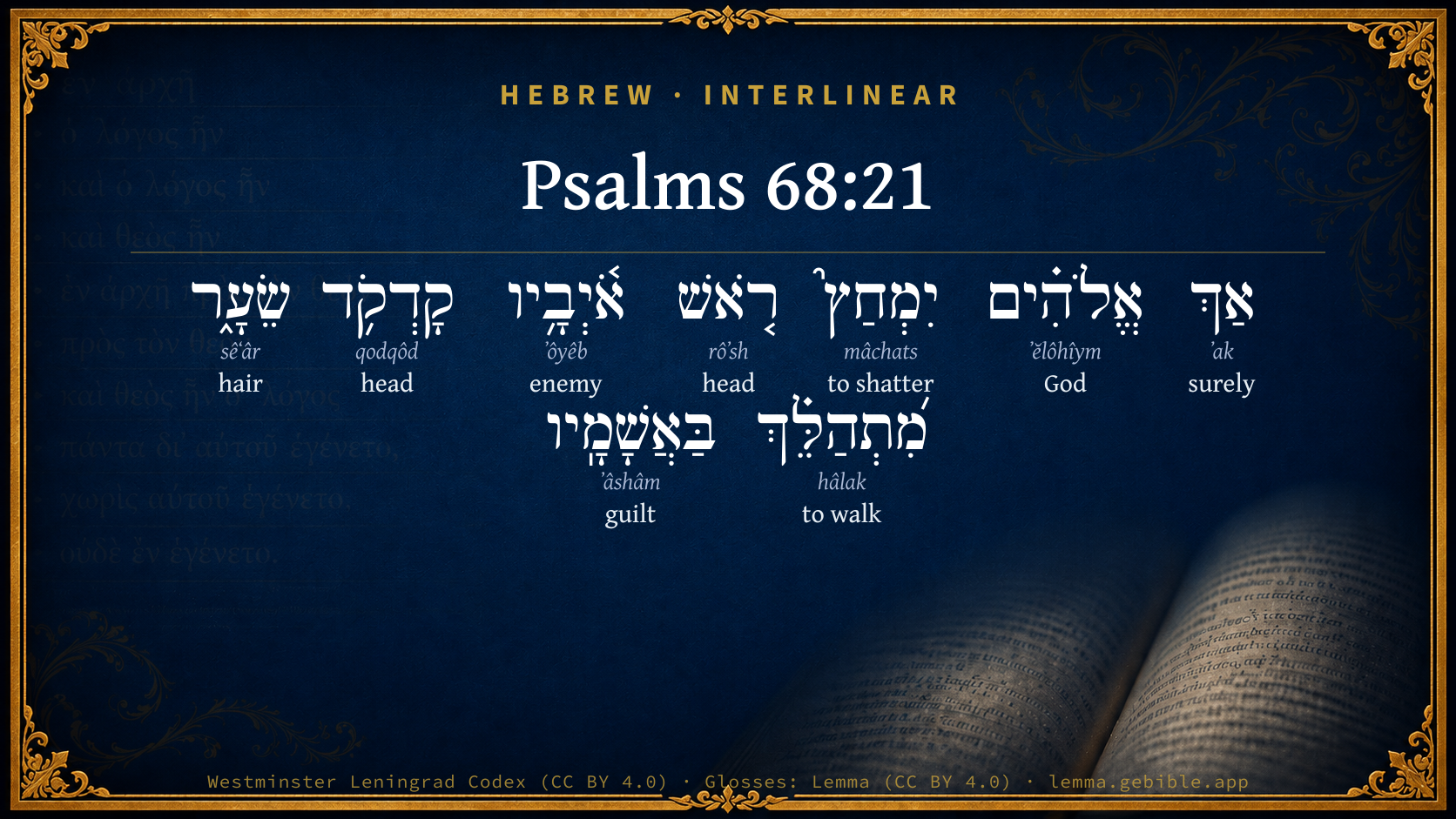
Psalms 68:21

Hebrew (Westminster Leningrad Codex) Psalms 68:21 appears in the Hebrew Old Testament. The text above is from the Westminster Leningrad Codex. Each word links to its Strong’s number, a concise gloss, and parsing drawn from the Open Scriptures Hebrew Bible morphology. Click any word for its full Brown-Driver-Briggs (BDB) entry.
Download image
Cite this verse

Psalms 68:21 (World English Bible). Public Domain. Lemma interlinear Bible study tool, https://lemma.gebible.app/v/psalms/68/21.

Show BibTeX & RIS
BibTeX
RIS
English Translation
But God will strike through the head of his enemies, The hairy scalp of such a one as still continues in his guiltiness.
World English Bible · Public Domain
Download a study sheet

One document with this verse’s original text, its word-by-word gloss line, the meaning frame, cross-references with their text, attributed commentary, and full source and license credits — printable, and it pastes into notes with its structure intact.

This verse Autodidact and up

Study sheet (.html) Plain text (.txt)

A passage Seminary Student

Up to 50 verses in one chapter. A passage sheet keeps up to 6 commentary sources and 12 cross-references per verse, in the order this page ranks them, and says so on the sheet whenever that leaves anything out. Ask for a single verse and you get the Autodidact verse sheet above.

Everything on this page stays free to read, with no account — the sheet is a download of what is already on screen, not access to it.

Want to remove ads? Support Godless Engineer
Compare translations 3

The same verse in 3 English versions, stacked beneath the original-language interlinear above. Click any original word for its lexicon entry.

Each is an independent rendering of the whole verse — the interlinear is not word-aligned to these translations.

Highlighted words mark where these versions differ — a whole-verse word diff, not a word-by-word alignment.

  • World English Bible Public Domain
    But God will strike through the head of his enemies, The hairy scalp of such a one as still continues in his guiltiness.
  • King James Version Public Domain
    But God shall wound the head of his enemies, and the hairy scalp of such an one as goeth on still in his trespasses.
  • unfoldingWord Literal Text CC BY-SA 4.0
    Surely God will crush the head of his enemies, the pate of hair of the one walking ahead in his trespasses.

unfoldingWord Literal Text — © unfoldingWord, licensed CC BY-SA 4.0. Word-aligned USFM3 via Door43 (git.door43.org/unfoldingWord/en_ult).

Versions to compare (up to 4)

3 of 4 selected

Show all 18 translations

Every available English version of this verse, each an independent rendering of the whole verse.

  • World English Bible Public Domain
    But God will strike through the head of his enemies, The hairy scalp of such a one as still continues in his guiltiness.
  • Berean Standard Bible Public Domain
    Surely God will crush the heads of His enemies, the hairy crowns of those who persist in guilty ways.
  • Majority Standard Bible Public Domain
    Surely God will crush the heads of His enemies, the hairy crowns of those who persist in guilty ways.
  • King James Version Public Domain
    But God shall wound the head of his enemies, and the hairy scalp of such an one as goeth on still in his trespasses.
  • American Standard Version (1901) Public Domain
    But God will smite through the head of his enemies, The hairy scalp of such a one as goeth on still in his guiltiness.
  • Revised Version (1885) Public Domain
    But God shall smite through the head of his enemies, the hairy scalp of such an one as goeth on still in his guiltiness.
  • Geneva Bible (1599) Public Domain
    Surely God will wound the head of his enemies, and the hearie pate of him that walketh in his sinnes.
  • Douay-Rheims (1899) Public Domain
    Our God is the God of salvation: and of the Lord, of the Lord are the issues from death.
  • Young's Literal Translation Public Domain
    Only -- God doth smite The head of His enemies, The hairy crown of a habitual walker in his guilt.
  • Literal Standard Version CC BY-SA 4.0
    Only—God strikes || The head of His enemies, || The hairy crown of a habitual walker in his guilt.
  • Unlocked Literal Bible CC BY-SA 4.0
    But God will strike through the heads of his enemies, through the hairy scalps of those who walk in offenses against him.
  • unfoldingWord Literal Text CC BY-SA 4.0
    Surely God will crush the head of his enemies, the pate of hair of the one walking ahead in his trespasses.
  • Darby Bible Public Domain
    Verily God will smite the head of his enemies, the hairy scalp of him that goeth on still in his trespasses.
  • World Messianic Bible Public Domain
    But God will strike through the head of his enemies, the hairy scalp of such a one as still continues in his guiltiness.
  • Webster's Bible Public Domain
    \\68:20\\He that is our God is the God of salvation; and to GOD the Lord belong the issues from death.
  • Free Bible Version CC BY-SA 4.0
    But God will crush the heads of his enemies, the hairy heads of those who continue to sin.
  • Bible in Basic English Public Domain
    The heads of the haters of God will be crushed; even the head of him who still goes on in his evil ways.
  • JPS Tanakh (1917) Public Domain
    (68-22) Surely God will smite through the head of His enemies, the hairy scalp of him that goeth about in his guiltiness.

Literal Standard Version (2020), Covenant Press — licensed CC BY-SA 4.0. Text via the HelloAO Bible API (eBible.org). Unlocked Literal Bible (unfoldingWord) — licensed CC BY-SA 4.0. Text via the HelloAO Bible API (eBible.org). unfoldingWord Literal Text — © unfoldingWord, licensed CC BY-SA 4.0. Word-aligned USFM3 via Door43 (git.door43.org/unfoldingWord/en_ult). Free Bible Version, Dr. Jonathan Gallagher — licensed CC BY-SA 4.0. Text via the HelloAO Bible API (eBible.org).

Word by word

More ways to search: Search by grammar → Find every occurrence → Compare this word →

Practice this passage: Drill this verse → Learn its vocabulary →

About this verse

These counts appear in no published source. They are computed here, from the morphology-tagged text and Lemma’s own curated glosses. What Lemma adds →

9
words
9
distinct lemmas
Wisdom
section

Notable vocabulary

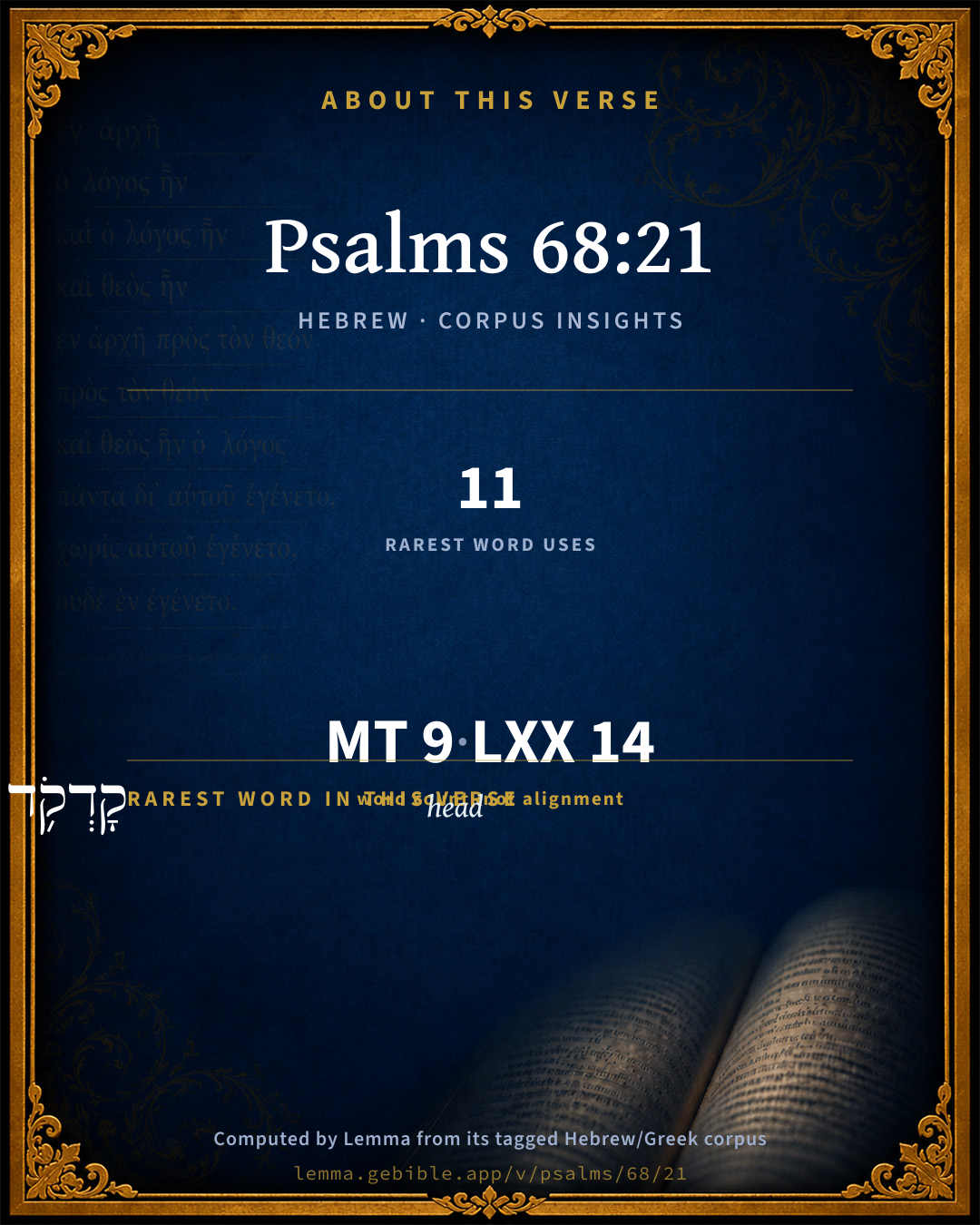
The rarest word here is קָדְקֹ֥ד head H6936 — appearing just 11 times in the whole Hebrew Bible.

Shared distinctive vocabulary

קָדְקֹ֥ד head H6936 occurs in 11 verses of the Hebrew Bible. Also found in:

Grammatical profile

  • 3 verbs
  • 5 nouns
  • 1 particle

Verb forms

  • יִמְחַץ֮ Qal · Imperfect
  • אֹ֫יְבָ֥יו Qal · Participle Active
  • מִ֝תְהַלֵּ֗ךְ Hithpael · Participle Active

Hebrew & Septuagint length

In English translation the verse runs 23 words from the Hebrew and 20 from the Septuagint (LXX English) — closely comparable.

A rough comparison of the two English renderings, which tokenize alike — not a word-level alignment.

Word counts can differ between the Hebrew and the Greek without any difference in meaning — e.g. the Hebrew direct-object marker אֵת has no separate Greek word, and Greek often adds the article ὁ.

In the original languages it is 9 Hebrew tokens and 14 Greek tokens — but the two are counted differently (Hebrew bundles its prefixes and suffixes into one token; the Greek is in lemma form), so that isn’t a like-for-like length.

Cross-references

12

Topical passages linked to Psalms 68:21 in the Treasury of Scripture Knowledge — connected by theme and wording, ordered by reader-vote popularity; previews shown in the World English Bible.

  • Habakkuk 3:13 You went forth for the salvation of your people, For the salvation of your anointed. You crushed the head of the land of wickedness. You stripped them head to foot. Selah.
  • Psalms 7:12 If a man doesn't relent, he will sharpen his sword; He has bent and strung his bow.
  • Psalms 110:6 He will judge among the nations. He will heap up dead bodies. He will crush the ruler of the whole earth.
  • Luke 13:5 I tell you, no, but, unless you repent, you will all perish in the same way."
  • Ezekiel 18:27–30 Again, when the wicked man turns away from his wickedness that he has committed, and does that which is lawful and right, he shall save his soul alive.
  • Hebrews 12:25 See that you don't refuse him who speaks. For if they didn't escape when they refused him who warned on the Earth, how much more will we not escape who turn away from him who warns from heaven,
  • Revelation 2:14–16 But I have a few things against you, because you have there some who hold the teaching of Balaam, who taught Balak to throw a stumbling block before the children of Israel, to eat things sacrificed to idols, and to commit sexual immorality.
  • Psalms 55:23 But you, God, will bring them down into the pit of destruction. Bloodthirsty and deceitful men shall not live out half their days, But I will trust in you.
  • Proverbs 1:24–33 Because I have called, and you have refused; I have stretched out my hand, and no one has paid attention;
  • Hebrews 2:1–3 Therefore we ought to pay greater attention to the things that were heard, lest perhaps we drift away.
  • Psalms 68:18 You have ascended on high. You have led away captives. You have received gifts among men, Yes, among the rebellious also, that Yah God might dwell there.
  • Mark 12:4 Again, he sent another servant to them; and they threw stones at him, wounded him in the head, and sent him away shamefully treated.

Cross-references courtesy of OpenBible.info (CC BY 4.0).

Hebrew and Greek witnesses Masoretic Hebrew ↔ Greek Septuagint

The same verse in the two great witnesses to the Old Testament, shown verse-for-verse.

You’re reading Greek Psalm 67 (Hebrew Psalm 68). The Septuagint counts the superscription, so verse numbers can differ from the Hebrew — chapter-level alignment, not verse-by-verse. Numbering follows Rahlfs.

These are two independent witnesses, not word-aligned to each other, and the Septuagint is shown in lemma (dictionary) form.

Hebrew Psalms 68:21 Masoretic · Westminster Leningrad Codex

אַךְ אֱלֹהִ֗ים יִמְחַץ֮ רֹ֤אשׁ אֹ֫יְבָ֥יו קָדְקֹ֥ד שֵׂעָ֑ר מִ֝תְהַלֵּ֗ךְ בַּאֲשָׁמָֽיו

But God will strike through the head of his enemies, The hairy scalp of such a one as still continues in his guiltiness.

World English Bible · Public Domain

Greek LXX Greek Psalm 67:21 Septuagint · lemma form

ὁ θεός ἐγώ θεός ὁ σώζω καί ὁ κύριος κύριος ὁ διέξοδος ὁ θάνατος

But God shall crust the heads of his enemies; the hairy crown of them that go on in their trespasses.

LXX2012 (modern English Septuagint) · Public Domain

Hebrew: Westminster Leningrad Codex (CC BY 4.0). Greek: Septuagint (public domain); English from LXX2012 (modern English Septuagint) (Public Domain). How the Septuagint differs from the Hebrew →

Commentary

Notes on Psalms 68:21 from classic Christian and Jewish commentators (each source and its license shown beneath its notes). The classic Christian expositions comment on the surrounding passage and are grouped to its opening verse, so a note may address several verses; the Jewish commentaries on the Tanakh (Rashi and others) are per-verse, so they appear only where the commentator wrote on this verse.

Lemma curates 59 commentaries, every one of them public domain or Creative Commons licensed, each selected and text-cleaned for this edition rather than reprinted as found. About our sources →

Trapp's Complete Commentary

John Trapp

Psa 68:21 But God shall wound the head of his enemies, [and] the hairy scalp of such an one as goeth on still in his trespasses.

Ver. 21. But God shall wound the head of his enemies] Cruentabit caput, a wound in the head if deep (and God strikes no small blows) is mortal. Christ will break the head of those that bruise his heel, that attempt anything against him and his. By head here Diodati understandetb the devil, that prince of the world, Deu 32:42 Psa 110:6 Hab 3:13. Evil spirits in Scripture are called Shegnirim, shag-haired, Lev 17:7 Isa 13:21. And they go on in their trespasses; they do infinitely hate God, and sin that sin against the Holy Ghost every moment. But the most understand it of wicked men.

And the hairy scalp of such a one as goeth on still, &c.] This is God’s enemy, that by his wilful wickedness striketh, and as it were shooteth, at God, runneth upon him, even upon his neck, and upon the thick bosses of his bucklers, Job 15:25-26, His hairy scalp, setting forth his fierceness, Job 5:5. Note this against anti-roundheads. See Eze 44:20.

John Trapp, A Commentary or Exposition upon All the Books of the Old and New Testament (1647–1656) — public domain. Text from a community e-Sword module.

The Biblical Illustrator

Joseph S. Exell

Psa_68:21

But God shall wound the head of His enemies, and the hairy scalp of such an one as goeth on still in his trespasses.

Gods threatenings against incorrigible sinners

I. The persons threatened.

1. In general, Gods enemies; in particular, those who go on still in their trespasses (Lev_26:18; Deu_29:19-20; Pro_29:1). In these and other passages of Scripture, God threatens the pertinacious sinner.

2. There is very good ground for it, which may appear in these following considerations.

(1) Because he multiplies sin.

(2) Because he aggravates it.

(3) Because he confirms it.

He makes his sins more numerous. He makes his sins more heinous. He makes his sins more settled, and hardened and difficult to be removed; therefore draws on the punishment of them.

II. The evil threatened. Wound.

1. A mollified expression. Not kill, but wound. Counts it enough for Him to lay His enemies flat. He does not so much care to insult, and to triumph over them, or to do the worst that He can against them.

2. As it is a mollified expression, so it is a peremptory. He shall or will do it, does it not yet it may be, but yet means to do it hereafter, if He be not the better prevented, that He would have understood.

III. The part wherein they are threatened. The head.

1. This is not exclusive but specificative; it is not the head so, as if nowhere else besides but the head as therein especially. As for obstinate sinners, they have many wounds inflicted upon them in other respects.

(1) In their good names they have a wound oftentimes in them (Pro_6:33).

(2) In estate.

(3) In conscience.

2. But it is especially in the head.

(1) In their intellectuals, takes away their brains from them.

(2) In their vitals, takes away their life from them.

(3) In their principalities, and eminencies, takes away their glory from them.

3. And we cannot wonder at it, if we do but consider how they use their heads oftentimes against Himself; which they do by a double practice.

(1) In the contriving of sin.

(2) In the defending of it. Wicked men use their heads against God to each of these purposes, and therefore does He wound them in them.

4. There are two principles which do engage Him, and move Him hereunto.

(1) His own glory.

(2) His Churchs good.

5. If we shall ask when He will do it, because He does it not always, nor presently--I answer in these two cases.

(1) When the sins of the enemies are thoroughly ripened.

(2) When the hearts of the Christians are thoroughly humbled. In these two conditions does God wound the head of His enemies, and not before.

6. But how shall we be kept and preserved from it? what helps are there against persistency in sin?

(1) Mortify the principle of corruption in us. The way to be kept from the acts of sin, is to have the habit of it subdued in us. There must be the killing of this viper in the egg, a slaying it in the root; till this be done there is no security at all for us.

(2) Stop the beginnings, as we desire not to go on in trespasses, let us not at first venture upon them, for it is like the letting out of waters, as Solomon speaks of strife, which a man knows not where it will end.

(3) Have daily, and continual, and fresh, and actual apprehensions in us of the filthiness and dangerousness of it. (T. Horton, D. D.)

The Biblical Illustrator, edited by Joseph S. Exell (c. 1880s–1900s) — public domain. Text from a community e-Sword module.

Joseph Benson's Commentary

Psa 68:21. But God shall wound the head of his enemies — Of Satan, the old serpent, of whom it was, by the first promise, foretold, that the seed of the woman should bruise his head; and the heads of all the powers of the nations, whether Jews or Gentiles, that oppose him and his kingdom among men. Psa 110:6, He shall wound the heads over many countries; of all those, whoever they are, that will not have him to reign over them. For these he accounts his enemies, and they shall be brought forth and slain before him, Luk 19:27. The hairy scalp, &c. — This expression seems to refer to the custom prevalent with many, in ancient times, of wearing long shaggy hair, that their looks might be more terrible to their enemies. Of such a one as goeth on still in his trespasses — And hates to be reformed. Christ looks on all such as his enemies, and will treat them accordingly. The original words here used have great emphasis, and imply, God shall strike deep, or exhaust the blood of the head of his enemies, that is, utterly destroy them. As if he had said, “He will avenge himself on their devoted heads; nor shall their strength or craft be able to protect them from his indignation.” For the head, and the hairy scalp, or crown, denote the principal part, the strength, the pride, and the glory of the adversary, which was to be crushed, according to the original sentence, Gen 3:15. It is justly observed here by Dr. Horne, that this verse begins a prediction of that vengeance which the person who was “ascended on high would infallibly execute upon his impenitent enemies, and which was shadowed forth in the destruction of the enemies of Israel by David, after that the ark of God was placed upon the hill of Zion.”

Joseph Benson's Commentary on the Old and New Testaments (1811–1818) — public domain. Text from a community e-Sword module.

J. A. Alexander on Psalms

Joseph Addison Alexander

22. (Psa 68:21). Surely God will crush the head of his enemies, the hairy scalp, going on in his trespasses. The first word properly means only, and is here used to denote that this and not the contrary is true, a purpose which in our idiom may be answered by a particle of strong asseveration, such as certainly or surely. See above, Psa 69:6, and compare Psa 39:11; Psa 58:11. Crush the head, a stroll figure for violent and complete destruction. See below, on Psa 68:23, and compare Gen 3:15, Num 24:8; Num 24:17. The hairy scalp, or crown of hair, is merely a poetical equivalent or parallel to head. he words that follow seem to be applied to it by a kind of personification. Compare Pro 16:31. But this figure, if too bold, may be avoided by supplying of one or of the man before going. This last word does not necessarily mean going on, but according to its usage elsewhere may be endered going about, i.e. habitually acting, in a sinful manner. See alove, on Psa 68:8; Psa 20:6; Psa 26:3; Psa 25:14; Psa 39:6; Psa 43:1.

Joseph Addison Alexander, The Psalms Translated and Explained (1850) — public domain. Text from a community e-Sword module.

Tyndale Open Study Notes

Tyndale Open Resources

68:21 God will smash the heads of his enemies: Cp. Gen 3:15.

Tyndale Open Study Notes — © Tyndale Open Resources, licensed CC BY-SA 4.0. Text via the HelloAO Bible API.

Jamieson, Fausset & Brown

Robert Jamieson, A. R. Fausset & David Brown

wound the head--or, "violently destroy" (Num 24:8; Psa 110:6).

goeth on still in . . . trespasses--perseveringly impenitent.

Jamieson, Fausset & Brown — Commentary Critical and Explanatory on the Whole Bible (1871) — public domain (CC PDM 1.0). Text via the HelloAO Bible API.

Adam Clarke's Commentary

Verse 21. The hairy scalp] קדקד שער kodkod sear. Does this mean any thing like the Indian scalping? Or does it refer to a crest on a helmet or headcap? I suppose the latter.

Adam Clarke's Commentary on the Bible (1810–1826) — public domain. Text from a community e-Sword/MySword module.

John Calvin's Commentaries

21. Surely God shall wound, etc. The enemies of the Church are fierce and formidable, and it is impossible that she can be preserved from their continued assaults, without a vigorous protection being extended. To persuade us that she enjoys such a defense, David represents God as armed with dreadful power for the overthrow of the ungodly. The verse stands connected as to scope with the preceding, and we might render the Hebrew particle אך, ach, by wherefore, or on which account; but it seems better to consider it as expressing simple affirmation. We are to notice the circumstance, that God counts all those his enemies who unjustly persecute the righteous, and thus assures us of his being always ready to interpose for our defense. The concern he feels in our preservation is forcibly conveyed by the expressions which follow, that he will wound the head of his enemies, and the crown of their hair; intimating, that he will inflict a deadly and incurable wound upon such as harass his Church. This is still more strikingly brought out in what is added immediately afterwards, when God is described as wading through destruction.

John Calvin's Commentaries (1540-1563) — public domain. Text from the Calvin Translation Society English edition (1840s-50s) via the Christian Classics Ethereal Library (ccel.org). Calvin's coverage is partial (roughly two-thirds of the Bible); uncommented books and verses are honest gaps, never fabricated. The 19th-century editor's footnotes and remarks are omitted so the notes are faithfully Calvin's own voice.

Ellicott's Commentary for English Readers

(21) Hairy scalp.—Literally, crown, or top, or head of hair. The word is rendered “pate” in Psa_7:16. This is probably a portrait of some historical person hostile to Israel. Others take it as a type of pride and arrogance, comparing the use of the Greek verb κομαν. The word “scalp,” properly shell (comp. “skull”), was a word in common use at the time of the translation of the English Bible—

“White beards have armed their thin and hairless scalps

Against thy majesty.”

SHAKSPERE: Richard II.

A Bible Commentary for English Readers, edited by Charles John Ellicott (1878–1897) — public domain. Text from a community e-Sword module.

The Cambridge Bible for Schools and Colleges

gen. ed. J. J. S. Perowne

21. But God shall wound the head &c.) Yea, God shall smite through the head &c. Cp. Jdg_5:26; Hab_3:13-14.

and the hairy scalp] Omit and. The warrior’s long hair is mentioned not merely as “a sign of exuberant strength and impenitent pride,” but in allusion to the ancient practice of allowing the hair to grow when a vow had been undertaken. “With warriors in primitive times the unshorn head was a usual mark of their consecration to the work they had undertaken, and their locks remained untouched till they had achieved their enterprise or had perished in the attempt. War among most primitive peoples is a sacred function.” J. S. Black in the Smaller Cambr. Bible for Schools, on Jdg_5:2, which should be rendered

“For that flowing locks were worn in Israel,

For that the people volunteered themselves, bless ye the Lord,”

i.e. give thanks for the zeal with which the people devoted themselves to the sacred war of independence. Cp. Deu_32:42, where “from the beginning of revenges on the enemy” should be rendered “from the hairy head of the enemy.”

of such a one &c.] According to strict grammar, the hairy scalp that goeth on in his guiltiness, the scalp standing by metonymy for the man. The verb expresses the idea of open and defiant persistence.

The Cambridge Bible for Schools and Colleges (gen. ed. J. J. S. Perowne; Cambridge University Press, 1878–1918) — public domain. Text from a community e-Sword module.

John Gill's Exposition

But God shall wound the head of his enemies,.... Him who is the chief of his enemies, even Satan the prince of devils, the god of the world, the father of the wicked Jews, all enemies of Christ; to "wound" is the same as to bruise him, as in Gen 3:15; and so the Targum here,

"but God shall break the head of his enemies;''

disappoint his schemes, blast his designs, crush his power and authority, demolish his empire, and eternally destroy him with the fire prepared for him and his angels; and the same may be applied to the man of sin, and all other enemies of Christ, who is the divine Person here, and all along, spoken of; see Psa 110:6;

and the hairy scalp of such an one as goeth on still in his trespasses; by whom may be meant antichrist: Jarchi interprets it of Esau, who was an hairy man, and a figure of antichrist: and his hairy scalp may denote his fierceness and cruelty, appearing like a savage beast, drinking the blood of the saints; and like a thief and a robber, who used to let their hair grow long, shagged, and entangled, to strike terror into men they met with, Job 5:5; and also his pride and haughtiness; he exalting himself above all that is called God, and opening his mouth in blasphemy against him: and likewise it signifies his great power and authority, he having people, kingdoms, and nations, depending upon him, as hair on the head, and subject to him: and of him it may be truly said, that he "goes on still in his trespasses"; in tyranny, idolatry, superstition, and will worship; taking no notice of what God says by his witnesses, nor any warning by what the eastern empire suffered by the Turks and Saracens; so as to repent of the works of his hands, of worshipping idols of gold, silver, brass, and wood; nor of his murders, sorceries, fornications, and thefts; but still persisting in them, until his, and the sins of his followers, reach to heaven, Rev 9:20; but the God-man, Christ Jesus, will give him a deadly wound, of which he shall never be healed: this also holds true of all that persist in a sinful course of life without repentance; who are workers of iniquity, whose lives are one continued series of sinning; these will be punished by Christ with everlasting destruction.

John Gill's Exposition of the Whole Bible (1746–1763) — public domain (CC PDM 1.0). Text via the HelloAO Bible API.

Albert Barnes' Notes on the Bible

But God shall wound the head of his enemies - More properly, “God shall crush the head,” etc. The idea is that of complete destruction, - as, if the head is crushed, life becomes ex tinct. See Gen 3:15; compare Psa 110:6.

And the hairy scalp - More literally, “the top of the hair.” The Hebrew word used here for “scalp” means the vertex, the top, the crown, as of the head, where the hair “divides itself;” and the idea is properly, “the dividing of the hair.” Gesenius, Lexicon. The allusion is to the top of the head; that is, the blow would descend on the top of the head, producing death.

Of such an one as goeth on still in his trespasses - Of the man who perseveres in a course of wickedness. If he repents, God will be merciful to him; if he persists in sin, he will be punished. The literal rendering would be, “the hairy scalp going on, or going, sc. “about”, in his trespasses.” The reference is to a wicked man “continuing” in his transgressions.

Albert Barnes' Notes on the Bible (1834–1885) — public domain. Text from a community e-Sword/MySword module.

Matthew Poole's English Annotations

The head; either,

1. The political head, their ruler or rulers, the devil or other wicked Christians. Or rather,

2. The natural head, as appears from the following expression, added to explain this, and

the hairy scalp; and he speaks of the heads or hairy scalps not of one, but of all his enemies; the singular number being put for the plural, than which nothing is more frequent. The hairy scalp, i.e. his most fierce and terrible enemies. For in ancient times many people used to wear long and shaggy hair, that their looks might be more terrible to their enemies.

Of such a one as goeth on still in his trespasses; of those who persist in their enmity and rebellion against him; whereby he opens a door of hope and mercy to his very enemies, if they return and submit themselves to him.

Matthew Poole's English Annotations on the Holy Bible (1683–1685) — public domain. Text from a community e-Sword/MySword module.

The Treasury of David

Charles H. Spurgeon

Ver. 21. But God shall wound the head of his enemies. The Preserver is also the Destroyer. He smites his foes on the crown of their pride. The seed of the woman crushes the serpent's head. There is no defence against the Lord, he can in a moment smite with utter destruction the lofty crests of his haughty foes.

And the hairy scalp of such an one as goeth on still in his trespasses. He may glory in his outward appearance, and make his hair his pride, as Absalom did; but the Lord's sword shall find him out, and pour out his soul. Headstrong sinners will find that providence overcomes them despite their strong heads. They who go on in sin will find judgments come on them; and the adornment of their pride may be made the instrument of their doom. He covers the head of his servants, but he crushes the head of his foes. At the second coming of the Lord Jesus, his enemies will find his judgments to be beyond conception terrible.

Ver. 21. The hairy scalp. That is, even the most fearful enemies, that with their ghastly visage, deformed with long hair, would strike a terror into the hearts of beholders. Edward Leigh.

Ver. 21. Hairy scalp. It was a practice among some of the ancient inhabitants of Arabia to allow their hair to grow luxuriantly on the top of the head, and to shave the head in other parts. Francis Hare. 1740.

Ver. 21. The power, pride, wisdom, and very life of evil, to be conquered by God.

Psalms 68:22*

Charles H. Spurgeon's The Treasury of David (1869–1885) — public domain. Psalms only. Text from a community e-Sword/MySword module.

Whedon's Commentary on the Bible

Daniel D. Whedon

21. Hairy scalp—That is, The hair-covered crown. Luxuriant hair was a sign of beauty and strength, and an occasion of pride and lofty airs, and shaving the head a sign of degradation. See Deu_32:42, where, instead of “from the beginning of revenges upon the enemy,” translate, from the uncoverings of the head of the enemy.

Daniel D. Whedon (gen. ed.), Commentary on the Old and New Testaments (1874–1909) — public domain. Text from a community e-Sword module.

The Pulpit Commentary

But God shall wound the head of his enemies; or, "yet surely God will smite," etc. Though he gives escape from death, yet he will not do so always. On the contrary, he will assuredly smite and destroy his enemies, wounding them where a wound is fatal. And the hairy scalp of such a one as goeth on still in his trespasses. "The hairy scalp," says Dr. Kay, "points almost certainly to Absalom." Others take it as merely indicating the young and strong.

The Pulpit Commentary (1880–1919), ed. H.D.M. Spence-Jones & Joseph S. Exell — public domain. Text from a community e-Sword module.

John Wesley's Explanatory Notes

Hairy - In ancient times many people used to wear long and shaggy hair, that their looks might be more terrible to their enemies.

John Wesley, Explanatory Notes Upon the Whole Bible (1754–1765) — public domain. Text via the GEBible commentary corpus.

Rashi

Rabbi Shlomo Yitzchaki (Rashi)

God is to us the God of salvations God is our Savior, but He has many paths, i.e., kinds of death. תוצאות means, ways to death. However, He does not lay them upon us, but with them He wounds the head of His enemies.

Rashi on the Tanakh — English translations: “The Judaica Press complete Tanach with Rashi, translated by A. J. Rosenberg” (CC BY 4.0); “Pentateuch with Rashi's commentary by M. Rosenbaum and A.M. Silbermann, 1929-1934” (public domain); “The Metsudah Tanach series, Lakewood, N.J” (CC BY 4.0); and “The Book of Joshua, Metsudah Publications, 1997” (CC BY 4.0). Text via Sefaria.

Lesson kit

Teaching starters — assembled from the data on this page, not authored interpretation. Every prompt links to the verse data it draws on. Edit before teaching.

Psalms, in the Wisdom, opens this verse with 9 words (9 distinct Hebrew lemmas). Its most distinctive word is qodqôd (“head”). A historical commentator’s framing appears above. Read the whole chapter for the surrounding context.

Discussion questions

  1. The word qodqôd carries the sense “head.” How does it shape the verse?
  2. How does Genesis 49:26, which shares the word «head», read alongside this verse?
  3. These translations render this verse differently; the difference is in the English rendering, not the original. What questions does that raise?
  4. «יִמְחַץ֮» is a Qal Imperfect verb. How does that grammatical form shape the action described?
  5. Compare how Trapp's Complete Commentary and The Biblical Illustrator read this verse. Where do they agree or differ?

Things to notice

Reading settings

Reading text

Shown beneath each verse's original-language words.

Old Testament
Old Testament edition

Read the OT as the Masoretic Hebrew (MT) or the Greek Septuagint (LXX).

English shown for the Greek Septuagint (in the Hebrew ↔ Greek comparison).

Comparing translations? Open the Compare panel on any verse page to stack up to four side by side.