
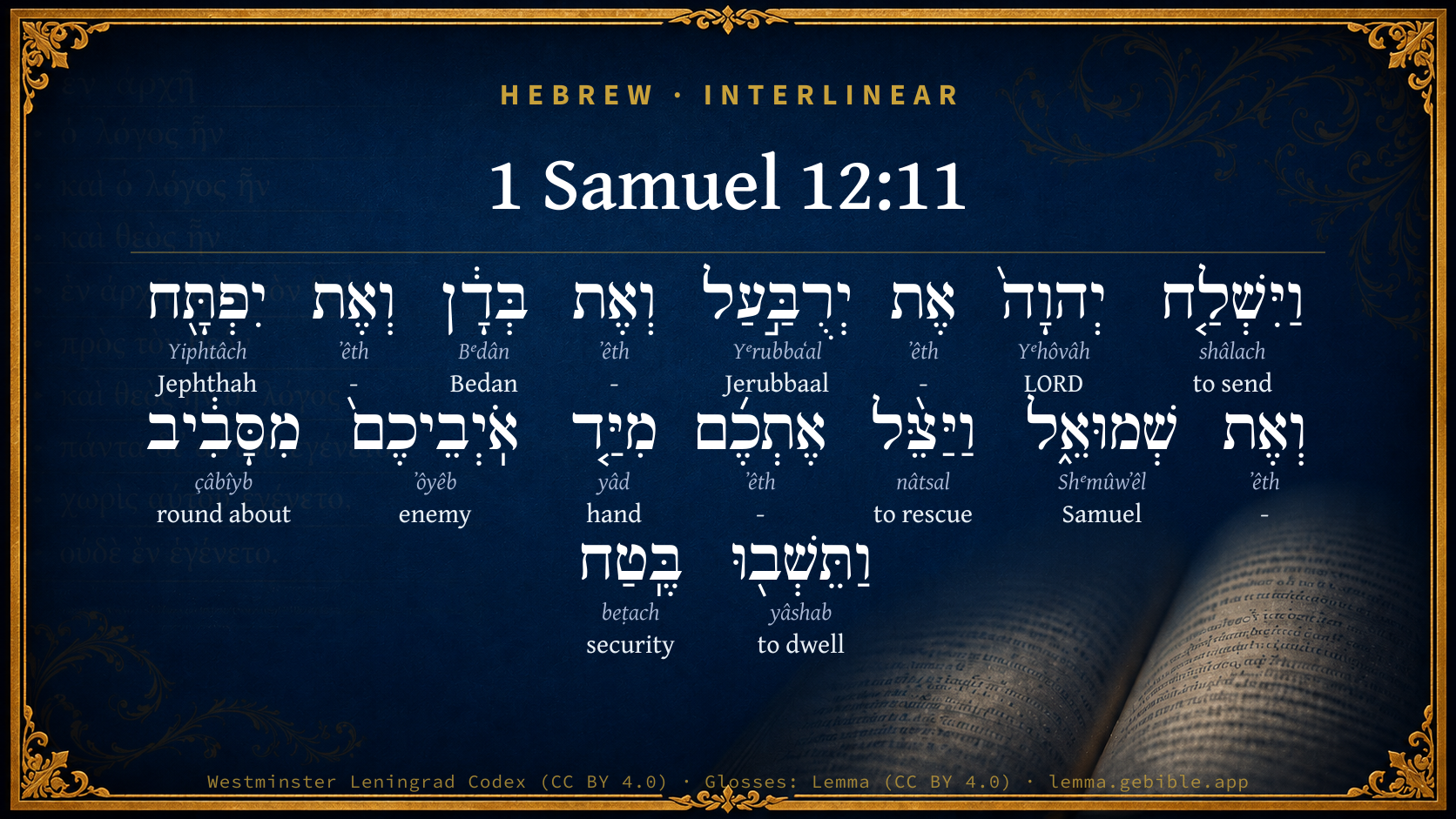
1 Samuel 12:11

Hebrew (Westminster Leningrad Codex) 1 Samuel 12:11 appears in the Hebrew Old Testament. The text above is from the Westminster Leningrad Codex. Each word links to its Strong’s number, a concise gloss, and parsing drawn from the Open Scriptures Hebrew Bible morphology. Click any word for its full Brown-Driver-Briggs (BDB) entry.
Download image
Cite this verse

1 Samuel 12:11 (World English Bible). Public Domain. Lemma interlinear Bible study tool, https://lemma.gebible.app/v/1-samuel/12/11.

Show BibTeX & RIS
BibTeX
RIS
English Translation
Yahweh sent Jerubbaal, and Bedan, and Jephthah, and Samuel, and delivered you out of the hand of your enemies on every side; and you lived in safety.
World English Bible · Public Domain
Highlights
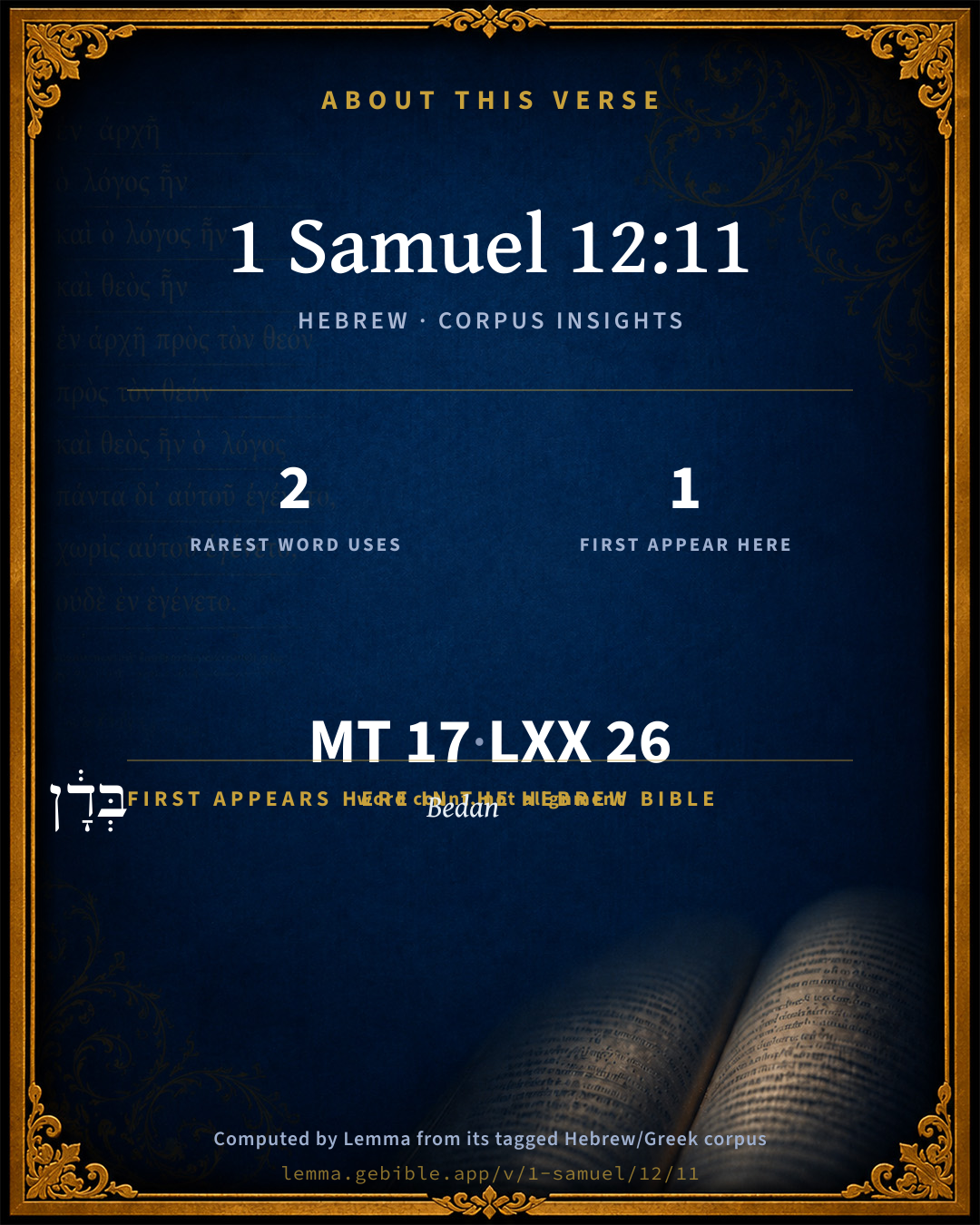
  • 1 first appearance in the Hebrew Bible
Full analysis ↓
Download a study sheet

One document with this verse’s original text, its word-by-word gloss line, the meaning frame, cross-references with their text, attributed commentary, and full source and license credits — printable, and it pastes into notes with its structure intact.

This verse Autodidact and up

Study sheet (.html) Plain text (.txt)

A passage Seminary Student

Up to 50 verses in one chapter. A passage sheet keeps up to 6 commentary sources and 12 cross-references per verse, in the order this page ranks them, and says so on the sheet whenever that leaves anything out. Ask for a single verse and you get the Autodidact verse sheet above.

Everything on this page stays free to read, with no account — the sheet is a download of what is already on screen, not access to it.

Want to remove ads? Support Godless Engineer
Compare translations 3

The same verse in 3 English versions, stacked beneath the original-language interlinear above. Click any original word for its lexicon entry.

Each is an independent rendering of the whole verse — the interlinear is not word-aligned to these translations.

Highlighted words mark where these versions differ — a whole-verse word diff, not a word-by-word alignment.

  • World English Bible Public Domain
    Yahweh sent Jerubbaal, and Bedan, and Jephthah, and Samuel, and delivered you out of the hand of your enemies on every side; and you lived in safety.
  • King James Version Public Domain
    And the LORD sent Jerubbaal, and Bedan, and Jephthah, and Samuel, and delivered you out of the hand of your enemies on every side, and ye dwelled safe.
  • unfoldingWord Literal Text CC BY-SA 4.0
    So Yahweh sent Jerubbaal and Bedan and Jephthah and Samuel. And he delivered you from the hand of your enemies from all around, and you dwelled in security.

unfoldingWord Literal Text — © unfoldingWord, licensed CC BY-SA 4.0. Word-aligned USFM3 via Door43 (git.door43.org/unfoldingWord/en_ult).

Versions to compare (up to 4)

3 of 4 selected

Show all 18 translations

Every available English version of this verse, each an independent rendering of the whole verse.

  • World English Bible Public Domain
    Yahweh sent Jerubbaal, and Bedan, and Jephthah, and Samuel, and delivered you out of the hand of your enemies on every side; and you lived in safety.
  • Berean Standard Bible Public Domain
    So the LORD sent Jerubbaal, Barak, Jephthah, and Samuel, and He delivered you from the hands of your enemies on every side, and you dwelt securely.
  • Majority Standard Bible Public Domain
    So the LORD sent Jerubbaal, Barak, Jephthah, and Samuel, and He delivered you from the hands of your enemies on every side, and you dwelt securely.
  • King James Version Public Domain
    And the LORD sent Jerubbaal, and Bedan, and Jephthah, and Samuel, and delivered you out of the hand of your enemies on every side, and ye dwelled safe.
  • American Standard Version (1901) Public Domain
    And Jehovah sent Jerubbaal, and Bedan, and Jephthah, and Samuel, and delivered you out of the hand of your enemies on every side; and ye dwelt in safety.
  • Revised Version (1885) Public Domain
    And the LORD sent Jerubbaal, and Bedan, and Jephthah, and Samuel, and delivered you out of the hand of your enemies on every side, and ye dwelled in safety.
  • Geneva Bible (1599) Public Domain
    Therefore the Lord sent Ierubbaal and Bedan and Iphtaph, and Samuel, and deliuered you out of the handes of your enemies on euery side, and yee dwelled safe.
  • Douay-Rheims (1899) Public Domain
    And the Lord sent Jerobaal, and Badan, and Jephte, and Samuel, and delivered you from the hand of your enemies round about, and you dwelt securely.
  • Young's Literal Translation Public Domain
    `And Jehovah sendeth Jerubbaal, and Bedan, and Jephthah, and Samuel, and delivereth you out of the hand of your enemies round about, and ye dwell confidently.
  • Literal Standard Version CC BY-SA 4.0
    And YHWH sends Jerubba‘al, and Bedan, and Jephthah, and Samuel, and delivers you out of the hand of your surrounding enemies, and you dwell confidently.
  • Unlocked Literal Bible CC BY-SA 4.0
    So Yahweh sent Jerub Baal, Bedan, Jephthah, and Samuel, and gave you victory over your enemies all around you, so that you lived in security.
  • unfoldingWord Literal Text CC BY-SA 4.0
    So Yahweh sent Jerubbaal and Bedan and Jephthah and Samuel. And he delivered you from the hand of your enemies from all around, and you dwelled in security.
  • Darby Bible Public Domain
    And Jehovah sent Jerubbaal and Bedan and Jephthah and Samuel, and delivered you out of the hand of your enemies round about, so that ye dwelt in safety.
  • World Messianic Bible Public Domain
    The LORD sent Jerubbaal, Bedan, Jephthah, and Samuel, and delivered you out of the hand of your enemies on every side; and you lived in safety.
  • Webster's Bible Public Domain
    And the LORD sent Jerubbaal and Bedan, and Jephthah, and Samuel, and delivered you from the hand of your enemies on every side, and ye dwelt safe.
  • Free Bible Version CC BY-SA 4.0
    Then the Lord sent Gideon, Barak, Jephthah and Samuel, and he saved you from your enemies who surrounded you so you could live in safety.
  • Bible in Basic English Public Domain
    So the Lord sent Jerubbaal and Barak and Jephthah and Samuel and took you out of the power of those who were fighting against you on every side, and made you safe.
  • JPS Tanakh (1917) Public Domain
    And the LORD sent Jerubbaal, and Bedan, and Jephthah, and Samuel, and delivered you out of the hand of your enemies on every side, and ye dwelt in safety.

Literal Standard Version (2020), Covenant Press — licensed CC BY-SA 4.0. Text via the HelloAO Bible API (eBible.org). Unlocked Literal Bible (unfoldingWord) — licensed CC BY-SA 4.0. Text via the HelloAO Bible API (eBible.org). unfoldingWord Literal Text — © unfoldingWord, licensed CC BY-SA 4.0. Word-aligned USFM3 via Door43 (git.door43.org/unfoldingWord/en_ult). Free Bible Version, Dr. Jonathan Gallagher — licensed CC BY-SA 4.0. Text via the HelloAO Bible API (eBible.org).

Word by word

More ways to search: Search by grammar → Find every occurrence → Compare this word →

Practice this passage: Drill this verse → Learn its vocabulary →

בְּדָ֔ן
Bᵉdân
H917
“Bedan”
Noun, Proper
Part of Speech
Noun
Type
Proper
Full BDB Definition

Origin: probably shortened for H5658

TWOT: None

Bedan = "in judging" - a judge who followed Gideon - a Manassite
  1. וַיִּשְׁלַ֤ח shâlach H7971 “and · to send” Conjunction + Verb, Qal, Sequential Imperfect, 3rd Person, Masculine, Singular
  2. יְהוָה֙ Yᵉhôvâh H3068 “LORD” Noun, Proper
  3. אֶת ʼêth H853 “-” Particle, Direct Object
  4. יְרֻבַּ֣עַל Yᵉrubbaʻal H3378 “Jerubbaal” Noun, Proper
  5. וְאֶת ʼêth H853 “and · -” Conjunction + Particle, Direct Object
  6. וְאֶת ʼêth H853 “and · -” Conjunction + Particle, Direct Object
  7. יִפְתָּ֖ח Yiphtâch H3316 “Jephthah” Noun, Proper
  8. וְאֶת ʼêth H853 “and · -” Conjunction + Particle, Direct Object
  9. שְׁמוּאֵ֑ל Shᵉmûwʼêl H8050 “Samuel” Noun, Proper
  10. וַיַּצֵּ֨ל nâtsal H5337 “and · to rescue” Conjunction + Verb, Hiphil, Sequential Imperfect, 3rd Person, Masculine, Singular
  11. אֶתְכֶ֜ם ʼêth H853 “- · you” Particle, Direct Object + Suffix, Personal, 2nd Person, Masculine, Plural
  12. מִיַּ֤ד yâd H3027 “from · hand of” Preposition + Noun, Common, Both, Singular, Construct
  13. אֹֽיְבֵיכֶם֙ ʼôyêb H341 “enemy · you” Verb, Qal, Participle Active, Masculine, Plural, Construct + Suffix, Personal, 2nd Person, Masculine, Plural
  14. מִסָּבִ֔יב çâbîyb H5439 “from · round about” Preposition + Noun, Common, Both, Singular, Absolute
  15. וַתֵּשְׁב֖וּ yâshab H3427 “and · to dwell” Conjunction + Verb, Qal, Sequential Imperfect, 2nd Person, Masculine, Plural
  16. בֶּֽטַח beṭach H983 “security” Noun, Common, Masculine, Singular, Absolute

About this verse

These counts appear in no published source. They are computed here, from the morphology-tagged text and Lemma’s own curated glosses. What Lemma adds →

17
words
13
distinct lemmas
Historical
section

Notable vocabulary

The rarest word here is בְּדָ֔ן Bedan H917 — appearing just 2 times in the whole Hebrew Bible.

First appearance in Scripture

This word makes its first canonical appearance in the Hebrew Bible here:

  • בְּדָ֔ן Bedan H917

Shared distinctive vocabulary

בְּדָ֔ן Bedan H917 occurs in 2 verses of the Hebrew Bible. Also found in:

Grammatical profile

  • 4 verbs
  • 8 nouns
  • 5 particles

Verb forms

  • וַיִּשְׁלַ֤ח Qal · Sequential Imperfect
  • וַיַּצֵּ֨ל Hiphil · Sequential Imperfect
  • אֹֽיְבֵיכֶם֙ Qal · Participle Active
  • וַתֵּשְׁב֖וּ Qal · Sequential Imperfect

Hebrew & Septuagint length

In English translation the verse runs 27 words from the Hebrew and 27 from the Septuagint (LXX English) — the same length.

A rough comparison of the two English renderings, which tokenize alike — not a word-level alignment.

Word counts can differ between the Hebrew and the Greek without any difference in meaning — e.g. the Hebrew direct-object marker אֵת has no separate Greek word, and Greek often adds the article ὁ.

In the original languages it is 17 Hebrew tokens and 26 Greek tokens — but the two are counted differently (Hebrew bundles its prefixes and suffixes into one token; the Greek is in lemma form), so that isn’t a like-for-like length.

Cross-references

8

Topical passages linked to 1 Samuel 12:11 in the Treasury of Scripture Knowledge — connected by theme and wording, ordered by reader-vote popularity; previews shown in the World English Bible.

  • Judges 6:32 Therefore on that day he named him Jerubbaal, saying, Let Baal contend against him, because he has broken down his altar.
  • Judges 4:6 She sent and called Barak the son of Abinoam out of Kedesh-naphtali, and said to him, Hasn't Yahweh, the God of Israel, commanded, [saying], Go and draw to Mount Tabor, and take with you ten thousand men of the children of Naphtali and of the children of Zebulun?
  • Judges 6:14 Yahweh looked at him, and said, Go in this your might, and save Israel from the hand of Midian: have not I sent you?
  • Judges 8:29 Jerubbaal the son of Joash went and lived in his own house.
  • Judges 8:35 neither shown they kindness to the house of Jerubbaal, [who is] Gideon, according to all the goodness which he had shown to Israel.
  • Judges 11:1–33 Now Jephthah the Gileadite was a mighty man of valor, and he was the son of a prostitute: and Gilead became the father of Jephthah.
  • 1 Samuel 7:13 So the Philistines were subdued, and they came no more within the border of Israel: and the hand of Yahweh was against the Philistines all the days of Samuel.
  • Judges 13:1–16 The children of Israel again did that which was evil in the sight of Yahweh; and Yahweh delivered them into the hand of the Philistines forty years.

Cross-references courtesy of OpenBible.info (CC BY 4.0).

Hebrew and Greek witnesses Masoretic Hebrew ↔ Greek Septuagint

The same verse in the two great witnesses to the Old Testament, shown verse-for-verse.

These are two independent witnesses, not word-aligned to each other, and the Septuagint is shown in lemma (dictionary) form.

Hebrew 1 Samuel 12:11 Masoretic · Westminster Leningrad Codex

וַיִּשְׁלַ֤ח יְהוָה֙ אֶת יְרֻבַּ֣עַל וְאֶת בְּדָ֔ן וְאֶת יִפְתָּ֖ח וְאֶת שְׁמוּאֵ֑ל וַיַּצֵּ֨ל אֶתְכֶ֜ם מִיַּ֤ד אֹֽיְבֵיכֶם֙ מִסָּבִ֔יב וַתֵּשְׁב֖וּ בֶּֽטַח

Yahweh sent Jerubbaal, and Bedan, and Jephthah, and Samuel, and delivered you out of the hand of your enemies on every side; and you lived in safety.

World English Bible · Public Domain

Greek LXX 1 Samuel 12:11 Septuagint · lemma form

καί ἀποστέλλω κύριος ὁ ιεροβααλ καί ὁ βαρακ καί ὁ ιεφθαε καί ὁ σαμουηλ καί ἐκαἱρέω σύ ἐκ χείρ ἐχθρός σύ ὁ κυκλόθεν καί καταοἰκέω πείθω

And he sent Jerobaal, and Barac, and Jephthae, and Samuel, and rescued us out of the hand of our enemies round about, and you⌃ lived in security.

LXX2012 (modern English Septuagint) · Public Domain

On this verse, Trapp's Complete Commentary discusses the Septuagint’s reading. Read the note in Commentary ↓

Hebrew: Westminster Leningrad Codex (CC BY 4.0). Greek: Septuagint (public domain); English from LXX2012 (modern English Septuagint) (Public Domain). How the Septuagint differs from the Hebrew →

Targum (Aramaic paraphrase)

1

The Targum is the ancient Jewish Aramaic paraphrase of the Hebrew Scriptures — an interpretive translation, not the Hebrew text itself. Onkelos (literal) and Pseudo-Jonathan (expansive) render the Torah, and Jonathan the Prophets. Coverage is partial: where no permissively-licensed English translation exists for a verse, only the Aramaic is shown. This is verse-level text, not a word-by-word alignment to the Hebrew.

  1. Targum Jonathan Prophets (Joshua–Malachi)
    וּשְׁלַח יְיָ יַת גִדְעוֹן וְיַת שִׁמְשׁוֹן וְיַת יִפְתָּח וְיַת שְׁמוּאֵל וְשֵׁיזֵיב יַתְכוֹן מִיַד בַעֲלֵי דְבָבֵיכוֹן מִסְחוֹר סְחוֹר וִיתֵיבְתּוּן לְרוֹחֲצָן:

    (no public-domain English translation for this verse)

    Targum Jonathan — Aramaic: “Mikraot Gedolot” (public domain). English: “Sefaria Community Translation” (CC0 1.0 (public-domain dedication)); “London "Chaldee Paraphrase," 1871” (public domain). Text via Sefaria.

Commentary

Notes on 1 Samuel 12:11 from classic Christian and Jewish commentators (each source and its license shown beneath its notes). The classic Christian expositions comment on the surrounding passage and are grouped to its opening verse, so a note may address several verses; the Jewish commentaries on the Tanakh (Rashi and others) are per-verse, so they appear only where the commentator wrote on this verse.

Lemma curates 59 commentaries, every one of them public domain or Creative Commons licensed, each selected and text-cleaned for this edition rather than reprinted as found. About our sources →

Trapp's Complete Commentary

John Trapp

1Sa 12:11 And the LORD sent Jerubbaal, and Bedan, and Jephthah, and Samuel, and delivered you out of the hand of your enemies on every side, and ye dwelled safe.

Ver. 11. And Bedan.] That is, Barak, according to the Septuagint. Others, Jair; but most likely Samson, as hath been noted. {See Trapp on "Jdg 13:25"}

And Samuel.] He mentioneth himself, not out of vain glory, but to aggravate their ingratitude toward him, by whom they had been so lately and memorably delivered. {1Sa 7:9-10; 1Sa 8:4-5}

John Trapp, A Commentary or Exposition upon All the Books of the Old and New Testament (1647–1656) — public domain. Text from a community e-Sword module.

Joseph Benson's Commentary

1Sa 12:11. And Bedan — We have no mention of Bedan in the book of Judges or elsewhere before, and therefore many commentators think this is another name for Barak. Others, however, think Samson to be the person here meant, being here called Ben-Dan, the son of Dan, or Be-Dan, that is, in or of Dan, because he was of that tribe, and to signify that they had no reason to distrust God, who could raise so eminent a saviour out of so obscure a tribe. And ye dwelled safe — So that it was not necessity, but mere wantonness, that made you desire a change.

Joseph Benson's Commentary on the Old and New Testaments (1811–1818) — public domain. Text from a community e-Sword module.

Tyndale Open Study Notes

Tyndale Open Resources

12:11 As in 12:9, this list of leaders is representative. • Bedan: Greek and Syriac versions read Barak (see Judg 4:6-24; 5:1, 12, 15). The identity of this judge remains uncertain.

Tyndale Open Study Notes — © Tyndale Open Resources, licensed CC BY-SA 4.0. Text via the HelloAO Bible API.

Geneva Bible (1599)

Geneva Bible translators

That is, Samson, Judg. 13:25.

Geneva Bible (1599) marginal notes — public domain. Text via Bolls.life.

Jamieson, Fausset & Brown

Robert Jamieson, A. R. Fausset & David Brown

Bedan--The Septuagint reads "Barak"; and for "Samuel" some versions read "Samson," which seems more natural than that the prophet should mention himself to the total omission of the greatest of the judges. (Compare Heb 11:32).

Jamieson, Fausset & Brown — Commentary Critical and Explanatory on the Whole Bible (1871) — public domain (CC PDM 1.0). Text via the HelloAO Bible API.

Adam Clarke's Commentary

Verse 11. Jerubbaal] That is, Gideon. And Bedan: instead of Bedan, whose name occurs nowhere else as a judge or deliverer of Israel, the Septuagint have Barak; the same reading is found in the Syriac and Arabic. The Targum has Samson. Many commentators are of this opinion; but Calmet thinks that Jair is intended, who judged Israel twenty-two years, Jdg 10:3.

Instead of Samuel the Syriac and Arabic have Samson; and it is most natural to suppose that Samuel does not mention himself in this place. St. Paul's authority confirms these alterations: The time would fail me, says he, to tell of Gideon, of Barak, of Samson, of Jephthah, of David, &c.

Adam Clarke's Commentary on the Bible (1810–1826) — public domain. Text from a community e-Sword/MySword module.

Ellicott's Commentary for English Readers

(11) And the Lord sent Jerubbaal.—Again the speaker only names a few of the God-sent deliverers, just the most prominent of their great and famous heroes. Gideon was surnamed Jerubbaal out of scorn and derision for the Phœnician deity: “Let Baal then strive or contend with me, Gideon.”

Bedan.—This name does not occur in the record of the “judges.” We meet with it only in 1Ch_7:17, as a name of one of the descendants of Machir the Manassite, but this Bedan of the Chronicles seems to have been a person of no importance. The LXX. and the Syriac, the two most ancient versions, read, instead of Bedan, Barak. The letters forming these two names in the Hebrew are very similar, and a scribe might easily have written the one for the other, and the mistake might well have been perpetuated—at least, this is probable. The famous Hebrew commentator, Rabbi D. Kimchi, suggests Bedan is written for Ben-Dan, the son of Dan the Danite. that is. Samson. The list of Hebrew heroes in Heb_11:32 noticeably connects Barak with Gideon and Jephthah. Wordsworth curiously prefers to leave the unknown name of Bedan in the hero catalogue, because he argues “that in this very obscurity of the name we have a confirmation of the genuineness of the speech. A forger would not have ventured to insert a name which occurs nowhere else.”

And Samuel.—The Syriac Version substitutes Samson for Samuel, finding, doubtless, a difficulty in the quotation of his own name by the speaker. But the other versions uniformly agree with the Hebrew text, and in truth Samuel could well cite himself a signal instance of God’s loving pity in sending deliverance, conscious as he was of his own high mission. No judge had accomplished such great things for the people, and none had received more general recognition. It was a most fitting name to bring in at the close of his list.

A Bible Commentary for English Readers, edited by Charles John Ellicott (1878–1897) — public domain. Text from a community e-Sword module.

The Cambridge Bible for Schools and Colleges

gen. ed. J. J. S. Perowne

11. And the Lord sent, &c.] Four typical deliverers of the nation are mentioned. (1) Jerubbaal, who brought the Midianite oppression to an end (Judges 6-8). His original name Gideon was changed to Jerubbaal (= let Baal plead) for his bold act of piety in destroying the altar of Baal (Jdg_6:31-32). (2) Bedan. This name is not found in the book of Judges, but as that book is not a complete history, Bedan may possibly have been the name of a judge not mentioned there. But more probably Bedan is a copyist’s error for Barak, which is the reading of the Sept. and Syriac. The letters of the two words are much alike. In this case the reference will be to the deliverance from the Canaanite oppression already mentioned (Jdg_4:6 ff.). Bedan has also been explained as a name of Samson, either = Ben-Dan, i.e. the son of Dan or Danite (Jdg_13:2): or as a bye-name = corpulent. (3) Jephthah the Gileadite, who routed the Ammonites (Judges 11). (4) Samuel. That Samuel should thus mention himself need not surprise us if we remember (a) that the apparent abruptness of the mention is due to the condensation of the narrative, which gives only a summary of the original speech: (b) that he has resigned his office, and standing as it were outside the era of the Judges, he reviews it as a whole: (c) that in order to point his rebuke of the Israelites for ingratitude to Jehovah in asking a king, it was necessary to prove that He had not forsaken them, but had continued His deliverances down to the present.

The Cambridge Bible for Schools and Colleges (gen. ed. J. J. S. Perowne; Cambridge University Press, 1878–1918) — public domain. Text from a community e-Sword module.

John Gill's Exposition

And the Lord sent Jerubbaal,.... Or Gideon, as the Targum, for Jerubbaal was the name given to Gideon, when he first became a judge, Jdg 6:32.

and Bedan; if this was one of the judges, he must have two names, or is one that is not mentioned in the book of Judges; the Targum interprets it of Samson; so Jerom (h), for the word may be rendered "in Dan"; one in Dan, who was of the tribe of Dan, as Samson was; and it was in the camp of Dan the Spirit of God first came upon him; and Kimchi observes that it is the same as Bendan, the son of Dan, that is, a Danite; and though he was after Jephthah, yet is set before him, because he was a greater man than he; and this way go the generality of Jewish writers (i); but a man of this name being among the posterity of Manasseh, Ch1 7:17. Junius, and who is followed by others, thinks that Jair is meant, and is so called to distinguish him from a more ancient Jair, the son of Manasseh, and with whom the order of the judges better agrees, see Num 32:41 but the Septuagint, Syriac, and Arabic versions read Barak; and he may rather be thought to be meant, because he was the instrument of delivering Israel out of the hand of Sisera, the captain of the host of Hazor before mentioned, Sa1 12:9 and agrees with the words of the apostle, Heb 11:32, who mentions those judges much in the same order:

and Jephthah, and Samuel; meaning himself, who was the last of the judges, and who speaks of himself as of a third person, as Lamech does, Gen 4:23 and this he did not out of ostentation, but to observe that God had made him an instrument of delivering them out of the hand of the Philistines, which must be fresh in their memory, as he had made use of others before him, when he sent judges, and not kings, and therefore they had no need to ask a king. The Syriac and Arabic versions read Samson instead of Samuel, and which also agrees best with Heb 11:32.

and delivered you out of the hands of your enemies on every side; not the judges, but the Lord; for the word for "delivered" is of the singular number:

and ye dwelled safe; in the greatest security and confidence, without any fear of enemies, having God their King in the midst of them, and stood in no need of any other king to protect and defend them.

(h) Heb. Trad. in lib. Reg. fol. 75. K. (i) So in T. Bab. Roshhashanah, fol. 25. 1.

John Gill's Exposition of the Whole Bible (1746–1763) — public domain (CC PDM 1.0). Text via the HelloAO Bible API.

Albert Barnes' Notes on the Bible

Bedan - No such name occurs among the Judges who delivered Israel. Some versions and commentators read “Barak,” the form of the letters of both words being in Hebrew somewhat similar.

And Samuel - There is nothing improper or out of place in Samuel mentioning his own judgeship. It had supplied a remarkable instance of God’s deliverance 1Sa 7:12-15; and, as it was the last as well as one of the very greatest deliverances, it was natural he should do so. The passage in Heb 11:32 is quite as favorable to the mention of Samuel here as to that of “Samson,” which some propose to read instead of “Samuel.”

Albert Barnes' Notes on the Bible (1834–1885) — public domain. Text from a community e-Sword/MySword module.

Haydock's Catholic Bible Commentary

Jerobaal and Badan. That is, Gedeon and Samson, called here Badan or Bedan, because he was of Dan. (Challoner) (Chaldean, &c.) (Worthington) --- Others think that Jair, (Judges x. 3.; Junius, Usher,) or, according to the Septuagint, "Barac," are designated. Jair was a descendant of one Bedan, 1 Paralipomenon ii. 21. (Calmet) --- But we do not read that Jair performed any great exploit. (Haydock) --- Samuel. He speaks of himself as of any other man: as the interests of God were not to be betrayed by an unseasonable modesty. (Calmet) --- Josephus only specifies Jephte and Gedeon. (Haydock) --- The Israelites thought that they could dispose things better than God had done under the judges; and hence their sin is so often repeated. (St. Gregory) (Worthington)

George Leo Haydock (1774–1849), Haydock's Catholic Family Bible and Commentary, 1859 edition — public domain. Excludes Psalms (Douay-Rheims chapter numbering differs from Protestant) and Deuterocanonical books (Catholic canon only).

Matthew Poole's English Annotations

Bedan is certainly one of the judges; and because there is no judge so called in the Book of Judges, it is reasonably concluded that this was one of the judges there mentioned having two names, as was very frequent. And this was either, first, Samson, as most interpreters believe, who is called Bedan, i.e. in Dan, or of Dan, or the son of Dan, one of the tribe, to signify that they had no reason to distrust that God, who could, and did, raise so eminent a saviour out of so obscure a tribe. Or, secondly, Jair the Gileadite, of whom Jdg 10:3; which may seem best to agree, first, With the time and order of the judges; for Jair was before Jephthah, but Samson was after him. Secondly, With other scriptures; for among the sons of a more ancient and a famous Jair, of whom see Num 32:41, we meet with one called Bedan, 1Ch 7:17, which name seems here given to Jair the judge, to distinguish him from that first Jair. Thirdly, With he following words, which show that this Bedan was one of those judges who

delivered them out of the hand of their enemies an every side, and made them to dwell safely; which seems not so properly to agree to Samson, who did only begin to deliver Israel out of the hand of the Philistines, as was foretold of him, Jdg 13:5, as to Jair, who kept them in peace and safety, in the midst of all their enemies, as may be gathered from Jdg 10:3-6; and so did all the rest of the judges here mentioned.

And Samuel; he speaks of himself in the third person, which is frequent in the Hebrew tongue, as Gen 4:23; Psa 132:1,10,11; Da 1:6; Isa 1:1. And he mentions himself not through vain ostentation, but for his own just and necessary vindication, and for the justification and enforcement of his following reproof, to show that he had not degenerated from his predecessors, nor had been so inconsiderable and unprofitable to them, as to give them any occasion to contrive or desire this change of government in his days.

Ye dwelled safe; so that it was no necessity, but mere wantonness, that made you desire a change.

Matthew Poole's English Annotations on the Holy Bible (1683–1685) — public domain. Text from a community e-Sword/MySword module.

Whedon's Commentary on the Bible

Daniel D. Whedon

11. Bedan — We have no record of any judge in Israel of this name, and interpreters have accordingly resorted to various conjectures as to the person meant. Some think the word בדןshould be rendered in Dan, that is, a native of Dan, meaning Samson, who was of that tribe. Jdg_13:2. Others think Jair, the Gileadite, is meant, because a descendant of Manasseh bears this name in 1Ch_7:17. There may, indeed, have been a judge of this name, of whom we have no mention in the book of Judges, for we are not to regard that book as a complete history; but the name Bedan is more probably a corruption of Abdon, (Jdg_12:13,) or of Barak. Jdg_4:6. The reading Barak is favoured by its resemblance to Bedan in orthography, ( בדן— ברק,) and by the fact that it is so taken in the Septuagint, Syriac, and Arabic versions. Compare also Heb_11:32.

Samuel — Some have thought proper, by the aid of the Syriac and Arabic versions, to emend the Hebrew text here and read Samson, on the ground that Samuel would not mention himself as one of the deliverers of Israel. But Samuel did more than any other judge to break the Philistine oppression, (1Sa_7:13,) and he mentions himself to show the people how inexcusable they were in “refusing to obey the voice of Samuel, and saying, Nay, but we will have a king over us.” 1Sa_8:19.

Daniel D. Whedon (gen. ed.), Commentary on the Old and New Testaments (1874–1909) — public domain. Text from a community e-Sword module.

The Pulpit Commentary

Bedan. Numerous ingenious explanations of this name have been given, but the only probable account is that Bedan is a misreading for Barak. The two names are very similar in the Hebrew, and the two most ancient versions, the Septuagint and the Syriac, actually have Barak. And Samuel. This is even more puzzling than Bedan. We cannot suppose that Samuel, who hitherto had confined himself to the old deliverances, would thus suddenly introduce his own name. In mentioning only them he had avoided everything that would grate upon the ears of the people, but this would look like giving way to personal vexation. Some, therefore, would read Samson; but this, though found in the Syriac, is supported by no other version. Possibly some scribe, mindful of Samuel"s recent achievement at Mizpah, wrote his name in the margin, whence it was admitted into the text. And ye dwelled safe. Literally, "in confidence," in security. With sin came danger and unquiet; upon repentance, not only was their country free from danger, but their minds were at rest.

The Pulpit Commentary (1880–1919), ed. H.D.M. Spence-Jones & Joseph S. Exell — public domain. Text from a community e-Sword module.

John Wesley's Explanatory Notes

Bedan - This was either Samson, as most interpreters believe, who is called Bedan; that is, in Daniel, or of Daniel, one of that tribe, to signify that they had no reason to distrust that God, who could raise so eminent a saviour out of so obscure a tribe: or, Jair the Gileadite, which may seem best to agree, first, with the time and order of the Judges; for Jair was before Jephthah, but Samson was after him. Secondly, with other scriptures: for among the sons of a more ancient Jair, we meet with one called Bedan, 1 Chron. vii, 17, which name seems here given to Jair the judge, to distinguish him from that first Jair. Safe - So that it was no necessity, but mere wantonness, that made you desire a change.

John Wesley, Explanatory Notes Upon the Whole Bible (1754–1765) — public domain. Text via the GEBible commentary corpus.

Rashi

Rabbi Shlomo Yitzchaki (Rashi)

יְרֻבַּעַל. This is Gideon.

Bedan. This is Shimshon who came from the tribe of Don.

And Yiphtoch. Here are three insignificant leaders with three world-important leaders: Moshe, Aharon and Shmuel, to teach you that the insignificant leader in his generation is equal to the important leader in his generation. Every court which is appointed over the generation, must be followed as though its [members] were the mightiest of the nobility.

Rashi on the Tanakh — English translations: “The Judaica Press complete Tanach with Rashi, translated by A. J. Rosenberg” (CC BY 4.0); “Pentateuch with Rashi's commentary by M. Rosenbaum and A.M. Silbermann, 1929-1934” (public domain); “The Metsudah Tanach series, Lakewood, N.J” (CC BY 4.0); and “The Book of Joshua, Metsudah Publications, 1997” (CC BY 4.0). Text via Sefaria.

Radak

Rabbi David Kimhi (Radak)

And Samuel:... This is a customary usage [found] in many places. And homiletically: Rabbi Eliezer said in the name of Rabbi Yose ben Zimrah, "Even Samuel, the teacher of the prophets, prophesies and does not know what he prophesies, as it is stated, 'And the Lord sent Yerubbaal, and Bedan, and Jephthah, and Samuel'... since he did not know what he was prophesying."

Radak on the Tanakh — English translations: “Sefaria Community Translation” (CC0 1.0 (public-domain dedication)); “Eliyahu Munk, HaChut Hameshulash” (CC BY 4.0); “Rabbi Mike Feuer, Jerusalem Anthology” (CC BY 4.0); and “R. David Kimhi on the first book of Psalms, Translated by R.G. Finch, London, 1919” (public domain). Text via Sefaria.

Lesson kit

Teaching starters — assembled from the data on this page, not authored interpretation. Every prompt links to the verse data it draws on. Edit before teaching.

1 Samuel, in the Historical, opens this verse with 17 words (13 distinct Hebrew lemmas). Its most distinctive word is Bᵉdân (“Bedan”). A historical commentator’s framing appears above. Read the whole chapter for the surrounding context.

Discussion questions

  1. How does “Bedan” (Bᵉdân) shape what this verse is saying?
  2. This is the first place “Bedan” appears in Scripture (first appears here). What does its debut here establish?
  3. How does 1 Chronicles 7:17, which shares the word «Bedan», read alongside this verse?
  4. The translations on this page render this verse differently — a whole-verse word diff, not a word-by-word alignment. What might account for the different wordings?
  5. «וַיִּשְׁלַ֤ח» is a Qal Sequential Imperfect verb. How does that grammatical form shape the action described?
  6. Compare how Trapp's Complete Commentary and Joseph Benson's Commentary read this verse. Where do they agree or differ?

Things to notice

Reading settings

Reading text

Shown beneath each verse's original-language words.

Old Testament
Old Testament edition

Read the OT as the Masoretic Hebrew (MT) or the Greek Septuagint (LXX).

English shown for the Greek Septuagint (in the Hebrew ↔ Greek comparison).

Comparing translations? Open the Compare panel on any verse page to stack up to four side by side.