Numbers 10:35

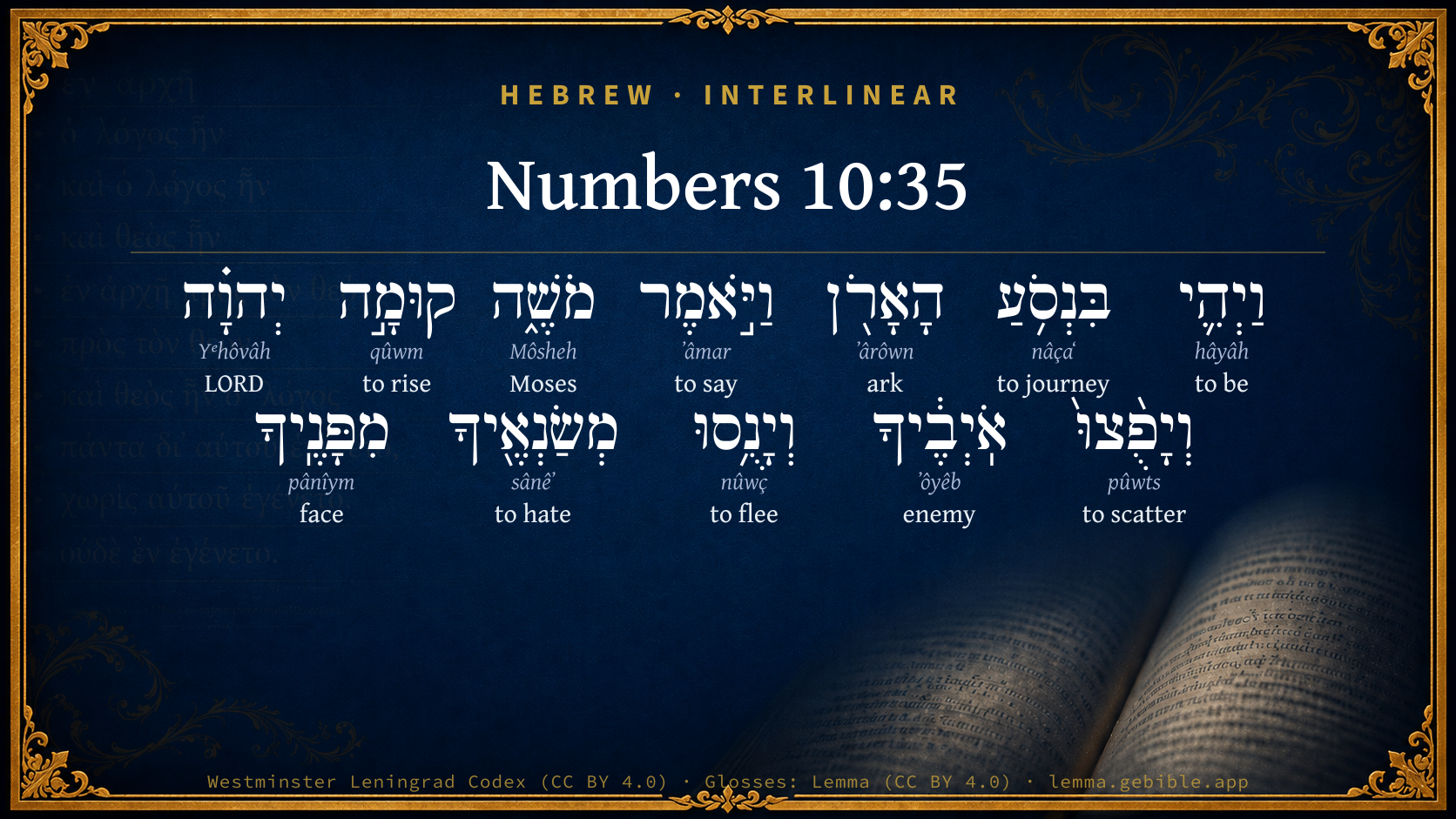
Hebrew (Westminster Leningrad Codex) Numbers 10:35 appears in the Hebrew Old Testament. The text above is from the Westminster Leningrad Codex. Each word links to its Strong’s number, a concise gloss, and parsing drawn from the Open Scriptures Hebrew Bible morphology. Click any word for its full Brown-Driver-Briggs (BDB) entry.
Download image
Cite this verse

Numbers 10:35 (World English Bible). Public Domain. Lemma interlinear Bible study tool, https://lemma.gebible.app/v/numbers/10/35.

Show BibTeX & RIS
BibTeX
RIS
English Translation
It happened, when the ark set forward, that Moses said, Rise up, Yahweh, and let your enemies be scattered; and let those who hate you flee before you.
World English Bible · Public Domain
Download a study sheet

One document with this verse’s original text, its word-by-word gloss line, the meaning frame, cross-references with their text, attributed commentary, and full source and license credits — printable, and it pastes into notes with its structure intact.

This verse Autodidact and up

Study sheet (.html) Plain text (.txt)

A passage Seminary Student

Up to 50 verses in one chapter. A passage sheet keeps up to 6 commentary sources and 12 cross-references per verse, in the order this page ranks them, and says so on the sheet whenever that leaves anything out. Ask for a single verse and you get the Autodidact verse sheet above.

Everything on this page stays free to read, with no account — the sheet is a download of what is already on screen, not access to it.

Want to remove ads? Support Godless Engineer
Compare translations 3

The same verse in 3 English versions, stacked beneath the original-language interlinear above. Click any original word for its lexicon entry.

Each is an independent rendering of the whole verse — the interlinear is not word-aligned to these translations.

Highlighted words mark where these versions differ — a whole-verse word diff, not a word-by-word alignment.

  • World English Bible Public Domain
    It happened, when the ark set forward, that Moses said, Rise up, Yahweh, and let your enemies be scattered; and let those who hate you flee before you.
  • King James Version Public Domain
    And it came to pass, when the ark set forward, that Moses said, Rise up, LORD, and let thine enemies be scattered; and let them that hate thee flee before thee.
  • unfoldingWord Literal Text CC BY-SA 4.0
    And it happened, when the box set out, that Moses said, “Rise up, Yahweh, and your enemies will scatter, and the ones hating you will flee from your face.”

unfoldingWord Literal Text — © unfoldingWord, licensed CC BY-SA 4.0. Word-aligned USFM3 via Door43 (git.door43.org/unfoldingWord/en_ult).

Versions to compare (up to 4)

3 of 4 selected

Show all 18 translations

Every available English version of this verse, each an independent rendering of the whole verse.

  • World English Bible Public Domain
    It happened, when the ark set forward, that Moses said, Rise up, Yahweh, and let your enemies be scattered; and let those who hate you flee before you.
  • Berean Standard Bible Public Domain
    Whenever the ark set out, Moses would say, “Rise up, O LORD! May Your enemies be scattered; may those who hate You flee before You.”
  • Majority Standard Bible Public Domain
    Whenever the ark set out, Moses would say, “Rise up, O LORD! May Your enemies be scattered; may those who hate You flee before You.”
  • King James Version Public Domain
    And it came to pass, when the ark set forward, that Moses said, Rise up, LORD, and let thine enemies be scattered; and let them that hate thee flee before thee.
  • American Standard Version (1901) Public Domain
    And it came to pass, when the ark set forward, that Moses said, Rise up, O Jehovah, and let thine enemies be scattered; and let them that hate thee flee before thee.
  • Revised Version (1885) Public Domain
    And it came to pass, when the ark set forward, that Moses said, Rise up, O LORD, and let thine enemies be scattered; and let them that hate thee flee before thee.
  • Geneva Bible (1599) Public Domain
    And when the Arke went forwarde, Moses saide, Rise vp, Lord, and let thine enemies bee scattered, and let them that hate thee, flee before thee.
  • Douay-Rheims (1899) Public Domain
    And when the ark was lifted up, Moses said: Arise, O Lord, and let thy enemies be scattered, and let them that hate thee, flee from before thy face.
  • Young's Literal Translation Public Domain
    And it cometh to pass in the journeying of the ark, that Moses saith, `Rise, O Jehovah, and Thine enemies are scattered, and those hating Thee flee from Thy presence.'
  • Literal Standard Version CC BY-SA 4.0
    And it comes to pass in the journeying of the Ark, that Moses says, “Rise, O YHWH, and Your enemies are scattered, and those hating You flee from Your presence.”
  • Unlocked Literal Bible CC BY-SA 4.0
    Whenever the ark set out, Moses would say, “Rise up, Yahweh. Scatter your enemies. Make those who hate you run from you.”
  • unfoldingWord Literal Text CC BY-SA 4.0
    And it happened, when the box set out, that Moses said, “Rise up, Yahweh, and your enemies will scatter, and the ones hating you will flee from your face.”
  • Darby Bible Public Domain
    And it came to pass when the ark set forward, that Moses said, Rise up, Jehovah, and let thine enemies be scattered; And let them that hate thee flee before thy face.
  • World Messianic Bible Public Domain
    When the ark went forward, Moses said, “Rise up, LORD, and let your enemies be scattered! Let those who hate you flee before you!”
  • Webster's Bible Public Domain
    And it came to pass, when the ark moved forward, that Moses said, Arise, LORD, and let thy enemies be scattered; and let them that hate thee flee before thee.
  • Free Bible Version CC BY-SA 4.0
    Whenever the Ark was carried out, Moses would call out, “Stand up, Lord, and may your enemies be scattered, and may those who hate you run away from you.”
  • Bible in Basic English Public Domain
    And when the ark went forward Moses said, Come up, O Lord, and let the armies of those who are against you be broken, and let your haters go in flight before you.
  • JPS Tanakh (1917) Public Domain
    And it came to pass, when the ark set forward, that Moses said: 'Rise up, O LORD, and let Thine enemies be scattered; and let them that hate Thee flee before Thee.'

Literal Standard Version (2020), Covenant Press — licensed CC BY-SA 4.0. Text via the HelloAO Bible API (eBible.org). Unlocked Literal Bible (unfoldingWord) — licensed CC BY-SA 4.0. Text via the HelloAO Bible API (eBible.org). unfoldingWord Literal Text — © unfoldingWord, licensed CC BY-SA 4.0. Word-aligned USFM3 via Door43 (git.door43.org/unfoldingWord/en_ult). Free Bible Version, Dr. Jonathan Gallagher — licensed CC BY-SA 4.0. Text via the HelloAO Bible API (eBible.org).

Word by word

More ways to search: Search by grammar → Find every occurrence → Compare this word →

Practice this passage: Drill this verse → Learn its vocabulary →

וְיָפֻ֨צוּ֙
pûwts
H6327
“and · to scatter”
Conjunction + Verb, Qal, Imperfect, 3rd Person, Masculine, Plural
Part of Speech
Conjunction + Verb
Stem
Qal
Form
Imperfect
Person
3rd Person
Gender
Masculine
Number
Plural
Full BDB Definition

Origin: a primitive root

TWOT: 1745 , 1746 , 1800

to scatter, be dispersed, be scattered - (Qal) to be dispersed, be scattered - (Niphal) - to be scattered - to be spread abroad - (Hiphil) to scatter - Hithpael) scatter - (Qal) to flow, overflow - to break - (Polel) to shatter - (Pilpel) to dash to pieces
  1. וַיְהִ֛י hâyâh H1961 “and · to be” Conjunction + Verb, Qal, Sequential Imperfect, 3rd Person, Masculine, Singular
  2. בִּנְסֹ֥עַ nâçaʻ H5265 “in/at · to journey” Preposition + Verb, Qal, Infinitive Construct
  3. הָאָרֹ֖ן ʼârôwn H727 “the · ark” Particle, Definite Article + Noun, Common, Both, Singular, Absolute
  4. וַיֹּ֣אמֶר ʼâmar H559 “and · to say” Conjunction + Verb, Qal, Sequential Imperfect, 3rd Person, Masculine, Singular
  5. מֹשֶׁ֑ה Môsheh H4872 “Moses” Noun, Proper
  6. קוּמָ֣ה qûwm H6965 “rise” Verb, Qal, Imperative, 2nd Person, Masculine, Singular + Suffix, h
  7. יְהוָ֗ה Yᵉhôvâh H3068 “LORD” Noun, Proper
  8. אֹֽיְבֶ֔יךָ ʼôyêb H341 “enemy · you” Verb, Qal, Participle Active, Masculine, Plural, Construct + Suffix, Personal, 2nd Person, Masculine, Singular
  9. וְיָנֻ֥סוּ nûwç H5127 “and · to flee” Conjunction + Verb, Qal, Imperfect, 3rd Person, Masculine, Plural
  10. מְשַׂנְאֶ֖יךָ sânêʼ H8130 “hating · you” Verb, Piel, Participle Active, Masculine, Plural, Construct + Suffix, Personal, 2nd Person, Masculine, Singular
  11. מִפָּנֶֽיךָ pânîym H6440 “from · face(s) · your” Preposition + Noun, Common, Both, Plural, Construct + Suffix, Personal, 2nd Person, Masculine, Singular

About this verse

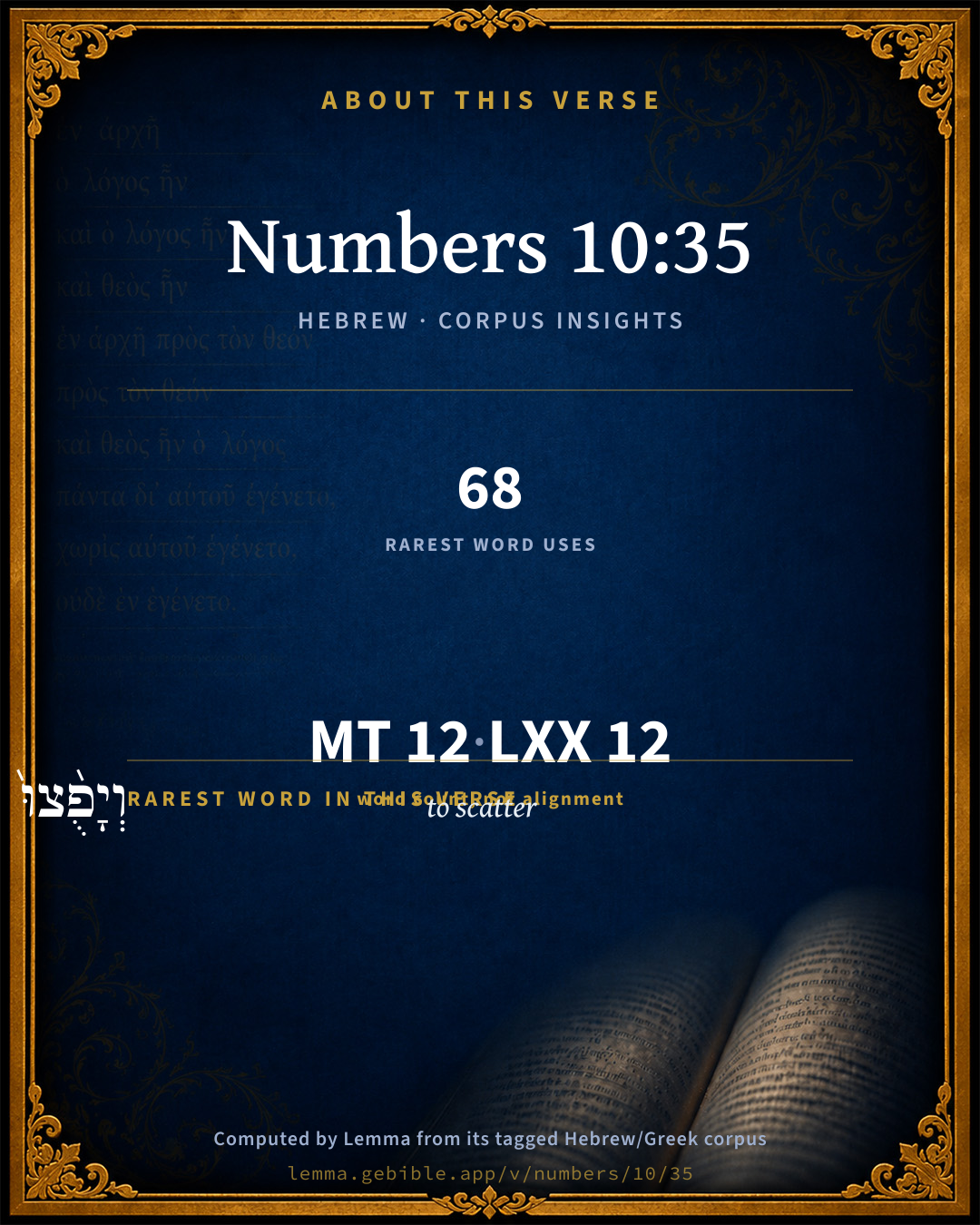
These counts appear in no published source. They are computed here, from the morphology-tagged text and Lemma’s own curated glosses. What Lemma adds →

12
words
12
distinct lemmas
Pentateuch
section

Grammatical profile

  • 8 verbs
  • 4 nouns

Verb forms

  • וַיְהִ֛י Qal · Sequential Imperfect
  • בִּנְסֹ֥עַ Qal · Infinitive Construct
  • וַיֹּ֣אמֶר Qal · Sequential Imperfect
  • קוּמָ֣ה Qal · Imperative
  • וְיָפֻ֨צוּ֙ Qal · Imperfect
  • אֹֽיְבֶ֔יךָ Qal · Participle Active
  • וְיָנֻ֥סוּ Qal · Imperfect
  • מְשַׂנְאֶ֖יךָ Piel · Participle Active

Hebrew & Septuagint length

In English translation the verse runs 28 words from the Hebrew and 28 from the Septuagint (LXX English) — the same length.

A rough comparison of the two English renderings, which tokenize alike — not a word-level alignment.

Word counts can differ between the Hebrew and the Greek without any difference in meaning — e.g. the Hebrew direct-object marker אֵת has no separate Greek word, and Greek often adds the article ὁ.

In the original languages it is 12 Hebrew tokens and 12 Greek tokens — but the two are counted differently (Hebrew bundles its prefixes and suffixes into one token; the Greek is in lemma form), so that isn’t a like-for-like length.

Cross-references

6

Topical passages linked to Numbers 10:35 in the Treasury of Scripture Knowledge — connected by theme and wording, ordered by reader-vote popularity; previews shown in the World English Bible.

  • Psalms 68:1–2 Let God arise! Let his enemies be scattered! Let them who hate him also flee before him.
  • Deuteronomy 7:10 and repays those who hate him to their face, to destroy them: he will not be slack to him who hates him, he will repay him to his face.
  • Deuteronomy 32:41 If I whet my glittering sword, My hand take hold on judgment; I will render vengeance to my adversaries, Will recompense those who hate me.
  • Psalms 132:8 Arise, Yahweh, into your resting place; You, and the ark of your strength.
  • Isaiah 17:12–14 Ah, the uproar of many peoples, who roar like the roaring of the seas; and the rushing of nations, that rush like the rushing of mighty waters!
  • Isaiah 51:9 Awake, awake, put on strength, arm of Yahweh; awake, as in the days of old, the generations of ancient times. Isn't it you who did cut Rahab in pieces, who pierced the monster?

Cross-references courtesy of OpenBible.info (CC BY 4.0).

Hebrew and Greek witnesses Masoretic Hebrew ↔ Greek Septuagint

The same verse in the two great witnesses to the Old Testament, shown verse-for-verse.

These are two independent witnesses, not word-aligned to each other, and the Septuagint is shown in lemma (dictionary) form.

Hebrew Numbers 10:35 Masoretic · Westminster Leningrad Codex

וַיְהִ֛י בִּנְסֹ֥עַ הָאָרֹ֖ן וַיֹּ֣אמֶר מֹשֶׁ֑ה קוּמָ֣ה יְהוָ֗ה וְיָפֻ֨צוּ֙ אֹֽיְבֶ֔יךָ וְיָנֻ֥סוּ מְשַׂנְאֶ֖יךָ מִפָּנֶֽיךָ

It happened, when the ark set forward, that Moses said, Rise up, Yahweh, and let your enemies be scattered; and let those who hate you flee before you.

World English Bible · Public Domain

Greek LXX Numbers 10:35 Septuagint · lemma form

καί ἐν ὁ κατάπαυσις εἶπον ἐπιστρέφω κύριος χιλιάς μυριάς ἐν ὁ ἰσραήλ

And it came to pass when the ark set forward, that Moses said, Arise, O Lord, and let your enemies be scattered: let all that hate you flee.

LXX2012 (modern English Septuagint) · Public Domain

Hebrew: Westminster Leningrad Codex (CC BY 4.0). Greek: Septuagint (public domain); English from LXX2012 (modern English Septuagint) (Public Domain). How the Septuagint differs from the Hebrew →

Targum (Aramaic paraphrase)

2

The Targum is the ancient Jewish Aramaic paraphrase of the Hebrew Scriptures — an interpretive translation, not the Hebrew text itself. Onkelos (literal) and Pseudo-Jonathan (expansive) render the Torah, and Jonathan the Prophets. Coverage is partial: where no permissively-licensed English translation exists for a verse, only the Aramaic is shown. This is verse-level text, not a word-by-word alignment to the Hebrew.

  1. Targum Onkelos Torah (Genesis–Deuteronomy)
    וַהֲוָה בְּמֵטַל אֲרוֹנָא וַאֲמַר משֶׁה אִתְגְלֵי יְיָ וְיִתְבַּדְרוּן סַנְאָיךְ וִיעַרְקוּן בַּעֲלֵּי דְבָבָךְ מִן קֳדָמָךְ

    (no public-domain English translation for this verse)

    Targum Onkelos — Aramaic: “Onkelos Genesis” (public domain); “Onkelos Exodus” (public domain); “Onkelos Leviticus” (public domain); “Onkelos Numbers” (public domain); “Onkelos Deuteronomy” (public domain). English: “Sefaria Community Translation” (CC0 1.0 (public-domain dedication)); “J.W. Etheridge. The Targums of Onkelos and Jonathan Ben Uzziel on the Pentateuch. London: Longmans, Green, 1862” (public domain). Text via Sefaria.

  2. Targum Pseudo-Jonathan Torah (Genesis–Deuteronomy)
    וַהֲוָה כַּד הֲוָה בָּעֵי לְמֵיטַל אֲרוֹנָא הֲוָה עֲנָנָא מְקַפֵּל וְקָאִים וְלָא הֲוָה נָטִיל עַד דְמשֶׁה הֲוָה קָאֵי בִּצְלוֹ מַצְלֵי וּבָעֵי רַחֲמִין מִן קֳדָם יְיָ וְכֵן אָמַר אִתְגְלֵי כְּדוֹן מֵימְרָא דַיְיָ בִּתְקוֹף רוּגְזָךְ וְיִתְבַּדְרוּן בַּעֲלֵי דְבָבֵיהוֹן דְעַמָךְ וְלָא יֶהֱוֵי לְסַנְאֵיהוֹן רֵיגַל לְמֵיקוּם קֳדָמָךְ

    And it was when the ark should go forward, the Cloud gathered itself together and stood still, not going on, until Mosheh, standing in prayer, prayed and supplicated mercy from before the Lord, and thus spake: Let the Word of the Lord be now revealed in the power of Thy anger, that the adversaries of Thy people may be scattered; and let not the banner of those who hate them be uplifted before Thee.

    Targum Pseudo-Jonathan — Aramaic: “Targum Jonathan on Genesis” (public domain); “Targum Jonathan on Exodus” (public domain); “Targum Jonathan on Leviticus” (public domain); “Targum Jonathan on Numbers” (public domain); “Targum Jonathan on Deuteronomy” (public domain). English: “The Targum of Jonathan ben Uzziel, trans. J. W. Etheridge, London, 1862” (public domain). Text via Sefaria.

Commentary

Notes on Numbers 10:35 from classic Christian and Jewish commentators (each source and its license shown beneath its notes). The classic Christian expositions comment on the surrounding passage and are grouped to its opening verse, so a note may address several verses; the Jewish commentaries on the Tanakh (Rashi and others) are per-verse, so they appear only where the commentator wrote on this verse.

Lemma curates 59 commentaries, every one of them public domain or Creative Commons licensed, each selected and text-cleaned for this edition rather than reprinted as found. About our sources →

The Cambridge Bible for Schools and Colleges

gen. ed. J. J. S. Perowne

Num_10:35-36. J

Prayers connected with the movements of the Ark

The two prayers have no real connexion with the journeyings. They appear to belong to a time when the Israelites had reached Canaan, and used to take the Ark with them into battle. The first prayer speaks of victory over enemies; and the second implies that the Ark returns to its sanctuary after the battle. In the desert it never returned to the people, but waited in advance until they came up to it.

35. The prayer is quoted in Psa_68:1.

36. unto the myriads of the thousands] i.e. of the clans of Israel. See on Num_1:16; Num_1:46.

The Cambridge Bible for Schools and Colleges (gen. ed. J. J. S. Perowne; Cambridge University Press, 1878–1918) — public domain. Text from a community e-Sword module.

Trapp's Complete Commentary

John Trapp

Num 10:35 And it came to pass, when the ark set forward, that Moses said, Rise up, LORD, and let thine enemies be scattered; and let them that hate thee flee before thee.

Ver. 35. Rise up, Lord.] Commanders must pray, as well as lead on their forces, as did Charles the Great, and that late brave King of Sweden, more addict to prayer than to fight.

Flee before thee.] Heb., Before thy face. The ark is called God’s face. {Psa 105:4} Yea, even God himself. {Psa 132:5}

John Trapp, A Commentary or Exposition upon All the Books of the Old and New Testament (1647–1656) — public domain. Text from a community e-Sword module.

The Biblical Illustrator

Joseph S. Exell

Num_10:35-36

When the ark set forward . . . and when it rested.

The march:--

I. This has been the watchword of the church of God in all ages. The people of God in the wilderness were the picture of Gods Church upon earth. We are strangers and foreigners upon the earth. Albeit that they had no habitation except their tents, yet it is true of Israel in the wilderness that they always had an habitation. Do you not remember the song of Moses:--Lord, Thou hast been our dwelling-place in all generations. Wherever they were, God was their dwelling-place. This, too, is true of the entire Church; always wandering, yet never far from home; unhoused, yet always in palaces; sometimes destitute, afflicted, tormented, and yet always clothed, always rich, always feasting to the full; deserted, yet not alone; forsaken, yet multiplied; left, yet still abiding with Him that filleth all in all We might carry the parallel out still further, but it is enough to remark that, in another point, the people of God in the wilderness were the picture of the Church of Christ. Wherever they marched, when God went before them, they marched to victory. Even so hath it been with the Church of God in all ages; her march has been that of one who is fair as the moon, clear as the sun, and terrible as an army with banners. Let but her silvery trumpet sound, and the echo shakes the vaults of hell. Let but her warriors unsheath their sword, and their enemies fly before them like the thin clouds before a Biscay gale. Her path is the pathway of a conqueror: her march has been a procession of triumph. Wherever she hath put her foot, the Lord hath given her that land to be her heritage for ever. Now, let me show how this war-cry has really been heard of God and has been fulfilled to all His people. Turn ye to this book, this book of the wars of the Lord. Wherever His Church has gone and He has risen up, have not His enemies been scattered? Methinks, in a spiritual sense, when Luther first bowed his knee, the Church began to chant, Let God arise, and let His enemies be scattered. When Knox in Scotland upheld the glory of Jesus name, was it not once again, O God arise, let them that hate Thee flee before Thee? When Whitefield and Wesley, seraphic evangelists of Jesus Christ, went through this land, was not this the very song of Israel, O God, arise, and let Thine enemies be scattered? And shall it not be ours to-day? Let but God go forth with our arms; let Him but speak through our ministers; let Him but dwell in our elders; let Him but make the bodies of our Church-members His temples, and His enemies must be scattered, and they must consume away. I can well conceive that such a prayer as this well befits the tongue of a minister who lands as the first herald of the Cross in some barbarian land. Those brave men who risk all for Christ, not counting their lives dear unto them that they might finish their course with joy--methinks when they as pioneers for Christ bear the ark in the midst of the wilderness, they could not breathe a better prayer for themselves, and you and I cannot do better than put it up for them now, Rise up, Lord, and let Thine enemies be scattered; let them that hate Thee flee before Thee.

II. Now take the text in its reference to Christ. Ah! methinks the sorrowing Church, when they beheld their Lord dragged by cruel men to judgment, when they heard Him accused and slandered, when they saw Him mocked and spit upon, must have considered the battle to be a defeat. The tears must have stood in their eyes when they saw that He who was to be the Deliverer of Israel could not deliver Himself. Was it not the day of bells triumph, the hour of earths despair, the moment of heavens defeat? No; it was the reverse of all this. That moment when Christ died, He gave the death-blow to all His enemies. Even when the Master was laid in the tomb, and had to sleep there His three days as Jonah in the whales belly, if the Church had had faith, they might have come early on the dawn of the first day in the week, and standing outside the tomb, they might have begun to sing, Rise up, Lord, and let Thine enemies be scattered, and let them that hate Thee flee before Thee.

III. What message has this text for us, and how may we use it? Rise up, Lord! O God the Father, rise up! Let Thy purposes be accomplished! O God the Son, rise up; show Thy wounds, and plead before Thy Fathers face, and let Thy blood-bought ones be saved! Rise up, O God the Holy Ghost, with solemn awe, we do invoke Thee! Let those that have resisted Thee give way I Come, Thou, melt Thou the ice; dissolve the granite; let the adamantine heart give way; cut Thou the iron sinew and bow Thou the stiff neck! Rise up, Lord, Father, Son, and Spirit, we can do nothing without Thee; but if Thou wilt arise, Thine enemies shall be scattered, and they that hate Thee shall flee before Thee. Will you and I go home and pray this prayer by ourselves, fervently laying hold upon the horns of Gods altar? I charge you do not neglect this private duty. Pray for your children, your neighbours, your families, and your friends, and let your prayer be--Rise up, Lord; rise up, Lord. Pray for this neighbourhood; pray for the dense darkness of Southwark, and Walworth, and Lambeth. And oh! if you cannot pray for others because your own needs come so strongly before your mind, remember, sinner, all thou needest is by faith to look to Christ, and then thou mayest say, Rise up, Lord; scatter my doubts; kill my unbelief; drown my sins in Thy blood; let these Thine enemies be scattered; let them that hate Thee flee before Thee. (C. H. Spurgeon.)

The Church in motion and at rest

I. The church in motion, the Church militant.

1. This camp composed of Israel, is distinguished from the enemies around it. Though we are in the world, we are not to be of the world; though we are surrounded with Anakims and Canaanites, we are still to maintain the purity of the visible Israel of God, our being upon the march is a circumstance calculated to hinder the ungodly from joining us to a great degree.

2. It is marching through a wilderness of woe to a land of promise. Is their way long? Is their journey weary? Are their trials great? Are their enemies numerous? Do they often halt, and think they are upon the verge of Canaan, and that the next mandate of their Sovereign will be to enter in; and are they disappointed by finding that there are many other halting places, and many a weary journey lying between them and the Canaan of their rest? Yet are they moving toward it--at last the command will be heard by this individual, and the other tribe, to cease their wanderings, and to enter into glorious and eternal rest.

3. It is under the guidance of the Mediator. It is certainly not worse off now than it was then. Christ is our Guide.

4. When His Church moves forward, God rises up on its behalf. Every progressive movement of the Church of Christ, as well as of the individuals who compose it, is, in fact, directed and dictated by the Spirit of God.

5. The movement of the Church ought to be always, and upon the whole, progressive.

6. This progress will and must be attended with the defeat of the Churchs enemies. We can win no ground except we win it from the foe; we cannot advance a single footstep in our onward journey except as we beat our enemies back.

7. The Churchs triumphant march shall end in the complete destruction of all the enemies of God.

II. The church at rest. We have seen it moving forward to that rest, and we have noticed that it sometimes enjoys temporary seasons of refreshment by the way, in different halting-places as it passes through the wilderness; and experiences the Divine protection and direction. But this rest is only tasted here below, and the foretaste of it is but designed to quicken the appetite of the people of God for their rest in glory.

1. As one feature of that rest, we observe, that there the true Israel shall be recognised, and the words shall be heard circulating through the happy host, Return, O Lord, unto the many thousands of Israel. There, notwithstanding their multitudes, not one intruder shall be found to have entered in; there nothing shall enter that will destroy or that will even disturb in all Gods holy mountain. However the mixed multitude may accompany us by the way, there must be a separation at the Jordan of death.

2. At that glorious period the Israel of God shall consist of thousands and thousands.

3. They shall then have triumphed gloriously. Enemies no more shall trouble them; the sound of war shall be a sound unheard; there shall be no more conflict with temptation, no more struggles with indwelling sin. Oh, to think of Canaans rest only in this point of view! Believer, what a happy, what a heavenly rest it will be! (W. H. Cooper.)

Moses prayer

Moses, the mouth of the congregation, lifts up a prayer, both at the removing and at the resting of the ark. Thus their going out and coming in were sanctified by prayer; and it is an example to us to begin and end every days journey, and every days work with prayer.

1. Here is his prayer when the ark set forward: Rise up, Lord, and let Thine enemies be scattered (Num_10:35). They were now in a desolate country, but they were marching towards an enemys country; and their dependence was upon God for success and victory in their wars, as well as for directions and supply in the wilderness. David used this prayer long after (Psa_68:1); for he also fought the Lords battles. Note--

(1) There are those in the world that are enemies to God, and haters of Him. Secret and open enemies; enemies to His truths, His laws, His ordinances, His people.

(2) The scattering and defeating of Gods enemies is a thing to be earnestly desired and believingly expected by all the Lords people. This prayer is a prophecy. Those that persist in rebellion against God are hastening towards their own ruin.

(3) For the scattering and defeating of Gods enemies, there needs no more but Gods arising. When God arose to judgment, the work was soon done (Psa_76:8-9). Rise, Lord, as the sun riseth to scatter the shadows of the night. Christ rising from the dead scattereth His enemies (Psa_68:18).

2. His prayer when the ark rested (Num_10:36).

(1) That God would cause His people to rest. So some read it, Return, O Lord, the many thousands of Israel; return them to their rest again after this fatigue. Thus it is said, The Spirit of the Lord caused him to rest (Isa_63:14). Thus he prays that God would give Israel success and victory abroad, and peace and tranquility at home.

(2) That God Himself would take up His rest among them. So we read it, Return to the thousands of Israel; the ten thousand thousand, so the word is. Note--

1. The Church of God is a great body; there are many thousands belonging to Gods Israel.

2. We ought in our prayers to concern ourselves for this body.

3. The welfare and happiness of the Israel of God consists in the remaining presence of God among them. (Matthew Henry, D. D.)

Protection and peace

There are here two prayers for different occasions: one for active life, the other for quiet rest. In both cases they are suitable and blessed.

I. We have God fighting our battles. His enemies are ours, and He will identify our struggles with His:

1. So far as we are going in the way of His commands.

2. So far as our actions are identified with His will. If we are fighting for our own will, our own ambition, our own ideas, we cannot say, Scatter Thy enemies.

II. We have God protecting our periods of rest.

1. He slumbereth not nor sleepeth, and to Him the darkness is as the day.

2. He never wearies nor is tired; hence there is nothing to hinder or prevent His constant care. (Homilist.)

The Church and its enemies

I. The church of God has had enemies in every age. This is accounted for by--

1. The favours they received. God has set His heart upon His people. This creates envy, which soon grows into opposition and mischief.

2. The principles they professed.

3. The expectations they cherished.

II. The enemies of the church are considered the enemies of God.

III. When God rises up to judgment, the destruction of his enemies is easy, terrible, and complete.

IV. The constant abode of God with his church is an object of their supreme desire,

1. Let us learn from this passage the condescension and grace of God, in that He will dwell with us.

2. Let each of us inquire whether we are amongst the many thousands of Israel.

3. What comfort should this give to the Church amidst her many trials.

4. This subject affords to the enemies of the Church a motive for seeking reconciliation with God. (G. Clayton, M. A.)

The true soldiers convoy

I. God himself hath many enemies.

II. As God hath enemies, so sometimes he sleepeth to all their enmity.

III. Though God sleepeth and they work, yet there is a time when they shall be scattered; and when God ariseth they are scattered.

IV. Our prayers awaken God.

V. When the people of the land go forth to war, Gods people should go forth to prayer. (W. Budge, M. A.)

The rising and the resting prayer

I. The rising prayer. Here is confession, that Israels onward path was thronged with foes. It is so still, and so will always be. There is no hour when sword and shield may hang unused. Next Moses feels that his own might is nought; vain are his counsels, powerless is his arm. Therefore to God he flees. Rise up, Lord. So now, if Gods right hand be not our help the tide of foes must bear us down. But God is moved by importunities of faith. Rise up, Lord, is a cry which brings all heaven to aid. It puts sure victory on the wing. Observe here how the prayer of faith yearns for Gods glory. Let Thine enemies be scattered. These enemies hate God. They would impede the progress of His truth. They would extinguish His Words light. They would cast down His righteous rule. Can faith sit still and see Him thus dethroned? Oh, no! It agonises with desire that He would vindicate His holy cause uphold His honour, and add trophies to His name. Rise up, Lord, and let them that hate Thee flee before Thee.

II. The resting prayer. The going forts would have been ruin except the Lord moved in the front. The rest will be no rest unless the Lord return Prayer called Him to precede their steps. Prayer calls Him to abide around their resting teats. Vast was the multitude. But what are numbers without God? His presence is their power, their peace, their joy, their glory, their strength, their fortress, their shield, and their repose. They know it, and they cry, Return, O Lord. (Dean Law.)

Israels hymn of rest

I. As we meditate upon these words we are reminded generally of the exercises of evening devotion. We connect this sentence with every individual who formed a part of that mighty host: we fancy that we hear these words whispering from the lips of every one as he enters his tent, and as he folds himself for rest. And then we connect it with the families, the tribes of the people, the groups of kindred, remote and intimate, in that singularly constituted nation, which, you know, consisted of one race--all were brothers by blood. And we connect it, further, with the congregation at large--the sum total of that great multitude that was numbered in the registration, Israels Book of Life, as it was called. And so the sentence leads us to think of evening worship in three ways--in the closet, in the family, in the church.

II. We are led to penetrate into that which forms the meaning, and essence, and spirit of the exercises of praise and prayer, at eventide, and at all times. We are brought immediately by prayer into the presence of God; we come into immediate contact and communion with His gracious Spirit! Rise up, O Lord; let Thine enemies be scattered. There is significancy in that expression, Rise up, O Lord! And so there is in this other expression, equally figurative--Return, O Lord. Rise up, O Lord! Return, O Lord. Now, such expressions are properly explained as indicating, not an absolute fact in Gods dealings, but in the perception and apprehension of God by man: not a Divine dispensation, but a human consciousness. God did not leave Israel in the days march, no, not for an instant. We speak sometimes of the returning sunrise, and we speak sometimes of the returning sunset: but the fact is, that we return to them, and not they to us. The fact is, that it is the earth that is turning, and it is the sun that remains the same. And as it is with the sun, so it is with regard to God. Absolute change in us produces relative change in Him. As we cease to think of Him, apparently He leaves us; as we return to Him in thought, desire, and purpose, He seems to return to us in actual presence. The process is ever taking place in the history of spiritual consciousness. God and man meet when man prays to God as the day is over. God and His people hold communion as the shades of evening close in upon us at our evening devotions.

III. The text suggests to us the thought of the peacefulness, and the security, and the joy of those to whom god thus returns.

IV. We turn to this evening hymn again, and we observe that it is very large-hearted--it is thoroughly Catholic. Here Moses takes up into that great heart of his the interests of all Israel--the many thousands of Israel. Earnestly should we pray for ourselves, and with equal earnestness should we identify ourselves with the interests of others, and pray for them. An individual consciousness of moral individuality will be as a growing tree; it will be rooted in the heart, but up will it grow, and out will the branches shoot in this direction, and in that. The heart will be as a fountain, and there will come ever forth the bubbling waters, but they will flow, flow, flow, on and on, in irrigating streams, that will reach a thousand hearts. So let us throw thorough catholicity into our devotion.

V. Last of all, we think of this hymn as what may be called the evening hymn of life. The last night will come, and we shall lie down to sleep in the grave! and oh! how beautiful then to be able, by faith, to lift up our hearts to heaven and say, Return, O Lord, return unto me! I will return unto Thee! At the end of my life-long journey, my weary spirit would find rest in Thee! Receive me to Thyself. And while this prayer is offered by us on our own behalf, we are to take heed of the whole Israel of God, and pray, as we are passing out of time into eternity, that the love and care which we have so richly enjoyed, may be vouchsafed to those who follow us. (J. Stoughton.)

Return, O Lord, &c.

I. The subjects of this prayer. Israel. What the thousands of Israel are not doing for themselves let us do for them. Let us make increasing prayers at the throne of Divine grace, that the veil may be taken away from their hearts, that, under the covenant of the blessed gospel, they may realise the promise of the Spirit unto the Churches(Rev_2:17). The thousands of Israel, tracing back their history, who were they? Looking at their present condition, what are they? And making castings into the future, what shall they be?

1. Who were they? They were the nation chosen from all the families of the earth, set apart (like the one day in seven) for the peculiar manifestation of the Divine attributes and glories.

2. Looking at their present condition, what are they? After struggling through persecutions, the fiercest and most appalling, after being the one common curse and hissing of nations, divided amongst themselves by deadly antipathies, after their long and many trackings of tears and of blood, through all countries and lands, what are they now? Still shorn of their glories; still a by-word and a mockery; still the dispersed, the wandering, and the outcast.

3. But in our castings into the future, what shall they be?

II. The nature of this prayer. Moses beheld the awful state of the people, as described in the first verse of the next chapter; and therefore he prayed to the Lord. And now the cloud of the Lord is before the Israelites; and now in the midst of them is the ark of the new covenant: and yet, as described in that verse, they are filled with sinful complaining, and the fire of the Lord is burning amongst them and consuming them; the just judgments of God are upon their heads because of their unbelief, and pride, and obduracy; and they are sinking beneath the fierceness of His anger. In this their condition it is the great business of Christs Church to pray over them, that the Lord return to the many thousands of Israel--that by the manifestation of His Holy Spirit He show them the darkness of their natural minds--that by the strength of His Spirit He bring down their arrogancy to the dust--that by the penetrating influence of His Spirit He open a way into their hearts, that they may receive Christ as the power of God and the wisdom of God unto salvation. (T. J. Judkin.)

.

The Biblical Illustrator, edited by Joseph S. Exell (c. 1880s–1900s) — public domain. Text from a community e-Sword module.

Whedon's Commentary on the Bible

Daniel D. Whedon

THE CHANT OF MOSES, Num_10:35-36.

The chant which was the signal for the ark to move was as follows:

“Arise, O Jehovah! let thine enemies be scattered;

Let them also that hate thee flee before thee.”

The chant which was the signal for the ark to rest, that the people might encamp, was:

“Return, O Jehovah,

To the ten thousand thousands of Israel.”

In the thought of Moses Jehovah is identified with the ark, his throne, and the visible pledge of his gracious presence. These chants are the language of believing confidence and wonderful intimacy with Jehovah. Their constant use had a tendency to inspire similar courage and joyous assurance in the hearts of the people of God in the presence of the whole hostile world. The first chant was the inspiration of Psalms 68, which, according to Hengstenberg, begins thus: “God arises, his enemies are scattered, and those that hate him flee before him.” “One single look,” says the same writer, “at the ark of the covenant, (whose place under the New Testament Christ occupies,) and all enemies sank down into nothing.” How remarkable the prediction in Jer_3:16, that the time will come when this ark, the centre of Israel’s hopes and the seat of omnipotence, will no more come to mind, “neither shall they remember it, neither shall they visit it.” Its Antitype, Jesus risen from the dead, glorified in his saints, and taking vengeance on his enemies, will then take exclusive possession of all minds, either as an object of love or of dread.

36. Return, O Lord — From marching in front, Jehovah is now invited to his customary abode amid the many thousands of Israel, literally, ten thousand thousands.

Daniel D. Whedon (gen. ed.), Commentary on the Old and New Testaments (1874–1909) — public domain. Text from a community e-Sword module.

Keil & Delitzsch

C. F. Keil & F. Delitzsch

In Num 10:35 and Num 10:36, the words which Moses was in the habit of uttering, both when the ark removed and when it came to rest again, are given not only as a proof of the joyous confidence of Moses, but as an encouragement to the congregation to cherish the same believing confidence. When breaking up, he said, "Rise up, Jehovah! that Thine enemies may be scattered, and they that hate Thee may flee before Thy face;" and when it rested, "Return, Jehovah, to the ten thousand thousands of Israel!" Moses could speak in this way, because he knew that Jehovah and the ark of the covenant were inseparably connected, and saw in the ark of the covenant, as the throne of Jehovah, a material pledge of the gracious presence of the Almighty God. He said this, however, not merely with reference to enemies who might encounter the Israelites in the desert, but with a confident anticipation of the calling of Israel, to strive for the cause of the Lord in this hostile world, and rear His kingdom upon earth. Human power was not sufficient for this; but to accomplish this end, it was necessary that the Almighty God should go before His people, and scatter their foes. The prayer addressed to God to do this, is an expression of bold believing confidence, - a prayer sure of its answer; and to Israel it was the word with which the congregation of God was to carry on the conflict at all times against the powers and authorities of a whole hostile world. It is in this sense that in Psa 68:2, the words are held up by David before himself and his generation as a banner of victory, "to arm the Church with confidence, and fortify it against the violent attacks of its foes" (Calvin). שׁוּבה is construed with an accusative: return to the ten thousands of the hosts of Israel, i.e., after having scattered Thine enemies, turn back again to Thy people to dwell among them. The "thousands of Israel," as in Num 1:16.

(Note: The inverted nuns, נ, at the beginning and close of Num 10:35, Num 10:36, which are found, according to R. Menachem's de Lonzano Or Torah (f. 17), in all the Spanish and German MSS, and are sanctioned by the Masorah, are said by the Talmud (tract de sabbatho) to be merely signa parentheseos, quae monerent praeter historiae seriem versum 35 et 36 ad capitis finem inseri (cf. Matt. Hilleri de Arcano Kethib et Keri libri duo, pp. 158, 159). The Cabbalists, on the other hand, according to R. Menach. l. c., find an allusion in it to the Shechinah, "quae velut obversa ad tergum facie sequentes Israelitas ex impenso amore respiceret" (see the note in J. H. Michaelis' Bibl. hebr.). In other MSS, however, which are supported by the Masora Erffurt, the inverted nun is found in the words בּנסע (Num 10:35) and כּמתאננים העם ויהי (Num 11:1): the first, ad innuendum ut sic retrorsum agantur omnes hostes Israeliarum; the second, ut esset symbolum perpetuum perversitatis populi, inter tot illustria signa liberationis et maximorum beneficiorum Dei acerbe quiritantium, ad declarandam ingratitudinem et contumaciam suam (cf. J. Buxtorf, Tiberias, p. 169).)

Keil & Delitzsch — Biblical Commentary on the Old Testament (1861–1891) — public domain (CC PDM 1.0). Text via the HelloAO Bible API. (Old Testament only.)

MacLaren's Expositions of Holy Scripture

Alexander MacLaren

Numbers

THE HALLOWING OF WORK AND OF REST

Num 10:35 - Num 10:36.

The picture suggested by this text is a very striking and vivid one. We see the bustle of the morning’s breaking up of the encampment of Israel. The pillar of cloud, which had lain diffused and motionless over the Tabernacle, gathers itself together into an upright shaft, and moves, a dark blot against the glittering blue sky, the sunshine masking its central fire, to the front of the encampment. Then the priests take up the ark, the symbol of the divine Presence, and fall into place behind the guiding pillar. Then come the stir of the ordering of the ranks, and a moment’s pause, during which the leader lifts his voice-’Rise, Lord, and let Thine enemies be scattered, and let them that hate Thee flee before Thee.’ Then, with braced resolve and confident hearts, the tribes set forward on the day’s march.

Long after those desert days a psalmist laid hold of the old prayer and offered it, as not antiquated yet by the thousand years that had intervened. ‘Let God arise, and let His enemies be scattered,’ prayed one of the later psalmists; ‘let them that hate Him flee before Him.’ We, too, in circumstances so different, may take up the immortal though ancient words, on which no dimming rust of antiquity has encrusted itself, and may, at the beginnings and the endings of all our efforts and of each of our days, and at the beginning and ending of life itself, offer this old prayer-the prayer which asked for a divine presence in the incipiency of our efforts, and the prayer which asked for a divine presence in the completion of our work and in the rest that remaineth.

I. So, then, if we put these two petitions together, I think we shall see in them first, a pattern of that realisation of, and aspiration after, the divine Presence, which ought to fill all our lives.

‘Rise, Lord, let Thine enemies be scattered.’

But was not that moving pillar the token that God had risen? And was not the psalmist who reiterated Moses’ prayer asking for what had been done before he asked it? Was not the ark the symbol of the divine Presence, and was not its movement after the pillar a pledge to the whole host of Israel that the petition which they were offering, through their leader’s lips, was granted ere it was offered? Yes. And yet the present God would not manifest His Presence except in response to the desire of His servants; and just because the ark was the symbol, and that moving column was the guarantee of God’s being with the host as their defence, therefore there rose up with confidence this prayer, ‘Rise, Lord, and let Thine enemies be scattered.’

That twofold attitude, the realisation of, and therefore the aspiration after, the divine gifts, which are given before they are desired, but are not appropriated and brought into operation in our lives unless they are desired, is precisely the paradox of the Christian life. Having, we long for, and longing, we have, and because we possess God we pray, ‘Oh! that we might possess Thee.’ The more we long, the more we receive. But unless He gave Himself in anticipation of our longing, there would be neither longing nor reception. Only on condition of our desiring to have Him does He flow into our lives, victorious and strength-giving, and the more we experience that omnipotent might and calming, guiding nearness, the more assuredly we shall long for it.

Let us then, dear brethren, blend these two things together, for indeed they are inseparable one from the other, and there can be no real experience in any depth of the one of them without the other. Blessed be God! there need be no long interval of waiting between sowing the seed of supplication and reaping the harvest of fruition. That process of growth and reaping goes on with instantaneous rapidity. ‘Before they call I will answer,’ for pillar and ark were there ere Moses opened his lips; and ‘while they are yet speaking I will hear,’ for, in response to the cry, the host moved triumphantly, guarded through the wilderness. So it may be, and ought to be, with each of us.

In like manner, coupling these two petitions together, and taking them as unitedly covering the whole field of life in their great antitheses of work and rest, effort and accomplishment, beginning and ending, morning and evening, we may say that here is an example, to be appropriated in our own lives, of that continuous longing and realisation which will encircle all life as with a golden ring, and make every part of it uniform and blessed. To begin, continue, and end with God is the secret of joyful beginning, of patient continuance, and of triumphant ending. There is no reason in heaven, though there are hosts of excuses on earth, why there should not be, in the case of each of us, an absolutely continuous and uninterrupted sense of being with God. O brethren! that is a stage of Christian experience high above the one on which most of us stand. But that is our fault, and not the necessity of our condition. Let us lay this to heart, that it is possible to have the pillar always guiding our march, and possible to have it stretching, calm and motionless, over all our hours of rest.

II. Now, if, turning from the lessons to be drawn from these two petitions, taken in conjunction, we look at them separately, we may say that we have here an example of the spirit in which we should set ourselves, day by day, and at each new epoch and beginning, be it greater or smaller, to every task.

There are truths that underlie that first prayer, ‘Rise up, Lord, and let Thine enemies be scattered,’ which are of perennial validity, and apply to us as truly as to these warriors of God in the wilderness long centuries ago. The first of them is that the divine Presence is the source of all energy, and of successful endeavour after, and accomplishment of, any duty. The second of them is that that presence is, as I have been saying, granted, in its operative power, only on condition of its being sought. And the third of them is that I have a right to identify my enemies with God’s only on condition that I have made His cause mine. When Moses prayed, ‘Let Thine enemies be scattered,’ he meant by these the hostile nomad tribes that might ring Israel round, and come down like a sandstorm upon them at any moment. What right had he to suppose that the people whose lances and swords threatened the motley host that he was leading through the wilderness were God’s enemies? Only this right, that his host had consented to be God’s soldiers, and that they having thus made His enemies theirs, He, on His part, was sure to make their enemies His. We are often tempted to identify our foes with God’s, without having taken the preliminary step of having so yielded ourselves to be His servants and instruments for carrying forward His will, as that our own wills have become a vanishing quantity, or rather have been ennobled and greatened in proportion as they have been moulded in submission to His. We must take God’s cause for ours, in all the various aspects of that phrase. And that means, first of all, that we make our own perfecting into the likeness of Jesus Christ the main aim of our own lives and efforts. It means, further, the putting ourselves bravely and manfully on the side of right and truth and justice, in all their forms. Above all, it means that we give ourselves to be God’s instruments in carrying on His great purposes for the salvation of the world through Jesus Christ. If we do these things, whatever obstacles may arise in our paths, we may be sure that these are God’s antagonists, because they are antagonists to God’s work in and by us.

Only in so far as they are such, can you pray, ‘Let them flee before Thee!’ Many of the things that we call our enemies come to us disguised, and are mistaken by our superficial sight, and we do not know that they are friends. ‘All things work together for good to them that love God.’ And, when we desire His Presence, the hindrances to doing His will-which are the only real enemies that we have to fight-will melt away before His power, ‘as wax melteth’ before the ardours of the fire; and, for the rest, the distresses, the difficulties, the sorrows, and all the other things that we so often think are our foes, we shall find out to have been our friends. Make God’s cause yours, and He will make your cause His.

That applies to the great things of life, and to the little things. I begin my day’s work some morning, perhaps wearied, perhaps annoyed with a multiplicity of trifles which seem too small to bring great principles to bear upon them. But do you not think there would be a strange change wrought in the petty annoyances of every day, and in the small trifles of which all our lives, of whatever texture they are, must largely be composed, if we began each day and each task with that old prayer, ‘Rise, Lord, and let Thine enemies be scattered’? Do you not think there would come a quiet into our hearts, and a victorious peace to which we are too much strangers? If we carried the assurance that there is One that fights for us, into the trifles as well as into the sore struggles of our lives, we should have peace and victory. Most of us will not have many large occasions of trial and conflict in our career; and, if God’s fighting for us is not available in regard to the small annoyances of home and daily life, I know not for what it is available. ‘Many littles make a mickle,’ and there are more deaths in skirmishes than in the field of a pitched battle. More Christian people lose their hold of God, their sense of His presence, and are beaten accordingly, by reason of the little enemies that come down on them, like a cloud of gnats in a summer evening, than are defeated by the shock of a great assault or a great temptation, which calls out their strength, and sends them to their knees to ask for help from God.

So we may learn from this prayer the spirit of expectance of victory which is not presumption, and of consecration, which alone will enable us to pass through life victorious. ‘Be of good cheer,’ said the Master, as if in answer to this prayer in its Christian form-’I have overcome the world.’ We turn to the helmed and sworded Figure that stands mysteriously beside us whilst we are all unaware of His coming, and the swift question that Joshua put rises to our lips, ‘Art Thou for us or for our adversaries?’ The reply comes, ‘Nay! but as Captain of the Lord’s host am I come up.’ That is Christ’s answer to the prayer, ‘Rise, Lord, let Thine enemies be scattered.’

III. Lastly, we have here a pattern of the temper for hours of repose.

‘When the ark rested, he said, "Return, O Lord, unto the many thousands of Israel."‘ As I said at the beginning of these remarks, the pillar of cloud seems to have taken two forms, braced together upright when it moved, diffused and stretched as a shelter and a covering over the host of Israel when it and they were at rest. In like manner, that divine Presence is Protean in its forms, and takes all shapes, according to the moment’s necessities of the Christian trusting heart. When we are to brace ourselves for the march it condenses itself into an upright and moving guide. When we lay ourselves down with relaxed muscles for repose, it softly expands itself and ‘covers our head’ in the hours of rest, ‘as in the day of battle.’

Ah! brother, we have more need of God in times of repose than in times of effort. It is harder to realise His Presence in the brief hours of relaxation than even in the many hours of strenuous toil. Every one who goes for a holiday knows that. You have only to look at the sort of amusements that most people fly to when they have not anything to do, to see that there is quite as much, if not more, peril to communion of soul with God in times when the whole nature is somewhat relaxed, and the strings are loosened, like those of a violin screwed down a turn or two of the peg, than there is in times of work.

So let us take special care of our hours of repose, and be quite sure that they are so spent as that we can ask when the day’s work is done, and we have come to slippered ease, in preparation for nightly rest, ‘Return, O Lord, unto Thy waiting servant.’ Work without God unfits for rest with Him. Rest without God unfits for work for Him.

We may take these two petitions as tests of the allowableness of any occupation, or of any relaxation. Dare I ask Him to come with me into that field of work? If I dare not, it is no place for me. Dare I ask Him to come with me into this other chamber of rest? If I dare not, I had better never cross its threshold. Take these two prayers, and where you cannot pray them, do not risk yourself.

But the highest form of the contrast between the two waits still to be realised. For life as a whole is a fight, and beyond it there is the ‘rest that remaineth,’ where there will be not merely God’s ‘return unto the thousands of Israel,’ but the realisation of His fuller presence, and of deeper rest, which shall be wondrously associated with more intense work, though in that work there will be no conflict. The two petitions will flow together then, for whilst we labour we shall rest; and whilst we rest we shall labour, according to the great sayings, ‘they rest from their labours,’ and yet ‘they rest not day nor night.’

Alexander MacLaren, Expositions of Holy Scripture (1904–1910) — public domain. Text from a community e-Sword module.

Tyndale Open Study Notes

Tyndale Open Resources

10:35 Moses’ invocation, spoken when the Ark set out, acknowledged the Lord as a warrior who would give Israel the Promised Land and called him to fight Israel’s battles (cp. Ps 68:1).

Tyndale Open Study Notes — © Tyndale Open Resources, licensed CC BY-SA 4.0. Text via the HelloAO Bible API.

Geneva Bible (1599)

Geneva Bible translators

Declare thy might and power.

Geneva Bible (1599) marginal notes — public domain. Text via Bolls.life.

Jamieson, Fausset & Brown

Robert Jamieson, A. R. Fausset & David Brown

when the ark set forward that Moses said, Rise up, Lord, and let thine enemies be scattered--Moses, as the organ of the people, uttered an appropriate prayer both at the commencement and the end of each journey. Thus all the journeys were sanctified by devotion; and so should our prayer be, "If thy presence go not with us, carry us not hence" [Exo 33:15].

Next: Numbers Chapter 11

Jamieson, Fausset & Brown — Commentary Critical and Explanatory on the Whole Bible (1871) — public domain (CC PDM 1.0). Text via the HelloAO Bible API.

Adam Clarke's Commentary

Verse 35. Rise up, Lord, and let thine enemies be scattered] If God did not arise in this way and scatter his enemies, there could be no hope that Israel could get safely through the wilderness. God must go first, if Israel would wish to follow in safety.

Adam Clarke's Commentary on the Bible (1810–1826) — public domain. Text from a community e-Sword/MySword module.

Ellicott's Commentary for English Readers

(35-36) And it came to pass . . . —It appears from these words that the marches of the Israelites began and ended with prayer, a significant lesson to the Church of all after ages. It is deserving of observation that the prayers were offered by Moses, not by Aaron. The inverted nuns, or parenthetical marks, which are found in a large number of Hebrew manuscripts at the beginning and end of these verses, are thought by some to denote their insertion as a break in the narrative whilst others have ascribed to them a mystical meaning. The words, “Return, O Lord,” Bishop “Wordsworth observes,” pre-announced the blessed time of rest and peace, when God would abide with His Church on earth, by the gift of the Holy Ghost, and will tabernacle for ever with His people in heavenly rest and joy.” (Rev_7:15; Rev_21:3.)

A Bible Commentary for English Readers, edited by Charles John Ellicott (1878–1897) — public domain. Text from a community e-Sword module.

Albert Barnes' Notes on the Bible

Each forward movement and each rest of the ark was made to bear a sacramental character. The one betokened the going forth of God against His enemies; the other, His gathering of His own people to Himself: the one was the pledge of victory, the other the earnest of repose.

Num 10:36 may be translated: “Restore” (i. e. to the land which their fathers sojourned in), “O Lord, the ten thousands of the thousands of Israel.” (Compare Psa 85:4, where the verb in the Hebrew is the same.)

Albert Barnes' Notes on the Bible (1834–1885) — public domain. Text from a community e-Sword/MySword module.

The Pulpit Commentary

When the ark set forward. These words, taken in connection with the words "when it rested," in the following verse, confirm the belief that at this time (at any rate) the ark went before the host; for if it had remained in the midst, it would not have stirred until half the tribes had moved off, nor would it have halted until half the camp was pitched, whereas it is evident that its setting forward and standing still were the decisive moments of the day. They had, as it were, a sacramental character; they were visible signs, corresponding to invisible realities, as the movements of the hands on the dial correspond to the action of the machinery within. When the ark and the cloud set forward, it was the Almighty God going on before to victory; when the ark and the cloud rested, it was the all-merciful God returning to protect and cherish his own. This is clearly recognized in the morning and evening prayer of Moses. The typical and spiritual character of that setting forward and that resting could not well have been lost upon any religious mind that God going before us is the certain and abiding pledge of final victory, that God returning to us is the only hope of present safety. Rise up, Lord, and let thine enemies be scattered. The sixty-eighth Psalm, which we have learnt to associate with the wonders of Pentecost and the triumphs of the Church on earth, seems to be an expansion of Moses" morning prayer.

HOMILIES BY D. YOUNG Vers. 35, 36. The prayers at the moving and resting of the ark.

Here are two petitions one as the cloud rose to point the way, the other as it settled down again to indicate the time for rest. The morning and the evening prayer cannot be the same; there is one set of needs to be supplied during the day, and another during the night.

THE FIRST PETITION. It was fixed on the one thing needed, as the Israelites journeyed on into unknown territory. Moses needed not to pray for guidance. They were being guided, and had nothing to do but follow. Behind the ark and the cloud there was the evident duty of obedience, but what was there in front? Moses could make some guess from what he had already experienced. Before the Israelites had been three months out of Egypt, they were met by Amalek at Rephidim, blocking the way to Sinai. Moses, therefore, recognizes the great likelihood of more enemies in front, now they have left Sinai. The great bulk of his followers doubtless thought more of the present than the future, and both present and future they wanted to be like the past in Egypt, full of good things for their sinful cravings. But Moses, with a different spirit, felt there were enemies in the way. Getting into Canaan meant not only journeying but fighting. It is a serious defect in us that we do not think enough of the spiritual enemies in front. There are examples to warn: Peter overrating natural courage; Demas, overcome by the allurements of the present age. Notice that, in its own way, the New Testament is every whit as warlike in its spirit as the old. (Mat_10:34 Rom_7:23 2Co_7:5 2Co_10:3-5 Eph_6:10-17 1Ti_1:18 Heb_4:12 Rev_1:16: indeed the Revelation is full of spiritual war and conquest) These enemies in front are considered also as God"s enemies. "Thine enemies." As men attack one another through their property, so God"s enemies attack him through his people. God in the blessedness and security of his own nature is unassailable, but in the workings of his manifold creation the powers of evil may attack him, maintaining a long and bitter struggle ("Paradise Lost," B. 2:310-370). Do not think of these powers as aiming simply at our destruction. This is but a means to an end. There is a far sublimer and more encouraging view, that they are aiming to destroy the government of God. We never find out the purpose of a battle by looking at the conflicts of the private soldiers and inferior officers. We must come to the supreme authorities. It is they who inspire and direct everything. So there may be a struggle going on in the universe of which we, with our little horizon, can form but a feeble conception. Lastly, it is prayed that these enemies should be decisively dealt with. It is an awful thing to think of, but we must not shut our eyes to plain and solemn facts, that as we look backwards from this point to the beginning of the Scriptures, we find the Almighty, in three instances, acting against the iniquity of the world in a most decisive and comprehensive way. The deluge was a scattering, so was the destruction of Sodom, so was the overwhelming of Pharaoh and his hosts, which last great punitive act of God, Moses had seen with his own eyes, and celebrated with his own laps. There is enough to assure his people that he will make a final scattering in his own time.

THE SECOND PETITION.

1. It was a welcome to the conqueror. God was doing something for his people in conquest every day. We may be sure there was no day in all these long forty years but something was done to undermine the huge and threatening" powers that opposed advancing Israel. As the huge tree is slowly hollowed and eaten away, leaving a mere shell to come down at last with a crash, so the strongholds of iniquity are effectually sapped, little by little. Jericho seemed to fall as in a day before the trumpet blasts of Israel; in reality it had been nodding to its fall for years. So we may be constantly welcoming Jesus as the Captain of our salvation. (Exo_15:2 Luk_4:14, 15 Act_14:26-28)

2. It indicated the use to be made of the victory. The enemies of God were scattered and dispossessed in order that his own people may come in and exercise a faithful stewardship for him. His victories open up regions which could not otherwise be attained. E.g., the risen Saviour, having triumphed over sin, death, and the grave, returned to his disciples in Galilee, telling them that all power was given to him in heaven and on earth, and thence he drew this consequence in the way of duty for them, that they were to go and disciple all nations, etc. (Mat_28:18-20) If the risen Lord be indeed with us, then, because he is risen, we, having still our fight with sin and death to accomplish, are nevertheless assured of ultimate victory. Y.

The Pulpit Commentary (1880–1919), ed. H.D.M. Spence-Jones & Joseph S. Exell — public domain. Text from a community e-Sword module.

unfoldingWord translationNotes

Door43 World Missions Community

Whenever the ark set out

Here the ark is spoken of as if were a person traveling. The ark was really being carried by men. AT: "Whenever the people carrying the ark set out" (See: Personification)

Rise up, Yahweh

Here the phrase "rise up" is a request for Yahweh to act, in this case Moses is asking him to scatter their enemies. (See: Metaphor)

Make those who hate you run from you

Here Moses speaks about Yahweh causing their enemies to flee from the people of Israel as if they were fleeing from Yahweh himself. AT: "Make those who hate you run away from your ark and your people" (See: Metaphor)

Whenever the ark stopped

Here the ark is spoken of as if were a person traveling. The ark was really being carried by men. AT: "Whenever the people carrying the ark stopped" (See: Personification)

many tens of thousands

This refers to people. The full meaning of this statement can be made explicit. AT: "many tens of thousands of people" (See: Assumed Knowledge and Implicit Information)

translationWords

ark

Moses

raise

Yahweh

adversary

Israel

unfoldingWord translationNotes — © Distant Shores Media and the Door43 World Missions Community, licensed CC BY-SA 4.0. Source: git.door43.org/Door43/en_tn.

Rashi

Rabbi Shlomo Yitzchaki (Rashi)

ויהי בנסע הארן AND IT CAME TO PASS WHEN THE ARK PROCEEDED [THAT MOSES SAID etc.] — He (the Lord; cf. Shabbat 115a) made for it (for this section) dividing marks (inverted “Nuns”), in front and behind it, in order to indicate that this is not its proper place (it would more fittingly find a place in the section dealing with the march of the people in chapter Numbers II. after v. 17). But why, then, is it written here? In order to make a break between the narrative of one punishment and that of another punishment etc., as is stated in the Talmudic chapter commencing with כל כתבי (Shabbat 115b, cf. Sifrei Bamidbar 84:1).

‘קומה ה RISE UP O LORD — Because it (the Ark) was in front of them a distance of three days’ march, Moses exclaimed, “Stay and wait for us, and do not travel further away from us; this is to be found in Tanchuma 2:10:7 on Sedra ויקהל.

ויפצו איביך [RISE UP, O LORD] AND LET THINE ENEMIES BE SCATTERED — i.e. those who massed for battle.

וינסו משנאיך AND LET THOSE THAT HATE THEE FLEE BEFORE THEE, — this refers to the pursuing enemies (those actually engaged in battle) (Sifrei Bamidbar 84:3).

משנאיך THOSE THAT HATE THEE — These are those who hate Israel, because whoever hates Israel, hates “Him who spoke and the world came into existence”, as it is said, (Psalms 83:3, 4) “[For lo, thine enemies are in an uproar] and they that hate Thee have lifted up the head” — and who are these that hate Thee? The next verse states this (v. 4): “They who have taken crafty counsel against thy people” (Sifrei Bamidbar 84:4).

Rashi on the Tanakh — English translations: “The Judaica Press complete Tanach with Rashi, translated by A. J. Rosenberg” (CC BY 4.0); “Pentateuch with Rashi's commentary by M. Rosenbaum and A.M. Silbermann, 1929-1934” (public domain); “The Metsudah Tanach series, Lakewood, N.J” (CC BY 4.0); and “The Book of Joshua, Metsudah Publications, 1997” (CC BY 4.0). Text via Sefaria.

Ramban (Nachmanides)

Rabbi Moshe ben Nachman (Ramban / Nachmanides)

AND IT CAME TO PASS WHEN THE ARK SET FORWARD. “He [the Eternal] made for this section [i.e., this verse and the following one] a special mark in front of it and behind it [by placing two inverted letters nun at the beginning and end of it] in order to indicate that this section is not in its proper place. etc. This section, beginning with And it came to pass when the ark set forward …, should have followed on there. Why then was it written here? In order to separate between [the narrative of] one punishment and that of another punishment, as is stated in the Chapter of ‘Any of the Holy Scriptures.’” This is Rashi’s language. But the Rabbi did not explain to us what is this [first] “punishment” from which it was necessary to separate [the later verses], for there is no “punishment” mentioned here in Scripture before the verse, And it came to pass when the ark set forward. The language of the Gemara there is:, 116 a. “The second punishment is [the section], And the people were as murmurers. The first ‘punishment’ is that which says, And they set forward from the mount of the Eternal, on which Rabbi Chanina said: This teaches us that they turned aside from the Eternal.” On this [statement of Rabbi Chanina] the Rabbi [Rashi] wrote there in his commentaries: “Within three days of their journeying the mixed multitude … fell a lusting, Verse 4. complaining about the [lack of] meat, in order to rebel against G-d.” But these are astonishing words, for the “punishment” stated in the verse And the people were as murmurers [… and the fire of the Eternal burnt among them etc.] is written first, and that of the lusting is second, Verse 4. and they are both next to each other [so why did Rashi mention the sin of the lusting following upon their journeying as the first “punishment,” since that of the murmurers is closer to it]? Perhaps the Rabbi [Rashi] thought that these episodes were not written in their [chronological] order, and that He [already] alluded to the first [punishment] in saying, [and they set forward] from the mount of the Eternal, for perhaps they already intended to do so [to demand meat] from the time that they set forth on that journey; but He made a break [by writing the section of the ark], and then wrote the second [punishment, i.e., that of the murmurers], and afterwards He went back to [relate the actual realization of their original intention to ask for meat, namely] the first punishment. But there is neither rhyme nor reason in this [explanation].But the meaning of this interpretation [of the Rabbis that they set forward from the mount of the Eternal indicates a punishment, is based on that which] they, (see Preface to Vol. I, pp. vii-viii). found in the Agadah, that “they set forward from Mount Sinai with joy, just like a child who runs away from school, saying: ‘Perhaps He will give us more commandments [if we stay]!’” This then is the sense of the expression, And they set forward from the mount of the Eternal, meaning that their intention was to remove themselves from there because it was the mount of the Eternal. This is the first “punishment” [i.e., the first sin, as explained further on], and then He interrupted [with the section on the ark] in order that there should not be three punishments one after the other, so that it would have established a basis for further punishment. He called the [first] sin “punishment” even though no actual punishment occurred to them because of it, [but since they deserved to have been punished, it is called a “punishment”]. Perhaps were it not for this sin of theirs He would have brought them into the Land immediately [and so there was indeed a “punishment”].

Ramban (Nachmanides) on the Tanakh — English translation: “Commentary on the Torah by Ramban (Nachmanides). Translated and annotated by Charles B. Chavel. New York, Shilo Pub. House, 1971-1976” (CC BY 4.0). Text via Sefaria.

Lesson kit

Teaching starters — assembled from the data on this page, not authored interpretation. Every prompt links to the verse data it draws on. Edit before teaching.

Numbers, in the Pentateuch, opens this verse with 12 words (12 distinct Hebrew lemmas). Its most distinctive word is pûwts (“to scatter”). A historical commentator’s framing appears above. Read the whole chapter for the surrounding context.

Discussion questions

  1. What does “to scatter” (pûwts) contribute to the verse as a whole?
  2. How does Psalms 68:1–2, which shares this passage’s theme, read alongside this verse?
  3. These translations render this verse differently. What is at stake in choosing one wording over another?
  4. «וַיְהִ֛י» is a Qal Sequential Imperfect verb. How does that grammatical form shape the action described?
  5. Compare how The Cambridge Bible for Schools and Colleges and Trapp's Complete Commentary read this verse. Where do they agree or differ?

Things to notice

Reading settings

Reading text

Shown beneath each verse's original-language words.

Old Testament
Old Testament edition

Read the OT as the Masoretic Hebrew (MT) or the Greek Septuagint (LXX).

English shown for the Greek Septuagint (in the Hebrew ↔ Greek comparison).

Comparing translations? Open the Compare panel on any verse page to stack up to four side by side.