
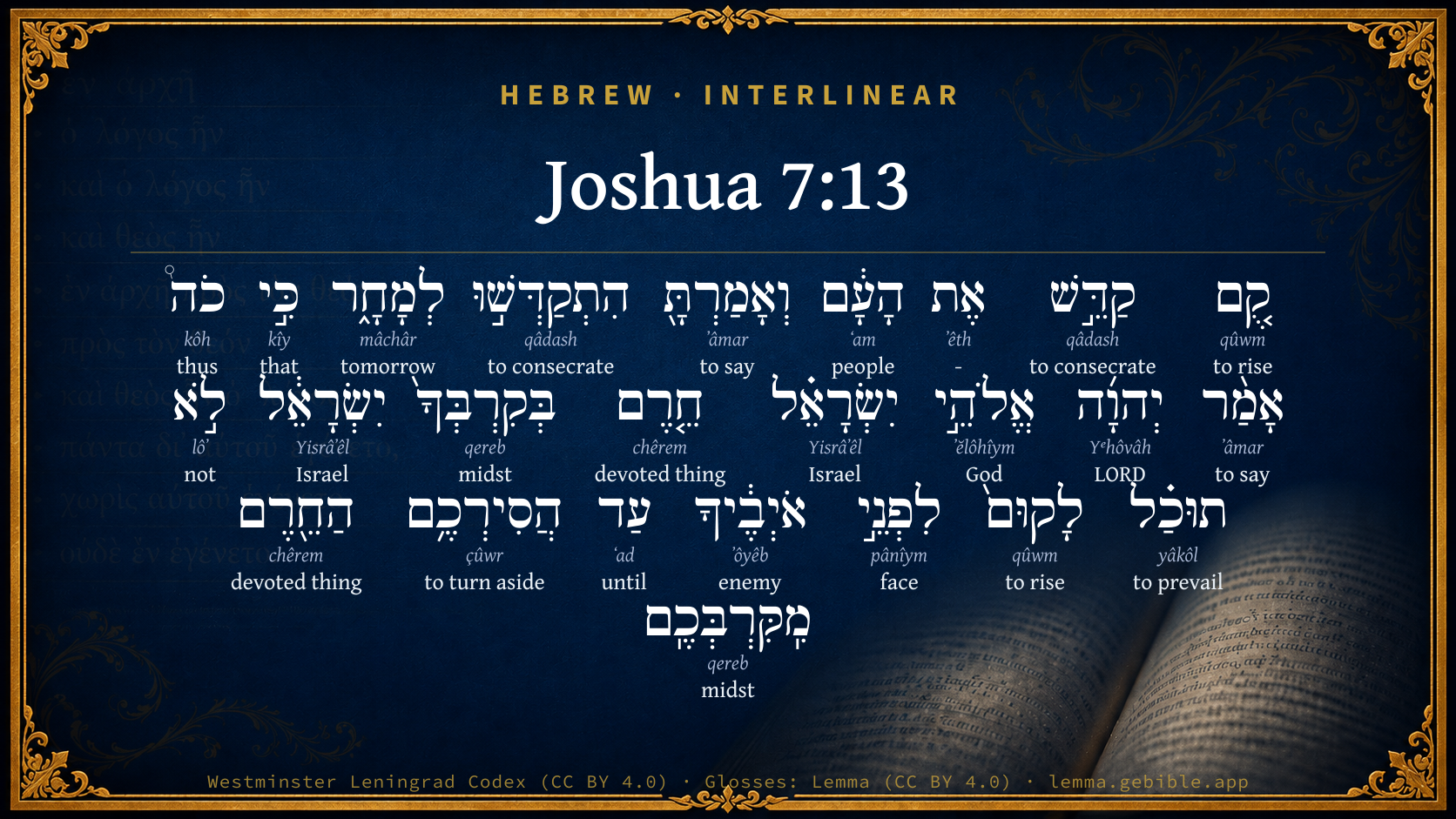
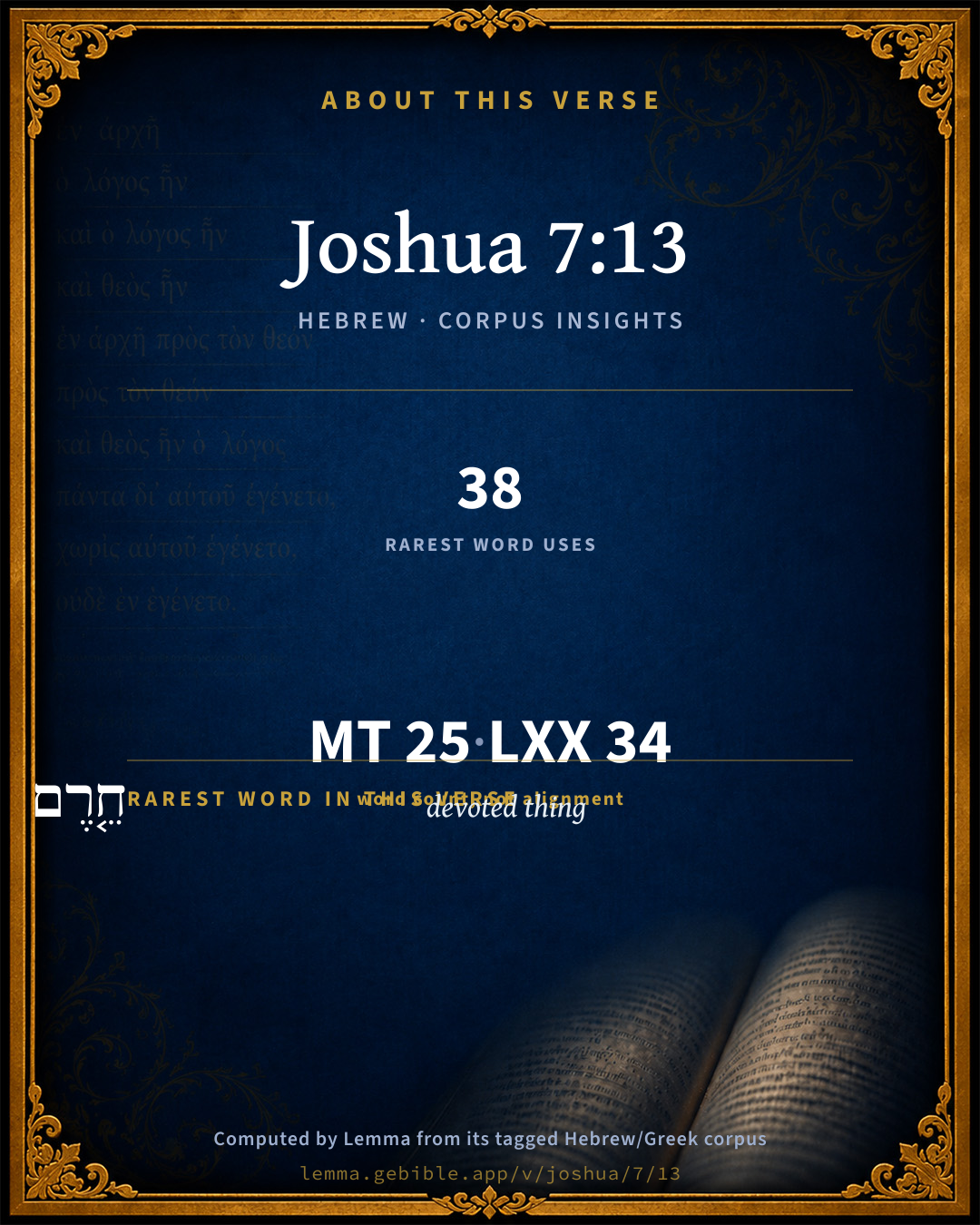
Joshua 7:13

Hebrew (Westminster Leningrad Codex) Joshua 7:13 appears in the Hebrew Old Testament. The text above is from the Westminster Leningrad Codex. Each word links to its Strong’s number, a concise gloss, and parsing drawn from the Open Scriptures Hebrew Bible morphology. Click any word for its full Brown-Driver-Briggs (BDB) entry.
Download image
Cite this verse

Joshua 7:13 (World English Bible). Public Domain. Lemma interlinear Bible study tool, https://lemma.gebible.app/v/joshua/7/13.

Show BibTeX & RIS
BibTeX
RIS
English Translation
Up, sanctify the people, and say, Sanctify yourselves against tomorrow: for thus says Yahweh, the God of Israel, There is a devoted thing in the midst of you, Israel; you can not stand before your enemies, until you take away the devoted thing from among you.
World English Bible · Public Domain
Download a study sheet

One document with this verse’s original text, its word-by-word gloss line, the meaning frame, cross-references with their text, attributed commentary, and full source and license credits — printable, and it pastes into notes with its structure intact.

This verse Autodidact and up

Study sheet (.html) Plain text (.txt)

A passage Seminary Student

Up to 50 verses in one chapter. A passage sheet keeps up to 6 commentary sources and 12 cross-references per verse, in the order this page ranks them, and says so on the sheet whenever that leaves anything out. Ask for a single verse and you get the Autodidact verse sheet above.

Everything on this page stays free to read, with no account — the sheet is a download of what is already on screen, not access to it.

Want to remove ads? Support Godless Engineer
Compare translations 3

The same verse in 3 English versions, stacked beneath the original-language interlinear above. Click any original word for its lexicon entry.

Each is an independent rendering of the whole verse — the interlinear is not word-aligned to these translations.

Highlighted words mark where these versions differ — a whole-verse word diff, not a word-by-word alignment.

  • World English Bible Public Domain
    Up, sanctify the people, and say, Sanctify yourselves against tomorrow: for thus says Yahweh, the God of Israel, There is a devoted thing in the midst of you, Israel; you can not stand before your enemies, until you take away the devoted thing from among you.
  • King James Version Public Domain
    Up, sanctify the people, and say, Sanctify yourselves against to morrow: for thus saith the LORD God of Israel, There is an accursed thing in the midst of thee, O Israel: thou canst not stand before thine enemies, until ye take away the accursed thing from among you.
  • unfoldingWord Literal Text CC BY-SA 4.0
    Arise! Consecrate the people and say, ‘Consecrate yourselves for tomorrow, because thus says Yahweh, the God of Israel, “A devoted thing is in your midst, Israel. You will not be able to stand to the face of your enemies until you remove the devoted thing from your midst.”

unfoldingWord Literal Text — © unfoldingWord, licensed CC BY-SA 4.0. Word-aligned USFM3 via Door43 (git.door43.org/unfoldingWord/en_ult).

Versions to compare (up to 4)

3 of 4 selected

Show all 18 translations

Every available English version of this verse, each an independent rendering of the whole verse.

  • World English Bible Public Domain
    Up, sanctify the people, and say, Sanctify yourselves against tomorrow: for thus says Yahweh, the God of Israel, There is a devoted thing in the midst of you, Israel; you can not stand before your enemies, until you take away the devoted thing from among you.
  • Berean Standard Bible Public Domain
    Get up and consecrate the people, saying, ‘Consecrate yourselves for tomorrow, for this is what the LORD, the God of Israel, says: Among you, O Israel, there are things devoted to destruction. You cannot stand against your enemies until you remove them.
  • Majority Standard Bible Public Domain
    Get up and consecrate the people, saying, ‘Consecrate yourselves for tomorrow, for this is what the LORD, the God of Israel, says: Among you, O Israel, there are things devoted to destruction. You cannot stand against your enemies until you remove them.
  • King James Version Public Domain
    Up, sanctify the people, and say, Sanctify yourselves against to morrow: for thus saith the LORD God of Israel, There is an accursed thing in the midst of thee, O Israel: thou canst not stand before thine enemies, until ye take away the accursed thing from among you.
  • American Standard Version (1901) Public Domain
    Up, sanctify the people, and say, Sanctify yourselves against tomorrow: for thus saith Jehovah, the God of Israel, There is a devoted thing in the midst of thee, O Israel; thou canst not stand before thine enemies, until ye take away the devoted thing from among you.
  • Revised Version (1885) Public Domain
    Up, sanctify the people, and say, Sanctify yourselves against tomorrow: for thus saith the LORD, the God of Israel, There is a devoted thing in the midst of thee, O Israel: thou canst not stand before thine enemies, until ye take away the devoted thing from among you.
  • Geneva Bible (1599) Public Domain
    Vp therefore, sanctifie the people, and say, Sanctifie your selues against to morowe: for thus saith the Lord God of Israel, There is an execrable thing among you, O Israel, therefore ye cannot stand against your enemies, vntill ye haue put the execrable thing from among you.
  • Douay-Rheims (1899) Public Domain
    Arise, sanctify the people, and say to them: Be ye sanctified against to morrow: for thus saith the Lord God of Israel: The anathema is in the midst of thee, O Israel: thou canst not stand before thy enemies, till he be destroyed out of thee that is defiled with this wickedness.
  • Young's Literal Translation Public Domain
    `Rise, sanctify the people, and thou hast said, Sanctify yourselves for to-morrow; for thus said Jehovah, God of Israel, A devoted thing `is' in thy midst, O Israel, thou art not able to stand before thine enemies till your turning aside of the devoted thing out of your midst;
  • Literal Standard Version CC BY-SA 4.0
    Rise, sanctify the people, and you have said, Sanctify yourselves for tomorrow; for thus said YHWH, God of Israel: A devoted thing [is] in your midst, O Israel, you are not able to stand before your enemies until your turning aside the devoted thing from your midst;
  • Unlocked Literal Bible CC BY-SA 4.0
    Get up! Consecrate the people to me and say to them, 'Consecrate yourselves for tomorrow. For Yahweh, the God of Israel says, “There are things set apart to be destroyed that are still among you, Israel. You cannot stand against your enemies until you remove from among you all the things that were set apart to be destroyed.”
  • unfoldingWord Literal Text CC BY-SA 4.0
    Arise! Consecrate the people and say, ‘Consecrate yourselves for tomorrow, because thus says Yahweh, the God of Israel, “A devoted thing is in your midst, Israel. You will not be able to stand to the face of your enemies until you remove the devoted thing from your midst.”
  • Darby Bible Public Domain
    Rise up, hallow the people, and say, Hallow yourselves for to-morrow; for thus saith Jehovah the God of Israel, There is an accursed thing in the midst of thee, Israel: thou shalt not be able to stand before thine enemies, until ye take away the accursed thing from your midst.
  • World Messianic Bible Public Domain
    Get up! Sanctify the people, and say, ‘Sanctify yourselves for tomorrow, for the LORD, the God of Israel, says, “There is a devoted thing among you, Israel. You cannot stand before your enemies until you take away the devoted thing from among you.”
  • Webster's Bible Public Domain
    Rise, sanctify the people, and say, Sanctify yourselves against to-morrow: for thus saith the LORD God of Israel, There is an accursed thing in the midst of thee, O Israel: thou canst not stand before thy enemies, until ye take away the accursed thing from among you.
  • Free Bible Version CC BY-SA 4.0
    Get up, and make sure the people are pure. Tell them, ‘Make yourselves pure in readiness for tomorrow, because this is what the Lord, the God of Israel, says, There are things set apart for me that are hidden among you, Israel. You will not be able to stand against your enemies until you remove all of them.
  • Bible in Basic English Public Domain
    Up! make the people holy; say to them, Make yourselves holy before tomorrow, for the Lord, the God of Israel, has said, There is a cursed thing among you, O Israel, and you will give way before your attackers in the fight till the cursed thing has been taken away from among you.
  • JPS Tanakh (1917) Public Domain
    Up, sanctify the people, and say: Sanctify yourselves against tomorrow; for thus saith the LORD, the God of Israel: There is a curse in the midst of thee, O Israel; thou canst not stand before thine enemies, until ye take away the accursed thing from among you.

Literal Standard Version (2020), Covenant Press — licensed CC BY-SA 4.0. Text via the HelloAO Bible API (eBible.org). Unlocked Literal Bible (unfoldingWord) — licensed CC BY-SA 4.0. Text via the HelloAO Bible API (eBible.org). unfoldingWord Literal Text — © unfoldingWord, licensed CC BY-SA 4.0. Word-aligned USFM3 via Door43 (git.door43.org/unfoldingWord/en_ult). Free Bible Version, Dr. Jonathan Gallagher — licensed CC BY-SA 4.0. Text via the HelloAO Bible API (eBible.org).

Word by word

More ways to search: Search by grammar → Find every occurrence → Compare this word →

Practice this passage: Drill this verse → Learn its vocabulary →

חֵ֤רֶם
chêrem
H2764
“devoted thing”
Noun, Common, Masculine, Singular, Absolute
Part of Speech
Noun
Type
Common
Gender
Masculine
Number
Singular
State
Absolute
Full BDB Definition

Origin: from H2763

TWOT: 744a , 745a

a thing devoted, thing dedicated, ban, devotion - a net, thing perforated - have been utterly destroyed, (appointed to) utter destruction
  1. קֻ֚ם qûwm H6965 “rise” Verb, Qal, Imperative, 2nd Person, Masculine, Singular
  2. קַדֵּ֣שׁ qâdash H6942 “consecrate” Verb, Piel, Imperative, 2nd Person, Masculine, Singular
  3. אֶת ʼêth H853 “-” Particle, Direct Object
  4. הָעָ֔ם ʻam H5971 “the · people” Particle, Definite Article + Noun, Common, Masculine, Singular, Absolute
  5. וְאָמַרְתָּ֖ ʼâmar H559 “and · to say” Conjunction + Verb, Qal, Sequential Perfect, 2nd Person, Masculine, Singular
  6. הִתְקַדְּשׁ֣וּ qâdash H6942 “consecrate” Verb, Hithpael, Imperative, 2nd Person, Masculine, Plural
  7. לְמָחָ֑ר mâchâr H4279 “to/for · tomorrow” Preposition + Noun, Common, Masculine, Singular, Absolute
  8. כִּ֣י kîy H3588 “that” Conjunction
  9. כֹה֩ kôh H3541 “thus” Adverb
  10. אָמַ֨ר ʼâmar H559 “to say” Verb, Qal, Perfect, 3rd Person, Masculine, Singular
  11. יְהוָ֜ה Yᵉhôvâh H3068 “LORD” Noun, Proper
  12. אֱלֹהֵ֣י ʼĕlôhîym H430 “God(s) of” Noun, Common, Masculine, Plural, Construct
  13. יִשְׂרָאֵ֗ל Yisrâʼêl H3478 “Israel” Noun, Proper
  14. בְּקִרְבְּךָ֙ qereb H7130 “in/at · midst · your” Preposition + Noun, Common, Masculine, Singular, Construct + Suffix, Personal, 2nd Person, Masculine, Singular
  15. יִשְׂרָאֵ֔ל Yisrâʼêl H3478 “Israel” Noun, Proper
  16. לֹ֣א lôʼ H3808 “not” Particle, Negative
  17. תוּכַ֗ל yâkôl H3201 “to prevail” Verb, Qal, Imperfect, 2nd Person, Masculine, Singular
  18. לָקוּם֙ qûwm H6965 “to rise” Preposition + Verb, Qal, Infinitive Construct
  19. לִפְנֵ֣י pânîym H6440 “to/for · face(s) of” Preposition + Noun, Common, Both, Plural, Construct
  20. אֹיְבֶ֔יךָ ʼôyêb H341 “enemy · you” Verb, Qal, Participle Active, Masculine, Plural, Construct + Suffix, Personal, 2nd Person, Masculine, Singular
  21. עַד ʻad H5704 “until” Preposition
  22. הֲסִירְכֶ֥ם çûwr H5493 “to turn aside · you” Verb, Hiphil, Infinitive Construct + Suffix, Personal, 2nd Person, Masculine, Plural
  23. הַחֵ֖רֶם chêrem H2764 “the · devoted thing” Particle, Definite Article + Noun, Common, Masculine, Singular, Absolute
  24. מִֽקִּרְבְּכֶֽם qereb H7130 “from · midst · your” Preposition + Noun, Common, Masculine, Singular, Construct + Suffix, Personal, 2nd Person, Masculine, Plural

About this verse

These counts appear in no published source. They are computed here, from the morphology-tagged text and Lemma’s own curated glosses. What Lemma adds →

25
words
19
distinct lemmas
Historical
section

Shared distinctive vocabulary

חֵ֤רֶם devoted thing H2764 occurs in 31 verses of the Hebrew Bible. Also found in:

Grammatical profile

  • 9 verbs
  • 11 nouns
  • 1 preposition
  • 1 conjunction
  • 1 adverb
  • 2 particles

Verb forms

  • קֻ֚ם Qal · Imperative
  • קַדֵּ֣שׁ Piel · Imperative
  • וְאָמַרְתָּ֖ Qal · Sequential Perfect
  • הִתְקַדְּשׁ֣וּ Hithpael · Imperative
  • אָמַ֨ר Qal · Perfect
  • תוּכַ֗ל Qal · Imperfect
  • לָקוּם֙ Qal · Infinitive Construct
  • אֹיְבֶ֔יךָ Qal · Participle Active
  • הֲסִירְכֶ֥ם Hiphil · Infinitive Construct

Repetition

Words recur within this verse — often emphatic in Hebrew:

  • קֻ֚ם to rise H6965 ×2
  • קַדֵּ֣שׁ to consecrate H6942 ×2
  • וְאָמַרְתָּ֖ to say H559 ×2
  • יִשְׂרָאֵ֗ל Israel H3478 ×2
  • חֵ֤רֶם devoted thing H2764 ×2
  • בְּקִרְבְּךָ֙ midst H7130 ×2

Hebrew & Septuagint length

In English translation the verse runs 46 words from the Hebrew and 47 from the Septuagint (LXX English) — closely comparable.

A rough comparison of the two English renderings, which tokenize alike — not a word-level alignment.

Word counts can differ between the Hebrew and the Greek without any difference in meaning — e.g. the Hebrew direct-object marker אֵת has no separate Greek word, and Greek often adds the article ὁ.

In the original languages it is 25 Hebrew tokens and 34 Greek tokens — but the two are counted differently (Hebrew bundles its prefixes and suffixes into one token; the Greek is in lemma form), so that isn’t a like-for-like length.

Cross-references

11

Topical passages linked to Joshua 7:13 in the Treasury of Scripture Knowledge — connected by theme and wording, ordered by reader-vote popularity; previews shown in the World English Bible.

  • Lamentations 3:40–41 Let us search and try our ways, and turn again to Yahweh.
  • Joshua 3:5 Joshua said to the people, Sanctify yourselves; for tomorrow Yahweh will do wonders among you.
  • Matthew 7:5 You hypocrite! First remove the beam out of your own eye, and then you can see clearly to remove the speck out of your brother's eye.
  • 1 Corinthians 5:11–13 But as it is, I wrote to you not to associate with anyone who is called a brother who is a sexual sinner, or covetous, or an idolater, or a slanderer, or a drunkard, or an extortioner. Don't even eat with such a person.
  • Joshua 6:18 But as for you, only keep yourselves from the devoted thing, lest when you have devoted it, you take of the devoted thing; so would you make the camp of Israel accursed, and trouble it.
  • Joshua 7:11 Israel has sinned; yes, they have even transgressed my covenant which I commanded them: yes, they have even taken of the devoted thing, and have also stolen, and dissembled also; and they have even put it among their own stuff.
  • Exodus 19:10–15 Yahweh said to Moses, "Go to the people, and sanctify them today and tomorrow, and let them wash their garments,
  • 2 Chronicles 28:10 Now you purpose to keep under the children of Judah and Jerusalem for bondservants and bondmaids to you: [but] aren't there even with you trespasses of your own against Yahweh your God?
  • Zephaniah 2:1–2 Gather yourselves together, yes, gather together, you nation that has no shame,
  • 1 Corinthians 5:1–6 It is actually reported that there is sexual immorality among you, and such sexual immorality as is not even named among the Gentiles, that one has his father's wife.
  • Joel 2:16–17 Gather the people. Sanctify the assembly. Assemble the elders. Gather the children, and those who suck the breasts. Let the bridegroom go forth from his room, And the bride out of her chamber.

Cross-references courtesy of OpenBible.info (CC BY 4.0).

Hebrew and Greek witnesses Masoretic Hebrew ↔ Greek Septuagint

The same verse in the two great witnesses to the Old Testament, shown verse-for-verse.

These are two independent witnesses, not word-aligned to each other, and the Septuagint is shown in lemma (dictionary) form.

Hebrew Joshua 7:13 Masoretic · Westminster Leningrad Codex

קֻ֚ם קַדֵּ֣שׁ אֶת הָעָ֔ם וְאָמַרְתָּ֖ הִתְקַדְּשׁ֣וּ לְמָחָ֑ר כִּ֣י כֹה֩ אָמַ֨ר יְהוָ֜ה אֱלֹהֵ֣י יִשְׂרָאֵ֗ל חֵ֤רֶם בְּקִרְבְּךָ֙ יִשְׂרָאֵ֔ל לֹ֣א תוּכַ֗ל לָקוּם֙ לִפְנֵ֣י אֹיְבֶ֔יךָ עַד הֲסִירְכֶ֥ם הַחֵ֖רֶם מִֽקִּרְבְּכֶֽם

Up, sanctify the people, and say, Sanctify yourselves against tomorrow: for thus says Yahweh, the God of Israel, There is a devoted thing in the midst of you, Israel; you can not stand before your enemies, until you take away the devoted thing from among you.

World English Bible · Public Domain

Greek LXX Joshua 7:13 Septuagint · lemma form

ἀναἵστημι ἁγιάζω ὁ λαός καί εἶπον ἁγιάζω εἰς αὔριον ὅδε λέγω κύριος ὁ θεός ἰσραήλ ὁ ἀνάθεμα ἐν σύ εἰμί οὐ δύναμαι ἀντιἵστημι ἀπέναντι ὁ ἐχθρός σύ ἕως ἄν ἐκαἴρω ὁ ἀνάθεμα ἐκ σύ

Rise, sanctify the people and tell them to sanctify themselves for the morrow: thus says the Lord God of Israel, The accursed thing is among you; you⌃ shall not be able to stand before your enemies, until you⌃ shall have removed the cursed thing from among you.

LXX2012 (modern English Septuagint) · Public Domain

On this verse, Haydock's Catholic Bible Commentary discusses the Septuagint’s reading. Read the note in Commentary ↓

Hebrew: Westminster Leningrad Codex (CC BY 4.0). Greek: Septuagint (public domain); English from LXX2012 (modern English Septuagint) (Public Domain). How the Septuagint differs from the Hebrew →

Targum (Aramaic paraphrase)

1

The Targum is the ancient Jewish Aramaic paraphrase of the Hebrew Scriptures — an interpretive translation, not the Hebrew text itself. Onkelos (literal) and Pseudo-Jonathan (expansive) render the Torah, and Jonathan the Prophets. Coverage is partial: where no permissively-licensed English translation exists for a verse, only the Aramaic is shown. This is verse-level text, not a word-by-word alignment to the Hebrew.

  1. Targum Jonathan Prophets (Joshua–Malachi)
    קוּם זַמֵן יַת עַמָא וְתֵימַר אִזְדַמְנוּ לִמְחַר אֲרֵי כִּדְנַן אֲמַר יְיָ אֱלָהָא דְיִשְׂרָאֵל חֶרְמָא בֵינָךְ יִשְׂרָאֵל לָא תִכּוּל לְמֵיקַם קֳדָם בַּעֲלֵי דְבָבָךְ עַד דְתַעֲדוּן חֶרְמָא מִבֵּינֵיכוֹן:

    (no public-domain English translation for this verse)

    Targum Jonathan — Aramaic: “Mikraot Gedolot” (public domain). English: “Sefaria Community Translation” (CC0 1.0 (public-domain dedication)); “London "Chaldee Paraphrase," 1871” (public domain). Text via Sefaria.

Commentary

Notes on Joshua 7:13 from classic Christian and Jewish commentators (each source and its license shown beneath its notes). The classic Christian expositions comment on the surrounding passage and are grouped to its opening verse, so a note may address several verses; the Jewish commentaries on the Tanakh (Rashi and others) are per-verse, so they appear only where the commentator wrote on this verse.

Lemma curates 59 commentaries, every one of them public domain or Creative Commons licensed, each selected and text-cleaned for this edition rather than reprinted as found. About our sources →

Trapp's Complete Commentary

John Trapp

Jos 7:13 Up, sanctify the people, and say, Sanctify yourselves against to morrow: for thus saith the LORD God of Israel, [There is] an accursed thing in the midst of thee, O Israel: thou canst not stand before thine enemies, until ye take away the accursed thing from among you.

Ver. 13. Up, sanctify the people, and say, Sanctify, &c.] Come before God with the best preparations you can make. That "God that is holy is to be sanctified in righteousness." {Isa 5:16} And he will be "sanctified of all them that draw nigh unto him" {Lev 10:3}

John Trapp, A Commentary or Exposition upon All the Books of the Old and New Testament (1647–1656) — public domain. Text from a community e-Sword module.

Joseph Benson's Commentary

Jos 7:13. Sanctify yourselves — Not only wash your clothes and give yourselves up to religious exercises, meditation, and prayer, as you were required to do formerly, when called to meet the Lord at Sinai, (see Exo 19:10,) and lately, when you were about to be led over Jordan, (Jos 3:5,) but purify yourselves from that defilement which you have all in some sort contracted by this accursed fact, and prepare yourselves to appear before the Lord, expecting his sentence for the discovery and punishment of the sin. This was enjoined that the guilty person might be awakened, and brought to a free confession of his fault. And it is a marvellous thing that he did not on this occasion acknowledge his crime. But this is to be imputed to the heart-hardening power of sin, which makes men grow worse and worse; to his pride, which made him loath to take to himself the shame of such a mischievous and infamous action; and to his vain conceit, whereby he might think others were guilty as well as he, and that some of them might be taken, and he escape.

Joseph Benson's Commentary on the Old and New Testaments (1811–1818) — public domain. Text from a community e-Sword module.

Tyndale Open Study Notes

Tyndale Open Resources

7:13 Command the people to purify themselves: See study note on 3:5.

Tyndale Open Study Notes — © Tyndale Open Resources, licensed CC BY-SA 4.0. Text via the HelloAO Bible API.

Geneva Bible (1599)

Geneva Bible translators

Meaning, the man that took of the thing forbidden.

Geneva Bible (1599) marginal notes — public domain. Text via Bolls.life.

Adam Clarke's Commentary

Verse 13. Up, sanctify the people] Joshua, all the time that God spake, lay prostrate before the ark: he is now commanded to get up, and sanctify the people, i.e., cause them to wash themselves, and get into a proper disposition to hear the judgment of the Lord relative to the late transactions.

Adam Clarke's Commentary on the Bible (1810–1826) — public domain. Text from a community e-Sword/MySword module.

John Calvin's Commentaries

13. Up, sanctify the people, etc Although the word קדש has a more extensive meaning, yet as the subject in question is the expiation of the people, I have no doubt that it prescribes a formal rite of sanctification. Those, therefore, who interpret it generally as equivalent to prepare, do not, in my judgment, give it its full force. Nay, as they were now to be in a manner brought into the divine presence, there was need of purification that they might not come while unclean. It is also to be observed in regard to the method of sanctifying, that Joshua intimates to the people a legal purgation. But though the ceremony might be in itself of little consequence, it had a powerful tendency to arouse a rude people. The external offering must have turned their thoughts to spiritual cleanness, while their abstinence from things otherwise lawful reminded them of the very high and unblemished purity which was required. And they are forewarned of what is to take place, in order that each may be more careful in examining himself. Nay, the Lord proceeds step by step, as if he meant to give intervals for repentance; for it is impossible to imagine any other reason for descending from tribe to family, and coming at length to the single individual.

In all this we see the monstrous stupor of Achan. Overcome perhaps by shame, he doubles his impudence, and putting on a bold front, hesitates not to insult his Maker. For why, when he sees himself discovered, does he not voluntarily come forward and confess the crime, instead of persisting in his effrontery till he is dragged forward against his will? But such is the just recompense of those who allow themselves to be blinded by the devil. Then when first by the taking of his tribe and next by that of his family, he plainly perceived that he was urged and held fast by the hand of God, why does he not then at least spring forward, and by a voluntary surrender deprecate punishment? It appears, then, that after he had hardened himself in his wickedness, his mind and all his senses were charmed by the devil.

Though God does not bring all guilty actions to light at the very moment, nor always employ the casting of lots for this purpose, he has taught us by this example that there is nothing so hidden as not to be revealed in its own time. The form of disclosure will, indeed, be different; but let every one reflect, for himself, that things which escape the knowledge of the whole world are not concealed from God, and that to make them public depends only on his pleasure. For though a sin may seem as it were to have fallen asleep, it is however awake before the door, and will beset the miserable man till it overtake and crush him.

John Calvin's Commentaries (1540-1563) — public domain. Text from the Calvin Translation Society English edition (1840s-50s) via the Christian Classics Ethereal Library (ccel.org). Calvin's coverage is partial (roughly two-thirds of the Bible); uncommented books and verses are honest gaps, never fabricated. The 19th-century editor's footnotes and remarks are omitted so the notes are faithfully Calvin's own voice.

The Cambridge Bible for Schools and Colleges

gen. ed. J. J. S. Perowne

13. sanctify the people] “Rise, halwe the puple,” Wyclif. Compare the instructions to Moses before the giving of the Law, Exo_19:10.

The Cambridge Bible for Schools and Colleges (gen. ed. J. J. S. Perowne; Cambridge University Press, 1878–1918) — public domain. Text from a community e-Sword module.

John Gill's Exposition

Up, sanctify the people,.... The word "up" not only signifies getting up from the ground on which he lay, but to bestir himself, and to be active in what he would now be enjoined and directed to do, and in the first place to "sanctify the people", that is, by giving them orders to do it themselves:

and say, sanctify yourselves against tomorrow; either by some ceremonial ablutions, or by the performance of moral duties, as prayer, repentance, and good works; or rather, they were to "prepare" themselves, as the Targum and Kimchi interpret it, to get ready against the morrow, and expect to be thoroughly searched, in order to find out the person who had taken the accursed thing:

for thus saith the Lord God of Israel, there is an accursed thing in the midst of thee, O Israel; an accursed person, who had taken of what was devoted to the Lord for his own use, and so accursed:

thou canst not stand before thine enemies, until ye take away the accursed thing from among you; by putting him to death.

John Gill's Exposition of the Whole Bible (1746–1763) — public domain (CC PDM 1.0). Text via the HelloAO Bible API.

Haydock's Catholic Bible Commentary

Sanctified. Prepared by washing, &c., to appear before the tabernacle, and see the event. Septuagint, "purify the people." Chaldean, "call an assembly."

George Leo Haydock (1774–1849), Haydock's Catholic Family Bible and Commentary, 1859 edition — public domain. Excludes Psalms (Douay-Rheims chapter numbering differs from Protestant) and Deuterocanonical books (Catholic canon only).

Matthew Poole's English Annotations

Sanctify yourselves; purify yourselves from that defilement which you have all in some sort contracted by this accursed fact, and prepare yourselves to appear before the Lord, as it is most probable they were required to do; as imploring and expecting the sentence of God for the discovery and punishment of the sin, and that the guilty person might hereby be awakened and terrified, and brought to a free and seasonable confession of his fault. And it is a marvellous thing that Achan did not on this occasion acknowledge his crime; but this is to be imputed to the heart-hardening power of sin, which makes men grow worse and worse; partly, to his pride, being loth to take to himself the shame of such a mischievous and infamous action; partly, to his self-flattering and vain conceit, whereby he might think many others were guilty as well as he, and some of them might be taken, and he escape; and partly, to the just judgment of God, whereby he blinds and hardens sinners to their own ruin. See a like instance, Mat 26:21,22,25.

Matthew Poole's English Annotations on the Holy Bible (1683–1685) — public domain. Text from a community e-Sword/MySword module.

Whedon's Commentary on the Bible

Daniel D. Whedon

13. Up… sanctify yourselves — This mode of address indicates the critical nature of the exigency, which demanded immediate action to prevent further disaster. There cannot be too great haste in putting ourselves right in the sight of God. In order to prepare for the scrutiny which the Lord was to exercise upon all the camp, the entire people were to perform the ablutions and observances required by the law. Jehovah required these washings whenever he came near to them in order to impress them with his own holiness. Exo_19:10-11; see Jos_3:5, note.

Daniel D. Whedon (gen. ed.), Commentary on the Old and New Testaments (1874–1909) — public domain. Text from a community e-Sword module.

The Pulpit Commentary

Sanctify the people. See note on Jos_3:5. Thou canst not stand before thine enemies. Observe the singular number here, intensifying the testimony of the whole history to the fact that Israel was one body before the Lord. And observe, moreover, how the existence of secret sin, even though unknown to and undetected by him in whom it lurks, has power to enfeeble the soul in its conflict with its enemies. Hence we learn the duties Of watchfulness and careful examination of the soul by the light of God"s Word.

The Pulpit Commentary (1880–1919), ed. H.D.M. Spence-Jones & Joseph S. Exell — public domain. Text from a community e-Sword module.

John Wesley's Explanatory Notes

Sanctify yourselves - Purify yourselves from that defilement which you have all in some sort contracted by this accursed fact, and prepare yourselves to appear before the Lord, expecting the sentence of God for the discovery and punishment of the sin, and that the guilty person might hereby be awakened, and brought to a free confession of his fault. And it is a marvelous thing that Achan did not on this occasion acknowledge his crime; but this is to be imputed to the heart-hardening power of sin, which makes men, grow worse and worse; to his pride, being loath to take to himself the shame of such a mischievous and infamous action; and to his vain conceit, whereby he might think others were guilty as well as he, and some of them might be taken, and he escape.

John Wesley, Explanatory Notes Upon the Whole Bible (1754–1765) — public domain. Text via the GEBible commentary corpus.

unfoldingWord translationNotes

Door43 World Missions Community

Connecting Statement:

Yahweh continues speaking to Joshua and tells him what to tell the people.

the people

This refers to the people of Israel.

You cannot stand against your enemies

Standing before their enemies represents fighting successfully against them. AT: "You cannot fight successfully against your enemies" or "You cannot defeat your enemies" (See: Metonymy)

translationWords

consecrate

Yahweh

God

Israel

unfoldingWord translationNotes — © Distant Shores Media and the Door43 World Missions Community, licensed CC BY-SA 4.0. Source: git.door43.org/Door43/en_tn.

Lesson kit

Teaching starters — assembled from the data on this page, not authored interpretation. Every prompt links to the verse data it draws on. Edit before teaching.

Joshua, in the Historical, opens this verse with 25 words (19 distinct Hebrew lemmas). Its most distinctive word is chêrem (“devoted thing”). A historical commentator’s framing appears above. Read the whole chapter for the surrounding context.

Discussion questions

  1. What does “devoted thing” (chêrem) contribute to the verse as a whole?
  2. How does Leviticus 27:21, which shares the word «devoted thing», read alongside this verse?
  3. What does the repetition of “to rise” (2× in this one verse) do in this verse?
  4. These translations render this verse differently. What is at stake in choosing one wording over another?
  5. «קֻ֚ם» is a Qal Imperative verb. How does that grammatical form shape the action described?
  6. Compare how Trapp's Complete Commentary and Joseph Benson's Commentary read this verse. Where do they agree or differ?

Things to notice

Reading settings

Reading text

Shown beneath each verse's original-language words.

Old Testament
Old Testament edition

Read the OT as the Masoretic Hebrew (MT) or the Greek Septuagint (LXX).

English shown for the Greek Septuagint (in the Hebrew ↔ Greek comparison).

Comparing translations? Open the Compare panel on any verse page to stack up to four side by side.