
2 Samuel 7:11

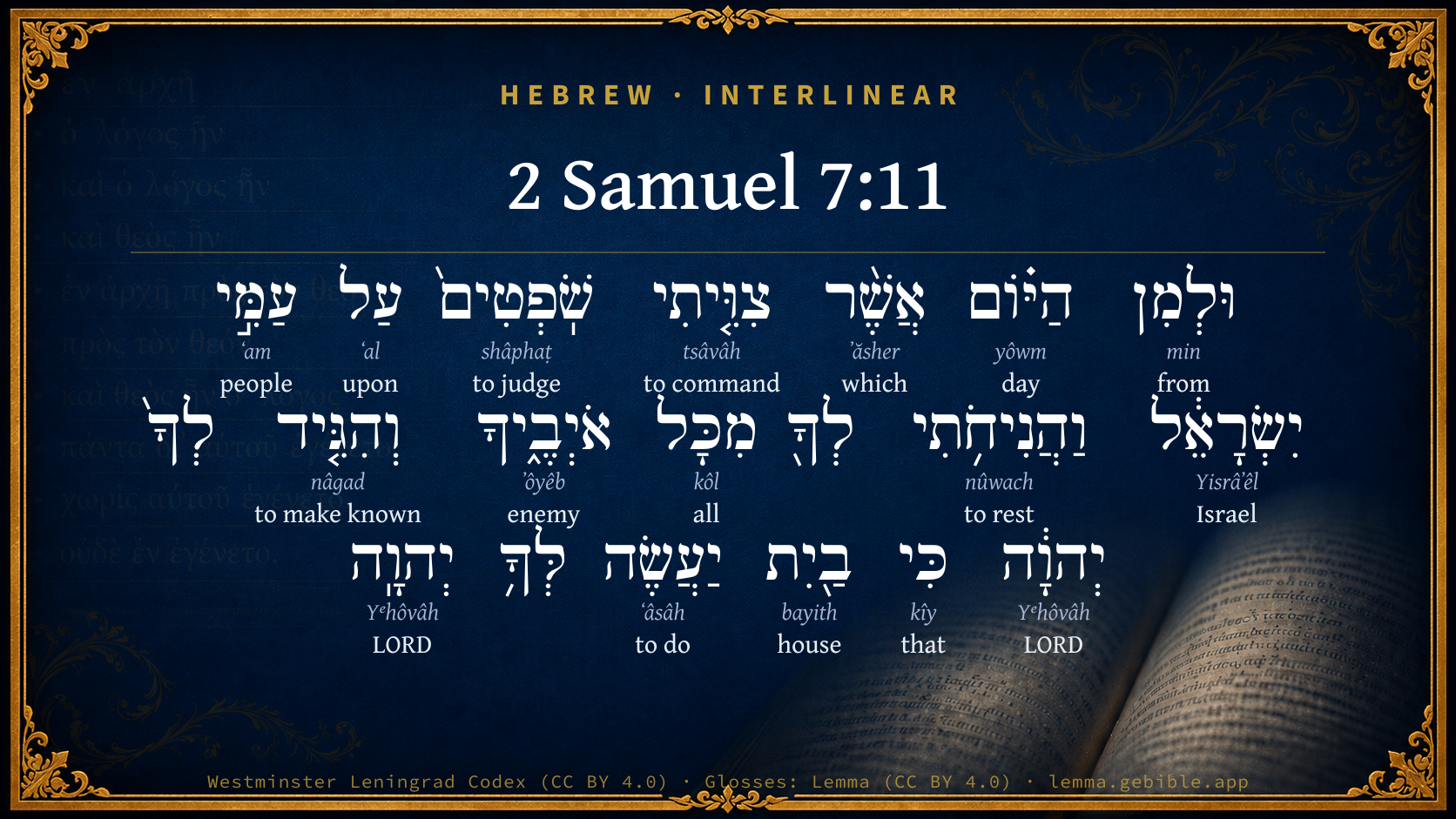
Hebrew (Westminster Leningrad Codex) 2 Samuel 7:11 appears in the Hebrew Old Testament. The text above is from the Westminster Leningrad Codex. Each word links to its Strong’s number, a concise gloss, and parsing drawn from the Open Scriptures Hebrew Bible morphology. Click any word for its full Brown-Driver-Briggs (BDB) entry.
Download image
Cite this verse

2 Samuel 7:11 (World English Bible). Public Domain. Lemma interlinear Bible study tool, https://lemma.gebible.app/v/2-samuel/7/11.

Show BibTeX & RIS
BibTeX
RIS
English Translation
and [as] from the day that I commanded judges to be over my people Israel; and I will cause you to rest from all your enemies. Moreover Yahweh tells you that Yahweh will make you a house.
World English Bible · Public Domain
Download a study sheet

One document with this verse’s original text, its word-by-word gloss line, the meaning frame, cross-references with their text, attributed commentary, and full source and license credits — printable, and it pastes into notes with its structure intact.

This verse Autodidact and up

Study sheet (.html) Plain text (.txt)

A passage Seminary Student

Up to 50 verses in one chapter. A passage sheet keeps up to 6 commentary sources and 12 cross-references per verse, in the order this page ranks them, and says so on the sheet whenever that leaves anything out. Ask for a single verse and you get the Autodidact verse sheet above.

Everything on this page stays free to read, with no account — the sheet is a download of what is already on screen, not access to it.

Want to remove ads? Support Godless Engineer
Compare translations 3

The same verse in 3 English versions, stacked beneath the original-language interlinear above. Click any original word for its lexicon entry.

Each is an independent rendering of the whole verse — the interlinear is not word-aligned to these translations.

Highlighted words mark where these versions differ — a whole-verse word diff, not a word-by-word alignment.

  • World English Bible Public Domain
    and [as] from the day that I commanded judges to be over my people Israel; and I will cause you to rest from all your enemies. Moreover Yahweh tells you that Yahweh will make you a house.
  • King James Version Public Domain
    And as since the time that I commanded judges to be over my people Israel, and have caused thee to rest from all thine enemies. Also the LORD telleth thee that he will make thee an house.
  • unfoldingWord Literal Text CC BY-SA 4.0
    and from the day when I commanded judges over my people Israel. And I will give rest to you from all of your enemies. And Yahweh declares to you that Yahweh will make a house for you.

unfoldingWord Literal Text — © unfoldingWord, licensed CC BY-SA 4.0. Word-aligned USFM3 via Door43 (git.door43.org/unfoldingWord/en_ult).

Versions to compare (up to 4)

3 of 4 selected

Show all 18 translations

Every available English version of this verse, each an independent rendering of the whole verse.

  • World English Bible Public Domain
    and [as] from the day that I commanded judges to be over my people Israel; and I will cause you to rest from all your enemies. Moreover Yahweh tells you that Yahweh will make you a house.
  • Berean Standard Bible Public Domain
    and have done since the day I appointed judges over My people Israel. I will give you rest from all your enemies. The LORD declares to you that He Himself will establish a house for you.
  • Majority Standard Bible Public Domain
    and have done since the day I appointed judges over My people Israel. I will give you rest from all your enemies. The LORD declares to you that He Himself will establish a house for you.
  • King James Version Public Domain
    And as since the time that I commanded judges to be over my people Israel, and have caused thee to rest from all thine enemies. Also the LORD telleth thee that he will make thee an house.
  • American Standard Version (1901) Public Domain
    and `as' from the day that I commanded judges to be over my people Israel; and I will cause thee to rest from all thine enemies. Moreover Jehovah telleth thee that Jehovah will make thee a house.
  • Revised Version (1885) Public Domain
    and as from the day that I commanded judges to be over my people Israel; and I will cause thee to rest from all thine enemies. Moreover the LORD telleth thee that the LORD will make thee an house.
  • Geneva Bible (1599) Public Domain
    And since the time that I set Iudges ouer my people of Israel) and I will giue thee rest from al thine enemies: also the Lord telleth thee, that he will make thee an house.
  • Douay-Rheims (1899) Public Domain
    From the day that I appointed judges over my people Israel: and I will give thee rest from all thy enemies. And the Lord foretelleth to thee, that the Lord will make thee a house.
  • Young's Literal Translation Public Domain
    even from the day that I appointed judges over My people Israel; and I have given rest to thee from all thine enemies, and Jehovah hath declared to thee that Jehovah doth make for thee a house.
  • Literal Standard Version CC BY-SA 4.0
    even from the day that I appointed judges over My people Israel; and I have given rest to you from all your enemies, and YHWH has declared to you that YHWH makes a house for you.
  • Unlocked Literal Bible CC BY-SA 4.0
    as they were doing from the days that I commanded judges to be over my people Israel. Now I will give you rest from all your enemies. Moreover, I, Yahweh declare to you that I will make you a house.
  • unfoldingWord Literal Text CC BY-SA 4.0
    and from the day when I commanded judges over my people Israel. And I will give rest to you from all of your enemies. And Yahweh declares to you that Yahweh will make a house for you.
  • Darby Bible Public Domain
    and since the time that I commanded judges to be over my people Israel. And I have given thee rest from all thine enemies; and Jehovah telleth thee that Jehovah will make thee a house.
  • World Messianic Bible Public Domain
    and as from the day that I commanded judges to be over my people Israel. I will cause you to rest from all your enemies. Moreover the LORD tells you that the LORD will make you a house.
  • Webster's Bible Public Domain
    And as since the time that I commanded judges to be over my people Israel, and have caused thee to rest from all thy enemies. Also the LORD telleth thee that he will make thee a house.
  • Free Bible Version CC BY-SA 4.0
    from the time I placed judges in charge of my people. I will defeat all of your enemies. Also I want to make it clear that I the Lord will build a house for you.
  • Bible in Basic English Public Domain
    From the time when I put judges over my people Israel; and I will give you peace from all who are against you. And the Lord says to you that he will make you the head of a line of kings.
  • JPS Tanakh (1917) Public Domain
    even from the day that I commanded judges to be over My people Israel; and I will cause thee to rest from all thine enemies. Moreover the LORD telleth thee that the LORD will make thee a house.

Literal Standard Version (2020), Covenant Press — licensed CC BY-SA 4.0. Text via the HelloAO Bible API (eBible.org). Unlocked Literal Bible (unfoldingWord) — licensed CC BY-SA 4.0. Text via the HelloAO Bible API (eBible.org). unfoldingWord Literal Text — © unfoldingWord, licensed CC BY-SA 4.0. Word-aligned USFM3 via Door43 (git.door43.org/unfoldingWord/en_ult). Free Bible Version, Dr. Jonathan Gallagher — licensed CC BY-SA 4.0. Text via the HelloAO Bible API (eBible.org).

Word by word

More ways to search: Search by grammar → Find every occurrence → Compare this word →

Practice this passage: Drill this verse → Learn its vocabulary →

וַהֲנִיחֹ֥תִי
nûwach
H5117
“and · to rest”
Conjunction + Verb, Hiphil, Sequential Perfect, 1st Person, Common, Singular
Part of Speech
Conjunction + Verb
Stem
Hiphil
Form
Sequential Perfect
Person
1st Person
Gender
Common
Number
Singular
Full BDB Definition

Origin: a primitive root

TWOT: 1323

to rest - (Qal) - to rest, settle down and remain - to repose, have rest, be quiet - (Hiphil) - to cause to rest, give rest to, make quiet - to cause to rest, cause to alight, set down - to lay or set down, deposit, let lie, place - to let remain, leave - to leave, depart from - to abandon - to permit - (Hophal) - to obtain rest, be granted rest - to be left, be placed - open space (substantive)
  1. וּלְמִן min H4480 “and · to/for · from” Conjunction + Preposition + Preposition
  2. הַיּ֗וֹם yôwm H3117 “the · day” Particle, Definite Article + Noun, Common, Masculine, Singular, Absolute
  3. אֲשֶׁ֨ר ʼăsher H834 “which” Particle, Relative
  4. צִוִּ֤יתִי tsâvâh H6680 “to command” Verb, Piel, Perfect, 1st Person, Common, Singular
  5. שֹֽׁפְטִים֙ shâphaṭ H8199 “judging” Verb, Qal, Participle Active, Masculine, Plural, Absolute
  6. עַל ʻal H5921 “upon” Preposition
  7. עַמִּ֣י ʻam H5971 “people · my” Noun, Common, Masculine, Singular, Construct + Suffix, Personal, 1st Person, Common, Singular
  8. יִשְׂרָאֵ֔ל Yisrâʼêl H3478 “Israel” Noun, Proper
  9. מִכָּל kôl H3605 “from · all of” Preposition + Noun, Common, Masculine, Singular, Construct
  10. אֹיְבֶ֑יךָ ʼôyêb H341 “enemy · you” Verb, Qal, Participle Active, Masculine, Plural, Construct + Suffix, Personal, 2nd Person, Masculine, Singular
  11. וְהִגִּ֤יד nâgad H5046 “and · to make known” Conjunction + Verb, Hiphil, Sequential Perfect, 3rd Person, Masculine, Singular
  12. יְהוָ֔ה Yᵉhôvâh H3068 “LORD” Noun, Proper
  13. כִּי kîy H3588 “that” Conjunction
  14. בַ֖יִת bayith H1004 “house” Noun, Common, Masculine, Singular, Absolute
  15. יַעֲשֶׂה ʻâsâh H6213 “to do” Verb, Qal, Imperfect, 3rd Person, Masculine, Singular
  16. יְהוָֽה Yᵉhôvâh H3068 “LORD” Noun, Proper

About this verse

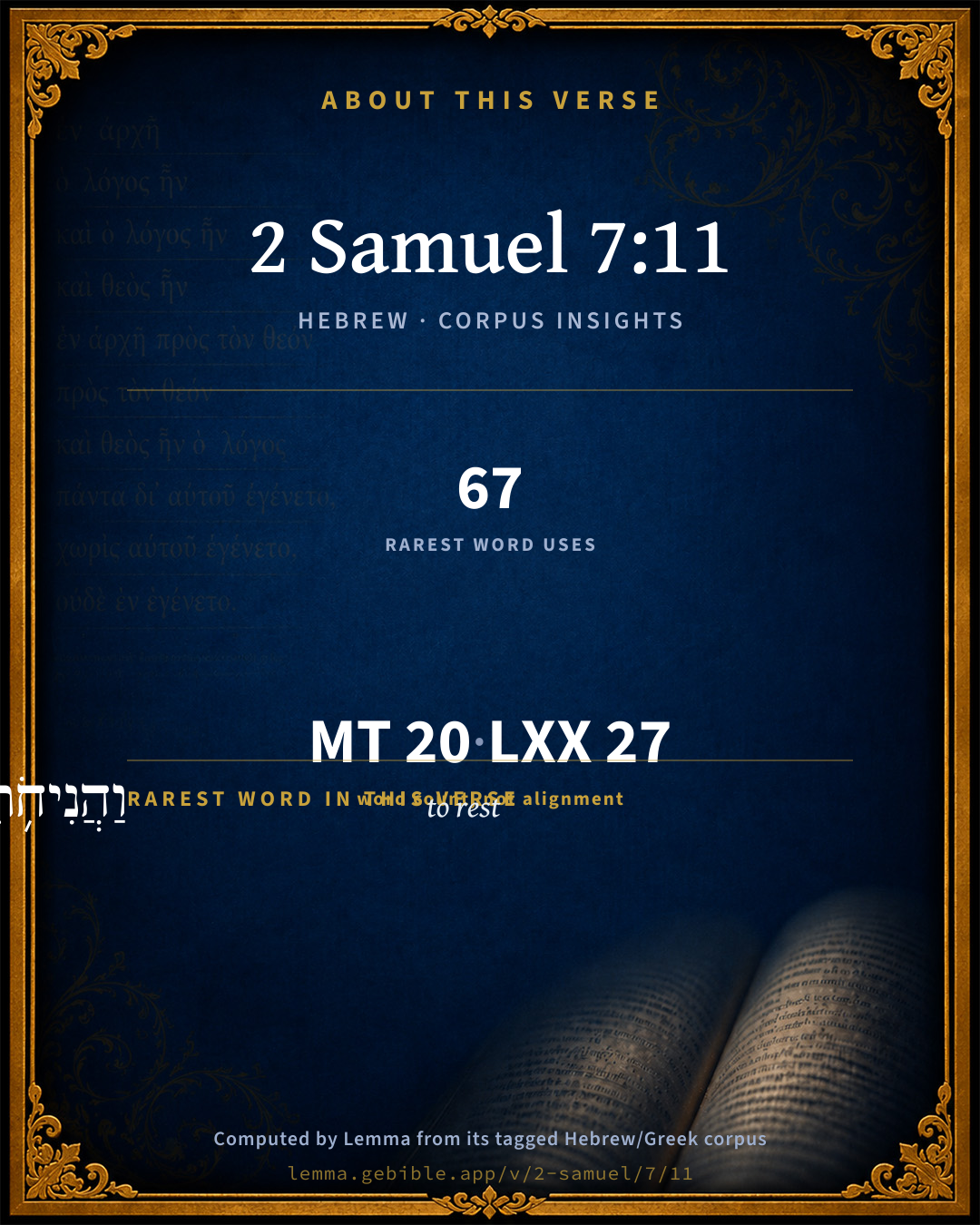
These counts appear in no published source. They are computed here, from the morphology-tagged text and Lemma’s own curated glosses. What Lemma adds →

20
words
16
distinct lemmas
Historical
section

Grammatical profile

  • 6 verbs
  • 7 nouns
  • 5 prepositions
  • 1 conjunction
  • 1 particle

Verb forms

  • צִוִּ֤יתִי Piel · Perfect
  • שֹֽׁפְטִים֙ Qal · Participle Active
  • וַהֲנִיחֹ֥תִי Hiphil · Sequential Perfect
  • אֹיְבֶ֑יךָ Qal · Participle Active
  • וְהִגִּ֤יד Hiphil · Sequential Perfect
  • יַעֲשֶׂה Qal · Imperfect

Repetition

A word recurs within this verse — often emphatic in Hebrew:

  • יְהוָ֔ה LORD H3068 ×2

Hebrew & Septuagint length

In English translation the verse runs 37 words from the Hebrew and 35 from the Septuagint (LXX English) — closely comparable.

A rough comparison of the two English renderings, which tokenize alike — not a word-level alignment.

Word counts can differ between the Hebrew and the Greek without any difference in meaning — e.g. the Hebrew direct-object marker אֵת has no separate Greek word, and Greek often adds the article ὁ.

In the original languages it is 20 Hebrew tokens and 27 Greek tokens — but the two are counted differently (Hebrew bundles its prefixes and suffixes into one token; the Greek is in lemma form), so that isn’t a like-for-like length.

Cross-references

17

Topical passages linked to 2 Samuel 7:11 in the Treasury of Scripture Knowledge — connected by theme and wording, ordered by reader-vote popularity; previews shown in the World English Bible.

  • 2 Samuel 7:27 For you, Yahweh of Hosts, the God of Israel, have revealed to your servant, saying, I will build you a house: therefore has your servant found in his heart to pray this prayer to you.
  • 2 Samuel 7:1 It happened, when the king lived in his house, and Yahweh had given him rest from all his enemies round about,
  • Judges 2:14–16 The anger of Yahweh was kindled against Israel, and he delivered them into the hands of spoilers who despoiled them; and he sold them into the hands of their enemies round about, so that they could not any longer stand before their enemies.
  • 1 Samuel 12:9–11 But they forgot Yahweh their God; and he sold them into the hand of Sisera, captain of the host of Hazor, and into the hand of the Philistines, and into the hand of the king of Moab; and they fought against them.
  • 1 Chronicles 17:10 and [as] from the day that I commanded judges to be over my people Israel; and I will subdue all your enemies. Moreover I tell you that Yahweh will build you a house.
  • Psalms 89:3–4 "I have made a covenant with my chosen one, I have sworn to David, my servant,
  • 1 Kings 11:38 It shall be, if you will listen to all that I command you, and will walk in my ways, and do that which is right in my eyes, to keep my statutes and my commandments, as David my servant did; that I will be with you, and will build you a sure house, as I built for David, and will give Israel to you.
  • Exodus 1:21 It happened, because the midwives feared God, that he gave them families.
  • 1 Samuel 25:28 Please forgive the trespass of your handmaid: for Yahweh will certainly make my lord a sure house, because my lord fights the battles of Yahweh; and evil shall not be found in you all your days.
  • 1 Kings 2:24 Now therefore as Yahweh lives, who has established me, and set me on the throne of David my father, and who has made me a house, as he promised, surely Adonijah shall be put to death this day.
  • 1 Chronicles 22:10 he shall build a house for my name; and he shall be my son, and I will be his father; and I will establish the throne of his kingdom over Israel for ever.
  • Job 5:18–19 For he wounds, and binds up; He injures, and his hands make whole.
  • Job 34:29 When he gives quietness, who then can condemn? When he hides his face, who then can see him? Alike whether to a nation, or to a man:
  • Psalms 46:9 He makes wars cease to the end of the earth. He breaks the bow, and shatters the spear. He burns the chariots in the fire.
  • Psalms 127:1 Unless Yahweh builds the house, They labor in vain who build it. Unless Yahweh watches over the city, The watchman guards it in vain.
  • Psalms 106:42 Their enemies also oppressed them. They were brought into subjection under their hand.
  • Proverbs 14:1 Every wise woman builds her house, But the foolish one tears it down with her own hands.

Cross-references courtesy of OpenBible.info (CC BY 4.0).

Hebrew and Greek witnesses Masoretic Hebrew ↔ Greek Septuagint

The same verse in the two great witnesses to the Old Testament, shown verse-for-verse.

These are two independent witnesses, not word-aligned to each other, and the Septuagint is shown in lemma (dictionary) form.

Hebrew 2 Samuel 7:11 Masoretic · Westminster Leningrad Codex

וּלְמִן הַיּ֗וֹם אֲשֶׁ֨ר צִוִּ֤יתִי שֹֽׁפְטִים֙ עַל עַמִּ֣י יִשְׂרָאֵ֔ל וַהֲנִיחֹ֥תִי לְךָ֖ מִכָּל אֹיְבֶ֑יךָ וְהִגִּ֤יד לְךָ֙ יְהוָ֔ה כִּי בַ֖יִת יַעֲשֶׂה לְּךָ֥ יְהוָֽה

and [as] from the day that I commanded judges to be over my people Israel; and I will cause you to rest from all your enemies. Moreover Yahweh tells you that Yahweh will make you a house.

World English Bible · Public Domain

Greek LXX 2 Samuel 7:11 Septuagint · lemma form

ἀπό ὁ ἡμέρα ὅς τάσσω κριτής ἐπί ὁ λαός ἐγώ ἰσραήλ καί ἀναπαύω σύ ἀπό πᾶς ὁ ἐχθρός σύ καί ἀποἀγγέλλω σύ κύριος ὅτι οἶκος οἰκοδομέω αὐτός

from the days when I appointed judges over my people Israel: and I will give you rest from all your enemies, and the Lord will tell you that you shall build a house to him.

LXX2012 (modern English Septuagint) · Public Domain

Hebrew: Westminster Leningrad Codex (CC BY 4.0). Greek: Septuagint (public domain); English from LXX2012 (modern English Septuagint) (Public Domain). How the Septuagint differs from the Hebrew →

Targum (Aramaic paraphrase)

1

The Targum is the ancient Jewish Aramaic paraphrase of the Hebrew Scriptures — an interpretive translation, not the Hebrew text itself. Onkelos (literal) and Pseudo-Jonathan (expansive) render the Torah, and Jonathan the Prophets. Coverage is partial: where no permissively-licensed English translation exists for a verse, only the Aramaic is shown. This is verse-level text, not a word-by-word alignment to the Hebrew.

  1. Targum Jonathan Prophets (Joshua–Malachi)
    וּלְמִן יוֹמָא דִי פַקְדֵית נְגִידִין עַל עַמִי יִשְׂרָאֵל וַאֲנָחֵית לָךְ מִכָּל בַּעֲלֵי דְבָבָךְ וְחַוֵי לָךְ יְיָ אֲרֵי בֵּית מַלְכוּ יְקַיֵים לָךְ יְיָ:

    (no public-domain English translation for this verse)

    Targum Jonathan — Aramaic: “Mikraot Gedolot” (public domain). English: “Sefaria Community Translation” (CC0 1.0 (public-domain dedication)); “London "Chaldee Paraphrase," 1871” (public domain). Text via Sefaria.

Commentary

Notes on 2 Samuel 7:11 from classic Christian and Jewish commentators (each source and its license shown beneath its notes). The classic Christian expositions comment on the surrounding passage and are grouped to its opening verse, so a note may address several verses; the Jewish commentaries on the Tanakh (Rashi and others) are per-verse, so they appear only where the commentator wrote on this verse.

Lemma curates 59 commentaries, every one of them public domain or Creative Commons licensed, each selected and text-cleaned for this edition rather than reprinted as found. About our sources →

Trapp's Complete Commentary

John Trapp

2Sa 7:11 And as since the time that I commanded judges [to be] over my people Israel, and have caused thee to rest from all thine enemies. Also the LORD telleth thee that he will make thee an house.

Ver. 11. That he will make thee an house,] i.e., Give thee a numerous and longlasting offspring to succeed thee in the throne. See Exo 2:21 Rth 4:11 1Ki 2:24. Scarce any of the Roman emperors had a son to succeed him: all or most of them, till Constantine, died unnatural deaths.

John Trapp, A Commentary or Exposition upon All the Books of the Old and New Testament (1647–1656) — public domain. Text from a community e-Sword module.

The Biblical Illustrator

Joseph S. Exell

2Sa_7:11-16

The Lord telleth thee that he will make thee an house.

Gods covenant with David

1. This narrative is an interesting illustration of the truth that God will honour the man who seeks to honour Him. David wanted to build a house for the Lord, and he was moved to it, we have reason to believe, by the highest considerations. He determined that he would build a house for the Lord, and as far as possible make it worthy of Him. But David, because he had been a man of war, was not permitted to carry out the high resolve. But while the Lord did not allow David to build the house, He permitted him to make all the necessary preparations for it. He was permitted to gather the materials and provide the gold and the silver. And this preparatory work does not stand as high with us as it should. It is the man who reaps the harvest, who brings the sheaves to the garner, who gets all the honour, while the man who did the still harder work of clearing the land and preparing the soil for the seed is scarcely thought of. Perhaps just here it might be well to remind ourselves that our gracious Master put a far higher value on this preparatory work than we are accustomed to do. He placed John the Baptist above all the prophets, above all who had gone before him, and yet Johns work from first to last was a preparatory one. After he had gone to his rest and reward, if any one had asked, What did John do while he dwelt among us? the only answer could have been, He prepared the way of the Lord; he made His path straight before Him. That was his mission, that was his life-work, and yet it was that mission and that short life-work which lifted him to as high a place as man had ever reached before.

2. Then, again, while David was not allowed to build the house of the Lord, he was called to do a still greater work for the Church. David was to write the songs of the sanctuary, and the Lord of hosts, it would seem, had been fitting him for this greater work from his childhood up. It is a fact to which our attention has been called by one of Englands greatest preachers that the life of David is constantly cropping out in the psalms--that they are so woven together and so essential to each other that we never could have had the psalms but for the life. Now, I have spoken of this contribution to the worship of Jehovah as a more important work than the one on which David had set his heart--as a more important work than to build the house of the Lord. Has not the result made the statement good? Where is the magnificent house which Solomon built, and where the Shekinah, the terrestrial throne of Jehovah? And where is the house built at such a fabulous cost that took its place? Not one stone is left standing on another. But the psalms are still ours; the sacred songs of David are still a part of our spiritual patrimony. We are marching still to the inspired and inspiring music. They are growing daily dearer to us, like the water from the rock which grew the sweeter the longer it flowed. But Davids covenant God was so well pleased with that which he had it in his heart to do that he went one step farther. If David might not build the house of the Lord, his son might do it in his stead. And this, I think, is just what David would have chosen for himself. If it had been left for the king of Israel to decide, I think he would have said, Let my son build the house; let him have all the glory of it; let it evermore be associated with his name. We cannot doubt that this is what such a man as the sweet singer of Israel was would have chosen. We live in our children. We rise up early, we sit up late, we eat the bread of sorrow, we wear ourselves out prematurely, we reach the grave before it is ready for us, and all: that it may be better for our children after we are gone. And yet, strong and tenacious as our affections are, there have been but few men among us who could love as David the king did. He was the man who left his throne, and fasted and wept and lay all night on the earth, and refused to be comforted, because the life of his little child was hanging by a thread. He was the man who uttered the bitterest cry save one that ever came from a breaking heart: O, my son Absalom! my son! my son! would God that I had died for thee! O, Absalom, my son! my son! The honour of the son is the honour of the father multiplied a hundred-fold. At all events, so it is with every man who can love as David did.

3. Because this work was not hurried on, because it was delayed, no one was robbed, no one was oppressed, no one was oppressively taxed. The bed of the poor man was not sold from under him to build the house of the Lord; the stones were not cemented together with tears and blood, and when the majestic edifice was dedicated no curses mingled with the alleluias. And that, no doubt, was one reason why the work was thus delayed, our heavenly Father is so considerate for the poor. And yet the building of that house in the way in which it was done was the best thing up to that time that Israel ever did for the poor. Next to God himself, the poor and needy, the widow and the fatherless, have no such friend as Gods house. Building a church in any place makes it sure that the sick will have a hospital, and the orphan a home, and the dead a burial-place where they may sleep in peace. From beneath the sanctuary flow those streams which carry health and life whithersoever they may go.

4. Now we have reached the climax. Davids covenant God went far beyond his thoughts, far beyond his highest aspirations, and gave him that which David would never have ventured to ask for. He promised to establish his throne for ever: And when thy days be fulfilled, etc. Look heavenward, and see how wonderfully this promise has been fulfilled. The Son of David is now at the right hand of the Majesty on high; the Son of David is now seated on that throne which has a rainbow round about it, and all power in heaven and on earth has been committed to His hands (J. B. Shaw, D. D.)

Gods covenant with David

I. The religious use of prosperity. In the hour of his greatest success the heart of the king was upon a plan for the building of Gods house. In his times of trial he had called upon God, and now in his triumph he did the same. The question as to the comparative helpfulness of adversity and prosperity in fixing the heart on sacred things admits of but one answer; if it fails in the one condition, it proves to have been a deception in the other.

II. The subjection of material prosperity to the spiritual. The supreme idea of David was to build a house for the Lord. This old-fashioned idea is the right one for to-day--the best belongs to God. It is also true that our gifts are largely in material form. The cup of cold water, the loaf of bread, the new garment for the needy--these are made sacred in Christs name. Practical religion means more than mere prayer, so-called. The cup of cold water in the name of a disciple of Christ, for aught we can see, is a factor in a real prayer. The gift of a garment to one shivering with cold is itself a factor in the religion that prompts one to say, Be ye warmed. The gift in Christs name is really the expression of our prayer to Him for His blessing upon the one on whom that gift is bestowed.

III. The divine veto on human plans. The resolution of many an ode, like David, may seem to be best even to the best men, and yet be out of Gods plan. But one great purpose of one great master mind can ever succeed. King David never even dreamed that his plans would miscarry; and Nathan the prophet declared the Lord is with thee. Every prophecy has been a special revelation. Not because a recognized prophet spoke was it certain that he would declare the mind of God. Nathan spoke without inspiration, and made a mistake. Disappointment filled the kings heart upon the Divine decree, but his royal hands were-stayed. His plan was not Divine. Scarce a man since but has winced under the Divine veto. We make splendid plans, but under the veto those plans become mere castles in the air. The same shadow darkens the palace and the cottage alike. We plan for health, and the veto brings sickness; we plan for success, and the veto brings failure; we plan for long life, and the veto brings death. It is ever so, and ever shall be; disappointments will never cease until from the heart we shall all say, Thy will, not mine, be done.

IV. The divine leadership in our personal history. What was true in Davids life is true in every life. We live under the Divine sovereignty. A personal God deals with His children. Events no human brain has foreseen shape our lives. The experience of the past gives hope for the future. He who has been with us in the days of youth will be with us in the valley of shadows. The future of each life brightens in our assurances of the Divine help in the past. This is the law. Because God had been with David in his struggles all the way, therefore He would be with him in all the days to come.

V. The great covenant. The Divine promises are better than our fears. To the disappointed king there came a covenant message of surpassing power. The disappointment arose because in this day of his greatness he was not permitted to carry out his chosen designs. The disheartened king heard the prophets message that Jehovah needed no house; but a greater declaration was awaiting his attention. It was a far-off vision the prophet has seen: The Lord telleth thee that He will make thee an house. This whole theme reveals the ever-recurring fact of the true spiritual meaning that lies beneath all Scripture history. Four thousand years before the star shone over Bethlehem, the expectation of the Messiah was cherished by the friends of God. The promise to Abraham was not of seeds, as of many, but of one which is Christ. Jacob could bless his sons without discerning Shiloh. Moses choice took into account the reproach of Christ. So in our text, David plans for a house that shall bear Jehovahs name; and immediately there is revealed to him the covenant, no man can break, that the anointed shall spring from his line; and further yet, that the importance of the spiritual kingdom far exceeds any importance of the earthly. This was the great consolation of the centuries that Messiahs kingdom should appear in the earth. They lived and they died in so grand a hope, founded upon the unshaken revelation of the Word of God--a word of the everlasting covenant. (Monday Club Sermons.)

The Biblical Illustrator, edited by Joseph S. Exell (c. 1880s–1900s) — public domain. Text from a community e-Sword module.

Joseph Benson's Commentary

2Sa 7:11. And as since the time that I commanded judges — In whose days they were sorely afflicted by the Moabites, Canaanites, Midianites, and others. But all this, as the event showed, was intended to be understood with a condition, except they should notoriously forsake God, which they did, and therefore this promise was not fulfilled in that extensive and absolute sense which the words here seem to convey. And have caused thee to rest, &c. — Have given thee a quiet possession of the whole kingdom of Israel, which was never in so happy a condition as now. But these words, though according to our translation they are enclosed in the same parenthesis with the foregoing clauses, may be better put without it, and taken by themselves. For the foregoing words in this verse, and in 2Sa 7:10, all concern the people of Israel; but these words concern David alone, to whom the speech returns, after a short digression concerning the people of Israel. And they may be rendered thus: And I will cause thee to rest, &c., more fully and perfectly than yet thou dost. He will make thee a house, &c. — For thy good intentions to make him a house, he will make thee a house, a sure house; that is, he will increase and uphold thy posterity, and continue the kingdom in thy family.

Joseph Benson's Commentary on the Old and New Testaments (1811–1818) — public domain. Text from a community e-Sword module.

Tyndale Open Study Notes

Tyndale Open Resources

7:11b he will make a house for you: God wanted to do infinitely more for David than David could conceive of doing for God. While David was primarily interested in projects such as building a temple, God was interested in bringing blessing to his people through one righteous dynasty of kings.

Tyndale Open Study Notes — © Tyndale Open Resources, licensed CC BY-SA 4.0. Text via the HelloAO Bible API.

Jamieson, Fausset & Brown

Robert Jamieson, A. R. Fausset & David Brown

Also the Lord telleth thee that he will make thee an house--As a reward for his pious purpose, God would increase and maintain the family of David and secure the succession of the throne to his dynasty. [See on Ch1 17:10].

Jamieson, Fausset & Brown — Commentary Critical and Explanatory on the Whole Bible (1871) — public domain (CC PDM 1.0). Text via the HelloAO Bible API.

Adam Clarke's Commentary

Verse 11. The Lord - will make thee a house.] Thou hast in thy heart to make me a house; I have it in my heart to make thee a house: thy family shall be built up, and shall prosper in the throne of Israel; and thy spiritual posterity shall remain for ever. God is the author of all our holy purposes, as well as of our good works, he first excites them; and if we be workers together with him, he will crown and reward them as though they were our own, though he is their sole author.

Adam Clarke's Commentary on the Bible (1810–1826) — public domain. Text from a community e-Sword/MySword module.

John Gill's Exposition

And as since the time that I commanded judges to be over my people Israel,.... Before the time the judges were raised they were greatly afflicted by one nation or another around them, and between judge and judge, but now they should be no more so; here the parenthesis should end:

and have caused thee to rest from all thine enemies; this belongs to David personally, and intends the same as in Sa2 7:1,

also the Lord telleth thee, that he will make thee an house; not only build up his family, and make that numerous, but establish the house of his kingdom, as the Targum; that whereas he was desirous of building an house for God, God would build up an house for him; which would be a clear proof, that though he did not think fit to make use of him in the building of his house, yet he was not cast out of his favour, nor was it to be so interpreted by himself or others.

John Gill's Exposition of the Whole Bible (1746–1763) — public domain (CC PDM 1.0). Text via the HelloAO Bible API.

Haydock's Catholic Bible Commentary

House, or give thee children, who shall hold the sceptre. (Menochius)

George Leo Haydock (1774–1849), Haydock's Catholic Family Bible and Commentary, 1859 edition — public domain. Excludes Psalms (Douay-Rheims chapter numbering differs from Protestant) and Deuterocanonical books (Catholic canon only).

Matthew Poole's English Annotations

Nor as they did under the judges, neither so oft nor so long. But all this is to be understood with a condition, except they should notoriously forsake God, or rebel against him; which being so oft declared by God in other places it was needless to mention it here. Or this may relate to the latter ages of the world, when the people of Israel shall be converted to Christ, and recalled out of captivity, and planted in their own place; when they shall enjoy a far greater degree of tranquillity than ever they did before. And this agrees best with the future tense,

I will appoint—and will plant them, & c.; otherwise the work was already done, God had already appointed this land for them, and actually planted them in it.

And have caused thee to rest from all thine enemies, i. e. and until this time in which I have given thee rest. But these words, though according to our translation they be enclosed in the same parenthesis with the foregoing clauses, may seem to be better put without it, and to be taken by themselves. For the foregoing words in this verse, and in 2Sa 7:10, do all concern the people of Israel; but these words seem to concern David alone, to whom the speech returns after a short digression concerning the people of Israel. And they may be rendered either thus, and I have caused thee to rest, &c., or, and I will cause thee to rest, &c., to wit, more fully and perfectly than vet thou dost.

He will make thee an house; for thy good intentions to make him an house, he will make thee an house, to wit, a sure house, as is expressed, 1Ki 11:38, i. e. he will increase and uphold thy posterity, and continue thy kingdom in thy family.

Matthew Poole's English Annotations on the Holy Bible (1683–1685) — public domain. Text from a community e-Sword/MySword module.

Whedon's Commentary on the Bible

Daniel D. Whedon

11. And as since — During the time of the Judges, as well as in Egypt, had Israel suffered much from heathen foes.

The Lord… will make thee a house — An allusion to the question of 2Sa_7:5. Thou shalt not build a house for me, but I will make a house for thee in thy posterity. “This thought is not merely a play upon words entirely in the spirit of prophecy, but contains the deep general truth that God must first of all build a man’s house before the man can build God’s house, and has reference especially to the kingdom of God in Israel.” — Keil.

Daniel D. Whedon (gen. ed.), Commentary on the Old and New Testaments (1874–1909) — public domain. Text from a community e-Sword module.

John Wesley's Explanatory Notes

And as since - Nor as they did under the Judges. But all this is to be understood with a condition, except they should notoriously forsake God. And have caused thee - That is, and as until this time in which I have given thee rest. But these words, though according to our translation they be enclosed in the same parenthesis with the foregoing clauses, may be better put without it, and taken by themselves. For the foregoing words in this verse, and in ver. 10, all concern the people of Israel; but these words concern David alone, to whom the speechs returns after a short digression concerning the people of Israel. And they may be rendered thus. And I will cause thee to rest, &c. - More fully and perfectly than yet thou dost. He will, &c. - For thy good intentions to make him an house, he will make thee an house, a sure house, that is, he will increase and uphold thy posterity, and continue thy kingdom in thy family.

John Wesley, Explanatory Notes Upon the Whole Bible (1754–1765) — public domain. Text via the GEBible commentary corpus.

Rashi

Rabbi Shlomo Yitzchaki (Rashi)

And from that day that I commanded. It is connected to what preceded it, they will no longer afflict [the people] as before, i.e., before the [days of the] Judges. And as they [also] did from the days of the Judges until now.

I will give you respite. More and more until you have respite from all your enemies.

Adonoy is telling you. Today, through me [Noson], that He will establish a monarchy for you to have your son [Shlomo] sit on your throne and he will secure the monarchy for you. And it is he [Shlomo] that will build the House

Rashi on the Tanakh — English translations: “The Judaica Press complete Tanach with Rashi, translated by A. J. Rosenberg” (CC BY 4.0); “Pentateuch with Rashi's commentary by M. Rosenbaum and A.M. Silbermann, 1929-1934” (public domain); “The Metsudah Tanach series, Lakewood, N.J” (CC BY 4.0); and “The Book of Joshua, Metsudah Publications, 1997” (CC BY 4.0). Text via Sefaria.

Lesson kit

Teaching starters — assembled from the data on this page, not authored interpretation. Every prompt links to the verse data it draws on. Edit before teaching.

2 Samuel, in the Historical, opens this verse with 20 words (16 distinct Hebrew lemmas). Its most distinctive word is nûwach (“to rest”). A historical commentator’s framing appears above. Read the whole chapter for the surrounding context.

Discussion questions

  1. What does “to rest” (nûwach) contribute to the verse as a whole?
  2. 2 Samuel 7:27 shares this passage’s theme. How do the two illuminate each other?
  3. “LORD” occurs 2× in this one verse. What is the effect of the repetition?
  4. These translations render this verse differently. What is at stake in choosing one wording over another?
  5. The verb «צִוִּ֤יתִי» is Piel Perfect. How does its form color the action?
  6. Reading how Trapp's Complete Commentary and The Biblical Illustrator read this verse, where do the two commentators agree and where do they part?

Things to notice

Reading settings

Reading text

Shown beneath each verse's original-language words.

Old Testament
Old Testament edition

Read the OT as the Masoretic Hebrew (MT) or the Greek Septuagint (LXX).

English shown for the Greek Septuagint (in the Hebrew ↔ Greek comparison).

Comparing translations? Open the Compare panel on any verse page to stack up to four side by side.