
Psalms 74:18

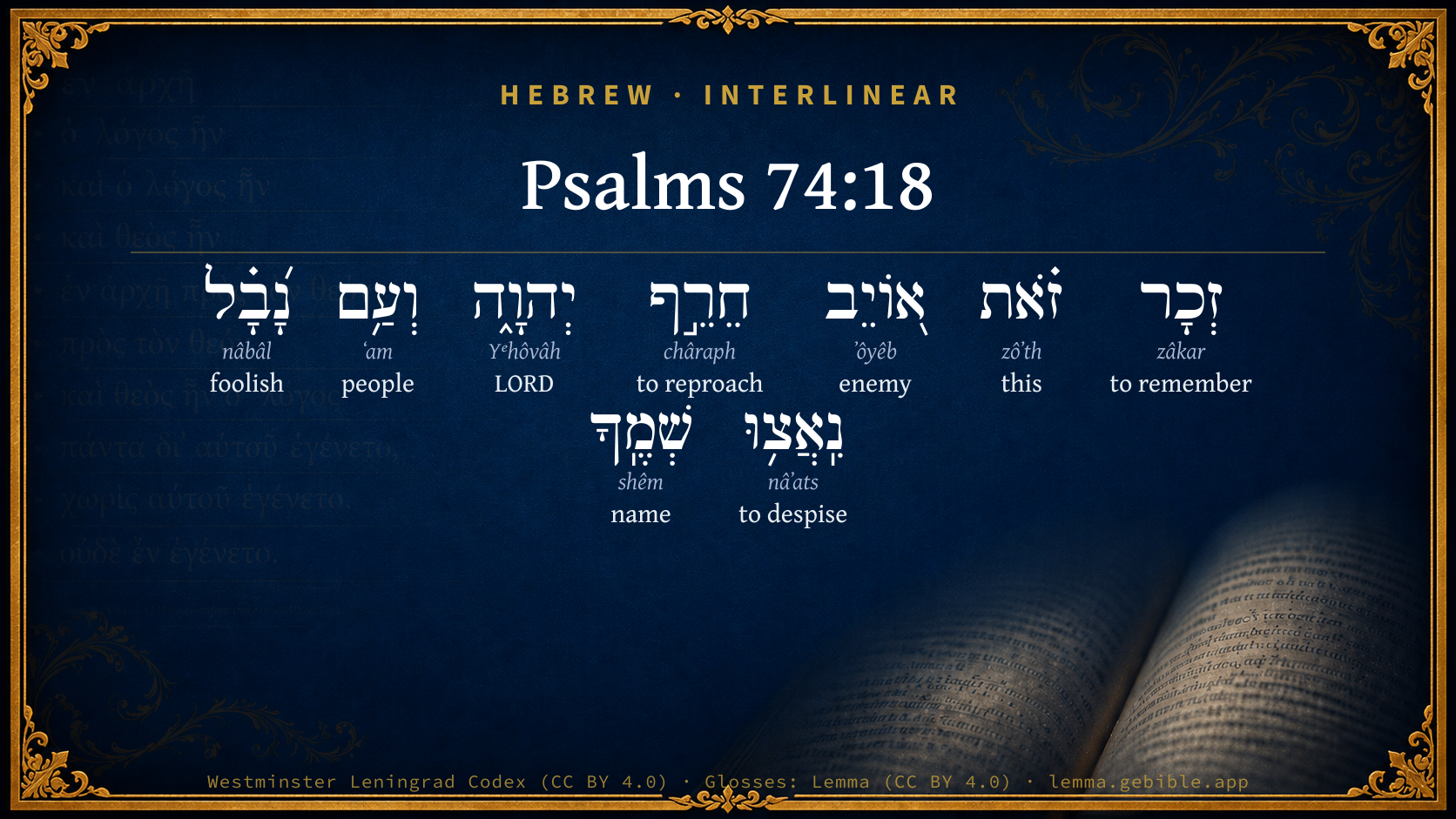
Hebrew (Westminster Leningrad Codex) Psalms 74:18 appears in the Hebrew Old Testament. The text above is from the Westminster Leningrad Codex. Each word links to its Strong’s number, a concise gloss, and parsing drawn from the Open Scriptures Hebrew Bible morphology. Click any word for its full Brown-Driver-Briggs (BDB) entry.
Download image
Cite this verse

Psalms 74:18 (World English Bible). Public Domain. Lemma interlinear Bible study tool, https://lemma.gebible.app/v/psalms/74/18.

Show BibTeX & RIS
BibTeX
RIS
English Translation
Remember this, that the enemy has mocked you, Yahweh. Foolish people have blasphemed your name.
World English Bible · Public Domain
Download a study sheet

One document with this verse’s original text, its word-by-word gloss line, the meaning frame, cross-references with their text, attributed commentary, and full source and license credits — printable, and it pastes into notes with its structure intact.

This verse Autodidact and up

Study sheet (.html) Plain text (.txt)

A passage Seminary Student

Up to 50 verses in one chapter. A passage sheet keeps up to 6 commentary sources and 12 cross-references per verse, in the order this page ranks them, and says so on the sheet whenever that leaves anything out. Ask for a single verse and you get the Autodidact verse sheet above.

Everything on this page stays free to read, with no account — the sheet is a download of what is already on screen, not access to it.

Want to remove ads? Support Godless Engineer
Compare translations 3

The same verse in 3 English versions, stacked beneath the original-language interlinear above. Click any original word for its lexicon entry.

Each is an independent rendering of the whole verse — the interlinear is not word-aligned to these translations.

Highlighted words mark where these versions differ — a whole-verse word diff, not a word-by-word alignment.

  • World English Bible Public Domain
    Remember this, that the enemy has mocked you, Yahweh. Foolish people have blasphemed your name.
  • King James Version Public Domain
    Remember this, that the enemy hath reproached, O LORD, and that the foolish people have blasphemed thy name.
  • unfoldingWord Literal Text CC BY-SA 4.0
    Remember this: the enemy has reproached Yahweh, and a foolish people has despised your name.

unfoldingWord Literal Text — © unfoldingWord, licensed CC BY-SA 4.0. Word-aligned USFM3 via Door43 (git.door43.org/unfoldingWord/en_ult).

Versions to compare (up to 4)

3 of 4 selected

Show all 18 translations

Every available English version of this verse, each an independent rendering of the whole verse.

  • World English Bible Public Domain
    Remember this, that the enemy has mocked you, Yahweh. Foolish people have blasphemed your name.
  • Berean Standard Bible Public Domain
    Remember how the enemy has mocked You, O LORD, how a foolish people has spurned Your name.
  • Majority Standard Bible Public Domain
    Remember how the enemy has mocked You, O LORD, how a foolish people has spurned Your name.
  • King James Version Public Domain
    Remember this, that the enemy hath reproached, O LORD, and that the foolish people have blasphemed thy name.
  • American Standard Version (1901) Public Domain
    Remember this, that the enemy hath reproached, O Jehovah, And that a foolish people hath blasphemed thy name.
  • Revised Version (1885) Public Domain
    Remember this, that the enemy hath reproached, O LORD, and that foolish people have blasphemed thy name.
  • Geneva Bible (1599) Public Domain
    Remember this, that the enemie hath reproched the Lord, and the foolish people hath blasphemed thy Name.
  • Douay-Rheims (1899) Public Domain
    Remember this, the enemy hath reproached the Lord: and a foolish people hath provoked thy name.
  • Young's Literal Translation Public Domain
    Remember this -- an enemy reproached Jehovah, And a foolish people have despised Thy name.
  • Literal Standard Version CC BY-SA 4.0
    Remember this—an enemy reproached YHWH, || And a foolish people have despised Your Name.
  • Unlocked Literal Bible CC BY-SA 4.0
    Call to mind how the enemy hurled insults at you, Yahweh, and that a foolish people has blasphemed your name.
  • unfoldingWord Literal Text CC BY-SA 4.0
    Remember this: the enemy has reproached Yahweh, and a foolish people has despised your name.
  • Darby Bible Public Domain
    Remember this, that an enemy hath reproached Jehovah, and a foolish people have contemned thy name.
  • World Messianic Bible Public Domain
    Remember this, that the enemy has mocked you, LORD. Foolish people have blasphemed your name.
  • Webster's Bible Public Domain
    Remember this, the enemy hath reproached, O LORD, and the foolish people have blasphemed thy name.
  • Free Bible Version CC BY-SA 4.0
    So keep in mind how the enemy ridiculed you, Lord, and how irreverent people insulted your reputation.
  • Bible in Basic English Public Domain
    Keep this in mind, O Lord, that your haters have said cruel things, and that your name has been looked down on by a people of evil behaviour.
  • JPS Tanakh (1917) Public Domain
    Remember this, how the enemy hath reproached the LORD, and how a base people have blasphemed Thy name.

Literal Standard Version (2020), Covenant Press — licensed CC BY-SA 4.0. Text via the HelloAO Bible API (eBible.org). Unlocked Literal Bible (unfoldingWord) — licensed CC BY-SA 4.0. Text via the HelloAO Bible API (eBible.org). unfoldingWord Literal Text — © unfoldingWord, licensed CC BY-SA 4.0. Word-aligned USFM3 via Door43 (git.door43.org/unfoldingWord/en_ult). Free Bible Version, Dr. Jonathan Gallagher — licensed CC BY-SA 4.0. Text via the HelloAO Bible API (eBible.org).

Word by word

More ways to search: Search by grammar → Find every occurrence → Compare this word →

Practice this passage: Drill this verse → Learn its vocabulary →

About this verse

These counts appear in no published source. They are computed here, from the morphology-tagged text and Lemma’s own curated glosses. What Lemma adds →

9
words
9
distinct lemmas
Wisdom
section

Notable vocabulary

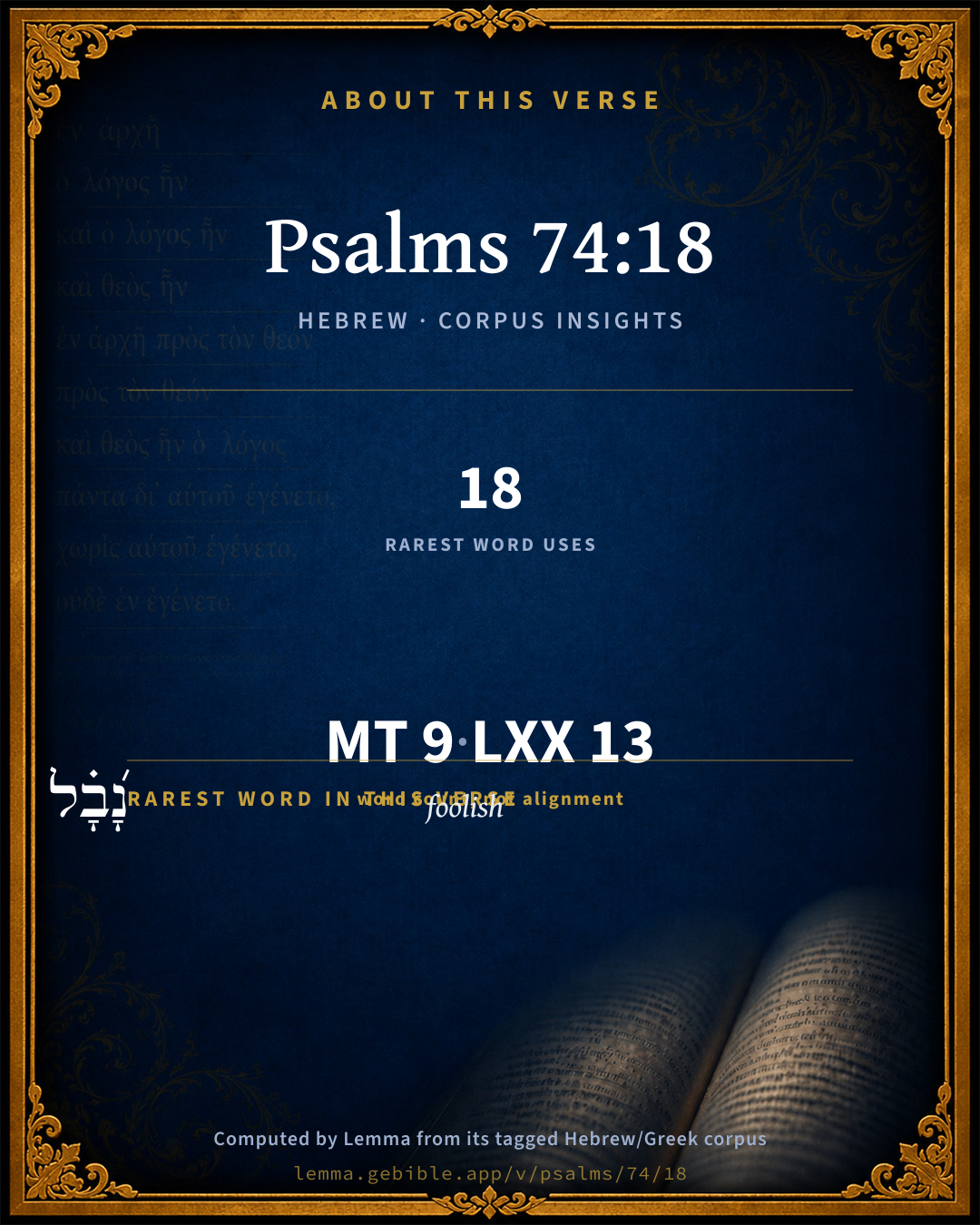
The rarest word here is נָ֝בָ֗ל foolish H5036 — appearing just 18 times in the whole Hebrew Bible.

Shared distinctive vocabulary

נָ֝בָ֗ל foolish H5036 occurs in 18 verses of the Hebrew Bible. Also found in:

Grammatical profile

  • 4 verbs
  • 3 nouns
  • 1 adjective
  • 1 pronoun

Verb forms

  • זְכָר Qal · Imperative
  • א֭וֹיֵב Qal · Participle Active
  • חֵרֵ֣ף Piel · Perfect
  • נִֽאֲצ֥וּ Piel · Perfect

Hebrew & Septuagint length

In English translation the verse runs 15 words from the Hebrew and 18 from the Septuagint (LXX English) — closely comparable.

A rough comparison of the two English renderings, which tokenize alike — not a word-level alignment.

Word counts can differ between the Hebrew and the Greek without any difference in meaning — e.g. the Hebrew direct-object marker אֵת has no separate Greek word, and Greek often adds the article ὁ.

In the original languages it is 9 Hebrew tokens and 13 Greek tokens — but the two are counted differently (Hebrew bundles its prefixes and suffixes into one token; the Greek is in lemma form), so that isn’t a like-for-like length.

Cross-references

12

Topical passages linked to Psalms 74:18 in the Treasury of Scripture Knowledge — connected by theme and wording, ordered by reader-vote popularity; previews shown in the World English Bible.

  • Psalms 39:8 Deliver me from all my transgressions. Don't make me the reproach of the foolish.
  • Deuteronomy 32:6 Do you thus requite Yahweh, Foolish people and unwise? Isn't he your father who has bought you? He has made you, and established you.
  • Revelation 16:19 The great city was divided into three parts, and the cities of the nations fell. Babylon the great was remembered in the sight of God, to give to her the cup of the wine of the fierceness of his wrath.
  • Deuteronomy 32:27 Were it not that I feared the provocation of the enemy, Lest their adversaries should judge wrongly, Lest they should say, Our hand is exalted, Yahweh has not done all this.
  • Psalms 41:1 Blessed is he who considers the poor: Yahweh will deliver him in the day of evil.
  • Psalms 74:22 Arise, God! Plead your own cause. Remember how the foolish man mocks you all day.
  • Psalms 89:50–51 Remember, Lord, the reproach of your servants, How I bear in my heart the taunts of all the mighty peoples,
  • Psalms 94:2–8 Rise up, you judge of the earth. Pay back the proud what they deserve.
  • Psalms 137:7 Remember, Yahweh, against the children of Edom, The day of Jerusalem; Who said, "Raze it! Raze it even to its foundation!"
  • Isaiah 37:23–24 Whom have you defied and blasphemed? and against whom have you exalted your voice and lifted up your eyes on high? [even] against the Holy One of Israel.
  • Isaiah 62:6–7 I have set watchmen on your walls, Jerusalem; they shall never hold their peace day nor night: you who call on Yahweh, take no rest,
  • Ezekiel 20:14 But I worked for my name's sake, that it should not be profaned in the sight of the nations, in whose sight I brought them out.

Cross-references courtesy of OpenBible.info (CC BY 4.0).

Hebrew and Greek witnesses Masoretic Hebrew ↔ Greek Septuagint

The same verse in the two great witnesses to the Old Testament, shown verse-for-verse.

You’re reading Greek Psalm 73 (Hebrew Psalm 74). The Septuagint counts the superscription, so verse numbers can differ from the Hebrew — chapter-level alignment, not verse-by-verse. Numbering follows Rahlfs.

These are two independent witnesses, not word-aligned to each other, and the Septuagint is shown in lemma (dictionary) form.

Hebrew Psalms 74:18 Masoretic · Westminster Leningrad Codex

זְכָר זֹ֗את א֭וֹיֵב חֵרֵ֣ף יְהוָ֑ה וְעַ֥ם נָ֝בָ֗ל נִֽאֲצ֥וּ שְׁמֶֽךָ

Remember this, that the enemy has mocked you, Yahweh. Foolish people have blasphemed your name.

World English Bible · Public Domain

Greek LXX Greek Psalm 73:18 Septuagint · lemma form

μιμνήσκω οὗτος ἐχθρός ὀνειδίζω ὁ κύριος καί λαός ἄφρων παραὀξύνω ὁ ὄνομα σύ

Remember this your creation: an enemy has reproached the Lord, and a foolish people has provoked your name.

LXX2012 (modern English Septuagint) · Public Domain

Hebrew: Westminster Leningrad Codex (CC BY 4.0). Greek: Septuagint (public domain); English from LXX2012 (modern English Septuagint) (Public Domain). How the Septuagint differs from the Hebrew →

Commentary

Notes on Psalms 74:18 from classic Christian and Jewish commentators (each source and its license shown beneath its notes). The classic Christian expositions comment on the surrounding passage and are grouped to its opening verse, so a note may address several verses; the Jewish commentaries on the Tanakh (Rashi and others) are per-verse, so they appear only where the commentator wrote on this verse.

Lemma curates 59 commentaries, every one of them public domain or Creative Commons licensed, each selected and text-cleaned for this edition rather than reprinted as found. About our sources →

Matthew Henry's Commentary

The psalmist here, in the name of the church, most earnestly begs that God would appear fro them against their enemies, and put an end to their present troubles. To encourage his own faith, he interests God in this matter (Psa 74:22): Arise, O God! plead thy own cause. This we may be sure he will do, for he is jealous for his own honour; whatever is his own cause he will plead it with a strong hand, will appear against those that oppose it and with and for those that cordially espouse it. He will arise and plead it, though for a time he seems to neglect it; he will stir up himself, will manifest himself, will do his own work in his own time. Note, The cause of religion is God's own cause and he will certainly plead it. Now, to make it out that the cause is God's, he pleads,

I. That the persecutors are God's sworn enemies: "Lord, they have not only abused us, but they have been, and are, abusive to thee; what is done against us, for thy sake, does, by consequence, reflect upon thee. But that is not all; they have directly and immediately reproached thee, and blasphemed thy name," Psa 74:18. This was that which they roared in the sanctuary; they triumphed as if they had now got the mastery of the God is Israel, of whom they had heard such great things. As nothing grieves the saints more than to hear God's name blasphemed, so nothing encourages them more to hope that God will appear against their enemies than when they have arrived at such a pitch of wickedness as to reproach God himself; this fills the measure of their sins apace and hastens their ruin. The psalmist insists much upon this: "We dare not answer their reproaches; Lord, do thou answer them. Remember that the foolish people have blasphemed thy name (Psa 74:18) and that still the foolish man reproaches thee daily." Observe the character of those that reproach God; they are foolish. As atheism is folly (Psa 14:1), profaneness and blasphemy are no less so. Perhaps those are cried up as the wits of the age that ridicule religion and sacred things; but really they are the greatest fools, and will shortly be made to appear so before all the world. And yet see their malice - They reproach God daily, as constantly as his faithful worshippers pray to him and praise him; see their impudence - They do not hide their blasphemous thoughts in their own bosoms, but proclaim them with a loud voice (forget not the voice of thy enemies, Psa 74:23), and this with a daring defiance of divine justice; they rise up against thee, and by their blasphemies even wage war with heaven and take up arms against the Almighty. Their noise and tumult ascend continually (so some), as the cry of Sodom came up before God, calling for vengeance, Gen 18:21. It increases continually (so we read it); they grow worse and worse, and are hardened in their impieties by their successes. Now, Lord, remember this; do not forget it. God needs not to be put in remembrance by us of what he has to do, but thus we must show our concern for his honour and believe that he will vindicate us.

II. That the persecuted are his covenant-people. 1. See what distress they are in. They have fallen into the hands of the multitude of the wicked, Psa 74:19. How are those increased that trouble them! There is no standing before an enraged multitude, especially like these, armed with power; and, as they are numerous, so they are barbarous: The dark places of the earth are full of the habitations of cruelty. The land of the Chaldeans, where there was none of the light of the knowledge of the true God (though otherwise it was famed for learning and arts), was indeed a dark place; the inhabitants of it were alienated from the life of God through the ignorance that was in them, and therefore they were cruel: where there was no true divinity there was scarcely to be found common humanity. They were especially cruel to the people of God; certainly those have no knowledge who eat them up, Psa 14:4. They are oppressed (Psa 74:21) because they are poor and unable to help themselves; they are oppressed, and so impoverished and made poor. 2. See what reason they had to hope that God would appear for their relief and not suffer them to be always thus trampled upon. Observe how the psalmist pleads with God for them. (1.) "It is thy turtle-dove that is ready to be swallowed up by the multitude of the wicked," Psa 74:19. The church is a dove for harmlessness and mildness, innocency and inoffensiveness, purity and fruitfulness, a dove for mournfulness in a day of distress, a turtle-dove for fidelity and the constancy of love: turtle-doves and pigeons were the only fowls that were offered in sacrifice to God. "Shall thy turtle-dove, that is true to thee and devoted to thy honour, be delivered, its life and soul and all, into the hand of the multitude of the wicked, to whom it will soon become an easy and acceptable prey? Lord, it will be thy honour to help the weak, especially to help thy own." (2.) "It is the congregation of thy poor, and they are not the less thine for their being poor (for God has chosen the poor of this world, Jam 2:5), but they have the more reason to expect thou wilt appear for them because they are many: it is the congregation of thy poor; let them not be abandoned and forgotten for ever." (3.) "They are in covenant with thee; and wilt thou not have respect unto the covenant? Psa 74:20. Wilt thou not perform the promises thou hast, in thy covenant, made to them? Wilt thou not own those whom thou hast brought into the bond of the covenant?" When God delivers his people it is in remembrance of his covenant, Lev 26:42. "Lord, though we are unworthy to be respected, yet have respect to the covenant." (4.) "They trust in thee, and boast of their relation to thee and expectations from thee. O let not them return ashamed of their hope (Psa 74:21), as they will be if they be disappointed." (5.) "If thou deliver them, they will praise thy name and give thee the glory of their deliverance. Appear, Lord, for those that will praise thy name, against those that blaspheme it."

Matthew Henry's Commentary on the Whole Bible (1708–1710) — public domain (CC PDM 1.0). Text via the HelloAO Bible API.

Trapp's Complete Commentary

John Trapp

Psa 74:18 Remember this, [that] the enemy hath reproached, O LORD, and [that] the foolish people have blasphemed thy name.

Ver. 18. Remember this] Forgetfulness befalleth not the Lord; nevertheless he giveth us leave to be his remembrancers, and not to keep silence when he is concerned, Isa 62:6.

That the enemy] See Psa 74:10.

And that the foolish people have blasphemed thy name] This irketh the saints worse than their own particular sufferings. The Egyptians, out of their respect to their Mercurius Trismegistus , would not rashly pronounce his name; no more would the Grecians their god Jupiter, no, not when they sware by him. Should not we be much more tender and respective of the holy and reverend name of our God, taking it ill when by any it is blasphemed?

John Trapp, A Commentary or Exposition upon All the Books of the Old and New Testament (1647–1656) — public domain. Text from a community e-Sword module.

Joseph Benson's Commentary

Psa 74:18. Remember this, that the enemy hath reproached thee — Though we deserve to be forgotten and destroyed, yet remember thyself, and do not suffer thine and our enemies to reproach and blaspheme the name of that great and glorious Being, the Creator and sovereign Lord of the whole world, whom they ought always to reverence and adore; and that the foolish people have blasphemed thy name — Who, though they think themselves, and are thought by others, to be wise, yet in truth are fools, and herein show their stupendous folly, that they vilify and provoke that God whose powerful anger they can neither resist, nor escape, nor endure.

Joseph Benson's Commentary on the Old and New Testaments (1811–1818) — public domain. Text from a community e-Sword module.

J. A. Alexander on Psalms

Joseph Addison Alexander

Psa 74:18. Remember this; an enemy has reviled Jehovah, and a foolish people have contemned thy name. For the meaning of the verbs see above on Psa 74:10, where the same facts are alleged, but are here recalled to God's remembrance as a reason for his interposition. Jehovah may also be construed as a vocative, which makes the parallelism more exact. Foolish, in the strong sense of that word, as used in Scripture, to denote the irrationality of sin. See above, on Psa 14:1, and compare Deu 32:6, from which place the whole phrase is borrowed.

Joseph Addison Alexander, The Psalms Translated and Explained (1850) — public domain. Text from a community e-Sword module.

Adam Clarke's Commentary

Verse 18. Remember this] The heathen not only deny these things, but give the honour of them to their false gods, and thus blaspheme thy name.

Adam Clarke's Commentary on the Bible (1810–1826) — public domain. Text from a community e-Sword/MySword module.

John Calvin's Commentaries

18. Remember this. The prophet having encouraged the hearts of the godly by magnifying the divine power and goodness, now returns to the prosecution of his prayer. He first complains that the enemies of his people revile God, and yet continue unpunished. When he says, Remember this, the manner of expression is emphatic; and the occasion demanded it, for it is not a crime of small magnitude to treat with contumely the sacred name of God. For the sake of contrast, he states that it was a worthless or foolish people who thus presumed insolently to pour forth their reproaches against God. The Hebrew word נבל, nabal, denotes not only a foolish man, but also a wicked and infamous person. The prophet, therefore, justly describes the despisers of God as people who are vile and worthless.

John Calvin's Commentaries (1540-1563) — public domain. Text from the Calvin Translation Society English edition (1840s-50s) via the Christian Classics Ethereal Library (ccel.org). Calvin's coverage is partial (roughly two-thirds of the Bible); uncommented books and verses are honest gaps, never fabricated. The 19th-century editor's footnotes and remarks are omitted so the notes are faithfully Calvin's own voice.

Ellicott's Commentary for English Readers

(18) Remember this.—Emphatical; the object of the enemy’s reproach is the Being who has done all these mighty works, and is the author of all this wonderful world.

A Bible Commentary for English Readers, edited by Charles John Ellicott (1878–1897) — public domain. Text from a community e-Sword module.

The Cambridge Bible for Schools and Colleges

gen. ed. J. J. S. Perowne

18. the foolish people] R.V. a foolish people. The epithet denotes the moral perversity of opposition to God. Cp. Psa_14:1, note. It is applied to the heathen in Deu_32:21.

18–23. Emboldened by his contemplation of the power of God in history and in nature the Psalmist returns to prayer.

The Cambridge Bible for Schools and Colleges (gen. ed. J. J. S. Perowne; Cambridge University Press, 1878–1918) — public domain. Text from a community e-Sword module.

John Gill's Exposition

O deliver not the soul of thy turtledove,.... By which is meant the church, see Sol 2:14, which is comparable to this creature for its cleanness and purity, for its amiableness and beauty, for its harmlessness and innocence, for its modesty and meekness, for its affection and chastity to its mate, for its mournful and bemoaning voice for the loss of it, for its being a timorous and fearful creature, a weak one, and exposed to the prey of others; all which is true of the church, and may be applied to it: the Targum is,

"do not deliver the souls of them that teach thy law;''

the word having some affinity with "torah", the law; but Jarchi says, that Jonathan, in his Targum (which is not now extant) interprets it a turtle; the Syriac version, by the change of a letter, renders it, "the soul that confesseth thee": and the Arabic version, by a like change, and the addition of a letter, "the soul that knows thee"; all which, indeed, is applicable to the church of God; but our version expresses the true sense of the word, with which agree Jarchi, Kimchi, Ben Melech, and others: and it is a prayer of the church for herself; that the life of her members, their corporeal life (for not the soul, the better part, and its eternal concerns, are meant, which are safe in Christ's hands), might not be delivered

unto the multitude of the wicked, or "to the beast" (g); to persecutors comparable to lions and bears, and particularly the Romish antichrist, often called the beast in Rev 11:8, do not deliver

"to the people, who are like to the beasts of the field, the souls of, &c.:''

forget not the congregation of thy poor for ever; the church of God is a congregation of men gathered out of the world by effectual grace, and consists chiefly of such who are literally poor, and all of them are spiritually so, and are sensible of it; for the most part they are a poor and "afflicted" (h) people, as the word may be also rendered, which the church is made up of; and may seem by themselves and others to be forgotten of God, when under divine desertions, or under afflictions, and immediate help is not given; but they are not forgotten, and still less for ever; see Isa 49:14.

(g) "ferae", Montanus, Piscator; "bestiae", Musculus, Vatablus, Cocceius, Gejerus, Michaelis; "bestiis", V. L. (h) "afflictorum tuorum", Montanus, Vatablus, Tigurine version, Junius & Tremellius, Piscator, &c.

John Gill's Exposition of the Whole Bible (1746–1763) — public domain (CC PDM 1.0). Text via the HelloAO Bible API.

Albert Barnes' Notes on the Bible

Remember this, that the enemy hath reproached - Has used opprobrious and abusive words in regard to thee, and to thy people. The idea is, that religion - the true religion - had been reproached by the foe. They had treated that religion as if it were false; they had reproached God as if he were a false God, and as if he were unable to defend his people. Compare Isa 36:4-10, Isa 36:13-20; Isa 37:10-13, Isa 37:23. The prayer here is, that God would remember that these words of reproach were against himself, and that he would regard them as such.

And that the foolish people have blasphemed thy name - Have blasphemed thee - the name often being put for the person himself. The word “foolish” here may refer to them as “wicked” as well as foolish. Wickedness and folly are so connected - they are so commonly combined, that the word may be used to describe the enemies of God in either sense - characterising their conduct as either the one or the other. Compare the notes at Psa 14:1.

Albert Barnes' Notes on the Bible (1834–1885) — public domain. Text from a community e-Sword/MySword module.

Matthew Poole's English Annotations

Though we deserve to be forgotten and destroyed, yet remember thyself, and do not suffer thine and our enemies to reproach and blaspheme the name of that great and glorious God, the Creator and sovereign Lord of the whole world, whom they ought always to reverence and adore.

The foolish people; who, though they think themselves and are thought by others to be wise, yet in truth are fools, and herein show their stupendous folly, that they vilify and provoke that God whose powerful anger they can neither resist, nor escape, nor endure.

Matthew Poole's English Annotations on the Holy Bible (1683–1685) — public domain. Text from a community e-Sword/MySword module.

The Treasury of David

Charles H. Spurgeon

Ver. 18. Remember this, that the enemy hath reproached, O Lord. Against thee, the ever glorious Maker of all things, have they spoken, thine honour have they assailed, and defied even thee. This is forcible pleading indeed, and reminds us of Moses and Hezekiah in their intercessions: "What wilt thou do unto thy great name?" "It may be that the Lord thy God will hear the words of Rabshakeh, who hath reproached the living God." Jehovah is a jealous God, and will surely glorify his own name; here our hope finds foothold.

And that the foolish people have blasphemed thy name. The meanness of the enemy is here pleaded. Sinners are fools, and shall fools be allowed to insult the Lord and oppress his people; shall the abjects curse the Lord and defy him to his face. When error grows too bold its day is near, and its fall certain. Arrogance foreshadows ripeness of evil, and the next step is rottenness. Instead of being alarmed when bad men grow worse and more audacious, we may reasonably take heart, for the hour of their judgment is evidently near.

None.

None.

Psalms 74:19*

Charles H. Spurgeon's The Treasury of David (1869–1885) — public domain. Psalms only. Text from a community e-Sword/MySword module.

Whedon's Commentary on the Bible

Daniel D. Whedon

18. Remember this—The issue is between thee and these idolaters. They have reproached and blasphemed thy name. O consider this!

Daniel D. Whedon (gen. ed.), Commentary on the Old and New Testaments (1874–1909) — public domain. Text from a community e-Sword module.

The Pulpit Commentary

Vers. 18-23. In conclusion, the psalmist prays earnestly that God will deliver his people from their wicked oppressors (vers. 18, 19), that he will remember his covenant (ver. 20), cause the oppressed ones to praise him (ver. 21), and assert himself against those who insult and oppose him (vers. 22, 23).

Remember this, that the enemy hath reproached, O Lord, and that the foolish people have blasphemed thy Name. (comp. Lam_1:7 Lam_2:7, 15 16) Every nation of idolaters is a "foolish people" to the sacred writers, whatever cleverness or intellectual capacity it may possess. Nabal, the word translated "foolish," designates a folly that is closely akin to wickedness.

The Pulpit Commentary (1880–1919), ed. H.D.M. Spence-Jones & Joseph S. Exell — public domain. Text from a community e-Sword module.

John Wesley's Explanatory Notes

Remember - Though we deserve to be forgotten, yet do not suffer our enemies to reproach the name of the great and glorious God.

John Wesley, Explanatory Notes Upon the Whole Bible (1754–1765) — public domain. Text via the GEBible commentary corpus.

Keil & Delitzsch

C. F. Keil & F. Delitzsch

The poet, after he has thus consoled himself by the contemplation of the power of God which He has displayed for His people's good as their Redeemer, and for the good of the whole of mankind as the Creator, rises anew to prayer, but all the more cheerfully and boldly. Since ever present facts of creation have been referred to just now, and the historical mighty deeds of God only further back, זאת refers rather forwards to the blaspheming of the enemies which He suffers now to go on unpunished, as though He took no cognizance of it. חרף has Pasek after it in order to separate the word, which signifies reviling, from the most holy Name. The epithet עם־נבל reminds one of Deu 32:21. In Psa 74:19 according to the accents חיּת is the absolute state (the primary form of חיּה, vid., on Psa 61:1): give not over, abandon not to the wild beast (beasts), the soul of Thy turtle-dove. This is probably correct, since לחיּת נפשׁ, "to the eager wild beast," this inversion of the well-known expression נפשׁ חיּה, which on the contrary yields the sense of vita animae, is an improbable and exampleless expression. If נפשׁ were intended to be thus understood, the poet might have written אל־תתן לנפשׁ חיּה תורך, "give not Thy turtle-dove over to the desire of the wild beast." Hupfeld thinks that the "old, stupid reading" may be set right at one stroke, inasmuch as he reads אל תתן לנפש חית תורך, and renders it "give not to rage the life Thy turtle-dove;" but where is any support to be found for this לנפשׁ, "to rage," or rather (Psychology, S. 202; tr. p. 239) "to eager desire?" The word cannot signify this in such an isolated position. Israel, which is also compared to a dove in Psa 68:14, is called a turtle-dove (תּור). In Psa 74:19 חיּת has the same signification as in Psa 74:19, and the same sense as Psa 68:11 (cf. Ps 69:37): the creatures of Thy miserable ones, i.e., Thy poor, miserable creatures - a figurative designation of the ecclesia pressa. The church, which it is the custom of the Asaphic Psalms to designate with emblematical names taken from the animal world, finds itself now like sheep among wolves, and seems to itself as if it were forgotten by God. The cry of prayer הבּט לבּרית comes forth out of circumstances such as were those of the Maccabaean age. בּרית is the covenant of circumcision (Gen. 17); the persecution of the age of the Seleucidae put faith to the severe test, that circumcision, this sign which was the pledge to Israel of God's gracious protection, became just the sign by which the Syrians knew their victims. In the Book of Daniel, Dan 11:28, Dan 11:30, cf. Ps. 22:32, ברית is used directly of the religion of Israel and its band of confessors. The confirmatory clause Psa 74:20 also corresponds to the Maccabaean age, when the persecuted confessors hid themselves far away in the mountains (1 Macc. 2:26ff., 2 Macc. 6:11), but were tracked by the enemy and slain, - at that time the hiding-places (κρύφοι, 1 Macc. 1:53) of the land were in reality full of the habitations of violence. The combination נאות חמס is like נאות השׁלום, Jer 25:37, cf. Gen 6:11. From this point the Psalm draws to a close in more familiar Psalm - strains. אל־ישׁב, Psa 74:21, viz., from drawing near to Thee with their supplications. "The reproach of the foolish all the day" is that which incessantly goes forth from them. עלה תּמיד, "going up (Sa1 5:12, not: increasing, Kg1 22:35) perpetually," although without the article, is not a predicate, but attributive (vid., on Psa 57:3). The tone of the prayer is throughout temperate; this the ground upon which it bases itself is therefore all the more forcible.

Keil & Delitzsch — Biblical Commentary on the Old Testament (1861–1891) — public domain (CC PDM 1.0). Text via the HelloAO Bible API. (Old Testament only.)

unfoldingWord translationNotes

Door43 World Missions Community

General Information:

Asaph is pleading for God's help.

Call to mind

"Pay attention to." See how this is translated in Psalms 74:2. (See: Idiom)

the enemy hurled insults at you

Asaph speaks of insulting words as if they were physical objects, like stones, which the enemy was throwing at Yahweh. AT: "the enemy insulted you many times" (See: Metaphor)

the life of your dove

Asaph speaks of himself as if he were a dove, a defenseless bird. This phrase may also be a metaphor for the people of Israel. AT: "me, your dove" (See: Metaphor)

dove

A small, defenseless bird often kept as a pet.

a wild animal

This phrase may be a metaphor for the enemies of Israel. AT: "a savage enemy that is like a wild animal" (See: Metaphor)

Do not forget forever the life of your oppressed people

"Do not continue forever to do nothing to help your oppressed people." This can be stated in positive form. AT: "Come soon to help your oppressed people" (See: Litotes)

translationWords

call

mind

Yahweh

fool

people group

blasphemy

dove

oppress

eternity

unfoldingWord translationNotes — © Distant Shores Media and the Door43 World Missions Community, licensed CC BY-SA 4.0. Source: git.door43.org/Door43/en_tn.

Rashi

Rabbi Shlomo Yitzchaki (Rashi)

Remember how the enemy, etc. And since all our salvation is through You, remember how the enemy reviled You by destroying us.

Rashi on the Tanakh — English translations: “The Judaica Press complete Tanach with Rashi, translated by A. J. Rosenberg” (CC BY 4.0); “Pentateuch with Rashi's commentary by M. Rosenbaum and A.M. Silbermann, 1929-1934” (public domain); “The Metsudah Tanach series, Lakewood, N.J” (CC BY 4.0); and “The Book of Joshua, Metsudah Publications, 1997” (CC BY 4.0). Text via Sefaria.

Lesson kit

Teaching starters — assembled from the data on this page, not authored interpretation. Every prompt links to the verse data it draws on. Edit before teaching.

Psalms, in the Wisdom, opens this verse with 9 words (9 distinct Hebrew lemmas). Its most distinctive word is nâbâl (“foolish”). A historical commentator’s framing appears above. Read the whole chapter for the surrounding context.

Discussion questions

  1. What does “foolish” (nâbâl) contribute to the verse as a whole?
  2. Deuteronomy 32:6 shares the word «foolish» with this verse. How do the two illuminate each other?
  3. These translations render this verse differently. What is at stake in choosing one wording over another?
  4. The verb «זְכָר» is Qal Imperative. How does its form color the action?
  5. Reading how Matthew Henry's Commentary and Trapp's Complete Commentary read this verse, where do the two commentators agree and where do they part?

Things to notice

Reading settings

Reading text

Shown beneath each verse's original-language words.

Old Testament
Old Testament edition

Read the OT as the Masoretic Hebrew (MT) or the Greek Septuagint (LXX).

English shown for the Greek Septuagint (in the Hebrew ↔ Greek comparison).

Comparing translations? Open the Compare panel on any verse page to stack up to four side by side.