Esther 7:6

Hebrew (Westminster Leningrad Codex) Esther 7:6 appears in the Hebrew Old Testament. The text above is from the Westminster Leningrad Codex. Each word links to its Strong’s number, a concise gloss, and parsing drawn from the Open Scriptures Hebrew Bible morphology. Click any word for its full Brown-Driver-Briggs (BDB) entry.
Download image
Cite this verse

Esther 7:6 (World English Bible). Public Domain. Lemma interlinear Bible study tool, https://lemma.gebible.app/v/esther/7/6.

Show BibTeX & RIS
BibTeX
RIS
English Translation
Esther said, An adversary and an enemy, even this wicked Haman. Then Haman was afraid before the king and the queen.
World English Bible · Public Domain
Download a study sheet

One document with this verse’s original text, its word-by-word gloss line, the meaning frame, cross-references with their text, attributed commentary, and full source and license credits — printable, and it pastes into notes with its structure intact.

This verse Autodidact and up

Study sheet (.html) Plain text (.txt)

A passage Seminary Student

Up to 50 verses in one chapter. A passage sheet keeps up to 6 commentary sources and 12 cross-references per verse, in the order this page ranks them, and says so on the sheet whenever that leaves anything out. Ask for a single verse and you get the Autodidact verse sheet above.

Everything on this page stays free to read, with no account — the sheet is a download of what is already on screen, not access to it.

Want to remove ads? Support Godless Engineer
Compare translations 3

The same verse in 3 English versions, stacked beneath the original-language interlinear above. Click any original word for its lexicon entry.

Each is an independent rendering of the whole verse — the interlinear is not word-aligned to these translations.

Highlighted words mark where these versions differ — a whole-verse word diff, not a word-by-word alignment.

  • World English Bible Public Domain
    Esther said, An adversary and an enemy, even this wicked Haman. Then Haman was afraid before the king and the queen.
  • King James Version Public Domain
    And Esther said, The adversary and enemy is this wicked Haman. Then Haman was afraid before the king and the queen.
  • unfoldingWord Literal Text CC BY-SA 4.0
    Esther answered, “A man, an adversary, and an enemy—this evil Haman!” Then Haman was terrified from before the face of the king and the queen.

unfoldingWord Literal Text — © unfoldingWord, licensed CC BY-SA 4.0. Word-aligned USFM3 via Door43 (git.door43.org/unfoldingWord/en_ult).

Versions to compare (up to 4)

3 of 4 selected

Show all 18 translations

Every available English version of this verse, each an independent rendering of the whole verse.

  • World English Bible Public Domain
    Esther said, An adversary and an enemy, even this wicked Haman. Then Haman was afraid before the king and the queen.
  • Berean Standard Bible Public Domain
    Esther replied, “The adversary and enemy is this wicked man—Haman!” And Haman stood in terror before the king and queen.
  • Majority Standard Bible Public Domain
    Esther replied, “The adversary and enemy is this wicked man—Haman!” And Haman stood in terror before the king and queen.
  • King James Version Public Domain
    And Esther said, The adversary and enemy is this wicked Haman. Then Haman was afraid before the king and the queen.
  • American Standard Version (1901) Public Domain
    And Esther said, An adversary and an enemy, even this wicked Haman. Then Haman was afraid before the king and the queen.
  • Revised Version (1885) Public Domain
    And Esther said, An adversary and an enemy, even this wicked Haman. Then Haman was afraid before the king and the queen.
  • Geneva Bible (1599) Public Domain
    And Ester said, The aduersarie and enemie is this wicked Haman. Then Haman was afrayde before the King and the Queene.
  • Douay-Rheims (1899) Public Domain
    And Esther said: It is this Aman that is our adversary and most wicked enemy. Aman hearing this was forthwith astonished, not being able to bear the countenance of the king and of the queen.
  • Young's Literal Translation Public Domain
    And Esther saith, `The man -- adversary and enemy -- `is' this wicked Haman;' and Haman hath been afraid at the presence of the king and of the queen.
  • Literal Standard Version CC BY-SA 4.0
    And Esther says, “The man—adversary and enemy—[is] this wicked Haman”; and Haman has been afraid at the presence of the king and of the queen.
  • Unlocked Literal Bible CC BY-SA 4.0
    Esther said, “The hostile man, that enemy, is this evil Haman!” Then Haman was terrified before the king and the queen.
  • unfoldingWord Literal Text CC BY-SA 4.0
    Esther answered, “A man, an adversary, and an enemy—this evil Haman!” Then Haman was terrified from before the face of the king and the queen.
  • Darby Bible Public Domain
    And Esther said, The adversary and enemy is this wicked Haman. Then Haman was terrified before the king and the queen.
  • World Messianic Bible Public Domain
    Esther said, “An adversary and an enemy, even this wicked Haman!” Then Haman was afraid before the king and the queen.
  • Webster's Bible Public Domain
    And Esther said, The adversary and enemy is this wicked Haman. Then Haman was afraid before the king and the queen.
  • Free Bible Version CC BY-SA 4.0
    “The man, the opponent, the enemy, is this evil Haman!” Esther replied. Haman shook with terror in front of the king and the queen.
  • Bible in Basic English Public Domain
    And Esther said, Our hater and attacker is this evil Haman. Then Haman was full of fear before the king and the queen.
  • JPS Tanakh (1917) Public Domain
    And Esther said: 'An adversary and an enemy, even this wicked Haman.' Then Haman was terrified before the king and the queen.

Literal Standard Version (2020), Covenant Press — licensed CC BY-SA 4.0. Text via the HelloAO Bible API (eBible.org). Unlocked Literal Bible (unfoldingWord) — licensed CC BY-SA 4.0. Text via the HelloAO Bible API (eBible.org). unfoldingWord Literal Text — © unfoldingWord, licensed CC BY-SA 4.0. Word-aligned USFM3 via Door43 (git.door43.org/unfoldingWord/en_ult). Free Bible Version, Dr. Jonathan Gallagher — licensed CC BY-SA 4.0. Text via the HelloAO Bible API (eBible.org).

Word by word

More ways to search: Search by grammar → Find every occurrence → Compare this word →

Practice this passage: Drill this verse → Learn its vocabulary →

נִבְעַ֔ת
bâʻath
H1204
“to terrify”
Verb, Niphal, Perfect, 3rd Person, Masculine, Singular
Part of Speech
Verb
Stem
Niphal
Form
Perfect
Person
3rd Person
Gender
Masculine
Number
Singular
Full BDB Definition

Origin: a primitive root

TWOT: 265

to terrify, startle, fall upon, dismay, be overtaken by sudden terror - (Niphal) to be terrified - (Piel) - to fall upon, overwhelm - to terrify
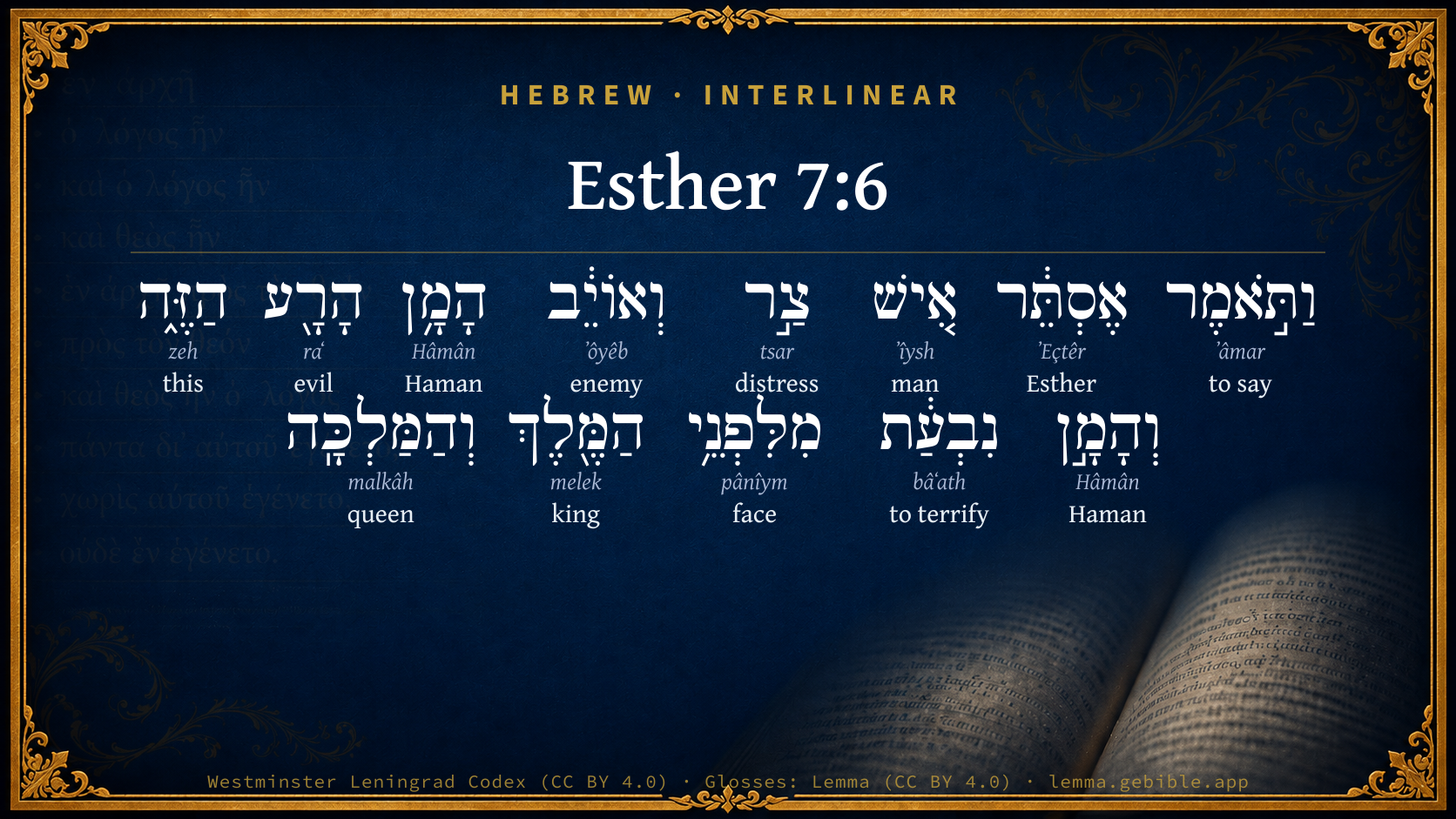
  1. וַתֹּ֣אמֶר ʼâmar H559 “and · to say” Conjunction + Verb, Qal, Sequential Imperfect, 3rd Person, Feminine, Singular
  2. אֶסְתֵּ֔ר ʼEçtêr H635 “Esther” Noun, Proper
  3. אִ֚ישׁ ʼîysh H376 “man” Noun, Common, Masculine, Singular, Absolute
  4. צַ֣ר tsar H6862 “distress” Noun, Common, Masculine, Singular, Absolute
  5. וְאוֹיֵ֔ב ʼôyêb H341 “and · enemy” Conjunction + Verb, Qal, Participle Active, Masculine, Singular, Absolute
  6. הָמָ֥ן Hâmân H2001 “Haman” Noun, Proper
  7. הָרָ֖ע raʻ H7451 “the · evil” Particle, Definite Article + Adjective, Adjective, Masculine, Singular, Absolute
  8. הַזֶּ֑ה zeh H2088 “the · this” Particle, Definite Article + Pronoun, Demonstrative, Masculine, Singular
  9. וְהָמָ֣ן Hâmân H2001 “and · Haman” Conjunction + Noun, Proper
  10. מִלִּפְנֵ֥י pânîym H6440 “from · to/for · face(s) of” Preposition + Preposition + Noun, Common, Both, Plural, Construct
  11. הַמֶּ֖לֶךְ melek H4428 “the · king” Particle, Definite Article + Noun, Common, Masculine, Singular, Absolute
  12. וְהַמַּלְכָּֽה malkâh H4436 “and · the · queen” Conjunction + Particle, Definite Article + Noun, Common, Feminine, Singular, Absolute

About this verse

These counts appear in no published source. They are computed here, from the morphology-tagged text and Lemma’s own curated glosses. What Lemma adds →

13
words
12
distinct lemmas
Historical
section

Notable vocabulary

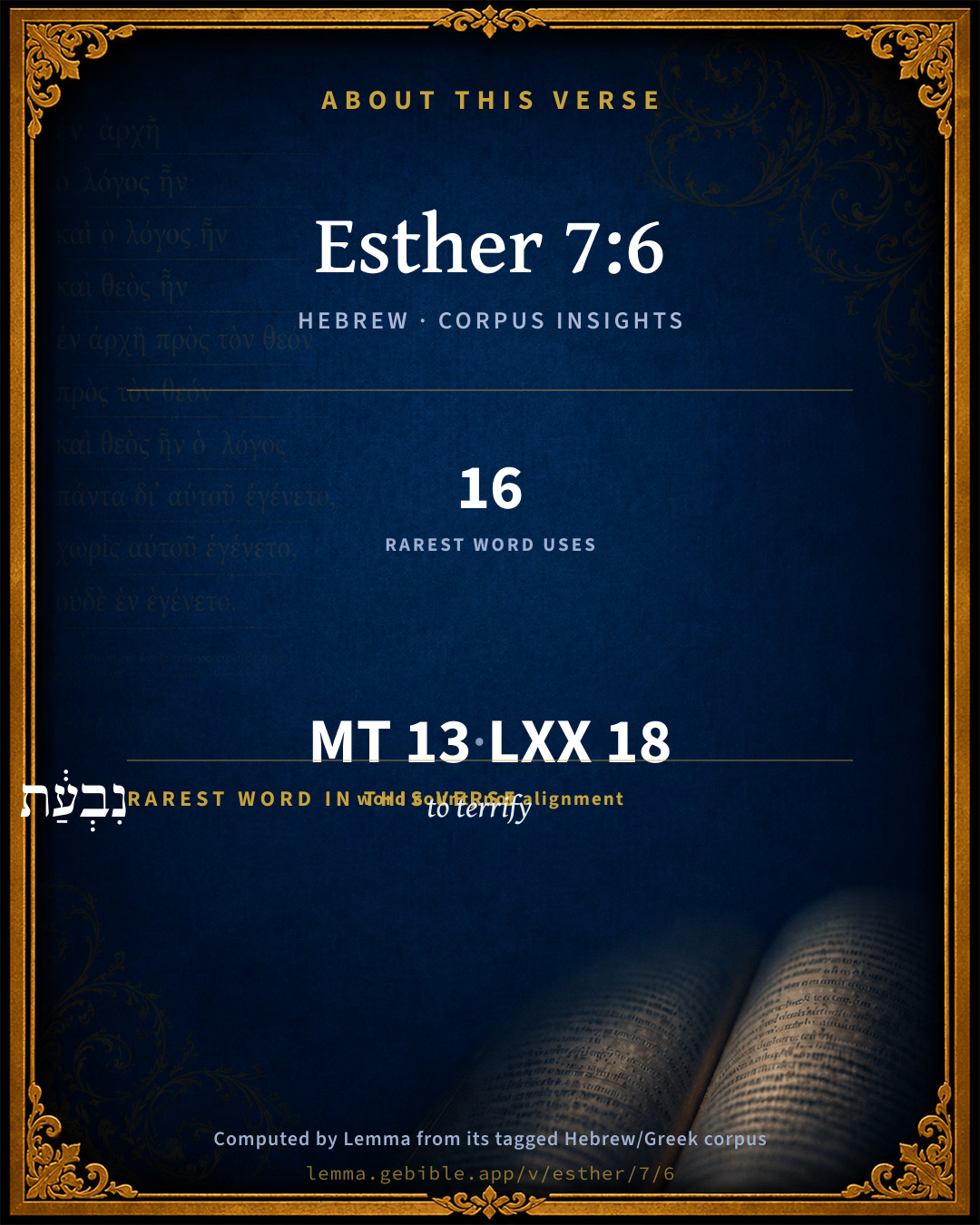
The rarest word here is נִבְעַ֔ת to terrify H1204 — appearing just 16 times in the whole Hebrew Bible.

Shared distinctive vocabulary

נִבְעַ֔ת to terrify H1204 occurs in 16 verses of the Hebrew Bible. Also found in:

Grammatical profile

  • 3 verbs
  • 8 nouns
  • 1 adjective
  • 1 pronoun

Verb forms

  • וַתֹּ֣אמֶר Qal · Sequential Imperfect
  • וְאוֹיֵ֔ב Qal · Participle Active
  • נִבְעַ֔ת Niphal · Perfect

Repetition

A word recurs within this verse — often emphatic in Hebrew:

  • הָמָ֥ן Haman H2001 ×2

Hebrew & Septuagint length

In English translation the verse runs 21 words from the Hebrew and 20 from the Septuagint (LXX English) — closely comparable.

A rough comparison of the two English renderings, which tokenize alike — not a word-level alignment.

Word counts can differ between the Hebrew and the Greek without any difference in meaning — e.g. the Hebrew direct-object marker אֵת has no separate Greek word, and Greek often adds the article ὁ.

In the original languages it is 13 Hebrew tokens and 18 Greek tokens — but the two are counted differently (Hebrew bundles its prefixes and suffixes into one token; the Greek is in lemma form), so that isn’t a like-for-like length.

Cross-references

16

Topical passages linked to Esther 7:6 in the Treasury of Scripture Knowledge — connected by theme and wording, ordered by reader-vote popularity; previews shown in the World English Bible.

  • Job 18:5–12 "Yes, the light of the wicked shall be put out, The spark of his fire shall not shine.
  • Psalms 139:19–22 If only you, God, would kill the wicked. Get away from me, you bloodthirsty men!
  • 1 Corinthians 5:13 But those who are outside, God judges. "Put away the wicked man from among yourselves."
  • 2 Thessalonians 2:8 Then the lawless one will be revealed, whom the Lord will kill with the breath of his mouth, and bring to nothing by the brightness of his coming;
  • 1 Samuel 24:13 As says the proverb of the ancients, Out of the wicked comes forth wickedness; but my hand shall not be on you.
  • Nehemiah 6:16 It happened, when all our enemies heard [of it], that all the nations that were about us feared, and were much cast down in their own eyes; for they perceived that this work was worked of our God.
  • Esther 3:10 The king took his ring from his hand, and gave it to Haman the son of Hammedatha the Agagite, the Jews' enemy.
  • Job 15:21–22 A sound of terrors is in his ears; In prosperity the destroyer shall come on him.
  • Psalms 27:2 When evil-doers came at me to eat up my flesh, Even my adversaries and my foes, they stumbled and fell.
  • Psalms 73:5–9 They are free from burdens of men, Neither are they plagued like other men.
  • Psalms 73:17–20 Until I entered God's sanctuary, And considered their latter end.
  • Proverbs 16:14 The king's wrath is a messenger of death, But a wise man will pacify it.
  • Proverbs 24:24–25 He who says to the wicked, "You are righteous;" Peoples shall curse him, and nations shall abhor him--
  • Ecclesiastes 5:8 If you see the oppression of the poor, and the violent taking away of justice and righteousness in a district, don't marvel at the matter: for one official is eyed by a higher one; and there are officials over them.
  • Isaiah 21:4 My heart flutters, horror has frightened me; the twilight that I desired has been turned into trembling to me.
  • Daniel 5:5–6 In the same hour came forth the fingers of a man's hand, and wrote over against the lampstand on the plaster of the wall of the king's palace: and the king saw the part of the hand that wrote.

Cross-references courtesy of OpenBible.info (CC BY 4.0).

Hebrew and Greek witnesses Masoretic Hebrew ↔ Greek Septuagint

The same verse in the two great witnesses to the Old Testament, shown verse-for-verse.

These are two independent witnesses, not word-aligned to each other, and the Septuagint is shown in lemma (dictionary) form.

Hebrew Esther 7:6 Masoretic · Westminster Leningrad Codex

וַתֹּ֣אמֶר אֶסְתֵּ֔ר אִ֚ישׁ צַ֣ר וְאוֹיֵ֔ב הָמָ֥ן הָרָ֖ע הַזֶּ֑ה וְהָמָ֣ן נִבְעַ֔ת מִלִּפְנֵ֥י הַמֶּ֖לֶךְ וְהַמַּלְכָּֽה

Esther said, An adversary and an enemy, even this wicked Haman. Then Haman was afraid before the king and the queen.

World English Bible · Public Domain

Greek LXX Esther 7:6 Septuagint · lemma form

εἶπον δέ εσθηρ ἄνθρωπος ἐχθρός αμαν ὁ πονηρός οὗτος αμαν δέ ταράσσω ἀπό ὁ βασιλεύς καί ὁ βασίλισσα

And Esther said, the adversary is Aman, this wicked man. Then Aman was troubled before the king and the queen.

LXX2012 (modern English Septuagint) · Public Domain

Hebrew: Westminster Leningrad Codex (CC BY 4.0). Greek: Septuagint (public domain); English from LXX2012 (modern English Septuagint) (Public Domain). How the Septuagint differs from the Hebrew →

Commentary

Notes on Esther 7:6 from classic Christian and Jewish commentators (each source and its license shown beneath its notes). The classic Christian expositions comment on the surrounding passage and are grouped to its opening verse, so a note may address several verses; the Jewish commentaries on the Tanakh (Rashi and others) are per-verse, so they appear only where the commentator wrote on this verse.

Lemma curates 59 commentaries, every one of them public domain or Creative Commons licensed, each selected and text-cleaned for this edition rather than reprinted as found. About our sources →

Trapp's Complete Commentary

John Trapp

Est 7:6 And Esther said, The adversary and enemy [is] this wicked Haman. Then Haman was afraid before the king and the queen.

Ver. 6. And Esther said] Now she found her time to strike while the iron was hot; she therefore layeth hold upon the opportunity that God had even thrust into her hand, and laying aside all base fear, pointeth out the enemy present, and painteth him out in his proper colours. A well chosen season, saith one, is the greatest advantage of any action; which as it is seldom found in haste, so it is too often lost in delay. It is not for Queen Esther now to drive off any longer. The negligent spirit cries, Cras, Domine. Tomorrow thou shalt pray for me, said Pharaoh to Moses. Fools are ever futuring, semper victuri, as Seneca hath it, but "a wise man’s heart discerneth both time and judgment," Ecc 8:5. The men of Issachar in David’s days were in great account, because they had understanding of the times to know what Israel ought to do, and when to do it, 1Ch 12:32.

The adversary] Heb. The man adversary, the Lycanthropos, the man of might that distresseth us, angustiator, that is, our calamity; as the people of Rome once, by an elegant solecism, cried out, Calamitas nostra Magnus est Our distress is great, meaning of it Pompey, surnamed Magnus.

And enemy] That is, the utter enemy, that sworn swordman of Satan, the old manslayer, from whom Haman hath drawn this ancient enmity, Gen 3:15.

Is this wicked Haman] Pessimus iste, such a most wicked one, this homo hominum quantum est, pessimus, homo post homines natos nequissimus, as wicked a man as goes on two legs, Bipedum nequissimus, a merum scelus, a man made up of mischief, a very breathing devil. Cicero telleth of one Tubulus, who was praetor a little before his time, so wicked a wretch, ut eius nomen non hominis sed vitii esse videretur, that his name seemed to be, not the name of a man, but of vice itself. And Josephus saith of Antipater, that his life was a very mystery of iniquity, Kακιας μυστηριον. Think the same of Haman, so portentously, so peerlessly wicked and malicious, that Esther can find no word bad enough for him, unless it be Harang, that naughtiest of all naughts; as St Paul could call sin no worse than by its own name, sinful sin, exceeding sinful, Rom 7:13. Tiberius was rightly characterized by his tutor Theodorus Gadareus, dirt kned with blood. Pηλος αιματι πεφυραμενος. Haman was such another, if not worse, and now he hears of it; for never till now did the man adversary hear his true title. Before some had styled him noble, others great; some magnificent, and some perhaps virtuous; only Esther gives him his own, wicked Haman. Ill deserving greatness doth in vain promise to itself a perpetuity of applause. There will be those that will deal plainly, and call a spade a spade. Thus Jeremiah dealt with Jehoiakim, and Ezekiel with Zedekiah, whom he calleth naught and polluted. Go, tell that fox, saith our Saviour, concerning Herod; and God shall smite thee, thou whited wall, saith Paul to Ananias. But what a courage had Esther to speak thus to the king, and of his favourite, and before his face! This was the work of her faith, and the fruit of her prayer.

Then Haman was afraid before the king and the queen] He was amazed and amated, troubled and terrified.

Obstupuit, steteruntque comae, vox faucibus haesit (Virg.).

In the fulness of his sufficiency he fell into straits, Job 20:22. So that being convinced in his own conscience that the queen’s accusation was very true, and that the king knew it to be so, he had nothing to say for himself, he was even gagged, as it were, or muzzled, as Mat 22:12-13, according to that of David, Psa 63:11, "the mouth of them that speak lies shall be stopped." And again, Psa 12:3, The Lord shall cut off lying lips, and the tongue that speaketh proud things. Here we see how suddenly wicked ones may be cast down upon the discovery of their wickedness, in the height of their pride, in the ruff of their jollity, as was Nebuchadnezzar, Belshazzar, Herod, Haman. Surely as thunder commonly is heard when the sky seemeth most clear; so this man saw himself enveloped in a storm in one of the fairest days that ever befell him.

John Trapp, A Commentary or Exposition upon All the Books of the Old and New Testament (1647–1656) — public domain. Text from a community e-Sword module.

Joseph Benson's Commentary

Est 7:6. Esther said, The enemy is this wicked Haman — It is he that has designed our murder, and I charge him with it before his face: here he is; let him speak for himself, for therefore he was invited. Then Haman was afraid before the king and the queen — It was time for him to fear, when the queen was his prosecutor, the king his judge, and his own conscience a witness against him; and the surprising operations of providence against him that same morning could not but increase his fear. Now he has little joy of his being invited to the banquet of wine, but finds himself in straits when he thought himself in the fulness of his sufficiency.

Joseph Benson's Commentary on the Old and New Testaments (1811–1818) — public domain. Text from a community e-Sword module.

Tyndale Open Study Notes

Tyndale Open Resources

7:6-7 Esther finally identified this wicked Haman as the enemy. • Haman grew pale with fright: With this surprising and aggressive accusation by the queen and the evident rage of the king, Haman’s doom suddenly became apparent.

Tyndale Open Study Notes — © Tyndale Open Resources, licensed CC BY-SA 4.0. Text via the HelloAO Bible API.

Ellicott's Commentary for English Readers

(6) Was afraid. . . .—Shrank back in terror before . . . See the use of the word in 1Ch_21:30; Dan_8:17.

A Bible Commentary for English Readers, edited by Charles John Ellicott (1878–1897) — public domain. Text from a community e-Sword module.

John Gill's Exposition

And Esther said, the adversary and enemy is this wicked Haman,.... Who was not only an enemy to her and her people, but an adversary to the king, by advising and persuading him to that which was to the loss of his revenues, as well as of his reputation; also, she pointed at him, and gave him his just character; her charge of wickedness upon him, as it was true, it was honourably made to his face before the king, of which, if he could, he had the opportunity of exculpating himself:

then Haman was afraid before the king and the queen; gave visible signs of his confusion, consternation, and trouble of mind, by the fall of his countenance, his pale looks, his trembling limbs, and quivering lips, being struck dumb, and not able to speak one word for himself.

John Gill's Exposition of the Whole Bible (1746–1763) — public domain (CC PDM 1.0). Text via the HelloAO Bible API.

Haydock's Catholic Bible Commentary

Astonished. Horror of a guilty conscience is the first punishment. (St. Chrysostom) (Worthington)

George Leo Haydock (1774–1849), Haydock's Catholic Family Bible and Commentary, 1859 edition — public domain. Excludes Psalms (Douay-Rheims chapter numbering differs from Protestant) and Deuterocanonical books (Catholic canon only).

Matthew Poole's English Annotations

The adversary and enemy of the king, and of my person and people.

Matthew Poole's English Annotations on the Holy Bible (1683–1685) — public domain. Text from a community e-Sword/MySword module.

Whedon's Commentary on the Bible

Daniel D. Whedon

6. This… Haman — With flashing eye and impassioned gesture the queen now boldly exposes the man whom yesterday her heart failed her to expose.

Daniel D. Whedon (gen. ed.), Commentary on the Old and New Testaments (1874–1909) — public domain. Text from a community e-Sword module.

The Pulpit Commentary

The adversary and enemy. Esther adds a second term of reproach stronger than the one which she had used before (ver. 4), to stir up the king to greater anger.

A changed attitude.

The priestess has risen from her knees, and appears suddenly transmuted into prosecutrix for herself and her people. The posture of prayer is exchanged for the full-drawn height. The suppliant attitude is replaced in a second by the defiant. Inclining arms, and hands clasped in prayer, are flung wide apart. The extended right hand points a finger of vigorous decision at Haman, that type of monstrous iniquity. The averted eye, shunning him, is to Ahasuerus, the present object of hope and trust. As one looks on from the distance, the tones scarcely heard just now have risen from suppliant earnestness to the pitch of indignant force and unmistaken denunciation. Such the transformation. And one token of genuineness, it was the work of an instant. The explanation of so violent a contrast and so rapid a change is the extreme opposite of any native fickleness, of any tendency to infidelity, of any unreality of heart. The opposed appearances are due to one fixed purpose, one imperious necessity, one unalterable religion. In the midst of most unpromising surroundings we seem to see here the long prostrate image of righteousness upraised again. Truth and goodness, oppressed and down-trodden without mercy, recover their standing. There rises in the centre before our vision what might seem a Divinely-sculptured form, for its beauty, its truth of outline, and its suddenness. Let us note some of its suggestions.

I IT STANDS FOR THE PRESENT A SOLITARY TESTIMONY TO REBUKE INIQUITY. Such has been almost always at the first, and often for a while, the history of integrity, of truth, of conscience. A unit of these heavenly forms appears. The individual is raised up. Strength is made perfect in the weakness of one. One has to bear, and bears the brunt. One has to do the work, and does it. One has to set the example, and show the way, and leap into the gulf, and unfurl the banner, and uplift the standard. ONE HANGS UPON THE CROSS. And there stands here, in the person of Esther denouncing the "wicked adversary Haman," one figure, absolutely alone, testifying rebuke of sin, and of the sin of the mighty. There are few positions more dangerous to the person who takes it than this. The one rebuker of the iniquity of the many, or of the powerful, needs to be sure of his cause, and supported by an informed conscience; otherwise he has little to expect from those on whom he visits rebuke.

II THE ATTITUDE OF IT HAS SUCCEEDED IMMEDIATELY TO THAT OF PRAYER. HOW many of the greatest works have, in point of historical fact, grown out of prayer. They have taken form after the silence and meditation of prayer. They have grown out of the strength given in answer to strong supplication and tears. The illustrations which Scripture offers are many, and are the beacons for us. But the illustrations of all history, and of our own lives, far surpass them in number.

III IT IS OF THE TYPE OF THE GENTLE AND WEAK AND DEPENDENT, THOUGH FOR ITS WORK ONE WOULD HAVE EXPECTED THE CONTRARY. At any time gentleness has its own proper force, tenderness its peculiar strength, and dependence can often summon a far vaster might to its service than any independence possesses of itself. But there are times when the feminine and the tender is manifestly endowed with an unusual force, and then it takes additional advantage from the background of weakness which belongs inherently to it. So now we are the more bound to study the reason of it when we find the eye of this one woman, with an unusual exercise of it, flashing a force of conviction which rends in twain the hard, gnarled courage of one of the worst of hearts, and shivers the flint. Tenderness is one thing, and strength another. Yet here we find the type of the one usurping the prerogative of the other, and to almost unequalled advantage. Not only "out of the mouths of babes and sucklings has God perfected praise;" but often does God choose "the weak things of the world to confound the things which are mighty." And so he brings it to light that it is not the force of man at all which really wins the victory, but the force of his truth, his goodness, his justice, HIMSELF.

IV THIS IS A FORM WHICH DIVIDES SO MUCH OF THE WORLD AS IS IN ITS PRESENCE INTO TWO GREAT PARTS. We have here a humble instance of what the cross of Christ did when it stood betwixt the two other crosses. It showed the world divided into the penitent and the impenitent, the believing and the unbelieving. So now the world is forced into one of two classes: there is he who consents to the judgment of Esther and will execute it, and there is he who is convicted and condemned irresistibly by it. The one consents with the deepest emotions, the other suffers conviction with a fear and trembling that positively incapacitate him from governing his actions or taking the most ordinary precaution. When truth and justice are the vision, the background being really nothing else than the sky, then the immediate consequences to all beholders are either those of consenting sympathy, or of stricken amazement and confusion of face. Seldom was the work of severance better done than by Esther now. Her form seems to bring the whole scene to life again, as though we were there. And the more we gaze, the more we justly wonder at the achievement of the moment, which shows Esther with finger pointed at Haman, and saying, "The adversary and enemy is this wicked Haman.

V THIS IS THE FORM OF CONVICTION LEFT MISTRESS OF THE SITUATION. The position is evidently in many respects more impressive than that which found Nathan confronting David, and saying, "Thou art the man." Nathan had a heart not callous, a conscience not lifelong injured, to deal with those of one man. How different the conditions of Esther"s task! What a contrast this moment to the moment when, after the fasting of herself, her maidens, and her people, she presented herself within sight of the despot, nor breathed freely till the golden sceptre was extended to her! Such the change for those who watch and pray, who pray and fight, who know and follow and trust the good that is above. They come to a point sometimes where all seems endangered, but prayer and trust and work convert that very time into the date of an exceeding great moral victory. Up to this time Esther had been a queen but in name; now she was a queen in deed and of a truth. The form of Esther is a very faint type, but a very true prophecy, of that great victory, which is ever drawing nearer, which shall show wickedness prostrate, righteousness supreme. B.

The Pulpit Commentary (1880–1919), ed. H.D.M. Spence-Jones & Joseph S. Exell — public domain. Text from a community e-Sword module.

John Wesley's Explanatory Notes

Afraid - And it was time for him to fear, when the queen was his prosecutor, the king his judge, his own conscience a witness against him. And the surprising turns of providence that very morning, could not but increase his fear.

John Wesley, Explanatory Notes Upon the Whole Bible (1754–1765) — public domain. Text via the GEBible commentary corpus.

unfoldingWord translationNotes

Door43 World Missions Community

was terrified

"was extremely afraid"

The king got up in a rage

Being in a rage is an idiom for being extremely angry. AT: "The king was extremely angry and got up" (See: Idiom)

to beg for his life from Queen Esther

"to beg Queen Esther to save his life"

He saw that disaster was being decided

Here seeing represents realizing or understanding. AT: "He realized that disaster was being decided" (See: Metaphor)

disaster was being decided against him by the king

This can be stated in active form. The abstract noun "disaster" can be expressed with the more concrete verbs "destroy" or "kill." AT: "the king was deciding to cause a disaster against him" or "the king was deciding to destroy him" (See: Active or Passive and Abstract Nouns)

translationWords

Esther

adversary

evil

wine

feast

beg

unfoldingWord translationNotes — © Distant Shores Media and the Door43 World Missions Community, licensed CC BY-SA 4.0. Source: git.door43.org/Door43/en_tn.

Lesson kit

Teaching starters — assembled from the data on this page, not authored interpretation. Every prompt links to the verse data it draws on. Edit before teaching.

Esther, in the Historical, opens this verse with 13 words (12 distinct Hebrew lemmas). Its most distinctive word is bâʻath (“to terrify”). A historical commentator’s framing appears above. Read the whole chapter for the surrounding context.

Discussion questions

  1. How does “to terrify” (bâʻath) shape what this verse is saying?
  2. 1 Samuel 16:14 shares the word «to terrify» with this verse. How do the two illuminate each other?
  3. “Haman” occurs 2× in this one verse. What is the effect of the repetition?
  4. The translations on this page render this verse differently — a whole-verse word diff, not a word-by-word alignment. What might account for the different wordings?
  5. The verb «וַתֹּ֣אמֶר» is Qal Sequential Imperfect. How does its form color the action?
  6. Reading how Trapp's Complete Commentary and Joseph Benson's Commentary read this verse, where do the two commentators agree and where do they part?

Things to notice

Reading settings

Reading text

Shown beneath each verse's original-language words.

Old Testament
Old Testament edition

Read the OT as the Masoretic Hebrew (MT) or the Greek Septuagint (LXX).

English shown for the Greek Septuagint (in the Hebrew ↔ Greek comparison).

Comparing translations? Open the Compare panel on any verse page to stack up to four side by side.