
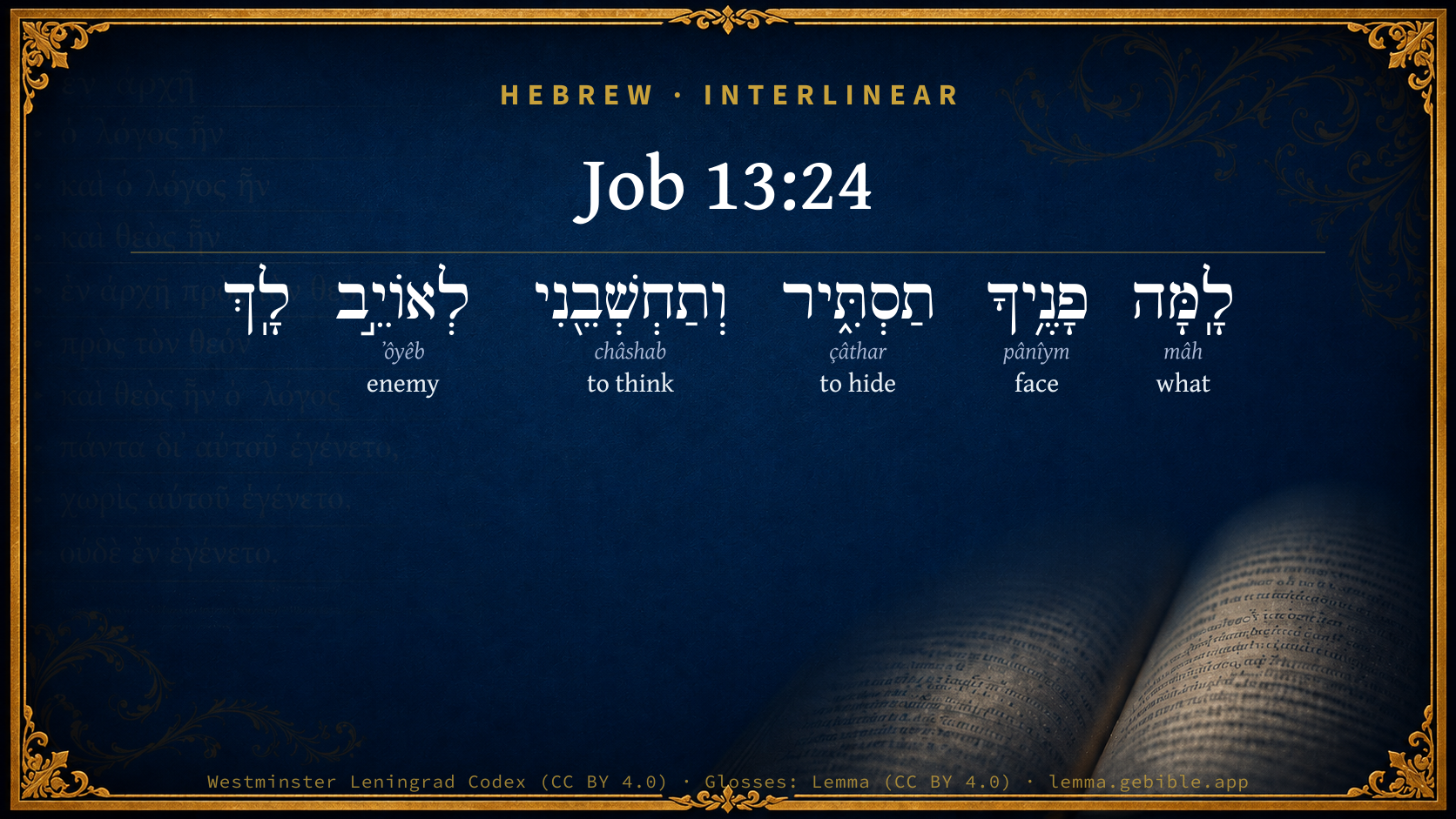
Job 13:24

Hebrew (Westminster Leningrad Codex) Job 13:24 appears in the Hebrew Old Testament. The text above is from the Westminster Leningrad Codex. Each word links to its Strong’s number, a concise gloss, and parsing drawn from the Open Scriptures Hebrew Bible morphology. Click any word for its full Brown-Driver-Briggs (BDB) entry.
Download image
Cite this verse

Job 13:24 (World English Bible). Public Domain. Lemma interlinear Bible study tool, https://lemma.gebible.app/v/job/13/24.

Show BibTeX & RIS
BibTeX
RIS
English Translation
Why hide you your face, And hold me for your enemy?
World English Bible · Public Domain
Download a study sheet

One document with this verse’s original text, its word-by-word gloss line, the meaning frame, cross-references with their text, attributed commentary, and full source and license credits — printable, and it pastes into notes with its structure intact.

This verse Autodidact and up

Study sheet (.html) Plain text (.txt)

A passage Seminary Student

Up to 50 verses in one chapter. A passage sheet keeps up to 6 commentary sources and 12 cross-references per verse, in the order this page ranks them, and says so on the sheet whenever that leaves anything out. Ask for a single verse and you get the Autodidact verse sheet above.

Everything on this page stays free to read, with no account — the sheet is a download of what is already on screen, not access to it.

Want to remove ads? Support Godless Engineer
Compare translations 3

The same verse in 3 English versions, stacked beneath the original-language interlinear above. Click any original word for its lexicon entry.

Each is an independent rendering of the whole verse — the interlinear is not word-aligned to these translations.

Highlighted words mark where these versions differ — a whole-verse word diff, not a word-by-word alignment.

  • World English Bible Public Domain
    Why hide you your face, And hold me for your enemy?
  • King James Version Public Domain
    Wherefore hidest thou thy face, and holdest me for thine enemy?
  • unfoldingWord Literal Text CC BY-SA 4.0
    Why do you hide your face and consider me an enemy to you?

unfoldingWord Literal Text — © unfoldingWord, licensed CC BY-SA 4.0. Word-aligned USFM3 via Door43 (git.door43.org/unfoldingWord/en_ult).

Versions to compare (up to 4)

3 of 4 selected

Show all 18 translations

Every available English version of this verse, each an independent rendering of the whole verse.

  • World English Bible Public Domain
    Why hide you your face, And hold me for your enemy?
  • Berean Standard Bible Public Domain
    Why do You hide Your face and consider me as Your enemy?
  • Majority Standard Bible Public Domain
    Why do You hide Your face and consider me as Your enemy?
  • King James Version Public Domain
    Wherefore hidest thou thy face, and holdest me for thine enemy?
  • American Standard Version (1901) Public Domain
    Wherefore hidest thou thy face, And holdest me for thine enemy?
  • Revised Version (1885) Public Domain
    Wherefore hidest thou thy face, and holdest me for thine enemy?
  • Geneva Bible (1599) Public Domain
    Wherefore hidest thou thy face, and takest me for thine enemie?
  • Douay-Rheims (1899) Public Domain
    Why hidest thou thy face, and thinkest me thy enemy?
  • Young's Literal Translation Public Domain
    Why dost Thou hide Thy face? And reckonest me for an enemy to Thee?
  • Literal Standard Version CC BY-SA 4.0
    Why do You hide Your face? And reckon me for an enemy to You?
  • Unlocked Literal Bible CC BY-SA 4.0
    Why do you hide your face from me and treat me like your enemy?
  • unfoldingWord Literal Text CC BY-SA 4.0
    Why do you hide your face and consider me an enemy to you?
  • Darby Bible Public Domain
    Wherefore dost thou hide thy face, and countest me for thine enemy?
  • World Messianic Bible Public Domain
    Why do you hide your face, and consider me your enemy?
  • Webster's Bible Public Domain
    Why hidest thou thy face, and holdest me for thy enemy?
  • Free Bible Version CC BY-SA 4.0
    Why are you unfriendly towards me? Why do you treat me as your enemy?
  • Bible in Basic English Public Domain
    Why is your face veiled from me, as if I was numbered among your haters?
  • JPS Tanakh (1917) Public Domain
    Wherefore hidest Thou Thy face, and holdest me for Thine enemy?

Literal Standard Version (2020), Covenant Press — licensed CC BY-SA 4.0. Text via the HelloAO Bible API (eBible.org). Unlocked Literal Bible (unfoldingWord) — licensed CC BY-SA 4.0. Text via the HelloAO Bible API (eBible.org). unfoldingWord Literal Text — © unfoldingWord, licensed CC BY-SA 4.0. Word-aligned USFM3 via Door43 (git.door43.org/unfoldingWord/en_ult). Free Bible Version, Dr. Jonathan Gallagher — licensed CC BY-SA 4.0. Text via the HelloAO Bible API (eBible.org).

Word by word

More ways to search: Search by grammar → Find every occurrence → Compare this word →

Practice this passage: Drill this verse → Learn its vocabulary →

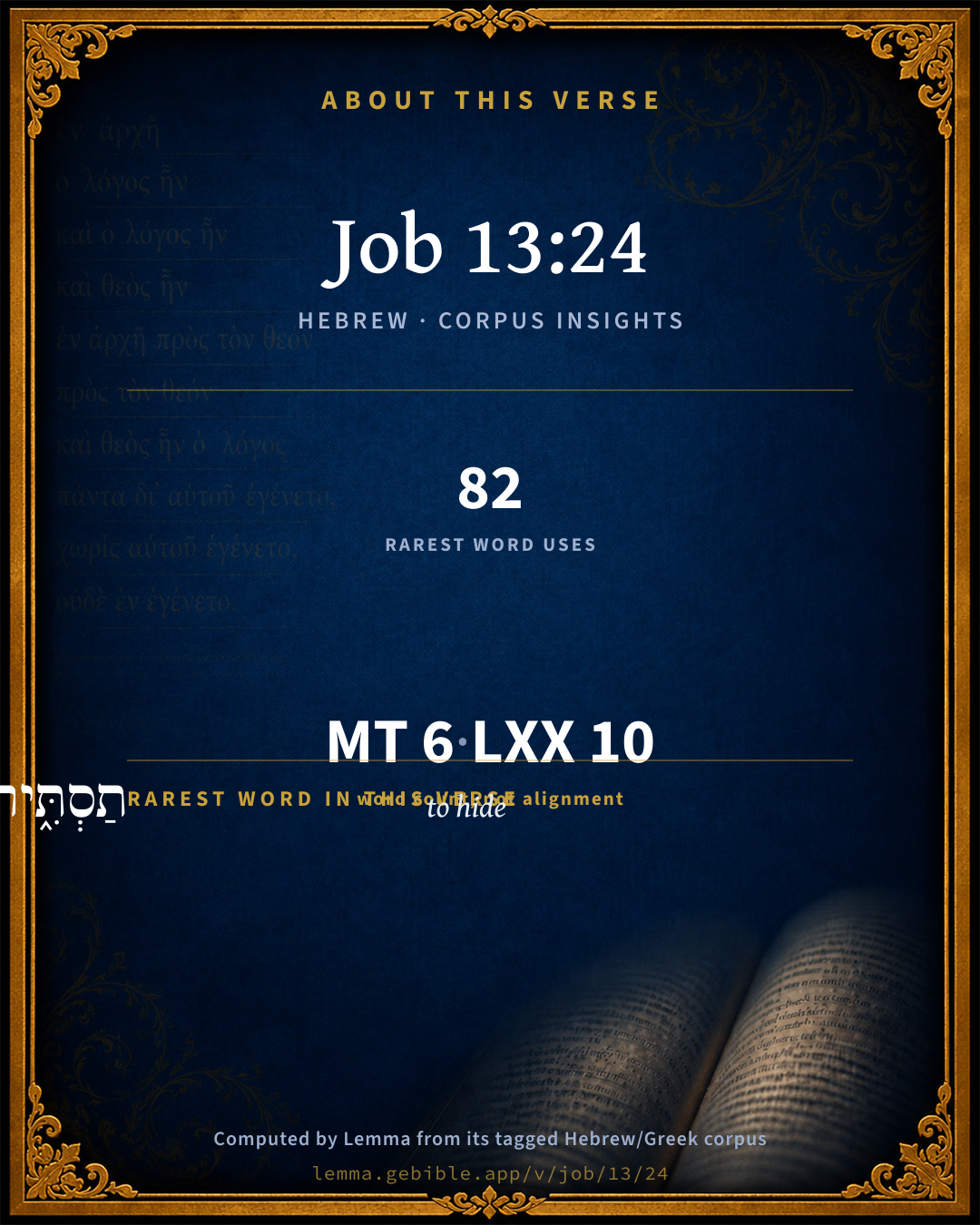
About this verse

These counts appear in no published source. They are computed here, from the morphology-tagged text and Lemma’s own curated glosses. What Lemma adds →

6
words
5
distinct lemmas
Wisdom
section

Grammatical profile

  • 3 verbs
  • 1 noun
  • 1 preposition
  • 1 particle

Verb forms

  • תַסְתִּ֑יר Hiphil · Imperfect
  • וְתַחְשְׁבֵ֖נִי Qal · Imperfect
  • לְאוֹיֵ֣ב Qal · Participle Active

Hebrew & Septuagint length

In English translation the verse runs 11 words from the Hebrew and 11 from the Septuagint (LXX English) — the same length.

A rough comparison of the two English renderings, which tokenize alike — not a word-level alignment.

Word counts can differ between the Hebrew and the Greek without any difference in meaning — e.g. the Hebrew direct-object marker אֵת has no separate Greek word, and Greek often adds the article ὁ.

In the original languages it is 6 Hebrew tokens and 10 Greek tokens — but the two are counted differently (Hebrew bundles its prefixes and suffixes into one token; the Greek is in lemma form), so that isn’t a like-for-like length.

Cross-references

17

Topical passages linked to Job 13:24 in the Treasury of Scripture Knowledge — connected by theme and wording, ordered by reader-vote popularity; previews shown in the World English Bible.

  • Job 19:11 He has also kindled his wrath against me. He counts me among his adversaries.
  • Psalms 13:1 How long, Yahweh? Will you forget me forever? How long will you hide your face from me?
  • Lamentations 2:5 The Lord is become as an enemy, he has swallowed up Israel; He has swallowed up all her palaces, he has destroyed his strongholds; He has multiplied in the daughter of Judah mourning and lamentation.
  • Deuteronomy 32:20 He said, I will hide my face from them, I will see what their end shall be: For they are a very perverse generation, Children in whom is no faithfulness.
  • Job 33:10 Behold, he finds occasions against me, He counts me for his enemy:
  • Psalms 44:24 Why do you hide your face, And forget our affliction and our oppression?
  • Psalms 88:14 Yahweh, why do you reject my soul? Why do you hide your face from me?
  • Isaiah 8:17 I will wait for Yahweh, who hides his face from the house of Jacob, and I will look for him.
  • 1 Samuel 28:16 Samuel said, Why then do you ask of me, seeing Yahweh is departed from you, and is become your adversary?
  • Job 10:2 I will tell God, 'Do not condemn me, Show me why you contend with me.
  • Job 16:9 He has torn me in his wrath, and persecuted me; He has gnashed on me with his teeth: My adversary sharpens his eyes on me.
  • Job 29:2–3 "Oh that I were as in the months of old, As in the days when God watched over me;
  • Job 30:21 You have turned to be cruel to me. With the might of your hand you persecute me.
  • Job 31:35 Oh that I had one to hear me! (Behold, here is my signature, let the Almighty answer me); Let the accuser write my indictment!
  • Psalms 10:1 Why do you stand far off, Yahweh? Why do you hide yourself in times of trouble?
  • Psalms 77:6–9 I remember my song in the night. I consider in my own heart; My spirit diligently inquires:

Cross-references courtesy of OpenBible.info (CC BY 4.0).

Hebrew and Greek witnesses Masoretic Hebrew ↔ Greek Septuagint

The same verse in the two great witnesses to the Old Testament, shown verse-for-verse.

These are two independent witnesses, not word-aligned to each other, and the Septuagint is shown in lemma (dictionary) form.

Hebrew Job 13:24 Masoretic · Westminster Leningrad Codex

לָֽמָּה פָנֶ֥יךָ תַסְתִּ֑יר וְתַחְשְׁבֵ֖נִי לְאוֹיֵ֣ב לָֽךְ

Why hide you your face, And hold me for your enemy?

World English Bible · Public Domain

Greek LXX Job 13:24 Septuagint · lemma form

διά τίς ἀπό ἐγώ κρύπτω ἡγέομαι δέ ἐγώ ὑπεναντίος σύ

Therefore hide you yourself from me, and deem me your enemy?

LXX2012 (modern English Septuagint) · Public Domain

Hebrew: Westminster Leningrad Codex (CC BY 4.0). Greek: Septuagint (public domain); English from LXX2012 (modern English Septuagint) (Public Domain). How the Septuagint differs from the Hebrew →

Commentary

Notes on Job 13:24 from classic Christian and Jewish commentators (each source and its license shown beneath its notes). The classic Christian expositions comment on the surrounding passage and are grouped to its opening verse, so a note may address several verses; the Jewish commentaries on the Tanakh (Rashi and others) are per-verse, so they appear only where the commentator wrote on this verse.

Lemma curates 59 commentaries, every one of them public domain or Creative Commons licensed, each selected and text-cleaned for this edition rather than reprinted as found. About our sources →

Trapp's Complete Commentary

John Trapp

Job 13:24 Wherefore hidest thou thy face, and holdest me for thine enemy?

Ver. 24. Wherefore hidest thou thy face] Who wast wont to shine upon me, Job 29:2-3. He that hideth his face showeth that he neither pitieth nor purposeth to relieve. God seemed to look upon Job no otherwise than as under Satan’s cloak, said that martyr. But he hideth his love sometimes out of increasement of love, as Joseph did to his brethren; and is never so near us as when, with Mary Magdalene, we are so bleared with tears for his absence, that we cannot see him, though at hand. A child of light may walk in darkness, Isa 50:10, which, when he doth, he must resolve, as Isa 8:17, I will wait upon the Lord, who hideth his face from the house of Jacob, and I will look tbr him: he must also in that dark condition cast anchor, as they did in the shipwreck, Act 27:29-30, and pray still for day, waiting till the day star arise in their hearts, and all clear up.

And holdest me for thine enemy?] Which if God should have doue indeed, it would have been wide with Job, and far worse than ever yet it had been; for if a man find his enemy, will he let him go well away? 1Sa 24:19. I think not, unless it be for a greater mischief at another time. But Job was out when he judged himself hated of God, because afflicted, since he scourgeth every son whom he receiveth, Heb 12:5. See my Love tokens, pp. 23, 54.

John Trapp, A Commentary or Exposition upon All the Books of the Old and New Testament (1647–1656) — public domain. Text from a community e-Sword module.

Tyndale Open Study Notes

Tyndale Open Resources

13:24 God can turn away in wrath (Deut 31:18; Isa 54:8; Jer 33:5) or refuse to show friendship (Pss 30:7; 69:17; 102:2). • Job, perhaps playing on his own name (’iyyob), denied that he was God’s enemy (’oyeb).

Tyndale Open Study Notes — © Tyndale Open Resources, licensed CC BY-SA 4.0. Text via the HelloAO Bible API.

Jamieson, Fausset & Brown

Robert Jamieson, A. R. Fausset & David Brown

hidest . . . face--a figure from the gloomy impression caused by the sudden clouding over of the sun.

enemy--God treated Job as an enemy who must be robbed of power by ceaseless sufferings (Job 7:17, Job 7:21).

Jamieson, Fausset & Brown — Commentary Critical and Explanatory on the Whole Bible (1871) — public domain (CC PDM 1.0). Text via the HelloAO Bible API.

Adam Clarke's Commentary

Verse 24. Wherefore hidest thou thy face] Why is it that I no longer enjoy thy approbation?

Holdest me for thine enemy?] Treatest me as if I were the vilest of sinners?

Adam Clarke's Commentary on the Bible (1810–1826) — public domain. Text from a community e-Sword/MySword module.

The Cambridge Bible for Schools and Colleges

gen. ed. J. J. S. Perowne

24. Wherefore hidest thou thy face] This does not mean, Wherefore dost thou refuse to answer me now? the reference is to God’s severity in afflicting him, as is shewn by the words “holdest me for thine enemy,” cf. ch. Job_19:5, Job_35:2 seq.

The Cambridge Bible for Schools and Colleges (gen. ed. J. J. S. Perowne; Cambridge University Press, 1878–1918) — public domain. Text from a community e-Sword module.

John Gill's Exposition

Wherefore hidest thou thy face,.... Not from his cry, because of his sore and grievous afflictions, as Bar Tzemach; nor from helping and saving him from his troubles, as Sephorno; nor from looking on his right ways, as Jarchi; but from his person, withdrawing the manifestation of his face and favour; withholding the discoveries of his love; and denying him the light of his countenance, and sensible communion with him, and enjoyment of him, he had been indulged with; Job formerly had seen the face of God, enjoyed his presence, and walked in fellowship with him; but now he had withdrawn himself from him, and he knew not where to find him; see Job 23:2; a greater blessing cannot be had than the gracious presence of God; nothing gives more pleasure when enjoyed, and nothing more grievous to good men when it is withheld; oftentimes sin is the cause of it, but not always, as in this instance of Job; the end of the Lord in all his afflictions, both inward and outward, was to try his patience, his integrity, and faithfulness; but as Job was for the present ignorant of it, he desires to know the reason of this the Lord's behaviour towards him; as it is what all good men should do in the like circumstances, nothing being more afflicting and distressing to them, and even intolerable; see Psa 10:11; some think here is an allusion to the behaviour of judges towards such as were condemned by them, they were prejudiced against, and would neither hear nor see them; or to a rite and custom in former times, as Pineda observes, when judges, at the time of pronouncing sentence on a malefactor, used to draw a curtain between them; or to the covering of the face of the criminal, see Job 9:24;

and holdest me for thine enemy? Job had been an enemy to God, as all men are in a state of nature, yea, enmity itself, as is shown by their wicked works; but he was now reconciled unto God, the enmity of his heart was slain, and he had laid down his weapons of rebellion, and ceased committing hostilities against God, and was become subject to him and to his law, through the power of efficacious grace; a principle of love, which is the fruit of the spirit in regeneration, was implanted in him; and he was a true and sincere lover of God, one that feared him, and trusted in him; whose faith worked by love, and so appeared to be of the right kind; and therefore, since he was conscious to himself that he loved God with all his heart, loved his word, his ways, and worship, his people and all that belonged to him, it was cutting and grievous to him to be thought and accounted, or deal with, as an enemy to him; for so he interpreted his conduct towards him; as he afflicted him, he took it to be in anger and fury, and hot displeasure; and as he hid his face from him, he supposed it was in great wrath, viewing him in this light as his enemy.

John Gill's Exposition of the Whole Bible (1746–1763) — public domain (CC PDM 1.0). Text via the HelloAO Bible API.

Albert Barnes' Notes on the Bible

Wherefore hidest thou thy face - To hide the face, or to turn it away, is expressive of disapprobation. We turn away the face when we are offended with anyone. See the notes at Isa 1:15.

And holdest me for thine enemy - Regardest and treatest me as an enemy.

Albert Barnes' Notes on the Bible (1834–1885) — public domain. Text from a community e-Sword/MySword module.

Haydock's Catholic Bible Commentary

CHAPTER XIII.

George Leo Haydock (1774–1849), Haydock's Catholic Family Bible and Commentary, 1859 edition — public domain. Excludes Psalms (Douay-Rheims chapter numbering differs from Protestant) and Deuterocanonical books (Catholic canon only).

Matthew Poole's English Annotations

Hidest thou thy face, i.e. withdrawest thy favour and help which thou didst use to afford me; as this phrase is commonly used, as Deu 31:17; Psa 13:1; 102:2, &c.

Holdest me for thine enemy, i.e. dealest as sharply with me as if I were thy professed enemy.

Matthew Poole's English Annotations on the Holy Bible (1683–1685) — public domain. Text from a community e-Sword/MySword module.

The Pulpit Commentary

Wherefore hidest thou thy face, and holdest me for thine enemy? What is thy reason for withdrawing from me the light of thy countenance, and behaving towards me as though thou weft mine enemy? Job does not believe God to be his enemy. He knows that God will one day be his Salvation (ver. 16); but he recognizes a present alienation, and desires to be made acquainted with the cause of it.

The reasons for sorrow.

It has ever been a longing of the suffering heart of man to know why afflictions are permitted. Job is a striking example of the sufferer reduced to questioning. He makes his appeal for the reasons. "Wherefore hidest thou thy face?" Others have urged this inquiry. Even the Exemplar of all patient, submissive, trustful, obedient sufferers cried aloud, "My God, my God, why hast thou forsaken me?" But the answer comes not to Job with the quickness he may have desired. Yet though he giveth none account of his ways, all may be assured his purposes are wise and good. In the light of later teachings we may read "the end of the Lord." That which we "endure" we know "is for chastening." This, then, is the answer in general to the cry, "Wherefore hidest thou thy face?" Then, as far as we can interpret the answer to the cry to which no answer is immediately given, we may say

I A reason for sorrow may be found in ITS FITNESS TO BE A TEST OF FAITH. That faith should be tested, and so developed and perfected, is an obvious propriety. But for such testing it would be a dead, inoperative faculty. As the wing of the young eagle is strengthened by the demands made upon it when borne aloft, and then committed to its own unaided effort, so faith grows in strength by every appeal made to it. It is here experience is gained. By this men grow. The heart is made acquainted with "the ways of the Lord." The exercised faculty becomes familiarized with its duties. It learns to bear a heavier strain. Each successful performance of duty leaves it better fitted to act in future. The strong faith is the faith that has borne the severe test.

II A second reason may be found in THE NECESSARY DEVELOPMENT OF PATIENCE. The heroic fortitude of the soul that can endure "as seeing him who is invisible" is not gained with suddenness. By slow steps is this height reached. By slow accretions is this grace perfected. The man unaccustomed to discomfort is unwilling to leave his freedom and ease, and to undertake toilsome and painful service. Sorrow oppresses the soul, but it thereby develops that power by which the soul is upheld. The slothful, self-indulgent spirit is unfitted for hard toil; and the world needs the willing labourer. There is a schooling of the soul by self-denial, by fasting. The substitute for the self-imposed training is the divinely imposed trial. The trial of faith is very precious if it leaves the soul steadier in patient endurance. By such trained souls is the world"s great work to be done.

III SORROW PERFECTS THE SOUL IN A LOWLY SUBMISSION TO THE DIVINE WILL. "It is the Lord: let him do as seemeth him good," may be a defiant cry of rebellion: "Do thy worst;" or it may be a lowly, trustful, resigned committal of the life to the Divine purposes: "What he wills is best." The school of affliction is a hard school, but its patient scholars are well taught. And though "no affliction for the present seemeth to be joyous, but grievous, nevertheless afterward it yieldeth the peaceable fruit of righteousness to them that are exercised thereby.

IV SORROW MAY BE THE MEANS OF EVOKING THE MOST SINCERE AND BEAUTIFUL EXAMPLES OF OBEDIENCE. The histories of human suffering present us with examples of consummate and unflinching obedience, rendered in unquestioning acquiescence in the Divine purpose and in the pure love of the heart. The highest point ever reached by the obedient spirit was that of our great Pattern, who, in the depth of darkest affliction and sorrow of soul, patiently reiterated the sublime expression of a wholly consecrated service, "Nevertheless not my will, but thy will, be done. R.G.

The hiding of God"s face.

I THE SORROWFUL EXPERIENCE. The thought that God"s face is hidden is most distressing to Job. Let us see what he is thinking of, and why he is distressed. The unveiled countenance is a sign of favour; the veiled, or averted face, of displeasure. Therefore Job"s word suggests an idea of God"s withdrawal of favour. He explains himself by adding, "And holdest me for thine enemy." But Job means more than the withdrawal of manifested favours, as gifts of grace flowing from the bounty of God. God is more than his gifts. The light of God"s countenance is better than the blessings of God"s storehouse. The very smiting by God is itself a supreme source of life and gladness. As the plant blooms in the sunshine and grows pale and sickly in the dark, so the soul blooms in the light of God"s love and fades into desolation when that is hidden. To some, indeed, the hiding of God"s face is no trouble. They cannot exclaim with delight, like Hagar, "Thou God seest me." Such words are to them only the expression of a great terror. But souls that know and love God bask in the sunshine of his presence. To lose the consciousness of God"s loving presence is to such souls the desolation of a Siberian winter, the darkness of a storm-girt night.

II THE MYSTERIOUS CAUSE. The cause is a mystery. We may see it afterwards, or in regard to the experience of others. But, while we are passing through the great darkness, its meaning is hidden from us, and this is part of its deepest trouble. Even Christ, in the human limitations of his earthly sufferings, exclaimed, "My God, my God, why hast thou forsaken; (Mat_27:46) and there came no reply like that which followed immediately on other words of Christ addressed to his Father in heaven. (e.g. Joh_12:28) Still some hints of the cause may sometimes Be gathered up. If we are conscious of sin, this is sufficient. The only wonder is that God has not withdrawn his countenance before this. If we have lost our first love (Rev_2:4) and have wandered from God, we may well look back with regret to the happier past; but we can scarcely be surprised at our present depression. Then we can say with Cowper "Where is the blessedness I knew When first I saw the Lord? Where is the soul-refreshing view Of Jesus and his Word? "What peaceful hours I once enjoyed! How sweet their memory still! But they have left an aching void The world can never fill. Possibly, like the author of the Olney Hymns, we may Be suffering from morbid subjective feelings. It may be that God has not hidden his face, but that our eyes are dim with needless tears, so that we cannot see his gracious countenance.

III THE LIGHT BEHIND. God may be hiding his face, but he has not changed it. The sun has gone behind a cloud, but it still shines. God has not turned his love into hatred when we can no longer see his kind countenance. He loves us in the dark as much as in the light. He has not withdrawn his face in hiding it. The veil does not increase the distance Between us and God; it only prevents us from seeing him, though he is really as near to us as ever. Nay, he may be most near when we cannot see him, We are warmed and vitalized by the sun even while it is hidden by the cloud. God does not cease to bless us when we cease to perceive him. Yet the greatest blessing is with the unveiled countenance. That blessing of the beatific vision is reserved for the pure in heart. W.F.A. (Mat_5:8)

The Pulpit Commentary (1880–1919), ed. H.D.M. Spence-Jones & Joseph S. Exell — public domain. Text from a community e-Sword module.

Rashi

Rabbi Shlomo Yitzchaki (Rashi)

Why do You hide Your face from seeing the ways of my uprightness?

Rashi on the Tanakh — English translations: “The Judaica Press complete Tanach with Rashi, translated by A. J. Rosenberg” (CC BY 4.0); “Pentateuch with Rashi's commentary by M. Rosenbaum and A.M. Silbermann, 1929-1934” (public domain); “The Metsudah Tanach series, Lakewood, N.J” (CC BY 4.0); and “The Book of Joshua, Metsudah Publications, 1997” (CC BY 4.0). Text via Sefaria.

Lesson kit

Teaching starters — assembled from the data on this page, not authored interpretation. Every prompt links to the verse data it draws on. Edit before teaching.

Job, in the Wisdom, opens this verse with 6 words (5 distinct Hebrew lemmas). Its most distinctive word is çâthar (“to hide”). A historical commentator’s framing appears above. Read the whole chapter for the surrounding context.

Discussion questions

  1. How does “to hide” (çâthar) shape what this verse is saying?
  2. How does Job 19:11, which shares this passage’s theme, read alongside this verse?
  3. The translations on this page render this verse differently — a whole-verse word diff, not a word-by-word alignment. What might account for the different wordings?
  4. «תַסְתִּ֑יר» is a Hiphil Imperfect verb. How does that grammatical form shape the action described?
  5. Compare how Trapp's Complete Commentary and Tyndale Open Study Notes read this verse. Where do they agree or differ?

Things to notice

Reading settings

Reading text

Shown beneath each verse's original-language words.

Old Testament
Old Testament edition

Read the OT as the Masoretic Hebrew (MT) or the Greek Septuagint (LXX).

English shown for the Greek Septuagint (in the Hebrew ↔ Greek comparison).

Comparing translations? Open the Compare panel on any verse page to stack up to four side by side.