
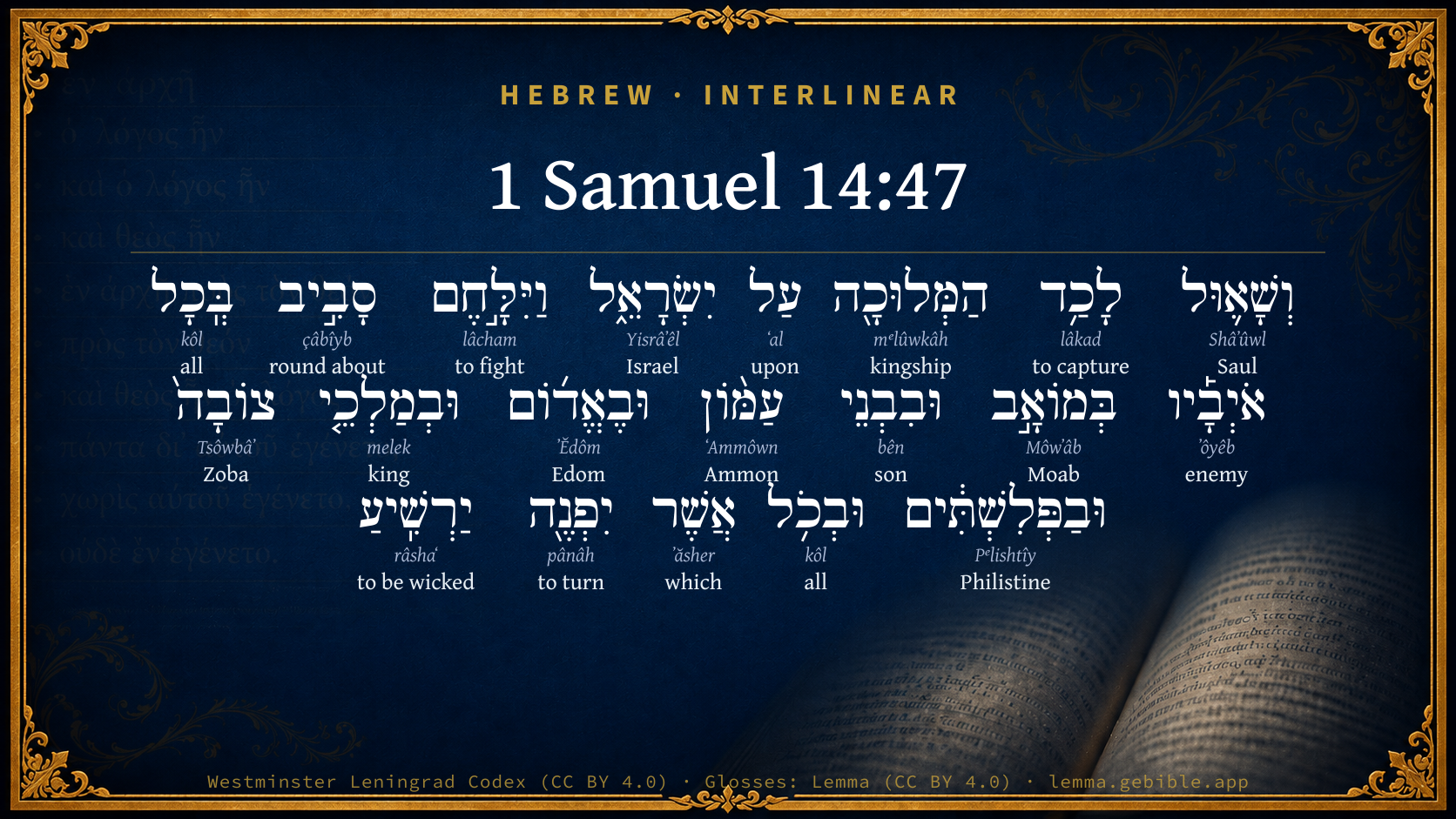
1 Samuel 14:47

Hebrew (Westminster Leningrad Codex) 1 Samuel 14:47 appears in the Hebrew Old Testament. The text above is from the Westminster Leningrad Codex. Each word links to its Strong’s number, a concise gloss, and parsing drawn from the Open Scriptures Hebrew Bible morphology. Click any word for its full Brown-Driver-Briggs (BDB) entry.
Download image
Cite this verse

1 Samuel 14:47 (World English Bible). Public Domain. Lemma interlinear Bible study tool, https://lemma.gebible.app/v/1-samuel/14/47.

Show BibTeX & RIS
BibTeX
RIS
English Translation
Now when Saul had taken the kingdom over Israel, he fought against all his enemies on every side, against Moab, and against the children of Ammon, and against Edom, and against the kings of Zobah, and against the Philistines: and wherever he turned himself, he put [them] to the worse.
World English Bible · Public Domain
Highlights
  • 1 first appearance in the Hebrew Bible
Full analysis ↓
Download a study sheet

One document with this verse’s original text, its word-by-word gloss line, the meaning frame, cross-references with their text, attributed commentary, and full source and license credits — printable, and it pastes into notes with its structure intact.

This verse Autodidact and up

Study sheet (.html) Plain text (.txt)

A passage Seminary Student

Up to 50 verses in one chapter. A passage sheet keeps up to 6 commentary sources and 12 cross-references per verse, in the order this page ranks them, and says so on the sheet whenever that leaves anything out. Ask for a single verse and you get the Autodidact verse sheet above.

Everything on this page stays free to read, with no account — the sheet is a download of what is already on screen, not access to it.

Want to remove ads? Support Godless Engineer
Compare translations 3

The same verse in 3 English versions, stacked beneath the original-language interlinear above. Click any original word for its lexicon entry.

Each is an independent rendering of the whole verse — the interlinear is not word-aligned to these translations.

Highlighted words mark where these versions differ — a whole-verse word diff, not a word-by-word alignment.

  • World English Bible Public Domain
    Now when Saul had taken the kingdom over Israel, he fought against all his enemies on every side, against Moab, and against the children of Ammon, and against Edom, and against the kings of Zobah, and against the Philistines: and wherever he turned himself, he put [them] to the worse.
  • King James Version Public Domain
    So Saul took the kingdom over Israel, and fought against all his enemies on every side, against Moab, and against the children of Ammon, and against Edom, and against the kings of Zobah, and against the Philistines: and whithersoever he turned himself, he vexed them.
  • unfoldingWord Literal Text CC BY-SA 4.0
    Now Saul had taken the kingship over Israel. And he fought with all of his enemies all around, with Moab and with the sons of Ammon and with Edom and with the kings of Zobah and with the Philistines. And upon all where he turned, he inflicted punishment.

unfoldingWord Literal Text — © unfoldingWord, licensed CC BY-SA 4.0. Word-aligned USFM3 via Door43 (git.door43.org/unfoldingWord/en_ult).

Versions to compare (up to 4)

3 of 4 selected

Show all 18 translations

Every available English version of this verse, each an independent rendering of the whole verse.

  • World English Bible Public Domain
    Now when Saul had taken the kingdom over Israel, he fought against all his enemies on every side, against Moab, and against the children of Ammon, and against Edom, and against the kings of Zobah, and against the Philistines: and wherever he turned himself, he put [them] to the worse.
  • Berean Standard Bible Public Domain
    After Saul had assumed the kingship over Israel, he fought against all his enemies on every side—the Moabites, the Ammonites, the Edomites, the kings of Zobah, and the Philistines. Wherever he turned, he routed them.
  • Majority Standard Bible Public Domain
    After Saul had assumed the kingship over Israel, he fought against all his enemies on every side—the Moabites, the Ammonites, the Edomites, the kings of Zobah, and the Philistines. Wherever he turned, he routed them.
  • King James Version Public Domain
    So Saul took the kingdom over Israel, and fought against all his enemies on every side, against Moab, and against the children of Ammon, and against Edom, and against the kings of Zobah, and against the Philistines: and whithersoever he turned himself, he vexed them.
  • American Standard Version (1901) Public Domain
    Now when Saul had taken the kingdom over Israel, he fought against all his enemies on every side, against Moab, and against the children of Ammon, and against Edom, and against the kings of Zobah, and against the Philistines: and whithersoever he turned himself, he put `them' to the worse.
  • Revised Version (1885) Public Domain
    Now when Saul had taken the kingdom over Israel, he fought against all his enemies on every side, against Moab, and against the children of Ammon, and against Edom, and against the kings of Zobah, and against the Philistines: and whithersoever he turned himself, he vexed them.
  • Geneva Bible (1599) Public Domain
    So Saul helde the kingdome ouer Israel, and fought against all his enemies on euery side, against Moab, and against the children of Ammon, and against Edom, and against the Kings of Zobah, and against the Philistims: and whithersoeuer he went, he handled them as wicked men.
  • Douay-Rheims (1899) Public Domain
    And Saul having his kingdom established over Israel, fought against all his enemies round about, against Moab, and against the children of Ammon, and Edom, and the kings of Soba, and the Philistines; and whithersoever he turned himself, he overcame.
  • Young's Literal Translation Public Domain
    and Saul captured the kingdom over Israel, and he fighteth round about against all his enemies, against Moab, and against the Bene-Ammon, and against Edom, and against the kings of Zobah, and against the Philistines, and whithersoever he turneth he doth vex `them'.
  • Literal Standard Version CC BY-SA 4.0
    and Saul captured the kingdom over Israel, and he fights all around against all his enemies, against Moab, and against the sons of Ammon, and against Edom, and against the kings of Zobah, and against the Philistines, and wherever he turns he distresses [them].
  • Unlocked Literal Bible CC BY-SA 4.0
    When Saul began to rule over Israel, he fought against all his enemies on every side. He fought against Moab, the Ammonites, Edom, the kings of Zobah, and the Philistines. Wherever he turned, he inflicted punishment on them.
  • unfoldingWord Literal Text CC BY-SA 4.0
    Now Saul had taken the kingship over Israel. And he fought with all of his enemies all around, with Moab and with the sons of Ammon and with Edom and with the kings of Zobah and with the Philistines. And upon all where he turned, he inflicted punishment.
  • Darby Bible Public Domain
    And Saul took the kingdom over Israel, and fought against all his enemies round about, against Moab, and against the children of Ammon, and against Edom, and against the kings of Zobah, and against the Philistines; and whithersoever he turned himself, he discomfited [them].
  • World Messianic Bible Public Domain
    Now when Saul had taken the kingdom over Israel, he fought against all his enemies on every side: against Moab, and against the children of Ammon, and against Edom, and against the kings of Zobah, and against the Philistines. Wherever he turned himself, he defeated them.
  • Webster's Bible Public Domain
    So Saul took the kingdom over Israel, and fought against all his enemies on every side, against Moab, and against the children of Ammon, and against Edom, and against the kings of Zobah, and against the Philistines: and whithersoever he turned himself, he harassed them.
  • Free Bible Version CC BY-SA 4.0
    After Saul had made his hold over Israel secure, he fought against all his enemies all around: Moabites, Ammonites, Edomites, the kings of Zobah, and the Philistines. Whatever direction he went he defeated them all.
  • Bible in Basic English Public Domain
    Now when Saul had taken his place as ruler of Israel, he made war on those who were against him on every side, Moab and the Ammonites and Edom and the kings of Zobah and the Philistines: and whichever way he went, he overcame them.
  • JPS Tanakh (1917) Public Domain
    So Saul took the kingdom over Israel, and fought against all his enemies on every side, against Moab, and against the children of Ammon, and against Edom, and against the kings of Zobah, and against the Philistines; and whithersoever he turned himself, he put them to the worse.

Literal Standard Version (2020), Covenant Press — licensed CC BY-SA 4.0. Text via the HelloAO Bible API (eBible.org). Unlocked Literal Bible (unfoldingWord) — licensed CC BY-SA 4.0. Text via the HelloAO Bible API (eBible.org). unfoldingWord Literal Text — © unfoldingWord, licensed CC BY-SA 4.0. Word-aligned USFM3 via Door43 (git.door43.org/unfoldingWord/en_ult). Free Bible Version, Dr. Jonathan Gallagher — licensed CC BY-SA 4.0. Text via the HelloAO Bible API (eBible.org).

Word by word

More ways to search: Search by grammar → Find every occurrence → Compare this word →

Practice this passage: Drill this verse → Learn its vocabulary →

צוֹבָה֙
Tsôwbâʼ
H6678
“Zoba”
Noun, Proper
Part of Speech
Noun
Type
Proper
Full BDB Definition

Origin: from an unused root meaning to station

TWOT: None

Zoba or Zobah = "station" - the name of a portion of Syria which formed a separate kingdom in the times of Saul, David, and Solomon; located northeast of Damascus
  1. וְשָׁא֛וּל Shâʼûwl H7586 “and · Saul” Conjunction + Noun, Proper
  2. לָכַ֥ד lâkad H3920 “to capture” Verb, Qal, Perfect, 3rd Person, Masculine, Singular
  3. הַמְּלוּכָ֖ה mᵉlûwkâh H4410 “the · kingship” Particle, Definite Article + Noun, Common, Feminine, Singular, Absolute
  4. עַל ʻal H5921 “upon” Preposition
  5. יִשְׂרָאֵ֑ל Yisrâʼêl H3478 “Israel” Noun, Proper
  6. וַיִּלָּ֣חֶם lâcham H3898 “and · to fight” Conjunction + Verb, Niphal, Sequential Imperfect, 3rd Person, Masculine, Singular
  7. סָבִ֣יב çâbîyb H5439 “round about” Noun, Common, Both, Singular, Absolute
  8. בְּֽכָל kôl H3605 “in/at · all of” Preposition + Noun, Common, Masculine, Singular, Construct
  9. אֹיְבָ֡יו ʼôyêb H341 “enemy · him” Verb, Qal, Participle Active, Masculine, Plural, Construct + Suffix, Personal, 3rd Person, Masculine, Singular
  10. בְּמוֹאָ֣ב Môwʼâb H4124 “in/at · Moab” Preposition + Noun, Proper
  11. וּבִבְנֵי bên H1121 “and · in/at · sons of” Conjunction + Preposition + Noun, Common, Masculine, Plural, Construct
  12. עַמּ֨וֹן ʻAmmôwn H5983 “Ammon” Noun, Proper
  13. וּבֶאֱד֜וֹם ʼĔdôm H123 “and · in/at · Edom” Conjunction + Preposition + Noun, Proper
  14. וּבְמַלְכֵ֤י melek H4428 “and · in/at · kings of” Conjunction + Preposition + Noun, Common, Masculine, Plural, Construct
  15. וּבַפְּלִשְׁתִּ֔ים Pᵉlishtîy H6430 “and · in/at the · Philistines” Conjunction + Preposition, Determined + Noun, Gentilic, Masculine, Plural, Absolute
  16. וּבְכֹ֥ל kôl H3605 “and · in/at · all” Conjunction + Preposition + Noun, Common, Masculine, Singular, Absolute
  17. אֲשֶׁר ʼăsher H834 “which” Particle, Relative
  18. יִפְנֶ֖ה pânâh H6437 “to turn” Verb, Qal, Imperfect, 3rd Person, Masculine, Singular
  19. יַרְשִֽׁיעַ râshaʻ H7561 “to be wicked” Verb, Hiphil, Imperfect, 3rd Person, Masculine, Singular

About this verse

These counts appear in no published source. They are computed here, from the morphology-tagged text and Lemma’s own curated glosses. What Lemma adds →

20
words
19
distinct lemmas
Historical
section

Notable vocabulary

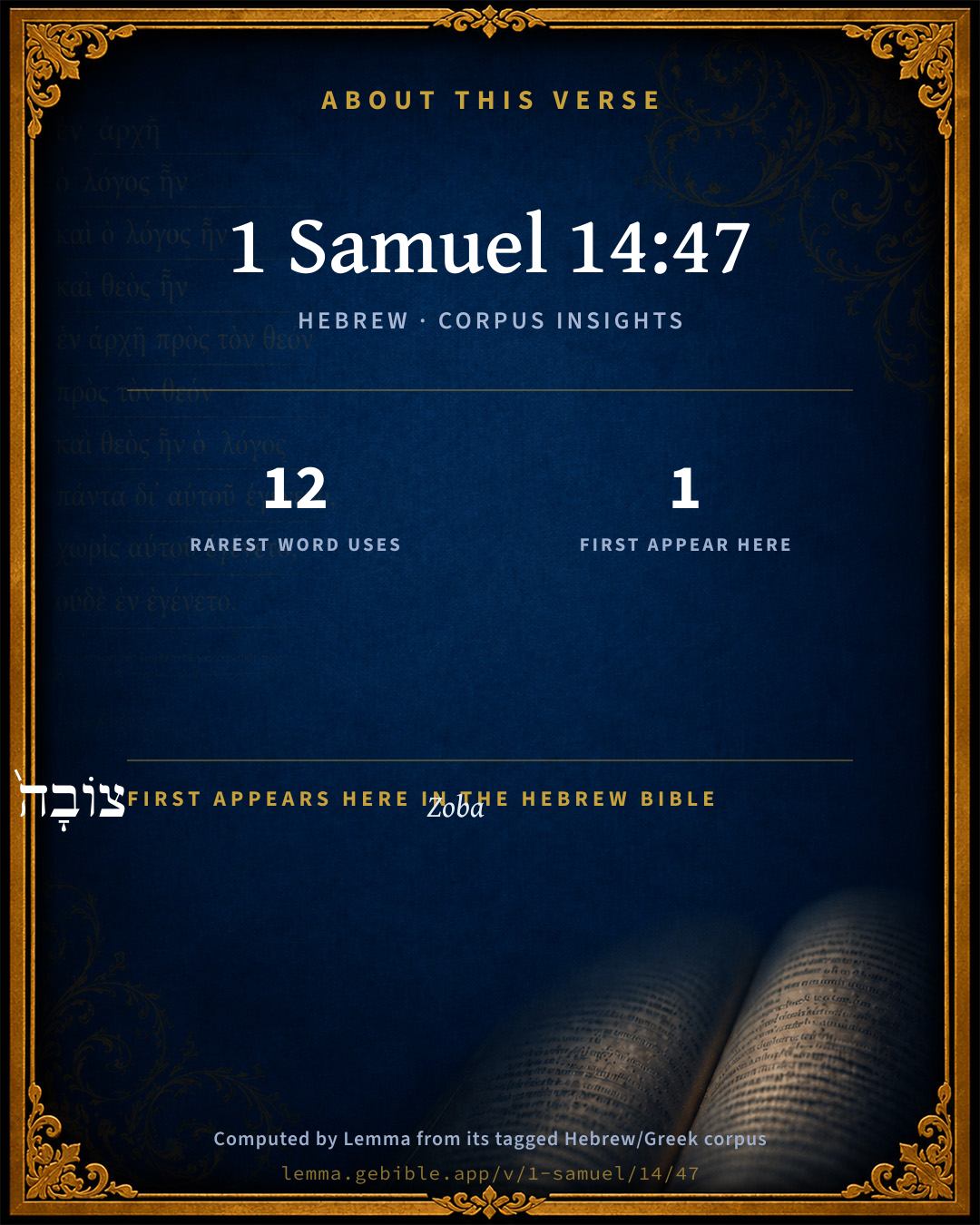
The rarest word here is צוֹבָה֙ Zoba H6678 — appearing just 12 times in the whole Hebrew Bible.

First appearance in Scripture

This word makes its first canonical appearance in the Hebrew Bible here:

  • צוֹבָה֙ Zoba H6678

Shared distinctive vocabulary

צוֹבָה֙ Zoba H6678 occurs in 12 verses of the Hebrew Bible. Also found in:

Grammatical profile

  • 5 verbs
  • 13 nouns
  • 1 preposition
  • 1 particle

Verb forms

  • לָכַ֥ד Qal · Perfect
  • וַיִּלָּ֣חֶם Niphal · Sequential Imperfect
  • אֹיְבָ֡יו Qal · Participle Active
  • יִפְנֶ֖ה Qal · Imperfect
  • יַרְשִֽׁיעַ Hiphil · Imperfect

Repetition

A word recurs within this verse — often emphatic in Hebrew:

  • בְּֽכָל all H3605 ×2

Hebrew & Septuagint length

In English translation the verse runs 50 words from the Hebrew and 57 from the Septuagint (LXX English) — closely comparable.

A rough comparison of the two English renderings, which tokenize alike — not a word-level alignment.

Word counts can differ between the Hebrew and the Greek without any difference in meaning — e.g. the Hebrew direct-object marker אֵת has no separate Greek word, and Greek often adds the article ὁ.

Cross-references

8

Topical passages linked to 1 Samuel 14:47 in the Treasury of Scripture Knowledge — connected by theme and wording, ordered by reader-vote popularity; previews shown in the World English Bible.

  • 2 Samuel 10:6 When the children of Ammon saw that they were become odious to David, the children of Ammon sent and hired the Syrians of Beth Rehob, and the Syrians of Zobah, twenty thousand footmen, and the king of Maacah with one thousand men, and the men of Tob twelve thousand men.
  • 1 Samuel 14:52 There was sore war against the Philistines all the days of Saul: and when Saul saw any mighty man, or any valiant man, he took him to him.
  • 1 Samuel 11:1–13 Then Nahash the Ammonite came up, and encamped against Jabesh Gilead: and all the men of Jabesh said to Nahash, Make a covenant with us, and we will serve you.
  • 1 Samuel 12:2 Now, behold, the king walks before you; and I am old and gray-headed; and, behold, my sons are with you: and I have walked before you from my youth to this day.
  • 1 Samuel 13:1 Saul was [forty] years old when he began to reign; and when he had reigned two years over Israel,
  • 2 Samuel 8:3 David struck also Hadadezer the son of Rehob, king of Zobah, as he went to recover his dominion at the River.
  • 1 Kings 11:23 God raised up [another] adversary to him, Rezon the son of Eliada, who had fled from his lord Hadadezer king of Zobah.
  • 2 Kings 14:27 Yahweh didn't say that he would blot out the name of Israel from under the sky; but he saved them by the hand of Jeroboam the son of Joash.

Cross-references courtesy of OpenBible.info (CC BY 4.0).

Hebrew and Greek witnesses Masoretic Hebrew ↔ Greek Septuagint

The same verse in the two great witnesses to the Old Testament, shown verse-for-verse.

These are two independent witnesses, not word-aligned to each other, and the Septuagint is shown in lemma (dictionary) form.

Hebrew 1 Samuel 14:47 Masoretic · Westminster Leningrad Codex

וְשָׁא֛וּל לָכַ֥ד הַמְּלוּכָ֖ה עַל יִשְׂרָאֵ֑ל וַיִּלָּ֣חֶם סָבִ֣יב בְּֽכָל אֹיְבָ֡יו בְּמוֹאָ֣ב וּבִבְנֵי עַמּ֨וֹן וּבֶאֱד֜וֹם וּבְמַלְכֵ֤י צוֹבָה֙ וּבַפְּלִשְׁתִּ֔ים וּבְכֹ֥ל אֲשֶׁר יִפְנֶ֖ה יַרְשִֽׁיעַ

Now when Saul had taken the kingdom over Israel, he fought against all his enemies on every side, against Moab, and against the children of Ammon, and against Edom, and against the kings of Zobah, and against the Philistines: and wherever he turned himself, he put [them] to the worse.

World English Bible · Public Domain

Greek LXX 1 Samuel 14:47 Septuagint · lemma form

καί σαούλ κατακληρόω ἔργον ἐπί ἰσραήλ καί πολεμέω κύκλος πᾶς ὁ ἐχθρός αὐτός εἰς ὁ μωαβ καί εἰς ὁ υἱός αμμων καί εἰς ὁ υἱός εδωμ καί εἰς ὁ βαιθεωρ καί εἰς βασιλεύς σουβα καί εἰς ὁ ἀλλόφυλος ὅς ἄν στρέφω σώζω

And Saul received the kingdom, by lot he inherits the office of ruling over Israel: and he fought against all his enemies round about, against Moab, and against the children of Ammon, and against the children of Edom, and against Baethaeor, and against the king of Suba, and against the Philistines: wherever he turned, he was victorious.

LXX2012 (modern English Septuagint) · Public Domain

On this verse, Whedon's Commentary on the Bible discusses the Septuagint’s reading. Read the note in Commentary ↓

Hebrew: Westminster Leningrad Codex (CC BY 4.0). Greek: Septuagint (public domain); English from LXX2012 (modern English Septuagint) (Public Domain). How the Septuagint differs from the Hebrew →

Targum (Aramaic paraphrase)

1

The Targum is the ancient Jewish Aramaic paraphrase of the Hebrew Scriptures — an interpretive translation, not the Hebrew text itself. Onkelos (literal) and Pseudo-Jonathan (expansive) render the Torah, and Jonathan the Prophets. Coverage is partial: where no permissively-licensed English translation exists for a verse, only the Aramaic is shown. This is verse-level text, not a word-by-word alignment to the Hebrew.

  1. Targum Jonathan Prophets (Joshua–Malachi)
    וְשָׁאוּל אַצְלַח בְּמַלְכוּתָא עַל יִשְׂרָאֵל וְאַגִיחַ קְרָבָא סְחוֹר סְחוֹר בְּכָל בַּעֲלֵי דְבָבוֹהִי בְּמוֹאָב וּבִבְנֵי עַמוֹן וּבֶאֱדוֹם וּבְמַלְכֵי צוֹבָה וּבִפְלִשְׁתָּאֵי וּבְכָל אֲתַר דְמִתְפְּנֵי מְחַיָב:

    (no public-domain English translation for this verse)

    Targum Jonathan — Aramaic: “Mikraot Gedolot” (public domain). English: “Sefaria Community Translation” (CC0 1.0 (public-domain dedication)); “London "Chaldee Paraphrase," 1871” (public domain). Text via Sefaria.

Commentary

Notes on 1 Samuel 14:47 from classic Christian and Jewish commentators (each source and its license shown beneath its notes). The classic Christian expositions comment on the surrounding passage and are grouped to its opening verse, so a note may address several verses; the Jewish commentaries on the Tanakh (Rashi and others) are per-verse, so they appear only where the commentator wrote on this verse.

Lemma curates 59 commentaries, every one of them public domain or Creative Commons licensed, each selected and text-cleaned for this edition rather than reprinted as found. About our sources →

Matthew Henry's Commentary

Here is a general account of Saul's court and camp. 1. Of his court and family, the names of his sons and daughters (Sa1 14:49), and of his wife and his cousin-german that was general of his army, Sa1 14:50. There is mention of another wife of Saul's (Sa2 21:8), Rizpah, a secondary wife, and of the children he had by her. 2. Of his camp and military actions. (1.) How he levied his army: When he saw any strong valiant man, that was remarkably fit for service, he took him unto him (Sa1 14:52), as Samuel had told them the manner of the king would be (Sa1 8:11); and, if he must have a standing army, it was his prudence to fill it up with the ablest men he could make choice of. (2.) How he employed his army. He guarded his country against the insults of its enemies on every side, and prevented their incursions, Sa1 14:47, Sa1 14:48. It is supposed that he acted only defensively against those that used to invade the borders of Israel; and withersoever he turned himself, as there was occasion, he vexed them, by checking and disappointing them. But the enemies he struggled most with were the Philistines, with whom he had sore war all his days, Sa1 14:52. He had little reason to be proud of his royal dignity, nor had any of his neighbours cause to envy him, for he had little enjoyment of himself after he took the kingdom. He could not vex his enemies without some vexation to himself, such thorns are crowns quilted with.

Matthew Henry's Commentary on the Whole Bible (1708–1710) — public domain (CC PDM 1.0). Text via the HelloAO Bible API.

Trapp's Complete Commentary

John Trapp

1Sa 14:47 So Saul took the kingdom over Israel, and fought against all his enemies on every side, against Moab, and against the children of Ammon, and against Edom, and against the kings of Zobah, and against the Philistines: and whithersoever he turned himself, he vexed [them].

Ver. 47. So Saul took the kingdom.] Out of which he had been well nigh ousted by the Philistines; he took it, that is, he undertook the managing administration of it. Or, he took it, though God had said he should lose it, as it were in opposition to God; and therefore gathered a host and beat his enemies round about. Like as wicked Ahab, to cross the oracle concerning the rooting out of his posterity, so followed the work of generation, that he left seventy sons behind him. {2Ki 10:1}

And against the kings of Zobah.] The inhabitants of which country - lying between Batanea and Euphrates - are corruptly called by Pliny, {a} Nubei.

He vexed them.] Heb., He worsted them; and very much infested them; but the honour of vanquishing them was reserved for David.

{a} Lib. vi. cap. 28.

John Trapp, A Commentary or Exposition upon All the Books of the Old and New Testament (1647–1656) — public domain. Text from a community e-Sword module.

Albert Barnes' Notes on the Bible

Compare 2Sa 8:15. The preceding narrative shows that before this time Saul had been king in name only, since his country was occupied by the Philistines, and he could only muster 600 men, and those but half armed and pent up in a narrow stronghold. Now, however, on the expulsion of the Philistines from his country, and the return of the Israelites from their vassalage and from their hiding places 1Sa 14:21-22, Saul became king in deed as well as in name, and acted the part of a king through the rest of his reign in defending his people against their enemies round about. A comprehensive list of these enemies, including the Ammonite war which had already been described 1Sa 11:1-15, and the Amalekite war which follows in 1 Sam. 15, is given in 1Sa 14:47-48. There is not the slightest indication from the words whether this “taking the kingdom” occurred soon or really years after Saul’s anointing at Gilgal. Hence, some would place the clause 1Sa 14:47-52 immediately after 1Sa 11:1-15, or 1 Sam. 12, as a summary of Saul’s reign. The details of the reign, namely, of the Philistine war in 1 Sam. 13; 14, of the Amalekite war in 1 Sam. 15, and the other events down to the end of 1Sa 31:1-13, preceded by the formulary, 1Sa 13:1, would then follow according to the common method of Hebrew historical narrative.

Zobah - This was one of the petty Ara-roman kingdoms flourishing at this time (Psa 60:1-12 title). It seems to have been situated between Damascus and the Euphrates.

Albert Barnes' Notes on the Bible (1834–1885) — public domain. Text from a community e-Sword/MySword module.

Joseph Benson's Commentary

1Sa 14:47-48. Saul took the kingdom — That is, resumed the administration of it, after he had, in a manner, lost it by the Philistines, who had almost got the entire possession of it, and enslaved Israel. And fought against all his enemies on every side — He did not invade them, as may be gathered from the next verse, but repelled them, and kept them within their own limits. He gathered a host, and smote the Amalekites; which war is described at large in the next chapter.

Joseph Benson's Commentary on the Old and New Testaments (1811–1818) — public domain. Text from a community e-Sword module.

Whedon's Commentary on the Bible

Daniel D. Whedon

BRIEF SUMMARY OF SAUL’S WARS AND GENEALOGY, 1Sa_14:47-52.

Several things occurred during this last Philistine invasion to weaken the people’s confidence in Saul. Nevertheless he was now established in the kingdom, and other successful battles served to strengthen his regal authority and power.

47. Against Moab — These enemies had sought to injure Israel in the days of Moses. Numbers 22.

Against the children of Ammon — As described in chap. 11.

Against Edom — The descendants of Esau, who had refused the Israelites a passage through their country. Num_20:14-21.

The kings of Zobah — Zobah seems to have lain somewhere between Damascus and the Euphrates, but its exact position has not been determined. In the days of David it was ruled by a single king, named Hadadezer. 2Sa_8:3.

Against the Philistines — Against these inveterate foes he carried on war, at intervals, all his days, (1Sa_14:52,) and at last was conquered by them. Chap. 31.

He vexed them — The Hebrew word thus rendered here is the Hiphil form of the verb רשׁע, and has been rendered variously. Septuagint, He saved himself. Vulgate, He was victorious. So Gesenius and Furst. Luther, He executed punishment. This last is best supported by the usage of the language.

Daniel D. Whedon (gen. ed.), Commentary on the Old and New Testaments (1874–1909) — public domain. Text from a community e-Sword module.

The Preacher's Complete Homiletical Commentary

Joseph S. Exell (gen. ed.)

1Sa_14:47. “So Saul took the kingdom.” “As Saul had first of all secured a recognition of himself as king on the part of all the tribes of Israel by his victories over the Ammonites at Jabesh (1Sa_11:12), so it was through the victory which he had gained over the Philistines, and by which these obstinate foes of Israel were driven back into their own land, that he first acquired the kingship over Israel, i.e., first really secured the regal authority over the Israelites.… The war against the Ammonites is described in chap. 11; but with the Philistines Saul had to wage war all the days of his life (1Sa_14:52). The other wars are none of them more fully described, simply because they were of no importance to the kingdom of God.” (Keil.) Dr. Erdmann takes a different view of these words. He says: “The words do not stand in pragmatical connection with the preceding narrative of the battle against the Philistines, as if the intention was to state that thus Saul gained royal authority. His accession to the throne is mentioned merely as starting-point for the historical statistical statement of the various wars which he carried on from the beginning of his government.… What is said of them before and after this is determined by the theocratic point of view, and is designed to show how Saul, in fulfilling his royal calling (essentially a warlike one), came into principal conflict with the theocratic task and significance of the kingdom, and therefore incurred of necessity the judgment of God.” “There seems to be something of disapprobation in this expression, as if Saul took it as his own, rather than received it from God.” (Wordsworth.) “Zobah.” “This was one of the petty Aramæan kingdoms flourishing at this time (Psalms 60, title). It seems to have been situated between Damascus and the Euphrates. The details given in 2Sa_8:3-8; 2Sa_8:12; 2Sa_10:6-8; 2Ch_8:3, show it to have been a wealthy and powerful tribe, and to have asserted its independence in Solomon’s reign.” (Biblical Commentary.)

1Sa_14:49. “Ishni.” Abinadab stands for this name in 1Sa_31:2; 1Ch_8:33; 1Ch_9:39. In the passages in Chronicles there is a fourth son mentioned, named Esh-baal, who is doubtless the one called Ishbosheth in 2Sa_2:8. It is impossible to say why he is not mentioned here.

1Sa_14:51. This verse should be read: “And Kish the father of Saul, and Ner the father of Abner, were the sons of Abiel.”

1Sa_14:52. “When Saul saw any strong man,” etc. “This remark is probably made in anticipation of David’s being taken into Saul’s service, 1Sa_16:18-19; 1Sa_18:2, where the expressions are the same as here.” (Biblical Commentary.)

The Preacher's Complete Homiletical Commentary (gen. ed. Joseph S. Exell; Funk & Wagnalls, c. 1892) — public domain (pre-1929). A full-Bible homiletical/sermon-outline anthology covering 65 of 66 books (2 John is absent from the source module). Text from a community e-Sword module.

Keil & Delitzsch

C. F. Keil & F. Delitzsch

General Summary of Saul's other Wars, and Account of his Family. - Sa1 14:47. "But Saul had taken the sovereignty." As Saul had first of all secured a recognition of himself as king on the part of all the tribes of Israel, through his victory over the Ammonites at Jabesh (Sa1 11:12.), so it was through the victory which he had gained over the Philistines, and by which these obstinate foes of Israel were driven back into their own land, that he first acquired the kingship over Israel, i.e., first really secured the regal authority over the Israelites. This is the meaning of המּלוּכה לכד; and this statement is not at variance either with the election of Saul by lot (Sa1 10:17.), or with his confirmation at Gilgal (Sa1 11:14-15). But as Saul had to fight for the sovereignty, and could only secure it by successful warfare, his other wars are placed in the foreground in the summary account of his reign which follows (Sa1 14:47, Sa1 14:48), whilst the notices concerning his family, which stand at the very beginning in the case of other kings, are not mentioned till afterwards (Sa1 14:49-51). Saul fought successfully against all the enemies of Israel round about; against Moab, the Ammonites, Edom, the kings of Zobah, a district of Syria on this side the Euphrates (see at Sa2 8:3), and against the Philistines. The war against the Ammonites is described in Sa1 11:1-15; but with the Philistines Saul had to wage repeated war all the days of his life (Sa1 14:52). The other wars are none of them more fully described, simply because they were of no importance to the history of the kingdom of God, having neither furnished occasion for any miraculous displays of divine omnipotence, nor brought about the subjection of hostile nations to the power of Israel. "Whithersoever he turned, he inflicted punishment." This is the rendering which Luther has very aptly given to ירשׁיא; for הרשׁיע signifies to declare wrong, hence to condemn, more especially as applied to judges: here it denotes sentence or condemnation by deeds. Saul chastised these nations for their attacks upon Israel.

Sa1 14:48

"And he acquired power;" חיל עשׂה (as in Num 24:18) does not merely signify he proved himself brave, or he formed an army, but denotes the development and unfolding of power in various respects. Here it relates more particularly to the development of strength in the war against Amalek, by virtue of which Saul smote this arch-enemy of Israel, and put an end to their depredations. This war is described more fully in 1 Samuel 15, on account of its consequences in relation to Saul's own sovereignty.

Sa1 14:49-51

Saul's family. - Sa1 14:49. Only three of his sons are mentioned, namely those who fell with him, according to Sa1 31:2, in the war with the Philistines. Jisvi is only another name for Abinadab (Sa1 31:2; Ch1 8:33; Ch1 9:39). In these passages in the Chronicles there is a fourth mentioned, Esh-baal, i.e., the one who is called Ish-bosheth in Sa2 2:8, etc., and who was set up by Abner as the antagonist of David. The reason why he is not mentioned here it is impossible to determine. It may be that the name has fallen out simply through some mistake in copying: the daughters Michal and Merab are mentioned, with special reference to the occurrence described in Sa1 18:17.

Sa1 14:50-51

Abner the general was also Saul's cousin. For "son of Abiel" (ben Abiel) we must read "sons of Abiel" (bne Abiel: see Sa1 9:1).

Sa1 14:52

The statement, "and the war was hard (severe) against the Philistines as long as Saul lived," merely serves to explain the notice which follows, namely, that Saul took or drew to himself every strong man and every brave man that he saw. If we observe this, which is the true relation between the two clauses in this verse, the appearance of abruptness which we find in the first notice completely vanishes, and the verse follows very suitably upon the allusion to the general. The meaning might be expressed in this manner: And as Saul had to carry on a severe war against the Philistines his whole life long, he drew to himself every powerful man and every brave man that he met with.

Keil & Delitzsch — Biblical Commentary on the Old Testament (1861–1891) — public domain (CC PDM 1.0). Text via the HelloAO Bible API. (Old Testament only.)

Tyndale Open Study Notes

Tyndale Open Resources

14:47-52 In contrast to the folly described in 14:1-46, these verses summarize Saul’s military successes. A similar summary of achievements ends the description of each king’s reign in 1 Samuel—2 Kings.

14:47 secured his grasp: Samuel had used this verb repeatedly when speaking about what a king would do: “He will take . . . take . . . take” (8:10-18). • Moab, Ammon, Edom, . . . Zobah: David confronted these same foes during his reign and expanded Israel’s territory in the process (see 2 Sam 8:1-14).

Tyndale Open Study Notes — © Tyndale Open Resources, licensed CC BY-SA 4.0. Text via the HelloAO Bible API.

Geneva Bible (1599)

Geneva Bible translators

Or, overcame them.

Geneva Bible (1599) marginal notes — public domain. Text via Bolls.life.

Jamieson, Fausset & Brown

Robert Jamieson, A. R. Fausset & David Brown

So Saul . . . fought against all his enemies on every side--This signal triumph over the Philistines was followed, not only by their expulsion from the land of Israel, but by successful incursions against various hostile neighbors, whom he harassed though he did not subdue them.

Next: 1 Samuel Chapter 15

Jamieson, Fausset & Brown — Commentary Critical and Explanatory on the Whole Bible (1871) — public domain (CC PDM 1.0). Text via the HelloAO Bible API.

Adam Clarke's Commentary

Verse 47. So Saul took the kingdom] The Targum appears to give the meaning of this expression: "Saul prospered in his government over Israel." And the proofs of his prosperity are immediately subjoined.

Fought against all his enemies] Of the wars which are mentioned here we have no particulars; they must have endured a long time, and have been, at least in general, successful.

Adam Clarke's Commentary on the Bible (1810–1826) — public domain. Text from a community e-Sword/MySword module.

Ellicott's Commentary for English Readers

(47) So Saul took the kingdom over Israel.—Some expositors closely connect this verse with the successful termination of the Philistine war, considering that it was through this great victory over the nation which had so long harassed and impoverished Israel that Saul really acquired for the first time the regal authority over all Israel, and that previously his rule had only been acknowledged in certain of the tribes. It is, however, better to consider the statement contained in this verse as simply a general view of Saul’s reign, which was a reign of perpetual wars. The words, then, of our verse are simply introductory to the list of wars waged from the very beginning of his government. It should be observed that this view is supported by the mention of the Ammonite war, which took place a considerable time before the events just related. Such a mention would, therefore, be out of place, unless we take this verse as containing a general statement—in other words, “Saul assumed the reins of government, and during his reign he waged the following wars.”

On every side . . . Moab . . . Ammon . . . Edom . . . Zobah . . . Philistines.—This enumeration of the nations with whom he fought literally included the countries on every side of the Land of Promise. Moab and Ammon bounded the Israelites on the east; Edom on the south; the Philistines on the west, along the coast of the Mediterranean; while Zobah was a district of Syria on the north-east of the territory of the twelve tribes, lying between the Euphrates and the Syrian Orontes.

He vexed them.—The exact sense of the Hebrew word yar’shia, rendered in our version “he vexed,” has puzzled all commentators. The LXX. evidently read another word here, as they translate it by esôzeto, “he was preserved.” The majority of the versions and Gesenius, however, give the real sense: “Whithersoever he (Saul) turned himself lie was victorious.” Luther’s rendering is scholarly: “Whithersoever he turned he inflicted punishment,” and is adopted by Keil.

A Bible Commentary for English Readers, edited by Charles John Ellicott (1878–1897) — public domain. Text from a community e-Sword module.

The Cambridge Bible for Schools and Colleges

gen. ed. J. J. S. Perowne

47–52. Summary account of Saul’s wars and family

47. So Saul took the kingdom] The various wars undertaken by Saul whom the people elected king “to go out before them and fight their battles” are here summarily noticed. (1) Against Moab. See note on 1Sa_11:1. (2) Against the children of Ammon, as recorded in ch. 11, and perhaps upon other occasions. (3) Against the Edomites, the descendants of Esau, surnamed Edom (Gen_25:30), who occupied Edom or Idumaea, previously called Mount Seir (= rugged), the mountainous district stretching from the Dead Sea to the head of the Gulf of Elath. The Edomites were conquered by David (2Sa_8:14), and remained subject to Judah till the reign of Jehoram (2Ki_8:20). They are fiercely denounced by the later prophets, especially Obadiah, for their hostility to Judah. (4) Against the Syrian kingdom of Zobah on the north-east. This kingdom was probably situated between Damascus and the Euphrates, but its exact position and limits are undetermined. The “kings” were apparently independent chiefs; in David’s time it was ruled by a single king Hadadezer, and the account of David’s wars with it testify to its power and importance (2Sa_8:3-10). (5) Against the Philistines throughout his reign (1Sa_14:52). No special account of the wars against Moab, Edom and Zobah is given, for the object of the book is not to give a complete history of Saul’s reign, but to describe its salient features, and the sins which led to his rejection.

he vexed them] The word means literally “to condemn,” and so (if the reading is correct) “to conquer,” the war being regarded as a suit against the enemies of God, in which defeat was tantamount to a verdict of condemnation. The Sept. however reads simply, “he was victorious.”

The Cambridge Bible for Schools and Colleges (gen. ed. J. J. S. Perowne; Cambridge University Press, 1878–1918) — public domain. Text from a community e-Sword module.

John Gill's Exposition

So Saul took the kingdom over Israel,.... Which seemed to be almost taken from him when he was shut up in Gibeah, and the Philistines ravaged his country at pleasure; but now, having obtained a victory over them, he recovered his kingdom, and reassumed his power and authority; or he was now strengthened in it, as Kimchi interprets it; the people seeing that he succeeded in his wars with their enemies, they readily submitted to his government without any hesitation, and obeyed his commands; so the Targum,"Saul prospered in the kingdom over Israel;''and, according to Abarbinel, these words will admit of another sense, that whereas, after he was anointed and made king, he followed the herd, and attended rustic affairs; but now, after this victory over the Philistines, he took upon him the state and majesty of a king, and no more concerned himself with his farm and cattle, but betook himself wholly to regal and military affairs, as follows:

and fought against all his enemies on every side; who invaded his kingdom from different quarters; he defended himself against them, and preserved his kingdom:

against Moab, and against the children of Ammon; who lay to the east of him:

and against Edom; which was on the southern border of his land:

and against the king of Zobah; a part of Syria, which was to the north of the land of Israel, and was near Damascus, see Sa2 8:3, and, according to Benjamin of Tudela (o), the same with Haleb, or Aleppo, There never were but two kings of it, Rehob and Hadadezer, who lived in the reigns of Saul and David, Sa2 8:3.

and against the Philistines; who were on the western border of the land of Canaan:

and whithersoever he turned himself, he vexed them; disturbed and disquieted them, and made them very uneasy; he terrified and distressed them; the Targum is, he "condemned" them, he treated them as wicked and ungodly persons, and punished them as such.

(o) Itinerar. p. 59.

John Gill's Exposition of the Whole Bible (1746–1763) — public domain (CC PDM 1.0). Text via the HelloAO Bible API.

Haydock's Catholic Bible Commentary

Soba, in the north. (Menochius) --- Rohab was the capital of another part of Cœlosyria, 1 Paralipomenon xviii. 3., and 2 Kings x. 6. --- Overcame. We are not to judge of the virtue of a man from his success in the world. (Calmet) --- Under the reign of Saul, the tribe of Ruben overcame the Agarites, 1 Paralipomenon v. 10, 18. (Salien, the year of the world 2965.)

George Leo Haydock (1774–1849), Haydock's Catholic Family Bible and Commentary, 1859 edition — public domain. Excludes Psalms (Douay-Rheims chapter numbering differs from Protestant) and Deuterocanonical books (Catholic canon only).

Matthew Poole's English Annotations

Took the kingdom, i.e. recovered it, and resumed the administration of it, after he had in a manner lost it, partly by Samuel’s sentence, 1Sa 13:14, and partly by the Philistines, who had almost turned him out of it. But now, being encouraged by this success, he returns to the exercise of his kingly office.

Zobah lay not far from Damascus. See 2Sa 8:5.

He vexed them, Heb. he condemned them, he treated them like wicked people, and enemies to God and his people; or, he punished them.

Matthew Poole's English Annotations on the Holy Bible (1683–1685) — public domain. Text from a community e-Sword/MySword module.

The Pulpit Commentary

SUMMARY OF SAUL"S WARS, AND ACCOUNT OF HIS FAMILY (vers. 47-52).

So Saul took the kingdom. Instead of so the Hebrew has and, rightly; for this is no result or consequence of Saul"s victory over the Philistines, but a mere historical introduction to the summary of his wars. The more correct translation would be, "When Saul had taken the kingdom over Israel, he fought," etc. Saul"s reign was valiant and full of military glory. He was, in fact, in war all that the people had longed for, and not only. did he gain independence for Israel.. but laid the foundation of the vast empire of David and Solomon. But it is not the purpose of Holy, Scripture to give us the history of all Saul s valiant exploits, but only of his moral probation and failure. Of wars we read more than enough in profane history; here we read of the formation of character, and how a hero in the midst of noble and worthy feats of arms may yet lose something nobler and worthier the favour of God. On every side. Moab and Ammon were on the east, Edom on the south, Zobah on the northeast, and the Philistines on the west. Zobah lay beyond Damascus, and, from the accounts given in 2Sa_8:3-8 2Sa_10:6, must have been a powerful state. He vexed them. The verb is a judicial one, used of punishing the guilty, and might be translated "he chastised them." The Syriac and Vulgate give the real sense was victorious.

Vers. 47-52.

Gradation in service.

The facts are

1. Saul"s warlike efforts issue in the general discomfiture of his enemies.

2. The domestic relations of Saul are incorporated in the record of factspertaining to gradual unfolding of the Divine purpose.

3. During all his conflicts with the Philistines Saul shows prudence instrengthening his military position. The section gives a summary of the military operations of Saul"s reign and of the success of his efforts, and also places on the page of sacred history the names of the members of his family. Judged by rules applicable to ordinary historical records, the brief reference to his wars may appear to have little or no moral significance, and the allusion to his father, his wife, and children to be merely a matter of Jewish antiquarian interest. But the Bible was composed under the guidance of a higher than human wisdom; and both in what it includes and omits there is a relation to the higher spiritual issues in which the events of Jewish history culminated. There had been given to Saul the opportunity of rendering service to Israel, both by setting them free from the oppression of enemies and by inspiring the nation with a spirit conformable to the great Messianic purpose for which they existed. He failed to enter into the high spiritual aspirations suitable to a ruler of the chosen race, and therefore history simply records the fact that his life was spent in the rendering of the lower kind of service. Repression of the foe was service, but of an inferior type. He missed a chance of doing a more glorious and enduring work.

I THERE IS A GRADUATED SERVICE POSSIBLE TO MEN. The possibilities of Saul"s life when entering on his public career are manifest. They were not realised, though he, using certain natural abilities, succeeded in rendering valuable service as a warrior. Of every human being it may be said, as he enters on life, there is a possibility of conferring few or many, small or great, benefits on his kind. The conditions of rising to the higher grade of service are the possession of appropriate natural abilities and an occasion for employing them. These conditions being given, it rests with his will to rise to the higher level or to be content with the lower. Secular and spiritual are not always good terms to indicate spheres of activity, because every act can and ought to be spiritual in its tone and principle.

But for our present purpose we may use the terms in the common acceptation. There are grades of service

1. In the secular sphere. It may not be easy to construct a scale that shall in detail exhibit the relative value of labour, but there are broad outlines which are always recognised in civilised society. Manual toil is not comparable with mental. That service which relates to the material condition of mankind is inferior to that which bears on the moral. Whatever produces temporary effects is of less value than that which issues in the enduring. There are men who remain all their days on the lowest level, and there have been some who rose from that position to almost, if not quite, the highest in the scale. No man"s contribution to the common weal is to be despised, but every man is bound to rise as high as possible in the scale of valuable service.

2. In the spiritual sphere. As in ancient times there were "hewers of wood and drawers of water," subordinate, in the common work of the chosen race, to men of loftier aspiration and more refined occupation, so in the Christian Church there are diversities in gifts and service. Generically all true Christians are equal in privilege of position and in function as witness bearers for Christ. And there is no room for boasting or invidious comparisons, as it is the "grace of God" which worketh all in all. Yet as a matter of fact, arising partly from great diversity in natural capacity and partly from causes in the individual will, there are distinct gradations in kind and value of service rendered, as tested by the strength of principle involved and the enduring character of the effect. There are men who devote time and means only to the preservation of the outward organisations of the Church. Others, nourishing their own piety with care, minister consolation and instruction to the sick and ignorant. Others, again, by a wonderfully holy and beautiful life at home, as well as quiet zeal outside, train souls for Christ, and leave an imperishable impress on the world.

II The GRADE OF SERVICE ATTAINED TO DEPENDS CHIEFLY ON A WISE USE OF EARLY OPPORTUNITIES. Had Saul cherished the spirit awakened by his converse with Samuel and the subsequent inspiration from God, (1Sa_9:25-27 1Sa_10:9) and strengthened it by obedience in the hour of trial, (1Sa_13:13) far nobler service would have been recorded of him than that he made war with the Philistines all the days of his life. His successor David entered on a higher sphere. Of course both in the secular and spiritual spheres natural capacity and education are important determinants, as also the occurrence of favourable opportunities. But, as a rule, the position we occupy depends on our disposition to improve such opportunities as now and then fall to the lot of most persons. Hundreds are "hewers of wood and drawers of water" all their days because in early life they failed to seize the chance of developing their own powers. In science and literature there are men who, when raw youths of meagre education, laid hold of some passing opportunity for self-improvement which opened the way to still higher advantages. In the Church there are and have been noble men who, carefully nourishing the sacred gift of a new spirit and availing themselves of some chance of doing good, rose from obscurity to the distinction of ambassadors for Christ, "whose praise is in all the Churches." There are Sauls and Davids still.

General lessons:

1. While thankful for being permitted to render the smallest service to the Church and the world, we should "covet earnestly the best gifts". (1Co_12:31)

2. Youths and persons young in the Christian life should be repressed withthe importance of the due improvement of their position.

3. Whenever possible we should look favourably upon any effort to enter on a wider range of usefulness.

4. The standard of service, as to aim, method, and spirit, by which ouraspirations should be regulated, is the life of Christ.

Vers. 47-52. (GIBEAH.)

Saul"s sovereignty and wars, his army and family.

From this summary observe that

I THE PEOPLE OF GOD ARE BESET BY NUMEROUS ADVERSARIES. Moab, Ammon, etc. every side," of varied character, imbued with the same enmity, and threatening their existence. Conflict is necessary to self-preservation.

II THE CHASTISEMENT OF THE WICKED IS INFLICTED BY SUITABLE AGENTS, "And Saul took the kingdom," etc. "Whithersoever he turned himself he chastised them. For this work he was well qualified by warlike courage and skill, indomitable energy and zeal, and in it he met with success. God often employs men to carry out his purposes who possess little of the spirit of obedience.

III DIVERSITY OF CHARACTER IS OFTEN MANIFESTED IN THE SAME CIRCUMSTANCES. "Now the sons of Saul were Jonathan, and Ishui (Abinadab), and Melchishua." The fourth, Esh-baal (Ishbosheth), is not here mentioned. "And the names of his two daughters were Merab and Michal," etc. (vers. 49-51). What a contrast of character is presented in this familye.g. between Jonathan and his father and sister (Michal). Hidden hereditary influences and special associations may have contributed to the difference, but much more the voluntary use or abuse of preliminary conditions, outward circumstances, and spiritual gifts.

IV THE MISUSE OF POWER IS the RUIN OF ITS POSSESSOR. "He gathered a host" (ver. 48), or acquired power. He formed a standing army, as it had been predicted. (1Sa_8:11, 16 22:7) He employed his power for his own aggrandisement. "If he could have done as he wished, there would have been an end to the supremacy of God in Israel. Rude despotism would have usurped its place" (Hengstenberg). Samuel"s antagonistic working preserved the principle of the theocracy, and Saul"s kingdom departed from him. (Dan_4:31)

V THE PERVERSITY OF MEN INVOLVES THEM IN SORE DISTRESS. "There was sore war," etc. (ver. 52). "Very different had been the state of things when Samuel ruled Israel. (1Sa_7:13) And the people who looked for protection to an arm of flesh rather than to God, who was their King, were punished by that instrument Saul which they had chosen for themselves in order that they might be saved by it" (Wordsworth"s "Com.").

VI THE KINGDOM OF GOD MUST PREVAIL OVER ALL OPPOSITION, whether from open adversaries or disloyal adherents. That which seems to hinder it is often made a means of its furtherance. The Divine purpose concerning it cannot be defeated. It endured, wrought, and was developed amidst all the vicissitudes of Israel"s history until the advent of "the King Messiah," and it is still advancing toward its perfect and eternal consummation. D. (1Co_15:24, 1Co_15:25)

HOMILIES BY D. FRASER Vers. 47, 48.

The restless king.

When a locomotive engine slips off the rails, it would do little harm if it could stop at once; but its momentum carries it forward. It ploughs up the way, it dashes over an embankment, and drags ever so many carriages and passengers to destruction. So is it with the deflection of a man of force and influence from the right course. If he would stop at once, or if he should soon die, the mischief might be small. But the momentum of his character and position drives him on; he goes further and further from the straight lines of righteousness, and in the end not only hurls himself on ruin, but pulls many after him to their hurt. It was so with king Saul. He sinned, and the prophet Samuel intimated to him the Lord"s displeasure. Had the king stopped there, no great damage might have been done; but he could not stop. The vehemence of his nature, and what seemed to be the necessities of his position, drove him on. He became more and more arbitrary. So we see him in this chapter of the history issuing the most unreasonable restrictions and commands, lenient when he should have been strict, and severe when he should have been lenient. By his rashness he very nearly turned to mourning the signal triumph over the Philistines which crowned the faith and valour of Prince Jonathan, and from that day he fell even below his own subjects in his perception of right and wrong, forfeited their respect, and became more and more wayward and unreasonable. Yet he had successes great successes as a warrior. His martial temper and skill did not leave him, and all the surrounding nations felt his heavy hand. Not content with defending the territory, Saul organised and disciplined the army of Israel, so as to be able to use it in aggressive war, and smite the nations which had at various periods oppressed his country. Whithersoever he turned himself he was victorious. And yet Saul did not conduct those wars or win those victories in a manner worthy of a servant of Jehovah. There is no trace of his having command or counsel from God. There is no reference to the fulness of Divine promise regarding the land such as one sees in the thoughts of David when he enlarged the territory of Israel till they possessed all that the Lord had assigned to the posterity of Abraham. Saul struck right and left as the mood seized him, and "whithersoever he turned himself" he conquered. This is worth noting. A man may have many successes in life; nay, may have them in the Church, and in vindication of sacred truth, yet not have them as a Christian ought, and so not please God. Especially may this be the case in ecclesiastical and theological controversy. One may be quite on the right side, and may strike heavy blows at errorists and heretics all round, just as he "turns himself," and yet have no communion with the God of truth whom he seems to sense, obey motives unworthy of a servant of Christ, and indulge a harsh and wilful temper such as God cannot approve. Restlessness indicates an undisciplined, unhallowed energy. Restfulness belongs to those who submit all their plans to God, and lay all their energies at his feet. No men are so deaf to expostulation and so hard of recovery as those who try to keep an accusing conscience quiet by ceaseless activity. They turn hither and smite, thither and smite again. Perhaps they attack what deserves to be smitten; but it is a bad sign of themselves that they are never still before the Lord, letting his word search them. Under ever so much noise of debate and controversy, what hollowness may lurk, what degeneracy! Alas, it is so easy to go wrong, and having gone wrong once, easier to do it again. And then it is so hard to accept blame before God or man, and to submit to correction. Why not brandish our swords, and show ourselves brave Christian soldiers? Will not this compensate for our faults? O foolish Saul!

O more foolish followers of the restless, haughty king! Lord, keep us back from all presumptuous sin! F.

The Pulpit Commentary (1880–1919), ed. H.D.M. Spence-Jones & Joseph S. Exell — public domain. Text from a community e-Sword module.

John Wesley's Explanatory Notes

Took the kingdom - That is, resumed the administration of it, after he had in a manner lost it by the Philistines, who had almost turned him out of it.

John Wesley, Explanatory Notes Upon the Whole Bible (1754–1765) — public domain. Text via the GEBible commentary corpus.

Kretzmann's Popular Commentary

Paul E. Kretzmann

Saul’s Campaigns

v. 47. So Saul took the kingdom over Israel, he was now really established in his royal power, and fought against all his enemies on every side, against Moab, and against the children of Ammon, and against Edom, south of the Dead Sea, and against the kings of Zobah, a district of Syria between the Euphrates and the Orontes, and against the Philistines, whose power was not yet broken; and whithersoever he turned himself, he vexed them, he chastised them, he punished them for their attacks on Israel.

v. 48. And he gathered an host, he increased in strength and made his power felt, and smote the Amalekites, the desert tribes in the South, and delivered Israel out of the hands of them that spoiled them, making an end to their raids against the territory of Israel.

v. 49. Now, the sons of Saul were Jonathan, and Ishui, and Melchishua; and the names of his two daughters were these: the name of the first-born Merab, and the name of the younger Michal;

v. 50. and the name of Saul’s wife was Ahinoam, the daughter of Ahimaaz; and the name of the captain of his host was Abner, the son of Ner, Saul’s uncle, and thus his own cousin.

v. 51. And Kish was the father of Saul; and Ner, the father of Abner, was the son of Abiel.

v. 52. And there was sore war against the Philistines all the days of Saul; and, for this reason, when Saul saw any strong man or any valiant man, who would probably make a good soldier, he took him unto him. Even men whom God has rejected as His children are still used by Him in performing His will in the world.

Paul E. Kretzmann, Popular Commentary of the Bible (1921–1924) — public domain. Text from a community e-Sword module.

unfoldingWord translationNotes

Door43 World Missions Community

General Information:

For a brief period Saul served with great courage in defeating Israel's enemies.

Israel

This is a metonym that represents the people of Israel. AT: "the Israelites" (See: Metonymy)

Moab

This refers to the people of Moab. AT: "the Moabites" (See: Metonymy)

Edom

This refers to the people of Edom. AT: "the Edomites" (See: Metonymy)

Wherever he turned

"Wherever he sent his army"

out of the hands

The word "hand" represents control. AT: "out of the control" (See: Metonymy)

translationWords

adversary

Moab

Ammon

Edom

turn

Amalek

hand

unfoldingWord translationNotes — © Distant Shores Media and the Door43 World Missions Community, licensed CC BY-SA 4.0. Source: git.door43.org/Door43/en_tn.

Lesson kit

Teaching starters — assembled from the data on this page, not authored interpretation. Every prompt links to the verse data it draws on. Edit before teaching.

1 Samuel, in the Historical, opens this verse with 20 words (19 distinct Hebrew lemmas). Its most distinctive word is Tsôwbâʼ (“Zoba”). A historical commentator’s framing appears above. Read the whole chapter for the surrounding context.

Discussion questions

  1. The word Tsôwbâʼ carries the sense “Zoba.” How does it shape the verse?
  2. The word “Zoba” first appears here in Scripture. What is being introduced at this debut?
  3. 2 Samuel 8:3 shares the word «Zoba» with this verse. How do the two illuminate each other?
  4. “all” occurs 2× in this one verse. What is the effect of the repetition?
  5. These translations render this verse differently; the difference is in the English rendering, not the original. What questions does that raise?
  6. The verb «לָכַ֥ד» is Qal Perfect. How does its form color the action?
  7. Reading how Matthew Henry's Commentary and Trapp's Complete Commentary read this verse, where do the two commentators agree and where do they part?

Things to notice

  • 1 word makes its first canonical appearance in Scripture here.
  • These translations choose different wording for 23 words in this verse.
  • “all” occurs 2× in this single verse.
  • 19 distinct Hebrew lemmas span 20 words in this verse.

Reading settings

Reading text

Shown beneath each verse's original-language words.

Old Testament
Old Testament edition

Read the OT as the Masoretic Hebrew (MT) or the Greek Septuagint (LXX).

English shown for the Greek Septuagint (in the Hebrew ↔ Greek comparison).

Comparing translations? Open the Compare panel on any verse page to stack up to four side by side.