
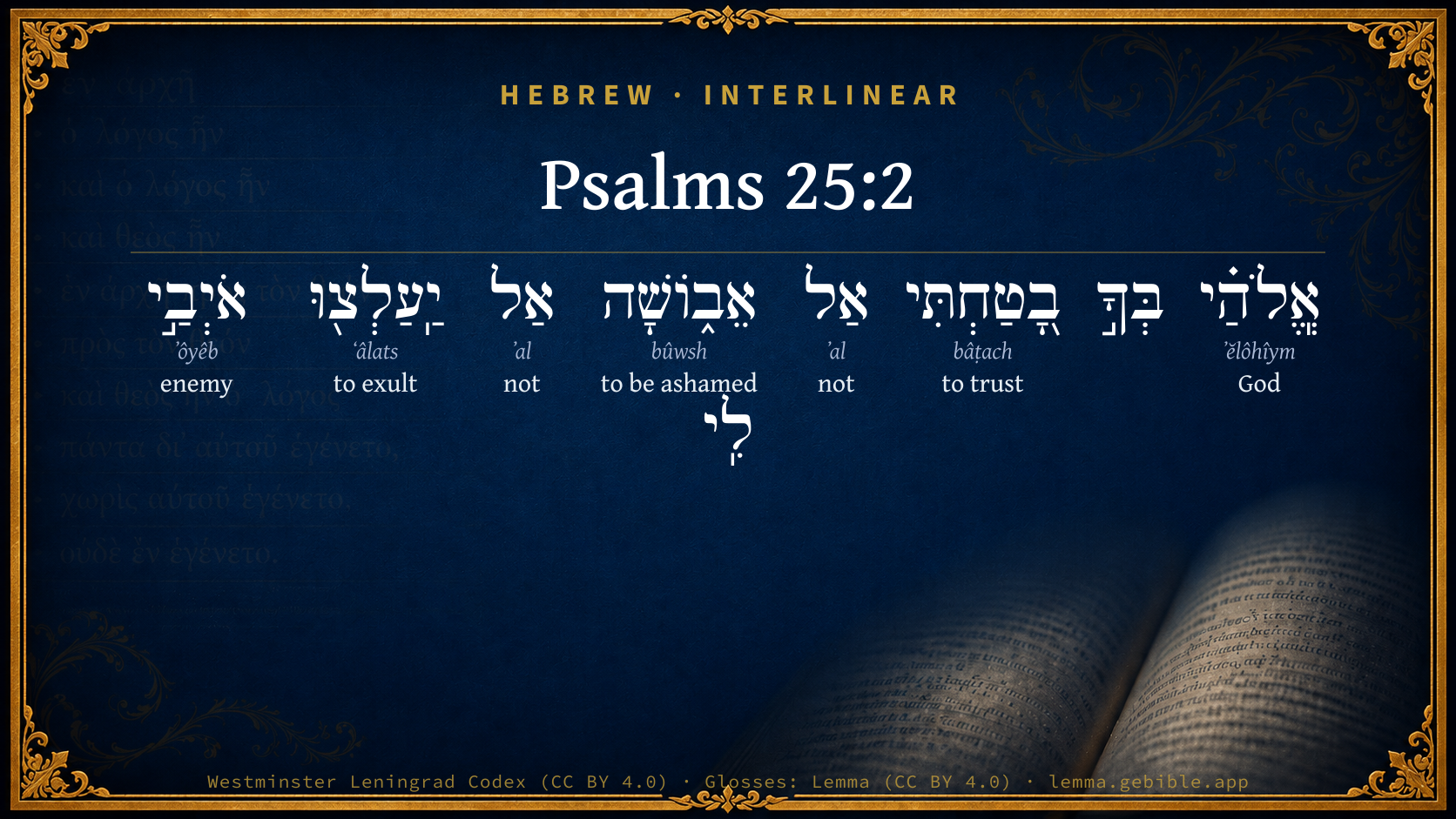
Psalms 25:2

Hebrew (Westminster Leningrad Codex) Psalms 25:2 appears in the Hebrew Old Testament. The text above is from the Westminster Leningrad Codex. Each word links to its Strong’s number, a concise gloss, and parsing drawn from the Open Scriptures Hebrew Bible morphology. Click any word for its full Brown-Driver-Briggs (BDB) entry.
Download image
Cite this verse

Psalms 25:2 (World English Bible). Public Domain. Lemma interlinear Bible study tool, https://lemma.gebible.app/v/psalms/25/2.

Show BibTeX & RIS
BibTeX
RIS
English Translation
My God, I have trusted in you, Don't let me be shamed. Don't let my enemies triumph over me.
World English Bible · Public Domain
Download a study sheet

One document with this verse’s original text, its word-by-word gloss line, the meaning frame, cross-references with their text, attributed commentary, and full source and license credits — printable, and it pastes into notes with its structure intact.

This verse Autodidact and up

Study sheet (.html) Plain text (.txt)

A passage Seminary Student

Up to 50 verses in one chapter. A passage sheet keeps up to 6 commentary sources and 12 cross-references per verse, in the order this page ranks them, and says so on the sheet whenever that leaves anything out. Ask for a single verse and you get the Autodidact verse sheet above.

Everything on this page stays free to read, with no account — the sheet is a download of what is already on screen, not access to it.

Want to remove ads? Support Godless Engineer
Compare translations 3

The same verse in 3 English versions, stacked beneath the original-language interlinear above. Click any original word for its lexicon entry.

Each is an independent rendering of the whole verse — the interlinear is not word-aligned to these translations.

Highlighted words mark where these versions differ — a whole-verse word diff, not a word-by-word alignment.

  • World English Bible Public Domain
    My God, I have trusted in you, Don't let me be shamed. Don't let my enemies triumph over me.
  • King James Version Public Domain
    O my God, I trust in thee: let me not be ashamed, let not mine enemies triumph over me.
  • unfoldingWord Literal Text CC BY-SA 4.0
    My God, in you I trust; do not let me have shame; do not let my enemies exult over me.

unfoldingWord Literal Text — © unfoldingWord, licensed CC BY-SA 4.0. Word-aligned USFM3 via Door43 (git.door43.org/unfoldingWord/en_ult).

Versions to compare (up to 4)

3 of 4 selected

Show all 18 translations

Every available English version of this verse, each an independent rendering of the whole verse.

  • World English Bible Public Domain
    My God, I have trusted in you, Don't let me be shamed. Don't let my enemies triumph over me.
  • Berean Standard Bible Public Domain
    in You, my God, I trust. Do not let me be put to shame; do not let my enemies exult over me.
  • Majority Standard Bible Public Domain
    in You, my God, I trust. Do not let me be put to shame; do not let my enemies exult over me.
  • King James Version Public Domain
    O my God, I trust in thee: let me not be ashamed, let not mine enemies triumph over me.
  • American Standard Version (1901) Public Domain
    O my God, in thee have I trusted, Let me not be put to shame; Let not mine enemies triumph over me.
  • Revised Version (1885) Public Domain
    O my God, in thee have I trusted, let me not be ashamed; let not mine enemies triumph over me.
  • Geneva Bible (1599) Public Domain
    My God, I trust in thee: let me not be confounded: let not mine enemies reioyce ouer mee.
  • Douay-Rheims (1899) Public Domain
    In thee, O my God, I put my trust; let me not be ashamed.
  • Young's Literal Translation Public Domain
    My God, in Thee I have trusted, Let me not be ashamed, Let not mine enemies exult over me.
  • Literal Standard Version CC BY-SA 4.0
    My God, in You I have trusted, || Do not let me be ashamed, || Do not let my enemies exult over me.
  • Unlocked Literal Bible CC BY-SA 4.0
    My God, I trust in you. Do not let me be humiliated; do not let my enemies rejoice triumphantly over me.
  • unfoldingWord Literal Text CC BY-SA 4.0
    My God, in you I trust; do not let me have shame; do not let my enemies exult over me.
  • Darby Bible Public Domain
    My God, I confide in thee; let me not be ashamed, let not mine enemies triumph over me.
  • World Messianic Bible Public Domain
    My God, I have trusted in you. Don’t let me be shamed. Don’t let my enemies triumph over me.
  • Webster's Bible Public Domain
    O my God, I trust in thee: let me not be ashamed, let not my enemies triumph over me,
  • Free Bible Version CC BY-SA 4.0
    I trust in you, my God. Don't let me be humiliated, and don't let my enemies triumph over me.
  • Bible in Basic English Public Domain
    O my God, I have put my faith in you, let me not be shamed; let not my haters be glorying over me.
  • JPS Tanakh (1917) Public Domain
    O my God, in Thee have I trusted, let me not be ashamed; let not mine enemies triumph over me.

Literal Standard Version (2020), Covenant Press — licensed CC BY-SA 4.0. Text via the HelloAO Bible API (eBible.org). Unlocked Literal Bible (unfoldingWord) — licensed CC BY-SA 4.0. Text via the HelloAO Bible API (eBible.org). unfoldingWord Literal Text — © unfoldingWord, licensed CC BY-SA 4.0. Word-aligned USFM3 via Door43 (git.door43.org/unfoldingWord/en_ult). Free Bible Version, Dr. Jonathan Gallagher — licensed CC BY-SA 4.0. Text via the HelloAO Bible API (eBible.org).

Word by word

More ways to search: Search by grammar → Find every occurrence → Compare this word →

Practice this passage: Drill this verse → Learn its vocabulary →

About this verse

These counts appear in no published source. They are computed here, from the morphology-tagged text and Lemma’s own curated glosses. What Lemma adds →

9
words
6
distinct lemmas
Wisdom
section

Notable vocabulary

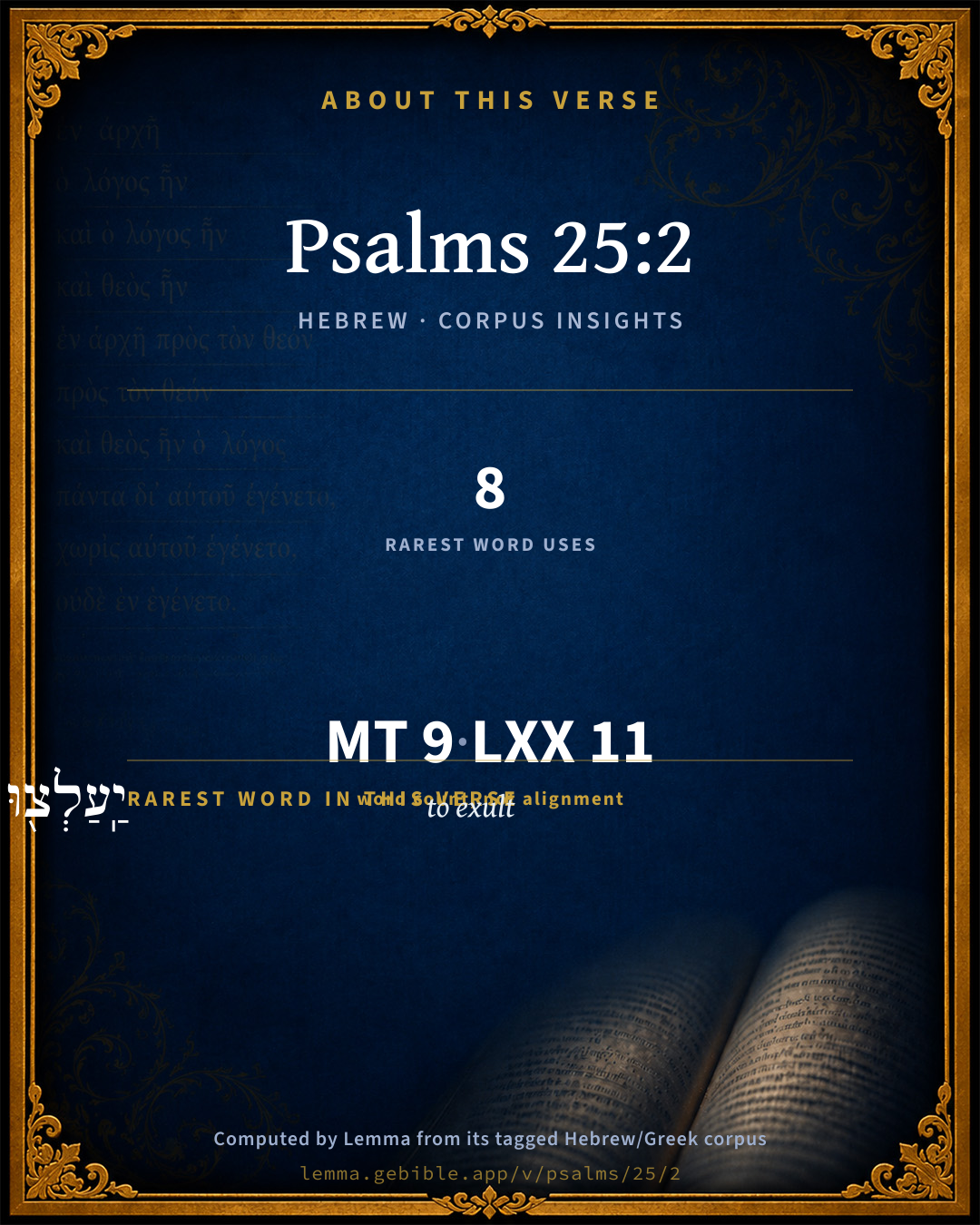
The rarest word here is יַֽעַלְצ֖וּ to exult H5970 — appearing just 8 times in the whole Hebrew Bible.

Shared distinctive vocabulary

יַֽעַלְצ֖וּ to exult H5970 occurs in 8 verses of the Hebrew Bible. Also found in:

Grammatical profile

  • 4 verbs
  • 1 noun
  • 2 prepositions
  • 2 particles

Verb forms

  • בָ֭טַחְתִּי Qal · Perfect
  • אֵב֑וֹשָׁה Qal · Cohortative
  • יַֽעַלְצ֖וּ Qal · Jussive
  • אֹיְבַ֣י Qal · Participle Active

Repetition

A word recurs within this verse — often emphatic in Hebrew:

  • אַל not H408 ×2

Hebrew & Septuagint length

In English translation the verse runs 19 words from the Hebrew and 21 from the Septuagint (LXX English) — closely comparable.

A rough comparison of the two English renderings, which tokenize alike — not a word-level alignment.

Word counts can differ between the Hebrew and the Greek without any difference in meaning — e.g. the Hebrew direct-object marker אֵת has no separate Greek word, and Greek often adds the article ὁ.

In the original languages it is 9 Hebrew tokens and 11 Greek tokens — but the two are counted differently (Hebrew bundles its prefixes and suffixes into one token; the Greek is in lemma form), so that isn’t a like-for-like length.

Cross-references

26

Topical passages linked to Psalms 25:2 in the Treasury of Scripture Knowledge — connected by theme and wording, ordered by reader-vote popularity; previews shown in the World English Bible.

  • Romans 10:11 For the Scripture says, "Whoever believes in him will not be disappointed."
  • Psalms 41:11 By this I know that you delight in me, Because my enemy doesn't triumph over me.
  • Psalms 22:5 They cried to you, and were delivered. They trusted in you, and were not disappointed.
  • Psalms 71:1 In you, Yahweh, I take refuge. Never let me be disappointed.
  • Romans 5:5 and hope doesn't disappoint us, because God's love has been poured out into our hearts through the Holy Spirit who was given to us.
  • Psalms 142:6 Listen to my cry, For I am in desperate need. Deliver me from my persecutors, For they are stronger than me.
  • Psalms 31:1 In you, Yahweh, I take refuge. Let me never be disappointed: Deliver me in your righteousness.
  • Isaiah 37:35 For I will defend this city to save it, for my own sake, and for my servant David's sake.
  • Psalms 13:2–4 How long shall I take counsel in my soul, Having sorrow in my heart every day? How long shall my enemy triumph over me?
  • Psalms 34:8 Oh taste and see that Yahweh is good. Blessed is the man who takes refuge in him.
  • Psalms 94:3 Yahweh, how long will the wicked, How long will the wicked triumph?
  • Isaiah 26:3 You will keep [him] in perfect peace, [whose] mind [is] stayed [on you]; because he trusts in you.
  • Psalms 7:1 Yahweh, my God, I take refuge in you. Save me from all those who pursue me, and deliver me,
  • Psalms 18:2 Yahweh is my rock, my fortress, and my deliverer; My God, my rock, in whom I take refuge; My shield, and the horn of my salvation, my high tower.
  • Psalms 35:19–25 Don't let those who are my enemies wrongfully rejoice over me; Neither let them wink with the eye who hate me without a cause.
  • Psalms 37:40 Yahweh helps them, and rescues them. He rescues them from the wicked, and saves them, Because they have taken refuge in him.
  • Isaiah 37:20 Now therefore, Yahweh our God, save us from his hand, that all the kingdoms of the earth may know that you are Yahweh, even you only.
  • Isaiah 49:23 Kings shall be your nursing fathers, and their queens your nursing mothers: they shall bow down to you with their faces to the earth, and lick the dust of your feet; and you shall know that I am Yahweh; and those who wait for me shall not be disappointed.
  • 1 Peter 2:6 Because it is contained in Scripture, "Behold, I lay in Zion a chief cornerstone, chosen, and precious: He who believes in him will not be disappointed."
  • Psalms 22:1 My God, my God, why have you forsaken me? Why are you so far from helping me, and from the words of my groaning?
  • Psalms 22:8 "He trusts in Yahweh; Let him deliver him; Let him rescue him, since he delights in him."
  • Isaiah 36:14–20 Thus says the king, Don't let Hezekiah deceive you; for he will not be able to deliver you:
  • Isaiah 37:10 Thus shall you speak to Hezekiah king of Judah, saying, Don't let your God in whom you trust deceive you, saying, Jerusalem shall not be given into the hand of the king of Assyria.
  • Isaiah 41:16 You shall winnow them, and the wind shall carry them away, and the whirlwind shall scatter them; and you shall rejoice in Yahweh, you shall glory in the Holy One of Israel.
  • Psalms 56:1 Be merciful to me, God, for man wants to swallow me up. All day long, he attacks and oppresses me.
  • Isaiah 28:16 therefore thus says the Lord Yahweh, Behold, I lay in Zion for a foundation a stone, a tried stone, a precious corner -[stone] of sure foundation: he who believes shall not be in haste.

Cross-references courtesy of OpenBible.info (CC BY 4.0).

Hebrew and Greek witnesses Masoretic Hebrew ↔ Greek Septuagint

The same verse in the two great witnesses to the Old Testament, shown verse-for-verse.

You’re reading Greek Psalm 24 (Hebrew Psalm 25). The Septuagint counts the superscription, so verse numbers can differ from the Hebrew — chapter-level alignment, not verse-by-verse. Numbering follows Rahlfs.

These are two independent witnesses, not word-aligned to each other, and the Septuagint is shown in lemma (dictionary) form.

Hebrew Psalms 25:2 Masoretic · Westminster Leningrad Codex

אֱֽלֹהַ֗י בְּךָ֣ בָ֭טַחְתִּי אַל אֵב֑וֹשָׁה אַל יַֽעַלְצ֖וּ אֹיְבַ֣י לִֽי

My God, I have trusted in you, Don't let me be shamed. Don't let my enemies triumph over me.

World English Bible · Public Domain

Greek LXX Greek Psalm 24:2 Septuagint · lemma form

ἐπί σύ πείθω μή κατααἰσχύνω μηδέ καταγελάω ἐγώ ὁ ἐχθρός ἐγώ

O my God, I have trusted in you: let me not be confounded, neither let my enemies laugh me to scorn.

LXX2012 (modern English Septuagint) · Public Domain

On this verse, The Cambridge Bible for Schools and Colleges discusses the Septuagint’s reading. Read the note in Commentary ↓

Hebrew: Westminster Leningrad Codex (CC BY 4.0). Greek: Septuagint (public domain); English from LXX2012 (modern English Septuagint) (Public Domain). How the Septuagint differs from the Hebrew →

Commentary

Notes on Psalms 25:2 from classic Christian and Jewish commentators (each source and its license shown beneath its notes). The classic Christian expositions comment on the surrounding passage and are grouped to its opening verse, so a note may address several verses; the Jewish commentaries on the Tanakh (Rashi and others) are per-verse, so they appear only where the commentator wrote on this verse.

Lemma curates 59 commentaries, every one of them public domain or Creative Commons licensed, each selected and text-cleaned for this edition rather than reprinted as found. About our sources →

The Cambridge Bible for Schools and Colleges

gen. ed. J. J. S. Perowne

2. This verse should begin with the letter Beth in the word for in thee. It has been suggested that the first word O my God was disregarded in the alphabetic arrangement; but it is more probable that it originally belonged to the second line of the preceding verse (so codd. אBA of the LXX), which has now been lost or misplaced. Otherwise it must be omitted. Psa_25:2 then forms a proper distich:

In thee have I trusted, let me not be ashamed:

Let not mine enemies triumph over me.

Cp. Psa_25:20; Psa_22:5; Psa_31:1; Psa_31:17.

The Cambridge Bible for Schools and Colleges (gen. ed. J. J. S. Perowne; Cambridge University Press, 1878–1918) — public domain. Text from a community e-Sword module.

Trapp's Complete Commentary

John Trapp

Psa 25:2 O my God, I trust in thee: let me not be ashamed, let not mine enemies triumph over me.

Ver. 2. O my God, I trust in thee] I pray in faith, which is as the fire, and my prayer as the flame that ariseth out of it. Faith is the foundation of prayer; and prayer is the fervency of faith. Now David knew that the hand of faith never knocketh at the gate of grace in vain.

Let me not be ashamed] Shame is the daughter of disappointment. This David deprecateth; Quaeque repulsa gravis. See Job 6:20.

Let not mine enemies triumph over me] By saying that I pray to no purpose, as Rabshakeh did, Isa 35:6. I say (saith Hezekiah) I have words of my lips, prayer; prayer? but alas, what is that more than empty words, an airy nothing? Counsel and strength are for the battle. Thus he.

John Trapp, A Commentary or Exposition upon All the Books of the Old and New Testament (1647–1656) — public domain. Text from a community e-Sword module.

The Biblical Illustrator

Joseph S. Exell

Psa_25:2

Let me not be put to shame.

Deliverance and guidance

Trust that was not vindicated by deliverance would cover the face with confusion. Hopes that breed not shame are the treasure of him whose hope is in Jehovah. Foes unnamed threaten; but the stress of the petitions in the first section of the Psalm is less on enemies than on sins. One cry for protection from the former is all that the Psalmist utters, and then his prayer swiftly turns to deeper needs. In the last section the petitions are more exclusively for deliverance from enemies. Needful as such escape is, it is less needful than the knowledge of Gods ways, and the man in extremest peril orders his desires rightly if he asks holiness first and safety second. The cry in Psa_25:2 rests upon the confidence nobly expressed in Psa_25:3, in which the verbs are not optatives, but futures, declaring a truth certain to be realised in the Psalmists experience, because it is true for all who, like him, wait on Jehovah. True prayer is the individuals sheltering himself under the broad folds of the mantle that covers all who pray. The double confidence as to the waiters on Jehovah and the treacherous without cause is the summary of human experience as read by faith. Sense has much to adduce in contradiction, but the dictum is nevertheless true; only, its truth does not always appear in the small are of the circle which lies between cradle and grave. The prayer for deliverance glides into that for guidance, since the latter is the deeper need, and the former will scarcely be answered unless the suppliants will docilely offers the latter. The soul lifted to Jehovah will long to know His will, and submit itself to His manifold teachings. Thy ways and Thy paths necessarily here mean the ways in which Jehovah desires that the Psalmist should go. In Thy truth is ambiguous, both as to the preposition and as to the noun. The clause may either mean Gods truth (i.e. faithfulness)

as His motive for answering the prayer, or His truth (i.e. the objective revelation)

as the path for men. Predominant usage inclines to the former signification of the noun, but the possibility still remains of regarding Gods faithfulness as the path in which the Psalmist desires to be led, i.e. to experience it. The cry for forgiveness strikes a deeper note of pathos, and, as asking a more wondrous blessing, grasps still more firmly the thought of what Jehovah is and always has been. The appeal is made to Thy compassions and loving kindnesses, as belonging to His nature, and to their past exercise as having been from of old. Emboldened thus, the Psalmist can look back on his own past, both on his outbursts of youthful passion and levity, which he calls failures, as missing the mark; and on the darker evils of later manhood, which he calls rebellions, and can trust that Jehovah will think upon him according to His mercy, and for the sake of His goodness or love. The vivid realisation of that Eternal Mercy, as the very mainspring of Gods actions, and as setting forth in many an ancient deed the eternal pattern of His dealings, enables a man to bear the thought of his own sins. (A. Maclaren, D. D.)

The Biblical Illustrator, edited by Joseph S. Exell (c. 1880s–1900s) — public domain. Text from a community e-Sword module.

The Treasury of David

Charles H. Spurgeon

Ver. 2. O my God. This title is more dear than the name Jehovah, which is used in the first sentence. Already the sweet singer has drawn nearer to his heavenly helper, for he makes bold to grasp him with the hand of assured possession, calling him, my God. Oh the more than celestial music of that word"My God!" It is to be observed that the psalmist does not deny expression to those gracious feelings with which God had favoured him; he does not fall into loathsome mock modesty, but finding in his soul a desire to seek the Lord he avows it; believing that he had a rightful interest in Jehovah he declares it, and knowing that he had confidence in his God he professes it; O my God, I trust in thee. Faith is the cable which binds our boat to the shore, and by pulling at it we draw ourselves to the land; faith unites us to God, and then draws us near to him. As long as the anchor of faith holds there is no fear in the worst tempest; if that should fail us there would be no hope left. We must see to it that our faith is sound and strong, for otherwise prayer cannot prevail with God. Woe to the warrior who throws away his shield; what defence can be found for him who finds no defence in his God? Let me not be ashamed. Let no my disappointed hopes make me feel ashamed of my former testimonies of thy faithfulness. Many were on the watch for this. The best of men have their enemies, and should pray against them that they may not see their wicked desires accomplished. Let not mine enemies triumph over me. Suffer no wicked mouth to make blasphemous mirth out of my distresses by asking, "Where is thy God?" There is a great jealousy in believers for the honour of God, and they cannot endure that unbelievers should taunt them with the failure of their expectations from the God of their salvation. All other trusts will end in disappointment and eternal shame, but our confidence shall never be confounded.

Ver. 2-3. When David had prayed, O my God, I trust in thee; let me not be ashamed! In the next verse, as if conscious to himself that his prayers were too restrictive, narrow, and niggardly, he enlargeth the bounds thereof, and builds them on a broader bottom, "Yea, let none that wait on thee be ashamed." Thus it is that charity in the midst of our religious devotions must have rehoboth (room enough to expatiate in). Our petitions must not be pent or confined to our own private good, but extended to the benefit of all God's servants, in what condition soever. Thomas Fuller.

Ver. 2. The soul at anchor, and the two rocks from which it would be delivered.

Psalms 25:3*

Ver. 2-3. See Psalms on "Ps 25:2" for further information.

Charles H. Spurgeon's The Treasury of David (1869–1885) — public domain. Psalms only. Text from a community e-Sword/MySword module.

Tyndale Open Study Notes

Tyndale Open Resources

25:2 Enemies would rejoice by singing a victory song.

Tyndale Open Study Notes — © Tyndale Open Resources, licensed CC BY-SA 4.0. Text via the HelloAO Bible API.

Geneva Bible (1599)

Geneva Bible translators

That thou wilt take away mine enemies, which are thy rods.

Geneva Bible (1599) marginal notes — public domain. Text via Bolls.life.

Jamieson, Fausset & Brown

Robert Jamieson, A. R. Fausset & David Brown

not be ashamed--by disappointment of hopes of relief.

Jamieson, Fausset & Brown — Commentary Critical and Explanatory on the Whole Bible (1871) — public domain (CC PDM 1.0). Text via the HelloAO Bible API.

Adam Clarke's Commentary

Verse 2. I trust in thee] I depend upon thy infinite goodness and mercy for my support and salvation.

Let me not be ashamed] Hide my iniquity, and forgive my guilt.

Adam Clarke's Commentary on the Bible (1810–1826) — public domain. Text from a community e-Sword/MySword module.

John Calvin's Commentaries

2. O my God! I have put my trust in thee. By this verse we learn, (what will appear more clearly afterwards,) that David had to do with men; but as he was persuaded that his enemies were, as it were, the scourges of God, he with good reason asks that God would restrain them by his power, lest they should become more insolent, and continue, to exceed all bounds. By the word trust he confirms what he had just said of the lifting up of his soul to God; for the term is employed either as descriptive of the way in which the souls of the faithful are lifted up, or else faith and hope are added as the cause of such an effect, namely, the lifting up of the soul. And, indeed, these are the wings by which our souls, rising above this world, are lifted up to God. David, then, was carried upward to God with the whole desire of his heart, because, trusting to his promises, he thereby hoped for sure salvation. When he asks that God would not suffer him to be put to shame, he offers up a prayer which is taken from the ordinary doctrine of Scripture, namely, that they who trust in God shall never be ashamed. The reason which is added, and which he here pleads, to induce God to have pity upon him, ought also to be noticed. It is this, that he might not be exposed to the derision of his enemies, whose pride is no less hurtful to the feelings of the godly than it is displeasing to God.

John Calvin's Commentaries (1540-1563) — public domain. Text from the Calvin Translation Society English edition (1840s-50s) via the Christian Classics Ethereal Library (ccel.org). Calvin's coverage is partial (roughly two-thirds of the Bible); uncommented books and verses are honest gaps, never fabricated. The 19th-century editor's footnotes and remarks are omitted so the notes are faithfully Calvin's own voice.

John Gill's Exposition

O my God, I trust in thee,.... He claims his interest in God, and expresses his faith and confidence in him, in the midst of all his troubles; See Gill on Psa 7:1;

let me not be ashamed; meaning of his trust in God, by being disappointed of the help, deliverance, and salvation from him, which he trusted in him for; and the believer, as he has no reason to be ashamed of God, the object of his trust; so neither of the act of his hope or trust in him; nor shall he; for hope makes not ashamed; see Psa 119:116, Rom 5:5;

let not mine enemies triumph over me; either his temporal enemies, his subjects that were risen up against him; or his spiritual enemies, Satan, and the men of the world, who rejoice and triumph when the saints are forsaken by God; and they are ready to say, as David's enemies did of him, there is no help or salvation for him in God, Psa 3:2; and when they fall into their hands, or fall by them.

John Gill's Exposition of the Whole Bible (1746–1763) — public domain (CC PDM 1.0). Text via the HelloAO Bible API.

Albert Barnes' Notes on the Bible

O my God, I trust in thee - This is the first thought - a feeling that he had true confidence in God, and that in all the duties of life, in all his trials, and in all his hopes for the future, his reliance was on God alone.

Let me not be ashamed - That is, let me never be so forsaken by thee as to have occasion for shame that I have thus trusted in thee. The prayer is not that he might never be ashamed to avow and confess his trust in God, but that he might “find” God to be such a helper and friend that he might never be ashamed on account of the trust which he had put in Him, as if it had been a false reliance; that he might not be disappointed, and made to feel that he had done a foolish thing in confiding in One who was not able to help him. See the word explained in the notes at Job 6:20. Compare Isa 30:5; Jer 8:9; Jer 14:3-4.

Let not mine enemies triumph over me - This explains what the psalmist meant by his prayer that he might not be “ashamed,” or put to shame. He prayed that he might not be vanquished by his foes, and that it might not appear that he had trusted in a Being who was unable to defend him. Applied now to us, the prayer would imply a desire that we may not be so overcome by our spiritual foes as to bring dishonor on ourselves and on the cause which we profess to love; that we may not be held up to the world as those who are unable to maintain the warfare of faith, and exposed to scorn as those who are unfaithful to their trust; that we may not be so forsaken, so left to trial without consolation, so given over to sadness, melancholy, or despair, as to leave the world to say that reliance on God is vain, and that there is no advantage in being his friends.

Albert Barnes' Notes on the Bible (1834–1885) — public domain. Text from a community e-Sword/MySword module.

Matthew Poole's English Annotations

Ashamed, i.e. disappointed of my hope, which will be reproachful to me, not without reflection upon thee, of whose power and faithfulness I have made my boast.

Matthew Poole's English Annotations on the Holy Bible (1683–1685) — public domain. Text from a community e-Sword/MySword module.

Whedon's Commentary on the Bible

Daniel D. Whedon

2. My God—The pronoun indicates a still nearer approach—the “Abba, Father,” of the Old Testament. Rom_8:15.

Ashamed—The word radically signifies to be pale, to change colour, and denotes that state of mind which arises from disappointment, the sudden cutting off of hope. It is opposed to the word triumph, exult, in next line. In Psa_25:3 the psalmist shows that this prayer is not selfish, but grounded in righteousness. Shame and pale-facedness belong to the wicked; exultation and leaping for joy to the righteous.

Daniel D. Whedon (gen. ed.), Commentary on the Old and New Testaments (1874–1909) — public domain. Text from a community e-Sword module.

The Pulpit Commentary

O my God, I trust in thee. (comp. Psa_7:1 Psa_11:1 Psa 31:I, Psa_31:6, etc.) Let me not be ashamed; i.e. do not disappoint my trust, and thereby bring me to shame. (comp. Job_6:20) Let not mine enemies triumph over me. It does not appear whether the "enemies" intended are domestic or foreign foes. Either would triumph were David disappointed of a confident expectation.

The Pulpit Commentary (1880–1919), ed. H.D.M. Spence-Jones & Joseph S. Exell — public domain. Text from a community e-Sword module.

John Wesley's Explanatory Notes

Ashamed - Disappointed of my hope.

John Wesley, Explanatory Notes Upon the Whole Bible (1754–1765) — public domain. Text via the GEBible commentary corpus.

J. A. Alexander on Psalms

Joseph Addison Alexander

2. My God, in thee have I trusted, let me not be ashamed; let not my enemies triumph over me, or more exactly, with respect to me. As the future verb of the preceding verse implies a fixed determination to confide in God hereafter, so the preterite in this verse indicates that such trust has been exercised already. The present is included under both forms.—Ashamed, disappointed, defeated in my plans and expectations. See above, on Psa 22:6 (5).—The last clause shews that suffering from enemies was in the Psalmist's mind throughout.

Joseph Addison Alexander, The Psalms Translated and Explained (1850) — public domain. Text from a community e-Sword module.

Scofield Reference Notes

C. I. Scofield

trust

(See Scofield "Psa 2:12").

The Scofield Reference Bible (1917 edition), notes by C. I. Scofield — public domain. Text from a community e-Sword module.

Lesson kit

Teaching starters — assembled from the data on this page, not authored interpretation. Every prompt links to the verse data it draws on. Edit before teaching.

Psalms, in the Wisdom, opens this verse with 9 words (6 distinct Hebrew lemmas). Its most distinctive word is ʻâlats (“to exult”). A historical commentator’s framing appears above. Read the whole chapter for the surrounding context.

Discussion questions

  1. How does “to exult” (ʻâlats) shape what this verse is saying?
  2. How does 1 Samuel 2:1, which shares the word «to exult», read alongside this verse?
  3. What does the repetition of “not” (2× in this one verse) do in this verse?
  4. The translations on this page render this verse differently — a whole-verse word diff, not a word-by-word alignment. What might account for the different wordings?
  5. «בָ֭טַחְתִּי» is a Qal Perfect verb. How does that grammatical form shape the action described?
  6. Compare how The Cambridge Bible for Schools and Colleges and Trapp's Complete Commentary read this verse. Where do they agree or differ?

Things to notice

Reading settings

Reading text

Shown beneath each verse's original-language words.

Old Testament
Old Testament edition

Read the OT as the Masoretic Hebrew (MT) or the Greek Septuagint (LXX).

English shown for the Greek Septuagint (in the Hebrew ↔ Greek comparison).

Comparing translations? Open the Compare panel on any verse page to stack up to four side by side.