
Psalms 38:19

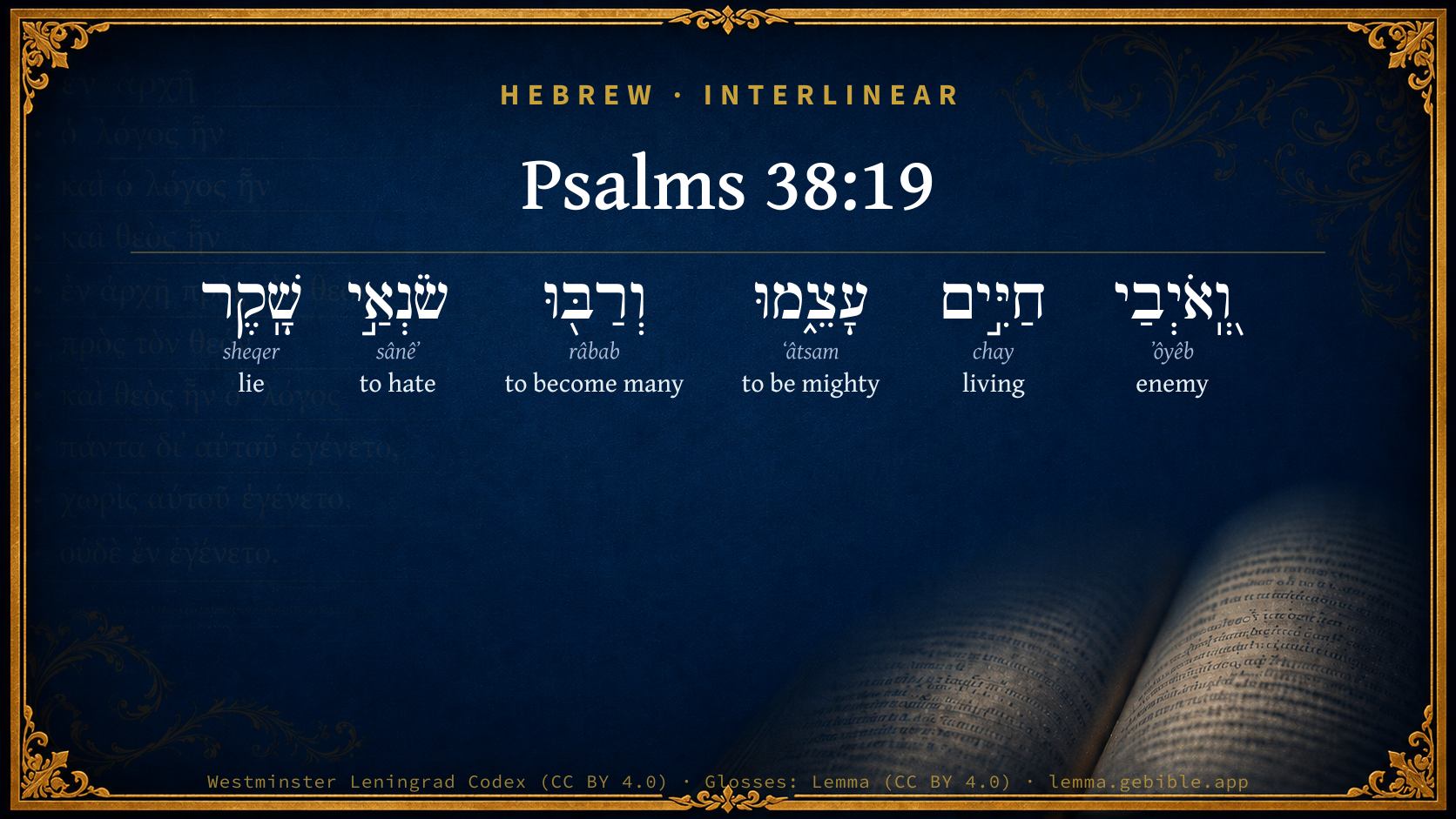
Hebrew (Westminster Leningrad Codex) Psalms 38:19 appears in the Hebrew Old Testament. The text above is from the Westminster Leningrad Codex. Each word links to its Strong’s number, a concise gloss, and parsing drawn from the Open Scriptures Hebrew Bible morphology. Click any word for its full Brown-Driver-Briggs (BDB) entry.
Download image
Cite this verse

Psalms 38:19 (World English Bible). Public Domain. Lemma interlinear Bible study tool, https://lemma.gebible.app/v/psalms/38/19.

Show BibTeX & RIS
BibTeX
RIS
English Translation
But my enemies are vigorous and many. Those who hate me without reason are numerous.
World English Bible · Public Domain
Download a study sheet

One document with this verse’s original text, its word-by-word gloss line, the meaning frame, cross-references with their text, attributed commentary, and full source and license credits — printable, and it pastes into notes with its structure intact.

This verse Autodidact and up

Study sheet (.html) Plain text (.txt)

A passage Seminary Student

Up to 50 verses in one chapter. A passage sheet keeps up to 6 commentary sources and 12 cross-references per verse, in the order this page ranks them, and says so on the sheet whenever that leaves anything out. Ask for a single verse and you get the Autodidact verse sheet above.

Everything on this page stays free to read, with no account — the sheet is a download of what is already on screen, not access to it.

Want to remove ads? Support Godless Engineer
Compare translations 3

The same verse in 3 English versions, stacked beneath the original-language interlinear above. Click any original word for its lexicon entry.

Each is an independent rendering of the whole verse — the interlinear is not word-aligned to these translations.

Highlighted words mark where these versions differ — a whole-verse word diff, not a word-by-word alignment.

  • World English Bible Public Domain
    But my enemies are vigorous and many. Those who hate me without reason are numerous.
  • King James Version Public Domain
    But mine enemies are lively, and they are strong: and they that hate me wrongfully are multiplied.
  • unfoldingWord Literal Text CC BY-SA 4.0
    But my living enemies are strong, and my haters of falsehood are many.

unfoldingWord Literal Text — © unfoldingWord, licensed CC BY-SA 4.0. Word-aligned USFM3 via Door43 (git.door43.org/unfoldingWord/en_ult).

Versions to compare (up to 4)

3 of 4 selected

Show all 18 translations

Every available English version of this verse, each an independent rendering of the whole verse.

  • World English Bible Public Domain
    But my enemies are vigorous and many. Those who hate me without reason are numerous.
  • Berean Standard Bible Public Domain
    Many are my enemies without cause, and many hate me without reason.
  • Majority Standard Bible Public Domain
    Many are my enemies without cause, and many hate me without reason.
  • King James Version Public Domain
    But mine enemies are lively, and they are strong: and they that hate me wrongfully are multiplied.
  • American Standard Version (1901) Public Domain
    But mine enemies are lively, `and' are strong; And they that hate me wrongfully are multiplied.
  • Revised Version (1885) Public Domain
    But mine enemies are lively, and are strong: and they that hate me wrongfully are multiplied.
  • Geneva Bible (1599) Public Domain
    Then mine enemies are aliue and are mightie, and they that hate me wrongfully are many.
  • Douay-Rheims (1899) Public Domain
    For I will declare my inequity: and I will think for my sin.
  • Young's Literal Translation Public Domain
    And mine enemies `are' lively, They have been strong, and those hating me without cause, Have been multiplied.
  • Literal Standard Version CC BY-SA 4.0
    And my enemies [are] lively, || They have been strong, and those hating me without cause, || Have been multiplied.
  • Unlocked Literal Bible CC BY-SA 4.0
    But my enemies are numerous; those who hate me wrongfully are many.
  • unfoldingWord Literal Text CC BY-SA 4.0
    But my living enemies are strong, and my haters of falsehood are many.
  • Darby Bible Public Domain
    But mine enemies are lively, they are strong; and they that hate me wrongfully are multiplied:
  • World Messianic Bible Public Domain
    But my enemies are vigorous and many. Those who hate me without reason are numerous.
  • Webster's Bible Public Domain
    \\38:18\\For I will declare my iniquity; I will be sorry for my sin.
  • Free Bible Version CC BY-SA 4.0
    I have many powerful enemies—they are very active, hating me for no reason.
  • Bible in Basic English Public Domain
    But they are strong who have hate for me without cause: those who are against me falsely are increased in numbers.
  • JPS Tanakh (1917) Public Domain
    (38-20) But mine enemies are strong in health; and they that hate me wrongfully are multiplied.

Literal Standard Version (2020), Covenant Press — licensed CC BY-SA 4.0. Text via the HelloAO Bible API (eBible.org). Unlocked Literal Bible (unfoldingWord) — licensed CC BY-SA 4.0. Text via the HelloAO Bible API (eBible.org). unfoldingWord Literal Text — © unfoldingWord, licensed CC BY-SA 4.0. Word-aligned USFM3 via Door43 (git.door43.org/unfoldingWord/en_ult). Free Bible Version, Dr. Jonathan Gallagher — licensed CC BY-SA 4.0. Text via the HelloAO Bible API (eBible.org).

Word by word

More ways to search: Search by grammar → Find every occurrence → Compare this word →

Practice this passage: Drill this verse → Learn its vocabulary →

About this verse

These counts appear in no published source. They are computed here, from the morphology-tagged text and Lemma’s own curated glosses. What Lemma adds →

6
words
6
distinct lemmas
Wisdom
section

Notable vocabulary

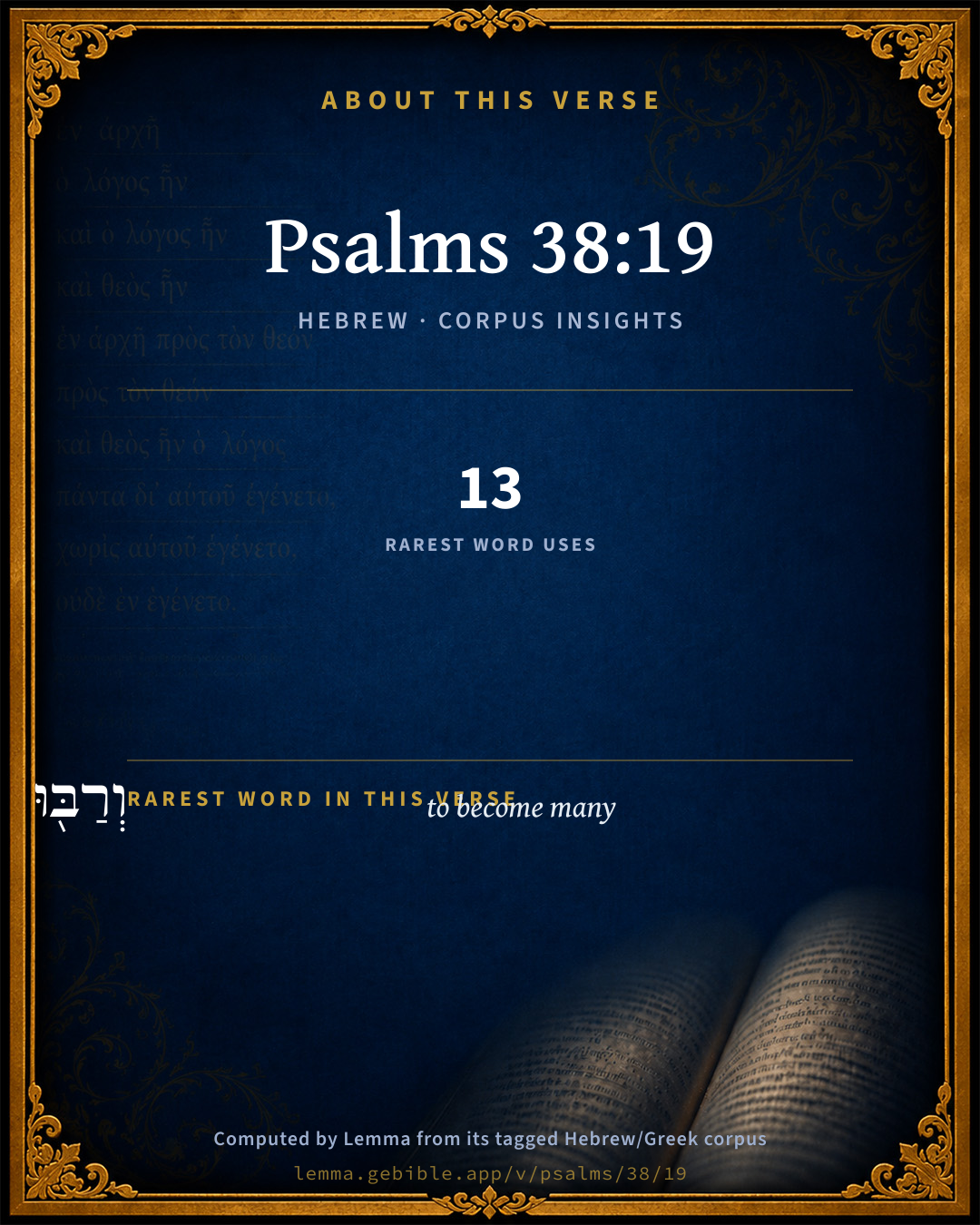
The rarest word here is וְרַבּ֖וּ to become many H7231 — appearing just 13 times in the whole Hebrew Bible.

Shared distinctive vocabulary

וְרַבּ֖וּ to become many H7231 occurs in 13 verses of the Hebrew Bible. Also found in:

Grammatical profile

  • 4 verbs
  • 1 noun
  • 1 adjective

Verb forms

  • וְֽ֭אֹיְבַי Qal · Participle Active
  • עָצֵ֑מוּ Qal · Perfect
  • וְרַבּ֖וּ Qal · Perfect
  • שֹׂנְאַ֣י Qal · Participle Active

Hebrew & Septuagint length

In English translation the verse runs 15 words from the Hebrew and 17 from the Septuagint (LXX English) — closely comparable.

A rough comparison of the two English renderings, which tokenize alike — not a word-level alignment.

Word counts can differ between the Hebrew and the Greek without any difference in meaning — e.g. the Hebrew direct-object marker אֵת has no separate Greek word, and Greek often adds the article ὁ.

Cross-references

10

Topical passages linked to Psalms 38:19 in the Treasury of Scripture Knowledge — connected by theme and wording, ordered by reader-vote popularity; previews shown in the World English Bible.

  • Psalms 35:19 Don't let those who are my enemies wrongfully rejoice over me; Neither let them wink with the eye who hate me without a cause.
  • John 15:18–25 If the world hates you, you know that it has hated me before it hated you.
  • Matthew 10:22 You will be hated by all men for my name's sake, but he who endures to the end will be saved.
  • Psalms 69:4 Those who hate me without a cause are more than the hairs of my head. Those who want to cut me off, being my enemies wrongfully, are mighty. I have to restore what I didn't take away.
  • Psalms 3:1 Yahweh, how my adversaries have increased! Many are those who rise up against me.
  • Psalms 18:17 He delivered me from my strong enemy, From those who hated me; for they were too mighty for me.
  • Psalms 25:19 Consider my enemies, for they are many. They hate me with cruel hatred.
  • Psalms 56:1–2 Be merciful to me, God, for man wants to swallow me up. All day long, he attacks and oppresses me.
  • Psalms 59:1–3 Deliver me from my enemies, my God. Set me on high from those who rise up against me.
  • Acts 4:25–28 who by the mouth of your servant, David, said, 'Why do the nations rage, And the peoples plot a vain thing?

Cross-references courtesy of OpenBible.info (CC BY 4.0).

Hebrew and Greek witnesses Masoretic Hebrew ↔ Greek Septuagint

The same verse in the two great witnesses to the Old Testament, shown verse-for-verse.

You’re reading Greek Psalm 37 (Hebrew Psalm 38). The Septuagint counts the superscription, so verse numbers can differ from the Hebrew — chapter-level alignment, not verse-by-verse. Numbering follows Rahlfs.

These are two independent witnesses, not word-aligned to each other, and the Septuagint is shown in lemma (dictionary) form.

Hebrew Psalms 38:19 Masoretic · Westminster Leningrad Codex

וְֽ֭אֹיְבַי חַיִּ֣ים עָצֵ֑מוּ וְרַבּ֖וּ שֹׂנְאַ֣י שָֽׁקֶר

But my enemies are vigorous and many. Those who hate me without reason are numerous.

World English Bible · Public Domain

Greek LXX Greek Psalm 37:19 Septuagint · lemma form

ὅτι ὁ ἀνομία ἐγώ ἐγώ ἀναἀγγέλλω καί μεριμνάω ὑπέρ ὁ ἁμαρτία ἐγώ

But my enemies live, and are mightier than I: and they that hate me unjustly are multiplied.

LXX2012 (modern English Septuagint) · Public Domain

Hebrew: Westminster Leningrad Codex (CC BY 4.0). Greek: Septuagint (public domain); English from LXX2012 (modern English Septuagint) (Public Domain). How the Septuagint differs from the Hebrew →

Commentary

Notes on Psalms 38:19 from classic Christian and Jewish commentators (each source and its license shown beneath its notes). The classic Christian expositions comment on the surrounding passage and are grouped to its opening verse, so a note may address several verses; the Jewish commentaries on the Tanakh (Rashi and others) are per-verse, so they appear only where the commentator wrote on this verse.

Lemma curates 59 commentaries, every one of them public domain or Creative Commons licensed, each selected and text-cleaned for this edition rather than reprinted as found. About our sources →

Trapp's Complete Commentary

John Trapp

Psa 38:19 But mine enemies [are] lively, [and] they are strong: and they that hate me wrongfully are multiplied.

Ver. 19. Mine enemies are lively, &c.] q.d. It is nuts to them, and they soon compose comedies out of my tragedies, growing more insolent by mine afflictions, and upbraiding me with my sins.

John Trapp, A Commentary or Exposition upon All the Books of the Old and New Testament (1647–1656) — public domain. Text from a community e-Sword module.

Joseph Benson's Commentary

Psa 38:19-20. Mine enemies are lively — Hebrew, living; that is, thriving, flourishing, and prosperous. They that render evil for good — That hate and persecute me, not only without any injury or provocation on my part, but, as it were, in requital of the good I have done to them. Because I follow the thing that good is — Because I love and diligently practise justice and piety, which they hate, and which I exercised, as I had opportunity, in the punishment of such as they are.

Joseph Benson's Commentary on the Old and New Testaments (1811–1818) — public domain. Text from a community e-Sword module.

J. A. Alexander on Psalms

Joseph Addison Alexander

20. (Psa 38:19). And my deadly enemies are strong, and multiplied are those hating me falsely (or without a cause). Instead of deadly some find the opposite idea, lively, here expressed. My enemies (are) living (or alive), they are strong. Or, my living enemies are strong. But the writer here uses the common Hebrew word for life, and as the Hebrew literally means my enemies of falsehood, or more appropriately, it may mean my enemies of life, those who hate my life and would deprive me of it. Compare this with Psa 17:9 above.— Hating me falsely. Compare Psa 35:19; Psa 69:5 (4).

Joseph Addison Alexander, The Psalms Translated and Explained (1850) — public domain. Text from a community e-Sword module.

Tyndale Open Study Notes

Tyndale Open Resources

38:19 That the psalmist’s enemies hate him without reason compounds his pain.

Tyndale Open Study Notes — © Tyndale Open Resources, licensed CC BY-SA 4.0. Text via the HelloAO Bible API.

Geneva Bible (1599)

Geneva Bible translators

In my greatest misery they most rejoice.

Geneva Bible (1599) marginal notes — public domain. Text via Bolls.life.

Jamieson, Fausset & Brown

Robert Jamieson, A. R. Fausset & David Brown

Still, while humbled before God, he is the victim of deadly enemies, full of malice and treachery.

enemies are lively--literally, "of life," who would take my life, that is, deadly.

Jamieson, Fausset & Brown — Commentary Critical and Explanatory on the Whole Bible (1871) — public domain (CC PDM 1.0). Text via the HelloAO Bible API.

Adam Clarke's Commentary

Verse 19. But mine enemies are lively] Instead of חיים chaiyim, lively, I would read חינם chinam, without cause; a change made by the half of one letter, נ nun for a י yod. See the parallel places, Ps 35:19; Ps 79:5. See also the Preliminary Dissertation to Dr. Lowth's Isaiah, p. 40: "But without cause my enemies have strengthened themselves; and they who wrongfully hate me are multiplied." Here the one member of the verse answers to the other.

Adam Clarke's Commentary on the Bible (1810–1826) — public domain. Text from a community e-Sword/MySword module.

John Calvin's Commentaries

This living, which he attributes to his enemies, implies as much as to enjoy continued and abundant prosperity in all things; and therefore he adds, that they are become strong and increase in power I interpret the word רבב, rabbab, in this place, increase in power, because he would speak improperly were he to be understood as saying, that they were multiplied. He does not here complain that they increased in number, but rather exalts their greatness, because the more they acquired of riches, they acquired so much the greater audacity in oppressing the good and the simple. He tells us that he is assailed by them wrongfully, and without cause, that he may induce God to be the more favorable and propitious to him. And surely, if we would have the favor of God for our defense, we must always take care not to injure any man, and to do nothing to provoke the hatred of any against us.

John Calvin's Commentaries (1540-1563) — public domain. Text from the Calvin Translation Society English edition (1840s-50s) via the Christian Classics Ethereal Library (ccel.org). Calvin's coverage is partial (roughly two-thirds of the Bible); uncommented books and verses are honest gaps, never fabricated. The 19th-century editor's footnotes and remarks are omitted so the notes are faithfully Calvin's own voice.

Ellicott's Commentary for English Readers

(19) But mine enemies are lively.—See margin. But the parallelism and a comparison with Psa_35:19 lead to the suspicion that the true reading is “without cause.”

A Bible Commentary for English Readers, edited by Charles John Ellicott (1878–1897) — public domain. Text from a community e-Sword module.

The Cambridge Bible for Schools and Colleges

gen. ed. J. J. S. Perowne

19. mine enemies are lively] He contrasts their vigour with his own weakness. But the expression is somewhat strange; and a comparison of Psa_35:19 suggests that we should read without cause, corresponding to wrongfully in the next line, in place of are lively. The Hebrew words are very similar (חיים—חנם).

wrongfully] Lit. falsely. Their hatred is based on misconception and misrepresentation.

The Cambridge Bible for Schools and Colleges (gen. ed. J. J. S. Perowne; Cambridge University Press, 1878–1918) — public domain. Text from a community e-Sword module.

John Gill's Exposition

They also that render evil for good are mine adversaries,.... See Gill on Psa 35:12;

because I follow the thing that good is; or "follow good"; a good God, whom his soul followed hard after, Psa 63:8; the good Shepherd of the sheep, who led him into green pastures, whither he followed him, Psa 23:1; the good Spirit of God his guide, whom he walked after, Rom 8:1; good and holy men of God, whom he took for examples and copied after; and every good work, which he pursued with eagerness and pleasure; and all this drew upon him the hatred of his adversaries.

John Gill's Exposition of the Whole Bible (1746–1763) — public domain (CC PDM 1.0). Text via the HelloAO Bible API.

Albert Barnes' Notes on the Bible

But mine enemies are lively ... - DeWette renders this, “My enemies live and are strong.” The word translated “lively” - חיים chayiym - means properly “living, being alive.” The literal translation would be, “My enemies, being alive, are strong.” The idea is, that while he was weak and apparently near to death, they were in the full vigor of life and health. They were able to engage in active efforts to accomplish their purposes. They could take advantage of his weakness; and he could not contend with them, for he was no match for them. In every respect they had the advantage of him; and he prays, therefore, for the divine interposition in his behalf.

And they that hate me wrongfully - Hebrew, “falsely.” See Psa 35:19.

Are multiplied - They are numerous. They are constantly increasing.

Albert Barnes' Notes on the Bible (1834–1885) — public domain. Text from a community e-Sword/MySword module.

Matthew Poole's English Annotations

Lively, Heb. living, i.e. thriving, or flourishing, or prosperous, as life is used, Psa 22:26; 34:12, and elsewhere.

Matthew Poole's English Annotations on the Holy Bible (1683–1685) — public domain. Text from a community e-Sword/MySword module.

The Treasury of David

Charles H. Spurgeon

Ver. 19. But mine enemies are lively, and they are strong. However weak and dying the righteous man may be, the evils which oppose him are sure to be lively enough. Neither the world, the flesh, nor the devil, are ever afflicted with debility or inertness; this trinity if evils labour with mighty unremitting energy to overthrow us. If the devil were sick, or our lusts feeble, or Madame Bubble infirm, we might slacken prayer; but with such lively and vigorous enemies we must not cease to cry mightily unto our God. And they that hate me wrongfully are multiplied. Here is another misery, that as we are no match for our enemies in strength, so also they outnumber us as a hundred to one. Wrong as the cause of evil is, it is a popular one. More and more the kingdom of darkness grows. Oh, misery of miseries, that we see the professed friends of Jesus forsaking him, and the enemies of his cross and his cause mustering in increasing bands!

None.

Ver. 19. The terrible energy and industry of the powers of evil.

Psalms 38:20*

Charles H. Spurgeon's The Treasury of David (1869–1885) — public domain. Psalms only. Text from a community e-Sword/MySword module.

Whedon's Commentary on the Bible

Daniel D. Whedon

19. Mine enemies are lively… strong— “Lively” seems to be used in the sense of full of life, as opposed to David’s condition of exhaustion and infirmity. “Strong” may refer to their public influence, or to their numbers, or both.

Daniel D. Whedon (gen. ed.), Commentary on the Old and New Testaments (1874–1909) — public domain. Text from a community e-Sword module.

The Pulpit Commentary

But mine enemies are lively, and they are strong. The psalmist goes back to the thought of his enemies, to whom he has made no answer, and whom he has not ventured to rebuke (vers. 13, 14). He remembers that they are full of life and strength; he calls to mind the fact that they are many in number; he puts on record the cause of their enmity, which is not his sin, but his earnest endeavour to forsake his sin and follow after righteousness (ver. 20); and then, in conclusion, he makes a direct appeal to God for aid against them first negatively (ver. 21), and then positively in the final outburst, "Make haste to help me, O Lord my Salvation" (ver. 22). And they that hate me wrongfully are multiplied. This suits well the time of Absalom"s conspiracy, when day by day more and more of the people forsook David and joined the party of his son. (2Sa_15:12, 2Sa_15:13)

The Pulpit Commentary (1880–1919), ed. H.D.M. Spence-Jones & Joseph S. Exell — public domain. Text from a community e-Sword module.

John Wesley's Explanatory Notes

Strong - Are thriving and flourishing.

John Wesley, Explanatory Notes Upon the Whole Bible (1754–1765) — public domain. Text via the GEBible commentary corpus.

unfoldingWord translationNotes

Door43 World Missions Community

But my enemies are numerous ... are many

These two phrases mean basically the same thing. (See: Parallelism)

They repay me evil for good

The actions of the writer's enemies are spoken of as a financial transaction where they gave him evil things in exchange for good things. The abstract nouns "evil" and "good" can be stated as adjectives. AT: "They do evil thing to me after I was good to them" (See: Metaphor and Abstract Nouns)

hurl accusations at me

The way the writer's enemies accuse him is spoken of as if they were throwing accusations at him like rocks. (See: Metaphor)

pursued what is good

The writers desire for what is good is spoken of as if he were running after good things. (See: Metaphor)

translationWords

wrong

evil

accuse

unfoldingWord translationNotes — © Distant Shores Media and the Door43 World Missions Community, licensed CC BY-SA 4.0. Source: git.door43.org/Door43/en_tn.

Rashi

Rabbi Shlomo Yitzchaki (Rashi)

For I relate my iniquity My heart tells me my iniquity. Therefore, I worry, and fear my sin, lest it cause me disaster and pain.

Rashi on the Tanakh — English translations: “The Judaica Press complete Tanach with Rashi, translated by A. J. Rosenberg” (CC BY 4.0); “Pentateuch with Rashi's commentary by M. Rosenbaum and A.M. Silbermann, 1929-1934” (public domain); “The Metsudah Tanach series, Lakewood, N.J” (CC BY 4.0); and “The Book of Joshua, Metsudah Publications, 1997” (CC BY 4.0). Text via Sefaria.

Lesson kit

Teaching starters — assembled from the data on this page, not authored interpretation. Every prompt links to the verse data it draws on. Edit before teaching.

Psalms, in the Wisdom, opens this verse with 6 words (6 distinct Hebrew lemmas). Its most distinctive word is râbab (“to become many”). A historical commentator’s framing appears above. Read the whole chapter for the surrounding context.

Discussion questions

  1. What does “to become many” (râbab) contribute to the verse as a whole?
  2. How does Genesis 6:1, which shares the word «to become many», read alongside this verse?
  3. The translations on this page render this verse differently — a whole-verse word diff, not a word-by-word alignment. What might account for the different wordings?
  4. «וְֽ֭אֹיְבַי» is a Qal Participle Active verb. How does that grammatical form shape the action described?
  5. Compare how Trapp's Complete Commentary and Joseph Benson's Commentary read this verse. Where do they agree or differ?

Things to notice

Reading settings

Reading text

Shown beneath each verse's original-language words.

Old Testament
Old Testament edition

Read the OT as the Masoretic Hebrew (MT) or the Greek Septuagint (LXX).

English shown for the Greek Septuagint (in the Hebrew ↔ Greek comparison).

Comparing translations? Open the Compare panel on any verse page to stack up to four side by side.