
Numbers 10:9

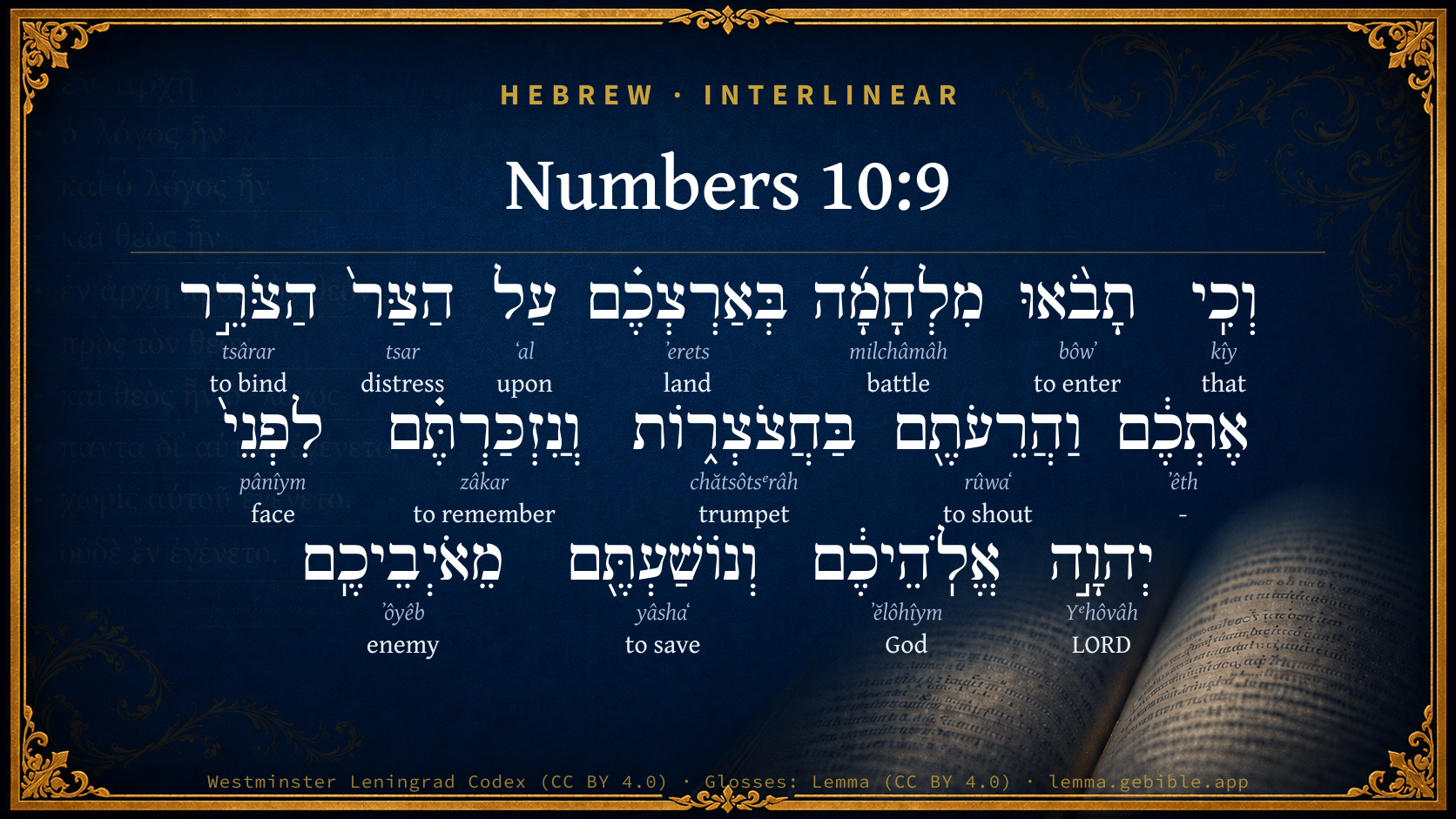
Hebrew (Westminster Leningrad Codex) Numbers 10:9 appears in the Hebrew Old Testament. The text above is from the Westminster Leningrad Codex. Each word links to its Strong’s number, a concise gloss, and parsing drawn from the Open Scriptures Hebrew Bible morphology. Click any word for its full Brown-Driver-Briggs (BDB) entry.
Download image
Cite this verse

Numbers 10:9 (World English Bible). Public Domain. Lemma interlinear Bible study tool, https://lemma.gebible.app/v/numbers/10/9.

Show BibTeX & RIS
BibTeX
RIS
English Translation
When you go to war in your land against the adversary who oppresses you, then you shall sound an alarm with the trumpets; and you shall be remembered before Yahweh your God, and you shall be saved from your enemies.
World English Bible · Public Domain
Download a study sheet

One document with this verse’s original text, its word-by-word gloss line, the meaning frame, cross-references with their text, attributed commentary, and full source and license credits — printable, and it pastes into notes with its structure intact.

This verse Autodidact and up

Study sheet (.html) Plain text (.txt)

A passage Seminary Student

Up to 50 verses in one chapter. A passage sheet keeps up to 6 commentary sources and 12 cross-references per verse, in the order this page ranks them, and says so on the sheet whenever that leaves anything out. Ask for a single verse and you get the Autodidact verse sheet above.

Everything on this page stays free to read, with no account — the sheet is a download of what is already on screen, not access to it.

Want to remove ads? Support Godless Engineer
Compare translations 3

The same verse in 3 English versions, stacked beneath the original-language interlinear above. Click any original word for its lexicon entry.

Each is an independent rendering of the whole verse — the interlinear is not word-aligned to these translations.

Highlighted words mark where these versions differ — a whole-verse word diff, not a word-by-word alignment.

  • World English Bible Public Domain
    When you go to war in your land against the adversary who oppresses you, then you shall sound an alarm with the trumpets; and you shall be remembered before Yahweh your God, and you shall be saved from your enemies.
  • King James Version Public Domain
    And if ye go to war in your land against the enemy that oppresseth you, then ye shall blow an alarm with the trumpets; and ye shall be remembered before the LORD your God, and ye shall be saved from your enemies.
  • unfoldingWord Literal Text CC BY-SA 4.0
    And when you go a battle in your land against the opponent who opposes you, then you shall blow an alarm on the trumpets, and you shall be remembered to the face of Yahweh your God, and you shall be saved from your enemies.

unfoldingWord Literal Text — © unfoldingWord, licensed CC BY-SA 4.0. Word-aligned USFM3 via Door43 (git.door43.org/unfoldingWord/en_ult).

Versions to compare (up to 4)

3 of 4 selected

Show all 18 translations

Every available English version of this verse, each an independent rendering of the whole verse.

  • World English Bible Public Domain
    When you go to war in your land against the adversary who oppresses you, then you shall sound an alarm with the trumpets; and you shall be remembered before Yahweh your God, and you shall be saved from your enemies.
  • Berean Standard Bible Public Domain
    When you enter into battle in your land against an adversary who attacks you, sound short blasts on the trumpets, and you will be remembered before the LORD your God and saved from your enemies.
  • Majority Standard Bible Public Domain
    When you enter into battle in your land against an adversary who attacks you, sound short blasts on the trumpets, and you will be remembered before the LORD your God and saved from your enemies.
  • King James Version Public Domain
    And if ye go to war in your land against the enemy that oppresseth you, then ye shall blow an alarm with the trumpets; and ye shall be remembered before the LORD your God, and ye shall be saved from your enemies.
  • American Standard Version (1901) Public Domain
    And when ye go to war in your land against the adversary that oppresseth you, then ye shall sound an alarm with the trumpets; and ye shall be remembered before Jehovah your God, and ye shall be saved from your enemies.
  • Revised Version (1885) Public Domain
    And when ye go to war in your land against the adversary that oppresseth you, then ye shall sound an alarm with the trumpets; and ye shall be remembered before the LORD your God, and ye shall be saved from your enemies.
  • Geneva Bible (1599) Public Domain
    And when ye goe to warre in your lande against the enemie that vexeth you, ye shall blowe an alarme with the trumpets, and ye shall bee remembred before the Lord your God, and shalbe saued from your enemies.
  • Douay-Rheims (1899) Public Domain
    If you go forth to war out of your land against the enemies that fight against you, you shall sound aloud with the trumpets, and there shall be a remembrance of you before the Lord your God, that you may be delivered out of the hands of your enemies.
  • Young's Literal Translation Public Domain
    `And when ye go into battle in your land against the adversary who is distressing you, then ye have shouted with the trumpets, and ye have been remembered before Jehovah your God, and ye have been saved from your enemies.
  • Literal Standard Version CC BY-SA 4.0
    And when you go into battle in your land against the adversary who is distressing you, then you have shouted with the trumpets, and you have been remembered before your God YHWH, and you have been saved from your enemies.
  • Unlocked Literal Bible CC BY-SA 4.0
    When you go to war in your land against an adversary who oppresses you, then you must sound an alarm with the trumpets. I, Yahweh your God, will call you to mind and save you from your enemies.
  • unfoldingWord Literal Text CC BY-SA 4.0
    And when you go a battle in your land against the opponent who opposes you, then you shall blow an alarm on the trumpets, and you shall be remembered to the face of Yahweh your God, and you shall be saved from your enemies.
  • Darby Bible Public Domain
    And if ye go to war in your land against the enemy that oppresseth you, then ye shall blow an alarm with the trumpets; and ye shall be remembered before Jehovah your God, and ye shall be saved from your enemies.
  • World Messianic Bible Public Domain
    When you go to war in your land against the adversary who oppresses you, then you shall sound an alarm with the shofars. Then you will be remembered before the LORD your God, and you will be saved from your enemies.
  • Webster's Bible Public Domain
    And if ye go to war in your land against the enemy that oppresseth you, then ye shall blow an alarm with the trumpets; and ye shall be remembered before the LORD your God, and ye shall be saved from your enemies.
  • Free Bible Version CC BY-SA 4.0
    When you're in your own land and have to go into battle against an enemy who has attacked you, blow the alarm signal and the Lord your God won't forget you—he will save you from your enemies.
  • Bible in Basic English Public Domain
    And if you go to war in your land against any who do you wrong, then let the loud note of the horn be sounded; and the Lord your God will keep you in mind and give you salvation from those who are against you.
  • JPS Tanakh (1917) Public Domain
    And when ye go to war in your land against the adversary that oppresseth you, then ye shall sound an alarm with the trumpets; and ye shall be remembered before the LORD your God, and ye shall be saved from your enemies.

Literal Standard Version (2020), Covenant Press — licensed CC BY-SA 4.0. Text via the HelloAO Bible API (eBible.org). Unlocked Literal Bible (unfoldingWord) — licensed CC BY-SA 4.0. Text via the HelloAO Bible API (eBible.org). unfoldingWord Literal Text — © unfoldingWord, licensed CC BY-SA 4.0. Word-aligned USFM3 via Door43 (git.door43.org/unfoldingWord/en_ult). Free Bible Version, Dr. Jonathan Gallagher — licensed CC BY-SA 4.0. Text via the HelloAO Bible API (eBible.org).

Word by word

More ways to search: Search by grammar → Find every occurrence → Compare this word →

Practice this passage: Drill this verse → Learn its vocabulary →

בַּחֲצֹצְר֑וֹת
chătsôtsᵉrâh
H2689
“in/at · trumpets”
Preposition + Noun, Common, Feminine, Plural, Absolute
Part of Speech
Preposition + Noun
Type
Common
Gender
Feminine
Number
Plural
State
Absolute
Full BDB Definition

Origin: by reduplication from H2690

TWOT: 726a

trumpet, clarion
  1. וְכִֽי kîy H3588 “and · that” Conjunction + Conjunction
  2. תָבֹ֨אוּ bôwʼ H935 “to enter” Verb, Qal, Imperfect, 2nd Person, Masculine, Plural
  3. מִלְחָמָ֜ה milchâmâh H4421 “battle” Noun, Common, Feminine, Singular, Absolute
  4. בְּאַרְצְכֶ֗ם ʼerets H776 “in/at · land · your” Preposition + Noun, Common, Both, Singular, Construct + Suffix, Personal, 2nd Person, Masculine, Plural
  5. עַל ʻal H5921 “upon” Preposition
  6. הַצַּר֙ tsar H6862 “the · distress” Particle, Definite Article + Noun, Common, Masculine, Singular, Absolute
  7. הַצֹּרֵ֣ר tsârar H6887 “the · binding” Particle, Definite Article + Verb, Qal, Participle Active, Masculine, Singular, Absolute
  8. אֶתְכֶ֔ם ʼêth H853 “- · you” Particle, Direct Object + Suffix, Personal, 2nd Person, Masculine, Plural
  9. וַהֲרֵעֹתֶ֖ם rûwaʻ H7321 “and · to shout” Conjunction + Verb, Hiphil, Sequential Perfect, 2nd Person, Masculine, Plural
  10. וֲנִזְכַּרְתֶּ֗ם zâkar H2142 “and · to remember” Conjunction + Verb, Niphal, Sequential Perfect, 2nd Person, Masculine, Plural
  11. לִפְנֵי֙ pânîym H6440 “to/for · face(s) of” Preposition + Noun, Common, Both, Plural, Construct
  12. יְהוָ֣ה Yᵉhôvâh H3068 “LORD” Noun, Proper
  13. אֱלֹֽהֵיכֶ֔ם ʼĕlôhîym H430 “God(s) · your” Noun, Common, Masculine, Plural, Construct + Suffix, Personal, 2nd Person, Masculine, Plural
  14. וְנוֹשַׁעְתֶּ֖ם yâshaʻ H3467 “and · to save” Conjunction + Verb, Niphal, Sequential Perfect, 2nd Person, Masculine, Plural
  15. מֵאֹיְבֵיכֶֽם ʼôyêb H341 “from · enemy · you” Preposition + Verb, Qal, Participle Active, Masculine, Plural, Construct + Suffix, Personal, 2nd Person, Masculine, Plural

About this verse

These counts appear in no published source. They are computed here, from the morphology-tagged text and Lemma’s own curated glosses. What Lemma adds →

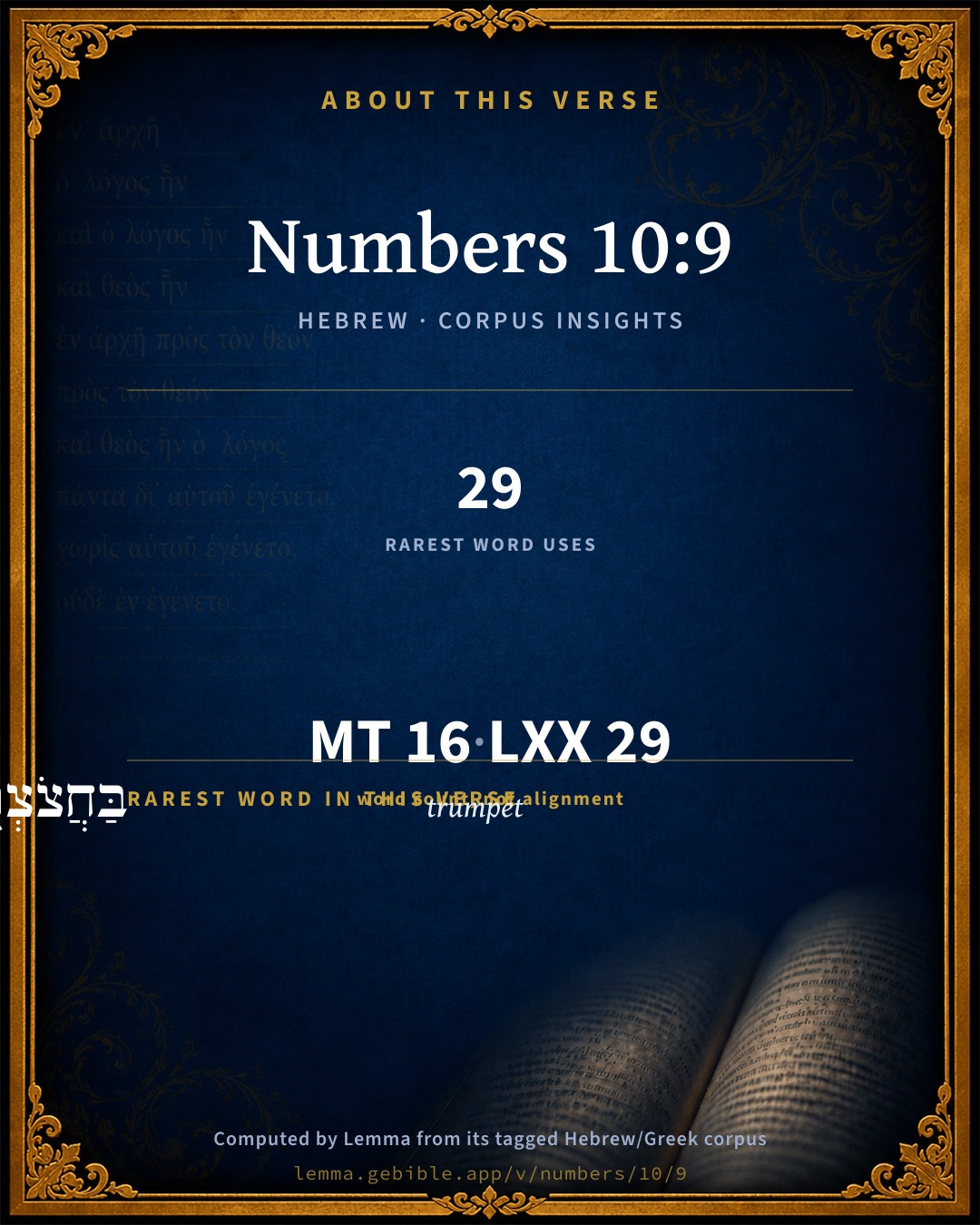
16
words
16
distinct lemmas
Pentateuch
section

Shared distinctive vocabulary

בַּחֲצֹצְר֑וֹת trumpet H2689 occurs in 27 verses of the Hebrew Bible. Also found in:

Grammatical profile

  • 6 verbs
  • 7 nouns
  • 1 preposition
  • 1 conjunction
  • 1 particle

Verb forms

  • תָבֹ֨אוּ Qal · Imperfect
  • הַצֹּרֵ֣ר Qal · Participle Active
  • וַהֲרֵעֹתֶ֖ם Hiphil · Sequential Perfect
  • וֲנִזְכַּרְתֶּ֗ם Niphal · Sequential Perfect
  • וְנוֹשַׁעְתֶּ֖ם Niphal · Sequential Perfect
  • מֵאֹיְבֵיכֶֽם Qal · Participle Active

Hebrew & Septuagint length

In English translation the verse runs 40 words from the Hebrew and 44 from the Septuagint (LXX English) — closely comparable.

A rough comparison of the two English renderings, which tokenize alike — not a word-level alignment.

Word counts can differ between the Hebrew and the Greek without any difference in meaning — e.g. the Hebrew direct-object marker אֵת has no separate Greek word, and Greek often adds the article ὁ.

In the original languages it is 16 Hebrew tokens and 29 Greek tokens — but the two are counted differently (Hebrew bundles its prefixes and suffixes into one token; the Greek is in lemma form), so that isn’t a like-for-like length.

Cross-references

30

Topical passages linked to Numbers 10:9 in the Treasury of Scripture Knowledge — connected by theme and wording, ordered by reader-vote popularity; previews shown in the World English Bible.

  • 1 Samuel 10:18 and he said to the children of Israel, Thus says Yahweh, the God of Israel, I brought up Israel out of Egypt, and I delivered you out of the hand of the Egyptians, and out of the hand of all the kingdoms that oppressed you:
  • Judges 2:18 When Yahweh raised them up judges, then Yahweh was with the judge, and saved them out of the hand of their enemies all the days of the judge: for it repented Yahweh because of their groaning by reason of those who oppressed them and vexed them.
  • Genesis 8:1 God remembered Noah, all the animals, and all the cattle that were with him in the ark; and God made a wind to pass over the earth. The waters subsided.
  • Psalms 106:4 Remember me, Yahweh, with the favor that you show to your people. Visit me with your salvation,
  • Psalms 106:42 Their enemies also oppressed them. They were brought into subjection under their hand.
  • Numbers 31:6 Moses sent them, one thousand of every tribe, to the war, them and Phinehas the son of Eleazar the priest, to the war, with the vessels of the sanctuary and the trumpets for the alarm in his hand.
  • Joshua 6:5 It shall be that when they make a long blast with the ram's horn, and when you hear the sound of the trumpet, all the people shall shout with a great shout; and the wall of the city shall fall down flat, and the people shall go up every man straight before him.
  • Judges 6:34 But the Spirit of Yahweh came on Gideon; and he blew a trumpet; and Abiezer was gathered together after him.
  • Judges 10:8 They vexed and oppressed the children of Israel that year: eighteen years [oppressed they] all the children of Israel that were beyond the Jordan in the land of the Amorites, which is in Gilead.
  • Judges 10:12 The Sidonians also, and the Amalekites, and the Maonites, did oppress you; and you cried to me, and I saved you out of their hand.
  • 2 Chronicles 13:14 When Judah looked back, behold, the battle was before and behind them; and they cried to Yahweh, and the priests sounded with the trumpets.
  • Isaiah 58:1 Cry aloud, don't spare, lift up your voice like a trumpet, and declare to my people their disobedience, and to the house of Jacob their sins.
  • Jeremiah 4:5 Declare you in Judah, and publish in Jerusalem; and say, Blow you the trumpet in the land: cry aloud and say, Assemble yourselves, and let us go into the fortified cities.
  • Jeremiah 4:21 How long shall I see the standard, and hear the sound of the trumpet?
  • Luke 1:70–74 (As he spoke by the mouth of his holy prophets who have been from of old),
  • Judges 3:27 It happened, when he had come, that he blew a trumpet in the hill-country of Ephraim; and the children of Israel went down with him from the hill-country, and he before them.
  • Judges 4:2–3 Yahweh sold them into the hand of Jabin king of Canaan, who reigned in Hazor; the captain of whose host was Sisera, who lived in Harosheth of the Gentiles.
  • Judges 6:9 and I delivered you out of the hand of the Egyptians, and out of the hand of all who oppressed you, and drove them out from before you, and gave you their land;
  • Psalms 136:23 Who remembered us in our low estate; For his loving kindness endures forever;
  • Jeremiah 6:17 I set watchmen over you, [saying], Listen to the sound of the trumpet; but they said, We will not listen.
  • Amos 3:6 Does the trumpet alarm sound in a city, Without the people being afraid? Does evil happen to a city, And Yahweh hasn't done it?
  • 1 Corinthians 14:8 For if the trumpet gave an uncertain sound, who would prepare himself for war?
  • Isaiah 18:3 All you inhabitants of the world, and you dwellers on the earth, when an ensign is lifted up on the mountains, look; and when the trumpet is blown, listen.
  • Jeremiah 4:19 My anguish, my anguish! I am pained at my very heart; my heart is disquieted in me; I can't hold my peace; because you have heard, O my soul, the sound of the trumpet, the alarm of war.
  • Judges 7:16–21 He divided the three hundred men into three companies, and he put into the hands of all of them trumpets, and empty pitchers, with torches within the pitchers.
  • Jeremiah 6:1 Flee for safety, you children of Benjamin, out of the midst of Jerusalem, and blow the trumpet in Tekoa, and raise up a signal on Beth Haccherem; for evil looks forth from the north, and a great destruction.
  • Ezekiel 7:14 They have blown the trumpet, and have made all ready; but none goes to the battle; for my wrath is on all the multitude of it.
  • Ezekiel 33:3–6 if, when he sees the sword come on the land, he blow the trumpet, and warn the people;
  • Hosea 5:8 "Blow the cornet in Gibeah, And the trumpet in Ramah! Sound a battle cry at Beth Aven, behind you, Benjamin!
  • Zephaniah 1:16 a day of the trumpet and alarm, against the fortified cities, and against the high battlements.

Cross-references courtesy of OpenBible.info (CC BY 4.0).

Hebrew and Greek witnesses Masoretic Hebrew ↔ Greek Septuagint

The same verse in the two great witnesses to the Old Testament, shown verse-for-verse.

These are two independent witnesses, not word-aligned to each other, and the Septuagint is shown in lemma (dictionary) form.

Hebrew Numbers 10:9 Masoretic · Westminster Leningrad Codex

וְכִֽי תָבֹ֨אוּ מִלְחָמָ֜ה בְּאַרְצְכֶ֗ם עַל הַצַּר֙ הַצֹּרֵ֣ר אֶתְכֶ֔ם וַהֲרֵעֹתֶ֖ם בַּחֲצֹצְר֑וֹת וֲנִזְכַּרְתֶּ֗ם לִפְנֵי֙ יְהוָ֣ה אֱלֹֽהֵיכֶ֔ם וְנוֹשַׁעְתֶּ֖ם מֵאֹיְבֵיכֶֽם

When you go to war in your land against the adversary who oppresses you, then you shall sound an alarm with the trumpets; and you shall be remembered before Yahweh your God, and you shall be saved from your enemies.

World English Bible · Public Domain

Greek LXX Numbers 10:9 Septuagint · lemma form

ἐάν δέ ἐκἔρχομαι εἰς πόλεμος ἐν ὁ γῆ σύ πρός ὁ ὑπεναντίος ὁ ἀντιἵστημι σύ καί σημαίνω ὁ σάλπιγξ καί ἀναμιμνήσκω ἔναντι κύριος καί διασώζω ἀπό ὁ ἐχθρός σύ

And if you⌃ shall go forth to war in your land against your enemies that are opposed to you, then shall you⌃ sound with the trumpets; and you⌃ shall be had in remembrance before the Lord, and you⌃ shall be saved from your enemies.

LXX2012 (modern English Septuagint) · Public Domain

Hebrew: Westminster Leningrad Codex (CC BY 4.0). Greek: Septuagint (public domain); English from LXX2012 (modern English Septuagint) (Public Domain). How the Septuagint differs from the Hebrew →

Targum (Aramaic paraphrase)

2

The Targum is the ancient Jewish Aramaic paraphrase of the Hebrew Scriptures — an interpretive translation, not the Hebrew text itself. Onkelos (literal) and Pseudo-Jonathan (expansive) render the Torah, and Jonathan the Prophets. Coverage is partial: where no permissively-licensed English translation exists for a verse, only the Aramaic is shown. This is verse-level text, not a word-by-word alignment to the Hebrew.

  1. Targum Onkelos Torah (Genesis–Deuteronomy)
    וַאֲרֵי תֵעֲלוּן לְאַגָחָא קְרָבָא בְּאַרְעַכוֹן עַל מְעִיקֵי דִמְעִיקִין לְכוֹן וּתְיַבְּבוּן בַּחֲצוֹצְרָתָא וְיֵיעוֹל דוּכְרָנֵיכוֹן לְטָּבָא קֳדָם יְיָ אֱלָהָכוֹן וְתִתְפָּרְקוּן מִסַנְאֵיכוֹן

    (no public-domain English translation for this verse)

    Targum Onkelos — Aramaic: “Onkelos Genesis” (public domain); “Onkelos Exodus” (public domain); “Onkelos Leviticus” (public domain); “Onkelos Numbers” (public domain); “Onkelos Deuteronomy” (public domain). English: “Sefaria Community Translation” (CC0 1.0 (public-domain dedication)); “J.W. Etheridge. The Targums of Onkelos and Jonathan Ben Uzziel on the Pentateuch. London: Longmans, Green, 1862” (public domain). Text via Sefaria.

  2. Targum Pseudo-Jonathan Torah (Genesis–Deuteronomy)
    וַאֲרוּם תְּעוּלוּן לִמְסַדְרָא סִדְרֵי קְרָבָא בְּאַרְעֲכוֹן עַל מְעִיקֵי דִמְעִיקִין לְכוֹן וּתְיַבְּבוּן בַּחֲצוֹצְרָתָא וְיֵיעוּל דוּכְרַנְכוֹן לְטָבָא קֳדָם יְיָ אֱלָהָכוֹן וְתִתְפָּרְקוּן מִבַּעֲלֵי דְבָבֵיכוֹן

    And when you enter upon the order of the line of battle for your country, with oppressors who oppress you, then shall you blow the alarm on the trumpets, that the remembrance of you may come up for good before the Lord your God, that you may be delivered from your enemies.

    Targum Pseudo-Jonathan — Aramaic: “Targum Jonathan on Genesis” (public domain); “Targum Jonathan on Exodus” (public domain); “Targum Jonathan on Leviticus” (public domain); “Targum Jonathan on Numbers” (public domain); “Targum Jonathan on Deuteronomy” (public domain). English: “The Targum of Jonathan ben Uzziel, trans. J. W. Etheridge, London, 1862” (public domain). Text via Sefaria.

Commentary

Notes on Numbers 10:9 from classic Christian and Jewish commentators (each source and its license shown beneath its notes). The classic Christian expositions comment on the surrounding passage and are grouped to its opening verse, so a note may address several verses; the Jewish commentaries on the Tanakh (Rashi and others) are per-verse, so they appear only where the commentator wrote on this verse.

Lemma curates 59 commentaries, every one of them public domain or Creative Commons licensed, each selected and text-cleaned for this edition rather than reprinted as found. About our sources →

The Cambridge Bible for Schools and Colleges

gen. ed. J. J. S. Perowne

9. 2Ch_13:12-16 relates an occasion on which the clarions brought success in battle.

9, 10. In Canaan the clarions are to be used in war (Num_10:9) and in peace (Num_10:10); and their purpose, in both, is to remind Jehovah of His people; see Num_5:26.

The Cambridge Bible for Schools and Colleges (gen. ed. J. J. S. Perowne; Cambridge University Press, 1878–1918) — public domain. Text from a community e-Sword module.

Trapp's Complete Commentary

John Trapp

Num 10:9 And if ye go to war in your land against the enemy that oppresseth you, then ye shall blow an alarm with the trumpets; and ye shall be remembered before the LORD your God, and ye shall be saved from your enemies.

Ver. 9. Ye shall be remembered before the Lord.] Who will arise, as it were, awakened by this sound of the trumpet. See 2Ch 13:12 Isa 51:9. That is, by the prayer of faith; such as were the prayers of the ministers of Angrogna, in France, wherewith their enemies cried out, they were so bewitched that they could not fight. It was the custom of these poor persecuted Protestants, so soon as they saw the enemy approach, to cry all together for aid and help to the Lord: and when the combat was ended, constantly to give him thanks for the good success he had sent them. {a} So, at the siege of Montauban, the people of God, using daily humiliation, as their service would permit, did sing a psalm after it, immediately before their sallying forth: with this practice the enemy coming acquainted, ever upon the singing of the psalm, after which they expected a sally, they would so quake and tremble, saying, They come, they come, as though the wrath of God had been breaking out upon them.

{a} Act. and Mon., fol. 883.

John Trapp, A Commentary or Exposition upon All the Books of the Old and New Testament (1647–1656) — public domain. Text from a community e-Sword module.

Joseph Benson's Commentary

Num 10:9. Ye shall be saved — If you use this ordinance of God with trust and dependance upon God for help.

Joseph Benson's Commentary on the Old and New Testaments (1811–1818) — public domain. Text from a community e-Sword module.

Tyndale Open Study Notes

Tyndale Open Resources

10:9-10 The trumpets marked holy events that might not readily be recognized as such. Trumpets that sounded a call to arms (Hos 5:8; Joel 2:1) would remind . . . the Lord to rescue the Hebrews from their enemies.

Tyndale Open Study Notes — © Tyndale Open Resources, licensed CC BY-SA 4.0. Text via the HelloAO Bible API.

Jamieson, Fausset & Brown

Robert Jamieson, A. R. Fausset & David Brown

If ye go to war--In the land of Canaan, either when attacked by foreign invaders or when they went to take possession according to the divine promise, "ye [that is, the priests] shall blow an alarm." This advice was accordingly acted upon (Num 31:6; Ch2 13:12); and in the circumstances it was an act of devout confidence in God. A solemn and religious act on the eve of a battle has often animated the hearts of those who felt they were engaged in a good and just cause; and so the blowing of the trumpet, being an ordinance of God, produced that effect on the minds of the Israelites. But more is meant by the words--namely, that God would, as it were, be aroused by the trumpet to bless with His presence and aid.

Jamieson, Fausset & Brown — Commentary Critical and Explanatory on the Whole Bible (1871) — public domain (CC PDM 1.0). Text via the HelloAO Bible API.

Adam Clarke's Commentary

Verse 9. If ye go to war] These trumpets shall be sounded for the purpose of collecting the people together, to deliberate about the war, and to implore the protection of God against their enemies.

Ye shall be remembered before the Lord] When ye decamp, encamp, make war, and hold religious festivals, according to his appointment, which appointment shall be signified to you by the priests, who at the command of God, for such purposes, shall blow the trumpets, then ye may expect both the presence and blessing of Jehovah in all that ye undertake.

Adam Clarke's Commentary on the Bible (1810–1826) — public domain. Text from a community e-Sword/MySword module.

Ellicott's Commentary for English Readers

(9) And if ye go to war.—Better, And when ye shall go to war. In Num_31:6 we read that in the war against the Midianites, Phinehas, the son of Eleazar, had these trumpets of alarm (hazozeroth) in his hand. So also Abijah, in his address to Jeroboam, previously to the battle, lays great stress upon the fact that Judah had on their side the priests with the trumpets of alarm (2Ch_13:12; 2Ch_13:14). On the other hand, the seven priests who compassed the city of Jericho carried the shophar, or keren—i.e., rams’ horn—not the hazozerah, or silver trumpet.

A Bible Commentary for English Readers, edited by Charles John Ellicott (1878–1897) — public domain. Text from a community e-Sword module.

John Gill's Exposition

And when ye go to war in your land against the enemy that oppresseth you,.... That enters in to invade it, to besiege cities, and distress the inhabitants of it:

then ye shall blow an alarm with the trumpets: a "tara-tan-tara" with both of them, to call the several tribes together to join against the enemy; or to call them to fasting and humiliation, to repentance and prayer, to seek the Lord in the exercise of these, and cry for help and assistance, for victory and salvation; for, as Ben Gersom observes, by this alarm their hearts would be broken and become contrite, and they would return to the Lord, and he would have mercy on them when they pray unto him; for such a sound makes a man's heart shake and tremble, according to Amo 3:6; see Jer 4:19; this is a third use of the trumpets, and in a mystical sense it may be observed, that saints are in a militant state, and have many enemies that come in to them to oppress them, sin, Satan, and the world; and the Gospel calls and encourages them to fight, furnishes them with armour, and assures them of victory, and directs them where to fight and with whom, and bids them endure hardness as good soldiers of Christ:

and ye shall be remembered before the Lord your God; for a book of remembrance is written for them that fear God, humble themselves before him, and pray unto him:

and ye shall be saved from your enemies; as Israel from their temporal, so the people of God from their spiritual enemies, being made more than conquerors through him that loved them.

John Gill's Exposition of the Whole Bible (1746–1763) — public domain (CC PDM 1.0). Text via the HelloAO Bible API.

Albert Barnes' Notes on the Bible

For examples of the employment of trumpets in war compare marginal references and 2Ch 20:28. By employment of them was signified the dependence of God’s people on His aid.

Albert Barnes' Notes on the Bible (1834–1885) — public domain. Text from a community e-Sword/MySword module.

Haydock's Catholic Bible Commentary

Your God, who will reward your obedience with victory.

George Leo Haydock (1774–1849), Haydock's Catholic Family Bible and Commentary, 1859 edition — public domain. Excludes Psalms (Douay-Rheims chapter numbering differs from Protestant) and Deuterocanonical books (Catholic canon only).

Matthew Poole's English Annotations

Which was practised accordingly. See Num 31:6; 2Ch 13:12.

Ye shall be saved from your enemies, if you use this ordinance of God with trust and dependence upon God for help, which condition is necessarily to be understood from divers others scriptures, where it is expressed.

Matthew Poole's English Annotations on the Holy Bible (1683–1685) — public domain. Text from a community e-Sword/MySword module.

Whedon's Commentary on the Bible

Daniel D. Whedon

9. If ye go to war — The most virtuous and God-fearing nation may in defense of its life be compelled to engage in war. Until the conquest of the Canaanites Israel was commanded to wage an offensive war.

And ye shall be remembered — “The blast of these trumpets,” says Keil, “was to call Israel to remembrance before Jehovah in time of war and on their feast days.” This anthropomorphic conception of Jehovah would be avoided by saying that Israel, in obeying this law, would be remembered or favored by him. We have intimation elsewhere that the divine regards were bestowed on moral and spiritual conditions accompanying the trumpet alarms. See Joe_1:14; Joe_2:1-16.

Daniel D. Whedon (gen. ed.), Commentary on the Old and New Testaments (1874–1909) — public domain. Text from a community e-Sword module.

The Pulpit Commentary

If ye go to war. hmjlmi awOB, "come into war," or "be engaged," denoting actual hostilities. In your land. The practical use of the trumpets ceased with the years of wandering; the ceremonial use was continued as long as the people dwelt in "their land;" the spiritual use remains an "ordinance for ever," as long as the Church is militant here on earth. That the use of the two silver trumpets was ceremonial, and not practical, after the conquest of Canaan is evident from the purpose and effect ascribed to that use. Whether in war or in worship, that purpose was not to convoke the people, nor to give signals to the host, but to put God in mind of his promises, and to invoke his covenanted grace. Indeed, two trumpets, as here prescribed, could not be otherwise than ceremonially used after the nation was spread abroad over the whole face of Canaan; and there is no direction to make more than two such trumpets. The use of trumpets in subsequent times is indeed often mentioned both in war and in holy festivities, and it was undoubtedly founded upon this Divine ordinance; but it was not in literal compliance with it, for the obvious reason that many trumpets were used instead of two only. (see 1Ch_15:24 2Ch_5:12 Neh_12:35) In these passages (and probably in 2Ch_13:12) we have abundant evidence of one of those expansions and adaptations of the Mosaic ritual which were so freely made under the house of David. Num_31:6, and (perhaps) 1Ch_16:6, and Psa_81:3 may be quoted as pointing to the strict fulfillment of the law as it stands.

The Pulpit Commentary (1880–1919), ed. H.D.M. Spence-Jones & Joseph S. Exell — public domain. Text from a community e-Sword module.

John Wesley's Explanatory Notes

Ye shall be saved - If you use this ordinance of God with trust and dependance upon God for help.

John Wesley, Explanatory Notes Upon the Whole Bible (1754–1765) — public domain. Text via the GEBible commentary corpus.

unfoldingWord translationNotes

Door43 World Missions Community

When you go to war ... oppresses you

Yahweh is speaking to Moses and uses the word "you," but he is actually referring the people of Israel going to war. AT: "When the people of Israel to war ... oppresses Israel" (See: Synecdoche)

then you must sound an alarm with the trumpets

Here Yahweh again speaks to Moses using the word "you" but actually wants Moses to have the priests blow the trumpets. AT: "then you must command the priests to sound an alarm with the trumpets" (See: Metonymy)

call you to mind

This phrase "call to mind" means to remember. AT: "remember you" (See: Idiom)

translationWords

adversary

oppress

alarm

trumpet

Yahweh

God

mind

save

unfoldingWord translationNotes — © Distant Shores Media and the Door43 World Missions Community, licensed CC BY-SA 4.0. Source: git.door43.org/Door43/en_tn.

Ibn Ezra

Rabbi Abraham ibn Ezra

And you will be remembered because you did as Hashem commanded you. Additionally, the teruah is a reminder to cry out to Hashem.

Ibn Ezra on the Tanakh — English translations: “Sefaria Community Translation” (CC0 1.0 (public-domain dedication)); “Yalkut, Sifsei Chachomim Chumash, Metsudah Publications, 2009” (CC BY 4.0); and “Commentary of Ibn Ezra on Isaiah - trans. by M. Friedlander, 1873” (public domain). Text via Sefaria.

Lesson kit

Teaching starters — assembled from the data on this page, not authored interpretation. Every prompt links to the verse data it draws on. Edit before teaching.

Numbers, in the Pentateuch, opens this verse with 16 words (16 distinct Hebrew lemmas). Its most distinctive word is chătsôtsᵉrâh (“trumpet”). A historical commentator’s framing appears above. Read the whole chapter for the surrounding context.

Discussion questions

  1. What does “trumpet” (chătsôtsᵉrâh) contribute to the verse as a whole?
  2. Numbers 10:2 shares the word «trumpet» with this verse. How do the two illuminate each other?
  3. These translations render this verse differently; the difference is in the English rendering, not the original. What questions does that raise?
  4. The verb «תָבֹ֨אוּ» is Qal Imperfect. How does its form color the action?
  5. Reading how The Cambridge Bible for Schools and Colleges and Trapp's Complete Commentary read this verse, where do the two commentators agree and where do they part?

Things to notice

Reading settings

Reading text

Shown beneath each verse's original-language words.

Old Testament
Old Testament edition

Read the OT as the Masoretic Hebrew (MT) or the Greek Septuagint (LXX).

English shown for the Greek Septuagint (in the Hebrew ↔ Greek comparison).

Comparing translations? Open the Compare panel on any verse page to stack up to four side by side.