Psalms 18:48

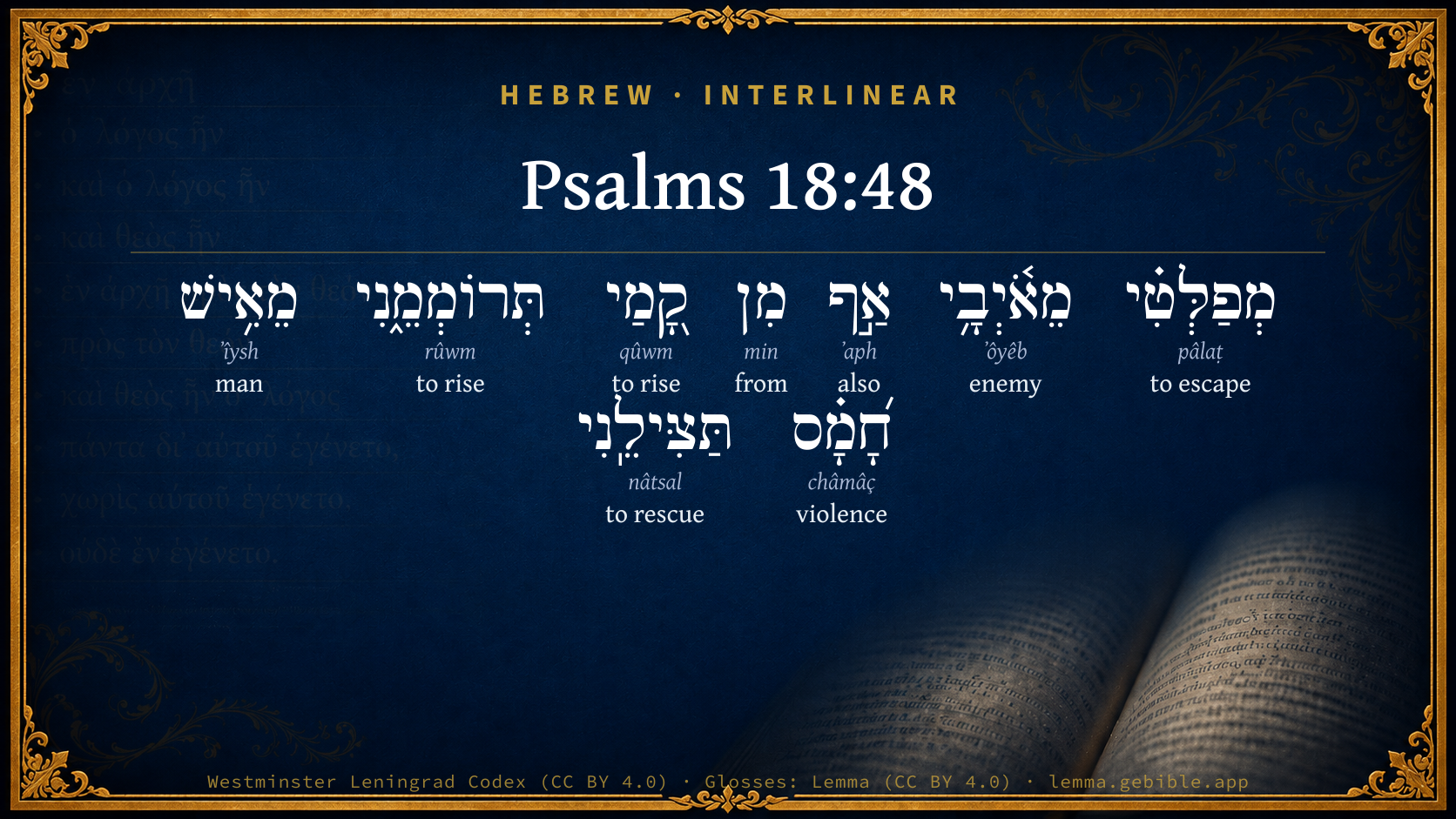
Hebrew (Westminster Leningrad Codex) Psalms 18:48 appears in the Hebrew Old Testament. The text above is from the Westminster Leningrad Codex. Each word links to its Strong’s number, a concise gloss, and parsing drawn from the Open Scriptures Hebrew Bible morphology. Click any word for its full Brown-Driver-Briggs (BDB) entry.
Download image
Cite this verse

Psalms 18:48 (World English Bible). Public Domain. Lemma interlinear Bible study tool, https://lemma.gebible.app/v/psalms/18/48.

Show BibTeX & RIS
BibTeX
RIS
English Translation
He rescues me from my enemies. Yes, you lift me up above those who rise up against me. You deliver me from the violent man.
World English Bible · Public Domain
Download a study sheet

One document with this verse’s original text, its word-by-word gloss line, the meaning frame, cross-references with their text, attributed commentary, and full source and license credits — printable, and it pastes into notes with its structure intact.

This verse Autodidact and up

Study sheet (.html) Plain text (.txt)

A passage Seminary Student

Up to 50 verses in one chapter. A passage sheet keeps up to 6 commentary sources and 12 cross-references per verse, in the order this page ranks them, and says so on the sheet whenever that leaves anything out. Ask for a single verse and you get the Autodidact verse sheet above.

Everything on this page stays free to read, with no account — the sheet is a download of what is already on screen, not access to it.

Want to remove ads? Support Godless Engineer
Compare translations 3

The same verse in 3 English versions, stacked beneath the original-language interlinear above. Click any original word for its lexicon entry.

Each is an independent rendering of the whole verse — the interlinear is not word-aligned to these translations.

Highlighted words mark where these versions differ — a whole-verse word diff, not a word-by-word alignment.

  • World English Bible Public Domain
    He rescues me from my enemies. Yes, you lift me up above those who rise up against me. You deliver me from the violent man.
  • King James Version Public Domain
    He delivereth me from mine enemies: yea, thou liftest me up above those that rise up against me: thou hast delivered me from the violent man.
  • unfoldingWord Literal Text CC BY-SA 4.0
    the one delivering me from my enemies. Also, from the ones arising me you lift me up, from a man of violence, you deliver me.

unfoldingWord Literal Text — © unfoldingWord, licensed CC BY-SA 4.0. Word-aligned USFM3 via Door43 (git.door43.org/unfoldingWord/en_ult).

Versions to compare (up to 4)

3 of 4 selected

Show all 18 translations

Every available English version of this verse, each an independent rendering of the whole verse.

  • World English Bible Public Domain
    He rescues me from my enemies. Yes, you lift me up above those who rise up against me. You deliver me from the violent man.
  • Berean Standard Bible Public Domain
    who delivers me from my enemies. You exalt me above my foes; You rescue me from violent men.
  • Majority Standard Bible Public Domain
    who delivers me from my enemies. You exalt me above my foes; You rescue me from violent men.
  • King James Version Public Domain
    He delivereth me from mine enemies: yea, thou liftest me up above those that rise up against me: thou hast delivered me from the violent man.
  • American Standard Version (1901) Public Domain
    He rescueth me from mine enemies; Yea, thou liftest me up above them that rise up against me; Thou deliverest me from the violent man.
  • Revised Version (1885) Public Domain
    He rescueth me from mine enemies: yea, thou liftest me up above them that rise up against me: thou deliverest me from the violent man.
  • Geneva Bible (1599) Public Domain
    O my deliuerer from mine enemies, euen thou hast set mee vp from them, that rose against me: thou hast deliuered mee from the cruell man.
  • Douay-Rheims (1899) Public Domain
    O God, who avengest me, and subduest the people under me, my deliverer from my enemies.
  • Young's Literal Translation Public Domain
    My deliverer from mine enemies, Above my withstanders Thou raisest me, From a man of violence dost deliver me.
  • Literal Standard Version CC BY-SA 4.0
    My deliverer from my enemies, || You raise me above my withstanders, || Deliver me from a man of violence.
  • Unlocked Literal Bible CC BY-SA 4.0
    I am set free from my enemies! Indeed, you lifted me above the ones who rose against me! You rescued me from violent men.
  • unfoldingWord Literal Text CC BY-SA 4.0
    the one delivering me from my enemies. Also, from the ones arising me you lift me up, from a man of violence, you deliver me.
  • Darby Bible Public Domain
    Who hath delivered me from mine enemies: yea, thou hast lifted me up above them that rose up against me; from the man of violence hast thou delivered me.
  • World Messianic Bible Public Domain
    He rescues me from my enemies. Yes, you lift me up above those who rise up against me. You deliver me from the violent man.
  • Webster's Bible Public Domain
    \\18:47\\It is God that avengeth me, and subdueth the people under me.
  • Free Bible Version CC BY-SA 4.0
    he rescues me from those who hate me. You keep me safe from those who rebel against me, you save me from violent men.
  • Bible in Basic English Public Domain
    He makes me free from my haters; I am lifted up over those who come up against me: you have made me free from the violent man.
  • JPS Tanakh (1917) Public Domain
    (18-49) He delivereth me from mine enemies; yea, Thou liftest me up above them that rise up against me; Thou deliverest me from the violent man.

Literal Standard Version (2020), Covenant Press — licensed CC BY-SA 4.0. Text via the HelloAO Bible API (eBible.org). Unlocked Literal Bible (unfoldingWord) — licensed CC BY-SA 4.0. Text via the HelloAO Bible API (eBible.org). unfoldingWord Literal Text — © unfoldingWord, licensed CC BY-SA 4.0. Word-aligned USFM3 via Door43 (git.door43.org/unfoldingWord/en_ult). Free Bible Version, Dr. Jonathan Gallagher — licensed CC BY-SA 4.0. Text via the HelloAO Bible API (eBible.org).

Word by word

More ways to search: Search by grammar → Find every occurrence → Compare this word →

Practice this passage: Drill this verse → Learn its vocabulary →

מְפַלְּטִ֗י
pâlaṭ
H6403
“escaping · me”
Verb, Piel, Participle Active, Masculine, Singular, Construct + Suffix, Personal, 1st Person, Common, Singular
Part of Speech
Verb
Stem
Piel
Form
Participle Active
Gender
Masculine
Number
Singular
State
Construct
Full BDB Definition

Origin: a primitive root

TWOT: 1774

to escape, save, deliver, slip away - (Qal) to escape - (Piel) - to bring into security, deliver - to cause to escape, cast forth - to be delivered - to slip away - (Hiphil) to bring into security, bring to safety
  1. מֵאֹ֫יְבָ֥י ʼôyêb H341 “from · enemy · me” Preposition + Verb, Qal, Participle Active, Masculine, Plural, Construct + Suffix, Personal, 1st Person, Common, Singular
  2. אַ֣ף ʼaph H637 “also” Particle, Accusative
  3. מִן min H4480 “from” Preposition
  4. קָ֭מַי qûwm H6965 “rising · me” Verb, Qal, Participle Active, Masculine, Plural, Construct + Suffix, Personal, 1st Person, Common, Singular
  5. תְּרוֹמְמֵ֑נִי rûwm H7311 “to rise · me” Verb, Polel, Imperfect, 2nd Person, Masculine, Singular + Suffix, Personal, 1st Person, Common, Singular
  6. מֵאִ֥ישׁ ʼîysh H376 “from · man of” Preposition + Noun, Common, Masculine, Singular, Construct
  7. חָ֝מָ֗ס châmâç H2555 “violence” Noun, Common, Masculine, Singular, Absolute
  8. תַּצִּילֵֽנִי nâtsal H5337 “to rescue · me” Verb, Hiphil, Imperfect, 2nd Person, Masculine, Singular + Suffix, Personal, 1st Person, Common, Singular

About this verse

These counts appear in no published source. They are computed here, from the morphology-tagged text and Lemma’s own curated glosses. What Lemma adds →

9
words
9
distinct lemmas
Wisdom
section

Notable vocabulary

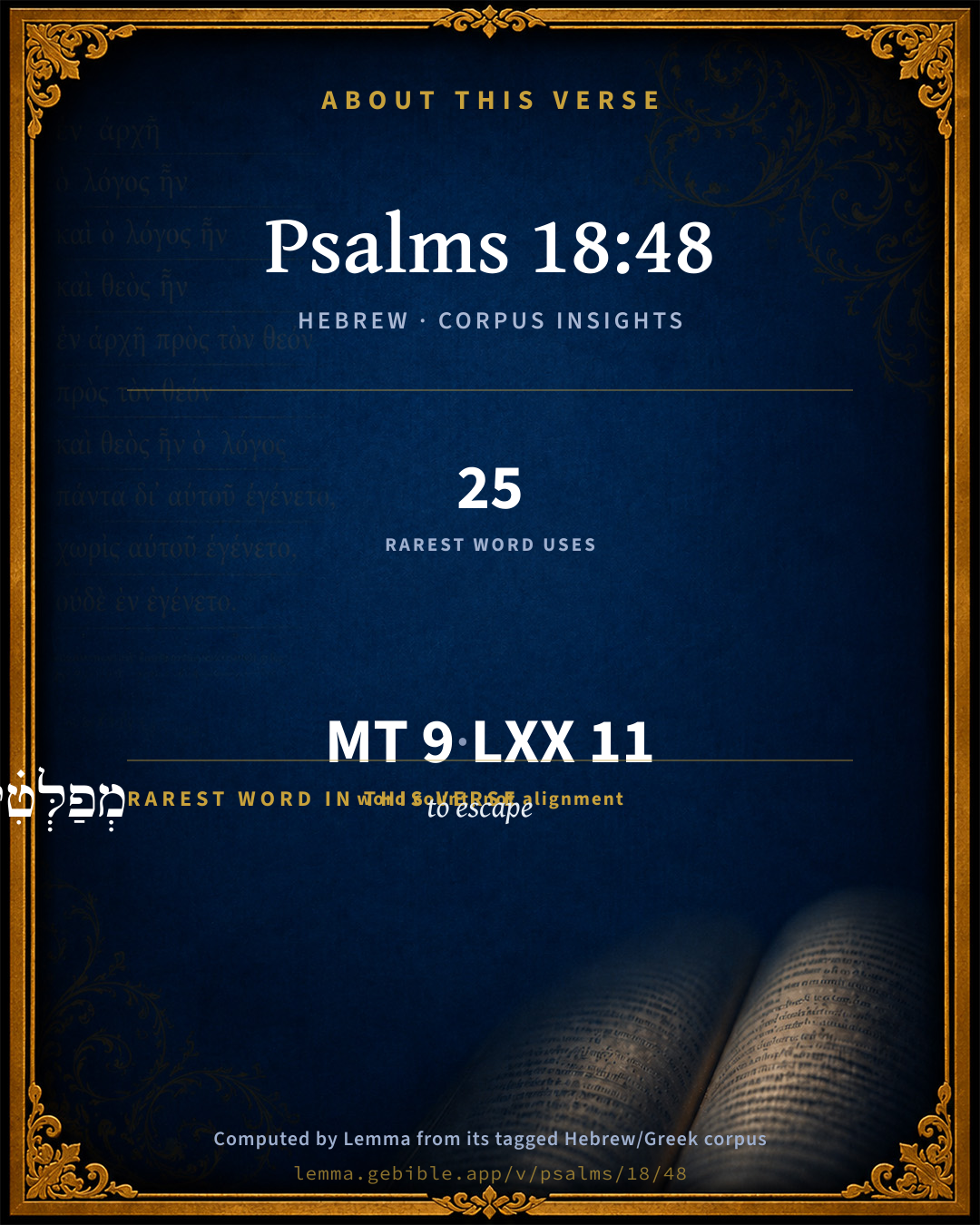
The rarest word here is מְפַלְּטִ֗י to escape H6403 — appearing just 25 times in the whole Hebrew Bible.

Shared distinctive vocabulary

מְפַלְּטִ֗י to escape H6403 occurs in 23 verses of the Hebrew Bible. Also found in:

Grammatical profile

  • 5 verbs
  • 2 nouns
  • 1 preposition
  • 1 particle

Verb forms

  • מְפַלְּטִ֗י Piel · Participle Active
  • מֵאֹ֫יְבָ֥י Qal · Participle Active
  • קָ֭מַי Qal · Participle Active
  • תְּרוֹמְמֵ֑נִי Polel · Imperfect
  • תַּצִּילֵֽנִי Hiphil · Imperfect

Hebrew & Septuagint length

In English translation the verse runs 25 words from the Hebrew and 26 from the Septuagint (LXX English) — closely comparable.

A rough comparison of the two English renderings, which tokenize alike — not a word-level alignment.

Word counts can differ between the Hebrew and the Greek without any difference in meaning — e.g. the Hebrew direct-object marker אֵת has no separate Greek word, and Greek often adds the article ὁ.

In the original languages it is 9 Hebrew tokens and 11 Greek tokens — but the two are counted differently (Hebrew bundles its prefixes and suffixes into one token; the Greek is in lemma form), so that isn’t a like-for-like length.

Cross-references

9

Topical passages linked to Psalms 18:48 in the Treasury of Scripture Knowledge — connected by theme and wording, ordered by reader-vote popularity; previews shown in the World English Bible.

  • Psalms 86:14 God, the proud have risen up against me. A company of violent men have sought after my soul, And they don't hold regard for you before them.
  • Psalms 140:1 Deliver me, Yahweh, from the evil man. Preserve me from the violent man;
  • Psalms 140:4 Yahweh, keep me from the hands of the wicked. Preserve me from the violent men who have determined to trip my feet.
  • Psalms 140:11 An evil speaker won't be established in the earth. Evil will hunt the violent man to overthrow him.
  • Psalms 7:16 The trouble he causes shall return to his own head. His violence shall come down on the crown of his own head.
  • Psalms 59:1–2 Deliver me from my enemies, my God. Set me on high from those who rise up against me.
  • Psalms 22:27–30 All the ends of the earth shall remember and turn to Yahweh. All the relatives of the nations shall worship before you.
  • Psalms 89:13 You have a mighty arm. Your hand is strong, and your right hand is exalted.
  • Philippians 2:9 Therefore God also highly exalted him, and gave to him the name which is above every name;

Cross-references courtesy of OpenBible.info (CC BY 4.0).

Hebrew and Greek witnesses Masoretic Hebrew ↔ Greek Septuagint

The same verse in the two great witnesses to the Old Testament, shown verse-for-verse.

You’re reading Greek Psalm 17 (Hebrew Psalm 18). The Septuagint counts the superscription, so verse numbers can differ from the Hebrew — chapter-level alignment, not verse-by-verse. Numbering follows Rahlfs.

These are two independent witnesses, not word-aligned to each other, and the Septuagint is shown in lemma (dictionary) form.

Hebrew Psalms 18:48 Masoretic · Westminster Leningrad Codex

מְפַלְּטִ֗י מֵאֹ֫יְבָ֥י אַ֣ף מִן קָ֭מַי תְּרוֹמְמֵ֑נִי מֵאִ֥ישׁ חָ֝מָ֗ס תַּצִּילֵֽנִי

He rescues me from my enemies. Yes, you lift me up above those who rise up against me. You deliver me from the violent man.

World English Bible · Public Domain

Greek LXX Greek Psalm 17:48 Septuagint · lemma form

ὁ θεός ὁ δίδωμι ἐκδίκησις ἐγώ καί ὑποτάσσω λαός ὑπό ἐγώ

my deliverer from angry enemies: you shall set me on high above them that rise up against me: you shall deliver me from the unrighteous man.

LXX2012 (modern English Septuagint) · Public Domain

Hebrew: Westminster Leningrad Codex (CC BY 4.0). Greek: Septuagint (public domain); English from LXX2012 (modern English Septuagint) (Public Domain). How the Septuagint differs from the Hebrew →

Commentary

Notes on Psalms 18:48 from classic Christian and Jewish commentators (each source and its license shown beneath its notes). The classic Christian expositions comment on the surrounding passage and are grouped to its opening verse, so a note may address several verses; the Jewish commentaries on the Tanakh (Rashi and others) are per-verse, so they appear only where the commentator wrote on this verse.

Lemma curates 59 commentaries, every one of them public domain or Creative Commons licensed, each selected and text-cleaned for this edition rather than reprinted as found. About our sources →

Trapp's Complete Commentary

John Trapp

Psa 18:48 He delivereth me from mine enemies: yea, thou liftest me up above those that rise up against me: thou hast delivered me from the violent man.

Ver. 48. He delivereth me from mine enemies] This David hath never done with, but goeth over it again and again, as desirous to do the Lord all the right that might be.

From the violent man] That is, from Saul, saith R. David, and him he mentioneth last, quia erat principium omnis Davidicae gloriae, because the fall of his house was the rise of all David’s glory. The Chaldee hath it, From Gog and his armies.

John Trapp, A Commentary or Exposition upon All the Books of the Old and New Testament (1647–1656) — public domain. Text from a community e-Sword module.

J. A. Alexander on Psalms

Joseph Addison Alexander

49. (Psa 18:48). Saving me from my enemies; yea, from my assailants (or insurgents) thou wilt raise me high; from the man of violence thou wilt deliver me. Here again the construction changes from the participle to the finite verb, but with a further change to the second person, which adds greatly to the life and energy of the expression. The yea may be taken as a simple copulative, and assailants as a mere equivalent to enemies. Some prefer, how ever, to assume a climax, and to understand the verse as meaning that he had not only been delivered from external foes, but from the more dangerous assaults of domestic treason or rebellion. There would then seem to be an allusion to Absalom's conspiracy. Thou wilt raise me, set me up on high, beyond the reach of all my enemies. For a similar expression see below, Psa 59:2 (1), as translated in the margin of the English Bible, The man of violence has, no doubt, reference to Saul, but only as the type of a whole class. Compare Psa 140:2; Psa 140:5 (1, 4).

Joseph Addison Alexander, The Psalms Translated and Explained (1850) — public domain. Text from a community e-Sword module.

Geneva Bible (1599)

Geneva Bible translators

That is, Saul, who of malice persecuted him.

Geneva Bible (1599) marginal notes — public domain. Text via Bolls.life.

Jamieson, Fausset & Brown

Robert Jamieson, A. R. Fausset & David Brown

liftest me up--to safety and honors.

Jamieson, Fausset & Brown — Commentary Critical and Explanatory on the Whole Bible (1871) — public domain (CC PDM 1.0). Text via the HelloAO Bible API.

Adam Clarke's Commentary

Verse 48. He delivereth me] That is, he hath delivered me, and continues to deliver me, from all that rise up against me.

The violent man.] Saul; this applies particularly to him.

Adam Clarke's Commentary on the Bible (1810–1826) — public domain. Text from a community e-Sword/MySword module.

The Cambridge Bible for Schools and Colleges

gen. ed. J. J. S. Perowne

48. My deliverer from mine enemies;

Yea, thou didst set me on high from them that rose up against me,

From the man of violence didst thou rescue me.

My deliverer, as in Psa_18:2. 2 Sam. has “that bringeth me forth.” The man of violence might mean men of violence in general, but it is more natural to regard it as a reference to Saul. Cp. Psa_140:1; Psa_140:4; Psa_140:11.

The Cambridge Bible for Schools and Colleges (gen. ed. J. J. S. Perowne; Cambridge University Press, 1878–1918) — public domain. Text from a community e-Sword module.

John Gill's Exposition

Therefore will I give thanks unto thee, O Lord, among the Heathen,.... These words are cited by the apostle, in Rom 15:9; and applied to the conversion of the Gentiles, which is manifestly prophesied of in some preceding verses of this psalm: there it is rendered, "I will confess to thee among the Gentiles"; and designs not confession of sin, nor profession of the truth, but an acknowledgment of unworthiness, joined with thankfulness for mercies received; done in the most public manner, not only in the congregation of the righteous, but before the Heathen conquered by him; owning before them all, that the victories he had obtained over them were not to be ascribed to his arm and sword, but to the power of the Lord;

and sing praises unto thy name; which is comely for the saints to do, and which Jesus Christ himself did, in the great congregation of his disciples, and among the Gentiles, by his apostles, and others, on the account of the conversion of them.

John Gill's Exposition of the Whole Bible (1746–1763) — public domain (CC PDM 1.0). Text via the HelloAO Bible API.

Albert Barnes' Notes on the Bible

He delivereth me from mine enemies - From all my foes.

Yea, thou liftest me up above those that rise up against me - So that I triumph over them. Instead of being subdued by them, and trampled under their feet, I am exalted, and they are humbled.

Thou hast delivered me from the violent man - Margin, as in Hebrew, man of violence; the man characterized by injustice and wrong; the man who endeavored to overcome and subdue me by force and arms. There is probably a special allusion here by the psalmist to Saul as his great enemy, but perhaps he had also in his eye others of the same kind, and the meaning may be that he had been delivered from all of that class of people.

Albert Barnes' Notes on the Bible (1834–1885) — public domain. Text from a community e-Sword/MySword module.

Matthew Poole's English Annotations

Above those that rise up against me; above their malice and power.

From the violent man; from Saul, whom for honour’s sake he forbears to mention.

Matthew Poole's English Annotations on the Holy Bible (1683–1685) — public domain. Text from a community e-Sword/MySword module.

The Pulpit Commentary

He delivereth me from mine enemies. The "deliverance" was especially from domestic foes (see vers. 17, 19). His foreign foes seem never to have brought David into much peril. Yea, thou liftest me up above those that rise up against me. The "lifting up" was above enemies of both kinds (see ver. 43). Thou hast delivered me from the violent man (comp. ver. 17). There is no reason to doubt that in both places Saul is intended. He was at once David"s "enemy," and a "man of violence." Were the question open otherwise, it would be closed by the statement in the title.

The Pulpit Commentary (1880–1919), ed. H.D.M. Spence-Jones & Joseph S. Exell — public domain. Text from a community e-Sword module.

John Wesley's Explanatory Notes

Violent man - From Saul: whom for honour's sake he forbears to mention.

John Wesley, Explanatory Notes Upon the Whole Bible (1754–1765) — public domain. Text via the GEBible commentary corpus.

unfoldingWord translationNotes

Door43 World Missions Community

I am set free

This can be stated in active form. AT: "God has set me free" (See: Active or Passive)

you lifted me above

Yahweh's protection of the writer is spoken of as if he lifted the writer up so high that his enemies could not reach him to harm him. AT: "you put me in a safe place high above" (See: Metaphor)

who rose against me

"who attacked me" or "who rebelled against me"

violent men

"cruel men" or "savage men"

among the nations

Here the writer means that he will give thanks to Yahweh so that all people will hear of Yahweh's greatness. AT: "so all the nations will hear about it" (See: Assumed Knowledge and Implicit Information)

to your name

Here "name" represents God himself. AT: "in honor of your name" or "to you" (See: Metonymy)

translationWords

free

adversary

nation

praise

name

unfoldingWord translationNotes — © Distant Shores Media and the Door43 World Missions Community, licensed CC BY-SA 4.0. Source: git.door43.org/Door43/en_tn.

Rashi

Rabbi Shlomo Yitzchaki (Rashi)

Who grants me vengeance Who gives me strength to avenge myself upon my enemies.

and destroys Heb. וידבר, and He slew, an expression of דבר, pestilence. Another explanation: as (in Exod. 3:1): “and he led (וינהג),” which is translated into Aramaic as וּדְבַר. Menachem (p. 61) too associated it in this manner. Likewise, he associated (below 47:4), “He leads (יַדְבֵּר) peoples under us.”

instead of me Heb. תחתי, in my place and in my stead, as the matter is stated (in Isa. 43:4): “and I give men in your stead (תחתיך), (verse 3), “I have given Egypt as your ransom. [Cush and Seba in your stead (תחתיך)].”

Rashi on the Tanakh — English translations: “The Judaica Press complete Tanach with Rashi, translated by A. J. Rosenberg” (CC BY 4.0); “Pentateuch with Rashi's commentary by M. Rosenbaum and A.M. Silbermann, 1929-1934” (public domain); “The Metsudah Tanach series, Lakewood, N.J” (CC BY 4.0); and “The Book of Joshua, Metsudah Publications, 1997” (CC BY 4.0). Text via Sefaria.

Lesson kit

Teaching starters — assembled from the data on this page, not authored interpretation. Every prompt links to the verse data it draws on. Edit before teaching.

Psalms, in the Wisdom, opens this verse with 9 words (9 distinct Hebrew lemmas). Its most distinctive word is pâlaṭ (“to escape”). A historical commentator’s framing appears above. Read the whole chapter for the surrounding context.

Discussion questions

  1. How does “to escape” (pâlaṭ) shape what this verse is saying?
  2. How does 2 Samuel 22:2, which shares the word «to escape», read alongside this verse?
  3. These translations render this verse differently. What is at stake in choosing one wording over another?
  4. «מְפַלְּטִ֗י» is a Piel Participle Active verb. How does that grammatical form shape the action described?
  5. Compare how Trapp's Complete Commentary and J. A. Alexander on Psalms read this verse. Where do they agree or differ?

Things to notice

Reading settings

Reading text

Shown beneath each verse's original-language words.

Old Testament
Old Testament edition

Read the OT as the Masoretic Hebrew (MT) or the Greek Septuagint (LXX).

English shown for the Greek Septuagint (in the Hebrew ↔ Greek comparison).

Comparing translations? Open the Compare panel on any verse page to stack up to four side by side.