
Psalms 78:53

Hebrew (Westminster Leningrad Codex) Psalms 78:53 appears in the Hebrew Old Testament. The text above is from the Westminster Leningrad Codex. Each word links to its Strong’s number, a concise gloss, and parsing drawn from the Open Scriptures Hebrew Bible morphology. Click any word for its full Brown-Driver-Briggs (BDB) entry.
Download image
Cite this verse

Psalms 78:53 (World English Bible). Public Domain. Lemma interlinear Bible study tool, https://lemma.gebible.app/v/psalms/78/53.

Show BibTeX & RIS
BibTeX
RIS
English Translation
He led them safely, so that they weren't afraid, But the sea overwhelmed their enemies.
World English Bible · Public Domain
Download a study sheet

One document with this verse’s original text, its word-by-word gloss line, the meaning frame, cross-references with their text, attributed commentary, and full source and license credits — printable, and it pastes into notes with its structure intact.

This verse Autodidact and up

Study sheet (.html) Plain text (.txt)

A passage Seminary Student

Up to 50 verses in one chapter. A passage sheet keeps up to 6 commentary sources and 12 cross-references per verse, in the order this page ranks them, and says so on the sheet whenever that leaves anything out. Ask for a single verse and you get the Autodidact verse sheet above.

Everything on this page stays free to read, with no account — the sheet is a download of what is already on screen, not access to it.

Want to remove ads? Support Godless Engineer
Compare translations 3

The same verse in 3 English versions, stacked beneath the original-language interlinear above. Click any original word for its lexicon entry.

Each is an independent rendering of the whole verse — the interlinear is not word-aligned to these translations.

Highlighted words mark where these versions differ — a whole-verse word diff, not a word-by-word alignment.

  • World English Bible Public Domain
    He led them safely, so that they weren't afraid, But the sea overwhelmed their enemies.
  • King James Version Public Domain
    And he led them on safely, so that they feared not: but the sea overwhelmed their enemies.
  • unfoldingWord Literal Text CC BY-SA 4.0
    And he guided them in security, and they did not fear, and the sea covered their enemies.

unfoldingWord Literal Text — © unfoldingWord, licensed CC BY-SA 4.0. Word-aligned USFM3 via Door43 (git.door43.org/unfoldingWord/en_ult).

Versions to compare (up to 4)

3 of 4 selected

Show all 18 translations

Every available English version of this verse, each an independent rendering of the whole verse.

  • World English Bible Public Domain
    He led them safely, so that they weren't afraid, But the sea overwhelmed their enemies.
  • Berean Standard Bible Public Domain
    He led them safely, so they did not fear, but the sea engulfed their enemies.
  • Majority Standard Bible Public Domain
    He led them safely, so they did not fear, but the sea engulfed their enemies.
  • King James Version Public Domain
    And he led them on safely, so that they feared not: but the sea overwhelmed their enemies.
  • American Standard Version (1901) Public Domain
    And he led them safely, so that they feared not; But the sea overwhelmed their enemies.
  • Revised Version (1885) Public Domain
    And he led them safely, so that they feared not: but the sea overwhelmed their enemies.
  • Geneva Bible (1599) Public Domain
    Yea, he caried them out safely, and they feared not, and the Sea couered their enemies.
  • Douay-Rheims (1899) Public Domain
    And he brought them out in hope, and they feared not: band the sea overwhelmed their enemies.
  • Young's Literal Translation Public Domain
    And He leadeth them confidently, And they have not been afraid, And their enemies hath the sea covered.
  • Literal Standard Version CC BY-SA 4.0
    And He leads them confidently, || And they have not been afraid, || And the sea has covered their enemies.
  • Unlocked Literal Bible CC BY-SA 4.0
    He led them secure and unafraid, but the sea overwhelmed their enemies.
  • unfoldingWord Literal Text CC BY-SA 4.0
    And he guided them in security, and they did not fear, and the sea covered their enemies.
  • Darby Bible Public Domain
    And he led them safely, so that they were without fear; and the sea covered their enemies.
  • World Messianic Bible Public Domain
    He led them safely, so that they weren’t afraid, but the sea overwhelmed their enemies.
  • Webster's Bible Public Domain
    And he led them on safely, so that they feared not: but the sea overwhelmed their enemies.
  • Free Bible Version CC BY-SA 4.0
    He led them to safety, and they were not afraid. He drowned their enemies in the sea.
  • Bible in Basic English Public Domain
    He took them on safely so that they had no fear; but their haters were covered by the sea.
  • JPS Tanakh (1917) Public Domain
    And He led them safely, and they feared not; but the sea overwhelmed their enemies.

Literal Standard Version (2020), Covenant Press — licensed CC BY-SA 4.0. Text via the HelloAO Bible API (eBible.org). Unlocked Literal Bible (unfoldingWord) — licensed CC BY-SA 4.0. Text via the HelloAO Bible API (eBible.org). unfoldingWord Literal Text — © unfoldingWord, licensed CC BY-SA 4.0. Word-aligned USFM3 via Door43 (git.door43.org/unfoldingWord/en_ult). Free Bible Version, Dr. Jonathan Gallagher — licensed CC BY-SA 4.0. Text via the HelloAO Bible API (eBible.org).

Word by word

More ways to search: Search by grammar → Find every occurrence → Compare this word →

Practice this passage: Drill this verse → Learn its vocabulary →

פָחָ֑דוּ
pâchad
H6342
“to fear”
Verb, Qal, Perfect, 3rd Person, Common, Plural
Part of Speech
Verb
Stem
Qal
Form
Perfect
Person
3rd Person
Gender
Common
Number
Plural
Full BDB Definition

Origin: a primitive root

TWOT: 1756

to fear, tremble, revere, dread, be in awe or dread - (Qal) - to be in dread - to be in awe - (Piel) to be in great dread - (Hiphil) to cause to dread
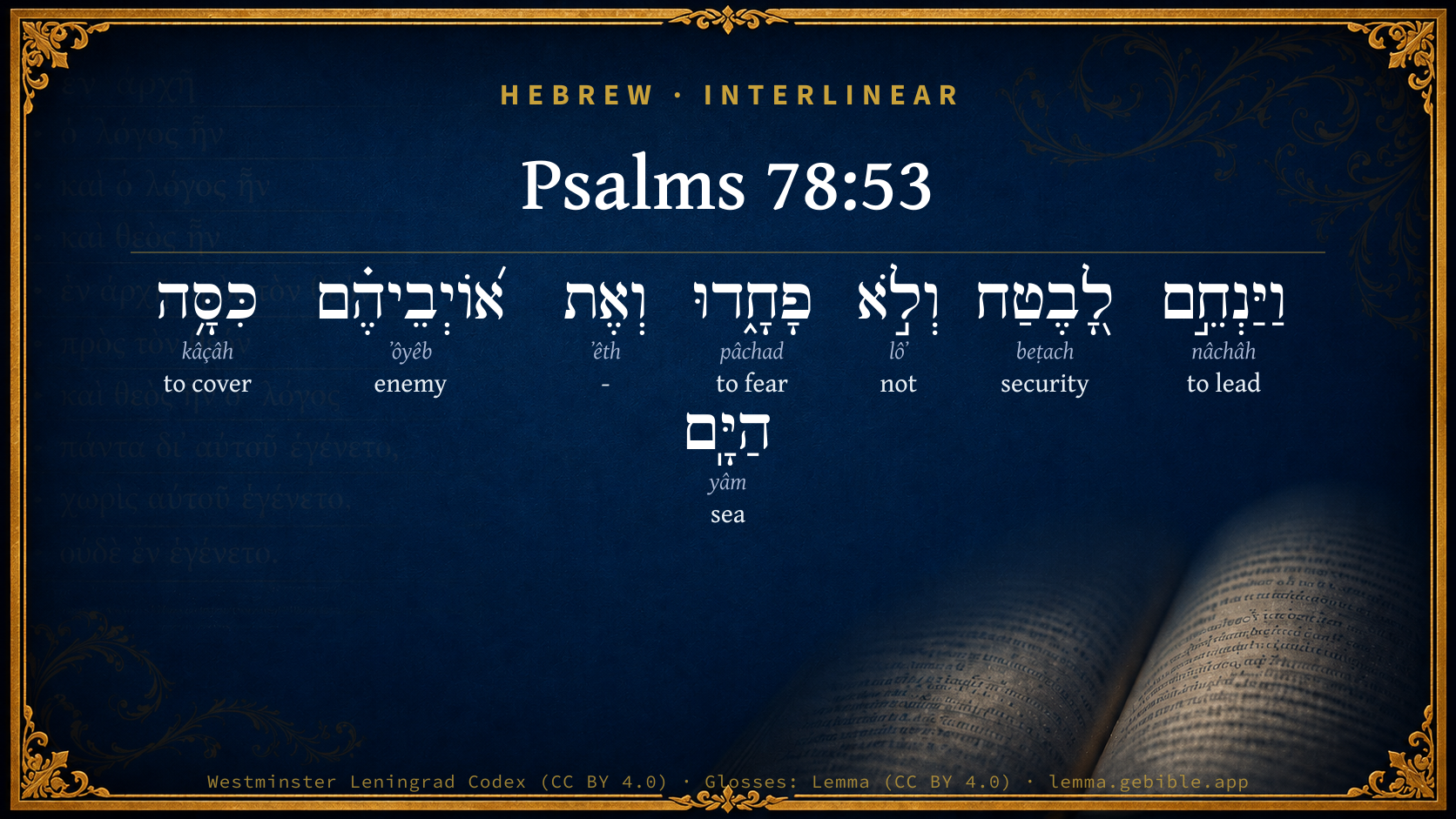
  1. וַיַּנְחֵ֣ם nâchâh H5148 “and · to lead · them” Conjunction + Verb, Hiphil, Sequential Imperfect, 3rd Person, Masculine, Singular + Suffix, Personal, 3rd Person, Masculine, Plural
  2. לָ֭בֶטַח beṭach H983 “to/for · security” Preposition + Noun, Common, Masculine, Singular, Absolute
  3. וְלֹ֣א lôʼ H3808 “and · not” Conjunction + Particle, Negative
  4. וְאֶת ʼêth H853 “and · -” Conjunction + Particle, Direct Object
  5. א֝וֹיְבֵיהֶ֗ם ʼôyêb H341 “enemy · them” Verb, Qal, Participle Active, Masculine, Plural, Construct + Suffix, Personal, 3rd Person, Masculine, Plural
  6. כִּסָּ֥ה kâçâh H3680 “to cover” Verb, Piel, Perfect, 3rd Person, Masculine, Singular
  7. הַיָּֽם yâm H3220 “the · sea” Particle, Definite Article + Noun, Common, Masculine, Singular, Absolute

About this verse

These counts appear in no published source. They are computed here, from the morphology-tagged text and Lemma’s own curated glosses. What Lemma adds →

8
words
8
distinct lemmas
Wisdom
section

Notable vocabulary

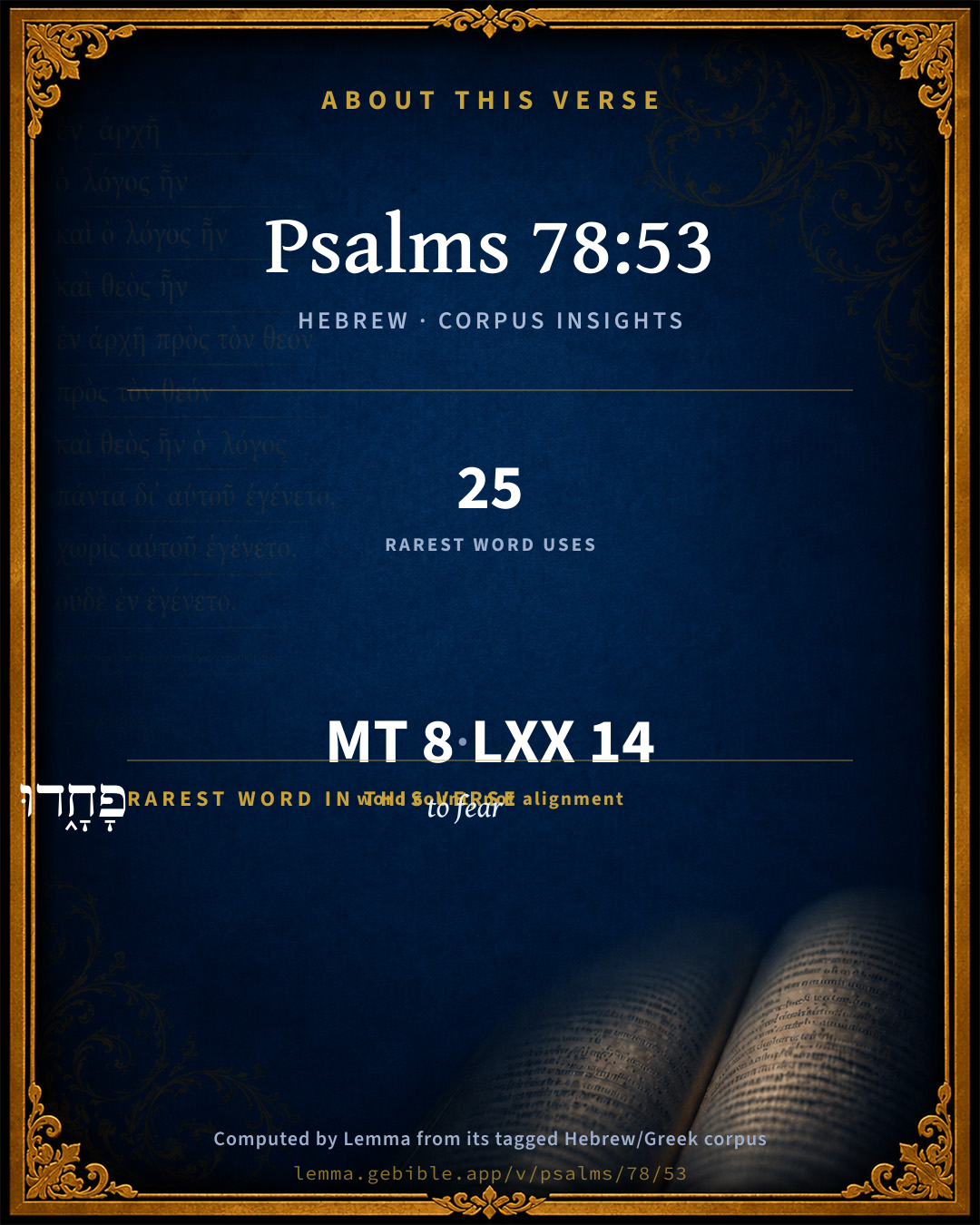
The rarest word here is פָחָ֑דוּ to fear H6342 — appearing just 25 times in the whole Hebrew Bible.

Shared distinctive vocabulary

פָחָ֑דוּ to fear H6342 occurs in 25 verses of the Hebrew Bible. Also found in:

Grammatical profile

  • 4 verbs
  • 2 nouns
  • 2 particles

Verb forms

  • וַיַּנְחֵ֣ם Hiphil · Sequential Imperfect
  • פָחָ֑דוּ Qal · Perfect
  • א֝וֹיְבֵיהֶ֗ם Qal · Participle Active
  • כִּסָּ֥ה Piel · Perfect

Hebrew & Septuagint length

In English translation the verse runs 15 words from the Hebrew and 16 from the Septuagint (LXX English) — closely comparable.

A rough comparison of the two English renderings, which tokenize alike — not a word-level alignment.

Word counts can differ between the Hebrew and the Greek without any difference in meaning — e.g. the Hebrew direct-object marker אֵת has no separate Greek word, and Greek often adds the article ὁ.

In the original languages it is 8 Hebrew tokens and 14 Greek tokens — but the two are counted differently (Hebrew bundles its prefixes and suffixes into one token; the Greek is in lemma form), so that isn’t a like-for-like length.

Cross-references

6

Topical passages linked to Psalms 78:53 in the Treasury of Scripture Knowledge — connected by theme and wording, ordered by reader-vote popularity; previews shown in the World English Bible.

  • Exodus 14:19–20 The angel of God, who went before the camp of Israel, moved and went behind them; and the pillar of cloud moved from before them, and stood behind them.
  • Exodus 15:10 You blew with your wind. The sea covered them. They sank like lead in the mighty waters.
  • Exodus 14:15 Yahweh said to Moses, "Why do you cry to me? Speak to the children of Israel, that they go forward.
  • Exodus 14:27–28 Moses stretched out his hand over the sea, and the sea returned to its strength when the morning appeared; and the Egyptians fled against it. Yahweh overthrew the Egyptians in the midst of the sea.
  • Psalms 136:15 But overthrew Pharaoh and his host in the Red Sea; For his loving kindness endures forever:
  • Hebrews 11:29 By faith, they passed through the Red sea as on dry land. When the Egyptians tried to do so, they were swallowed up.

Cross-references courtesy of OpenBible.info (CC BY 4.0).

Hebrew and Greek witnesses Masoretic Hebrew ↔ Greek Septuagint

The same verse in the two great witnesses to the Old Testament, shown verse-for-verse.

You’re reading Greek Psalm 77 (Hebrew Psalm 78). The Septuagint counts the superscription, so verse numbers can differ from the Hebrew — chapter-level alignment, not verse-by-verse. Numbering follows Rahlfs.

These are two independent witnesses, not word-aligned to each other, and the Septuagint is shown in lemma (dictionary) form.

Hebrew Psalms 78:53 Masoretic · Westminster Leningrad Codex

וַיַּנְחֵ֣ם לָ֭בֶטַח וְלֹ֣א פָחָ֑דוּ וְאֶת א֝וֹיְבֵיהֶ֗ם כִּסָּ֥ה הַיָּֽם

He led them safely, so that they weren't afraid, But the sea overwhelmed their enemies.

World English Bible · Public Domain

Greek LXX Greek Psalm 77:53 Septuagint · lemma form

καί ὁδηγέω αὐτός ἐν ἐλπίς καί οὐ δειλιάω καί ὁ ἐχθρός αὐτός καλύπτω θάλασσα

And he guided them with hope, and they feared not: but the sea covered their enemies.

LXX2012 (modern English Septuagint) · Public Domain

Hebrew: Westminster Leningrad Codex (CC BY 4.0). Greek: Septuagint (public domain); English from LXX2012 (modern English Septuagint) (Public Domain). How the Septuagint differs from the Hebrew →

Commentary

Notes on Psalms 78:53 from classic Christian and Jewish commentators (each source and its license shown beneath its notes). The classic Christian expositions comment on the surrounding passage and are grouped to its opening verse, so a note may address several verses; the Jewish commentaries on the Tanakh (Rashi and others) are per-verse, so they appear only where the commentator wrote on this verse.

Lemma curates 59 commentaries, every one of them public domain or Creative Commons licensed, each selected and text-cleaned for this edition rather than reprinted as found. About our sources →

Trapp's Complete Commentary

John Trapp

Psa 78:53 And he led them on safely, so that they feared not: but the sea overwhelmed their enemies.

Ver. 53. And he led them on safely, so that they feared not] Or, if they did, it was without cause, Cur enim metuat hominem homo in sinu Dei positus.

John Trapp, A Commentary or Exposition upon All the Books of the Old and New Testament (1647–1656) — public domain. Text from a community e-Sword module.

J. A. Alexander on Psalms

Joseph Addison Alexander

53. (Psa 78:53) And guided them in safety, and they did not fear, and their enemies the sea covered. They did not fear, because he removed all ground of apprehension. This was especially the case at the passage of the Red Sea, Exo 15:19, to which there is clearly a particular allusion.

Joseph Addison Alexander, The Psalms Translated and Explained (1850) — public domain. Text from a community e-Sword module.

Geneva Bible (1599)

Geneva Bible translators

That is, they had none occasion to fear, forasmuch as God destroyed their enemies, and delivered them safely.

Geneva Bible (1599) marginal notes — public domain. Text via Bolls.life.

John Calvin's Commentaries

53. And he conducted them in safety, and they were not afraid. This does not imply that they relied on God confidently, and with tranquil minds, but that, having God for their guide and the guardian of their welfare, they had no just cause to be afraid. When at any time they were thrown into consternation, this was owing to their own unbelief. From this cause proceeded these murmuring questions to which they gave utterance, when Pharaoh pursued them, upon their leaving Egypt, and when they were “sore afraid:” “Because there were no graves in Egypt, hast thou taken us away to die in the wilderness? wherefore hast thou dealt thus with us, to carry us forth out of Egypt? Is not this the word that we did tell thee in Egypt, saying, Let us alone, that we may serve the Egyptians? For it had been better for us to serve the Egyptians, than that we should die in the wilderness,” (Exodus 14:11.) This security, then, is not to be referred to the feeling of this in the minds of the people, but to the protection of God, by which it came to pass that, their enemies having been drowned in the Red Sea, they enjoyed quiet and repose in the wilderness. Other benefits which God had bestowed upon them are here recited, and at the same time other transgressions with which they had been chargeable. This shows the more clearly their deep ingratitude. After having obtained possession of the inheritance which was promised them, as if they had been under no obligations to God, their hearts were always rebellious and untractable. The accomplishment, and, as it were, the concluding act of their deliverance, was the putting them in possession of the land of Canaan, from entering which they had precluded themselves, had not God determined, notwithstanding their wickedness, to complete, in all respects, the work which he had commenced. The land itself is called the borders of God’s sanctuary, (verse 54,) because God, in assigning it to his people, had also consecrated it to himself. This, it is manifest, exhibits in a more heinous and aggravated light the iniquity of the people, who brought into that land the same pollutions with which it had been anciently defiled. What madness was it for the people of Israel, who knew that the old inhabitants of the country had been driven from it on account of their abominations, to strive to surpass them in all kinds of wickedness? as if they had been resolved to do all they could to bring down upon their own heads that divine vengeance which they had seen executed upon others. The words this mountain are improperly explained by some as applying to the whole country of Judea; for although it was a mountainous country, there were in it plain and level grounds of large extent, both as to breadth and length. I have, therefore, no doubt, that by way of amplification the Psalmist makes honorable mention of mount Zion, where God had chosen a habitation for himself, and his chief seat. I indeed allow, that under this expression, by the figure synecdoche, a part is put for the whole; only I would have my readers to understand, that this place is expressly named, because from it, as from a source or fountain, flowed the holiness of the whole land. It is asserted that God, by his right hand, possessed or acquired this mountain; for the Hebrew verb קנה, kanah, may be understood in either of these senses: and this assertion is made, that the Israelites might not be lifted up with pride, as if they had achieved the conquest of the land, or had obtained the peaceable possession of it by their own power. As is stated in Psalm 44:3,

“They got not the land in possession by their own sword, neither did their own arm save them, but thy right hand, and thine arm, and the light of thy countenance, because thou hadst a favor unto them.” (Psalm 44:3)

John Calvin's Commentaries (1540-1563) — public domain. Text from the Calvin Translation Society English edition (1840s-50s) via the Christian Classics Ethereal Library (ccel.org). Calvin's coverage is partial (roughly two-thirds of the Bible); uncommented books and verses are honest gaps, never fabricated. The 19th-century editor's footnotes and remarks are omitted so the notes are faithfully Calvin's own voice.

The Cambridge Bible for Schools and Colleges

gen. ed. J. J. S. Perowne

53. feared not] In contrast to their enemies, who were seized with panic (Exo_14:25), Israel had no cause for fear (Exo_14:13). Not of course that they never gave way to fear (Exo_14:10).

overwhelmed] The same word as that rendered covered in Exo_15:10.

The Cambridge Bible for Schools and Colleges (gen. ed. J. J. S. Perowne; Cambridge University Press, 1878–1918) — public domain. Text from a community e-Sword module.

John Gill's Exposition

And he brought them to the border of his sanctuary,.... Of the land of Canaan, which the Lord had sanctified, and set apart for them; and of Jerusalem, the holy city, the city of the great God, and of the temple where his residence was to be; so the Targum,

"to the border of the place of the house of his sanctuary:''

even to this mountain, which his right hand purchased; the mount Moriah, on which the temple was built; this psalm being composed, as Aben Ezra and Kimchi think, after it was made known to David, by the prophet Gad, the place where the temple should be built; namely, on the very mountain, on part of which David had his palace; and this was obtained and possessed, not by the power nor through the merits of the Israelites, but through the power and goodness of God; see Psa 44:3.

John Gill's Exposition of the Whole Bible (1746–1763) — public domain (CC PDM 1.0). Text via the HelloAO Bible API.

Albert Barnes' Notes on the Bible

And he led them on safely, so that they feared not - In hope; in confidence; so that they had no occasion for alarm. He showed himself able and willing to defend them.

But the sea overwhelmed their enemies - Margin, as in Hebrew, covered. See Exo 14:27-28; Exo 15:10.

Albert Barnes' Notes on the Bible (1834–1885) — public domain. Text from a community e-Sword/MySword module.

Matthew Poole's English Annotations

They feared not. But it is said that they were sore afraid, Exo 14:10.

Answ. 1. They were afraid at first, but after Moses had encouraged them they grew bold and secure; one evidence whereof was, that they confidently went into the middle of the sea, and passed between the vast heaps of water which were on both sides of them.

2. The meaning may be that they had no just cause to fear; for men are oft said to do not only what they actually do, but also what they ought to do, as Mal 1:6; 2:7, &c.

Matthew Poole's English Annotations on the Holy Bible (1683–1685) — public domain. Text from a community e-Sword/MySword module.

The Treasury of David

Charles H. Spurgeon

Ver. 53. And he led them on safely, so that they feared not. After the first little alarm, natural enough when they found themselves pursued by their old taskmasters, they plucked up courage and ventured forth boldly into the sea, and afterwards into the desert where no man dwelt.

But the sea overwhelmed their enemies. They were gone, gone for ever, never to disturb the fugitives again. That tremendous blow effectually defended the tribes for forty years from any further attempt to drive them back. Egypt found the stone too heavy and was glad to let it alone. Let the Lord be praised who thus effectually freed his elect nation.

What a grand narrative have we been considering. Well might the mightiest master of sacred song select "Israel in Egypt" as a choice theme for his genius; and well may every believing mind linger over every item of the amazing transaction. The marvel is that the favoured nation should live as if unmindful of it all, and yet such is human nature. Alas, poor man! Rather, alas, base heart!

We now, after a pause, follow again the chain of events, the narration of which had been interrupted by a retrospect, and we find Israel entering into the promised land, there to repeat her follies and enlarge her crimes.

Ver. 53. They feared not. First, they had no cause for fear, in their departure from Egypt. Though they saw the Egyptians slain, yet against them not even a dog moved its tongue. 2. They were all in sound health. 3. They were enriched with the spoils of the Egyptians. 4. They went forth a great multitude. 5. They supplied themselves with arms. Secondly, they feared not to enter the Red Sea, for the fear started by the approach of Pharaoh was swiftly suppressed. Thirdly, they feared not to wander in the desert for forty years, God going before his pillar. Fourthly, they feared not, though enemies attacked them. Thomas Le Blanc.

None.

Charles H. Spurgeon's The Treasury of David (1869–1885) — public domain. Psalms only. Text from a community e-Sword/MySword module.

Whedon's Commentary on the Bible

Daniel D. Whedon

53. Safely… they feared not—They had no cause of fear, for God was with them. Their exodus was not a flight in terror, but an orderly march. That their departure was a bold measure, humanly speaking, appears from all the facts in the case, and is thus recognised in the New Testament, Heb_11:27. But faith in God inspired them with superhuman courage.

Daniel D. Whedon (gen. ed.), Commentary on the Old and New Testaments (1874–1909) — public domain. Text from a community e-Sword module.

The Pulpit Commentary

And he led them on safely, so that they feared not. (comp. Exo_14:13-22) At Pi-hahiroth they "were sore afraid", (Exo_14:10) but after Moses had exhorted them (ver. 13), they showed no more signs of fear. But the sea overwhelmed their enemies. (Exo_14:26-31 Exo_15:1, Exo_15:4, Exo_15:10)

The Pulpit Commentary (1880–1919), ed. H.D.M. Spence-Jones & Joseph S. Exell — public domain. Text from a community e-Sword module.

Lesson kit

Teaching starters — assembled from the data on this page, not authored interpretation. Every prompt links to the verse data it draws on. Edit before teaching.

Psalms, in the Wisdom, opens this verse with 8 words (8 distinct Hebrew lemmas). Its most distinctive word is pâchad (“to fear”). A historical commentator’s framing appears above. Read the whole chapter for the surrounding context.

Discussion questions

  1. The word pâchad carries the sense “to fear.” How does it shape the verse?
  2. How does Deuteronomy 28:66, which shares the word «to fear», read alongside this verse?
  3. These translations render this verse differently. What is at stake in choosing one wording over another?
  4. «וַיַּנְחֵ֣ם» is a Hiphil Sequential Imperfect verb. How does that grammatical form shape the action described?
  5. Compare how Trapp's Complete Commentary and J. A. Alexander on Psalms read this verse. Where do they agree or differ?

Things to notice

Reading settings

Reading text

Shown beneath each verse's original-language words.

Old Testament
Old Testament edition

Read the OT as the Masoretic Hebrew (MT) or the Greek Septuagint (LXX).

English shown for the Greek Septuagint (in the Hebrew ↔ Greek comparison).

Comparing translations? Open the Compare panel on any verse page to stack up to four side by side.