
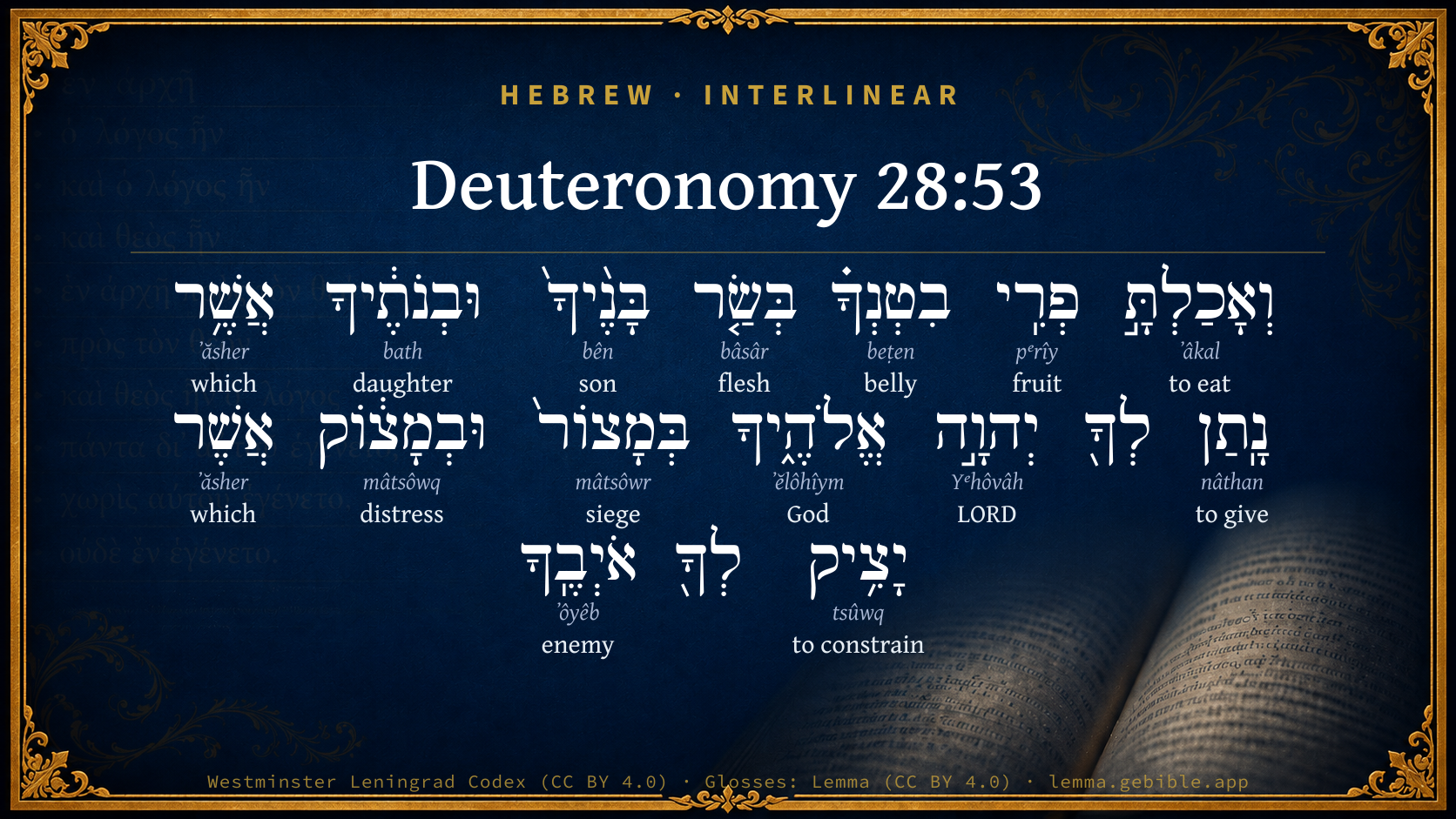
Deuteronomy 28:53

Hebrew (Westminster Leningrad Codex) Deuteronomy 28:53 appears in the Hebrew Old Testament. The text above is from the Westminster Leningrad Codex. Each word links to its Strong’s number, a concise gloss, and parsing drawn from the Open Scriptures Hebrew Bible morphology. Click any word for its full Brown-Driver-Briggs (BDB) entry.
Download image
Cite this verse

Deuteronomy 28:53 (World English Bible). Public Domain. Lemma interlinear Bible study tool, https://lemma.gebible.app/v/deuteronomy/28/53.

Show BibTeX & RIS
BibTeX
RIS
English Translation
You shall eat the fruit of your own body, the flesh of your sons and of your daughters, whom Yahweh your God has given you, in the siege and in the distress with which your enemies shall distress you.
World English Bible · Public Domain
Highlights
  • 2 first appearances in the Hebrew Bible
Full analysis ↓
Download a study sheet

One document with this verse’s original text, its word-by-word gloss line, the meaning frame, cross-references with their text, attributed commentary, and full source and license credits — printable, and it pastes into notes with its structure intact.

This verse Autodidact and up

Study sheet (.html) Plain text (.txt)

A passage Seminary Student

Up to 50 verses in one chapter. A passage sheet keeps up to 6 commentary sources and 12 cross-references per verse, in the order this page ranks them, and says so on the sheet whenever that leaves anything out. Ask for a single verse and you get the Autodidact verse sheet above.

Everything on this page stays free to read, with no account — the sheet is a download of what is already on screen, not access to it.

Want to remove ads? Support Godless Engineer
Compare translations 3

The same verse in 3 English versions, stacked beneath the original-language interlinear above. Click any original word for its lexicon entry.

Each is an independent rendering of the whole verse — the interlinear is not word-aligned to these translations.

Highlighted words mark where these versions differ — a whole-verse word diff, not a word-by-word alignment.

  • World English Bible Public Domain
    You shall eat the fruit of your own body, the flesh of your sons and of your daughters, whom Yahweh your God has given you, in the siege and in the distress with which your enemies shall distress you.
  • King James Version Public Domain
    And thou shalt eat the fruit of thine own body, the flesh of thy sons and of thy daughters, which the LORD thy God hath given thee, in the siege, and in the straitness, wherewith thine enemies shall distress thee:
  • unfoldingWord Literal Text CC BY-SA 4.0
    And you will eat the fruit of your womb, the flesh of your sons and your daughters, whom Yahweh your God gave to you, in the siege and in the distress when your enemies oppress you.

unfoldingWord Literal Text — © unfoldingWord, licensed CC BY-SA 4.0. Word-aligned USFM3 via Door43 (git.door43.org/unfoldingWord/en_ult).

Versions to compare (up to 4)

3 of 4 selected

Show all 18 translations

Every available English version of this verse, each an independent rendering of the whole verse.

  • World English Bible Public Domain
    You shall eat the fruit of your own body, the flesh of your sons and of your daughters, whom Yahweh your God has given you, in the siege and in the distress with which your enemies shall distress you.
  • Berean Standard Bible Public Domain
    Then you will eat the fruit of your womb, the flesh of the sons and daughters whom the LORD your God has given you, in the siege and distress that your enemy will inflict on you.
  • Majority Standard Bible Public Domain
    Then you will eat the fruit of your womb, the flesh of the sons and daughters whom the LORD your God has given you, in the siege and distress that your enemy will inflict on you.
  • King James Version Public Domain
    And thou shalt eat the fruit of thine own body, the flesh of thy sons and of thy daughters, which the LORD thy God hath given thee, in the siege, and in the straitness, wherewith thine enemies shall distress thee:
  • American Standard Version (1901) Public Domain
    And thou shalt eat the fruit of thine own body, the flesh of thy sons and of thy daughters, whom Jehovah thy God hath given thee, in the siege and in the distress wherewith thine enemies shall distress thee.
  • Revised Version (1885) Public Domain
    And thou shalt eat the fruit of thine own body, the flesh of thy sons and of thy daughters which the LORD thy God hath given thee; in the siege and in the straitness, wherewith thine enemies shall straiten thee.
  • Geneva Bible (1599) Public Domain
    And thou shalt eate the fruite of thy bodie: euen the flesh of thy sonnes and thy daughters, which the Lord thy God hath giuen thee, during the siege and straitnesse wherein thine enemie shall inclose thee:
  • Douay-Rheims (1899) Public Domain
    And thou shalt eat the fruit of thy womb, and the flesh of thy sons and of thy daughters, which the Lord thy God shall give thee, in the distress and extremity wherewith thy enemy shall oppress thee.
  • Young's Literal Translation Public Domain
    and thou hast eaten the fruit of thy body, flesh of thy sons and thy daughters (whom Jehovah thy God hath given to thee), in the siege, and in the straitness with which thine enemies do straiten thee.
  • Literal Standard Version CC BY-SA 4.0
    And you have eaten the fruit of your body, [the] flesh of your sons and your daughters (whom your God YHWH has given to you), in the siege and in the constriction with which your enemies constrict you.
  • Unlocked Literal Bible CC BY-SA 4.0
    You will eat the fruit of your own body, the flesh of your sons and of your daughters, whom Yahweh your God gave you, in the siege and in the distress with which your enemies will put upon you.
  • unfoldingWord Literal Text CC BY-SA 4.0
    And you will eat the fruit of your womb, the flesh of your sons and your daughters, whom Yahweh your God gave to you, in the siege and in the distress when your enemies oppress you.
  • Darby Bible Public Domain
    And in the siege, and in the straitness, wherewith thine enemies shall distress thee, thou shalt eat the fruit of thine own body, the flesh of thy sons and of thy daughters whom Jehovah thy God hath given thee.
  • World Messianic Bible Public Domain
    You will eat the fruit of your own body, the flesh of your sons and of your daughters, whom the LORD your God has given you, in the siege and in the distress with which your enemies will distress you.
  • Webster's Bible Public Domain
    And thou shalt eat the fruit of thy own body, the flesh of thy sons and of thy daughters which the LORD thy God hath given thee, in the siege and in the straitness with which thy enemies shall distress thee:
  • Free Bible Version CC BY-SA 4.0
    You'll end up eating your children, the flesh of the sons and daughters the Lord your God gave you, because of the siege and the suffering that your enemy will cause you.
  • Bible in Basic English Public Domain
    And your food will be the fruit of your body, the flesh of the sons and daughters which the Lord your God has given you; because of your bitter need and the cruel grip of your haters.
  • JPS Tanakh (1917) Public Domain
    And thou shalt eat the fruit of thine own body, the flesh of thy sons and of thy daughters whom the LORD thy God hath given thee; in the siege and in the straitness, wherewith thine enemies shall straiten thee.

Literal Standard Version (2020), Covenant Press — licensed CC BY-SA 4.0. Text via the HelloAO Bible API (eBible.org). Unlocked Literal Bible (unfoldingWord) — licensed CC BY-SA 4.0. Text via the HelloAO Bible API (eBible.org). unfoldingWord Literal Text — © unfoldingWord, licensed CC BY-SA 4.0. Word-aligned USFM3 via Door43 (git.door43.org/unfoldingWord/en_ult). Free Bible Version, Dr. Jonathan Gallagher — licensed CC BY-SA 4.0. Text via the HelloAO Bible API (eBible.org).

Word by word

More ways to search: Search by grammar → Find every occurrence → Compare this word →

Practice this passage: Drill this verse → Learn its vocabulary →

וּבְמָצ֔וֹק
mâtsôwq
H4689
“and · in/at · distress”
Conjunction + Preposition + Noun, Common, Masculine, Singular, Absolute
Part of Speech
Conjunction + Preposition + Noun
Type
Common
Gender
Masculine
Number
Singular
State
Absolute
Full BDB Definition

Origin: from H6693

TWOT: 1895d

straitness, straits, distress, stress, anguish
  1. וְאָכַלְתָּ֣ ʼâkal H398 “and · to eat” Conjunction + Verb, Qal, Sequential Perfect, 2nd Person, Masculine, Singular
  2. פְרִֽי pᵉrîy H6529 “fruit of” Noun, Common, Masculine, Singular, Construct
  3. בִטְנְךָ֗ beṭen H990 “belly · your” Noun, Common, Feminine, Singular, Construct + Suffix, Personal, 2nd Person, Masculine, Singular
  4. בְּשַׂ֤ר bâsâr H1320 “flesh of” Noun, Common, Masculine, Singular, Construct
  5. בָּנֶ֨יךָ֙ bên H1121 “sons · your” Noun, Common, Masculine, Plural, Construct + Suffix, Personal, 2nd Person, Masculine, Singular
  6. וּבְנֹתֶ֔יךָ bath H1323 “and · daughters · your” Conjunction + Noun, Common, Feminine, Plural, Construct + Suffix, Personal, 2nd Person, Masculine, Singular
  7. אֲשֶׁ֥ר ʼăsher H834 “which” Particle, Relative
  8. נָֽתַן nâthan H5414 “to give” Verb, Qal, Perfect, 3rd Person, Masculine, Singular
  9. יְהוָ֣ה Yᵉhôvâh H3068 “LORD” Noun, Proper
  10. אֱלֹהֶ֑יךָ ʼĕlôhîym H430 “God(s) · your” Noun, Common, Masculine, Plural, Construct + Suffix, Personal, 2nd Person, Masculine, Singular
  11. בְּמָצוֹר֙ mâtsôwr H4692 “in/at · siege” Preposition + Noun, Common, Masculine, Singular, Absolute
  12. אֲשֶׁר ʼăsher H834 “which” Particle, Relative
  13. יָצִ֥יק tsûwq H6693 “to constrain” Verb, Hiphil, Imperfect, 3rd Person, Masculine, Singular
  14. אֹיְבֶֽךָ ʼôyêb H341 “enemy · you” Verb, Qal, Participle Active, Masculine, Singular, Construct + Suffix, Personal, 2nd Person, Masculine, Singular

About this verse

These counts appear in no published source. They are computed here, from the morphology-tagged text and Lemma’s own curated glosses. What Lemma adds →

17
words
14
distinct lemmas
Pentateuch
section

Notable vocabulary

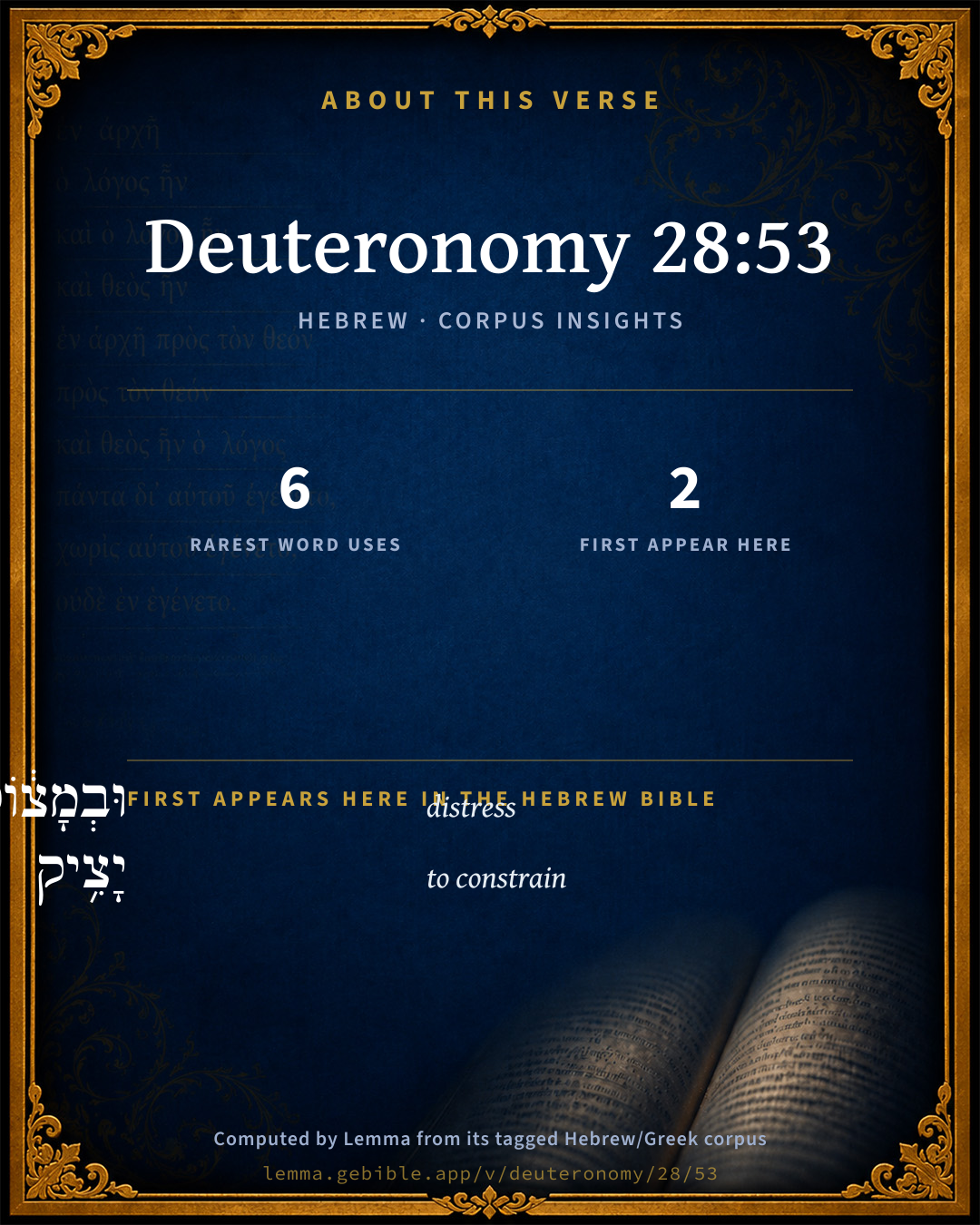
The rarest word here is וּבְמָצ֔וֹק distress H4689 — appearing just 6 times in the whole Hebrew Bible.

First appearance in Scripture

These words make their first canonical appearance in the Hebrew Bible here:

  • וּבְמָצ֔וֹק distress H4689
  • יָצִ֥יק to constrain H6693

Shared distinctive vocabulary

וּבְמָצ֔וֹק distress H4689 occurs in 6 verses of the Hebrew Bible. Also found in:

Grammatical profile

  • 4 verbs
  • 9 nouns
  • 2 prepositions
  • 2 particles

Verb forms

  • וְאָכַלְתָּ֣ Qal · Sequential Perfect
  • נָֽתַן Qal · Perfect
  • יָצִ֥יק Hiphil · Imperfect
  • אֹיְבֶֽךָ Qal · Participle Active

Repetition

A word recurs within this verse — often emphatic in Hebrew:

  • אֲשֶׁ֥ר which H834 ×2

Hebrew & Septuagint length

In English translation the verse runs 39 words from the Hebrew and 37 from the Septuagint (LXX English) — closely comparable.

A rough comparison of the two English renderings, which tokenize alike — not a word-level alignment.

Word counts can differ between the Hebrew and the Greek without any difference in meaning — e.g. the Hebrew direct-object marker אֵת has no separate Greek word, and Greek often adds the article ὁ.

Cross-references

10

Topical passages linked to Deuteronomy 28:53 in the Treasury of Scripture Knowledge — connected by theme and wording, ordered by reader-vote popularity; previews shown in the World English Bible.

  • Lamentations 4:10 The hands of the pitiful women have boiled their own children; They were their food in the destruction of the daughter of my people.
  • Leviticus 26:29 You will eat the flesh of your sons, and you will eat the flesh of your daughters.
  • Jeremiah 19:9 I will cause them to eat the flesh of their sons and the flesh of their daughters; and they shall eat everyone the flesh of his friend, in the siege and in the distress, with which their enemies, and those who seek their life, shall distress them.
  • Deuteronomy 28:57 and toward her young one who comes out from between her feet, and toward her children whom she shall bear; for she shall eat them for want of all things secretly, in the siege and in the distress with which your enemy shall distress you in your gates.
  • 2 Kings 6:28–29 The king said to her, What ails you? She answered, This woman said to me, Give your son, that we may eat him today, and we will eat my son tomorrow.
  • Lamentations 2:20 Look, Yahweh, and see to whom you have done thus! Shall the women eat their fruit, the children that are dandled in the hands? Shall the priest and the prophet be killed in the sanctuary of the Lord?
  • Ezekiel 5:10 Therefore the fathers shall eat the sons in the midst of you, and the sons shall eat their fathers; and I will execute judgments on you; and the whole remnant of you will I scatter to all the winds.
  • Deuteronomy 28:55 so that he will not give to any of them of the flesh of his children whom he shall eat, because he has nothing left him, in the siege and in the distress with which your enemy shall distress you in all your gates.
  • Deuteronomy 28:18 Cursed shall be the fruit of your body, and the fruit of your ground, the increase of your cattle, and the young of your flock.
  • Matthew 24:19 But woe to those who are with child and to nursing mothers in those days!

Cross-references courtesy of OpenBible.info (CC BY 4.0).

Hebrew and Greek witnesses Masoretic Hebrew ↔ Greek Septuagint

The same verse in the two great witnesses to the Old Testament, shown verse-for-verse.

These are two independent witnesses, not word-aligned to each other, and the Septuagint is shown in lemma (dictionary) form.

Hebrew Deuteronomy 28:53 Masoretic · Westminster Leningrad Codex

וְאָכַלְתָּ֣ פְרִֽי בִטְנְךָ֗ בְּשַׂ֤ר בָּנֶ֨יךָ֙ וּבְנֹתֶ֔יךָ אֲשֶׁ֥ר נָֽתַן לְךָ֖ יְהוָ֣ה אֱלֹהֶ֑יךָ בְּמָצוֹר֙ וּבְמָצ֔וֹק אֲשֶׁר יָצִ֥יק לְךָ֖ אֹיְבֶֽךָ

You shall eat the fruit of your own body, the flesh of your sons and of your daughters, whom Yahweh your God has given you, in the siege and in the distress with which your enemies shall distress you.

World English Bible · Public Domain

Greek LXX Deuteronomy 28:53 Septuagint · lemma form

καί ἐσθίω ὁ ἔκγονος ὁ κοιλία σύ κρέας υἱός σύ καί θυγάτηρ σύ ὅσος δίδωμι σύ κύριος ὁ θεός σύ ἐν ὁ στενοχωρία σύ καί ἐν ὁ θλῖψις σύ ὅς θλίβω σύ ὁ ἐχθρός σύ

And you shall eat the fruit of your body, the flesh of your sons and of your daughters, all that he has given you, in your straitness and your affliction, with which your enemy shall afflict you.

LXX2012 (modern English Septuagint) · Public Domain

Hebrew: Westminster Leningrad Codex (CC BY 4.0). Greek: Septuagint (public domain); English from LXX2012 (modern English Septuagint) (Public Domain). How the Septuagint differs from the Hebrew →

Targum (Aramaic paraphrase)

2

The Targum is the ancient Jewish Aramaic paraphrase of the Hebrew Scriptures — an interpretive translation, not the Hebrew text itself. Onkelos (literal) and Pseudo-Jonathan (expansive) render the Torah, and Jonathan the Prophets. Coverage is partial: where no permissively-licensed English translation exists for a verse, only the Aramaic is shown. This is verse-level text, not a word-by-word alignment to the Hebrew.

  1. Targum Onkelos Torah (Genesis–Deuteronomy)
    וְתֵיכוּל וַלְדָא דִמְעָךְ בְּשַׂר בְּנָיךְ וּבְנָתָיךְ דִי יְהַב לָךְ יְיָ אֱלָהָךְ בִּצְיָרָא וּבְעַקְתָא דְיָעֵק לָךְ סַנְאָךְ

    (no public-domain English translation for this verse)

    Targum Onkelos — Aramaic: “Onkelos Genesis” (public domain); “Onkelos Exodus” (public domain); “Onkelos Leviticus” (public domain); “Onkelos Numbers” (public domain); “Onkelos Deuteronomy” (public domain). English: “Sefaria Community Translation” (CC0 1.0 (public-domain dedication)); “J.W. Etheridge. The Targums of Onkelos and Jonathan Ben Uzziel on the Pentateuch. London: Longmans, Green, 1862” (public domain). Text via Sefaria.

  2. Targum Pseudo-Jonathan Torah (Genesis–Deuteronomy)
    וְיִגְמְרוּן וַולְדֵי מְעֵיכוֹן דְתֵיכְלוּנוּן בְּכַפְנָא בְּשַר בְּנֵיכוֹן וּבְנָתֵיכוֹן דִיהַב יְיָ אֱלָהָכוֹן לְכוֹן בְּצַעֲרוּ וּבְעָקָא דִיעִיקוּן לְכוֹן סַנְאֵיכוֹן

    And the children of your wombs shall be consumed; for you will eat them in the famine, even the flesh of your sons and daughters, whom the Lord your God did give you, by reason of the anguish and oppression wherewith your enemies shall oppress you.

    Targum Pseudo-Jonathan — Aramaic: “Targum Jonathan on Genesis” (public domain); “Targum Jonathan on Exodus” (public domain); “Targum Jonathan on Leviticus” (public domain); “Targum Jonathan on Numbers” (public domain); “Targum Jonathan on Deuteronomy” (public domain). English: “The Targum of Jonathan ben Uzziel, trans. J. W. Etheridge, London, 1862” (public domain). Text via Sefaria.

Commentary

Notes on Deuteronomy 28:53 from classic Christian and Jewish commentators (each source and its license shown beneath its notes). The classic Christian expositions comment on the surrounding passage and are grouped to its opening verse, so a note may address several verses; the Jewish commentaries on the Tanakh (Rashi and others) are per-verse, so they appear only where the commentator wrote on this verse.

Lemma curates 59 commentaries, every one of them public domain or Creative Commons licensed, each selected and text-cleaned for this edition rather than reprinted as found. About our sources →

Trapp's Complete Commentary

John Trapp

Deu 28:53 And thou shalt eat the fruit of thine own body, the flesh of thy sons and of thy daughters, which the LORD thy God hath given thee, in the siege, and in the straitness, wherewith thine enemies shall distress thee:

Ver. 53. And thou shalt eat.] {See Trapp on "Lev 26:29"}

John Trapp, A Commentary or Exposition upon All the Books of the Old and New Testament (1647–1656) — public domain. Text from a community e-Sword module.

Joseph Benson's Commentary

Deu 28:53. Thou shalt eat the fruit of thine own body — The stoutest and most obstinate resistance will avail you nothing; all the advantage you will gain by it will be to suffer such long and pressing straits by the siege as will force you, after thousands have perished with hunger, to feed upon the flesh of one another. This prediction was repeatedly fulfilled, especially when Vespasian and his son Titus begirt Jerusalem so closely that the besieged were reduced to a most grievous famine, which forced them, after they had eaten up their horses and other creatures, to eat even their own children, whom parents, who had used to live delicately, Moses here foretels, should themselves eat up privately, and let none share with them.

Joseph Benson's Commentary on the Old and New Testaments (1811–1818) — public domain. Text from a community e-Sword module.

Jamieson, Fausset & Brown

Robert Jamieson, A. R. Fausset & David Brown

And thou shalt eat the fruit of thine own body--(See Kg2 6:29; Lam 4:10). Such were the dreadful extremities to which the inhabitants during the siege were reduced that many women sustained a wretched existence by eating the flesh of their own children. Parental affection was extinguished, and the nearest relatives were jealously, avoided, lest they should discover and demand a share of the revolting viands.

Jamieson, Fausset & Brown — Commentary Critical and Explanatory on the Whole Bible (1871) — public domain (CC PDM 1.0). Text via the HelloAO Bible API.

Ellicott's Commentary for English Readers

(53) Thou shalt eat the fruit of thine own body.—Specially confirmed in the siege of Samaria by the Syrians (2Ki_6:26-29; but see on Deu_28:56), and also in Jerusalem when besieged by Nebuchadnezzar. (See Lam_2:20; Lam_4:10.)

A Bible Commentary for English Readers, edited by Charles John Ellicott (1878–1897) — public domain. Text from a community e-Sword module.

The Cambridge Bible for Schools and Colleges

gen. ed. J. J. S. Perowne

53. And thou shalt eat, etc.] Cp. Lev_26:29, Eze_5:10, and for instances of this horror 2Ki_6:28 f., Lam_2:20; Lam_4:10.

in the siege and in the straitness] A Refrain as in Deu_28:55; Deu_28:57. Similarly Jer_19:9, along with the eating of children as here.

The Cambridge Bible for Schools and Colleges (gen. ed. J. J. S. Perowne; Cambridge University Press, 1878–1918) — public domain. Text from a community e-Sword module.

John Gill's Exposition

And toward her young one that cometh out from between her feet,.... Or her secundine, "her afterbirth", as in the margin of our Bibles; so the Targum of Jonathan and Aben Ezra interpret it. The latter describes it,"the place of the fetus, while it abides in the womb of its mother;''the membrane in which the child is wrapped; and it is suggested that, as nauseous as that is, the delicate woman should eat it, and then the newborn child that was wrapped in it; so Jarchi interprets it, little children; though it seems to be distinguished from the children she bears or brings forth in the next clause:

and towards her children which she shall bear; that is, have an evil eye towards them, to eat them as follows:

for she shall eat them for want of all things secretly in the siege and straitness wherewith thine enemy shall distress thee in thy gates; that is, eat her children, being reduced to the utmost extremity, being in want of all things, having nothing at all to abate her sharp hunger; which, and nothing else, could incline her, and prevail upon her to do an action so monstrously horrid: and which she would do in the most private and secret manner; both lest others should partake with her, as well as being conscious of the foulness and blackness of the crime, that would not by any means bear the light; and all this owing to the closeness of the siege, and the unspeakable distress they should be in through it. For the illustration of this, take the following story as related by Josephus (f);"a woman, whose name was Mary, that lived beyond Jordan, illustrious for her descent and riches fled with the multitude to Jerusalem when besieged carrying with her her substance, and what food she could get that were left to her by the spoilers; where being pressed with famine, she took her sucking child, killed it boiled it, and ate half of it, and then laid up the rest, and covered it; and when the seditious party entered the house, they smelt it, and demanded her food, threatening to kill her if she did not deliver it; which when she brought forth, declaring what she had done, they were struck with horror; to whom she said, this is my son, and this my own deed; eat, for I have eaten; be not more tender or softer than a woman, and more sympathizing or more pitiful than a mother.''All the ideas that this prophecy of Moses conveys are to be met with in this account; as of a woman well bred and delicate, reduced to the utmost distress, and wanting all the necessaries of life, killing her tender infant, a sucking babe, eating it secretly, and laying up the rest covered for another time. If Moses had lived to have known the fact committed, as Josephus did, he could not have expressed it well in stronger and clearer terms than he has done. This is a most amazing instance of a prophecy delivered out two thousand years or more before the fact was done, and of the exact accomplishment of it; and if the observation of a learned critic (g) can be established, that the first word of this verse should be and so be rendered, "and she shall boil that which cometh out from between her feet, even her children which she shall bear", the fulfilment of the prophecy will appear still more exact, both at the siege of Samaria, Kg2 6:20; and of Jerusalem, as in the above relation of Josephus.

(f) De Bello Jud. l. 6. c. 3. sect. 4. (g) Dr. Kennicot's State of the Hebrew Text, Dissert. 1. p. 421.

John Gill's Exposition of the Whole Bible (1746–1763) — public domain (CC PDM 1.0). Text via the HelloAO Bible API.

Haydock's Catholic Bible Commentary

Womb; a cruelty which the Jews were guilty of in the sieges of Samaria and of Jerusalem. See Baruch ii. 2, 13., Lamentations ii. 20., and iv., and 4 Kings vi. 28., and Josephus, Jewish Wars vii. 8. (Calmet)

George Leo Haydock (1774–1849), Haydock's Catholic Family Bible and Commentary, 1859 edition — public domain. Excludes Psalms (Douay-Rheims chapter numbering differs from Protestant) and Deuterocanonical books (Catholic canon only).

Whedon's Commentary on the Bible

Daniel D. Whedon

53. Eat the fruit of thine own body — The terrible straits to which the nation will be reduced are here described with graphic distinctness, as if an historian rather than a prophet held the pen. With greater minuteness is the horrible distress portrayed in the verses that follow. The man accustomed to luxurious living, the woman so delicate that the sole of her foot had not touched the ground, in the extremity of famine caused by the siege will forget all natural affection. See 2Ki_6:28; also Josephus, Jewish War, book 7, chap. 2.

Daniel D. Whedon (gen. ed.), Commentary on the Old and New Testaments (1874–1909) — public domain. Text from a community e-Sword module.

Rashi

Rabbi Shlomo Yitzchaki (Rashi)

ואכלת … בשר בניך … במצור AND THOU SHALT EAT … THE FLESH OF THY SONS … IN THE SIEGE, [AND IN THE DISTRESS] — Because they (the enemies) will besiege the city and there will consequently be distress— i.e. the stress of famine.

Rashi on the Tanakh — English translations: “The Judaica Press complete Tanach with Rashi, translated by A. J. Rosenberg” (CC BY 4.0); “Pentateuch with Rashi's commentary by M. Rosenbaum and A.M. Silbermann, 1929-1934” (public domain); “The Metsudah Tanach series, Lakewood, N.J” (CC BY 4.0); and “The Book of Joshua, Metsudah Publications, 1997” (CC BY 4.0). Text via Sefaria.

Lesson kit

Teaching starters — assembled from the data on this page, not authored interpretation. Every prompt links to the verse data it draws on. Edit before teaching.

Deuteronomy, in the Pentateuch, opens this verse with 17 words (14 distinct Hebrew lemmas). Its most distinctive word is mâtsôwq (“distress”). A historical commentator’s framing appears above. Read the whole chapter for the surrounding context.

Discussion questions

  1. What does “distress” (mâtsôwq) contribute to the verse as a whole?
  2. 2 words make their first appearance in Scripture here. What does this debut establish?
  3. How does Deuteronomy 28:55, which shares the word «distress», read alongside this verse?
  4. What does the repetition of “which” (2× in this one verse) do in this verse?
  5. The translations on this page render this verse differently — a whole-verse word diff, not a word-by-word alignment. What might account for the different wordings?
  6. «וְאָכַלְתָּ֣» is a Qal Sequential Perfect verb. How does that grammatical form shape the action described?
  7. Compare how Trapp's Complete Commentary and Joseph Benson's Commentary read this verse. Where do they agree or differ?

Things to notice

  • 2 words make their first canonical appearance in Scripture here.
  • These translations choose different wording for 17 words in this verse.
  • “which” occurs 2× in this single verse.
  • 14 distinct Hebrew lemmas span 17 words in this verse.

Reading settings

Reading text

Shown beneath each verse's original-language words.

Old Testament
Old Testament edition

Read the OT as the Masoretic Hebrew (MT) or the Greek Septuagint (LXX).

English shown for the Greek Septuagint (in the Hebrew ↔ Greek comparison).

Comparing translations? Open the Compare panel on any verse page to stack up to four side by side.