Psalms 27:2

Hebrew (Westminster Leningrad Codex) Psalms 27:2 appears in the Hebrew Old Testament. The text above is from the Westminster Leningrad Codex. Each word links to its Strong’s number, a concise gloss, and parsing drawn from the Open Scriptures Hebrew Bible morphology. Click any word for its full Brown-Driver-Briggs (BDB) entry.
Download image
Cite this verse

Psalms 27:2 (World English Bible). Public Domain. Lemma interlinear Bible study tool, https://lemma.gebible.app/v/psalms/27/2.

Show BibTeX & RIS
BibTeX
RIS
English Translation
When evil-doers came at me to eat up my flesh, Even my adversaries and my foes, they stumbled and fell.
World English Bible · Public Domain
Download a study sheet

One document with this verse’s original text, its word-by-word gloss line, the meaning frame, cross-references with their text, attributed commentary, and full source and license credits — printable, and it pastes into notes with its structure intact.

This verse Autodidact and up

Study sheet (.html) Plain text (.txt)

A passage Seminary Student

Up to 50 verses in one chapter. A passage sheet keeps up to 6 commentary sources and 12 cross-references per verse, in the order this page ranks them, and says so on the sheet whenever that leaves anything out. Ask for a single verse and you get the Autodidact verse sheet above.

Everything on this page stays free to read, with no account — the sheet is a download of what is already on screen, not access to it.

Want to remove ads? Support Godless Engineer
Compare translations 3

The same verse in 3 English versions, stacked beneath the original-language interlinear above. Click any original word for its lexicon entry.

Each is an independent rendering of the whole verse — the interlinear is not word-aligned to these translations.

Highlighted words mark where these versions differ — a whole-verse word diff, not a word-by-word alignment.

  • World English Bible Public Domain
    When evil-doers came at me to eat up my flesh, Even my adversaries and my foes, they stumbled and fell.
  • King James Version Public Domain
    When the wicked, even mine enemies and my foes, came upon me to eat up my flesh, they stumbled and fell.
  • unfoldingWord Literal Text CC BY-SA 4.0
    When the ones doing evil advance against me to devour my flesh, my enemies and the ones being hostile to me, they stumbled and fell.

unfoldingWord Literal Text — © unfoldingWord, licensed CC BY-SA 4.0. Word-aligned USFM3 via Door43 (git.door43.org/unfoldingWord/en_ult).

Versions to compare (up to 4)

3 of 4 selected

Show all 18 translations

Every available English version of this verse, each an independent rendering of the whole verse.

  • World English Bible Public Domain
    When evil-doers came at me to eat up my flesh, Even my adversaries and my foes, they stumbled and fell.
  • Berean Standard Bible Public Domain
    When the wicked came upon me to devour my flesh, my enemies and foes stumbled and fell.
  • Majority Standard Bible Public Domain
    When the wicked came upon me to devour my flesh, my enemies and foes stumbled and fell.
  • King James Version Public Domain
    When the wicked, even mine enemies and my foes, came upon me to eat up my flesh, they stumbled and fell.
  • American Standard Version (1901) Public Domain
    When evil-doers came upon me to eat up my flesh, `Even' mine adversaries and my foes, they stumbled and fell.
  • Revised Version (1885) Public Domain
    When evil-doers came upon me to eat up my flesh, even mine adversaries and my foes, they stumbled and fell.
  • Geneva Bible (1599) Public Domain
    When the wicked, euen mine enemies and my foes came vpon mee to eate vp my flesh; they stumbled and fell.
  • Douay-Rheims (1899) Public Domain
    Whilst the wicked draw near against me, to eat my flesh. My enemies that trouble me, have themselves been weakened, and have fallen.
  • Young's Literal Translation Public Domain
    When evil doers come near to me to eat my flesh, My adversaries and mine enemies to me, They have stumbled and fallen.
  • Literal Standard Version CC BY-SA 4.0
    When evildoers come near to me to eat my flesh, || My adversaries and my enemies to me, || They have stumbled and fallen.
  • Unlocked Literal Bible CC BY-SA 4.0
    When evildoers approached me to devour my flesh, my adversaries and my enemies stumbled and fell.
  • unfoldingWord Literal Text CC BY-SA 4.0
    When the ones doing evil advance against me to devour my flesh, my enemies and the ones being hostile to me, they stumbled and fell.
  • Darby Bible Public Domain
    When evil-doers, mine adversaries and mine enemies, came upon me to eat up my flesh, they stumbled and fell.
  • World Messianic Bible Public Domain
    When evildoers came at me to eat up my flesh, even my adversaries and my foes, they stumbled and fell.
  • Webster's Bible Public Domain
    When the wicked, even my enemies and my foes, came upon me to eat up my flesh, they stumbled and fell.
  • Free Bible Version CC BY-SA 4.0
    When evil people come at me to tear me apart, it's my enemies, those who are against me, they're the ones who trip and fall.
  • Bible in Basic English Public Domain
    When evil-doers, even my haters, came on me to put an end to me, they were broken and put to shame.
  • JPS Tanakh (1917) Public Domain
    When evil-doers came upon me to eat up my flesh, even mine adversaries and my foes, they stumbled and fell.

Literal Standard Version (2020), Covenant Press — licensed CC BY-SA 4.0. Text via the HelloAO Bible API (eBible.org). Unlocked Literal Bible (unfoldingWord) — licensed CC BY-SA 4.0. Text via the HelloAO Bible API (eBible.org). unfoldingWord Literal Text — © unfoldingWord, licensed CC BY-SA 4.0. Word-aligned USFM3 via Door43 (git.door43.org/unfoldingWord/en_ult). Free Bible Version, Dr. Jonathan Gallagher — licensed CC BY-SA 4.0. Text via the HelloAO Bible API (eBible.org).

Word by word

More ways to search: Search by grammar → Find every occurrence → Compare this word →

Practice this passage: Drill this verse → Learn its vocabulary →

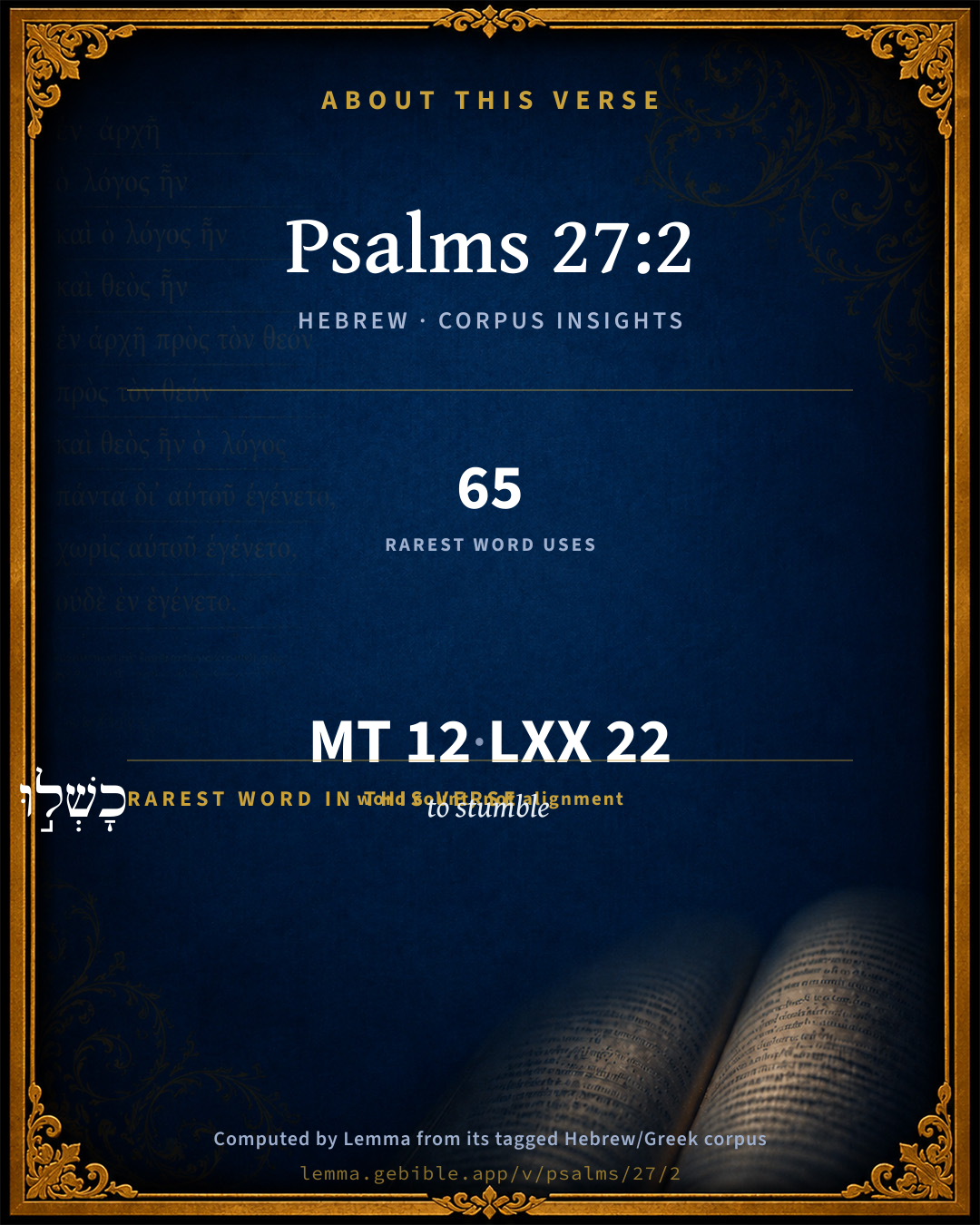
כָשְׁל֣וּ
kâshal
H3782
“to stumble”
Verb, Qal, Perfect, 3rd Person, Common, Plural
Part of Speech
Verb
Stem
Qal
Form
Perfect
Person
3rd Person
Gender
Common
Number
Plural
Full BDB Definition

Origin: a primitive root

TWOT: 1050

to stumble, stagger, totter - (Qal) - to stumble - to totter - (Niphal) - to stumble - to be tottering, be feeble - (Hiphil) - to cause to stumble, bring injury or ruin to, overthrow - to make feeble, make weak - (Hophal) to be made to stumble - (Piel) bereave
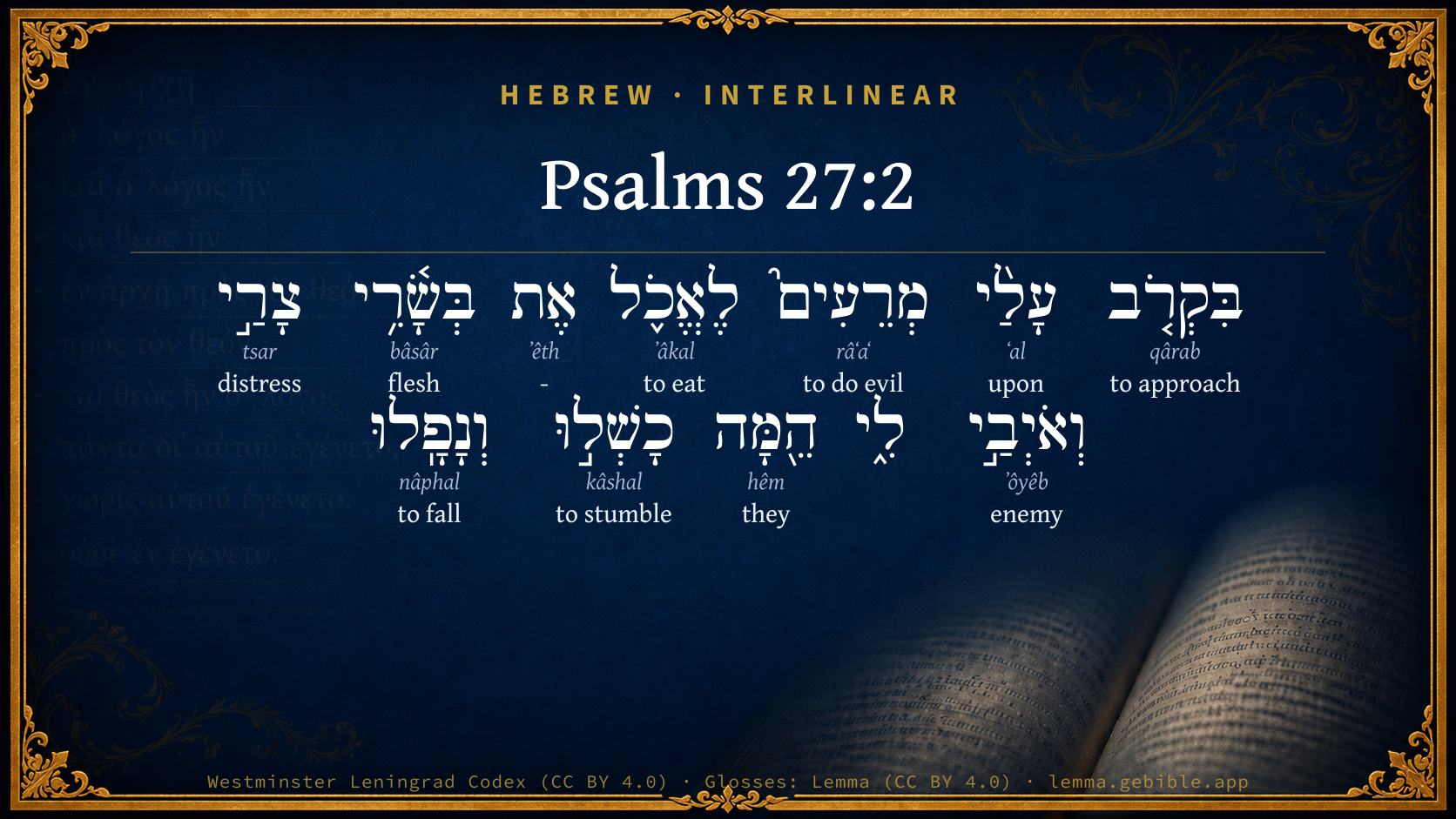
  1. בִּקְרֹ֤ב qârab H7126 “in/at · to approach” Preposition + Verb, Qal, Infinitive Construct
  2. עָלַ֨י ʻal H5921 “upon · me” Preposition + Suffix, Personal, 1st Person, Common, Singular
  3. מְרֵעִים֮ râʻaʻ H7489 “doing evil” Verb, Hiphil, Participle Active, Masculine, Plural, Absolute
  4. לֶאֱכֹ֪ל ʼâkal H398 “to eat” Preposition + Verb, Qal, Infinitive Construct
  5. אֶת ʼêth H853 “-” Particle, Direct Object
  6. בְּשָׂ֫רִ֥י bâsâr H1320 “flesh · my” Noun, Common, Masculine, Singular, Construct + Suffix, Personal, 1st Person, Common, Singular
  7. צָרַ֣י tsar H6862 “distresses · my” Noun, Common, Masculine, Plural, Construct + Suffix, Personal, 1st Person, Common, Singular
  8. וְאֹיְבַ֣י ʼôyêb H341 “and · enemy · me” Conjunction + Verb, Qal, Participle Active, Masculine, Plural, Construct + Suffix, Personal, 1st Person, Common, Singular
  9. הֵ֖מָּה hêm H1992 “they” Pronoun, Personal, 3rd Person, Masculine, Plural
  10. וְנָפָֽלוּ nâphal H5307 “and · to fall” Conjunction + Verb, Qal, Perfect, 3rd Person, Common, Plural

About this verse

These counts appear in no published source. They are computed here, from the morphology-tagged text and Lemma’s own curated glosses. What Lemma adds →

12
words
11
distinct lemmas
Wisdom
section

Grammatical profile

  • 6 verbs
  • 2 nouns
  • 1 pronoun
  • 2 prepositions
  • 1 particle

Verb forms

  • בִּקְרֹ֤ב Qal · Infinitive Construct
  • מְרֵעִים֮ Hiphil · Participle Active
  • לֶאֱכֹ֪ל Qal · Infinitive Construct
  • וְאֹיְבַ֣י Qal · Participle Active
  • כָשְׁל֣וּ Qal · Perfect
  • וְנָפָֽלוּ Qal · Perfect

Hebrew & Septuagint length

In English translation the verse runs 20 words from the Hebrew and 20 from the Septuagint (LXX English) — the same length.

A rough comparison of the two English renderings, which tokenize alike — not a word-level alignment.

Word counts can differ between the Hebrew and the Greek without any difference in meaning — e.g. the Hebrew direct-object marker אֵת has no separate Greek word, and Greek often adds the article ὁ.

In the original languages it is 12 Hebrew tokens and 22 Greek tokens — but the two are counted differently (Hebrew bundles its prefixes and suffixes into one token; the Greek is in lemma form), so that isn’t a like-for-like length.

Cross-references

13

Topical passages linked to Psalms 27:2 in the Treasury of Scripture Knowledge — connected by theme and wording, ordered by reader-vote popularity; previews shown in the World English Bible.

  • Psalms 118:12 They surrounded me like bees. They are quenched like the burning thorns. In the name of Yahweh I cut them off.
  • Psalms 3:7 Arise, Yahweh! Save me, my God! For you have struck all of my enemies on the cheek bone. You have broken the teeth of the wicked.
  • Psalms 9:3 When my enemies turn back, They stumble and perish in your presence.
  • Psalms 14:4 Have all the workers of iniquity no knowledge, Who eat up my people as they eat bread, And don't call on Yahweh?
  • Psalms 22:16 For dogs have surrounded me. A company of evil-doers have enclosed me. They pierced my hands and my feet.
  • Isaiah 8:15 Many shall stumble thereon, and fall, and be broken, and be snared, and be taken.
  • Job 19:22 Why do you persecute me as God, And are not satisfied with my flesh?
  • Psalms 18:4 The cords of death surrounded me. The floods of ungodliness made me afraid.
  • Psalms 18:38–42 I will strike them through, so that they will not be able to rise. They shall fall under my feet.
  • John 18:3–6 Judas then, having taken a detachment of soldiers and officers from the chief priests and the Pharisees, came there with lanterns, torches, and weapons.
  • Job 31:31 If the men of my tent have not said, 'Who can find one who has not been filled with his meat?'
  • Psalms 53:4 Have the workers of iniquity no knowledge, Who eat up my people as they eat bread, And don't call on God?
  • Psalms 62:3–4 How long will you assault a man, Would all of you throw him down, Like a leaning wall, like a tottering fence?

Cross-references courtesy of OpenBible.info (CC BY 4.0).

Hebrew and Greek witnesses Masoretic Hebrew ↔ Greek Septuagint

The same verse in the two great witnesses to the Old Testament, shown verse-for-verse.

You’re reading Greek Psalm 26 (Hebrew Psalm 27). The Septuagint counts the superscription, so verse numbers can differ from the Hebrew — chapter-level alignment, not verse-by-verse. Numbering follows Rahlfs.

These are two independent witnesses, not word-aligned to each other, and the Septuagint is shown in lemma (dictionary) form.

Hebrew Psalms 27:2 Masoretic · Westminster Leningrad Codex

בִּקְרֹ֤ב עָלַ֨י מְרֵעִים֮ לֶאֱכֹ֪ל אֶת בְּשָׂ֫רִ֥י צָרַ֣י וְאֹיְבַ֣י לִ֑י הֵ֖מָּה כָשְׁל֣וּ וְנָפָֽלוּ

When evil-doers came at me to eat up my flesh, Even my adversaries and my foes, they stumbled and fell.

World English Bible · Public Domain

Greek LXX Greek Psalm 26:2 Septuagint · lemma form

ἐν ὁ ἐγγίζω ἐπί ἐγώ κακόω ὁ ἐσθίω ὁ σάρξ ἐγώ ὁ θλίβω ἐγώ καί ὁ ἐχθρός ἐγώ αὐτός ἀσθενέω καί πίπτω

When evil-doers drew near against me to eat up my flesh, my persecutors and my enemies, they fainted and fell.

LXX2012 (modern English Septuagint) · Public Domain

On this verse, The Pulpit Commentary discusses the Septuagint’s reading. Read the note in Commentary ↓

Hebrew: Westminster Leningrad Codex (CC BY 4.0). Greek: Septuagint (public domain); English from LXX2012 (modern English Septuagint) (Public Domain). How the Septuagint differs from the Hebrew →

Commentary

Notes on Psalms 27:2 from classic Christian and Jewish commentators (each source and its license shown beneath its notes). The classic Christian expositions comment on the surrounding passage and are grouped to its opening verse, so a note may address several verses; the Jewish commentaries on the Tanakh (Rashi and others) are per-verse, so they appear only where the commentator wrote on this verse.

Lemma curates 59 commentaries, every one of them public domain or Creative Commons licensed, each selected and text-cleaned for this edition rather than reprinted as found. About our sources →

Trapp's Complete Commentary

John Trapp

Psa 27:2 When the wicked, [even] mine enemies and my foes, came upon me to eat up my flesh, they stumbled and fell.

Ver. 2. When the wicked, even mine enemies, came upon me] Made impression upon me, with utmost violence and open mouth, as if they would have devoured me, like a cannibal; or as a lion doth a sheep, inhumanissime, ferarumque more, saith Junius, barbarously and beastly.

They stumbled and fell] Irritis conatibus corruerunt, they utterly lost their design, as did those Amalekites who had sacked Ziklag, 1Sa 30:16-19, and Saul often. If a man stumble and fall not, he gets ground; but if after much blundering he kiss the ground, he falleth with a force. David’s enemies did so, corruerunt et conciderunt; they were irreparably ruined.

John Trapp, A Commentary or Exposition upon All the Books of the Old and New Testament (1647–1656) — public domain. Text from a community e-Sword module.

The Biblical Illustrator

Joseph S. Exell

Psa_27:2

They stumbled and fell.

Gods preservation of David in extreme danger

I. the state and condition of Davids enemies, They are wicked men. The reason whereof is the enmity put by God Himself between the seed of the serpent and the seed of the woman (Gen_3:15), which David found (Psa_38:19-20; Joh_15:15; Joh_16:33). Uses--

1. For instruction. The godly must expect bitter opposition and enmity from the wicked (Mat_10:16).

2. For admonition.

(1) To the wicked: that they consider their state in Gods sight, when they are so spitefully bent against the godly.

(2) To the godly: to be both wise as serpents and harmless as doves, and to beware of men.

3. For comfort to the godly, that their adversaries are wicked men, for they may hereon rest assured that God will not join with their enemies unless it be for trial of grace, as in Job, or for the sins of the godly, in forsaking Him.

II. the purpose and attempt of Davids enemies against him. They came upon him to eat up his flesh; that is, utterly to destroy him.

1. Because of his religion and piety, with which their corruption could admit no accord (Psa_38:20; 2Co_6:14; 1Jn_3:12).

2. Because of the honour and dignity whereto God had advanced him (Psa_4:2; Psa_62:4). Uses--

1. For instruction.

(1) To discover the exceeding measure of corruption that is in natural men, and thereupon their fearful state in soul to Godward (Psa_53:1; Psa_53:3-4; Psa_83:4; Act_22:22).

(2) To manifest that there is a special providence of God over His Church and children, that preserves and keeps them, notwithstanding all the spite and rage of the wicked against them (Psa_105:12-14).

2. For admonition.

(1) To the wicked, to consider of their corrupt affection, in spite and hatred against the godly, whence it comes, that so they may discern their fearful state in soul, and labour to alter it.

(2) To the godly, often to bethink themselves what their religion may bring upon them from the wicked; that so they may get the sure shelter from it, viz. to have God for them.

III. the issue and success of the cruel attempt of Davids enemies against him.

1. They did not only fail of their purpose against David, but even themselves stumbled and fell.

2. The reason or cause hereof was in God, who for just causes stood for David, and set Himself against Davids enemies.

(1) He found him out, and chose him to do Him service, in that place and state wherein he was so mightily opposed by his enemies (Psa_89:20-21).

(2) David trusted in God, and so was holpen (Psa_60:1-3).

(3) David prayed unto the Lord, and so was preserved (Psa_56:9; Psa_34:4).

(4) David made conscience of sin, and walked in obedience (Psa_18:21; Psa_18:24).

(5) God would not be with his enemies, because they were not called of God, nor sent by Him against David; they were wicked men, workers of iniquity; they did neither regard Gods word nor Gods works; they trusted in their own might and outward means.

Uses--

1. For instruction.

(1) See what a great blessing and privilege it is to stand rightly in covenant with God; whereby He becometh light or salvation to a man or to a people, and the strength of their life.

(2) See the misery of those that be out of covenant with God, for the Lords power is ever against them.

2. For admonition: to give all diligence to be truly in covenant with God, that so it may be with us as it was with David.

3. For comfort to the godly, fighting the Lords battles, and yet overmatched. (T. Pierson.)

The Biblical Illustrator, edited by Joseph S. Exell (c. 1880s–1900s) — public domain. Text from a community e-Sword module.

Joseph Benson's Commentary

Psa 27:2-3. When my foes came upon me to eat up my flesh — Greedy to devour me: aiming at no less than my utter destruction, and confident they should effect it; they stumbled and fell — Not, I smote them and they fell, but they stumbled, namely, of their own accord, without my lifting a hand against them; and fell — They were so confounded and weakened that they could not go on with their enterprise. Thus they that came to take Christ were, by a word of his, made to stagger and fall to the ground, Joh 18:6. The ruin of some of the enemies of God’s people is an earnest of the complete conquest of them all. And, therefore, these being fallen, he is fearless of the rest. Though a host should encamp, &c. — Though my enemies be numerous as a host; though they be daring, and their attempts threatening; though they encamp against me, an army against one man; though they wage war upon me, yet my heart shall not fear — Hosts cannot hurt us, if the Lord of hosts protect us.

Joseph Benson's Commentary on the Old and New Testaments (1811–1818) — public domain. Text from a community e-Sword module.

J. A. Alexander on Psalms

Joseph Addison Alexander

2. (Psa 27:2) In the drawing near against me of evil-doers, to devour my flesh, (in the drawing near of) my adversaries and my enenies to me, (it is) they (that) have stumbled and fallen. Even in the most imminent dangers which have hitherto befallen me, the divine protection has enabled me to see those who sought to overwhelm me, overwhelmed themselves. Evil-doers, not only against me, but in general. It was not because they were his enemies merely, but because they were the enemies of God, that he so easily subdued them.—To eat my flesh, a figure borrowed from the habits of wild beasts. Compare Job 19:22, Psa 14:4; Psa 35:1.—To me is to be construed not with enemies, but with the verb, as in Job 33:22. See below, on Psa 55:19. The pronoun expressed in the last clause is emphatic, "Tjin this will I be confident, although ambiguous, appears to mean, "I will confide in this, i.e. in the fact that Jehovah is my light and my salvation." This construction is grammatical, and yields a good sense, but the other is more pointed and emphatic, and the absolute use of the Hebrew in the sense of safe, secure, is justified by Jdg 18:27, Jer 12:5, Pro 11:15.

Joseph Addison Alexander, The Psalms Translated and Explained (1850) — public domain. Text from a community e-Sword module.

Tyndale Open Study Notes

Tyndale Open Resources

27:2 The psalmist’s enemies seek to devour him by living at his expense (see study note on 14:4).

Tyndale Open Study Notes — © Tyndale Open Resources, licensed CC BY-SA 4.0. Text via the HelloAO Bible API.

Jamieson, Fausset & Brown

Robert Jamieson, A. R. Fausset & David Brown

eat . . . my flesh-- (Job 19:22; Psa 14:4). The allusion to wild beasts illustrates their rapacity.

they stumbled--"they" is emphatic; not I, but they were destroyed.

Jamieson, Fausset & Brown — Commentary Critical and Explanatory on the Whole Bible (1871) — public domain (CC PDM 1.0). Text via the HelloAO Bible API.

Adam Clarke's Commentary

Verse 2. When the wicked - came upon me] Near as I appeared to you to be in danger of losing my life, I was safe enough in the hands of the Lord; and those who thought to have eaten me up, stumbled, failed of their purpose, and fell; the Philistine lost his own life.

Adam Clarke's Commentary on the Bible (1810–1826) — public domain. Text from a community e-Sword/MySword module.

John Calvin's Commentaries

2. When the wicked, etc. There is no reason for translating this sentence, as some interpreters do, into the future tense. The rendering of the learned Castellio is, “Si invadant — offensuri sunt atque casuri;” — “If they invade me they shall stumble and fall The Hebrew verbs for “stumble” and “fall”

French and Skinner read, “to devour my flesh;” and observe, that “this image is taken from a wild beast. Compare Psalm 3:7, and Psalm 22:13.”

John Calvin's Commentaries (1540-1563) — public domain. Text from the Calvin Translation Society English edition (1840s-50s) via the Christian Classics Ethereal Library (ccel.org). Calvin's coverage is partial (roughly two-thirds of the Bible); uncommented books and verses are honest gaps, never fabricated. The 19th-century editor's footnotes and remarks are omitted so the notes are faithfully Calvin's own voice.

Ellicott's Commentary for English Readers

(2) When . . .—Literally, In the coming against me (of) the wicked to devour my flesh—my enemies and my foes to me—themselves stumbled and fell. Job_19:22 would allow us to understand those who eat up flesh, as a figure for calumniators and detractors; but the context marks out the situation so clearly as that of a warrior, that we rather take it as a general metaphor for savage and violent attacks. To me, is an emphatic repetition—my enemies, mine.

A Bible Commentary for English Readers, edited by Charles John Ellicott (1878–1897) — public domain. Text from a community e-Sword module.

The Cambridge Bible for Schools and Colleges

gen. ed. J. J. S. Perowne

2. When evil-doers came near against me to eat my flesh,

Even mine adversaries and my foes, they stumbled and fell.

This may refer to past experience, or it may be a confident anticipation of the discomfiture of his foes. According to a common Hebrew idiom the perfect tense may realise their defeat as an accomplished plished fact. See Appendix, Note IV. He compares his assailants to wild beasts, eager to devour him. Cp. Psa_3:7.

stumbled and fell] Cp. Isa_8:15; Jer_46:6.

The Cambridge Bible for Schools and Colleges (gen. ed. J. J. S. Perowne; Cambridge University Press, 1878–1918) — public domain. Text from a community e-Sword module.

John Gill's Exposition

When the wicked, even mine enemies and my foes, came upon me,.... They are wicked men, men of malignant spirits, and evildoers, who are the enemies and foes of the people of God, and who hate them with an implacable hatred, and do everything they can to distress and afflict them; and such enemies David had, who were many and mighty; and these "came upon" him, or "approached against" him (c), they drew near to him to make war with him, as the word signifies (d); they attacked him in an hostile manner; and their view was, as he says,

to eat up my flesh, as they eat bread, Psa 14:4; to devour him at once, to make but one morsel of him, to destroy his life, to strip him of his substance, to take away his wives and children, as the Amalekites at Ziklag, Sa1 30:1;

they stumbled and fell; the Lord put stumbling blocks in their way, and retarded their march, and hindered them from executing their designs; and they fell into the hands of David, and were subdued under him, or fell by death; and these past instances of divine goodness the psalmist calls to mind, to keep up his heart and courage, and animate and strengthen him against the fears of men, of death and hell.

(c) "cum appropinquaverint adversum me", Pagninus; so Gejerus. (d) "Belligerantibus contra me", Junius & Tremellius; so Piscator & Ainsworth.

John Gill's Exposition of the Whole Bible (1746–1763) — public domain (CC PDM 1.0). Text via the HelloAO Bible API.

Albert Barnes' Notes on the Bible

When the wicked, even mine enemies and my foes, came upon me - This refers, doubtless, to some particular period of his past life when he was in very great danger, and when God interposed to save him. The margin here is, “approached against me.” The literal rendering would be, “in the drawing near against me of the wicked to eat up my flesh.” The reference is to some period when they purposed an attack upon him, and when he was in imminent danger from such a threatened attack.

To eat up my flesh - As if they would eat me up. That is, they came upon me like ravening wolves, or hungry lions. We are not to suppose that they literally purposed to eat up his flesh, or that they were cannibals; but the comparison is one that is drawn from the fierceness of wild beasts rushing on their prey. Compare Psa 14:4.

They stumbled and fell - They were overthrown. They failed in their purpose. Either they were thrown into a panic by a false fear, or they were overthrown in battle. The language would be rather applicable to the former, as if by some alarm they were thrown into consternation. Either they differed among themselves and became confused, or God threw obstacles in their way and they were driven back. The general idea is, that God had interposed in some way to prevent the execution of their purposes.

Albert Barnes' Notes on the Bible (1834–1885) — public domain. Text from a community e-Sword/MySword module.

Matthew Poole's English Annotations

To eat up my flesh; greedy to devour me at one morsel. Compare Job 19:22; 31:31.

Matthew Poole's English Annotations on the Holy Bible (1683–1685) — public domain. Text from a community e-Sword/MySword module.

The Treasury of David

Charles H. Spurgeon

Ver. 2. This verse records a past deliverance, and is an instance of the way in which experience should be employed to reassure our faith in times of trial. Each word is instructive. When the wicked. It is a hopeful sign for us when the wicked hate us; if our foes were godly men it would be a sore sorrow, but as for the wicked their hatred is better than their love. Even mine enemies and my foes. There were many of them, they were of different sorts, but they were unanimous in mischief and hearty in hatred. Came upon me advanced to the attack, leaping upon the victim like a lion upon its prey. To eat up my flesh, like cannibals they would make a full end of the man, tear him limb from limb, and make a feast for their malice. The enemies of our souls are not deficient in ferocity, they yield no quarter, and ought to have none in return. See in what danger David was; in the grip and grasp of numerous, powerful, and cruel enemies, and yet observe his perfect safety and their utter discomfiture! They stumbled and fell. God's breath blew them off their legs. There were stones in the way which they never reckoned upon, and over these they made an ignominious tumble. This was literally true in the case of our Lord in Gethsemane, when those who came to take him went backward and fell to the ground; and herein he was a prophetic representative of all wrestling believers who, rising from their knees shall, by the power of faith, throw their foes upon their faces.

Ver. 2. When the wicked, even mine enemies and my foes, came upon me to eat up my flesh, they stumbled and fell. There is no such dainty dish to a malicious stomach, as the flesh of an enemy; it goes down without chewing, and they swallow it up whole like cormorants. But though malice have a ravenous stomach, yet she hath but slow digestion; though her teeth be sharp, yet her feet are lame, at least apt to stumble; and this made well for David, for when his enemies came upon him to eat up his flesh, because they came upon the feet of malice, they stumbled and fell. A man may stumble and yet not fall; but to stumble and fall withal, is the proper stumbling of the wicked, and especially of the maliciously wicked; and such, it seems, was the stumbling of David's enemies, because the enemies were such; and such I doubt not shall be the stumbling of mine enemies, because mine are such; and of what then, of whom now, should I be afraid? Sir Richard Baker.

Ver. 2. When the wicked, even mine enemies and my foes, came upon me to eat up my flesh, they stumbled and fell. He describes his enemies by their malice and by their ruin. 1. His enemies were cruel enemies, blood suckers, eaters of flesh. We call them cannibals. As indeed men that have not grace, if they have greatness, and be opposed, their greatness is inaccessible, one man is a devil to another. The Scripture calls them "wolves, that leave nothing till morning." Zep 3:3. As the great fishes eat up the little ones, so great men they make no more conscience of eating up other men, than of eating bread; they make no more bones of overthrowing men and undoing them, than of eating bread. "They eat up my people as they eat bread." Ps 14:4. 2. But not withstanding their cruelty, they were overthrown. Saith David, When my foes came upon me to eat up my flesh, they stumbled and fell. For, indeed, God's children, when they are delivered, it is usually with the confusion of their enemies. God doth two things at once, because the special grievance of God's children it is from inward and outward enemies. He seldom or never delivers them but with the confusion of their enemies. This will be most apparent at the day of judgment when Satan, and all that are led by his spirit, all the malignant church, shall be sent to their own place, and the church shall be for ever free from all kind of enemies. When the church is most free, then the enemies of the church are nearest to destruction; like a pair of balances, when they are up at the one end, they are down at the other. So when it is up with the church, down go the enemies. Richard Sibbes.

Ver. 2. The wicked, mine enemies. The wicked hate the godly; there is enmity between the seed of the woman and the serpent. Ge 3:15. As in nature there is an antipathy between the vine and the bay tree, the elephant and the dragon. Vultures have an antipathy against sweet smells: so in the wicked there is an antipathy against the people of God; they hate the sweet perfumes of their graces. It is true the saints have their infirmities; but the wicked do not hate them for these, but for their holiness; and from this hatred ariseth open violence: the thief hates the light, therefore would blow it out. Thomas Watson.

Ver. 2. There was great wisdom in the prayer of John Wesley: "Lord, if I must contend, let it not be with thy people." When we have for foes and enemies those who hate good men, we have at least this consolation, that God is not on their side, and therefore it is essentially weak. William S. Plumer.

Ver. 2. The character, number, power, and cruelty of the enemies of the church, and the mysterious way in which they have been defeated.

Psalms 27:3*

Ver. 3 Though an host should encamp against me, my heart shall not fear. Before the actual conflict, while as yet the battle is untried, the warrior's heart, being held in suspense, is very liable to become fluttered. The encamping host often inspires greater dread than the same host in actual affray. Young tells us of some"Who feel a thousand deaths in fearing one." Doubtless the shadow of anticipated trouble is, to timorous minds, a more prolific source of sorrow than the trouble itself, but faith puts a strengthening plaister to the back of courage, and throws out of the window the dregs of the cup of trembling. Though war should rise against me, in this will I be confident. When it actually comes to push of pike, faith's shield will ward off the blow; and if the first brush should be but the beginning of a war, yet faith's banners will wave in spite of the foe. Though battle should succeed battle, and one campaign should be followed by another, the believer will not be dismayed at the length of the conflict. Reader, this third verse is the comfortable and logical inference from the second, confidence is the child of experience. Have you been delivered out of great perils? then set up your ensign, wait at your watch fire, and let the enemy do his worst.

Ver. 3 Though an host should encamp against me, etc. He puts the case of the greatest danger that can be. Though an host should encompass me, my heart shall not fear: though war should rise against me, in this will I be confident. Here is great courage for the time to come. "Experience breeds hope and confidence." David was not so courageous a man of himself; but upon experience of God's former comfort and assistance, his faith brake as fire out of the smoke, or as the sun out of a cloud. Though I was in such and such perplexities, yet for the time to come, I have such confidence and experience of God's goodness, that I will not fear. He that seeth God by a spirit of faith in his greatness and power, he sees all other things below as nothing. Therefore, he saith here, he cares not for the time to come for any opposition; no, not of an army. "If God be with us, who can be against us?" Ro 8:31. He saw God in his power; and then, looking from God to the creature, alas! who was he? As Micah, when he had seen God sitting upon his throne; what was Ahab to him, when he had seen God once? So when the prophet David had seen God once, then "though an host should encamp against me, my heart shall not fear, "etc. Richard Sibbes.

Ver. 3 Though an host should encamp against me, etc. If I love my God, and I love him with a noble spirited love, all my enemies will fight against me in vain; I shall never fear them, and the whole world cannot harm me. Charity cannot be offended, because she takes offence at nothing. Enemies, enviers, slanderers, persecutors, I defy you; if I love, I shall triumph over your attacks. Ye can take away my goods; but if my love has a generous spirit, I shall be always rich enough, and ye cannot take away my love, which alone makes all my riches and treasures. Ye may blacken my reputation; but as I hold you cheaply quit of all homage of praise and applause, I, with all my heart, give you a free leave to blame and to defame. Happily for me, ye cannot blacken me before my God, and his esteem alone makes amends to me, and rewards me, for all your contempt. Ye can persecute my body, but there I even will help you on by my penances; the sooner it shall perish, the sooner shall I be delivered from this domestic enemy, which is a burden to me. What harm, then, can ye do me? If I am resolved to suffer all, and if I think I deserve all the outrages ye can do me, ye will only give more loftiness of spirit to my love, more brilliancy to my crown. Jean Baptiste Elias Avrillon.

Ver. 3 Those who are willing to be combatants for God, shall also be more than conquerors through God. None are so truly courageous as those who are truly religious. If a Christian live, he knows by whose might he stands; and if he die, he knows for whose sake he falls. Where there is no confidence in God, there will be no continuance with God. When the wind of faith ceases to fill the sails, the ship of obedience cease to plough the seas. The taunts of Ishmael shall never make an Isaac disesteem his inheritance, William Secker.

Charles H. Spurgeon's The Treasury of David (1869–1885) — public domain. Psalms only. Text from a community e-Sword/MySword module.

Whedon's Commentary on the Bible

Daniel D. Whedon

2. To eat up my flesh—An image borrowed from the habits of beasts of prey. Job_19:22.

They stumbled and fell—An evident recognition of a great victory over his enemies. See 2 Samuel 18. Instead of devouring him, they themselves fell.

Daniel D. Whedon (gen. ed.), Commentary on the Old and New Testaments (1874–1909) — public domain. Text from a community e-Sword module.

The Pulpit Commentary

When the wicked, even mine enemies and my foes, came upon me to eat up my flesh, they stumbled and fell. A special occasion seems to be intended, so that the LXX have rightly, hsyenhsan kai epesan . Some unrecorded event in the war with Absalom before the final struggle, is probably alluded to. There is an emphasis on mine enemies," which implies that the adversaries were not the foes of the country, but David"s personal foes.

The Pulpit Commentary (1880–1919), ed. H.D.M. Spence-Jones & Joseph S. Exell — public domain. Text from a community e-Sword module.

John Wesley's Explanatory Notes

Light - My counsellor in all my difficulties, and my comforter and deliverer in all my distresses. Strength - The supporter and preserver of my life.

John Wesley, Explanatory Notes Upon the Whole Bible (1754–1765) — public domain. Text via the GEBible commentary corpus.

unfoldingWord translationNotes

Door43 World Missions Community

to devour my flesh

Destroying someone completely is spoken of as if it were devouring a person's flesh. He did not mean that they wanted to eat his body. AT: "to destroy me" (See: Metaphor)

my adversaries and my enemies

These words mean the same thing. These are the evildoers who came near to him. (See: Doublet)

stumbled and fell

This represents the writer's enemies failing to fulfill their plans to harm the writer. AT: "did not succeed" or "failed" (See: Metaphor)

Though an army encamps against me

"though an army surrounds me" or "though an army puts its tents around me"

my heart will not fear

Here "heart" represents the whole person. AT: "I will not be afraid" (See: Synecdoche)

though war rises up against me

The writer's enemies are spoken of as if they themselves were a war. AT: "though my enemies come to fight against me" (See: Metaphor)

I will remain confident

"I will continue to trust God to help me"

translationWords

evildoer

devour

flesh

adversary

heart

fear

raise

unfoldingWord translationNotes — © Distant Shores Media and the Door43 World Missions Community, licensed CC BY-SA 4.0. Source: git.door43.org/Door43/en_tn.

Lesson kit

Teaching starters — assembled from the data on this page, not authored interpretation. Every prompt links to the verse data it draws on. Edit before teaching.

Psalms, in the Wisdom, opens this verse with 12 words (11 distinct Hebrew lemmas). Its most distinctive word is kâshal (“to stumble”). A historical commentator’s framing appears above. Read the whole chapter for the surrounding context.

Discussion questions

  1. How does “to stumble” (kâshal) shape what this verse is saying?
  2. How does Psalms 118:12, which shares this passage’s theme, read alongside this verse?
  3. These translations render this verse differently; the difference is in the English rendering, not the original. What questions does that raise?
  4. «בִּקְרֹ֤ב» is a Qal Infinitive Construct verb. How does that grammatical form shape the action described?
  5. Compare how Trapp's Complete Commentary and The Biblical Illustrator read this verse. Where do they agree or differ?

Things to notice

Reading settings

Reading text

Shown beneath each verse's original-language words.

Old Testament
Old Testament edition

Read the OT as the Masoretic Hebrew (MT) or the Greek Septuagint (LXX).

English shown for the Greek Septuagint (in the Hebrew ↔ Greek comparison).

Comparing translations? Open the Compare panel on any verse page to stack up to four side by side.