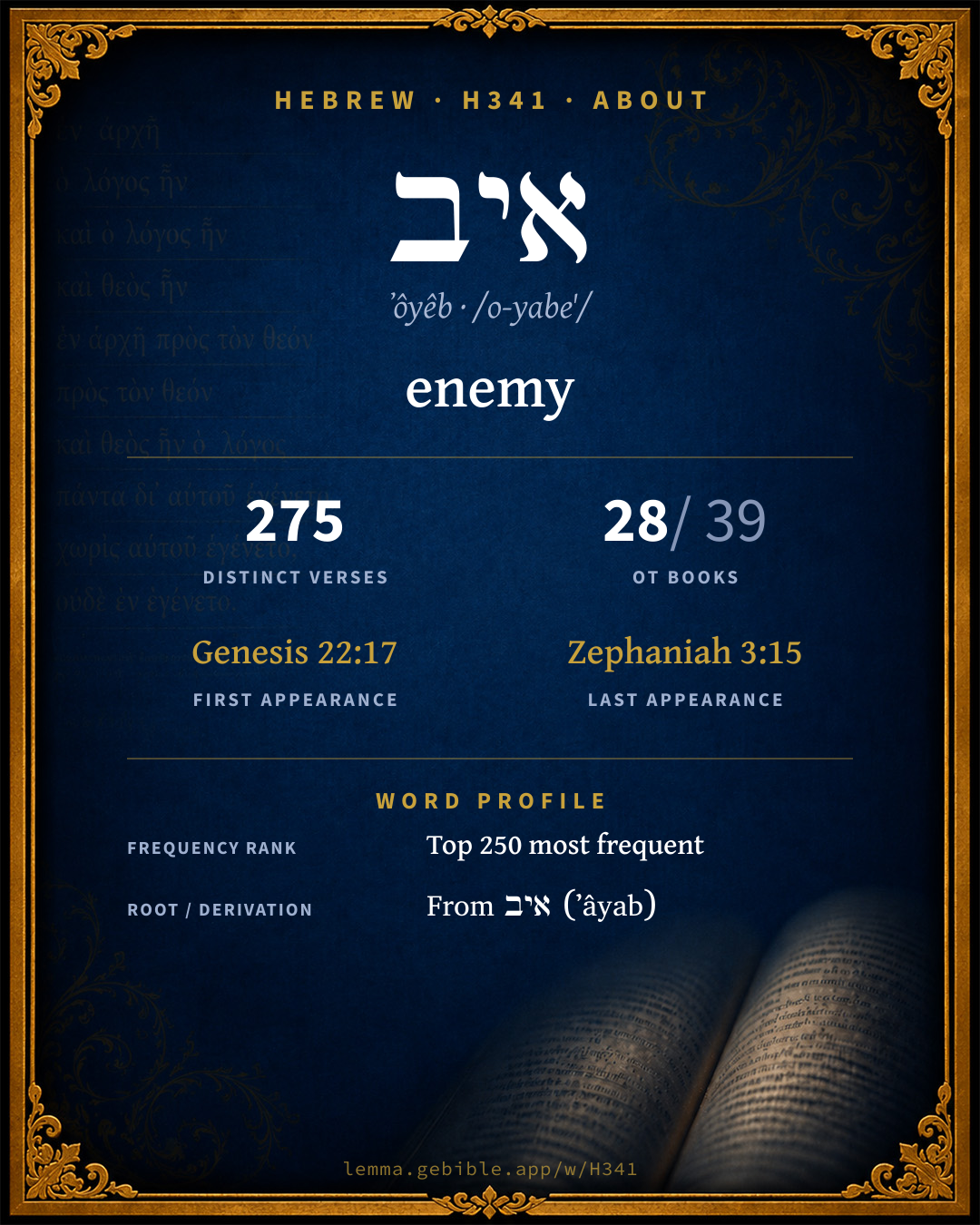
אָיַב
enemy
‘enemy’ is one of 3 main senses fuller range ↓
Full lexicon entry — Brown-Driver-Briggs (BDB)
From Brown-Driver-Briggs (BDB)
Where this word appears
Grammar key — what these labels mean
Part of speech
- Verb
- An action or state-of-being word.
Stem
- Qal
- The basic, simple active stem — the plain form of the verb (“he wrote”).
Form
- Participle Active
- A verbal adjective expressing ongoing or characteristic action (“writing / one who writes”).
State
- Construct
- A noun bound to a following noun in a possessive / “of” relationship (the construct chain).
- Absolute
- The independent form of a noun, not bound to a following word.
Gender
- Masculine
- Grammatically masculine.
- Feminine
- Grammatically feminine.
Number
- Plural
- More than one (in Hebrew, generally three or more).
- Singular
- One.
Every verse where H341 appears in the Book of Ezra — 2 distinct verses. Click any verse to open its interlinear word-by-word view. Verse text shown in the World English Bible for context — . Each verse’s Hebrew form is shown with its reference; the English is not keyword-highlighted, since the data carries no word-level English alignment. Use “Compare translations” on any verse to read it across multiple English versions. This concordance covers the Hebrew Bible; Septuagint (Greek Old Testament) occurrences are not indexed here.
Ezra
- Ezra 8:22 מֵ/אוֹיֵ֖ב prep + Qal ptcp.act ms For I was ashamed to ask of the king a band of soldiers and horsemen to help us against the enemy in the way, because we had spoken to the king, saying, The hand of our God is on all those who seek him, for good; but his power and his wrath is against all those who forsake him.
- Ezra 8:31 אוֹיֵ֛ב Qal ptcp.act ms Then we departed from the river Ahava on the twelfth [day] of the first month, to go to Jerusalem: and the hand of our God was on us, and he delivered us from the hand of the enemy and the bandit by the way.
About this entry
At a glance — auto-summarized from this page’s data, not written by a person. Every figure links to its source below. This summary describes the numbers; it doesn’t interpret them.
איב (ʼôyêb) is a Hebrew word most often rendered “enemy.” It first appears in Genesis 22:17. With 275 verses in 28 books, it is a common word in the Hebrew Bible. It concentrates in Psalms, which alone accounts for 27% of its uses. Not a single-sense word: explore its full sense range. The sections below give every sense, occurrence, and version rendering.
Gloss history
Strong's 1890 vs modern scholarship
About this word
Strong's H341 catalogs a Hebrew word from the Hebrew Old Testament.
These counts are not copied from any lexicon or concordance. They are computed here, from the morphology-tagged Hebrew Old Testament. What Lemma adds →
- 275
- distinct verses
- The word appears in 275 distinct verses.
- 28 / 39
- OT books
- The word appears in 28 of 39 Old Testament books.
- #175
- by frequency
- Top 250 most frequent Hebrew words (rank 175 of 8,640 Hebrew words by occurrence).
View all 275 occurrences in the concordance →
Most concentrated in
- Psalms 73 verses 27%
- Deuteronomy 25 verses 9%
- 1 Samuel 20 verses 7%
By section of the Old Testament
By traditional corpus
Conventional, traditional groupings — biblical authorship is debated, so this is a traditional corpus grouping, not an authorship claim. Each share is this word’s portion of its verses in that division of the Hebrew canon. Each figure is a share of the word’s 275 distinct verses.
- Writings (Ketuvim) 119 verses · 43%
- Prophets (Nevi'im) 103 verses · 37%
- Torah (Pentateuch) 53 verses · 19%
How translations render this word
Counts come from each version’s own published word-to-Strong’s tagging or interlinear alignment — an approximate guide to how each version renders this word, not a word-level alignment the data otherwise carries. Because each total is that version’s own tagged count, the per-version totals vary from one another and need not match the appearance or distinct-verse counts above. These counts may also differ from a printed concordance because Lemma counts each distinctly tagged rendering and does not collapse phrase taggings into a single head-word total. This is a fixed set of word-tagged versions (KJV, ASV, BSB, ULT) and does not change with the reading translation you choose elsewhere. Each version’s license is shown beside its name below (and on Sources).
- King James Version: Enemies 128×, Enemy 56×, All thine enemies 10×
- American Standard Version: Enemies 115×, Enemy 51×, All thine enemies 9×
- Berean Standard Bible: Enemies 178×, Enemy 63×, Foes 9×
- unfoldingWord Literal Text: Enemies 170×, Enemy 69×, Enemies of 11×
King James Version Public Domain
Renders H341 across 281 tagged occurrences — most commonly:
Plus other, less common renderings. Plus 56 renderings that appear only once — usually multi-word phrases or single function words the recovered tagging swept in, not distinct renderings. Not rendered by a distinct English word in 1 further occurrence.
American Standard Version Public Domain
Renders H341 across 281 tagged occurrences — most commonly:
Plus other, less common renderings. Plus 62 renderings that appear only once — usually multi-word phrases or single function words the recovered tagging swept in, not distinct renderings.
Berean Standard Bible Public Domain
Renders H341 across 279 tagged occurrences — most commonly:
Plus 17 renderings that appear only once — usually multi-word phrases or single function words the recovered tagging swept in, not distinct renderings. Not rendered by a distinct English word in 3 further occurrences.
unfoldingWord Literal Text CC BY-SA 4.0
Renders H341 across 284 tagged occurrences — most commonly:
Plus 13 renderings that appear only once — usually multi-word phrases or single function words the recovered tagging swept in, not distinct renderings.
Senses in the full BDB
What do BDB’s symbols mean?
BDB uses these scholarly abbreviations:
| Symbol | Meaning |
|---|---|
| 𝔊 | the Septuagint (the ancient Greek translation, LXX) |
| 𝔙 | the Vulgate (the Latin translation) |
| 𝔖 | the Syriac version (the Peshitta) |
| 𝔗 | the Targum (the Aramaic translation) |
| ψ | the Psalms |
| √ | root (the underlying root or stem) |
| ‖ | parallel passage (a synonymous or contrasted parallel) |
| † | the dagger: every passage where the word occurs is cited |
The 1 sense the full Brown-Driver-Briggs lexicon distinguishes for this word, in lexicon order (not ranked by frequency), with BDB’s own verbatim wording and sub-sense lettering. Shown in Hebrew script with BDB’s own scholarly abbreviations. The condensed entry is in the Lexicon Entry tab. See also the Forms in the corpus table below.
Qal
- Pf. †וְאָיַבְתִּ֫י Ex 23:22; Pt. אוֹיֵב (אֹיֵב) Ex 15:6 +; sf. (אוֹיְבִי) אֹיְבִי 2 S 22:18 = ψ 18:18 +; f. sf. אֹיַבְתִּי Mi 7:8, 10; אֹיִבְךָ Ex 23:4 +, etc.; pl. אוֹיְבִים ψ 68:24; 127:5; אֹיְבִים ψ 139:22, etc.;—be hostile to, treat as enemy Ex 23:22 (E, Cov’t code) וְאָיַבְתִּ֫י אֶת־אֹיְבֶיךָ וְצַרְתִּ֫י אֶת־צֹרְרֶיךָ (subj. י׳); elsewhere Pt. 1 S 18:29 וַיְהִי שָׁאוּל אֹיֵב אֶת־דָּוִד; usually as subst. & mostly sf.; enemy, of personal foe Ex 23:4 (E ‖ שֹׂנֵא v 5) Nu 35:23 (P) 1 S 19:17 (cf. 18:29) 24:5, 20 2 S 4:8 1 K 21:20 Jb 27:7 ψ 54:9; 55:13 (‖ מְשַׂנֵּא; opp. אַלּוּף, מְיֻדָּע v 14) Mi 2:8 Pr 16:7; 24:17 +; in sim. Je 30:14 (מַכַּת אוֹיֵב); of public national enemy, sg. Ju 16:23, 24; coll. Ex 15:6, 9 Dt 33:27 Na 3:11 2 Ch 6:24 +; personif. Mi 7:8, 10; more oft. pl. Ex 23:22 (E) Lv 26:7f (H) Nu 10:9 (P) Dt 1:42; 6:19 Je 15:9; 34:20, 21 +; of enemies of God, as protector of his people Nu 10:35 (J) Ju 5:31 1 S 30:26 2 S 18:19 ψ 66:3; 68:1, 22 Na 1:2, 8 Is 66:6 +; as morally supreme Jb 13:24; 33:10 ψ 37:20; 92:10(×2) +; of God as enemy of rebellious people Is 63:10, in sim. La 2:4, 5. e.g. Exodus 23:22
Senses from the full Brown-Driver-Briggs lexicon (Brown, Driver, Briggs; Oxford 1906 — public domain), digitized via Sefaria, supplemented by the OpenScriptures HebrewLexicon (CC BY 4.0). Full attribution on Sources.
Word origin
vb. be hostile to (Ass. aibu (v. DlW), enemy = אֹיֵב)—
— Brown-Driver-Briggs (Oxford 1906, public domain), digitized via Sefaria, supplemented by the OpenScriptures HebrewLexicon (CC BY 4.0). See Sources.
Derived from איב (ʼâyab) (H340) — to be hostile.
Jastrow Dictionary
A second Hebrew/Aramaic lexicon for comparison, covering Aramaic and post-biblical (Talmudic, Targumic, Midrashic) usage that the biblical-Hebrew BDB does not. Matched by lemma rather than by Strong’s number, so a lemma may carry more than one Jastrow headword (shown separately below), and the entries cover usage well beyond the Bible.
אֵיב
- v. אֵב
A Dictionary of the Targumim, the Talmud Babli and Yerushalmi, and the Midrashic Literature (Marcus Jastrow; London, Luzac, 1903) — Public Domain. Digitized via Sefaria. Digitized via Sefaria. Full attribution on Sources.
Forms in the corpus
The 178 distinct written forms H341 takes in the Hebrew Bible, most frequent first — each parse links to that stem’s occurrences in the concordance. Hebrew forms include their vowel points and cantillation, so a single lemma takes many written forms.
| Form | Parsing | Example | Uses |
|---|---|---|---|
| אוֹיֵֽב | Verb, Qal, Participle Active, Masculine, Singular, Absolute | Deuteronomy 32:42 | 10 |
| אֹֽיְבֵי/הֶ֔ם | Verb, Qal, Participle Active, Masculine, Plural, Construct | Jeremiah 19:7 | 7 |
| אֹיְבֵי/הֶ֖ם | Verb, Qal, Participle Active, Masculine, Plural, Construct | 1 Kings 8:48 | 6 |
| אֹיְבֶ֑י/ךָ | Verb, Qal, Participle Active, Masculine, Plural, Construct | Deuteronomy 21:10 | 6 |
| אֹיְבַ֣/י | Verb, Qal, Participle Active, Masculine, Plural, Construct | Psalms 3:7 | 6 |
| אֹיְבָֽי/ו | Verb, Qal, Participle Active, Masculine, Plural, Construct | Genesis 22:17 | 6 |
| אֹיְבֵי/כֶ֑ם | Verb, Qal, Participle Active, Masculine, Plural, Construct | Deuteronomy 20:3 | 5 |
| אֹיְבֵי/כֶֽם | Verb, Qal, Participle Active, Masculine, Plural, Construct | Deuteronomy 1:42 | 5 |
| אֹיְבָ֖י/ו | Verb, Qal, Participle Active, Masculine, Plural, Construct | 1 Samuel 14:30 | 5 |
| אוֹיֵ֑ב | Verb, Qal, Participle Active, Masculine, Singular, Absolute | 1 Kings 8:46 | 5 |
| אוֹיֵ֖ב | Verb, Qal, Participle Active, Masculine, Singular, Absolute | Deuteronomy 33:27 | 5 |
| אֹיְבֶ֨י/ךָ֙ | Verb, Qal, Participle Active, Masculine, Plural, Construct | Deuteronomy 23:14 | 4 |
| א֝וֹיֵ֗ב | Verb, Qal, Participle Active, Masculine, Singular, Absolute | Psalms 8:2 | 3 |
| אֹ֣יְבֵי/הֶ֔ם | Verb, Qal, Participle Active, Masculine, Plural, Construct | Esther 9:5 | 3 |
| אֹ֣יְבֶ֔י/ךָ | Verb, Qal, Participle Active, Masculine, Plural, Construct | Exodus 23:22 | 3 |
| אֹיְבִ֣/י | Verb, Qal, Participle Active, Masculine, Singular, Construct | Psalms 13:2 | 3 |
| אֹיְבֵ֥י | Verb, Qal, Participle Active, Masculine, Plural, Construct | 1 Samuel 20:16 | 3 |
| אֹיְבֵי/כֶ֛ם | Verb, Qal, Participle Active, Masculine, Plural, Construct | Deuteronomy 12:10 | 3 |
| אֹיְבֶ֔י/ךָ | Verb, Qal, Participle Active, Masculine, Plural, Construct | Deuteronomy 20:14 | 3 |
| אֹיְבֶ֖י/ךָ | Verb, Qal, Participle Active, Masculine, Plural, Construct | Deuteronomy 6:19 | 3 |
| אוֹיֵ֔ב | Verb, Qal, Participle Active, Masculine, Singular, Absolute | 2 Chronicles 25:8 | 3 |
| אוֹיֵ֣ב | Verb, Qal, Participle Active, Masculine, Singular, Absolute | Numbers 35:23 | 3 |
| לְ/אוֹיֵ֣ב | Verb, Qal, Participle Active, Masculine, Singular, Absolute | Job 13:24 | 3 |
| אֹ֣יְב֔/וֹ | Verb, Qal, Participle Active, Masculine, Singular, Construct | 1 Kings 8:44 | 2 |
| אֹֽיְבֵי/הֶ֑ם | Verb, Qal, Participle Active, Masculine, Plural, Construct | Ezekiel 39:27 | 2 |
| אֹֽיְבֵי/כֶ֔ם | Verb, Qal, Participle Active, Masculine, Plural, Construct | Joshua 10:19 | 2 |
| אֹֽיְבָ֔י/ו | Verb, Qal, Participle Active, Masculine, Plural, Construct | Jeremiah 44:30 | 2 |
| אֹיְב֖/וֹ | Verb, Qal, Participle Active, Masculine, Singular, Construct | 1 Kings 8:37 | 2 |
| אֹיְבֵ֣י | Verb, Qal, Participle Active, Masculine, Plural, Construct | 1 Samuel 20:15 | 2 |
| אֹיְבֵֽי/נוּ | Verb, Qal, Participle Active, Masculine, Plural, Construct | 1 Samuel 4:3 | 2 |
| אֹיְבֵי/הֶ֑ם | Verb, Qal, Participle Active, Masculine, Plural, Construct | Leviticus 26:36 | 2 |
| אֹיְבֵי/הֶֽם | Verb, Qal, Participle Active, Masculine, Plural, Construct | 2 Kings 21:14 | 2 |
| אֹיְבֵי/כֶ֖ם | Verb, Qal, Participle Active, Masculine, Plural, Construct | Deuteronomy 20:4 | 2 |
| אֹיְבֶ֗י/ךָ | Verb, Qal, Participle Active, Masculine, Plural, Construct | Deuteronomy 20:1 | 2 |
| אֹיְבֶֽי/ךָ | Verb, Qal, Participle Active, Masculine, Plural, Construct | Psalms 66:3 | 2 |
| אֹיְבַ֥/י | Verb, Qal, Participle Active, Masculine, Plural, Construct | Lamentations 3:52 | 2 |
| אֹיִבְ/ךָ֖ | Verb, Qal, Participle Active, Masculine, Singular, Construct | Deuteronomy 28:55 | 2 |
| אֹיַ֨בְתִּ/י֙ | Verb, Qal, Participle Active, Feminine, Singular, Construct | Micah 7:8 | 2 |
| אוֹיְבֵ֥י | Verb, Qal, Participle Active, Masculine, Plural, Construct | 2 Chronicles 20:29 | 2 |
| אוֹיְבֵֽי/נוּ | Verb, Qal, Participle Active, Masculine, Plural, Construct | Judges 16:23 | 2 |
| אוֹיְבַ֣/י | Verb, Qal, Participle Active, Masculine, Plural, Construct | Psalms 56:9 | 2 |
| אוֹיְבַ֥/י | Verb, Qal, Participle Active, Masculine, Plural, Construct | Psalms 9:3 | 2 |
| אוֹיְבָ֖י/ו | Verb, Qal, Participle Active, Masculine, Plural, Construct | 1 Chronicles 22:9 | 2 |
| אוֹיֵ֛ב | Verb, Qal, Participle Active, Masculine, Singular, Absolute | Exodus 15:9 | 2 |
| אוֹיֵ֨ב | Verb, Qal, Participle Active, Masculine, Singular, Absolute | Psalms 7:5 | 2 |
| וְ/אוֹיֵ֔ב | Verb, Qal, Participle Active, Masculine, Singular, Absolute | Esther 7:6 | 2 |
| לְ/אֹ֣יְבַ֔יִ/ךְ | Verb, Qal, Participle Active, Masculine, Plural, Construct | Isaiah 62:8 | 2 |
| לְ/אֹיְבָֽי/ו | Verb, Qal, Participle Active, Masculine, Plural, Construct | Isaiah 66:6 | 2 |
| מֵ/אֹיְבַ֥/י | Verb, Qal, Participle Active, Masculine, Plural, Construct | Psalms 59:1 | 2 |
| א֝וֹיְבֵי/הֶ֗ם | Verb, Qal, Participle Active, Masculine, Plural, Construct | Psalms 78:53 | 1 |
| א֝וֹיְבַ֗/י | Verb, Qal, Participle Active, Masculine, Plural, Construct | Psalms 31:15 | 1 |
| א֝וֹיְבָ֗י/ו | Verb, Qal, Participle Active, Masculine, Plural, Construct | Proverbs 16:7 | 1 |
| א֣וֹיְבֵ֔/נוּ | Verb, Qal, Participle Active, Masculine, Singular, Construct | Judges 16:24 | 1 |
| א֣וֹיְבֵ֔י/נוּ | Verb, Qal, Participle Active, Masculine, Plural, Construct | Nehemiah 6:16 | 1 |
| א֣וֹיְבַ֔/י | Verb, Qal, Participle Active, Masculine, Plural, Construct | 1 Samuel 2:1 | 1 |
| א֣וֹיְבַ֔יִ/ךְ | Verb, Qal, Participle Active, Masculine, Plural, Construct | Lamentations 2:16 | 1 |
| א֣וֹיְבָ֔י/ו | Verb, Qal, Participle Active, Masculine, Plural, Construct | 2 Chronicles 6:34 | 1 |
| א֭וֹיְבֶי/ךָ | Verb, Qal, Participle Active, Masculine, Plural, Construct | Psalms 83:2 | 1 |
| א֭וֹיְבַ/י | Verb, Qal, Participle Active, Masculine, Plural, Construct | Psalms 18:37 | 1 |
| א֭וֹיְבָי/ו | Verb, Qal, Participle Active, Masculine, Plural, Construct | Psalms 132:18 | 1 |
The 60 most common forms are shown; 118 rarer forms follow in the full concordance.
Same root — word family
Other BDB entries built from the same root as H341, grouped by Strong’s listed origin. These share a root / origin per the lexicon — not necessarily a shared meaning. Each links to that word’s own entry.
Derives from
Shares the same root
Proper names from this root
People and places named from this root — a name, not an additional meaning of the word.
Compare all same-root words → 1 of the same-root words is a proper name (a person or place). They share a root, not necessarily a meaning.
Septuagint verse parallels
This word appears in 243 verses that also exist in the Greek Old Testament (Septuagint), out of the 275 Hebrew verses it occurs in. You can read those verses in Greek by switching the Old Testament edition to the Septuagint.
Read these verses in the Septuagint
- Genesis 22:17
- Exodus 15:6
- Leviticus 26:7
- Numbers 10:9
- Deuteronomy 1:42
- Joshua 7:8
- Judges 2:14
- 1 Samuel 2:1
- 2 Samuel 3:18
- 1 Kings 3:11
- 2 Kings 17:39
- 1 Chronicles 14:11
This is a verse-level parallel only — the same verses exist in both the Hebrew and Greek Old Testaments. No word-level Hebrew↔Greek correspondence is claimed: the data carries no such alignment, so no Greek word is shown as this Hebrew word’s translation. Coverage is not total — the Septuagint omits the deuterocanon and renumbers the Psalms, so some Hebrew verses have no direct Greek parallel.