
1 Samuel 24:19

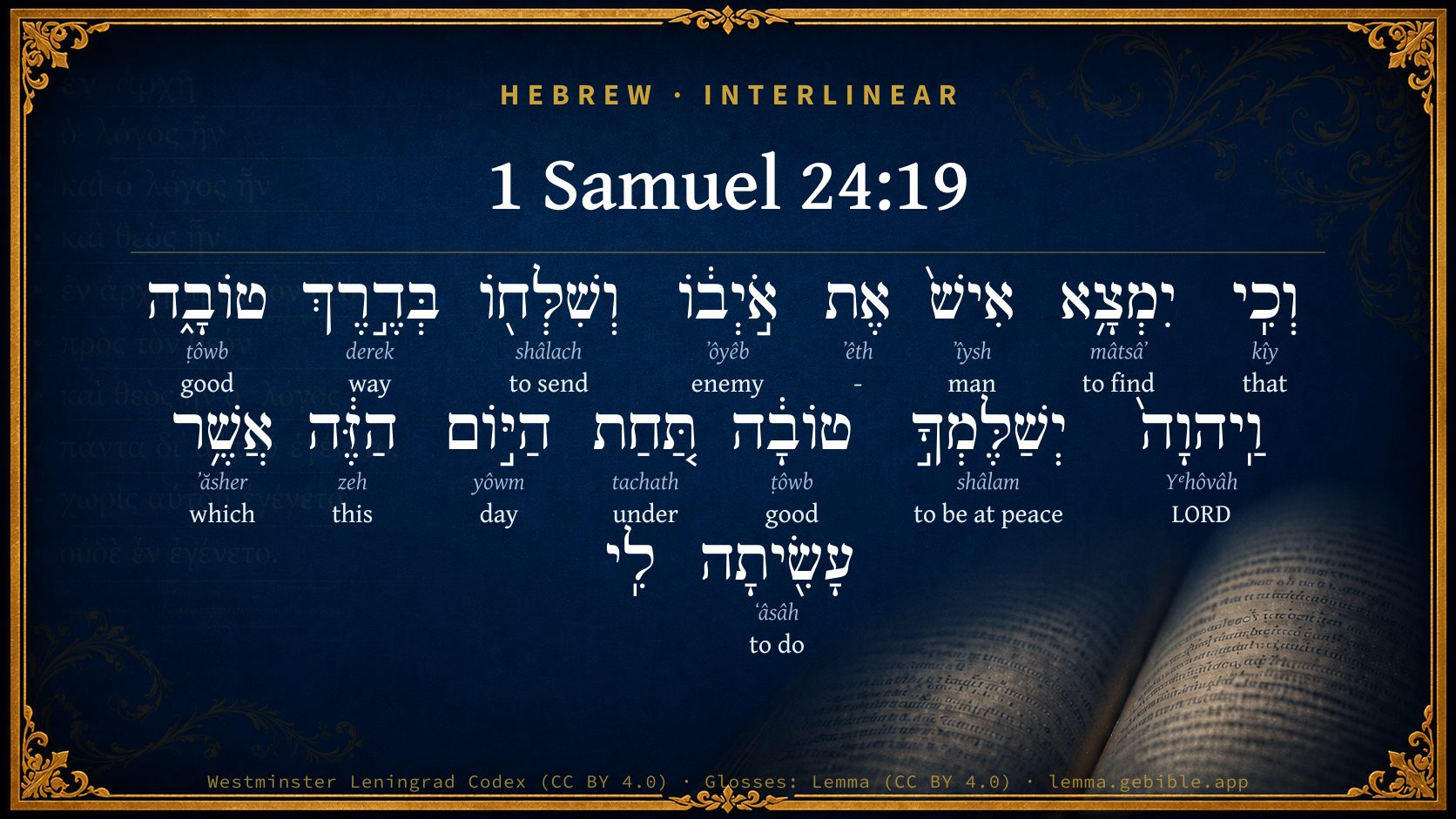
Hebrew (Westminster Leningrad Codex) 1 Samuel 24:19 appears in the Hebrew Old Testament. The text above is from the Westminster Leningrad Codex. Each word links to its Strong’s number, a concise gloss, and parsing drawn from the Open Scriptures Hebrew Bible morphology. Click any word for its full Brown-Driver-Briggs (BDB) entry.
Download image
Cite this verse

1 Samuel 24:19 (World English Bible). Public Domain. Lemma interlinear Bible study tool, https://lemma.gebible.app/v/1-samuel/24/19.

Show BibTeX & RIS
BibTeX
RIS
English Translation
For if a man finds his enemy, will he let him go away unharmed? Therefore may Yahweh reward you good for that which you have done to me this day.
World English Bible · Public Domain
Download a study sheet

One document with this verse’s original text, its word-by-word gloss line, the meaning frame, cross-references with their text, attributed commentary, and full source and license credits — printable, and it pastes into notes with its structure intact.

This verse Autodidact and up

Study sheet (.html) Plain text (.txt)

A passage Seminary Student

Up to 50 verses in one chapter. A passage sheet keeps up to 6 commentary sources and 12 cross-references per verse, in the order this page ranks them, and says so on the sheet whenever that leaves anything out. Ask for a single verse and you get the Autodidact verse sheet above.

Everything on this page stays free to read, with no account — the sheet is a download of what is already on screen, not access to it.

Want to remove ads? Support Godless Engineer
Compare translations 3

The same verse in 3 English versions, stacked beneath the original-language interlinear above. Click any original word for its lexicon entry.

Each is an independent rendering of the whole verse — the interlinear is not word-aligned to these translations.

Highlighted words mark where these versions differ — a whole-verse word diff, not a word-by-word alignment.

  • World English Bible Public Domain
    For if a man finds his enemy, will he let him go away unharmed? Therefore may Yahweh reward you good for that which you have done to me this day.
  • King James Version Public Domain
    For if a man find his enemy, will he let him go well away? wherefore the LORD reward thee good for that thou hast done unto me this day.
  • unfoldingWord Literal Text CC BY-SA 4.0
    Now if a man finds his enemy, will he send him on a good way? So may Yahweh repay you good for what you have done for me this day.

unfoldingWord Literal Text — © unfoldingWord, licensed CC BY-SA 4.0. Word-aligned USFM3 via Door43 (git.door43.org/unfoldingWord/en_ult).

Versions to compare (up to 4)

3 of 4 selected

Show all 18 translations

Every available English version of this verse, each an independent rendering of the whole verse.

  • World English Bible Public Domain
    For if a man finds his enemy, will he let him go away unharmed? Therefore may Yahweh reward you good for that which you have done to me this day.
  • Berean Standard Bible Public Domain
    When a man finds his enemy, does he let him go away unharmed? May the LORD reward you with good for what you have done for me this day.
  • Majority Standard Bible Public Domain
    When a man finds his enemy, does he let him go away unharmed? May the LORD reward you with good for what you have done for me this day.
  • King James Version Public Domain
    For if a man find his enemy, will he let him go well away? wherefore the LORD reward thee good for that thou hast done unto me this day.
  • American Standard Version (1901) Public Domain
    For if a man find his enemy, will he let him go well away? wherefore Jehovah reward thee good for that which thou hast done unto me this day.
  • Revised Version (1885) Public Domain
    For if a man find his enemy, will he let him go well away? wherefore the LORD reward thee good for that thou hast done unto me this day.
  • Geneva Bible (1599) Public Domain
    And thou hast shewed this day, that thou hast dealt well with me: forasmuch as when the Lord had closed me in thine hands, thou killedst me not.
  • Douay-Rheims (1899) Public Domain
    And thou hast shewn this day what good things thou hast done to me: how the Lord delivered me into thy hand, and thou hast not killed me.
  • Young's Literal Translation Public Domain
    and that a man doth find his enemy, and hath sent him away in a good manner; and Jehovah doth repay thee good for that which thou didst to me this day.
  • Literal Standard Version CC BY-SA 4.0
    and that a man finds his enemy, and has sent him away in a good manner; and YHWH repays you good for that which you did to me this day.
  • Unlocked Literal Bible CC BY-SA 4.0
    For if a man finds his enemy, will he let him go safely? May Yahweh reward you with good for what you have done to me today.
  • unfoldingWord Literal Text CC BY-SA 4.0
    Now if a man finds his enemy, will he send him on a good way? So may Yahweh repay you good for what you have done for me this day.
  • Darby Bible Public Domain
    For if a man find his enemy, will he let him go well away? wherefore Jehovah reward thee good for that thou hast done to me this day.
  • World Messianic Bible Public Domain
    For if a man finds his enemy, will he let him go away unharmed? Therefore may the LORD reward you good for that which you have done to me today.
  • Webster's Bible Public Domain
    \\24:18\\And thou hast showed this day how thou hast dealt with me; forasmuch as when the LORD had delivered me into thy hand, thou didst not kill me.
  • Free Bible Version CC BY-SA 4.0
    For if a man caught hold of his enemy, would he let him escape unharmed? The Lord reward you well for how you've treated me today.
  • Bible in Basic English Public Domain
    And you have made clear to me how good you have been to me today: because, when the Lord gave me up into your hands, you did not put me to death.
  • JPS Tanakh (1917) Public Domain
    (24-20) For if a man find his enemy, will he let him go well away? wherefore the LORD reward thee good for that which thou hast done unto me this day.

Literal Standard Version (2020), Covenant Press — licensed CC BY-SA 4.0. Text via the HelloAO Bible API (eBible.org). Unlocked Literal Bible (unfoldingWord) — licensed CC BY-SA 4.0. Text via the HelloAO Bible API (eBible.org). unfoldingWord Literal Text — © unfoldingWord, licensed CC BY-SA 4.0. Word-aligned USFM3 via Door43 (git.door43.org/unfoldingWord/en_ult). Free Bible Version, Dr. Jonathan Gallagher — licensed CC BY-SA 4.0. Text via the HelloAO Bible API (eBible.org).

Word by word

More ways to search: Search by grammar → Find every occurrence → Compare this word →

Practice this passage: Drill this verse → Learn its vocabulary →

יְשַׁלֶּמְךָ֣
shâlam
H7999
“to be at peace · you”
Verb, Piel, Imperfect, 3rd Person, Masculine, Singular + Suffix, Personal, 2nd Person, Masculine, Singular
Part of Speech
Verb
Stem
Piel
Form
Imperfect
Person
3rd Person
Gender
Masculine
Number
Singular
Full BDB Definition

Origin: a primitive root

TWOT: 2401c

to be in a covenant of peace, be at peace - (Qal) - to be at peace - peaceful one (participle) - (Pual) one in covenant of peace (participle) - (Hiphil) - to make peace with - to cause to be at peace - (Hophal) to live in peace - to be complete, be sound - (Qal) - to be complete, be finished, be ended - to be sound, be uninjured - (Piel) - to complete, finish - to make safe - to make whole or good, restore, make compensation - to make good, pay - to requite, recompense, reward - (Pual) - to be performed - to be repaid, be requited - (Hiphil) - to complete, perform - to make an end of
  1. וְכִֽי kîy H3588 “and · that” Conjunction + Conjunction
  2. יִמְצָ֥א mâtsâʼ H4672 “to find” Verb, Qal, Imperfect, 3rd Person, Masculine, Singular
  3. אִישׁ֙ ʼîysh H376 “man” Noun, Common, Masculine, Singular, Absolute
  4. אֶת ʼêth H853 “-” Particle, Direct Object
  5. אֹ֣יְב֔וֹ ʼôyêb H341 “enemy · him” Verb, Qal, Participle Active, Masculine, Singular, Construct + Suffix, Personal, 3rd Person, Masculine, Singular
  6. וְשִׁלְּח֖וֹ shâlach H7971 “and · to send · him” Conjunction + Verb, Piel, Sequential Perfect, 3rd Person, Masculine, Singular + Suffix, Personal, 3rd Person, Masculine, Singular
  7. בְּדֶ֣רֶךְ derek H1870 “in/at · way” Preposition + Noun, Common, Both, Singular, Absolute
  8. טוֹבָ֑ה ṭôwb H2896 “good” Adjective, Adjective, Feminine, Singular, Absolute
  9. וַֽיהוָה֙ Yᵉhôvâh H3068 “and · LORD” Conjunction + Noun, Proper
  10. טוֹבָ֔ה ṭôwb H2896 “good” Adjective, Adjective, Feminine, Singular, Absolute
  11. תַּ֚חַת tachath H8478 “under” Preposition
  12. הַיּ֣וֹם yôwm H3117 “the · day” Particle, Definite Article + Noun, Common, Masculine, Singular, Absolute
  13. הַזֶּ֔ה zeh H2088 “the · this” Particle, Definite Article + Pronoun, Demonstrative, Masculine, Singular
  14. אֲשֶׁ֥ר ʼăsher H834 “which” Particle, Relative
  15. עָשִׂ֖יתָה ʻâsâh H6213 “to do” Verb, Qal, Perfect, 2nd Person, Masculine, Singular

About this verse

These counts appear in no published source. They are computed here, from the morphology-tagged text and Lemma’s own curated glosses. What Lemma adds →

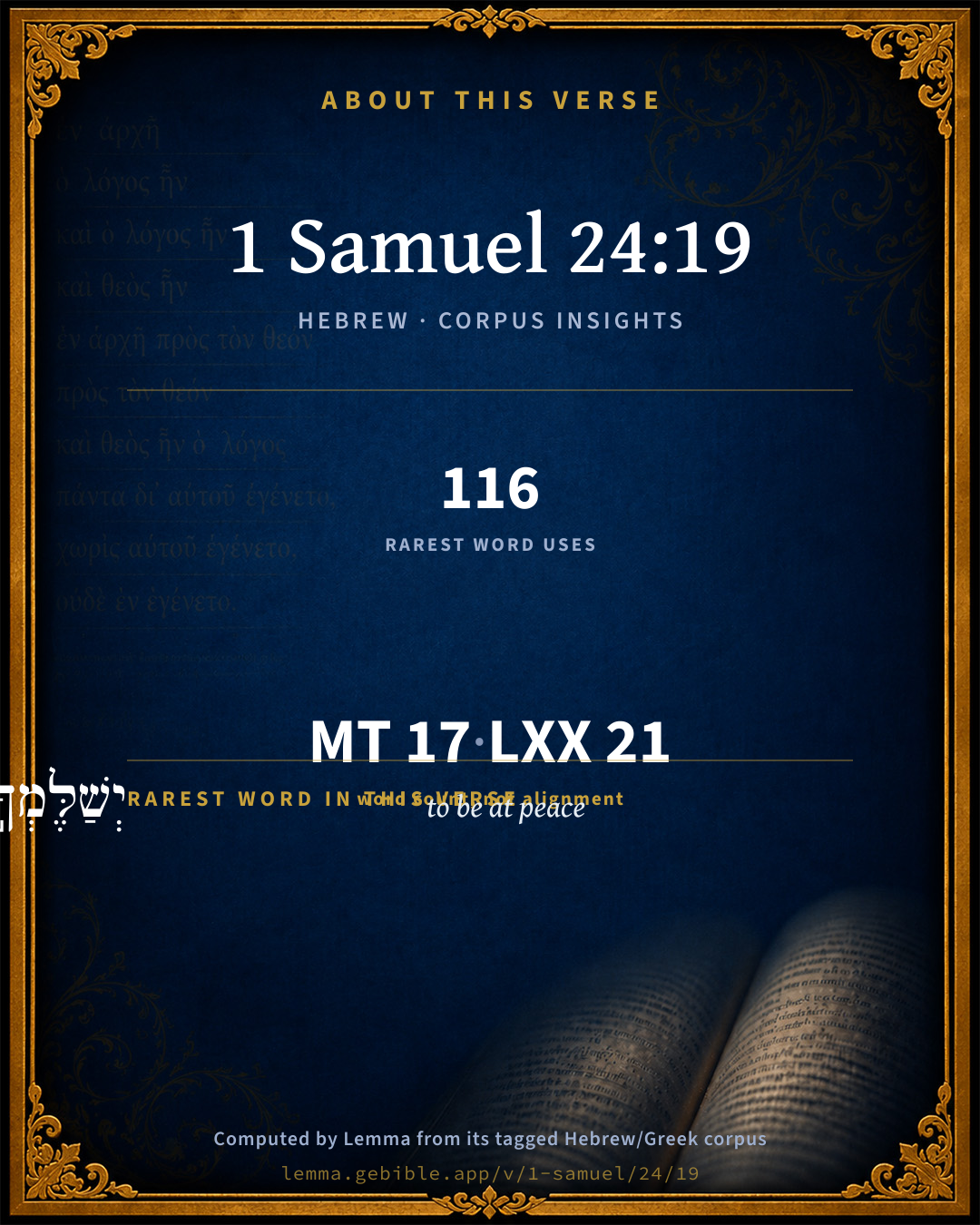
17
words
15
distinct lemmas
Historical
section

Grammatical profile

  • 5 verbs
  • 4 nouns
  • 2 adjectives
  • 1 pronoun
  • 2 prepositions
  • 1 conjunction
  • 2 particles

Verb forms

  • יִמְצָ֥א Qal · Imperfect
  • אֹ֣יְב֔וֹ Qal · Participle Active
  • וְשִׁלְּח֖וֹ Piel · Sequential Perfect
  • יְשַׁלֶּמְךָ֣ Piel · Imperfect
  • עָשִׂ֖יתָה Qal · Perfect

Repetition

A word recurs within this verse — often emphatic in Hebrew:

  • טוֹבָ֑ה good H2896 ×2

Hebrew & Septuagint length

In English translation the verse runs 30 words from the Hebrew and 28 from the Septuagint (LXX English) — closely comparable.

A rough comparison of the two English renderings, which tokenize alike — not a word-level alignment.

Word counts can differ between the Hebrew and the Greek without any difference in meaning — e.g. the Hebrew direct-object marker אֵת has no separate Greek word, and Greek often adds the article ὁ.

In the original languages it is 17 Hebrew tokens and 21 Greek tokens — but the two are counted differently (Hebrew bundles its prefixes and suffixes into one token; the Greek is in lemma form), so that isn’t a like-for-like length.

Cross-references

5

Topical passages linked to 1 Samuel 24:19 in the Treasury of Scripture Knowledge — connected by theme and wording, ordered by reader-vote popularity; previews shown in the World English Bible.

  • Judges 17:2 He said to his mother, The eleven hundred [pieces] of silver that were taken from you, about which you did utter a curse, and did also speak it in my ears, behold, the silver is with me; I took it. His mother said, Blessed be my son of Yahweh.
  • 1 Samuel 23:21 Saul said, Blessed be you of Yahweh; for you have had compassion on me.
  • 1 Samuel 26:25 Then Saul said to David, Blessed be you, my son David: you shall both do mightily, and shall surely prevail. So David went his way, and Saul returned to his place.
  • Psalms 18:20 Yahweh has rewarded me according to my righteousness. According to the cleanness of my hands has he recompensed me.
  • Proverbs 25:21–22 If your enemy is hungry, give him food to eat; If he is thirsty, give him water to drink:

Cross-references courtesy of OpenBible.info (CC BY 4.0).

Hebrew and Greek witnesses Masoretic Hebrew ↔ Greek Septuagint

The same verse in the two great witnesses to the Old Testament, shown verse-for-verse.

These are two independent witnesses, not word-aligned to each other, and the Septuagint is shown in lemma (dictionary) form.

Hebrew 1 Samuel 24:19 Masoretic · Westminster Leningrad Codex

וְכִֽי יִמְצָ֥א אִישׁ֙ אֶת אֹ֣יְב֔וֹ וְשִׁלְּח֖וֹ בְּדֶ֣רֶךְ טוֹבָ֑ה וַֽיהוָה֙ יְשַׁלֶּמְךָ֣ טוֹבָ֔ה תַּ֚חַת הַיּ֣וֹם הַזֶּ֔ה אֲשֶׁ֥ר עָשִׂ֖יתָה לִֽי

For if a man finds his enemy, will he let him go away unharmed? Therefore may Yahweh reward you good for that which you have done to me this day.

World English Bible · Public Domain

Greek LXX 1 Samuel 24:19 Septuagint · lemma form

καί σύ ἀποἀγγέλλω ἐγώ σήμερον ὅς ποιέω ἐγώ ἀγαθός ὡς ἀποκλείω ἐγώ κύριος σήμερον εἰς χείρ σύ καί οὐ ἀποκτείνω ἐγώ

And you have told me today what good you have done me, how the Lord shut me up into your hands today, and you did not kill me.

LXX2012 (modern English Septuagint) · Public Domain

On this verse, Adam Clarke's Commentary discusses the Septuagint’s reading. Read the note in Commentary ↓

Hebrew: Westminster Leningrad Codex (CC BY 4.0). Greek: Septuagint (public domain); English from LXX2012 (modern English Septuagint) (Public Domain). How the Septuagint differs from the Hebrew →

Targum (Aramaic paraphrase)

1

The Targum is the ancient Jewish Aramaic paraphrase of the Hebrew Scriptures — an interpretive translation, not the Hebrew text itself. Onkelos (literal) and Pseudo-Jonathan (expansive) render the Torah, and Jonathan the Prophets. Coverage is partial: where no permissively-licensed English translation exists for a verse, only the Aramaic is shown. This is verse-level text, not a word-by-word alignment to the Hebrew.

  1. Targum Jonathan Prophets (Joshua–Malachi)
    וְאַתְּ חֲוֵיתָא יוֹמָא דֵין יַת דַעֲבַדְתָּ עִמִי טִיבוּ וְיַת דְמַסְרַנִי יְיָ בִּידָךְ וְלָא קְטַלְתָּנִי:

    (no public-domain English translation for this verse)

    Targum Jonathan — Aramaic: “Mikraot Gedolot” (public domain). English: “Sefaria Community Translation” (CC0 1.0 (public-domain dedication)); “London "Chaldee Paraphrase," 1871” (public domain). Text via Sefaria.

Commentary

Notes on 1 Samuel 24:19 from classic Christian and Jewish commentators (each source and its license shown beneath its notes). The classic Christian expositions comment on the surrounding passage and are grouped to its opening verse, so a note may address several verses; the Jewish commentaries on the Tanakh (Rashi and others) are per-verse, so they appear only where the commentator wrote on this verse.

Lemma curates 59 commentaries, every one of them public domain or Creative Commons licensed, each selected and text-cleaned for this edition rather than reprinted as found. About our sources →

Trapp's Complete Commentary

John Trapp

1Sa 24:19 For if a man find his enemy, will he let him go well away? wherefore the LORD reward thee good for that thou hast done unto me this day.

Ver. 19. For if a man find his enemy; will he let him go well away?] Not likely, unless he be more than a natural man; for we are all revengeful enough. Aristotle thinketh revenge lawful. Mohammed’s laws run thus - Avenge yourselves of your enemies; marry as many wives as you can maintain; kill the infidels, &c. But we have not so learned Christ. God giveth more grace, &c.

For that thou hast done unto me this day.] Thou hast given me my life, which is more to me than my kingdom. Therefore David, though but a subject, was herein greater than King Saul; Nil enim ira magnum et magnanimum facit, {a} for nothing showeth more a magnanimous man, than to love an enemy, and to pardon injuries.

{a} A. Lap.

John Trapp, A Commentary or Exposition upon All the Books of the Old and New Testament (1647–1656) — public domain. Text from a community e-Sword module.

Adam Clarke's Commentary

Verse 19. If a man find his enemy, will he let him go well away?] Or rather, Will he send him in a good way? But Houbigant translates the whole clause thus: Si quis, inimicum suum reperiens, dimittit eum in viam bonam, redditur ei adomino sua merces; "If a man, finding his enemy, send him by a good way, the Lord will give him his reward." The words which are here put in italic, are not in the Hebrew text, but they are found, at least in the sense, in the Septuagint, Syriac, and Arabic, and seem necessary to complete the sense; therefore, adds Saul, the Lord will reward thee good for what thou hast done unto me.

Adam Clarke's Commentary on the Bible (1810–1826) — public domain. Text from a community e-Sword/MySword module.

The Cambridge Bible for Schools and Colleges

gen. ed. J. J. S. Perowne

19. find his enemy] Get him into his power. Cp. 1Sa_23:17; Psa_21:8.

will he let him go well away] A negative answer is of course to be supplied. “No: yet thou hast done so to me: wherefore, &c.”

The Cambridge Bible for Schools and Colleges (gen. ed. J. J. S. Perowne; Cambridge University Press, 1878–1918) — public domain. Text from a community e-Sword module.

John Gill's Exposition

For if a man find his enemy, will he let him go well away?.... Or "in a good way" (e), in peace and safety, without doing him any hurt; this is not usual among men, and yet this was the present case; David had found his enemy Saul, which Saul tacitly owns, and yet had let him go well away from him, without hurting him:

wherefore the Lord reward thee good for that thou hast done unto me this day; he does not promise to reward him himself, but prays the Lord to reward him; and had he been sincere in it, he could not have done better for him. Some connect the former clause with this, after this manner, "if a man find his enemy, and let him go away, the Lord will reward him, the Lord reward thee", &c. so the Syriac and Arabic versions.

(e) "in via bona", Pagninus, Montanus.

John Gill's Exposition of the Whole Bible (1746–1763) — public domain (CC PDM 1.0). Text via the HelloAO Bible API.

Matthew Poole's English Annotations

Will he let him go well away? i. e. he will certainly destroy him. And therefore thou hast not dealt with me after the manner of men, but hast imitated the clemency of God in this act.

Matthew Poole's English Annotations on the Holy Bible (1683–1685) — public domain. Text from a community e-Sword/MySword module.

The Pulpit Commentary

Will he let him go well away? Hebrew, "will he let him go on a good way?" i.e. will he let him go on his way in peace, unhurt? As David, nevertheless, had let his enemy go unharmed, Saul, touched momentarily by his generosity, prays that Jehovah will reward him for what he had done.

The Pulpit Commentary (1880–1919), ed. H.D.M. Spence-Jones & Joseph S. Exell — public domain. Text from a community e-Sword module.

John Wesley's Explanatory Notes

The Lord reward thee - Because he thought himself not able to recompense so great a favour, he prays God to recompense it.

John Wesley, Explanatory Notes Upon the Whole Bible (1754–1765) — public domain. Text via the GEBible commentary corpus.

Keil & Delitzsch

C. F. Keil & F. Delitzsch

"If a man meet with his enemy, will he send him (let him go) in peace?" This sentence is to be regarded as a question, which requires a negative reply, and expresses the thought: When a man meets with an enemy, he does not generally let him escape without injury. But thou hast acted very differently towards me. This thought is easily supplied from the context, and what follows attaches itself to this: "The Lord repay thee good for what thou hast done to me this day."

Keil & Delitzsch — Biblical Commentary on the Old Testament (1861–1891) — public domain (CC PDM 1.0). Text via the HelloAO Bible API. (Old Testament only.)

unfoldingWord translationNotes

Door43 World Missions Community

For if a man finds his enemy, will he let him go safely?

A rhetorical question with the answer included in the question. AT: "For if a man finds his enemy, he will not let him go safely." (See: Rhetorical Question)

For if a man finds his enemy, will he let him go safely?

Where Saul had believed David was his enemy, he learns that even though David will be king, David will not take over the throne from Saul by force, but will wait for Yahweh's appointed time.

the kingdom of Israel will be established in your hand

This can be stated in active form. Possible meanings are 1) David will cause the kingdom of Israel to prosper through his power as king. AT: "the kingdom of Israel will prosper as you rule the Israelite people" or 2) Yahweh will cause David to have complete control over the kingdom of Israel. AT: "you will have complete rule over the kingdom of Israel" (See: Active or Passive)

in your hand

The word "hand" is a metonym that represents power or control. (See: Metonymy)

translationWords

adversary

Yahweh

reward

king

kingdom of Israel

hand

unfoldingWord translationNotes — © Distant Shores Media and the Door43 World Missions Community, licensed CC BY-SA 4.0. Source: git.door43.org/Door43/en_tn.

Lesson kit

Teaching starters — assembled from the data on this page, not authored interpretation. Every prompt links to the verse data it draws on. Edit before teaching.

1 Samuel, in the Historical, opens this verse with 17 words (15 distinct Hebrew lemmas). Its most distinctive word is shâlam (“to be at peace”). A historical commentator’s framing appears above. Read the whole chapter for the surrounding context.

Discussion questions

  1. How does “to be at peace” (shâlam) shape what this verse is saying?
  2. Judges 17:2 shares this passage’s theme. How do the two illuminate each other?
  3. “good” occurs 2× in this one verse. What is the effect of the repetition?
  4. The translations on this page render this verse differently — a whole-verse word diff, not a word-by-word alignment. What might account for the different wordings?
  5. The verb «יִמְצָ֥א» is Qal Imperfect. How does its form color the action?
  6. Reading how Trapp's Complete Commentary and Adam Clarke's Commentary read this verse, where do the two commentators agree and where do they part?

Things to notice

Reading settings

Reading text

Shown beneath each verse's original-language words.

Old Testament
Old Testament edition

Read the OT as the Masoretic Hebrew (MT) or the Greek Septuagint (LXX).

English shown for the Greek Septuagint (in the Hebrew ↔ Greek comparison).

Comparing translations? Open the Compare panel on any verse page to stack up to four side by side.