
1 Chronicles 22:9

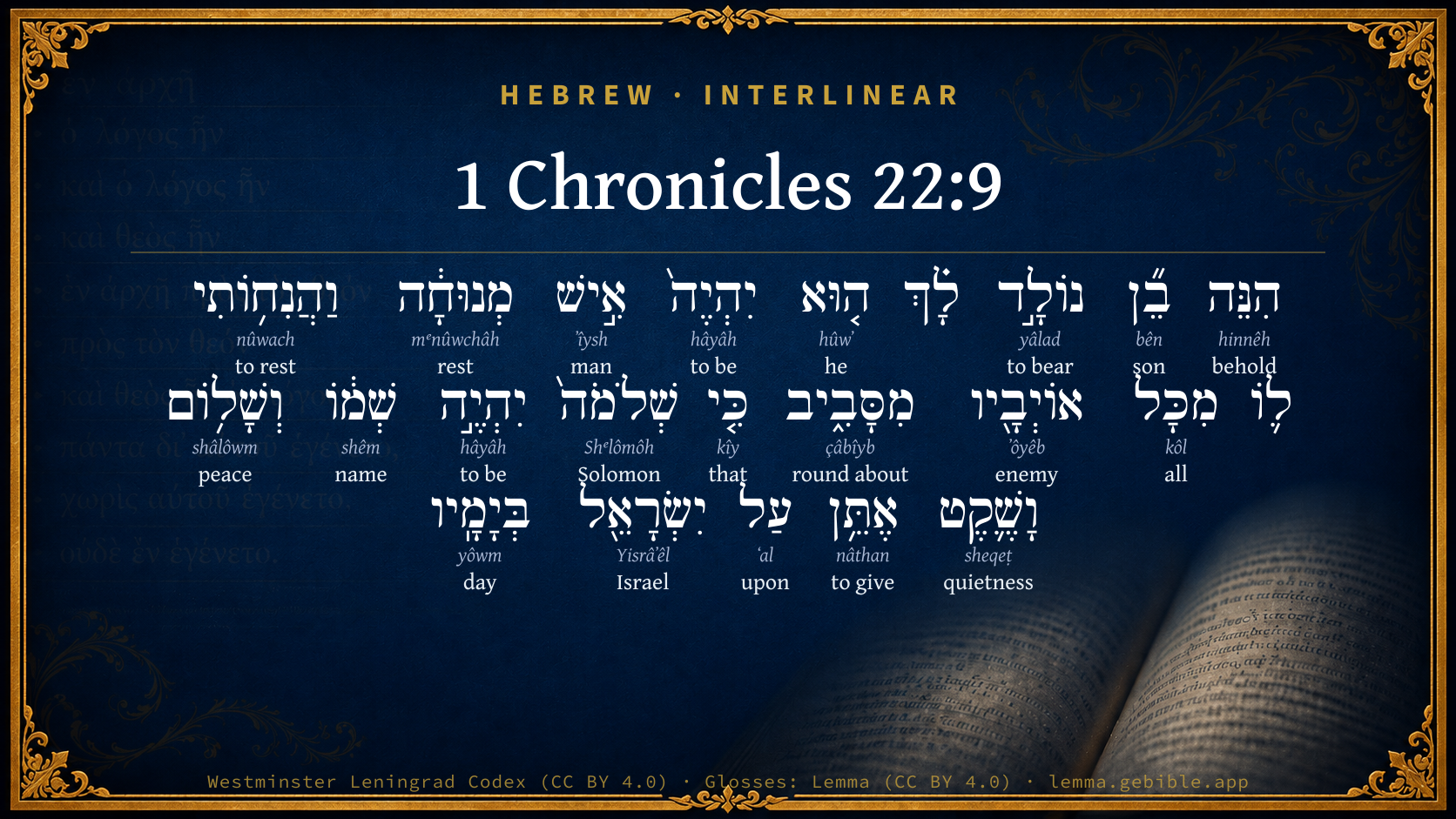
Hebrew (Westminster Leningrad Codex) 1 Chronicles 22:9 appears in the Hebrew Old Testament. The text above is from the Westminster Leningrad Codex. Each word links to its Strong’s number, a concise gloss, and parsing drawn from the Open Scriptures Hebrew Bible morphology. Click any word for its full Brown-Driver-Briggs (BDB) entry.
Download image
Cite this verse

1 Chronicles 22:9 (World English Bible). Public Domain. Lemma interlinear Bible study tool, https://lemma.gebible.app/v/1-chronicles/22/9.

Show BibTeX & RIS
BibTeX
RIS
English Translation
Behold, a son shall be born to you, who shall be a man of rest; and I will give him rest from all his enemies round about; for his name shall be Solomon, and I will give peace and quietness to Israel in his days:
World English Bible · Public Domain
Highlights
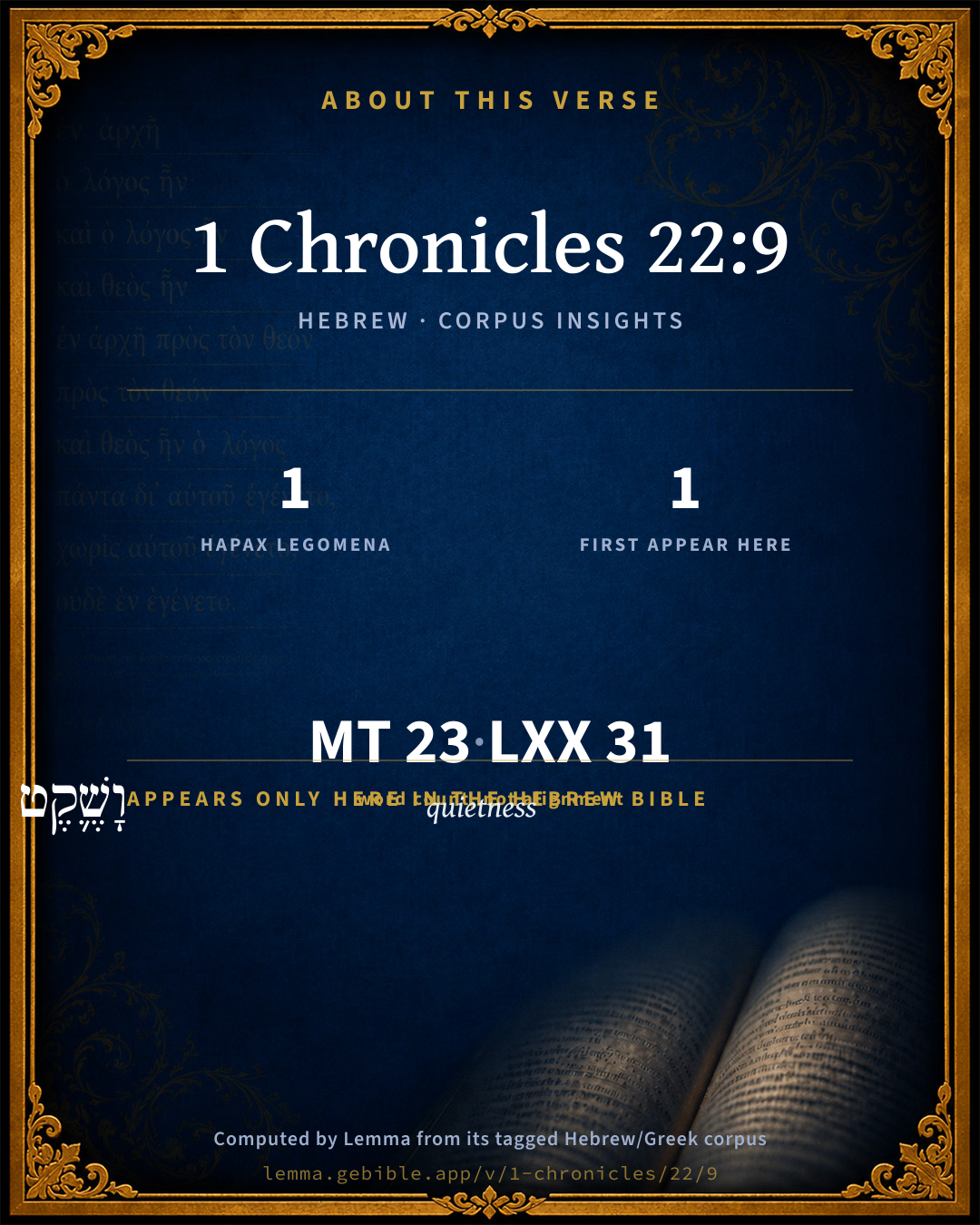
  • 1 hapax legomenon — only here in the Hebrew Bible
  • 1 first appearance in the Hebrew Bible
Full analysis ↓
Download a study sheet

One document with this verse’s original text, its word-by-word gloss line, the meaning frame, cross-references with their text, attributed commentary, and full source and license credits — printable, and it pastes into notes with its structure intact.

This verse Autodidact and up

Study sheet (.html) Plain text (.txt)

A passage Seminary Student

Up to 50 verses in one chapter. A passage sheet keeps up to 6 commentary sources and 12 cross-references per verse, in the order this page ranks them, and says so on the sheet whenever that leaves anything out. Ask for a single verse and you get the Autodidact verse sheet above.

Everything on this page stays free to read, with no account — the sheet is a download of what is already on screen, not access to it.

Want to remove ads? Support Godless Engineer
Compare translations 3

The same verse in 3 English versions, stacked beneath the original-language interlinear above. Click any original word for its lexicon entry.

Each is an independent rendering of the whole verse — the interlinear is not word-aligned to these translations.

Highlighted words mark where these versions differ — a whole-verse word diff, not a word-by-word alignment.

  • World English Bible Public Domain
    Behold, a son shall be born to you, who shall be a man of rest; and I will give him rest from all his enemies round about; for his name shall be Solomon, and I will give peace and quietness to Israel in his days:
  • King James Version Public Domain
    Behold, a son shall be born to thee, who shall be a man of rest; and I will give him rest from all his enemies round about: for his name shall be Solomon, and I will give peace and quietness unto Israel in his days.
  • unfoldingWord Literal Text CC BY-SA 4.0
    Behold a son being born to you; he, he will be a man of rest. And I will give rest to him from all of his enemies from around. For Solomon will be his name, and I will give peace and quietness to Israel in his days.

unfoldingWord Literal Text — © unfoldingWord, licensed CC BY-SA 4.0. Word-aligned USFM3 via Door43 (git.door43.org/unfoldingWord/en_ult).

Versions to compare (up to 4)

3 of 4 selected

Show all 18 translations

Every available English version of this verse, each an independent rendering of the whole verse.

  • World English Bible Public Domain
    Behold, a son shall be born to you, who shall be a man of rest; and I will give him rest from all his enemies round about; for his name shall be Solomon, and I will give peace and quietness to Israel in his days:
  • Berean Standard Bible Public Domain
    But a son will be born to you who will be a man of rest. I will give him rest from all his enemies on every side; for his name will be Solomon, and I will grant to Israel peace and quiet during his reign.
  • Majority Standard Bible Public Domain
    But a son will be born to you who will be a man of rest. I will give him rest from all his enemies on every side; for his name will be Solomon, and I will grant to Israel peace and quiet during his reign.
  • King James Version Public Domain
    Behold, a son shall be born to thee, who shall be a man of rest; and I will give him rest from all his enemies round about: for his name shall be Solomon, and I will give peace and quietness unto Israel in his days.
  • American Standard Version (1901) Public Domain
    Behold, a son shall be born to thee, who shall be a man of rest; and I will give him rest from all his enemies round about; for his name shall be Solomon, and I will give peace and quietness unto Israel in his days:
  • Revised Version (1885) Public Domain
    Behold, a son shall be born to thee, who shall be a man of rest; and I will give him rest from all his enemies round about: for his name shall be Solomon, and I will give peace and quietness unto Israel in his days:
  • Geneva Bible (1599) Public Domain
    Beholde, a sonne is borne to thee, which shalbe a man of rest, for I will giue him rest from all his enemies rounde about: therefore his name is Salomon: and I will sende peace and quietnes vpon Israel in his dayes.
  • Douay-Rheims (1899) Public Domain
    The son, that shall be born to thee, shall be a most quiet man: for I will make him rest from all his enemies round about: and therefore he shall be called Peaceable: and I will give peace and quietness to Israel all his days.
  • Young's Literal Translation Public Domain
    `Lo, a son is born to thee; he is a man of rest, and I have given rest to him from all his enemies round about, for Solomon is his name, and peace and quietness I give unto Israel in his days;
  • Literal Standard Version CC BY-SA 4.0
    Behold, a son is born to you; he is a man of rest, and I have given rest to him from all his surrounding enemies, for Solomon is his name, and I give peace and quietness to Israel in his days;
  • Unlocked Literal Bible CC BY-SA 4.0
    However, you will have a son who will be a peaceful man. I will give him rest from all his enemies on every side. For his name will be Solomon, and I will give peace and quiet to Israel in his days.
  • unfoldingWord Literal Text CC BY-SA 4.0
    Behold a son being born to you; he, he will be a man of rest. And I will give rest to him from all of his enemies from around. For Solomon will be his name, and I will give peace and quietness to Israel in his days.
  • Darby Bible Public Domain
    Behold, a son shall be born to thee, who shall be a man of rest; and I will give him rest from all his enemies round about; for his name shall be Solomon, and in his days I will give peace and quietness unto Israel.
  • World Messianic Bible Public Domain
    Behold, a son shall be born to you, who shall be a man of peace. I will give him rest from all his enemies all around; for his name shall be Solomon, and I will give peace and quietness to Israel in his days.
  • Webster's Bible Public Domain
    Behold, a son shall be born to thee, who shall be a man of rest; and I will give him rest from all his enemies around: for his name shall be Solomon, and I will give peace and quietness to Israel in his days.
  • Free Bible Version CC BY-SA 4.0
    But you will have a son who will be a man of peace. I will give him peace from all his enemies in the nations around. Solomon will be his name, and I will grant peace and quiet to Israel during his reign.
  • Bible in Basic English Public Domain
    But you will have a son who will be a man of rest; and I will give him rest from wars on every side. His name will be Solomon, and in his time I will give Israel peace and quiet;
  • JPS Tanakh (1917) Public Domain
    Behold, a son shall be born to thee, who shall be a man of rest; and I will give him rest from all his enemies round about; for his name shall be Solomon, and I will give peace and quietness unto Israel in his days.

Literal Standard Version (2020), Covenant Press — licensed CC BY-SA 4.0. Text via the HelloAO Bible API (eBible.org). Unlocked Literal Bible (unfoldingWord) — licensed CC BY-SA 4.0. Text via the HelloAO Bible API (eBible.org). unfoldingWord Literal Text — © unfoldingWord, licensed CC BY-SA 4.0. Word-aligned USFM3 via Door43 (git.door43.org/unfoldingWord/en_ult). Free Bible Version, Dr. Jonathan Gallagher — licensed CC BY-SA 4.0. Text via the HelloAO Bible API (eBible.org).

Word by word

More ways to search: Search by grammar → Find every occurrence → Compare this word →

Practice this passage: Drill this verse → Learn its vocabulary →

וָשֶׁ֛קֶט
sheqeṭ
H8253
“and · quietness”
Conjunction + Noun, Common, Masculine, Singular, Absolute
Part of Speech
Conjunction + Noun
Type
Common
Gender
Masculine
Number
Singular
State
Absolute
Full BDB Definition

Origin: from H8252

TWOT: 2453a

quiet, tranquillity, quietness
  1. הִנֵּה hinnêh H2009 “behold” Particle, Demonstrative
  2. בֵ֞ן bên H1121 “son” Noun, Common, Masculine, Singular, Absolute
  3. נוֹלָ֣ד yâlad H3205 “bearing” Verb, Niphal, Participle Active, Masculine, Singular, Absolute
  4. ה֤וּא hûwʼ H1931 “he” Pronoun, Personal, 3rd Person, Masculine, Singular
  5. יִהְיֶה֙ hâyâh H1961 “to be” Verb, Qal, Imperfect, 3rd Person, Masculine, Singular
  6. אִ֣ישׁ ʼîysh H376 “man of” Noun, Common, Masculine, Singular, Construct
  7. מְנוּחָ֔ה mᵉnûwchâh H4496 “rest” Noun, Common, Both, Singular, Absolute
  8. וַהֲנִח֥וֹתִי nûwach H5117 “and · to rest” Conjunction + Verb, Hiphil, Sequential Perfect, 1st Person, Common, Singular
  9. מִכָּל kôl H3605 “from · all of” Preposition + Noun, Common, Masculine, Singular, Construct
  10. אוֹיְבָ֖יו ʼôyêb H341 “enemy · him” Verb, Qal, Participle Active, Masculine, Plural, Construct + Suffix, Personal, 3rd Person, Masculine, Singular
  11. מִסָּבִ֑יב çâbîyb H5439 “from · round about” Preposition + Noun, Common, Both, Singular, Absolute
  12. כִּ֤י kîy H3588 “that” Conjunction
  13. שְׁלֹמֹה֙ Shᵉlômôh H8010 “Solomon” Noun, Proper
  14. יִהְיֶ֣ה hâyâh H1961 “to be” Verb, Qal, Imperfect, 3rd Person, Masculine, Singular
  15. שְׁמ֔וֹ shêm H8034 “name · his” Noun, Common, Masculine, Singular, Construct + Suffix, Personal, 3rd Person, Masculine, Singular
  16. וְשָׁל֥וֹם shâlôwm H7965 “and · peace” Conjunction + Noun, Common, Masculine, Singular, Absolute
  17. אֶתֵּ֥ן nâthan H5414 “to give” Verb, Qal, Imperfect, 1st Person, Common, Singular
  18. עַל ʻal H5921 “upon” Preposition
  19. יִשְׂרָאֵ֖ל Yisrâʼêl H3478 “Israel” Noun, Proper
  20. בְּיָמָֽיו yôwm H3117 “in/at · days · his” Preposition + Noun, Common, Masculine, Plural, Construct + Suffix, Personal, 3rd Person, Masculine, Singular

About this verse

These counts appear in no published source. They are computed here, from the morphology-tagged text and Lemma’s own curated glosses. What Lemma adds →

23
words
20
distinct lemmas
Historical
section

Notable vocabulary

1 hapax legomenon — a word that appears only here in the entire Hebrew Bible:

  • וָשֶׁ֛קֶט quietness H8253

First appearance in Scripture

This word makes its first canonical appearance in the Hebrew Bible here:

  • וָשֶׁ֛קֶט quietness H8253

Shared distinctive vocabulary

מְנוּחָ֔ה rest H4496 occurs in 22 verses of the Hebrew Bible. Also found in:

Grammatical profile

  • 6 verbs
  • 11 nouns
  • 1 pronoun
  • 3 prepositions
  • 1 conjunction
  • 1 particle

Verb forms

  • נוֹלָ֣ד Niphal · Participle Active
  • יִהְיֶה֙ Qal · Imperfect
  • וַהֲנִח֥וֹתִי Hiphil · Sequential Perfect
  • אוֹיְבָ֖יו Qal · Participle Active
  • יִהְיֶ֣ה Qal · Imperfect
  • אֶתֵּ֥ן Qal · Imperfect

Repetition

A word recurs within this verse — often emphatic in Hebrew:

  • יִהְיֶה֙ to be H1961 ×2

Hebrew & Septuagint length

In English translation the verse runs 45 words from the Hebrew and 45 from the Septuagint (LXX English) — the same length.

A rough comparison of the two English renderings, which tokenize alike — not a word-level alignment.

Word counts can differ between the Hebrew and the Greek without any difference in meaning — e.g. the Hebrew direct-object marker אֵת has no separate Greek word, and Greek often adds the article ὁ.

In the original languages it is 23 Hebrew tokens and 31 Greek tokens — but the two are counted differently (Hebrew bundles its prefixes and suffixes into one token; the Greek is in lemma form), so that isn’t a like-for-like length.

Cross-references

16

Topical passages linked to 1 Chronicles 22:9 in the Treasury of Scripture Knowledge — connected by theme and wording, ordered by reader-vote popularity; previews shown in the World English Bible.

  • 1 Kings 4:25 Judah and Israel lived safely, every man under his vine and under his fig tree, from Dan even to Beersheba, all the days of Solomon.
  • 1 Kings 4:20 Judah and Israel were many as the sand which is by the sea in multitude, eating and drinking and making merry.
  • 1 Kings 5:4 But now Yahweh my God has given me rest on every side; there is neither adversary, nor evil occurrence.
  • 2 Samuel 12:24–25 David comforted Bathsheba his wife, and went in to her, and lay with her: and she bore a son, and he called his name Solomon. Yahweh loved him;
  • Isaiah 9:6–7 For to us a child is born, to us a son is given; and the government shall be on his shoulder: and his name shall be called Wonderful, Counselor, Mighty God, Everlasting Father, Prince of Peace.
  • Judges 6:24 Then Gideon built an altar there to Yahweh, and called it Yahweh-shalom: to this day it is yet in Ophrah of the Abiezrites.
  • 2 Samuel 7:12–13 When your days are fulfilled, and you shall sleep with your fathers, I will set up your seed after you, who shall proceed out of your bowels, and I will establish his kingdom.
  • 1 Chronicles 17:11 It shall happen, when your days are fulfilled that you must go to be with your fathers, that I will set up your seed after you, who shall be of your sons; and I will establish his kingdom.
  • 1 Chronicles 28:5–7 Of all my sons (for Yahweh has given me many sons), he has chosen Solomon my son to sit on the throne of the kingdom of Yahweh over Israel.
  • Job 34:29 When he gives quietness, who then can condemn? When he hides his face, who then can see him? Alike whether to a nation, or to a man:
  • Psalms 72:7 In his days, the righteous shall flourish, And abundance of peace, until the moon is no more.
  • Isaiah 26:12 Yahweh, you will ordain peace for us; for you have also worked all our works for us.
  • Isaiah 45:7 I form the light, and create darkness; I make peace, and create evil. I am Yahweh, who does all these things.
  • Isaiah 57:19 I create the fruit of the lips: Peace, peace, to him who is far off and to him who is near, says Yahweh; and I will heal him.
  • Isaiah 66:12 For thus says Yahweh, Behold, I will extend peace to her like a river, and the glory of the nations like an overflowing stream: and you shall suck [of it]; you shall be borne on the side, and shall be dandled on the knees.
  • Haggai 2:9 'The latter glory of this house will be greater than the former,' says Yahweh of Hosts; 'and in this place will I give peace,' says Yahweh of Hosts."

Cross-references courtesy of OpenBible.info (CC BY 4.0).

Hebrew and Greek witnesses Masoretic Hebrew ↔ Greek Septuagint

The same verse in the two great witnesses to the Old Testament, shown verse-for-verse.

These are two independent witnesses, not word-aligned to each other, and the Septuagint is shown in lemma (dictionary) form.

Hebrew 1 Chronicles 22:9 Masoretic · Westminster Leningrad Codex

הִנֵּה בֵ֞ן נוֹלָ֣ד לָ֗ךְ ה֤וּא יִהְיֶה֙ אִ֣ישׁ מְנוּחָ֔ה וַהֲנִח֥וֹתִי ל֛וֹ מִכָּל אוֹיְבָ֖יו מִסָּבִ֑יב כִּ֤י שְׁלֹמֹה֙ יִהְיֶ֣ה שְׁמ֔וֹ וְשָׁל֥וֹם וָשֶׁ֛קֶט אֶתֵּ֥ן עַל יִשְׂרָאֵ֖ל בְּיָמָֽיו

Behold, a son shall be born to you, who shall be a man of rest; and I will give him rest from all his enemies round about; for his name shall be Solomon, and I will give peace and quietness to Israel in his days:

World English Bible · Public Domain

Greek LXX 1 Chronicles 22:9 Septuagint · lemma form

ἰδού υἱός τίκτω σύ οὗτος εἰμί ἀνήρ ἀνάπαυσις καί ἀναπαύω αὐτός ἀπό πᾶς ὁ ἐχθρός κυκλόθεν ὅτι σαλωμών ὄνομα αὐτός καί εἰρήνη καί ἡσυχία δίδωμι ἐπί ἰσραήλ ἐν ὁ ἡμέρα αὐτός

Behold, a son shall be born to you, he shall be a man of rest; and I will give him rest from all his enemies round about: for his name shall be Solomon, and I will give peace and quietness to Israel in his days.

LXX2012 (modern English Septuagint) · Public Domain

On this verse, Ellicott's Commentary for English Readers discusses the Septuagint’s reading. Read the note in Commentary ↓

Hebrew: Westminster Leningrad Codex (CC BY 4.0). Greek: Septuagint (public domain); English from LXX2012 (modern English Septuagint) (Public Domain). How the Septuagint differs from the Hebrew →

Commentary

Notes on 1 Chronicles 22:9 from classic Christian and Jewish commentators (each source and its license shown beneath its notes). The classic Christian expositions comment on the surrounding passage and are grouped to its opening verse, so a note may address several verses; the Jewish commentaries on the Tanakh (Rashi and others) are per-verse, so they appear only where the commentator wrote on this verse.

Lemma curates 59 commentaries, every one of them public domain or Creative Commons licensed, each selected and text-cleaned for this edition rather than reprinted as found. About our sources →

Trapp's Complete Commentary

John Trapp

1Ch 22:9 Behold, a son shall be born to thee, who shall be a man of rest; and I will give him rest from all his enemies round about: for his name shall be Solomon, and I will give peace and quietness unto Israel in his days.

Ver. 9. For his name shall be Solomon,] i.e., Peaceable: so Frederic, Solyman the Magnificent; but these answered not the signification of their names.

John Trapp, A Commentary or Exposition upon All the Books of the Old and New Testament (1647–1656) — public domain. Text from a community e-Sword module.

Tyndale Open Study Notes

Tyndale Open Resources

22:9-10 Solomon was a man of peace, free from war and from shedding blood in battle. The Temple was built during his peaceful reign (see 2 Chr 2–7). • The Hebrew deliberately uses two different words to describe conditions during Solomon’s reign: peace (Hebrew shalom, related to Solomon’s name), and quiet (Hebrew menukhah, related to the idea of redemption).

Tyndale Open Study Notes — © Tyndale Open Resources, licensed CC BY-SA 4.0. Text via the HelloAO Bible API.

Adam Clarke's Commentary

Verse 9. His name shall be Solomon] שלמה Shelomoh, from שלם shalam, he was peaceable; and therefore, says the Lord, alluding to the name, I will give PEACE, שלום SHALOM, in his days.

Adam Clarke's Commentary on the Bible (1810–1826) — public domain. Text from a community e-Sword/MySword module.

Ellicott's Commentary for English Readers

(9) Shall be born.—Is about to be born (participle).

Who shall be.—He (emphatic) shall become a man of rest, opposed to “a man of war,” such as was David (2Sa_17:8; 1Ch_28:3). The phrase is further explained by what follows.

And I will give him rest from all his enemies round about—i.e., the surrounding peoples, who are his natural foes, seeing that they were brought under the yoke by his father, will acquiesce in his dominion. The same words are used, in a somewhat different sense. about David (2Sa_7:1); and in 1Ki_5:4 Solomon applies them to himself. (Comp. also Pro_16:7.)

Solomon.—The emphatic word. (See 2Sa_12:24.) The Hebrew is Shĕlômô; for which the LXX. gives Sãlômôn; Syriac, Shĕleimûn; Arabic, Suleimân (same as “Solyman the Magnificent”). The original form of the word had the final n which we see in the cognate languages. The Assyrian Shalman (in Shalmaneser) and the Moabite Salamanu seem to be identical. The Vulg. has Pacificus (peace-maker). (Comp. the Greek Irenæeus, the German Friederich, our “Frederick,” peaceful.) Sŏlŏmon is the New Testament spelling.

It would seem that the original name of Solomon was Jedidiah (2Sa_12:25), but posterity, looking back with fond regret to the palmy days of his reign, remembered him only as Shelomoh, “The Peaceful.” (See on 1Ch_20:5.)

And I will give peace and quietness unto Israel in his days.—Literally, and peace and quietness will I put upon Israel, &c. His name will be a Divine augury of the character of his reign.

Quietness (shèqet).—Only here; but compare the cognate verb (Jdg_5:31 : “had rest”).

A Bible Commentary for English Readers, edited by Charles John Ellicott (1878–1897) — public domain. Text from a community e-Sword module.

The Cambridge Bible for Schools and Colleges

gen. ed. J. J. S. Perowne

9. I will give him rest] Cp. 1Ki_5:4. The promise here made is of a period of peace sufficiently long for the work of Temple-building. Solomon’s reign was not wholly peaceful; cp. 1Ki_11:14; 1Ki_11:23; 1Ki_11:26.

The Cambridge Bible for Schools and Colleges (gen. ed. J. J. S. Perowne; Cambridge University Press, 1878–1918) — public domain. Text from a community e-Sword module.

John Gill's Exposition

Behold, a son shall be born to thee,.... For this was said to David before the birth of Solomon, see Sa2 7:12.

who shall be a man of rest, and I will give him rest from all his enemies round about: and so should be at leisure for such a work, and his people enjoy great prosperity and riches, and so be capable of contributing largely and liberally to it:

for his name shall be Solomon; which signifies peace, and is one of the six persons that had their names given them before they were born, as the Jews observe (q):

and I will give peace and quietness unto Israel in his days; and so a proper time to begin and carry on such a work; of the fulfilment of this prophecy, see Kg1 4:24.

(q) Pirke Eliezer, c. 32.

John Gill's Exposition of the Whole Bible (1746–1763) — public domain (CC PDM 1.0). Text via the HelloAO Bible API.

Albert Barnes' Notes on the Bible

For the names of Solomon, compare 2Sa 12:24 note. The former name prevailed, probably on account of this prophecy, which attached to the name the promise of a blessing.

Albert Barnes' Notes on the Bible (1834–1885) — public domain. Text from a community e-Sword/MySword module.

Haydock's Catholic Bible Commentary

Peaceable. Hebrew, "Solomon," which has this meaning. (Calmet) --- Herein Solomon was a figure of Christ, who is styled the Prince of peace, Isaias ix. (Worthington)

George Leo Haydock (1774–1849), Haydock's Catholic Family Bible and Commentary, 1859 edition — public domain. Excludes Psalms (Douay-Rheims chapter numbering differs from Protestant) and Deuterocanonical books (Catholic canon only).

Whedon's Commentary on the Bible

Daniel D. Whedon

9. His name shall be Solomon — See note on 2Sa_12:24-25.

Daniel D. Whedon (gen. ed.), Commentary on the Old and New Testaments (1874–1909) — public domain. Text from a community e-Sword module.

The Pulpit Commentary

The mission of the men of rest.

The anticipative description of Solomon, as the man conceived by God to be fitted for the work of building his temple, is this shall be a man of rest." Very remarkable is the fact which may constantly be observed, that successors in office are usually marked contrasts in character, disposition, and modes of working. This is often observed in clergymen and ministers, and it is very marked in the succession of Solomon to David. The connections between the two we often cannot trace, and it seems as if the one could not possibly carry on to its completion the work of the former. Yet what seem to us to be contrasts may seem to God to be relations, the one becoming an actual preparation for the other. There are times when the work of God in the world needs the men of battle the Davids and the Wellingtons; and there are other times when God needs the men of rest the Solomons and the Gladstones. It may be well to show what gracious work for the well-being of mankind has always been done in times of peace and by men of peace. And yet such times have their peril, and round again comes the necessity for the rougher ages of conflict and intenser feeling. These points may be dealt with under several headings. Before presenting these, a few sentences from F. W. Robertson"s lecture on Wordsworth may be given, as suggestive of the mission of the men of rest. He says, "I will remark that Wordsworth"s was a life of contemplation, not of action, and therein differed from Arnold"s of Rugby. Arnold is the type of English action; Wordsworth is the type of English thought. If you look at the portraits of the two men, you will distinguish the difference. In one there is concentrativeness, energy, proclaimed; in the eye of the other there is vacancy, dreaminess. The life of Wordsworth was the life of a recluse. In these days it is the fashion to talk of the dignity of work as the one sole aim and end of human life, and foremost in proclaiming this as a great truth we find Thomas Carlyle In opposition to this, I believe that as the vocation of some is naturally work, so the vocation, the Heaven-born vocation of others, is naturally contemplation.

I WHAT MAY BE DONE BY "MEN OF REST" IN THE NATIONAL ORDER? Explain the perilous sentiments, painful conditions, and sense of exhaustion left from war-times. Harvests soon wave again where heroes shed their blood, but the moral condition of a nation cannot soon be recovered from the evils of war. New sentiments have to be inculcated, and the arts of peace have to be cultivated. Show how much peace-loving men do in our day towards keeping the nations, in their disputes, from seeking the fearful arbitrament of war. Nations ought to thank God more for her great peace-leaders than for her great war-victors.

II WHAT MAY BE DONE BY "MEN OF REST" IN THE SOCIAL SPHERES? In war-times social evils are neglected, and suffered to grow rank, as ill weeds do in the untended garden. And the good things of education and artistic culture, and the right development of the family life, are lightly esteemed. The "men of rest" find out the prevailing evils of an age, reveal them in satire, or poetry, or picture, or moral teachings, and devise schemes for national and social reformations. Illustrate from some of the social and educational schemes of the last sixty years of comparative peace since Waterloo. Recall names of men who have done good social work.

III WHAT MAY BE DONE BY "MEN OF REST" IN THE RELIGIOUS WORLD OF THOUGHT AND LIFE? Apply to Christian doctrine. Men have framed doctrinal schemes in times of conflict conflict of opinions and conflict of nations and the man does an infinite good to Christian thought who, only in small degrees, relieves from Christian doctrine the mischievous war associations, and puts in their place the truer family ones. But we may apply also to Christian worship and Christian life. Mystical and spiritual insight of the fuller truth is given only to the "men of rest." Solomon"s times remind us that peaceful ages have their own perils, and peaceful men their own temptations. R.T.

Shall be born. This is not the necessary translation of the verb. The form dl; wOn does not express here future time. Solomon was already born when the word of the Lord came to David. On the other hand, we may suppose special emphasis to belong to the clause, His name shall be Solomon. The name designates the man of peace, and the clause is an announcement, probably intended to throw further into the shade the alternative name Jedidiah, which also had been divinely given. (2Sa_12:24, 2Sa_12:25)

The Pulpit Commentary (1880–1919), ed. H.D.M. Spence-Jones & Joseph S. Exell — public domain. Text from a community e-Sword module.

Keil & Delitzsch

C. F. Keil & F. Delitzsch

Behold, a son shall be born to thee,.... For this was said to David before the birth of Solomon, see Sa2 7:12.

who shall be a man of rest, and I will give him rest from all his enemies round about: and so should be at leisure for such a work, and his people enjoy great prosperity and riches, and so be capable of contributing largely and liberally to it:

for his name shall be Solomon; which signifies peace, and is one of the six persons that had their names given them before they were born, as the Jews observe (q):

and I will give peace and quietness unto Israel in his days; and so a proper time to begin and carry on such a work; of the fulfilment of this prophecy, see Kg1 4:24.

(q) Pirke Eliezer, c. 32.

Keil & Delitzsch — Biblical Commentary on the Old Testament (1861–1891) — public domain (CC PDM 1.0). Text via the HelloAO Bible API. (Old Testament only.)

unfoldingWord translationNotes

Door43 World Missions Community

Connecting Statement:

David continues telling Solomon what Yahweh said to him.

be a peaceful man

"live at peace with everyone"

give him rest from all his enemies

"cause there to be peace between him and all his enemies"

on every side

This means in every place surrounding Israel.

For his name will be Solomon

The name "Solomon" sounds like the Hebrew word for "peace." This can be made explicit. AT: "His name will be Solomon, which sounds like the word for peace" (See: Assumed Knowledge and Implicit Information)

in his days

"while he rules"

a house for my name

Here "name" refers to honor. AT: "a temple to honor me" (See: Metonymy)

He will be my son, and I will be his father

God will treat Solomon as if he were God's own son. (See: Metaphor)

I will establish the throne of his kingdom over Israel forever

Here "throne" refers to the authority to rule as king. AT: "I will make his descendants rule over Israel forever" (See: Metonymy)

translationWords

peace

rest

adversary

Solomon

house of God

name

God the Father

throne

kingdom

eternity

unfoldingWord translationNotes — © Distant Shores Media and the Door43 World Missions Community, licensed CC BY-SA 4.0. Source: git.door43.org/Door43/en_tn.

Lesson kit

Teaching starters — assembled from the data on this page, not authored interpretation. Every prompt links to the verse data it draws on. Edit before teaching.

1 Chronicles, in the Historical, opens this verse with 23 words (20 distinct Hebrew lemmas). Its most distinctive word is sheqeṭ (“quietness”). A historical commentator’s framing appears above. Read the whole chapter for the surrounding context.

Discussion questions

  1. How does “quietness” (sheqeṭ) shape what this verse is saying?
  2. This verse holds 1 word here found nowhere else in the Hebrew Bible. What might the rare word draw attention to?
  3. The word “quietness” first appears here in Scripture. What is being introduced at this debut?
  4. Genesis 49:15 shares the word «rest» with this verse. How do the two illuminate each other?
  5. “to be” occurs 2× in this one verse. What is the effect of the repetition?
  6. The translations on this page render this verse differently — a whole-verse word diff, not a word-by-word alignment. What might account for the different wordings?
  7. The verb «נוֹלָ֣ד» is Niphal Participle Active. How does its form color the action?
  8. Reading how Trapp's Complete Commentary and Tyndale Open Study Notes read this verse, where do the two commentators agree and where do they part?

Things to notice

  • 1 word in this verse appears nowhere else in the Hebrew Bible.
  • 1 word makes its first canonical appearance in Scripture here.
  • This verse counts 23 Hebrew ↔ 31 Greek words.
  • These translations choose different wording for 7 words in this verse.
  • “to be” occurs 2× in this single verse.

Reading settings

Reading text

Shown beneath each verse's original-language words.

Old Testament
Old Testament edition

Read the OT as the Masoretic Hebrew (MT) or the Greek Septuagint (LXX).

English shown for the Greek Septuagint (in the Hebrew ↔ Greek comparison).

Comparing translations? Open the Compare panel on any verse page to stack up to four side by side.