
2 Samuel 22:4

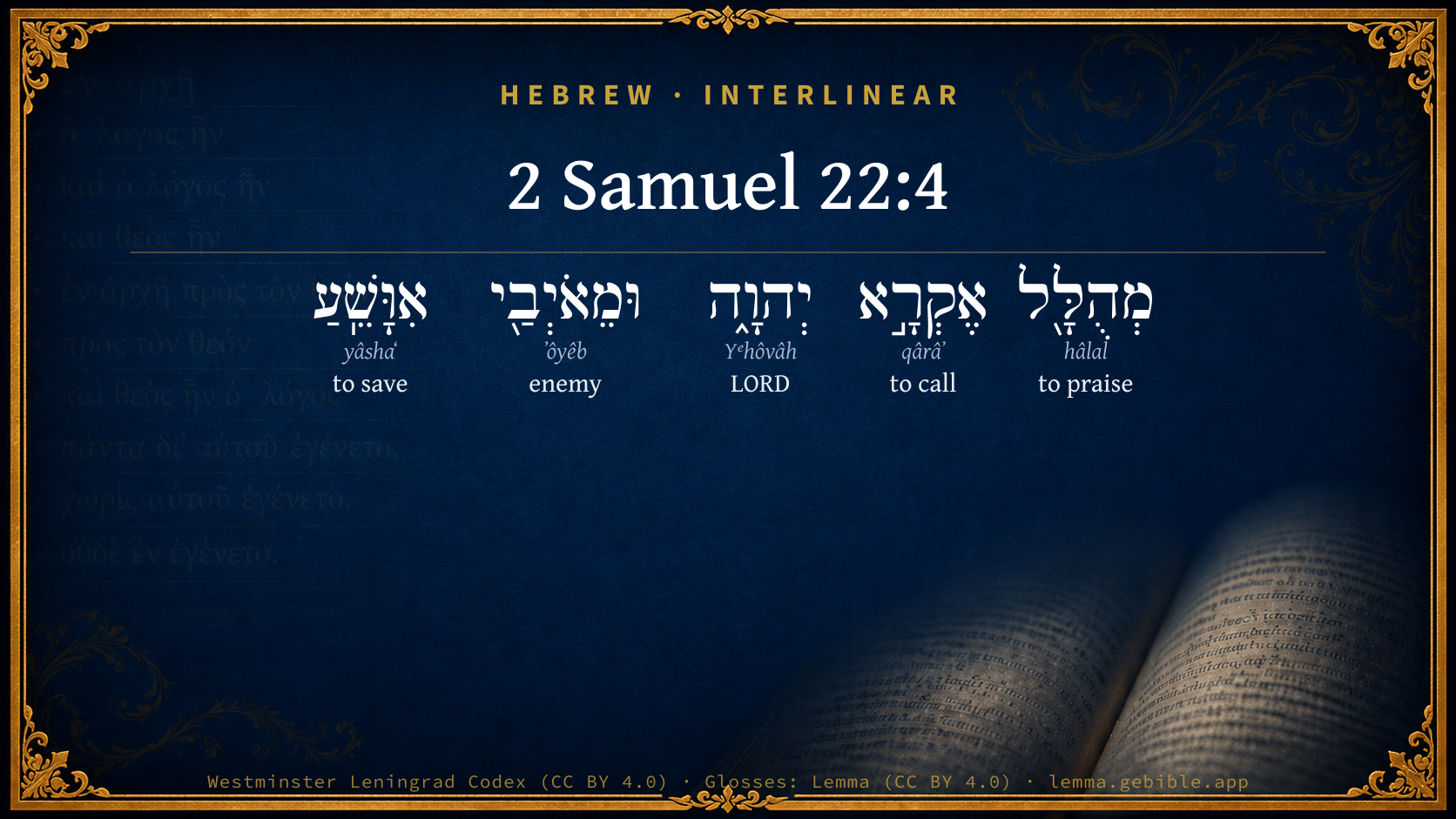
Hebrew (Westminster Leningrad Codex) 2 Samuel 22:4 appears in the Hebrew Old Testament. The text above is from the Westminster Leningrad Codex. Each word links to its Strong’s number, a concise gloss, and parsing drawn from the Open Scriptures Hebrew Bible morphology. Click any word for its full Brown-Driver-Briggs (BDB) entry.
Download image
Cite this verse

2 Samuel 22:4 (World English Bible). Public Domain. Lemma interlinear Bible study tool, https://lemma.gebible.app/v/2-samuel/22/4.

Show BibTeX & RIS
BibTeX
RIS
English Translation
I will call on Yahweh, who is worthy to be praised: So shall I be saved from my enemies.
World English Bible · Public Domain
Download a study sheet

One document with this verse’s original text, its word-by-word gloss line, the meaning frame, cross-references with their text, attributed commentary, and full source and license credits — printable, and it pastes into notes with its structure intact.

This verse Autodidact and up

Study sheet (.html) Plain text (.txt)

A passage Seminary Student

Up to 50 verses in one chapter. A passage sheet keeps up to 6 commentary sources and 12 cross-references per verse, in the order this page ranks them, and says so on the sheet whenever that leaves anything out. Ask for a single verse and you get the Autodidact verse sheet above.

Everything on this page stays free to read, with no account — the sheet is a download of what is already on screen, not access to it.

Want to remove ads? Support Godless Engineer
Compare translations 3

The same verse in 3 English versions, stacked beneath the original-language interlinear above. Click any original word for its lexicon entry.

Each is an independent rendering of the whole verse — the interlinear is not word-aligned to these translations.

Highlighted words mark where these versions differ — a whole-verse word diff, not a word-by-word alignment.

  • World English Bible Public Domain
    I will call on Yahweh, who is worthy to be praised: So shall I be saved from my enemies.
  • King James Version Public Domain
    I will call on the LORD, who is worthy to be praised: so shall I be saved from mine enemies.
  • unfoldingWord Literal Text CC BY-SA 4.0
    the one being praised I call, Yahweh, and I am saved from my enemies.

unfoldingWord Literal Text — © unfoldingWord, licensed CC BY-SA 4.0. Word-aligned USFM3 via Door43 (git.door43.org/unfoldingWord/en_ult).

Versions to compare (up to 4)

3 of 4 selected

Show all 18 translations

Every available English version of this verse, each an independent rendering of the whole verse.

  • World English Bible Public Domain
    I will call on Yahweh, who is worthy to be praised: So shall I be saved from my enemies.
  • Berean Standard Bible Public Domain
    I will call upon the LORD, who is worthy to be praised; so shall I be saved from my enemies.
  • Majority Standard Bible Public Domain
    I will call upon the LORD, who is worthy to be praised; so shall I be saved from my enemies.
  • King James Version Public Domain
    I will call on the LORD, who is worthy to be praised: so shall I be saved from mine enemies.
  • American Standard Version (1901) Public Domain
    I will call upon Jehovah, who is worthy to be praised: So shall I be saved from mine enemies.
  • Revised Version (1885) Public Domain
    I will call upon the LORD, who is worthy to be praised: so shall I be saved from mine enemies.
  • Geneva Bible (1599) Public Domain
    I will call on the Lord, who is worthy to be praysed: so shall I be safe from mine enemies.
  • Douay-Rheims (1899) Public Domain
    I will call on the Lord who is worthy to be praised: and I shall be saved from my enemies.
  • Young's Literal Translation Public Domain
    The Praised One, I call Jehovah: And from mine enemies I am saved.
  • Literal Standard Version CC BY-SA 4.0
    I call on YHWH, [who is worthy] to be praised: And I am saved from my enemies.
  • Unlocked Literal Bible CC BY-SA 4.0
    I will call on Yahweh, who is worthy to be praised, and I will be saved from my enemies.
  • unfoldingWord Literal Text CC BY-SA 4.0
    the one being praised I call, Yahweh, and I am saved from my enemies.
  • Darby Bible Public Domain
    I will call upon Jehovah, who is to be praised; So shall I be saved from mine enemies.
  • World Messianic Bible Public Domain
    I call on the LORD, who is worthy to be praised; So shall I be saved from my enemies.
  • Webster's Bible Public Domain
    I will call on the LORD, who is worthy to be praised: so shall I be saved from my enemies.
  • Free Bible Version CC BY-SA 4.0
    I call for help from the Lord, who should be praised, and he saves me from those who hate me.
  • Bible in Basic English Public Domain
    I will send up my cry to the Lord, who is to be praised; so will I be made safe from those who are against me.
  • JPS Tanakh (1917) Public Domain
    Praised, I cry, is the LORD, and I am saved from mine enemies.

Literal Standard Version (2020), Covenant Press — licensed CC BY-SA 4.0. Text via the HelloAO Bible API (eBible.org). Unlocked Literal Bible (unfoldingWord) — licensed CC BY-SA 4.0. Text via the HelloAO Bible API (eBible.org). unfoldingWord Literal Text — © unfoldingWord, licensed CC BY-SA 4.0. Word-aligned USFM3 via Door43 (git.door43.org/unfoldingWord/en_ult). Free Bible Version, Dr. Jonathan Gallagher — licensed CC BY-SA 4.0. Text via the HelloAO Bible API (eBible.org).

Word by word

More ways to search: Search by grammar → Find every occurrence → Compare this word →

Practice this passage: Drill this verse → Learn its vocabulary →

מְהֻלָּ֖ל
hâlal
H1984
“praised”
Verb, Pual, Participle Passive, Masculine, Singular, Absolute
Part of Speech
Verb
Stem
Pual
Form
Participle Passive
Gender
Masculine
Number
Singular
State
Absolute
Full BDB Definition

Origin: a primitive root

TWOT: 499 , 500

to shine - (Qal) to shine (figuratively of God's favour) - (Hiphil) to flash forth light - to praise, boast, be boastful - (Qal) - to be boastful - boastful ones, boasters (participle) - (Piel) - to praise - to boast, make a boast - (Pual) - to be praised, be made praiseworthy, be commended, be worthy of praise - (Hithpael) to boast, glory, make one's boast - (Poel) to make a fool of, make into a fool - (Hithpoel) to act madly, act like a madman
  1. אֶקְרָ֣א qârâʼ H7121 “to call” Verb, Qal, Imperfect, 1st Person, Common, Singular
  2. יְהוָ֑ה Yᵉhôvâh H3068 “LORD” Noun, Proper
  3. וּמֵאֹיְבַ֖י ʼôyêb H341 “and · from · enemy · me” Conjunction + Preposition + Verb, Qal, Participle Active, Masculine, Plural, Construct + Suffix, Personal, 1st Person, Common, Singular
  4. אִוָּשֵֽׁעַ yâshaʻ H3467 “to save” Verb, Niphal, Imperfect, 1st Person, Common, Singular

About this verse

These counts appear in no published source. They are computed here, from the morphology-tagged text and Lemma’s own curated glosses. What Lemma adds →

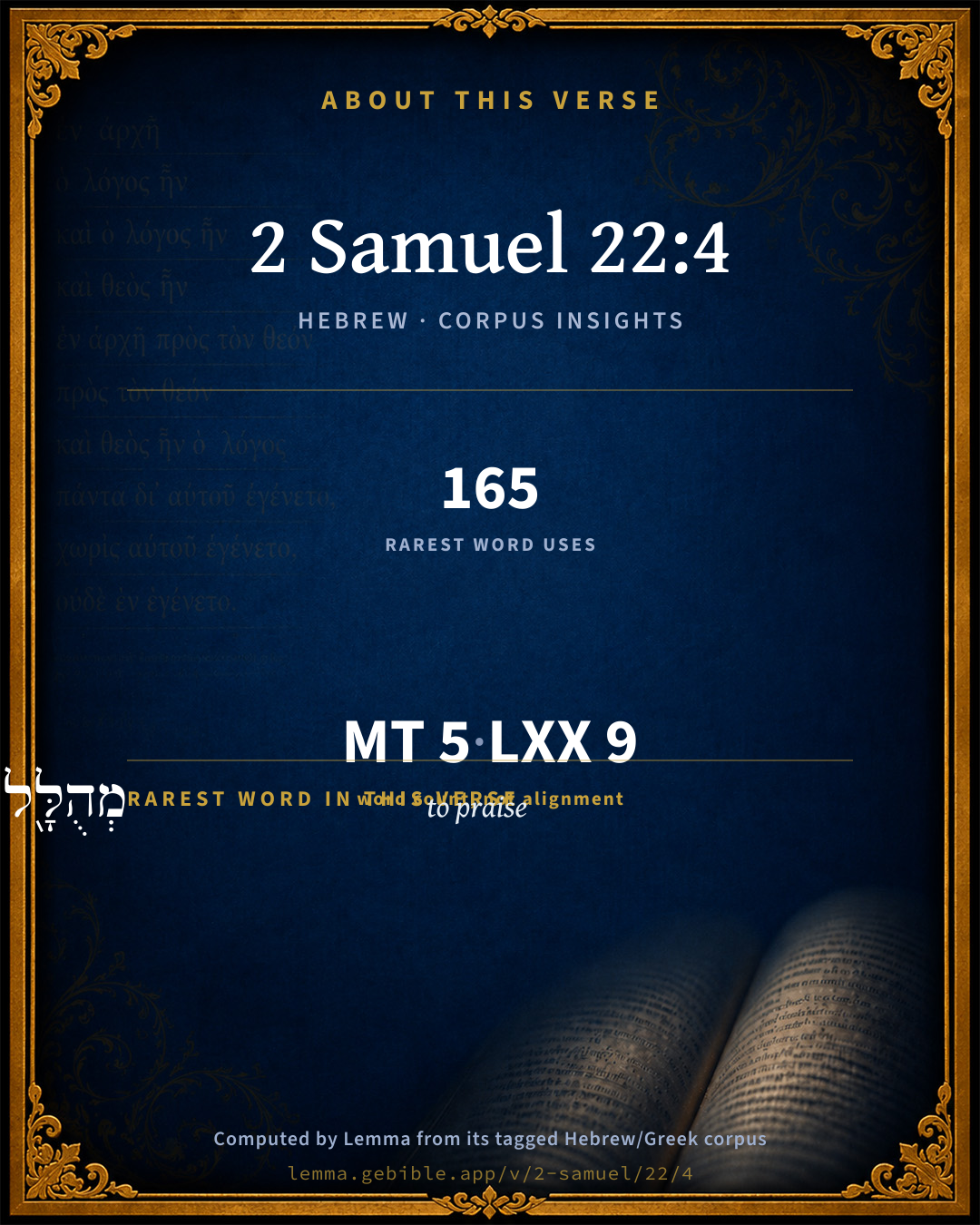
5
words
5
distinct lemmas
Historical
section

Grammatical profile

  • 4 verbs
  • 1 noun

Verb forms

  • מְהֻלָּ֖ל Pual · Participle Passive
  • אֶקְרָ֣א Qal · Imperfect
  • וּמֵאֹיְבַ֖י Qal · Participle Active
  • אִוָּשֵֽׁעַ Niphal · Imperfect

Hebrew & Septuagint length

In English translation the verse runs 19 words from the Hebrew and 20 from the Septuagint (LXX English) — closely comparable.

A rough comparison of the two English renderings, which tokenize alike — not a word-level alignment.

Word counts can differ between the Hebrew and the Greek without any difference in meaning — e.g. the Hebrew direct-object marker אֵת has no separate Greek word, and Greek often adds the article ὁ.

In the original languages it is 5 Hebrew tokens and 9 Greek tokens — but the two are counted differently (Hebrew bundles its prefixes and suffixes into one token; the Greek is in lemma form), so that isn’t a like-for-like length.

Cross-references

19

Topical passages linked to 2 Samuel 22:4 in the Treasury of Scripture Knowledge — connected by theme and wording, ordered by reader-vote popularity; previews shown in the World English Bible.

  • Psalms 18:3 I call on Yahweh, who is worthy to be praised; And I am saved from my enemies.
  • Psalms 116:2 Because he has turned his ear to me, Therefore I will call on him as long as I live.
  • Romans 10:13 For, "Whoever will call on the name of the Lord will be saved."
  • Psalms 34:6 This poor man cried, and Yahweh heard him, And saved him out of all his troubles.
  • Psalms 48:1 Great is Yahweh, and greatly to be praised, In the city of our God, in his holy mountain.
  • Psalms 50:15 Call on me in the day of trouble. I will deliver you, and you will honor me."
  • Psalms 55:16 As for me, I will call on God. Yahweh will save me.
  • Psalms 96:4 For great is Yahweh, and greatly to be praised! He is to be feared above all gods.
  • Psalms 116:4 Then called I on the name of Yahweh: "Yahweh, I beg you, deliver my soul."
  • Psalms 116:13 I will take the cup of salvation, and call on the name of Yahweh.
  • Revelation 5:12 saying with a loud voice, "Worthy is the Lamb who has been killed to receive the power, wealth, wisdom, strength, honor, glory, and blessing!"
  • Nehemiah 9:5 Then the Levites, Jeshua, and Kadmiel, Bani, Hashabneiah, Sherebiah, Hodiah, Shebaniah, [and] Pethahiah, said, Stand up and bless Yahweh your God from everlasting to everlasting; and blessed be your glorious name, which is exalted above all blessing and praise.
  • Psalms 56:9 Then my enemies shall turn back in the day that I call. I know this, that God is for me.
  • Psalms 57:1–3 Be merciful to me, God, be merciful to me, For my soul takes refuge in you. Yes, in the shadow of your wings, I will take refuge, Until disaster has passed.
  • Psalms 66:2 Sing to the glory of his name! Offer glory and praise!
  • Psalms 106:2 Who can utter the mighty acts of Yahweh, Or fully declare all his praise?
  • Psalms 116:17 I will offer to you the sacrifice of thanksgiving, And will call on the name of Yahweh.
  • Psalms 148:1–4 Praise Yah! Praise Yahweh from the heavens! Praise him in the heights!
  • Revelation 4:11 "Worthy are you, our Lord and God, the Holy One, to receive the glory, the honor, and the power, for you created all things, and because of your desire they existed, and were created!"

Cross-references courtesy of OpenBible.info (CC BY 4.0).

Hebrew and Greek witnesses Masoretic Hebrew ↔ Greek Septuagint

The same verse in the two great witnesses to the Old Testament, shown verse-for-verse.

These are two independent witnesses, not word-aligned to each other, and the Septuagint is shown in lemma (dictionary) form.

Hebrew 2 Samuel 22:4 Masoretic · Westminster Leningrad Codex

מְהֻלָּ֖ל אֶקְרָ֣א יְהוָ֑ה וּמֵאֹיְבַ֖י אִוָּשֵֽׁעַ

I will call on Yahweh, who is worthy to be praised: So shall I be saved from my enemies.

World English Bible · Public Domain

Greek LXX 2 Samuel 22:4 Septuagint · lemma form

αἰνετός ἐπικαλέω κύριος καί ἐκ ὁ ἐχθρός ἐγώ σώζω

I will call upon the Lord who is worthy to be praised, and I shall be saved from my enemies.

LXX2012 (modern English Septuagint) · Public Domain

Hebrew: Westminster Leningrad Codex (CC BY 4.0). Greek: Septuagint (public domain); English from LXX2012 (modern English Septuagint) (Public Domain). How the Septuagint differs from the Hebrew →

Targum (Aramaic paraphrase)

1

The Targum is the ancient Jewish Aramaic paraphrase of the Hebrew Scriptures — an interpretive translation, not the Hebrew text itself. Onkelos (literal) and Pseudo-Jonathan (expansive) render the Torah, and Jonathan the Prophets. Coverage is partial: where no permissively-licensed English translation exists for a verse, only the Aramaic is shown. This is verse-level text, not a word-by-word alignment to the Hebrew.

  1. Targum Jonathan Prophets (Joshua–Malachi)
    אֲמַר דָוִד בְּתוּשְׁבְּחָא אֲנָא מְצַלֵי קֳדָם יְיָ דִבְכָל עִדַן מִבַעֲלֵי דְבָבִי פָּרִיק יָתִי:

    (no public-domain English translation for this verse)

    Targum Jonathan — Aramaic: “Mikraot Gedolot” (public domain). English: “Sefaria Community Translation” (CC0 1.0 (public-domain dedication)); “London "Chaldee Paraphrase," 1871” (public domain). Text via Sefaria.

Commentary

Notes on 2 Samuel 22:4 from classic Christian and Jewish commentators (each source and its license shown beneath its notes). The classic Christian expositions comment on the surrounding passage and are grouped to its opening verse, so a note may address several verses; the Jewish commentaries on the Tanakh (Rashi and others) are per-verse, so they appear only where the commentator wrote on this verse.

Lemma curates 59 commentaries, every one of them public domain or Creative Commons licensed, each selected and text-cleaned for this edition rather than reprinted as found. About our sources →

The Cambridge Bible for Schools and Colleges

gen. ed. J. J. S. Perowne

4. I will call … so shall I be saved] Better, I called … and I was saved. The tenses are frequentative, describing David’s habitual experience of God’s readiness to answer prayer. This verse presents “the theme of the Psalm.”

The Cambridge Bible for Schools and Colleges (gen. ed. J. J. S. Perowne; Cambridge University Press, 1878–1918) — public domain. Text from a community e-Sword module.

John Gill's Exposition

The sorrows of hell compassed me about; the snares of death prevented me. See Gill on Psa 18:5.

.

2 Samuel 22:7

sa2 22:7

sa2 22:7

sa2 22:7In my distress I called upon the Lord, and cried to my God:

and he did hear my voice out of his temple, and my cry did enter into his ears. See Gill on Psa 18:6.

John Gill's Exposition of the Whole Bible (1746–1763) — public domain (CC PDM 1.0). Text via the HelloAO Bible API.

The Pulpit Commentary

God worthy to be praised.

The conjunction of ideas here is a little singular. "I will pray to the Lord, who is worthy to be praised. It may originate in the feeling that it is fitting that, when we seek new blessings from God, we should not be unmindful of those which he has already bestowed. Praise should accompany prayer. (see Php_4:6, "prayer... with thanksgiving Add that the subjects of praise are encouragements to prayer. In the act of praising him we are reminding ourselves of the strong reasons we have for hopefully seeking further mercies from him.

I GOD IS WORTHY TO BE PRAISED. Not merely to be feared, entreated, strictly obeyed, and submitted to. He is worthy of thankful and rejoicing obedience and submission. It is not fitting that he should be served sullenly or silently; or that prayer to him should be as a cry of a slave to his master, or of one oppressed to his oppressor, or as a request for help addressed to a stranger. We should speak to him with the confidence and love which his relation to us and past goodness are fitted to inspire. One way of ensuring this is to blend praise with prayer.

II WHAT IT IS THAT RENDERS HIM WORTHY TO BE PRAISED. Some obtain praise who are not worthy of it in any measure; others, much more than they deserve. But God is worthy of and "exalted above all blessing and praise". (Neh_9:5) Whether we consider his nature, his regard for his creatures, his works or his gifts, we must feel that it is impossible to render him praise worthy of him. But to the utmost of our power we should praise him for:

1. His glorious perfections. Especially his infinite moral excellences his truth, holiness, righteousness, and love.

2. His wonderful works. In creation, providence, and grace.

3. Specially, his redeeming mercy. His kindness to us in Christ. The display of his perfections in the gift, the Person, and the work of our Lord and Saviour. The mercy he exercises in the forgiveness of sin, the admission of sinners into his family, and all the operations by which he brings his "many sons and daughters unto glory,". (Heb_2:10) The gift of the Holy Spirit for this purpose. The final bliss and glory.

4. The goodness of God to ourselves. Not forgetting that he is "worthy to be praised" for the commonest blessings we enjoy, as well as those distinguishing blessings which we receive as his children through faith in Christ. And not only for the blessings which give us pleasure, but for those which give us pain, but are bestowed that we may become in a greater measure "partakers of his holiness". (Heb_12:10)

III BY WHOM HE OUGHT TO BE PRAISED.

1. By all his creatures according to their capacity. All his inanimate and irrational creatures do praise him. Their existence, qualities, order, and (as to the living creatures) their happiness "show forth the excellences" of their Creator. "All thy works shall praise thee, O Lord". (Psa_145:10; comp. Psa 148:19:1-4) All intelligent beings ought to praise him; all the right minded of them do. Those who enjoy least of his bounty have much to thank him for, and often praise him more than those who enjoy most. We do not say that those who are suffering in hell the penalty due to their sins can be expected to praise him whose wrath abides so terribly upon them; although, if a somewhat fashionable doctrine be true, they have strong reasons for giving him thanks, since he is taking the wisest and best means to make them meet for the glory and joy in heaven which will at length be their portion!

2. Especially by his redeemed people. Who are the objects of his special regard and gracious operation, and to whom the work of praise on earth is peculiarly committed (Isa_43:21; 1Pe_2:9) On some accounts the redeemed and regenerate have more reason to give thanks to God than those who have never sinned.

They see On earth a bounty not indulged on high, And downward look for Heaven"s superior praise They sang Creation, for in that they shared: Creation"s great superior, man, is thine; Thine is redemption; they just gave the key, "Tis thine to raise and eternize the song. (Young.)

Nevertheless, angels do give thanks for redemption, and with good reason. For it is the work of the God whom they love; it enriches their conceptions of him; it enlarges their service of him; and it supremely and eternally blesses vast multitudes in whom they feel the deepest interest. It thus gratifies their desires, and adds to their wealth of knowledge, goodness, and happiness.

IV THE KIND AND DURATION OF THE PRAISE OF WHICH HE IS WORTHY.

1. The kind. Clearly the best possible; which is not necessarily that which is most poetical or most musical, though in these respects man should do his best. But that is best of all which comes from the heart, and from a heart fullest of admiration, adoration, love, and gratitude. Much which professes to be praise of God is heartless mockery.

2. The duration. Forever and ever. (Eph_3:21) While we have any being, in this world and the next. (Psa_145:1, 2 146:2) For, as God is everlasting, the reasons for praising him can never end. G.W.

The Pulpit Commentary (1880–1919), ed. H.D.M. Spence-Jones & Joseph S. Exell — public domain. Text from a community e-Sword module.

Rashi

Rabbi Shlomo Yitzchaki (Rashi)

I call to Adonoy in praise. As it is translated, when I called Him, I praised Him (with my mouth) because I trusted that I would be saved from my enemies. And it is possible to interpret the words אֶקְרָא and אִוׇּשֵׁעַ as being used in the present tense.

Rashi on the Tanakh — English translations: “The Judaica Press complete Tanach with Rashi, translated by A. J. Rosenberg” (CC BY 4.0); “Pentateuch with Rashi's commentary by M. Rosenbaum and A.M. Silbermann, 1929-1934” (public domain); “The Metsudah Tanach series, Lakewood, N.J” (CC BY 4.0); and “The Book of Joshua, Metsudah Publications, 1997” (CC BY 4.0). Text via Sefaria.

Lesson kit

Teaching starters — assembled from the data on this page, not authored interpretation. Every prompt links to the verse data it draws on. Edit before teaching.

2 Samuel, in the Historical, opens this verse with 5 words (5 distinct Hebrew lemmas). Its most distinctive word is hâlal (“to praise”). A historical commentator’s framing appears above. Read the whole chapter for the surrounding context.

Discussion questions

  1. The word hâlal carries the sense “to praise.” How does it shape the verse?
  2. How does Psalms 18:3, which shares this passage’s theme, read alongside this verse?
  3. The translations on this page render this verse differently — a whole-verse word diff, not a word-by-word alignment. What might account for the different wordings?
  4. «מְהֻלָּ֖ל» is a Pual Participle Passive verb. How does that grammatical form shape the action described?
  5. Compare how The Cambridge Bible for Schools and Colleges and John Gill's Exposition read this verse. Where do they agree or differ?

Things to notice

Reading settings

Reading text

Shown beneath each verse's original-language words.

Old Testament
Old Testament edition

Read the OT as the Masoretic Hebrew (MT) or the Greek Septuagint (LXX).

English shown for the Greek Septuagint (in the Hebrew ↔ Greek comparison).

Comparing translations? Open the Compare panel on any verse page to stack up to four side by side.