
2 Samuel 22:38

Hebrew (Westminster Leningrad Codex) 2 Samuel 22:38 appears in the Hebrew Old Testament. The text above is from the Westminster Leningrad Codex. Each word links to its Strong’s number, a concise gloss, and parsing drawn from the Open Scriptures Hebrew Bible morphology. Click any word for its full Brown-Driver-Briggs (BDB) entry.
Download image
Cite this verse

2 Samuel 22:38 (World English Bible). Public Domain. Lemma interlinear Bible study tool, https://lemma.gebible.app/v/2-samuel/22/38.

Show BibTeX & RIS
BibTeX
RIS
English Translation
I have pursued my enemies, and destroyed them; Neither did I turn again until they were consumed.
World English Bible · Public Domain
Download a study sheet

One document with this verse’s original text, its word-by-word gloss line, the meaning frame, cross-references with their text, attributed commentary, and full source and license credits — printable, and it pastes into notes with its structure intact.

This verse Autodidact and up

Study sheet (.html) Plain text (.txt)

A passage Seminary Student

Up to 50 verses in one chapter. A passage sheet keeps up to 6 commentary sources and 12 cross-references per verse, in the order this page ranks them, and says so on the sheet whenever that leaves anything out. Ask for a single verse and you get the Autodidact verse sheet above.

Everything on this page stays free to read, with no account — the sheet is a download of what is already on screen, not access to it.

Want to remove ads? Support Godless Engineer
Compare translations 3

The same verse in 3 English versions, stacked beneath the original-language interlinear above. Click any original word for its lexicon entry.

Each is an independent rendering of the whole verse — the interlinear is not word-aligned to these translations.

Highlighted words mark where these versions differ — a whole-verse word diff, not a word-by-word alignment.

  • World English Bible Public Domain
    I have pursued my enemies, and destroyed them; Neither did I turn again until they were consumed.
  • King James Version Public Domain
    I have pursued mine enemies, and destroyed them; and turned not again until I had consumed them.
  • unfoldingWord Literal Text CC BY-SA 4.0
    I pursue my enemies, and I destroy them, and I do not return until I have ended them.

unfoldingWord Literal Text — © unfoldingWord, licensed CC BY-SA 4.0. Word-aligned USFM3 via Door43 (git.door43.org/unfoldingWord/en_ult).

Versions to compare (up to 4)

3 of 4 selected

Show all 18 translations

Every available English version of this verse, each an independent rendering of the whole verse.

  • World English Bible Public Domain
    I have pursued my enemies, and destroyed them; Neither did I turn again until they were consumed.
  • Berean Standard Bible Public Domain
    I pursued my enemies and destroyed them; I did not turn back until they were consumed.
  • Majority Standard Bible Public Domain
    I pursued my enemies and destroyed them; I did not turn back until they were consumed.
  • King James Version Public Domain
    I have pursued mine enemies, and destroyed them; and turned not again until I had consumed them.
  • American Standard Version (1901) Public Domain
    I have pursued mine enemies, and destroyed them; Neither did I turn again till they were consumed.
  • Revised Version (1885) Public Domain
    I have pursued mine enemies, and destroyed them; neither did I turn again till they were consumed.
  • Geneva Bible (1599) Public Domain
    I haue pursued mine enemies and destroyed them, and haue not turned againe vntill I had consumed them.
  • Douay-Rheims (1899) Public Domain
    I will pursue after my enemies, and crush them: and will not return again till I consume them.
  • Young's Literal Translation Public Domain
    I pursue mine enemies and destroy them, And I turn not till they are consumed.
  • Literal Standard Version CC BY-SA 4.0
    I pursue my enemies and destroy them, || And I do not turn until they are consumed.
  • Unlocked Literal Bible CC BY-SA 4.0
    I pursued my enemies and destroyed them. I did not turn back until they were destroyed.
  • unfoldingWord Literal Text CC BY-SA 4.0
    I pursue my enemies, and I destroy them, and I do not return until I have ended them.
  • Darby Bible Public Domain
    I pursued mine enemies, and destroyed them, And I turned not again till they were consumed.
  • World Messianic Bible Public Domain
    I have pursued my enemies and destroyed them. I didn’t turn again until they were consumed.
  • Webster's Bible Public Domain
    I have pursued my enemies, and destroyed them; and turned not again until I had consumed them.
  • Free Bible Version CC BY-SA 4.0
    I chased my enemies, and caught up with them. I did not turn around until I had destroyed them.
  • Bible in Basic English Public Domain
    I go after my haters and overtake them; not turning back till they are all overcome.
  • JPS Tanakh (1917) Public Domain
    I have pursued mine enemies, and destroyed them; neither did I turn back till they were consumed.

Literal Standard Version (2020), Covenant Press — licensed CC BY-SA 4.0. Text via the HelloAO Bible API (eBible.org). Unlocked Literal Bible (unfoldingWord) — licensed CC BY-SA 4.0. Text via the HelloAO Bible API (eBible.org). unfoldingWord Literal Text — © unfoldingWord, licensed CC BY-SA 4.0. Word-aligned USFM3 via Door43 (git.door43.org/unfoldingWord/en_ult). Free Bible Version, Dr. Jonathan Gallagher — licensed CC BY-SA 4.0. Text via the HelloAO Bible API (eBible.org).

Word by word

More ways to search: Search by grammar → Find every occurrence → Compare this word →

Practice this passage: Drill this verse → Learn its vocabulary →

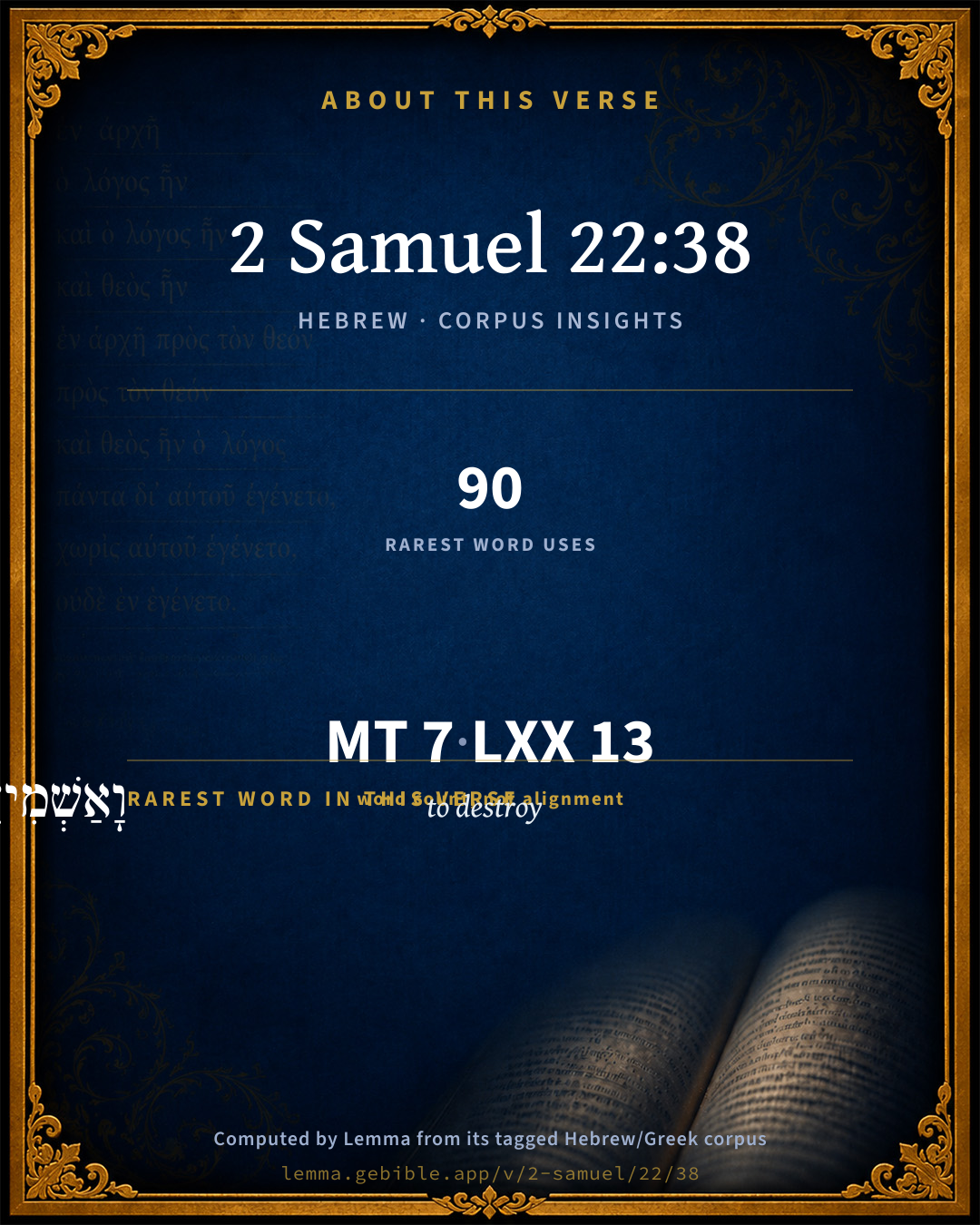
וָאַשְׁמִידֵ֑ם
shâmad
H8045
“and · to destroy · them”
Conjunction + Verb, Hiphil, Sequential Imperfect, 1st Person, Common, Singular + Suffix, Personal, 3rd Person, Masculine, Plural
Part of Speech
Conjunction + Verb
Stem
Hiphil
Form
Sequential Imperfect
Person
1st Person
Gender
Common
Number
Singular
Full BDB Definition

Origin: a primitive root

TWOT: 2406

to destroy, exterminate, be destroyed, be exterminated - (Niphal) - to be annihilated, be exterminated - to be destroyed, be devastated - (Hiphil) - to annihilate, exterminate - to destroy
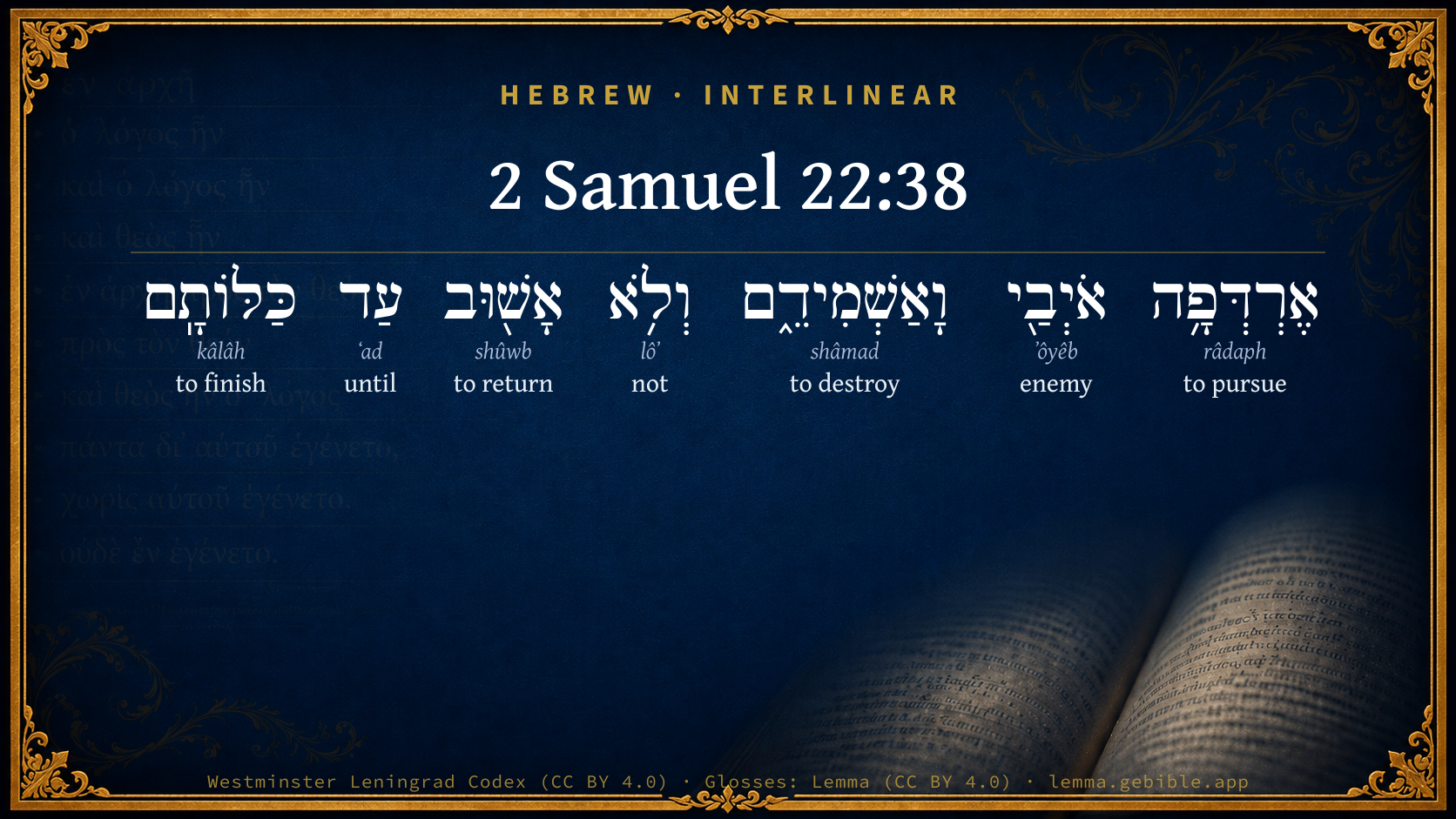
  1. אֶרְדְּפָ֥ה râdaph H7291 “to pursue” Verb, Qal, Cohortative, 1st Person, Common, Singular
  2. אֹיְבַ֖י ʼôyêb H341 “enemy · me” Verb, Qal, Participle Active, Masculine, Plural, Construct + Suffix, Personal, 1st Person, Common, Singular
  3. וְלֹ֥א lôʼ H3808 “and · not” Conjunction + Particle, Negative
  4. אָשׁ֖וּב shûwb H7725 “to return” Verb, Qal, Imperfect, 1st Person, Common, Singular
  5. עַד ʻad H5704 “until” Preposition
  6. כַּלּוֹתָֽם kâlâh H3615 “to finish · them” Verb, Piel, Infinitive Construct + Suffix, Personal, 3rd Person, Masculine, Plural

About this verse

These counts appear in no published source. They are computed here, from the morphology-tagged text and Lemma’s own curated glosses. What Lemma adds →

7
words
7
distinct lemmas
Historical
section

Grammatical profile

  • 5 verbs
  • 1 preposition
  • 1 particle

Verb forms

  • אֶרְדְּפָ֥ה Qal · Cohortative
  • אֹיְבַ֖י Qal · Participle Active
  • וָאַשְׁמִידֵ֑ם Hiphil · Sequential Imperfect
  • אָשׁ֖וּב Qal · Imperfect
  • כַּלּוֹתָֽם Piel · Infinitive Construct

Hebrew & Septuagint length

In English translation the verse runs 17 words from the Hebrew and 21 from the Septuagint (LXX English) — closely comparable.

A rough comparison of the two English renderings, which tokenize alike — not a word-level alignment.

Word counts can differ between the Hebrew and the Greek without any difference in meaning — e.g. the Hebrew direct-object marker אֵת has no separate Greek word, and Greek often adds the article ὁ.

In the original languages it is 7 Hebrew tokens and 13 Greek tokens — but the two are counted differently (Hebrew bundles its prefixes and suffixes into one token; the Greek is in lemma form), so that isn’t a like-for-like length.

Cross-references

6

Topical passages linked to 2 Samuel 22:38 in the Treasury of Scripture Knowledge — connected by theme and wording, ordered by reader-vote popularity; previews shown in the World English Bible.

  • Psalms 21:8–9 Your hand will find out all of your enemies. Your right hand will find out those who hate you.
  • 2 Samuel 5:18–25 Now the Philistines had come and spread themselves in the valley of Rephaim.
  • 2 Samuel 8:1–2 After this it happened that David struck the Philistines, and subdued them: and David took the bridle of the mother city out of the hand of the Philistines.
  • 2 Samuel 8:13–14 David got him a name when he returned from smiting the Syrians in the Valley of Salt, even eighteen thousand men.
  • 2 Samuel 10:14 When the children of Ammon saw that the Syrians were fled, they likewise fled before Abishai, and entered into the city. Then Joab returned from the children of Ammon, and came to Jerusalem.
  • Romans 8:37 No, in all these things, we are more than conquerors through him who loved us.

Cross-references courtesy of OpenBible.info (CC BY 4.0).

Hebrew and Greek witnesses Masoretic Hebrew ↔ Greek Septuagint

The same verse in the two great witnesses to the Old Testament, shown verse-for-verse.

These are two independent witnesses, not word-aligned to each other, and the Septuagint is shown in lemma (dictionary) form.

Hebrew 2 Samuel 22:38 Masoretic · Westminster Leningrad Codex

אֶרְדְּפָ֥ה אֹיְבַ֖י וָאַשְׁמִידֵ֑ם וְלֹ֥א אָשׁ֖וּב עַד כַּלּוֹתָֽם

I have pursued my enemies, and destroyed them; Neither did I turn again until they were consumed.

World English Bible · Public Domain

Greek LXX 2 Samuel 22:38 Septuagint · lemma form

διώκω ἐχθρός ἐγώ καί ἀπο ἀναἵζω αὐτός καί οὐ ἀναστρέφω ἕως συντελέω αὐτός

I will pursue my enemies, and will utterly destroy them; and I will not turn again till I have consumed them.

LXX2012 (modern English Septuagint) · Public Domain

Hebrew: Westminster Leningrad Codex (CC BY 4.0). Greek: Septuagint (public domain); English from LXX2012 (modern English Septuagint) (Public Domain). How the Septuagint differs from the Hebrew →

Targum (Aramaic paraphrase)

1

The Targum is the ancient Jewish Aramaic paraphrase of the Hebrew Scriptures — an interpretive translation, not the Hebrew text itself. Onkelos (literal) and Pseudo-Jonathan (expansive) render the Torah, and Jonathan the Prophets. Coverage is partial: where no permissively-licensed English translation exists for a verse, only the Aramaic is shown. This is verse-level text, not a word-by-word alignment to the Hebrew.

  1. Targum Jonathan Prophets (Joshua–Malachi)
    וּרְדָפִית סַנְאַי וְשֵׁיצֵיתִינוּן וְלָא תָבֵית עַד דִי גְמַרְתִּינוּן:

    (no public-domain English translation for this verse)

    Targum Jonathan — Aramaic: “Mikraot Gedolot” (public domain). English: “Sefaria Community Translation” (CC0 1.0 (public-domain dedication)); “London "Chaldee Paraphrase," 1871” (public domain). Text via Sefaria.

Commentary

Notes on 2 Samuel 22:38 from classic Christian and Jewish commentators (each source and its license shown beneath its notes). The classic Christian expositions comment on the surrounding passage and are grouped to its opening verse, so a note may address several verses; the Jewish commentaries on the Tanakh (Rashi and others) are per-verse, so they appear only where the commentator wrote on this verse.

Lemma curates 59 commentaries, every one of them public domain or Creative Commons licensed, each selected and text-cleaned for this edition rather than reprinted as found. About our sources →

Keil & Delitzsch

C. F. Keil & F. Delitzsch

38 I will pursue my enemies and destroy them,

I will not turn till they are consumed.

39 I will consume them and dash them in pieces, that they may not arise,

And may fall under my feet.

40 And Thou girdest me with strength for war,

Thou bowest mine adversaries under me.

41 And Thou makest mine enemies turn the back to me;

My haters, I root them out.

The optative form ארדּפה serves to make the future signification of ארדּף (in the psalm) the more apparent. Consequently it is quite out of the question to take the other verbs as preterites. We are not compelled to do this by the interchange of imperfects c. vav consec. with simple imperfects, as the vav consec. is not used exclusively as expressive of the past. On the contrary, the substance of the whole of the following description shows very clearly that David refers not only to the victories he has already won, but in general to the defeat of all his foes in the past, the present, and the future; for he speaks as distinctly as possible not only of their entire destruction (Sa2 22:38, Sa2 22:39, Sa2 22:43), but also of the fact that God makes him the head of the nations, and distant and foreign nations to him homage. Consequently he refers not only to his own personal dominion, but also, on the strength of the promise which he had received from God, to the increase of the dominion of the throne of his house, whilst he proclaims in the Spirit the ultimate defeat of all the enemies of the kingdom of God. This Messianic element in the following description comes out in a way that cannot be mistaken, in the praise of the Lord with which he concludes in Sa2 22:47-51. ואשׁמידם, "I destroy them," is stronger than ואשּׂיגם, "I reach them" (in the psalm). In Sa2 22:39 the words are crowded together, to express the utter destruction of all foes. In the psalm ואכלּם is omitted. ותּזרני for ותּאזּרני in the psalm is not a poetical Syriasm, and still less a "careless solecism" (Hupfeld), but a simple contraction, such as we meet with in many forms: e.g., מלּפנוּ for מאלּפנוּ (Job 35:11; cf. Ewald, 232, b.). The form תּתּה for נתתּה (in the psalm) is unusual, and the aphaeresis of the נ can only be accounted for from the fact that this much-used word constantly drops its נ as a radical sound in the imperfect (see Ewald, 195, c.). The phrase ערף לּי תּתּה is formed after Exo 23:27. "Giving the enemy to a person's back" means causing them to turn the back, i.e., putting them to flight.

Keil & Delitzsch — Biblical Commentary on the Old Testament (1861–1891) — public domain (CC PDM 1.0). Text via the HelloAO Bible API. (Old Testament only.)

Tyndale Open Study Notes

Tyndale Open Resources

22:38-40 David’s military accomplishments before he became king were impressive (see 1 Sam 17:12-58; 18:17-30; 23:1-5; 30:1-31). Yet rather than exalting himself, David glorified God and gave him the credit.

Tyndale Open Study Notes — © Tyndale Open Resources, licensed CC BY-SA 4.0. Text via the HelloAO Bible API.

Ellicott's Commentary for English Readers

(38) Destroyed them.—In the psalm, “overtaken them,” an expression intended to suggest the same thing as the plain expression here. The second clauses are identical in the original.

A Bible Commentary for English Readers, edited by Charles John Ellicott (1878–1897) — public domain. Text from a community e-Sword module.

The Cambridge Bible for Schools and Colleges

gen. ed. J. J. S. Perowne

38–43. David’s destruction of his enemies

38. destroyed them] In Psa_18:37, “overtaken them,” an echo of Exo_15:9.

The Cambridge Bible for Schools and Colleges (gen. ed. J. J. S. Perowne; Cambridge University Press, 1878–1918) — public domain. Text from a community e-Sword module.

Whedon's Commentary on the Bible

Daniel D. Whedon

38. I pursue… destroy — These verbs are in the future tense in the Hebrew, but we translate them in the present tense as designating not so much what David expects or threatens to do, as the confident assurance of what he is now able to do by the help of God.

Daniel D. Whedon (gen. ed.), Commentary on the Old and New Testaments (1874–1909) — public domain. Text from a community e-Sword module.

The Pulpit Commentary

Vers. 38-40.

I have pursued my enemies and destroyed them; Neither did I turn again until I had consumed them. And I have consumed them, and smitten them through, and they arose not; Yea, they fell under my feet. For thou hast girded me with strength unto the battle; Thou hast made them that rose against me to bow under me.

In the Psalms, for destroyed we find "overtaken," and the second "I have consumed them" is omitted. This exultation of David at the result of his wars is in accordance with the harsh treatment inflicted by him upon the vanquished. His enemies were God"s enemies, whom he must consume. The "new commandment" of Christianity forbids and condemns this delight in conquest.

The Pulpit Commentary (1880–1919), ed. H.D.M. Spence-Jones & Joseph S. Exell — public domain. Text from a community e-Sword module.

unfoldingWord translationNotes

Door43 World Missions Community

General Information:

David continues his song to Yahweh.

pursued my enemies

"chased my enemies"

I devoured them and smashed them

Here David compares himself to a wild animal. AT: "I completely destroyed them like a wild animal devouring its prey" (See: Metaphor)

under my feet

Here "feet" refers to the power and control of victory over his enemies. (See: Metonymy)

translationWords

turn

devour

raise

unfoldingWord translationNotes — © Distant Shores Media and the Door43 World Missions Community, licensed CC BY-SA 4.0. Source: git.door43.org/Door43/en_tn.

Lesson kit

Teaching starters — assembled from the data on this page, not authored interpretation. Every prompt links to the verse data it draws on. Edit before teaching.

2 Samuel, in the Historical, opens this verse with 7 words (7 distinct Hebrew lemmas). Its most distinctive word is shâmad (“to destroy”). A historical commentator’s framing appears above. Read the whole chapter for the surrounding context.

Discussion questions

  1. What does “to destroy” (shâmad) contribute to the verse as a whole?
  2. Psalms 21:8–9 shares this passage’s theme. How do the two illuminate each other?
  3. The translations on this page render this verse differently — a whole-verse word diff, not a word-by-word alignment. What might account for the different wordings?
  4. The verb «אֶרְדְּפָ֥ה» is Qal Cohortative. How does its form color the action?
  5. Reading how Keil & Delitzsch and Tyndale Open Study Notes read this verse, where do the two commentators agree and where do they part?

Things to notice

Reading settings

Reading text

Shown beneath each verse's original-language words.

Old Testament
Old Testament edition

Read the OT as the Masoretic Hebrew (MT) or the Greek Septuagint (LXX).

English shown for the Greek Septuagint (in the Hebrew ↔ Greek comparison).

Comparing translations? Open the Compare panel on any verse page to stack up to four side by side.